I still remember the first time I decided to cook stinging nettle. Arms full of bright green leaves wrapped in a canvas bag, fingers tingling from a few careless grabs. My partner looked at the pile of weeds on the counter and said, “You’re going to eat that?” Thirty minutes later, she was going back for seconds of the most vibrant green soup either of us had ever tasted.
That’s the magic of stinging nettle (Urtica dioica). It’s one of the most aggressively defensive plants in the wild — and one of the most rewarding things you’ll ever bring into your kitchen. Once you disarm those tiny hypodermic needles, you unlock one of nature’s most nutritious leafy greens.
This guide is not about identifying nettle (we’ve covered that in our Common Edible Weeds article). This is purely about what happens after you’ve got your harvest: how to handle, prepare, cook, and preserve stinging nettle so you can enjoy it year-round.
Safety First: How to Handle Stinging Nettle Without Getting Stung
Yes, nettles sting. Those silica-tipped hairs inject a cocktail of histamine, acetylcholine, and formic acid — causing a burning rash that can last hours.
The good news: the sting disappears completely with heat. Just 30-60 seconds in boiling water and the plant goes from defensive warrior to docile spinach substitute.
What You’ll Need
- Thick kitchen gloves — rubber dishwashing gloves are ideal.
- Tongs or slotted spoon — for transferring without touching.
- Large bowl of ice water — for shocking and locking in color.
- Colander — for draining.
The Golden Rule
Don’t touch raw nettles with bare skin. Period. Gloves on every single time until they’re blanched.
Pro tip: If you do get stung, look for curled dock or broadleaf plantain — they almost always grow near nettle patches. Crush a leaf and rub the juice on the sting for genuine relief.
Step 1: Cleaning and Trimming Your Nettles
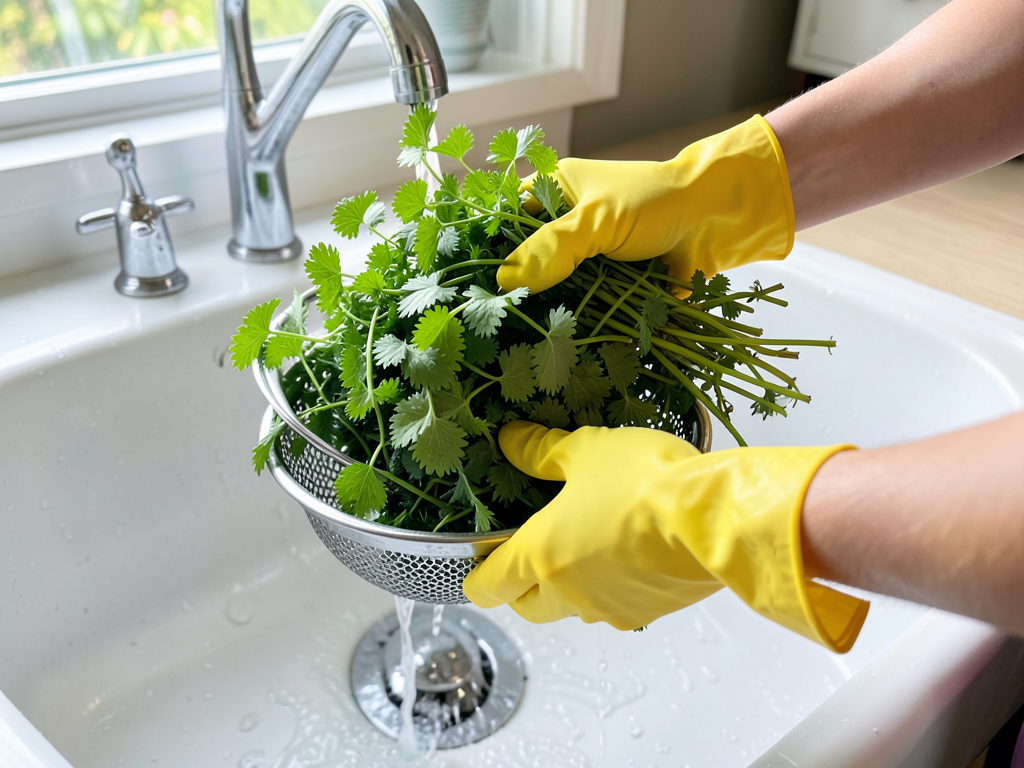
Give your nettles a good rinse in cold water — wild nettles carry dirt, tiny insects, and the occasional spider. Swish them around, let grit settle, lift them out. Repeat if needed.
For trimming, you don’t need to be precious about stripping every leaf. My approach:
- Snip off tough, woody stems at the bottom — the top 4-6 inches of young nettles are tender enough stem and all.
- Remove yellowing or damaged leaves.
- If older or flowering, strip leaves from thick stems. Flowering nettles develop kidney-irritating cystoliths.
- For pesto and purées, remove stems thoroughly. For soups and sautés, tender stems are fine.
Harvest young plants in early spring through early summer, before they flower. These have the best texture and you can use virtually the entire above-ground portion.
Step 2: Blanching — The Moment of Transformation
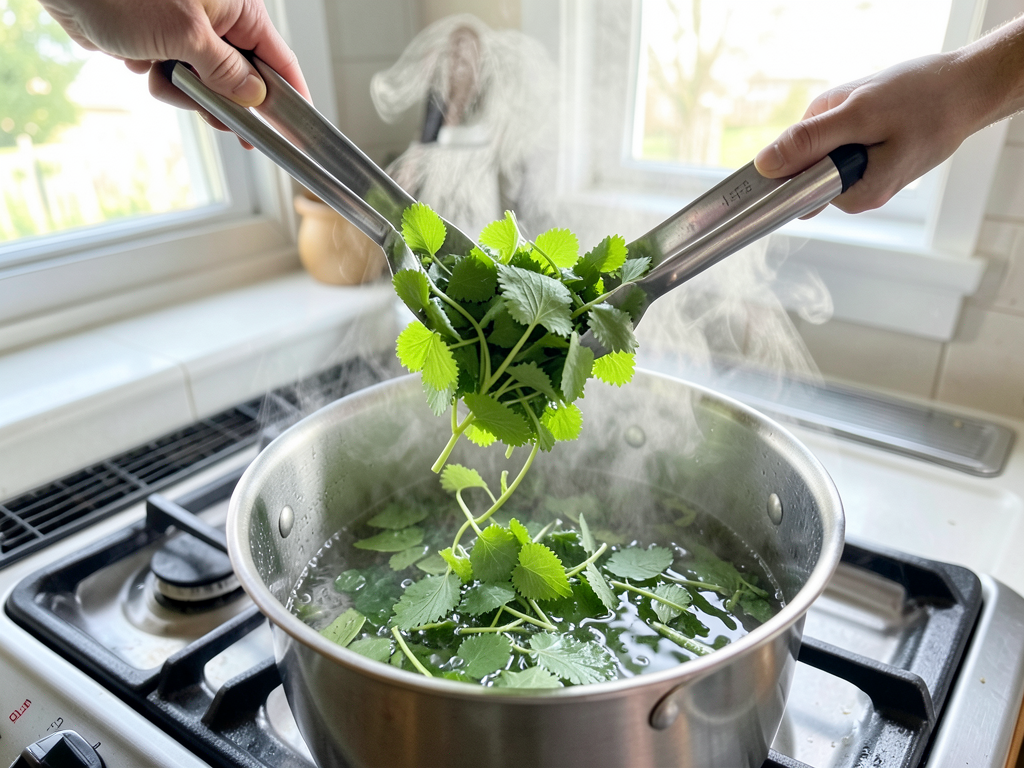
This is where the magic happens. Blanching is the essential step that neutralizes the sting and sets you up for every recipe that follows.
How to Blanch Nettles
- Bring a large pot of generously salted water to a rolling boil.
- Drop nettles in using tongs — don’t overcrowd, work in batches.
- Blanch for 45-60 seconds — leaves will wilt and deepen in color.
- Immediately transfer to ice water for 1-2 minutes to lock in the emerald color.
- Drain and squeeze out excess water — now you can use bare hands! Get aggressive with squeezing; waterlogged nettles ruin sautés and make pesto watery.
- Rough chop as needed for your recipe.
Blanched nettles keep in the fridge for 3-4 days, or freeze them (more on that below).
Kickstart Your Foraging Journey
Cooking nettles is one of the best entry points to foraging — abundant, unmistakable, and forgiving in the kitchen.
📚 Foraging Beginners Guide — tools, safety rules, and beginner-friendly plants. ⚠️ Poisonous Lookalikes Guide — know what else grows in similar habitats.
Now, let’s cook.
Recipe 1: Classic Creamy Nettle Soup
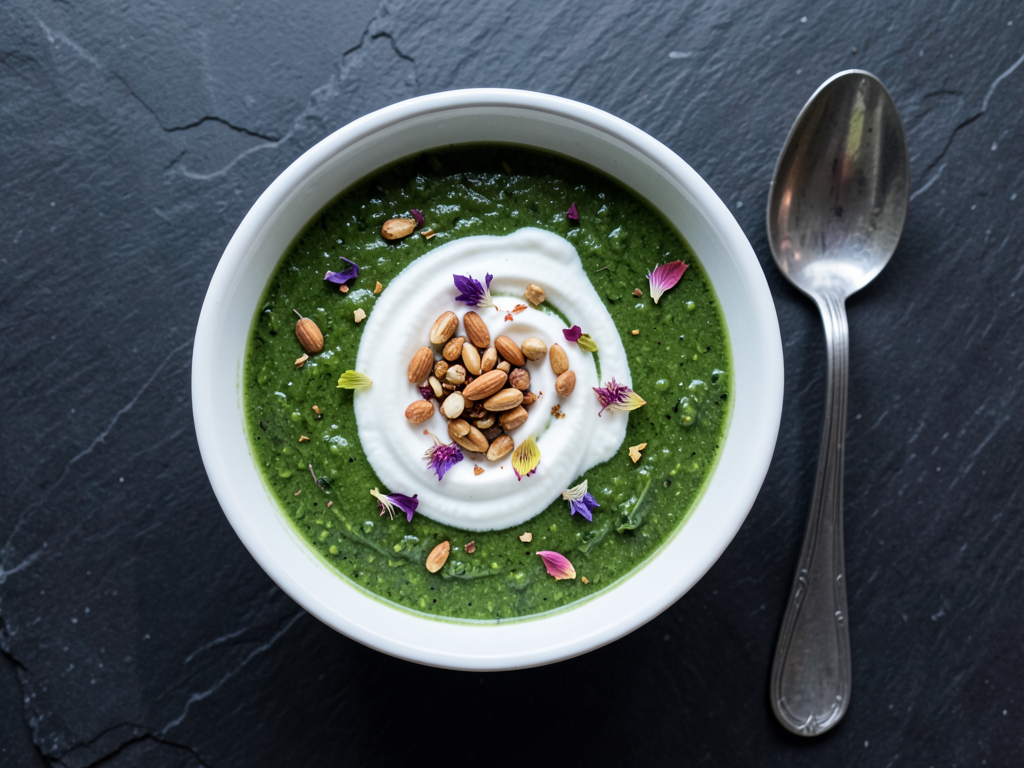
If you only ever make one thing with nettles, make this soup. It’s the gateway dish that converts skeptics into nettle enthusiasts. I’ve served this at dinner parties without telling guests what’s in it until after they’ve complimented it — the reveal is always priceless.
The flavor sits between spinach and asparagus, with an earthy depth that spinach can only dream of. The color alone is worth the effort.
Ingredients (Serves 4-6)
- 1 large paper grocery bag of fresh nettle tops (roughly 8-10 oz after blanching and squeezing)
- 2 tablespoons butter or olive oil
- 1 large onion, diced
- 2 cloves garlic, minced
- 1 large potato, peeled and diced (for creaminess without cream)
- 4 cups vegetable or chicken stock
- ½ cup heavy cream (optional — the potato already provides body)
- Salt and freshly ground black pepper
- Freshly grated nutmeg (just a whisper)
- To serve: a squeeze of lemon, a drizzle of good olive oil, toasted pine nuts or croutons
Method
- Blanch your nettles as above. Squeeze dry, roughly chop.
- Sweat the aromatics. Melt butter in a large pot. Cook onion with a pinch of salt until translucent, ~8 min. Add garlic, cook 1 min.
- Add potato and stock. Bring to a boil, simmer until potato is fork-tender, ~12-15 min.
- Add nettles, simmer 3-4 min. Don’t overcook — preserve that color.
- Blend until silky smooth with an immersion blender.
- Finish. Stir in cream if using, add a tiny grating of nutmeg, season with salt and pepper, and finish with a squeeze of lemon.
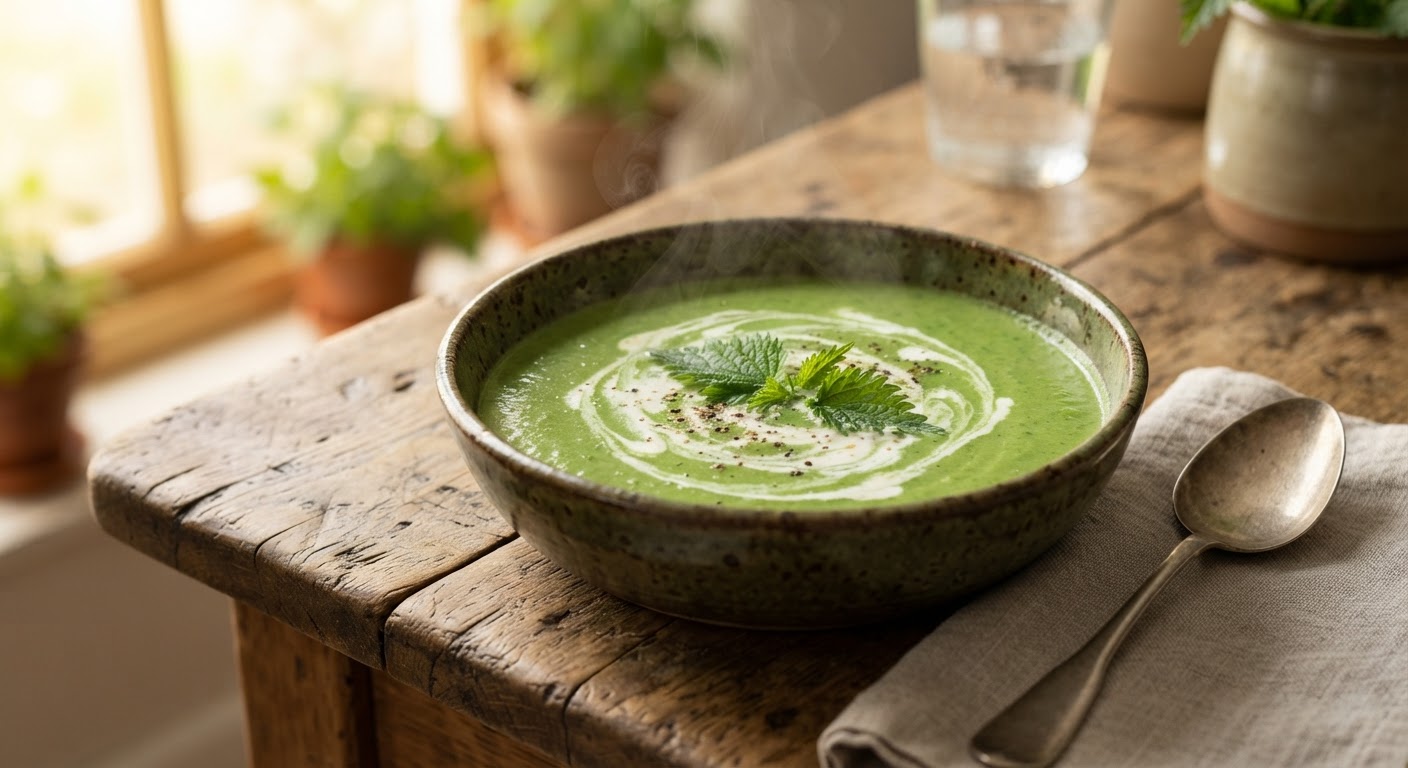
Serve in warm bowls with a swirl of cream, toasted pine nuts, olive oil, and black pepper.
Personal note: Go all nettle. The first time I diluted mine with spinach, I regretted it — you’ll miss what makes this soup special.
Recipe 2: Nettle Pesto — Your New Favorite Pasta Sauce
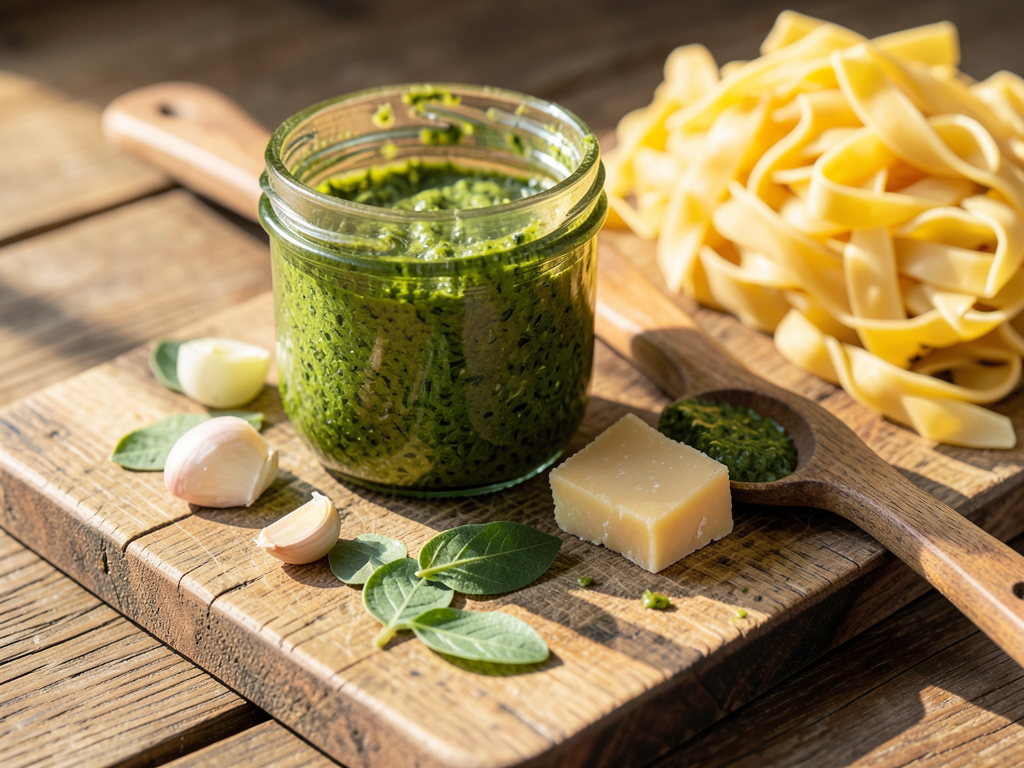
Basil pesto is wonderful but expensive and seasonal. Nettle pesto costs nothing if you forage it, freezes beautifully, and may be more nutritious. It has an earthier, more complex flavor — perfect on pasta, crusty bread, roasted vegetables, or thinned with pasta water as an instant sauce.
Ingredients (Makes about 1½ cups)
- 6 oz blanched nettles, squeezed very dry and roughly chopped
- ½ cup toasted pine nuts or walnuts (walnuts are cheaper and equally delicious here)
- 2-3 cloves garlic, peeled
- ½ cup freshly grated Parmesan or Pecorino
- Zest and juice of 1 lemon
- ½ cup good extra-virgin olive oil, plus more as needed
- Salt and freshly ground black pepper
Method
- Toast nuts in a dry pan until fragrant and golden. Cool slightly.
- Pulse nuts and garlic in a food processor until finely chopped.
- Add nettles, cheese, lemon zest, and juice. Pulse to a coarse paste.
- Stream in olive oil with the processor running until desired consistency.
- Season with salt and pepper (Parmesan is already salty, go gradual).
Storage: Jar it up with a thin layer of olive oil on top, refrigerate up to a week. Freeze in ice cube trays for individual servings that last months.
Variation: Nutritional yeast makes a great vegan version. Add fresh basil or wild garlic leaves when in season.
Recipe 3: Simple Sautéed Nettles with Garlic and Lemon
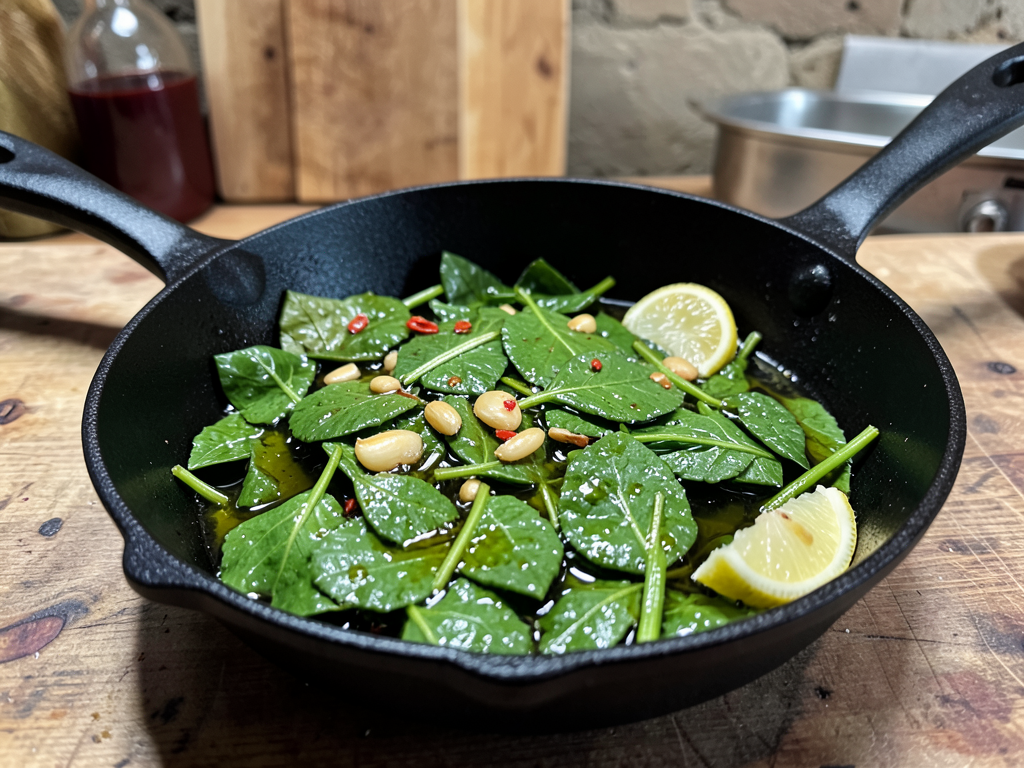
Sometimes the simplest preparations are the best. Sautéed nettles take about 10 minutes from start to finish and make an incredible side dish for grilled fish, roast chicken, or a fried egg on toast.
This is the purest way to taste nettle before blending it into soups and pestos.
Ingredients (Serves 2 as a side)
- 8 oz blanched nettles, squeezed dry and roughly chopped
- 2 tablespoons olive oil or butter
- 3 cloves garlic, thinly sliced
- Pinch of red pepper flakes (optional)
- Juice of ½ lemon
- Flaky sea salt
Method
-
Heat the fat. Warm the olive oil or butter in a wide skillet over medium-high heat.
-
Infuse the oil. Add the sliced garlic and red pepper flakes. Cook for about 30 seconds until the garlic is golden and fragrant — don’t let it burn.
-
Add the nettles. Toss in your chopped blanched nettles and spread them into an even layer. Let them sizzle undisturbed for about a minute to get a tiny bit of caramelization, then stir-fry for another 2-3 minutes until heated through.
-
Finish and serve. Squeeze lemon juice over the top, toss once more, and transfer to a serving dish. Finish with a generous pinch of flaky salt.
Serving ideas: On toast with a poached egg, folded into an omelette, tossed with pasta and extra Parmesan, or simply piled next to a piece of grilled fish.
Recipe 4: Crispy Nettle Chips
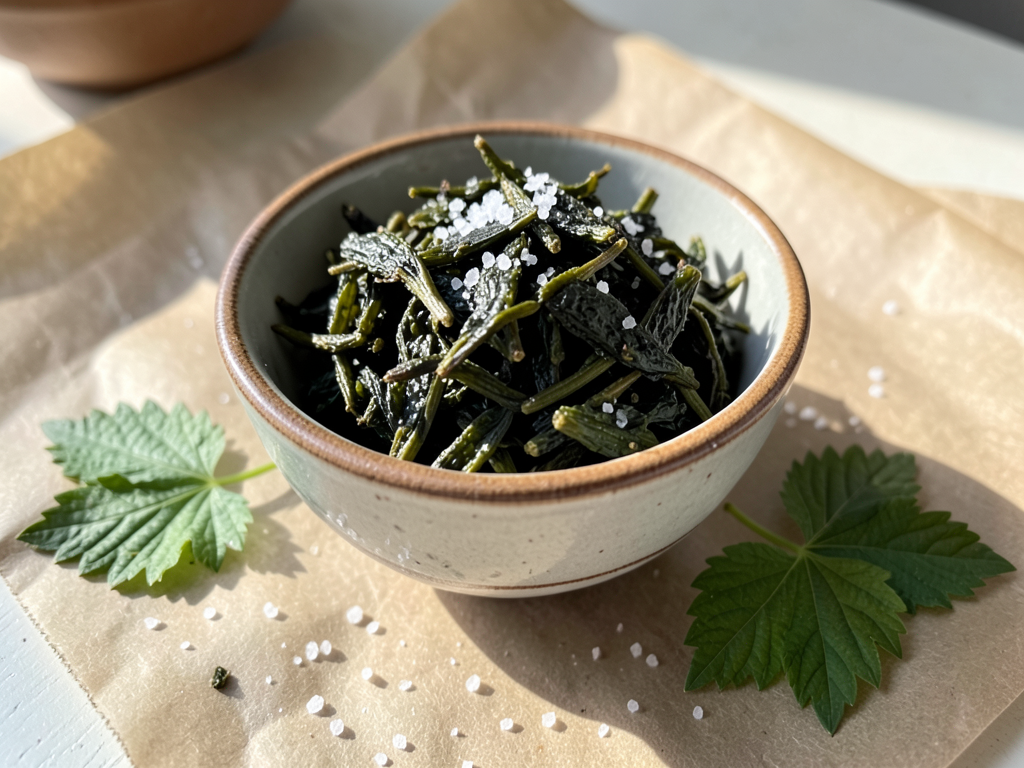
Think kale chips, but with a delicate, nori-like quality. Dangerously snackable and guilt-free.
The key: bone-dry leaves and no overcrowding. Steam is the enemy of crispiness.
Ingredients
- Fresh nettle leaves (stems removed — you want individual leaves here)
- Olive oil
- Sea salt
- Optional seasonings: smoked paprika, nutritional yeast, garlic powder, or cayenne
Method
- Preheat oven to 300°F (150°C). Line a baking sheet with parchment.
- Prep leaves — WEARING GLOVES. Pick largest leaves, wash, and pat absolutely bone-dry. Any moisture = soggy chips.
- Toss with a whisper of olive oil, salt, and any seasonings.
- Arrange in a single layer, no overlapping — or they steam instead of crisping.
- Bake 10-15 min, rotating halfway. Watch closely after 8 min — they burn fast. Look for dry, crinkly leaves.
- Cool completely on the sheet. They’ll crisp further as they cool.
Storage: If you somehow don’t eat them all immediately, store in an airtight container at room temperature for 2-3 days. They’ll lose some crispiness over time.
Recipe 5: Nettle Risotto
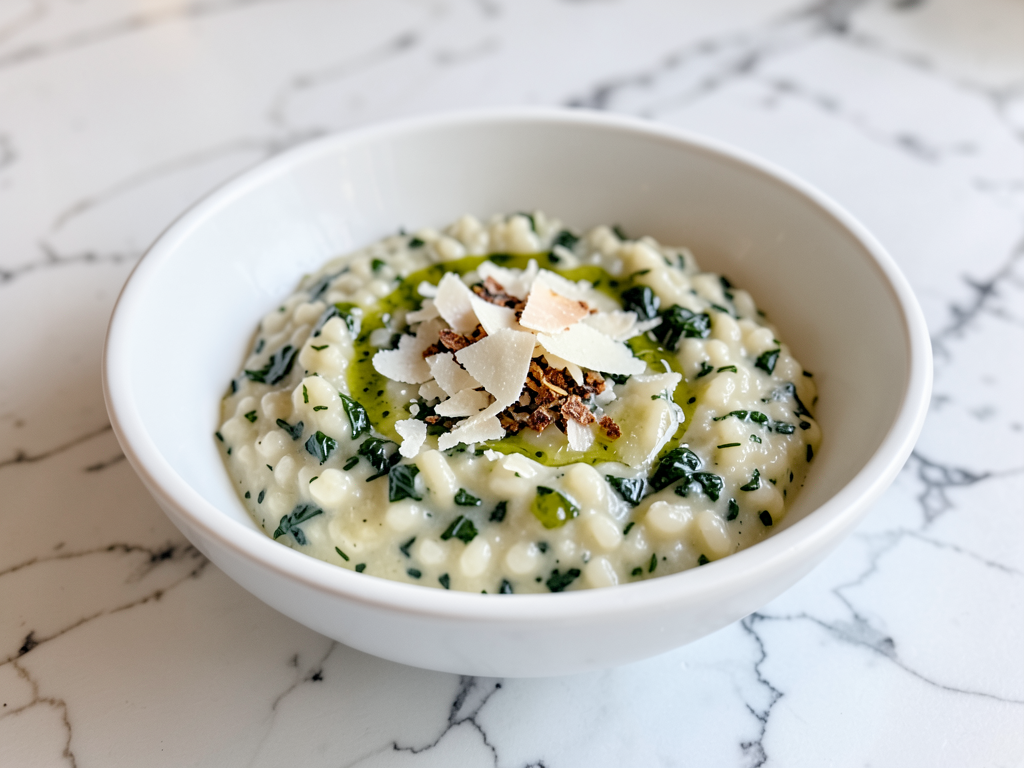
Restaurant-quality food from a plant most people spray with herbicide. The nettle purée stirred in at the end gives the risotto an extraordinary color and savory depth.
Ingredients (Serves 4)
- 6 oz blanched nettles, squeezed dry
- 1½ cups Arborio or Carnaroli rice
- 4-5 cups warm vegetable or chicken stock
- 1 small onion, finely diced
- 2 cloves garlic, minced
- ½ cup dry white wine
- 3 tablespoons butter, divided
- ½ cup freshly grated Parmesan, plus more for serving
- Zest of 1 lemon
- Salt and white pepper
Method
- Make nettle purée: Blend half the blanched nettles with a splash of stock until smooth. Roughly chop the rest.
- Sweat onion in 2 tbsp butter until soft, ~8 min. Add garlic, 30 sec.
- Toast rice 2-3 min, stirring constantly, until grains are translucent at the edges.
- Deglaze with wine, stir until absorbed.
- Add warm stock one ladle at a time, stirring frequently, waiting until absorbed. ~18-20 min. Rice should be al dente.
- Stir in chopped nettles and purée, cook 1-2 min.
- Remove from heat. Stir in remaining butter, Parmesan, and lemon zest. Rest 2 min. Season with salt and white pepper.
Serve immediately in warm bowls, topped with more Parmesan, a drizzle of olive oil, and — if you made them — a few crispy nettle chips for crunch.
Recipe 6: Nettle Tea — Simple, Soothing, Mineral-Rich
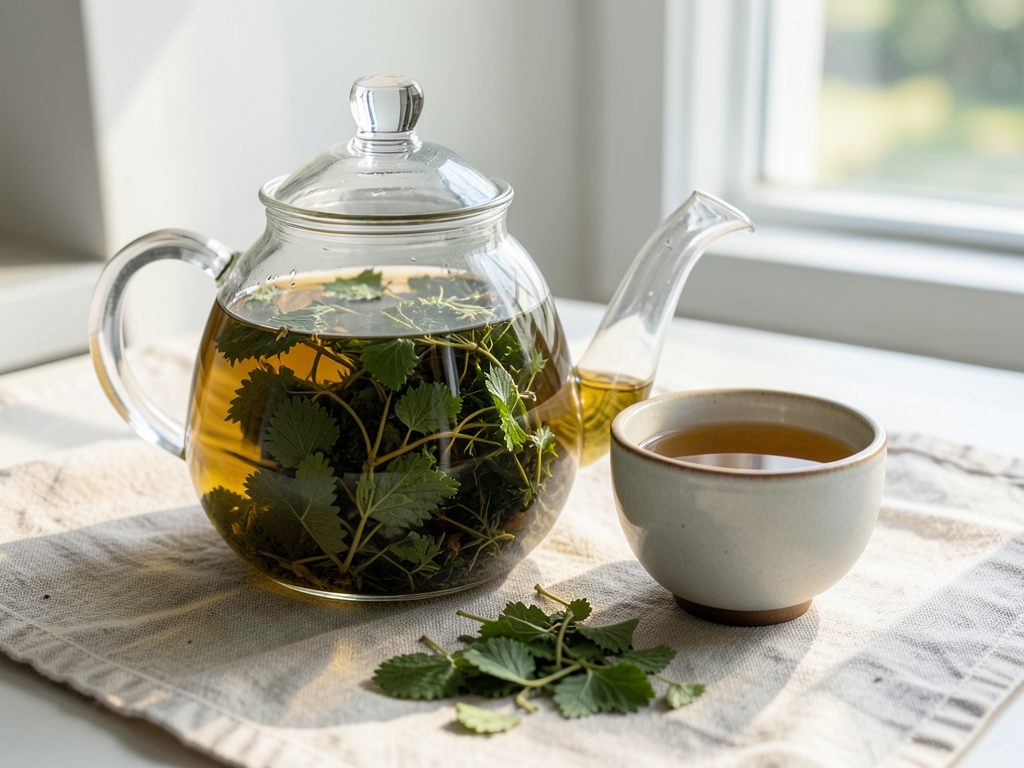
Nettle tea deserves its own section because it’s a daily ritual millions swear by for seasonal allergies and joint health.
The flavor is deeply green and mineral-rich — a mild, grassy green tea without astringency or caffeine. Incredibly soothing and nutrient-dense.
How to Make It
Fresh nettle tea: Pour boiling water over a small handful of fresh leaves (use gloves!). Steep 5-10 min. The boiling water neutralizes the sting immediately. Bright, vegetal flavor.
Dried nettle tea: Use 1-2 tsp dried leaf per cup, steep 10-15 min (longer for mineral extraction). Earthier and more mellow than fresh.
Blend with dried mint, lemon balm, or chamomile. A squeeze of lemon and honey make it genuinely delicious.
Health note: Nettle tea is rich in iron, calcium, magnesium, and silica. It’s a natural antihistamine popular during allergy season. Check with your doctor if pregnant or on blood thinners or diuretics.
How to Store and Preserve Nettles
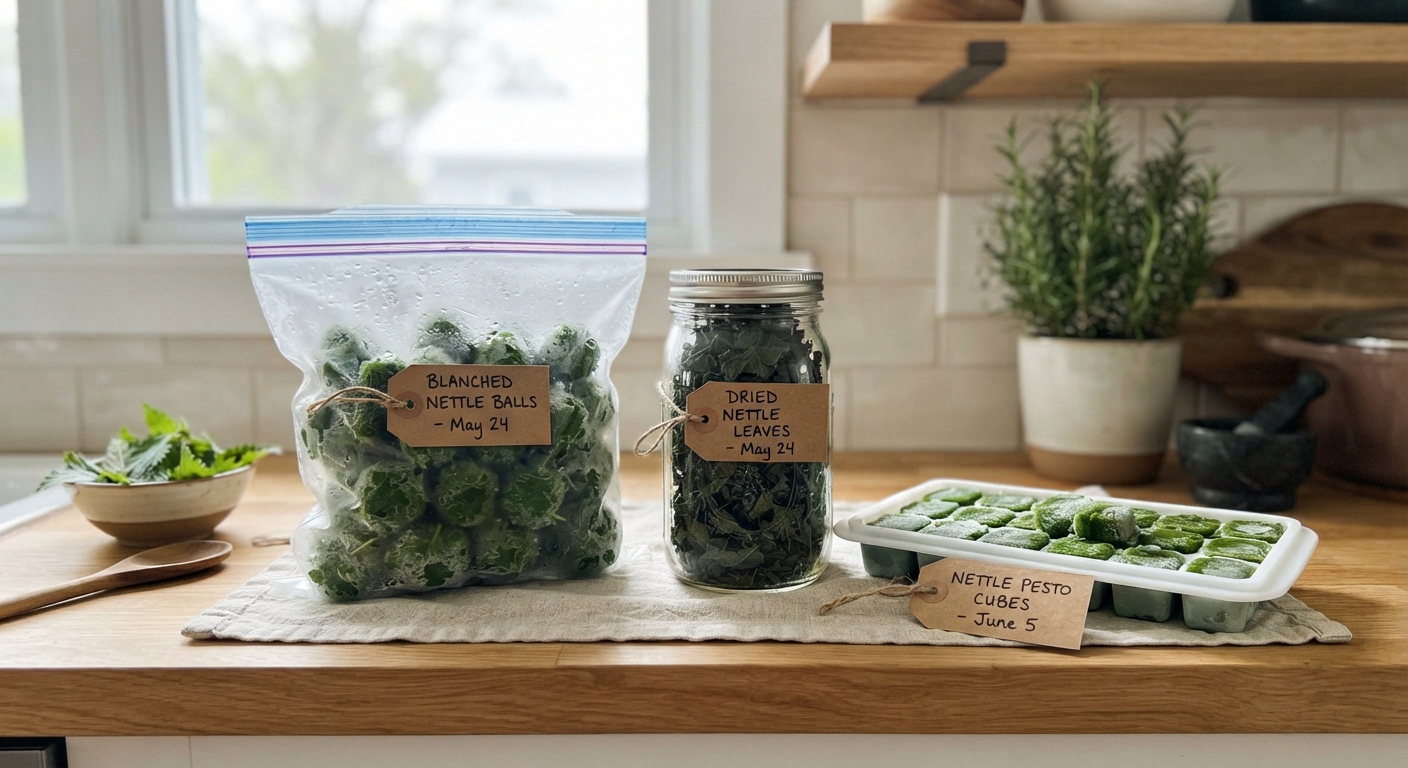
The nettle season is short — roughly March through June in most temperate regions, with a possible second flush in early autumn. If you want to cook with nettles year-round, you need a preservation strategy.
Freezing (Best All-Purpose Method)
Freezing blanched nettles preserves them for cooking year-round. Works for soups, sautés, pestos, risottos — everything except chips.
- Blanch 45-60 seconds, shock in ice water, and drain.
- Squeeze out as much water as possible. Get aggressive.
- Form into golf-ball-sized portions — each is roughly one serving.
- Wrap tightly or pack in freezer bags with air pressed out.
- Label and freeze for up to 12 months.
Just grab a ball, thaw, and cook as you would fresh blanched nettles.
Drying (Best for Tea)
Dried nettles are primarily for tea, though you can also powder them and add to smoothies or soups.
- Rinse fresh nettles and pat dry (wear gloves!).
- Hang in small bundles in a warm, dry, well-ventilated area away from direct sunlight. Alternatively, use a food dehydrator at 95-105°F (35-40°C).
- The nettles are fully dry when the leaves crumble easily between your fingers — usually 1-2 weeks for air-drying, or 4-8 hours in a dehydrator.
- Strip the dried leaves from the stems (the stems can be composted). Crush the leaves lightly and store in an airtight glass jar in a dark cupboard.
Properly dried and stored nettle leaves keep their potency for about a year. I keep a large jar in my pantry and make tea throughout the winter when I’m missing that taste of spring.
Nettle Powder & Nettle Salt
Grind thoroughly dried nettle leaves into a fine powder for smoothies, soups, pasta dough, and bread. For a finishing salt, blend 1 part nettle powder with 4 parts coarse sea salt — incredible on roasted vegetables, eggs, and grilled meats.
Nutritional Benefits: Why Nettle Deserves “Superfood” Status
Nettle isn’t just a free ingredient — it’s arguably one of the most nutrient-dense leafy greens on the planet. Here’s what you’re getting in every serving:
| Nutrient | What It Does | Comparison |
|---|---|---|
| Iron | Red blood cell production, energy | More iron than spinach (by dry weight) |
| Calcium | Bone health, muscle function | Comparable to cheese (by dry weight) |
| Vitamin C | Immune function, collagen | Significant amounts — helps iron absorption |
| Vitamin A | Eye health, immune function | High in beta-carotene |
| Protein | Tissue repair, enzymes | Up to 25% protein by dry weight — unusual for a leafy green |
| Silica | Hair, skin, nails, connective tissue | One of the richest plant sources |
| Magnesium | Muscle relaxation, sleep, mood | Substantial amounts |
| Chlorophyll | Detoxification, alkalizing | The deep green says it all |
A practical note: You absorb the most nutrients when cooking water is retained — think soups, teas, and stews. Water-soluble vitamins leach during blanching, so including the cooking liquid maximizes nutritional value. This is one reason nettle soup is so nutritionally complete.
The protein content is remarkable: about 25% by dry weight with a surprisingly complete amino acid profile. While you’d need a heroic quantity of fresh nettles to get meaningful protein, it’s a significant contributor — especially for plant-based diets.
Common Questions
Can I eat nettles raw?
Technically yes, if you’re brave — but I don’t recommend it. Raw nettles contain cystoliths that can irritate the kidneys. Cooking or drying neutralizes both the sting and these compounds. Just cook them.
Do I have to blanch before cooking?
For most recipes, yes — it neutralizes the sting and gives you control over texture. Exception: adding raw nettles (with tongs!) directly to a simmering soup or stew works fine.
Can I use older, flowering nettles?
Occasionally, yes — but don’t make a habit of it. Flowering nettles have higher levels of kidney-irritating cystoliths. Stick to young, pre-flowering plants for regular consumption.
What do nettles taste like?
Like spinach but more complex — earthier, with hints of green beans or asparagus. If spinach bores you, you’ll love nettles.
Why do my nettle dishes turn brown?
Overcooking. That brilliant emerald color comes from chlorophyll, which breaks down with heat. The ice water shock is critical, and most nettle dishes benefit from minimal cooking post-blanch. A squeeze of lemon at the end helps brighten the color.
Final Thoughts: Why Cooking Nettles Matters
Cooking stinging nettle is an act of reconnection — with the landscape, with food traditions that predate supermarkets, and with the satisfaction of turning something wild and defensive into something nourishing.
If you’ve never cooked with nettles, start with the soup. It’s forgiving and captures everything this plant offers. From there, work through the pesto, the chips, the risotto. Before you know it, you’ll be the person convincing strangers at the market to try the “weed” in their bag.
Just remember the gloves.
Enjoyed this guide? Check out our other foraging and wild food resources:
- Common Edible Weeds Guide — More free food hiding in your backyard
- Foraging Tips & Best Practices — Harvest sustainably and safely
- Edible Flowers for Salad — Add color and flavor to your plate
- Wild Edible Berries Guide — Nature’s sweetest treats