Cattail Edible Parts: Four Seasons of Free Food in a Marsh
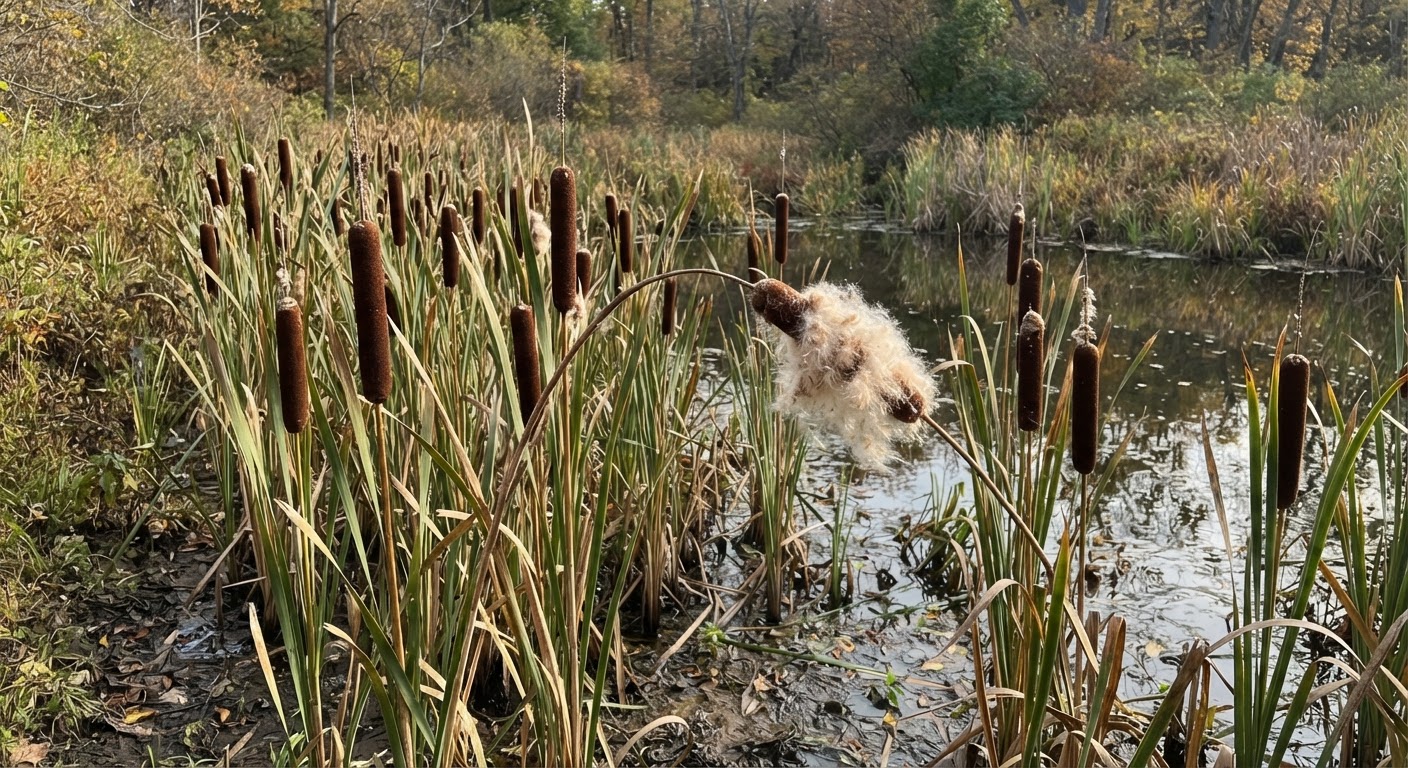
February on a shallow marsh is not the scene anyone photographs. Gray ice, brown stems, a wind that finds every gap in your jacket. The cattail heads are still there — hundreds of them, split open and pale, standing above the frozen mud like last year’s torches.
Most people walk past that and see dead plants. I see four different foods in four different seasons. Cattail edible parts are not one ingredient; they are a calendar: green shoots in late spring, a green flower spike in early summer, a three-week pollen window, and a starchy rhizome network under the mud from October through March.
The catch is what grows beside it. Cattail shares the water’s edge with plants that range from “upsetting” to “call an ambulance,” two of which look almost identical to cattail leaves.
What Cattail Edible Really Means, Part by Part
There is no “cattail season.” There are four harvest windows, and they barely overlap.
- Shoots — the young inner core, roughly April through early June.
- Immature flower spikes — green, tight heads before pollen, a two-week window in early summer.
- Pollen — yellow-green dust from the male portion of the spike, maybe ten days per stand.
- Rhizomes — the underground starch store, best from late October until new shoots break in April.
Miss a window and you have not missed the plant, just a food. A rhizome dug in July is fibrous and half empty; the same rhizome in December is dense with starch the plant packed away for winter.
One rule sits above all of it: a plant you cannot identify with certainty does not go in your mouth. Cattail is one of the easier wetland plants to confirm, but “easier” is not “foolproof.”
Reading the Plant From the Mud Up
Cattail is the genus Typha. In temperate North America and Europe you will mostly meet broadleaf cattail (T. latifolia), narrowleaf cattail (T. angustifolia), and their hybrid T. × glauca. Southern wetlands add T. domingensis.
They share a body plan. A thick, spongy rhizome creeps horizontally through the mud, sometimes 60 cm in a season, throwing up a clone of new shoots. Leaves are sword-shaped, 1.5 to 3 meters tall, sheathed around the stem. The flower spike is a dense brown cylinder: male flowers on top, female below, with a bare gap between them in narrowleaf cattail and none in broadleaf. After the male section releases pollen, it withers and drops, leaving the thin bare tip on every mature head in autumn.
One spike can release well over 200,000 seeds, which is why cattail colonizes disturbed wetlands so fast.
Cattail vs Iris vs Sweet Flag: The Table That Prevents a Bad Afternoon
Three plants dominate the same shallow edge, all with long sword-like leaves at roughly the same height. Two are not food.
| Feature | Cattail (Typha) | Yellow flag iris (Iris pseudacorus) | Sweet flag (Acorus calamus) |
|---|---|---|---|
| Leaf cross-section | Spongy, D-shaped or slightly concave, no true midrib | Flat, strongly ridged, folds into a fan | Flat, with a raised midrib |
| Leaf base | Layered sheaths wrapping a round stem | Equitant — leaves overlap like a hand of cards | Sheath-like, smells strong when crushed |
| Smell when crushed | Faint green, muddy, nothing distinctive | Acrid, rank | Sweet, spicy, tangerine-like |
| Flower | Dense brown cylinder on a round stem | Yellow iris flowers, 8–10 cm | Greenish-yellow spadix, 5–10 cm |
| Stem | Round, pithy, no nodes | Flattened, fan-arranged | Flattened, leaf-like |
| Status | Edible with correct timing | Toxic — vomiting, diarrhea, skin irritation | Not a food; medicinal, contains β-asarone |
The leaf base is the fastest check. Slide your hand down a cattail leaf: smooth, spongy sheath around a round stem. On iris the leaf folds flat against its neighbor, edge to edge. On sweet flag the smell arrives before your fingers close.
The winter check: water hemlock in the same mud
In winter the risk moves underground. Cattail rhizomes are white, solid, jointed, and spongy, thumb-thick, lying horizontally in the top 15 cm of mud. Water hemlock (Cicuta maculata) produces clusters of fleshy white tubers in the same wetland mud, and it is one of the most violently toxic plants in North America.
Cut a water hemlock root and it is chambered — hollow air spaces separated by walls, with yellow-tinged liquid. A cattail rhizome cut crosswise is continuous and evenly spongy. If you are unsure, do not root around in winter mud; wait for spring and take shoots.
Wild calla (Calla palustris) is another neighbor: heart-shaped leaf on a long stalk, every part loaded with calcium oxalate crystals that swell the mouth and throat.
The Harvest Calendar, Month by Month
Written for a temperate northern climate; push everything two to four weeks later in a cold zone, earlier if you are south.
| Window | Months | What to harvest | Field test | Notes |
|---|---|---|---|---|
| Early shoot | Apr–May | Inner core, 20–40 cm | Pulls free with a tug; snaps crisp | Best flavor of the year |
| Late shoot | May–early Jun | Thicker shoots to 60 cm | Core still white, not stringy | Blanch first |
| Green spike | Jun–early Jul | Spike still green and tight | Squeezes firm, no yellow dust | Two-week window |
| Pollen | Jun–Jul | Male portion of the spike | Tap over a bag, dust falls | 3–7 days per head |
| Rhizome | Oct–Mar | Horizontal rhizome, top 15 cm | White, solid, snaps starchy | Peaks after first frost |
| Leaf | Jun–Sep | Mature leaves | Flexible, unbroken | Cordage and mats, not food |
Pollen is the shortest window: three to seven good days per head, maybe two weeks per stand. Rhizomes are the longest, but quality peaks after the first hard frost and drops sharply once new shoots spend that starch in April.
What Each Part Actually Gives You
Yields are from my own harvests in shallow, productive marsh, working at a normal pace. A poor stand can halve them; a dense one can beat them.
| Part | Window | Realistic yield per hour | Texture / flavor | Best use |
|---|---|---|---|---|
| Green shoots | Apr–Jun | 30–50 shoots, 1–2 kg peeled | Crisp, cucumber-artichoke | Raw salad, pickle, stir-fry |
| Green spikes | Jun | 15–25 spikes | Corn-like, starchy, sweet | Boiled or grilled |
| Pollen | Jun–Jul | 2–3 cups from ~100 heads | Fine, mild, faintly floral | Pancakes, binder, 25% of flour |
| Rhizome | Oct–Mar | 1–2 kg peeled | Dense, earthy | Roast, soup thickener |
| Rhizome flour | Oct–Mar | 60–100 g per kg peeled | Neutral, slightly sweet | Griddle cakes, mixed flour |
That flour number surprises people. Cattail rhizome is roughly 30–45% starch on a dry basis, but most of its weight is water and fiber, so recovered flour is a small fraction of what you carry out. It is a real food, not a calorie-efficient one.
Green Shoots: The April Window
Find last year’s dead stalk — the gray-brown stub still in the mud — and look at its base. The new shoot emerges beside it, tightly rolled and pointed, usually 20–40 cm when it is at its best.
Grip low and pull with steady, increasing force. A good shoot releases with a soft pop as the rhizome connection breaks. If it tears into strings, you waited too long or grabbed too high.
Then peel. The outer three to five leaves are fibrous and will ruin a salad; strip them until you reach the pale core. That core tastes like a cross between cucumber and artichoke heart, with a clean snap. Sliced thin with salt and vinegar, it is genuinely good — not “good for wild food,” good.
Cooked, the same core holds for four to six minutes in salted water. Beyond that it goes limp. My rule: raw or four minutes, never ten. And pull shoots, do not cut them — cutting at ground level gives you fibrous outer leaves, no tender core, and a growth point left in the mud to rot.
The Green Flower Spike: A Two-Week Window
Before the spike turns brown, it is green, tight, and about the size of a small corn cob. This is the most underused part of the plant and, to my taste, the best.
Peel the sheath leaves and boil 8–10 minutes, then eat it off the core like corn with butter and salt. The flavor is starchy and sweet, closer to baby corn than anything else. Grilled over coals and turned every couple of minutes, it picks up a char that makes the sweetness read as corn.
The test is simple: squeeze it. Firm and green, take it. Yielding and yellow-dusted, you are late — collect pollen instead.
Pollen: The Shortest Harvest of the Year
On a warm, dry, windy morning in late June, a dense stand looks like it is smoking. Bend a ripe male spike into a paper bag and tap; the pollen falls in a visible puff. Or cut the top 5 cm, bag it, and sift at home. Skip plastic — static and condensation both work against you. A hundred heads give roughly two to three cups for an hour of work.
Two things ruin pollen: moisture and heat. Spread it on a tray in a dry room for a few hours the same day, then jar it. If it clumps, it is already too damp and will go musty within a week.
Pollen is about 20% protein and behaves like a soft, weakly binding flour. Use it at 20–25% of total flour in pancakes or flatbread, never 100% — it is too fine to carry a loaf. It browns fast, so drop the heat a notch.
Rhizomes: The Starch Under the Ice
After the leaves die back, the plant’s energy is underground. The rhizome is white, jointed, and surprisingly clean when pulled from black mud — a horizontal cable in the top 15 cm, sometimes an arm’s length before it turns.
Dig with your hands in soft mud, or lift with a fork in firmer ground. Cut a section and leave the rest: a cattail clone is one organism spread over meters, and trenching the whole mat kills it.
At home, wash, then peel the spongy rind with a knife or thumbnail. Break the white interior into 15 cm segments. Now you choose: roast, or starch.
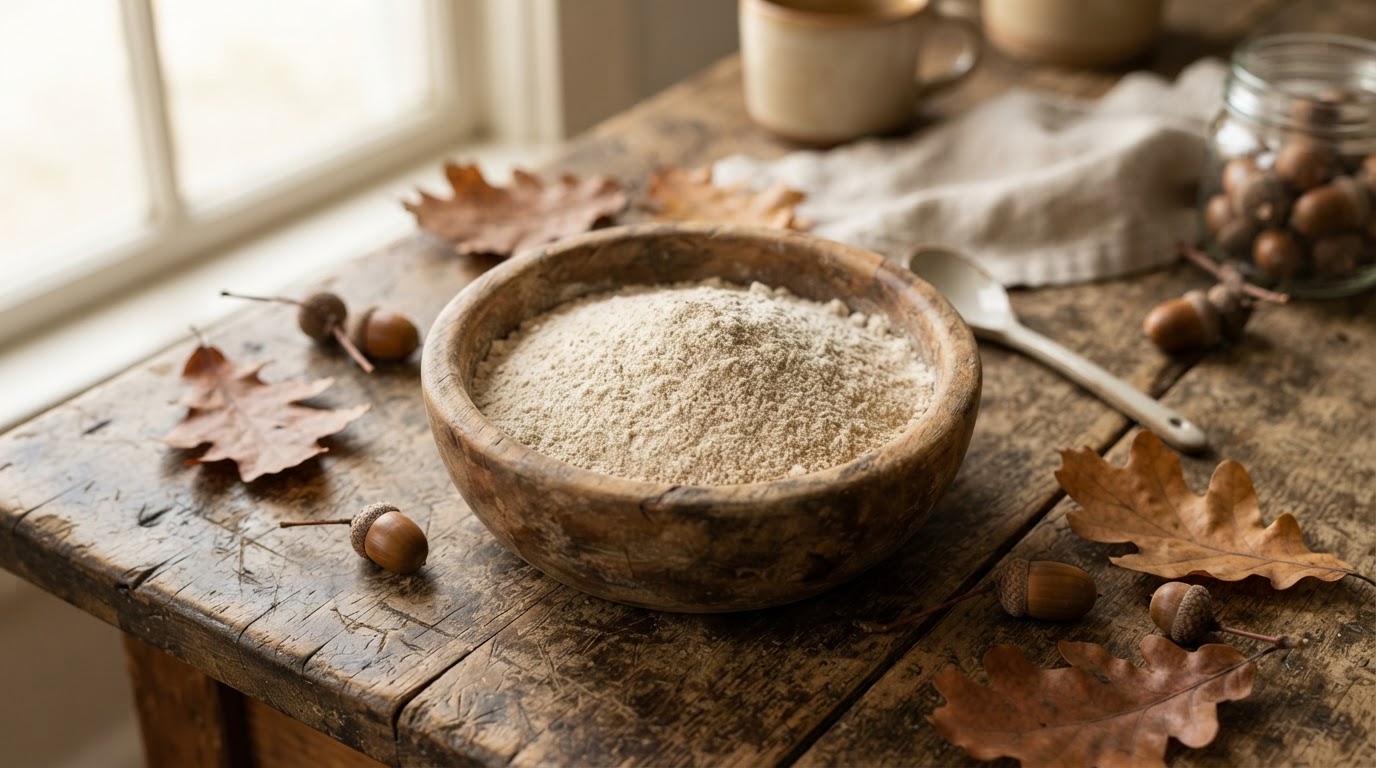
For starch, crush the peeled segments in a bucket of clean water. The water clouds immediately. Strain the fiber through cloth, let it settle two to four hours, pour off the water, and scrape the white layer from the bottom. Dry it warm, break the cake, grind fine. From a kilogram of peeled rhizome I typically recover 60–100 grams — enough for griddle cakes, and a lesson in how much work a calorie really is. Acorn processing runs a similar labor-to-flour ratio with more leaching; our guide to making acorn flour covers that trade-off.
Three Ways to Cook Cattail: Roast, Boil, Flour
Roast the rhizome and the spike
- Build a bed of coals, not a flame — cattail sugars scorch before they soften.
- Lay peeled rhizome segments on the coals for 10–15 minutes, turning every 3 minutes.
- Press one. When it gives like a baked potato, it is done.
- Split the skin, scrape the starch out with a spoon, and spit the fibers.
The roasted starch tastes of chestnut and potato. The same coals roast a green spike in 8–10 minutes, wrapped in a leaf to stop charring.
Boil the shoots and the green spike
- Bring well-salted water to a rolling boil.
- Add peeled shoot cores or peeled green spikes.
- Shoots: 4–6 minutes. Spikes: 8–10 minutes.
- Move straight into ice water for 2 minutes to stop cooking and keep the snap.
- Dress with butter and salt, or vinegar and chili.
Boiling removes the slight bitterness in older shoots. If a core still tastes bitter after boiling, it was too old.
Make flour from pollen and rhizome starch
- Dry pollen at room temperature 4–6 hours; dry starch until it cracks when pressed.
- Sift both through fine mesh to remove fluff and fiber.
- Pollen at 25% maximum of total flour; rhizome starch to 50% in flatbreads.
- Add 10–15% more liquid than usual — both absorb aggressively.
- Cook a minute cooler than wheat; cattail flour browns fast.
Rhizome starch thickens soup at roughly half the quantity of cornstarch without turning gluey. Pollen makes a yellow, faintly floral pancake that people ask about before they ask what is in it.
Clean Water, Clean Food
Cattail is a wetland filter. Its rhizome mat traps sediment and takes up whatever is dissolved around it, including things you do not want in dinner.
Skip these sites entirely:
- Water downstream of a road culvert, parking lot, or storm drain.
- Anything beside farmland, a golf course, or a manicured lawn.
- Standing water with an algal bloom, sulfur smell, or surface sheen.
- Ponds with heavy waterfowl traffic.
- Industrial sites and water with an unknown upstream.
Prefer flowing water, a clean lake edge, or a spring-fed marsh, a few hundred meters from any road. Wash everything in clean tap water at home, and cook shoots and spikes when water quality is less than excellent. Rhizomes take up more contaminants than above-ground parts, another reason to be picky about where you dig.
On public land, check the rules first; many parks prohibit harvesting wetland plants because digging rhizomes damages marsh structure, and some ban it outright. Our foraging mistakes guide covers the legal and health side, and the habitat field guide explains how to read a wetland before committing to a harvest.
Mistakes That Cost People a Meal
- Identifying by habitat alone. “It’s in the marsh, so it’s cattail” is how people eat iris. Check leaf base, stem, and flower every time.
- Taking shoots that are too tall. Anything over knee height is usually fibrous.
- Digging rhizomes in summer. The starch is gone and you damaged next year’s stand.
- Bagging damp pollen. It goes musty in 48 hours.
- Harvesting the whole clone. Take a section from the edge, leave the center.
- Trusting one source. Cross-check the ID before your first cattail meal. Our plant-part identification guide forces you to look at the base, not just the leaf.
Storing What You Take
Shoots keep five to seven days in a damp towel in the fridge. For longer storage, blanch two minutes, shock in ice water, drain, and freeze — about eight months of good texture. Green spikes are best within two days; after that the starch converts and they taste flat. Pollen goes into a glass jar in a dark cupboard for a month, or the freezer for a year. Label it with the date and the water body — you will not remember either in February.
Rhizome starch must be bone dry before storage. If the jar feels cool, it still has moisture. Store with a desiccant and use within six months. Raw peeled rhizomes keep about two weeks in clean water in the fridge, changed every couple of days.
FAQ
Are cattails safe to eat raw? Young peeled shoots are safe raw from clean water, and that is how they taste best. Rhizomes should be peeled and cooked. Pollen is edible raw but usually dried for flour. Avoid raw parts from stagnant or polluted water, where pathogens concentrate.
How do I tell cattail from poisonous lookalikes? Check the leaf base. Cattail leaves wrap a round stem in spongy sheaths with no midrib. Iris leaves fold flat into a fan with a raised ridge. Sweet flag smells of tangerine when crushed. In winter, cut any root: cattail rhizome is solid, water hemlock root is chambered.
What does cattail actually taste like? Shoots taste like cucumber and artichoke heart, crisp and mildly sweet. Green spikes taste like baby corn. Pollen is mild and faintly floral. Rhizome starch is neutral and slightly sweet, closer to potato than wheat. None of it is strongly flavored, which is why butter and salt work so well.
When is the best time to harvest cattail? Late April to early June for shoots, early summer for green spikes and pollen, late October through March for rhizomes. Pollen is the tightest window at roughly two weeks per stand. Rhizome quality peaks after the first hard frost, when starch has moved underground.
Can you eat the brown fuzzy head? No. By the time the head is brown and fluffy, the edible green spike stage is over and the structure is mostly seed fluff and fiber. The brown head is useful for tinder and insulation, not dinner. Harvest the spike while it is green and firm.
The Marsh Keeps Its Own Calendar
Cattail rewards patience more than enthusiasm. The forager who shows up in July with a shovel gets fiber and a damaged marsh. The one who comes in May for shoots, returns in June for pollen, and comes back after the first frost eats from the same patch for eight months.
One species, four windows, and identification checks you can run in ten seconds at the water’s edge. Very few wild foods give you that much for so little ground.
When you are standing in a marsh with a bucket and the light going, the gap between “I think that’s cattail” and “I know that’s cattail” is where mistakes happen. That is the gap Edible Plant Identifier was built for: point your phone at the leaf base or flower spike and it returns identification notes, lookalike warnings, and edible-part guidance, offline.