Most people who try foraging quit after two weeks — not because the plants aren’t there, but because they don’t know where to look. They wander into random green spaces, squint at field guide illustrations that look nothing like the actual plant in front of them, and go home empty-handed. The frustration is real, and it’s entirely preventable.
The secret that experienced foragers rarely explain to beginners is this: plants don’t grow randomly. Every edible species has a preferred habitat — a specific combination of sunlight, soil moisture, elevation, and companion plants that it gravitates toward. Once you learn to read the landscape and recognize these habitat patterns, foraging stops being a needle-in-a-haystack exercise and becomes more like grocery shopping — you know which aisle to walk down, and you know what you’ll find there.
This guide organizes common edible wild plants by habitat, not alphabetically or by plant family. Because when you’re standing in a field with an empty basket, what you need to know isn’t the Latin family name of a plant — you need to know what’s edible right here, right now, in this specific patch of ground.
Why Habitat-Based Foraging Changes Everything
Walk into a forest, a meadow, or even a neglected city lot and the sheer volume of green can overwhelm your eyes. Without a framework, every plant looks like every other plant — a blur of leaves, stems, and the occasional flower that might mean something or might not.
Habitat-based foraging gives you a filter. Instead of asking “what’s edible here?” — a question with fifty possible answers — you ask “what grows in disturbed soil near sidewalks?” That narrows the list to maybe six plants. Instead of “what can I eat in this forest?” you ask “what grows on the damp, shaded forest floor in late spring?” That’s three or four species at most.
This isn’t a theoretical distinction. It’s the difference between spending an afternoon identifying and a spending an afternoon actually harvesting.
Here’s a quick reference of what you’ll find in each habitat:
| Habitat | Typical Edible Plants | Best Season | Difficulty |
|---|---|---|---|
| Lawn & Garden | Dandelion, Purslane, Chickweed, Plantain, Clover | Spring–Fall | Beginner |
| Forest Floor | Wood Sorrel, Wild Garlic, Ramps, Fiddleheads | Spring | Intermediate |
| Fields & Meadows | Yarrow, Lamb’s Quarters, Wild Mustard, Red Clover | Spring–Summer | Beginner |
| Waterside & Wetland | Cattail, Watercress, Water Mint | Spring–Fall | Intermediate |
| Disturbed Ground & Urban | Purslane, Lamb’s Quarters, Mallow, Curly Dock | Summer–Fall | Beginner |
| Hedgerows & Edges | Blackberry, Elderberry, Nettle, Wild Rose | Summer–Fall | Beginner |
Habitat 1: The Lawn and Garden — Your Backyard Supermarket
If you have a lawn that isn’t drenched in pesticides, you already own a salad bar. The plants in this habitat share common traits: they thrive in full to partial sun, tolerate foot traffic, and grow low to the ground. Most are non-native species that followed agriculture around the globe and now grow on every continent except Antarctica.
Dandelion (Taraxacum officinale) needs no introduction, but it needs better PR. The jagged, tooth-shaped leaves that emerge in early spring are less bitter than the late-summer growth — that’s your window for salads. The yellow blossoms make a respectable fritter batter-dipped and fried. The taproot, roasted and ground, produces a coffee substitute that 19th-century Americans consumed by the ton when coffee prices spiked. Every part is usable.
Key identification: hollow stem with white latex sap, single yellow flower per stalk, deeply toothed leaves that point backward toward the center of the plant. No dangerous lookalikes in North America.
Purslane (Portulaca oleracea) looks like a succulent that fell off a garden center shelf and decided to colonize your driveway cracks. Thick, reddish stems radiate outward from a central point, with fleshy, paddle-shaped leaves that feel rubbery between your fingers. The entire plant has a mild, slightly lemony flavor and a satisfying crunch that holds up in salads better than most domesticated greens.
Here’s what makes purslane worth seeking out: it contains more omega-3 fatty acids than any other leafy vegetable ever tested. A 100-gram serving provides roughly 350 mg of alpha-linolenic acid — that’s more than some fish oil supplements. It’s also loaded with vitamin C, magnesium, and potassium.
The one lookalike to watch for is spurge (Euphorbia species), which also grows low to the ground with small leaves. Break the stem. Purslane leaks clear, watery sap. Spurge leaks white, milky sap that can irritate skin. That’s your test — takes two seconds.
Chickweed (Stellaria media) forms dense mats in damp, shaded corners of lawns and garden beds. The stems are thin and delicate, with a single line of fine hairs running down one side. Tiny white flowers have five petals so deeply split that they look like ten. The flavor is mild and grassy, somewhere between lettuce and fresh corn silk.
Chickweed’s best feature is that it grows in winter and early spring, when almost nothing else is available. In temperate climates, you can find chickweed from October through April — the off-season for most other wild greens.
Broadleaf Plantain (Plantago major) is the plant every kid instinctively grabs to put on a bee sting. That instinct is backed by science: plantain leaves contain aucubin, a compound with documented anti-inflammatory, antimicrobial, and wound-healing properties. But beyond first aid, the young leaves are edible — steam them like spinach or add them raw to mixed salads when they’re small and tender. The seeds, which grow on a distinctive rat-tail spike, can be harvested and ground into a flour substitute.
Habitat 2: The Forest Floor — Spring’s Hidden Treasure Chest
Forest floors are the seasonal pop-up shops of the foraging world. They explode with edible growth for a narrow window in early spring — before the canopy leafs out and blocks the sunlight — then settle into relative dormancy for the rest of the year. Timing is everything here, and the window can be as short as two weeks for some species.
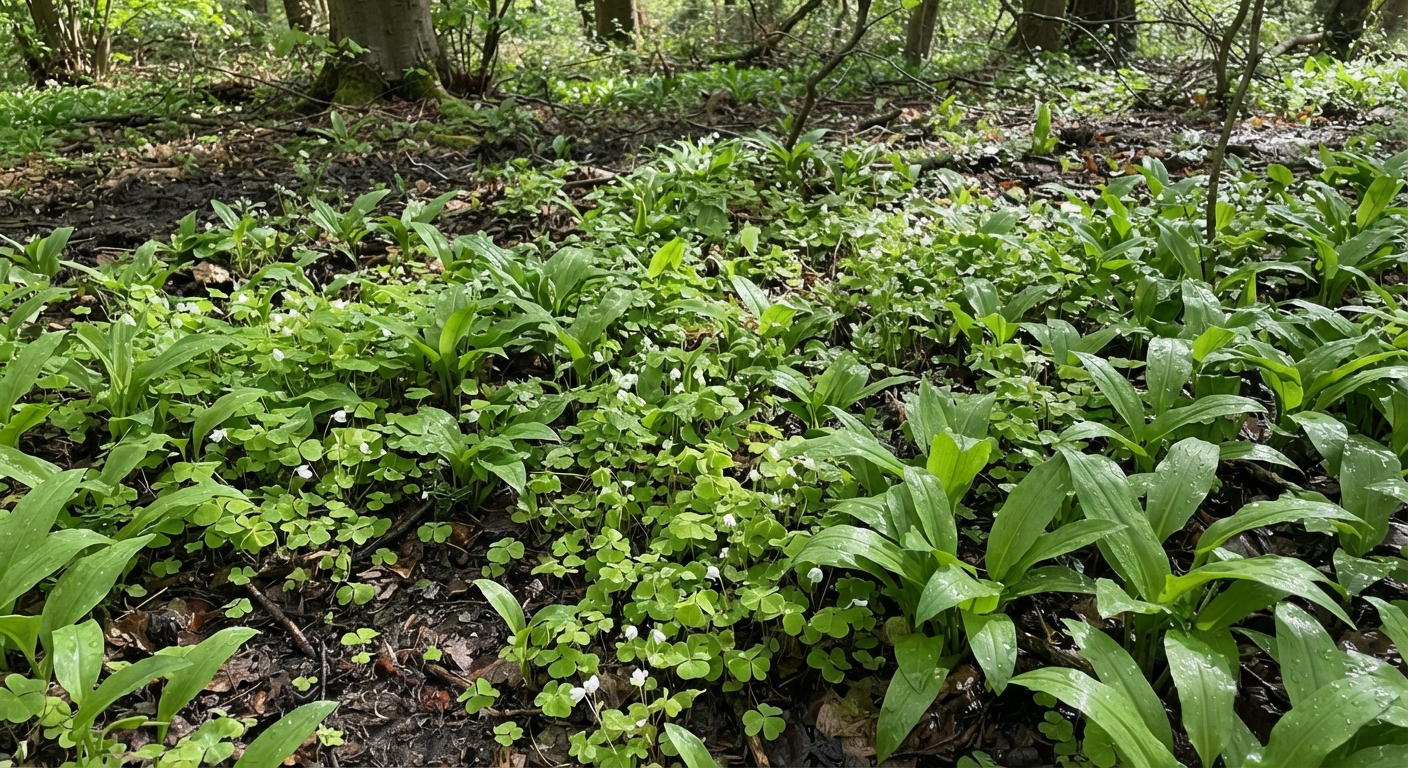
Wood Sorrel (Oxalis acetosella) carpets the shaded, moist forest floor in distinctive three-lobed leaves that beginners routinely mistake for clover. The giveaway: wood sorrel leaves are heart-shaped at the base, while clover leaves are oval. Crush a leaf — wood sorrel tastes like green apple candy, a sharp citrusy tang from oxalic acid. Clover tastes like… a leaf.
Use wood sorrel sparingly. That bright, lemony flavor makes it an excellent garnish for fish dishes, a zesty addition to salads, or a surprising twist in wild pesto. But the oxalic acid content means you shouldn’t eat handfuls of it daily — people with kidney issues should be particularly cautious.
Wild Garlic (Allium ursinum), also called ramsons or bear garlic, announces itself before you see it. The scent is unmistakable — a cloud of garlicky aroma that hangs over the forest floor in April and May. The broad, lance-shaped leaves emerge from the ground individually, each on its own stem, looking quite different from the clustered bulb of cultivated garlic.
The rule with wild garlic is absolute: if it doesn’t smell like garlic, it’s not wild garlic. Lily of the Valley (Convallaria majalis) has similar leaves and is fatally toxic — but it smells like nothing. Lords-and-Ladies (Arum maculatum) is also similar and also toxic — and smells like nothing. Your nose is the only identification tool you can trust here.
Every part of wild garlic is edible raw or cooked. The leaves make a spectacular pesto. The flowers are edible garnishes. The bulbs can be used exactly like cultivated garlic.
Stinging Nettle (Urtica dioica) is the plant that taught an entire generation of foragers to wear gloves. The hollow hairs on the stems and leaf undersides inject a cocktail of histamine and formic acid on contact, producing an itchy rash that lasts anywhere from 20 minutes to several hours.
Why would anyone voluntarily harvest this? Because once you apply heat — boiling water for 30 seconds is enough — the stinging hairs collapse and the plant becomes one of the most nutritious greens on the planet. Nettles contain more protein by dry weight than any other leafy green (roughly 25%), plus iron, calcium, and vitamins A and C in quantities that put kale to shame.
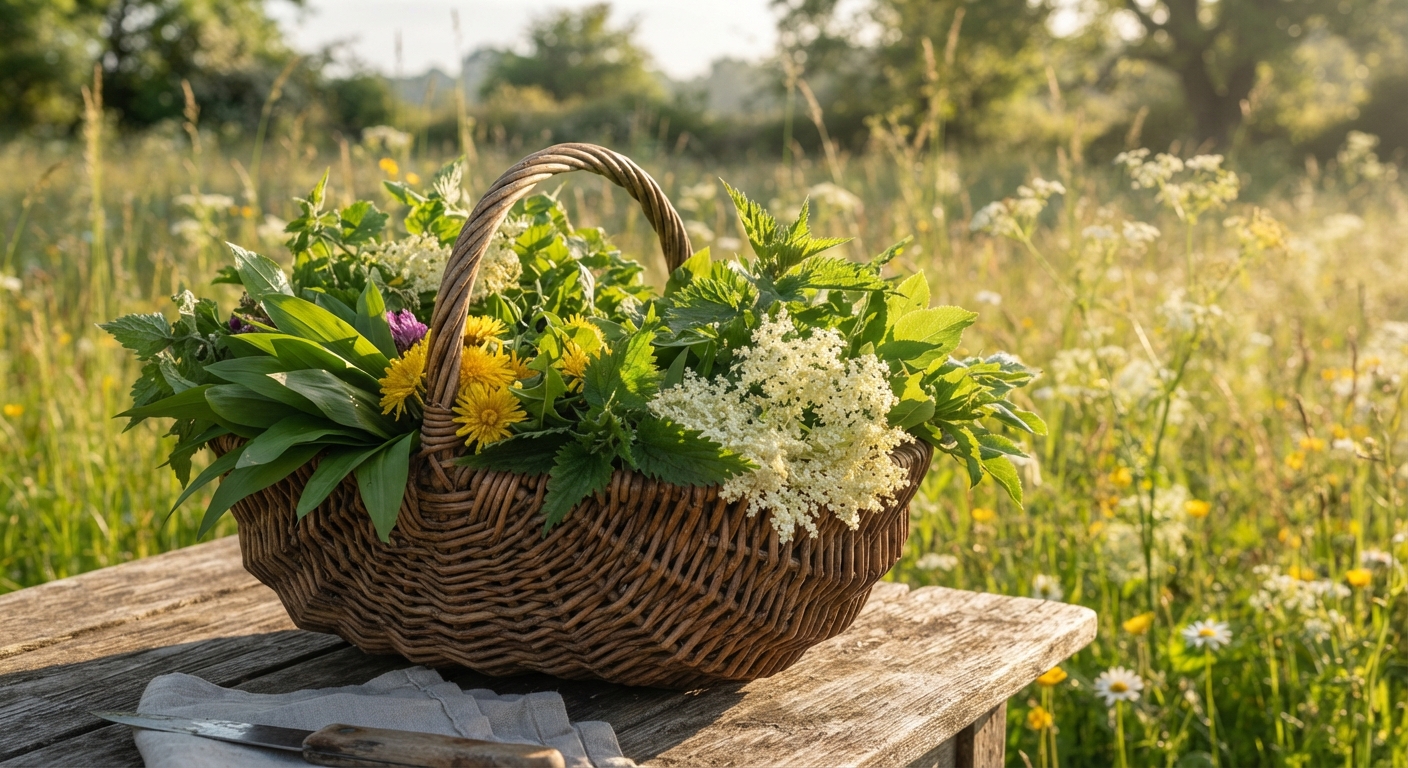
Nettles love nitrogen-rich soil, which means they’re often found near old farmsteads, compost piles, and woodland edges where deer congregate. Harvest in spring when the plants are under 12 inches tall. Wear thick gloves. Use scissors or a knife so you’re not wrestling the plants barehanded.
Once home, nettles can replace spinach in literally any recipe: soups, quiches, pasta fillings, saag paneer, smoothies. The cooking liquid itself becomes a mineral-rich broth.
Habitat 3: Fields, Meadows, and Open Ground
Open, sunny fields are the most productive foraging habitat by total biomass. The plants here are adapted to full sun, wind exposure, and competition from grasses — which means many of them grow tall, fast, and in dense stands.
Lamb’s Quarters (Chenopodium album) is the wild ancestor of quinoa, and you can taste the relationship in the seeds. But the leaves are the real prize — tender, mild, and almost sweet when harvested young. They cook down exactly like spinach, and unlike many wild greens, they don’t develop aggressive bitterness as the season progresses.
The identification is surprisingly straightforward once you know what to look for. Lamb’s quarters leaves are diamond-shaped with irregularly toothed edges, and the undersides — especially on younger leaves — are coated with a fine, white, mealy powder that feels slightly greasy between your fingers. This powder is entirely harmless and disappears when you cook the plant.
Yarrow (Achillea millefolium) straddles the line between food and medicine. The young leaves can be used sparingly as a bitter aromatic in salads or soups, but yarrow’s primary value to foragers is its medicinal profile. The leaves stop bleeding when applied directly to a wound — the botanical name Achillea references Achilles, who supposedly carried yarrow into battle for this exact purpose. A tea made from the leaves and flowers reduces fever and eases cold symptoms.
Field identification: yarrow leaves look like green feathers — extremely fine, fern-like, and multiply divided. The flowers form flat-topped clusters of tiny white (sometimes pink) blossoms. Rub a leaf between your fingers and you’ll smell something herbal and slightly camphor-like.
Red Clover (Trifolium pratense) is everywhere in meadows and grassy fields from late spring through early fall. The pink-purple flower heads are the edible part — pluck them from the stem, pull out the individual florets, and add them to salads, baked goods, or tea blends. The flavor is faintly sweet with a hay-like finish. Red clover blossoms make a particularly good iced tea when steeped with lemon and honey.
Habitat 4: The Water’s Edge — Cattails, Watercress, and Wet Feet
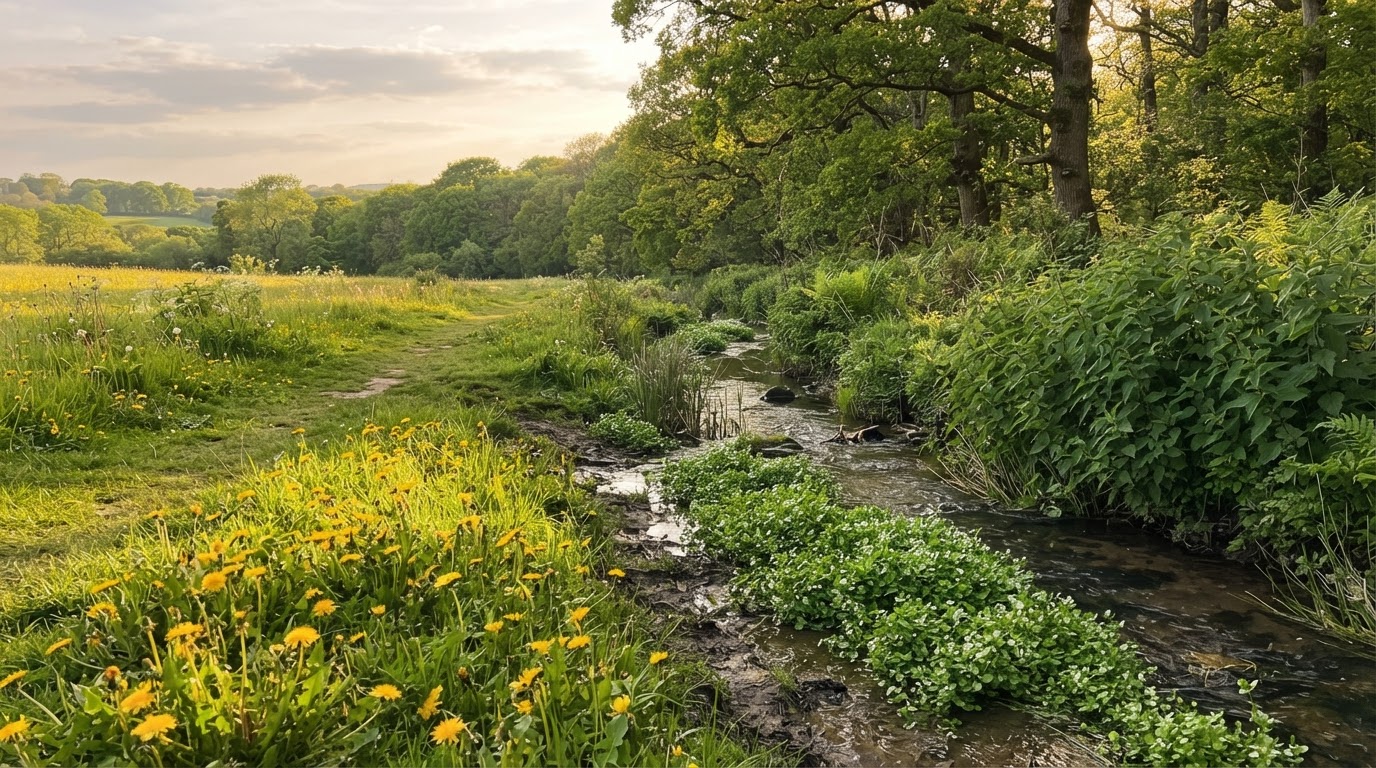
Wetland foraging produces some of the most calorie-dense wild foods available. The trade-off is that you’ll get muddy, and you need to be extra careful about water quality — plants absorb whatever’s in the water they grow in, including agricultural runoff and heavy metals.
Cattail (Typha species) has been called the supermarket of the swamp, and the nickname isn’t an exaggeration. In spring, the young shoots can be peeled and eaten raw or cooked — they taste like cucumber crossed with mild asparagus. The immature green flower spikes, still sheathed in their papery covering, can be boiled and eaten like corn on the cob. The yellow pollen produced in early summer is a protein-rich flour substitute. The rhizomes, harvested in fall and winter, contain more edible starch per square foot than potatoes.
No other wild plant in North America provides this many edible products across this many seasons. The only downside is the harvest effort — cattails grow in muck, and digging rhizomes is heavy work.
Positive identification is easy: no other emergent wetland plant produces the characteristic brown cigar-shaped seed head. If you see that brown cylinder on a tall stalk surrounded by flat, strap-like leaves, you’re looking at a cattail. There are no toxic lookalikes.
Watercress (Nasturtium officinale) grows in slow-moving, clean streams and springs, forming dense floating mats of glossy, rounded leaves. It’s the same watercress sold in supermarkets for $4 a bunch — growing wild, for free, often in staggering quantities.
The peppery, mustard-like bite comes from glucosinolates, the same compounds that give horseradish and wasabi their heat. Watercress makes an excellent salad base, soup ingredient, or sandwich green. It also ranks as one of the most nutrient-dense foods ever analyzed by the CDC, scoring a perfect 100 on their Aggregate Nutrient Density Index.
The critical safety warning with watercress: it grows in water, and in areas where livestock graze upstream, that water can carry liver fluke parasites. Only harvest watercress from clean, tested water sources. If you don’t know what’s upstream, cook the watercress thoroughly — heat kills the parasites.
Habitat 5: Disturbed Ground and Urban Spaces — The Survivors’ Buffet
Disturbed ground means exactly what it sounds like: construction sites, road edges, vacant lots, gravel driveways, the weedy strip between sidewalk and curb. These are tough environments — compacted soil, full sun, occasional herbicide exposure, zero shade — and the plants that thrive here are the botanical equivalent of survivalists.
Curly Dock (Rumex crispus) sends a deep taproot through the hardest, most unforgiving soil and produces leaves that, while too bitter for most palates when raw, become perfectly edible after boiling in two changes of water. The seeds, which ripen in late summer and hang on the plant well into winter, can be ground into a dark, nutty flour.
Common Mallow (Malva neglecta) grows flat against the ground in driveway edges and sidewalk cracks, producing small, round, scalloped leaves and tiny pale-purple flowers. Every part of the plant is edible. The leaves have a mild flavor and a slightly mucilaginous texture — think okra, but milder — that thickens soups and stews naturally. The immature seed pods, which look like tiny cheese wheels, earned mallow its folk name “cheeseweed.” Kids have been snacking on these for centuries.
Quick Identification Reference Table
This table covers the key identification features for every plant discussed above. Print it, screenshot it, or hand-copy it into your foraging journal. Use it in the field until these plants become second nature.
| Plant | Habitat | Key ID Features | Edible Parts | Harvest Season | Lookalike Warning |
|---|---|---|---|---|---|
| Dandelion | Lawns, fields | Hollow stem, white sap, jagged backward-pointing leaves | Leaves, flowers, root | Mar–Nov | None toxic |
| Purslane | Driveways, gardens, sidewalk cracks | Reddish fleshy stems, paddle-shaped succulent leaves, clear sap | Entire plant | Jun–Oct | Spurge (white milky sap — toxic) |
| Chickweed | Damp lawns, garden beds | Fine hair line on one side of stem, tiny white 5-petal flowers (looks like 10) | Leaves, stems, flowers | Oct–Apr | Scarlet pimpernel (square stem) |
| Broadleaf Plantain | Lawns, paths, compacted soil | Broad oval leaves with parallel veins, rat-tail seed spike | Young leaves, seeds | Apr–Oct | None toxic |
| Wood Sorrel | Forest floor, shaded areas | 3 heart-shaped leaflets, lemon-sour taste | Leaves, flowers | Mar–Sep | Clover (oval leaflets, no sour taste) |
| Wild Garlic | Damp woodland | Broad leaves, intense garlic smell when crushed | Leaves, flowers, bulbs | Mar–Jun | Lily of the Valley (no garlic smell — FATAL) |
| Stinging Nettle | Woodland edges, old farmsteads | Serrated leaves, hollow stinging hairs, square-ish stem | Leaves (cooked), seeds | Mar–May | Dead nettle (no sting, purple flowers) |
| Lamb’s Quarters | Fields, gardens, roadsides | Diamond-shaped leaves, white mealy underside | Leaves, seeds | May–Oct | None toxic |
| Yarrow | Sunny meadows, roadsides | Fern-like feathery leaves, flat white flower clusters | Young leaves (sparingly), flowers | May–Sep | Poison hemlock (much taller, purple-spotted stem) |
| Red Clover | Lawns, meadows | Pink-purple globe flower, 3 oval leaflets with pale chevron | Flower heads | May–Sep | None toxic |
| Cattail | Wetlands, pond edges | Brown cigar-shaped seed head, flat strap-like leaves | Shoots, flower spikes, pollen, rhizomes | Mar–Nov | None (iris leaves similar but no cigar head) |
| Watercress | Clean streams, springs | Glossy rounded leaves, hollow stems, white 4-petal flowers | Leaves, stems | Mar–Oct | Fool’s watercress (no mustard taste) |
| Curly Dock | Disturbed soil, roadsides | Long wavy-edged leaves, tall rusty-brown seed stalks | Young leaves (cooked in 2 waters), seeds | Mar–Nov | None toxic |
| Common Mallow | Driveways, sidewalk cracks | Round scalloped leaves, tiny cheese-wheel seed pods | Leaves, seed pods | Apr–Oct | None toxic |
Seasonal Harvest Calendar
Knowing which habitat to visit during each season eliminates the guesswork from foraging. This calendar covers temperate Northern Hemisphere climates — adjust by a few weeks depending on your local latitude and elevation.
| Season | Available Plants | Prime Habitats | What to Harvest |
|---|---|---|---|
| Early Spring (Mar–Apr) | Chickweed, Nettle, Wild Garlic, Dandelion, Fiddleheads | Forest floor, lawns, damp gardens | Young leaves, shoots |
| Late Spring (May–Jun) | Wood Sorrel, Lamb’s Quarters, Cattail shoots, Plantain, Yarrow | Forest edges, meadows, wetlands | Leaves, flowers, pollen |
| Summer (Jul–Aug) | Purslane, Red Clover, Mallow, Lamb’s Quarters | Gardens, fields, urban edges | Leaves, flowers, seed pods |
| Early Fall (Sep–Oct) | Curly Dock seeds, Dandelion root, Cattail rhizomes, Elderberry | Roadsides, wetlands, hedgerows | Roots, seeds, berries |
| Late Fall–Winter (Nov–Feb) | Chickweed, Cattail rhizomes, Dandelion root, Curly Dock seeds | Lawns, wetlands, disturbed ground | Roots, seeds, hardy greens |
The winter column is short for a reason — cold months are when your preserved harvest from the rest of the year pays off. But chickweed and cattail rhizomes will keep you connected to fresh food even in January.
Field Tips From Years of Getting It Wrong
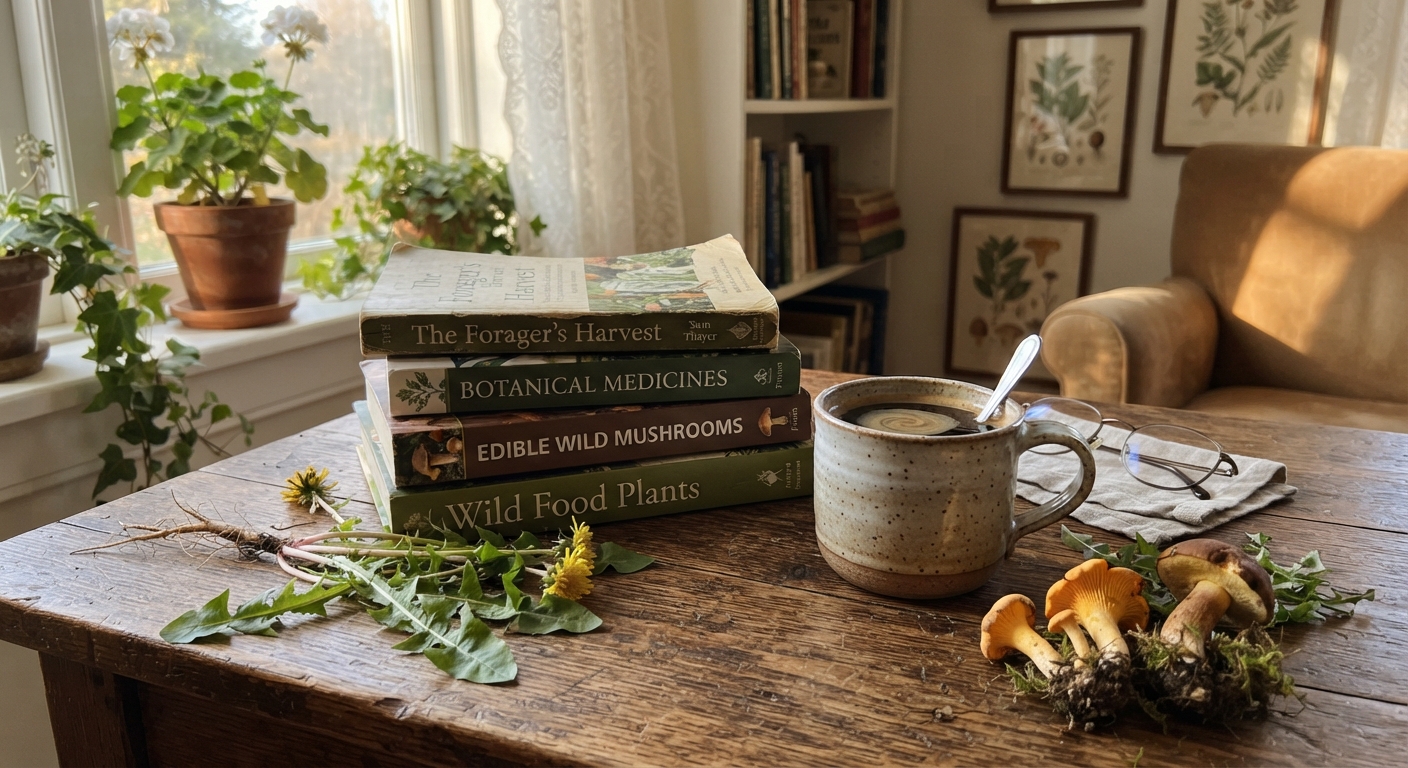
These aren’t the tips you’ll find in a glossy foraging coffee-table book. These come from wet feet, misidentified plants, and the occasional nettle rash.
The “three-feature confirmation” rule. Never identify a plant based on a single characteristic. Confirm at least three distinct features: leaf shape, flower structure, stem type, smell, habitat, or growth pattern. One feature can fool you. Three features, cross-referenced, make a mistake far less likely.
Take a photo before you pick. This sounds backwards, but a photo of the plant in its natural environment — showing the surrounding vegetation, the soil conditions, the light exposure — is often more useful for confirming identification than a photo of a single detached leaf on your kitchen counter. Context is identification data.
Learn the toxic lookalikes first. Most foraging courses teach edible plants and mention the poisonous ones as an afterthought. Flip that approach. For every plant you want to eat, learn its dangerous doppelgänger before you learn the edible version. Hemlock before wild carrot. Lily of the Valley before wild garlic. Knowing what you’re trying to avoid makes positive identification sharper.
Smell is an underrated tool. Many plant families have distinctive scents that no photograph captures. The mint family smells minty. The carrot family smells… carroty. The allium family smells like onions or garlic. Your nose adds a dimension to identification that field guides can’t provide.
Harvest like the plant needs to survive you. Take no more than one-third of any single plant or patch. Leave the roots intact when harvesting leaves. Don’t harvest rare species at all — there are plenty of abundant, invasive, or weedy species that can handle regular harvest pressure. Sustainability isn’t optional idealism in foraging; it’s the only way there will still be plants to find next year.
The water rule for urban foraging. Never harvest within 50 feet of a busy road — plants absorb heavy metals from exhaust residue. Avoid plants growing directly against building foundations where lead paint may have flaked into the soil. Community gardens, parks set back from roads, and residential yards (with permission) are safer bets. When in doubt about urban soil quality, stick to above-ground plant parts — leaves and flowers accumulate fewer soil contaminants than roots.
Start a foraging journal. Not a blog, not Instagram. A private notebook where you record what you found, where, when, and at what stage of growth. Over a single year, this journal becomes your personal field guide calibrated to your specific location. Year two, you’ll know exactly which patch of nettles emerges first in spring and which blackberry hedge produces the sweetest berries in August. No published guide can give you that.
Questions That Come Up in the Field
“How do I know if a plant has been sprayed with pesticides?”
Look for the telltale signs: uniform browning or yellowing across multiple plant species in the same area, chemical odor, or — most reliable of all — a perfect, weed-free lawn surrounding the plants. Municipal parks that maintain manicured turf almost certainly use herbicides. Golf courses, playing fields, and the strip between sidewalk and curb in suburban neighborhoods should all be treated as sprayed until proven otherwise. Your safest bets are wild areas (forests, meadows, wetlands), organic farms (with permission), and your own unsprayed yard.
“Is it legal to forage in public parks?”
The answer varies wildly by jurisdiction. National parks in the United States generally prohibit plant removal entirely. National forests often allow small quantities for personal use without a permit. State and local parks range from total bans to no restrictions whatsoever. Before foraging anywhere, search “[park name] foraging regulations” or call the park office. The conversation takes three minutes and removes all uncertainty.
“What’s the one plant every beginner should learn first?”
Dandelion. It’s unmistakable, abundant everywhere, available most of the year, has zero toxic lookalikes, and every part is usable. It’s also genuinely nutritious — more vitamin A than carrots, more calcium than kale. The only barrier is the cultural programming that labels it a weed. Once you start eating dandelions, you’ll never look at a lawn the same way.
“Can I really forage enough food to make a meal?”
Absolutely, but you need to adjust your expectations about what that meal looks like. A foraged meal isn’t a foraged steak — it’s a salad of wild greens with a dandelion flower garnish, a nettle soup starter, and maybe some cattail pollen flatbread if you’re ambitious. Think of wild plants as ingredients that supplement and elevate your existing cooking, not as a complete food replacement system. With practice, 20–30 minutes of foraging yields enough greens for a family dinner.
“What gear do I actually need?”
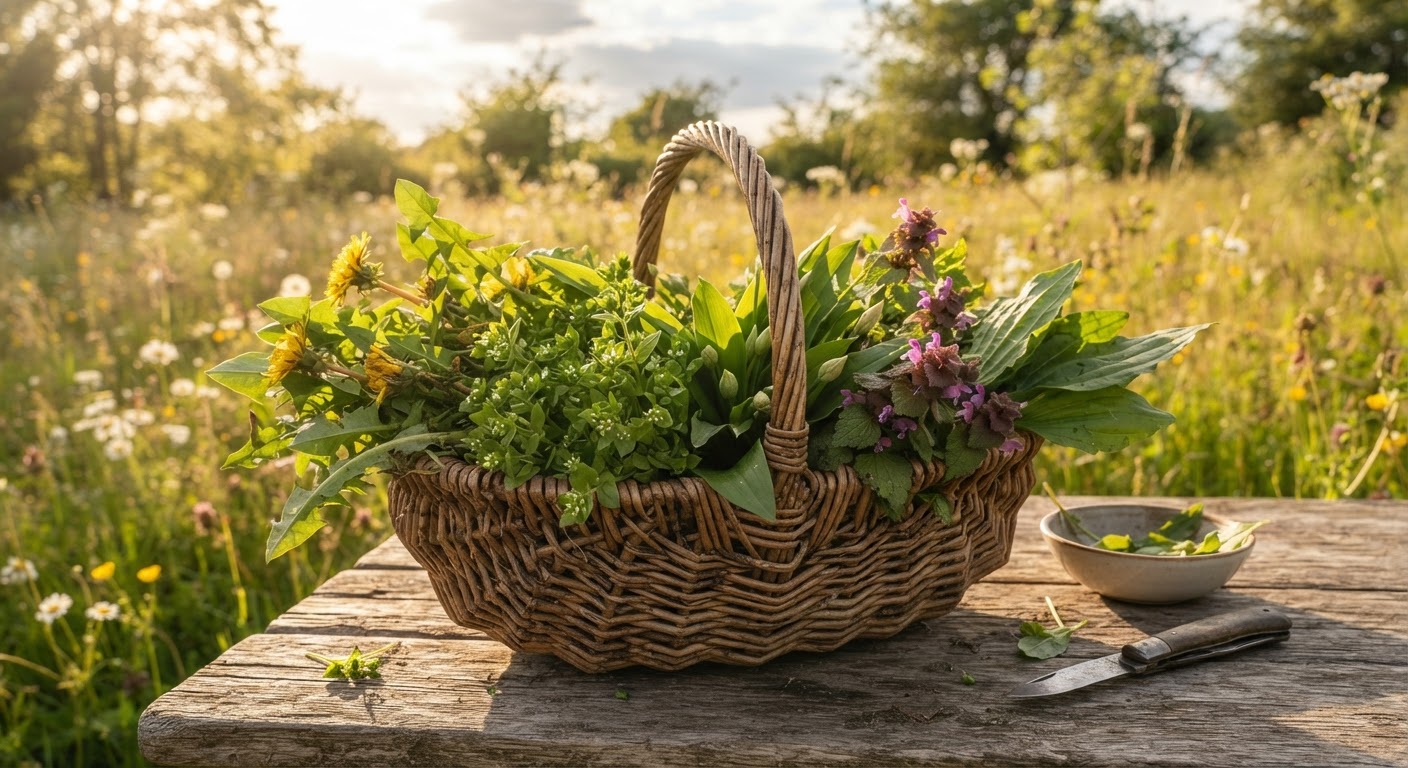
A basket or cloth bag (plastic bags cause greens to wilt and sweat), a sharp knife or scissors, garden gloves for nettles and thorny plants, and a field guide specific to your region. That’s it. You can add a hori-hori knife for digging roots and a collapsible water container for washing your harvest in the field as you gain experience, but the basic kit costs less than $30.
“How do I deal with the bitterness in some wild greens?”
Bitterness in wild greens comes from various compounds — tannins, alkaloids, sesquiterpene lactones — that the plant produces as natural pest deterrents. Young leaves are almost always less bitter than mature ones, so harvest early in the plant’s growth cycle. Blanching in boiling water for 60–90 seconds, then shocking in ice water, removes a significant portion of bitter compounds. For greens like curly dock and older dandelion, boiling in two separate changes of water eliminates bitterness almost entirely. Finally, fat and acid both mask bitterness — olive oil, lemon juice, and vinegar are your allies.
The Exit Strategy: From Guide to Practice
Reading about wild plants is necessary. Getting outside and finding them is what actually matters. Here’s a three-week plan that bridges the gap between theory and practice:
Week 1: Visit a lawn or garden — your own, a friend’s (with permission), or a community green space. Find and positively identify dandelion, plantain, and one other plant from the lawn habitat list. Don’t harvest anything yet. Just confirm you can find and correctly identify each one.
Week 2: Harvest dandelion leaves from an unsprayed location. Wash them thoroughly, sauté them in olive oil with garlic, and eat them alongside your regular dinner. This is your first foraged meal. It won’t be life-changing, but it’ll change how you see the plants you used to walk past.
Week 3: Visit a second habitat — a forest edge, a meadow, or a waterside — and find two new species. Harvest one, cook it, and record the experience in your foraging journal. Note the location, date, weather conditions, and what growth stage the plant was in.
Three weeks, three habitats, five plants. That’s the foundation. Everything after this is refinement — adding species, learning seasonal patterns, discovering your local microclimates and the unique plant communities they support.
The plants have been here the entire time. Now you know where to look.