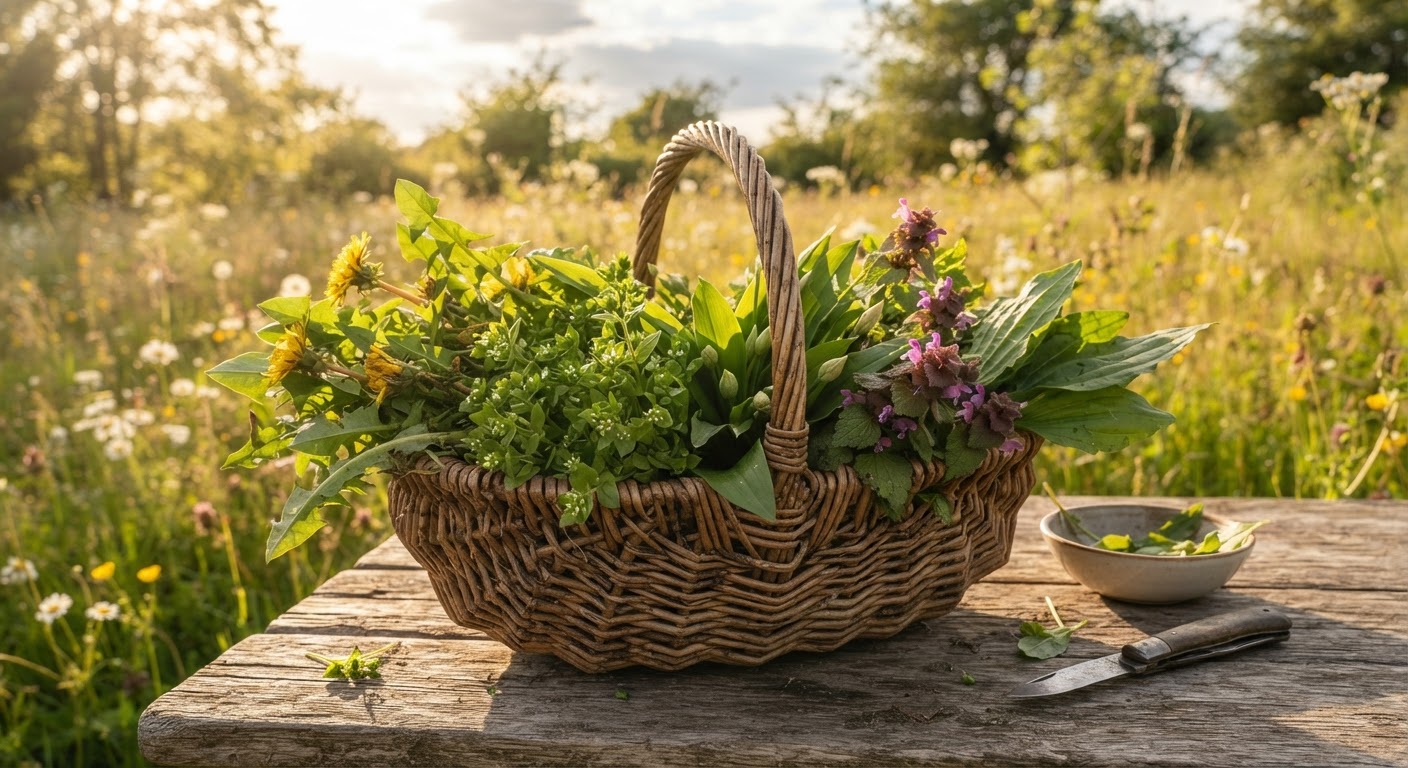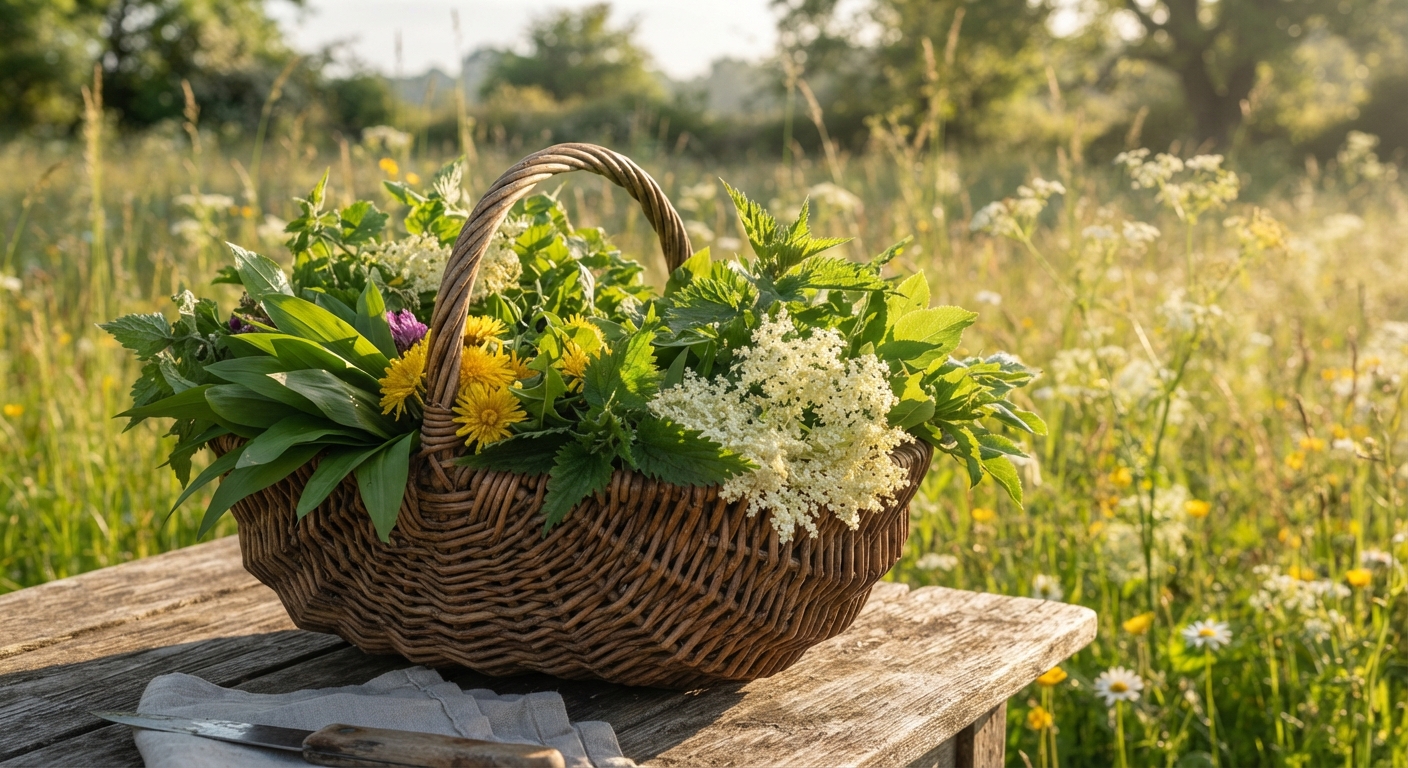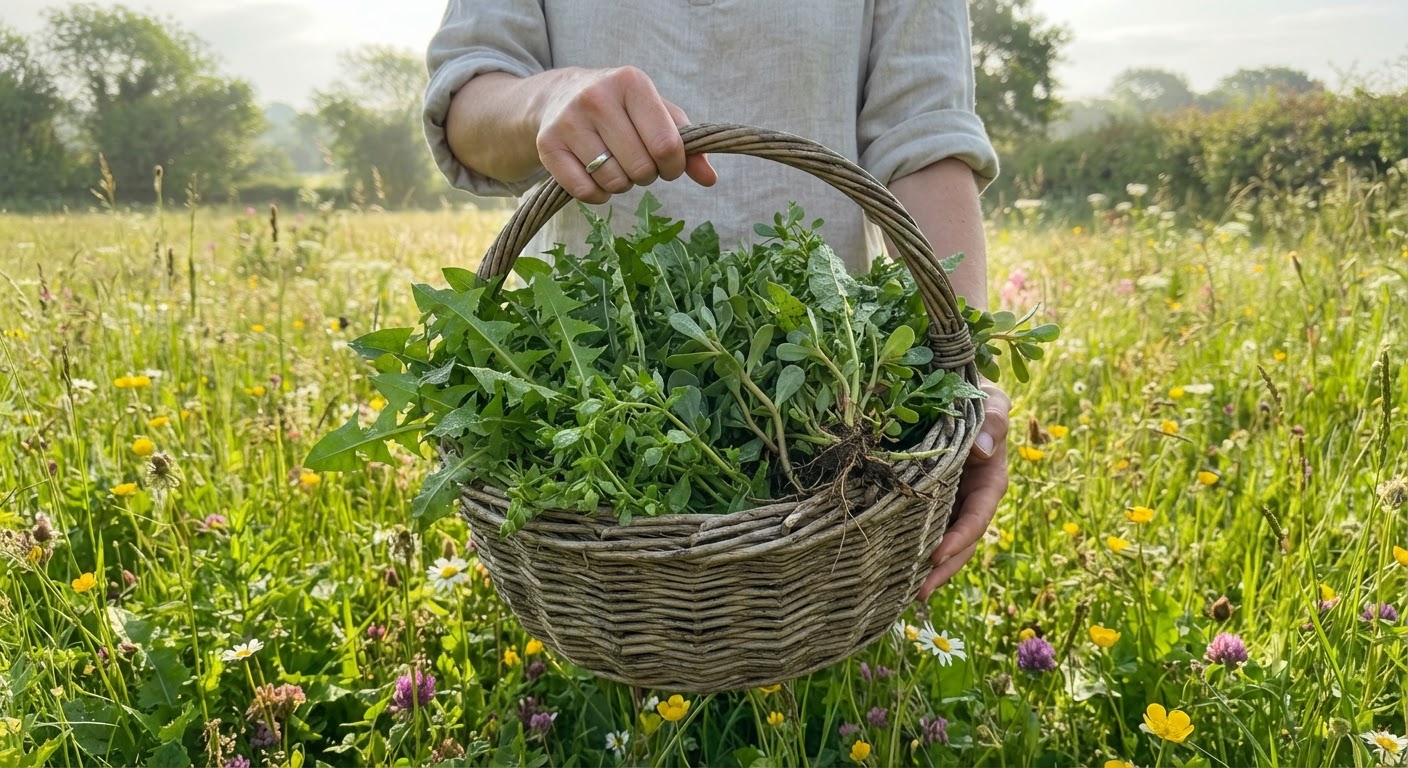
Last spring I watched a neighbor spend a whole weekend spraying, pulling, and bagging what she called “weeds.” Roughly half of what she removed — dandelion, lamb’s quarters, purslane — was more nutritious than anything in her refrigerator. And it was free. The only thing standing between her and a free salad was a little knowledge.
That’s the awkward truth about edible wild vegetables: most of us have been trained to see food as something you buy, not something that grows. The vegetables are already there, under our feet, and we poison them out of habit.
The real obstacle isn’t finding wild vegetables. It’s knowing which ones are food, which ones are dangerous, and — this is where most beginners quietly quit — how to turn a bitter, hairy leaf into something you’d actually want to eat. The cooking part is the easiest skill to fix, and it’s the one almost no guide bothers to teach.
This guide walks you through the entire process, step by step: the five vegetables to learn first, how to identify them with confidence, the rules that keep you safe, and the cooking methods that make them genuinely good. By the end, you’ll be able to walk into your own yard and come back with dinner.
Step 1 — Start With Five Vegetables You Can’t Easily Confuse
Your first job isn’t to memorize a hundred plants. It’s to learn five. Here’s why the “five starter greens” approach works when sprawling plant lists don’t: identification confidence is the whole game, and confidence comes from repetition. Learn five plants so well that you can spot them from across the yard, and you’ll eat well. Try to learn fifty, and you’ll eat nothing because you’ll never be sure.
The five below are chosen for a specific set of reasons. They’re common across most of North America, Europe, and temperate Asia. They’re easy to identify from two or three features that don’t overlap much with toxic plants. And they taste forgiving — a beginner can cook them badly and still end up with something edible.
| Vegetable | Key identification features | Where it grows | How to eat it |
|---|---|---|---|
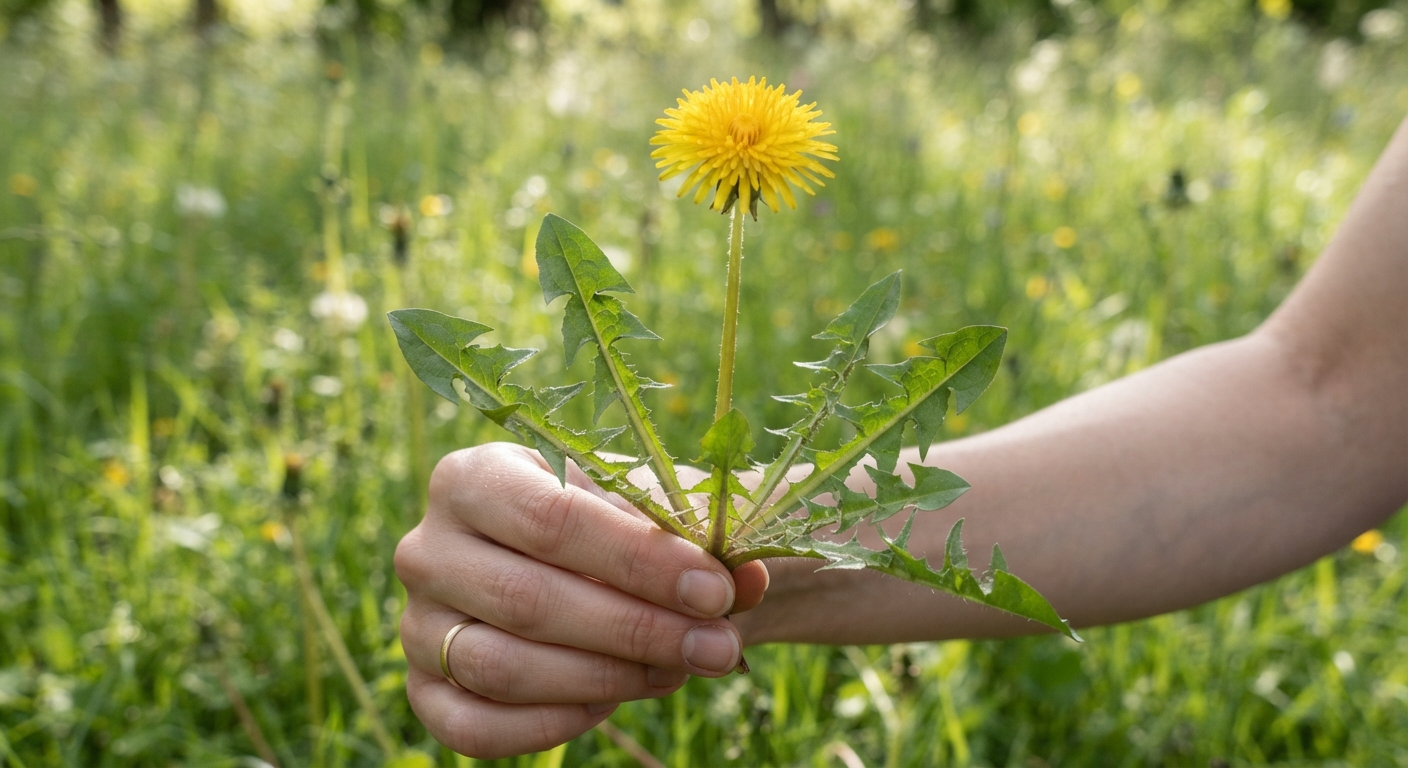
| Dandelion (Taraxacum officinale) | Deeply toothed leaves in a basal rosette, milky white sap, a single yellow flower per hollow stem | Lawns, fields, sidewalk cracks, disturbed soil | Young leaves raw or cooked, flowers raw or fried, roots roasted |
| Chickweed (Stellaria media) | Small oval leaves, a single line of fine hairs running down one side of the stem, tiny white star-shaped flowers | Moist garden beds, shaded edges, cool seasons | Raw in salads; mild and tender |
| Purslane (Portulaca oleracea) | Thick, succulent, paddle-shaped leaves on reddish rubbery stems, grows flat in a mat | Dry, sunny soil, cracks in pavement, garden rows | Raw; crunchy and slightly lemony |
| Stinging nettle (Urtica dioica) | Serrated opposite leaves, tiny stinging hairs, square stem | Damp, rich soil, woodland edges, old farm sites | Always cooked; tastes like rich spinach |
| Lamb’s quarters (Chenopodium album) | Diamond-shaped leaves with a silvery, mealy coating on the undersides | Disturbed soil, gardens, farm edges | Cook like spinach; leaves and young stems |
Why these five specifically? Because each one has a “trademark” feature you can check in seconds — the single line of hairs on chickweed, the milky sap on dandelion, the mealy silver underside on lamb’s quarters. None of these five has a dangerously toxic lookalike that a careful beginner is likely to confuse, which is more than you can say for wild carrot, wild parsnip, or anything in the carrot family. Start here. Master these. Then expand.
Step 2 — Identify With Three Features, Not One
The cardinal rule of foraging, stated plainly: you don’t eat a plant you haven’t positively identified — not a leaf, not a taste. A single matching feature (green, serrated leaves, whatever) is not identification. It’s a guess. Guesses are how people end up in the emergency room.
Here’s the method that turns a guess into an identification, in four moves.
Match three features at once. A real identification stacks features: leaf shape and stem type and flower and habitat and season. Dandelion has toothed leaves, and milky sap, and a single yellow flower on a hollow stem, and a basal rosette with no branching stem. If a plant has toothed leaves but no milky sap, it’s not a dandelion — and that discrepancy is your signal to stop.
Learn the toxic lookalikes before you learn the edible plant. This sounds backwards, but it’s how experienced foragers actually work. Before I teach anyone purslane, I make them memorize spotted spurge — the toxic lookalike that grows in the same cracks, has a milky (not clear) sap, and flatter, less fleshy leaves. Knowing the dangerous plant gives you a reason to hesitate, and hesitation is a survival skill.
Use a field guide or a trusted app as a confirmation, not a source. A guidebook you’ve cross-checked, or a plant ID app backed up by two field guides, is a good second opinion. It is never your first opinion. The decision to eat is yours, made from features you can see with your own eyes.
Never, ever rely on the “animal ate it so it’s safe” logic. Deer and rabbits process plant compounds differently from humans. A plant a rabbit chews happily can still make you very sick. Animals are not your tasters.
One more line that belongs in every beginner’s head: if a plant looks like it might be in the carrot family (umbrella-shaped flower clusters, ferny leaves), leave it alone for now. That family contains poison hemlock and water hemlock, and they are not worth learning by trial and error on your first season. The five starter greens are all safely outside that family.
Step 3 — Harvest at the Right Time and in the Right Place
A dandelion leaf picked in April is tender and almost sweet. The same leaf picked in July is bitter enough to pucker your face. Timing isn’t a detail — it’s the difference between “this is a vegetable” and “this is why people hate foraging.” The same is true of where you pick.
The season rule: most wild greens are at their best in early spring and late fall, when the plant is young and hasn’t yet flowered. Once a plant bolts (sends up a flower stalk), its leaves turn bitter and tough. The chart below is your cheat sheet for the five starters.
| Vegetable | Spring | Summer | Fall | Winter | Best part to harvest |
|---|---|---|---|---|---|
| Dandelion | Leaves at their most tender | Flowers peak early, leaves turn bitter | Leaves mild again after first frost | Roots sweetest | Leaves (spring/fall), flowers (summer), roots (winter) |
| Chickweed | Abundant and tender | Fades in heat | Returns with cool weather | Often available in mild winters | Leaves and tender stems |
| Purslane | Sprouts late spring | Peak — thick and juicy | Available until frost | Gone in cold climates | Leaves and stems |
| Stinging nettle | Best — young tips only | Too tough once it flowers | Second flush after cutting | Dormant | Young top leaves and tips |
| Lamb’s quarters | Young plants tender | Peak, harvest before flowering | Best until frost | Gone | Leaves and young stems |
The location rules, in order of importance:
- Never harvest from roadsides or sprayed lawns. Plants absorb heavy metals and exhaust residue, and lawn chemicals are the opposite of food. A beautiful patch next to a busy road is a no.
- Avoid dog-walk zones and the base of trees where animals mark. Anything below knee height in a park is questionable.
- Skip anything downhill from a farm field or a drainage ditch. Runoff carries fertilizers, pesticides, and worse.
- Ask permission on private land, and check the rules before harvesting on public land — some parks forbid removing plants entirely.
- Harvest clean, healthy plants only. Holes, yellowing, or a fine dust of what looks like mildew is your cue to leave it and find a healthier patch.
The rule that ties it together: the quality of the plant is the quality of your dinner. A bitter, sun-blasted dandelion from a roadside is not “a free salad.” It’s a bad meal you had to work for.
Step 4 — Clean, Prep, and Cook So It Actually Tastes Good
This is the step that separates the people who forage once from the people who keep doing it. Wild greens are not grocery spinach. They’re more fibrous, often more bitter, and they carry grit, insects, and the occasional surprise. A ten-minute prep routine fixes all of it.
The prep routine, in order:
- Sort first, wash second. Lay the harvest out and remove anything yellowed, wilted, or not what you intended to pick. Sort in good light, when you’re not tired.
- Soak, don’t just rinse. Submerge the greens in cold water and swish. Dirt, sand, and small insects sink or float off. Repeat until the water runs clear — two or three changes is normal for wild greens.
- Strip the tough parts. For dandelion and lamb’s quarters, pull the leaves off the central stem. For nettle, use gloves until it’s cooked. For chickweed, keep the tender top growth.
- Blanch anything bitter or hairy. A 30–60 second dunk in boiling, salted water strips bitterness, softens hairs, and sets a bright green color. Shock in ice water to stop the cooking. Nettle must be cooked to neutralize the sting — blanching or sautéing both do it.
Then choose a cooking method. Wild greens respond to a small set of techniques, and matching the method to the plant is most of the skill.
| Method | Best for | How to do it | The result |
|---|---|---|---|
| Raw | Chickweed, young purslane, very young dandelion | Wash well, dress lightly with lemon and oil | Fresh, mild, crisp |
| Blanched + dressed | Dandelion, lamb’s quarters | Boil 30–60 sec, ice shock, toss with oil, garlic, lemon | Tender, balanced, still green |
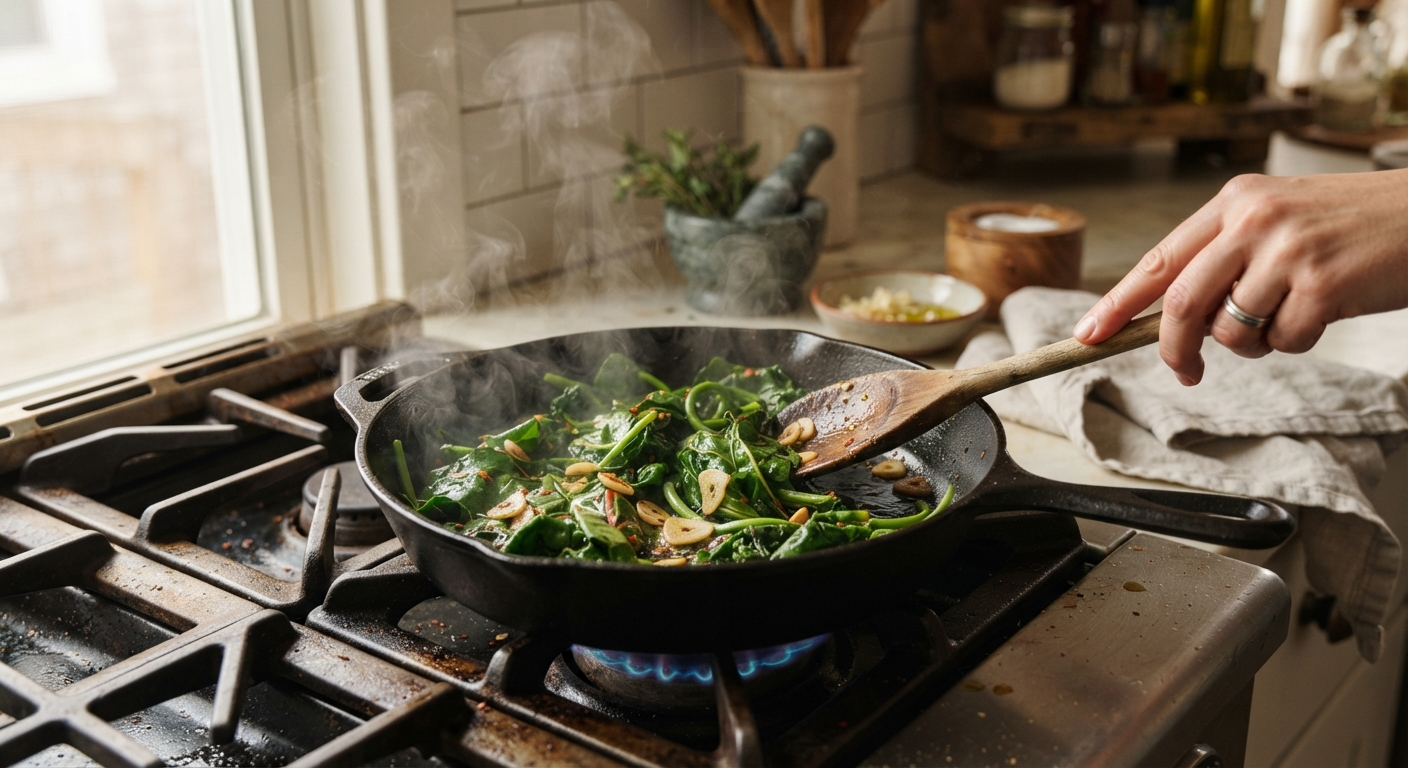
| Sautéed | Nettle, lamb’s quarters, mature greens | Cook in olive oil or butter with garlic and a pinch of salt until wilted | Rich, savory, spinach-like |
| Added to soup or eggs | Any of the five | Fold chopped blanched greens into soup, frittata, or rice in the last few minutes | Easy, forgiving, kid-friendly |
The one flavor trick that fixes most beginner mistakes: fat, acid, and salt. A little butter or olive oil, a squeeze of lemon or vinegar, and enough salt transform a bitter wild green into something balanced. Bitterness isn’t a flaw to be avoided — it’s a flavor to be dressed. Almost every “I tried foraging and it was gross” story comes down to someone eating a bitter leaf plain, with nothing on it.
A two-minute recipe to prove the point: blanch a handful of dandelion leaves for 45 seconds, shock them in cold water, squeeze dry, then toss in a hot pan with olive oil, one sliced clove of garlic, and a pinch of salt until just wilted. Finish with lemon. That’s a side dish people ask for by name.
Pro Tips From a Few Seasons of Getting It Wrong
Everything below is the kind of thing you only learn by doing it wrong first — which is why it’s worth reading before you repeat the same mistakes.
Start with chickweed, not dandelion. Chickweed is the friendliest introduction there is: mild, tender, hard to misidentify, good raw. Dandelion is more famous but more bitter, and a bitter first experience is how people get discouraged. Build momentum with the easy win first.
Taste a tiny bit before you commit to a big harvest. Once you’ve positively identified a plant, nibble a small, clean piece. Plants vary wildly by location, season, and individual — some dandelions are mild, some are punishingly bitter. Taste first, then decide how much to pick.
Harvest above the “traffic line.” In any public or semi-public space, aim for plants that grow high — on fences, shrubs, or raised ground — not the ones flattened by foot traffic and animals at ground level.
Bring the right two tools. A small pair of scissors or garden snips (cleaner cuts than ripping) and a breathable cloth or mesh bag (so greens don’t steam and wilt on the walk home). A plastic bag turns your harvest into cooked mush in an hour.
Don’t strip a patch. Take a little from many plants, never all from one. Leave the root, leave enough leaves for the plant to keep growing, and leave plenty behind for the next forager and the local wildlife. It’s a harvest, not a clear-cut.
Process greens the same day. Wild greens wilt fast and don’t forgive sitting in the fridge overnight. If you must store them, keep them damp and cold, and expect a shorter window than store-bought produce.
The Questions Every Beginner Asks (Answered Honestly)
1. Are wild vegetables actually safe to eat? Yes — when you positively identify them and harvest from a clean location. The danger isn’t wild vegetables themselves; it’s eating a plant you think you’ve identified but haven’t. Master the five starters, learn their toxic lookalikes, and follow the location rules, and the risk is very low.
2. Which wild vegetable should I try first? Chickweed. It’s mild enough to eat raw, easy to identify from its single line of stem hairs and tiny star flowers, and hard to confuse with anything harmful. It’s the gentlest possible first success.
3. How do I know a plant isn’t toxic? You identify it with three matching features, confirm against a field guide, and know the toxic lookalikes that grow nearby. You don’t guess, and you don’t use the “animals eat it” shortcut. If you can’t name the plant with certainty, you don’t eat it.
4. Why are some wild greens so bitter? Bitterness is often a plant’s natural defense, and it intensifies once the plant flowers (bolts) or grows in hot, dry conditions. Harvest young leaves in cool weather, and blanch or dress them with fat, acid, and salt to balance the flavor.
5. Do I need special equipment to forage? No. Scissors, a breathable bag, and a field guide (or a reliable app plus two field guides) are the whole kit. Gloves help with nettle. That’s it — the barrier to entry is knowledge, not gear.
6. Can I forage in the city? Sometimes, but carefully. Avoid roadsides, sprayed lawns, dog-walk areas, and anything downhill from runoff. Community gardens, clean parks, and your own untreated yard are better bets. When in doubt about contamination, leave it.
7. What’s the biggest beginner mistake? Eating something they haven’t truly identified because it “looks close enough.” Close enough is exactly what gets people hurt. The second-biggest is quitting after one bad, bitter, unseasoned mouthful — which is a cooking problem, not a foraging problem.
The Real Takeaway
Edible wild vegetables aren’t a novelty or a survival last resort. They’re food — abundant, nutritious, and growing in the places most people walk past every day. The entire skill comes down to three things: learn five plants deeply, identify them with three features instead of one, and cook them the way they deserve.
The neighbor I mentioned at the start ended up keeping her dandelions. By mid-summer she was blanching the leaves, frying the flowers, and giving away extra purslane to anyone who’d take it. The yard she used to poison had become a garden she hadn’t planted.
That’s the quiet reward here. You’re not adding a hobby; you’re noticing a food supply that was always there. Start with chickweed this weekend, learn the five starters, and trust the process one identification at a time. Your next free dinner is probably growing within fifty feet of where you’re sitting right now.