7 Poisonous Berries That Look Edible (And How to Tell Them Apart)
Every year, a forager, a hiker, or a kid on a summer walk eats the wrong berry because it “looked just like a blueberry.” The plant that gets the credit for most of those trips to the ER isn’t exotic — it grows along fences, forest edges, and park trails in half the country. The real problem isn’t that poisonous berries look identical to safe ones. It’s that we decide based on one feature — color — and ignore everything else the plant is telling us.
Here’s the good news: every dangerous berry on this list has at least one reliable tell that separates it from its edible twin. You just have to know which details to check.
The Quick-Reference Table
Before the details, here’s the whole danger board in one place. Print it, screenshot it, whatever — just know where to find it.
| Poisonous berry | Often mistaken for | The one tell that gives it away | Worst-case symptom |
|---|---|---|---|
| Deadly nightshade | Blueberry, bilberry | Single glossy berry + star-shaped calyx at the stem | Hallucinations, seizures, coma |
| Pokeweed | Elderberry | Magenta-pink stem, drooping cluster | Violent vomiting, convulsions |
| Moonseed | Wild grape | One crescent-shaped seed inside | Convulsions, can be fatal |
| Bittersweet nightshade | Red currant | Star-shaped calyx, berry on a vine | GI distress, nervous system effects |
| Yew | Red “berry” on a conifer | Red cup with a seed poking out the top | Sudden cardiac arrest |
| Daphne | Red currant | Berries tight against bare stems | Blistering, severe GI, can be fatal |
| Virginia creeper | Wild grape | Five leaflets per leaf, no tendril coils | Mouth/throat burning, GI upset |
The pattern to notice: color is the least reliable thing you can check. Structure — how the berry attaches, what’s inside, what the stem and leaves look like — is what actually saves you.
1. Deadly Nightshade vs. Blueberry
Deadly nightshade (Atropa belladonna) is the poster child for a reason. Its berries are glossy, round, and dark — close enough to a blueberry that people do eat them, especially kids.
The tells:
- Attachment. Nightshade berries grow singly, each on its own little stalk. Blueberries and bilberries grow in small clusters at the end of a twig.
- The calyx. Flip the berry over. Nightshade has a prominent star-shaped calyx (the leftover sepals) at the stem end. Blueberries have a five-pointed crown at the blossom end, on the opposite side.
- Shine. Belladonna berries are unusually glossy, almost lacquered. Blueberries have a frosted, matte bloom.
The toxin — a mix of atropine and scopolamine — is one of the most dangerous in the plant world. A handful of berries can kill a child, and adults have died from eating them too. The first symptoms are a dry mouth, dilated pupils, and a racing heart.
2. Pokeweed vs. Elderberry
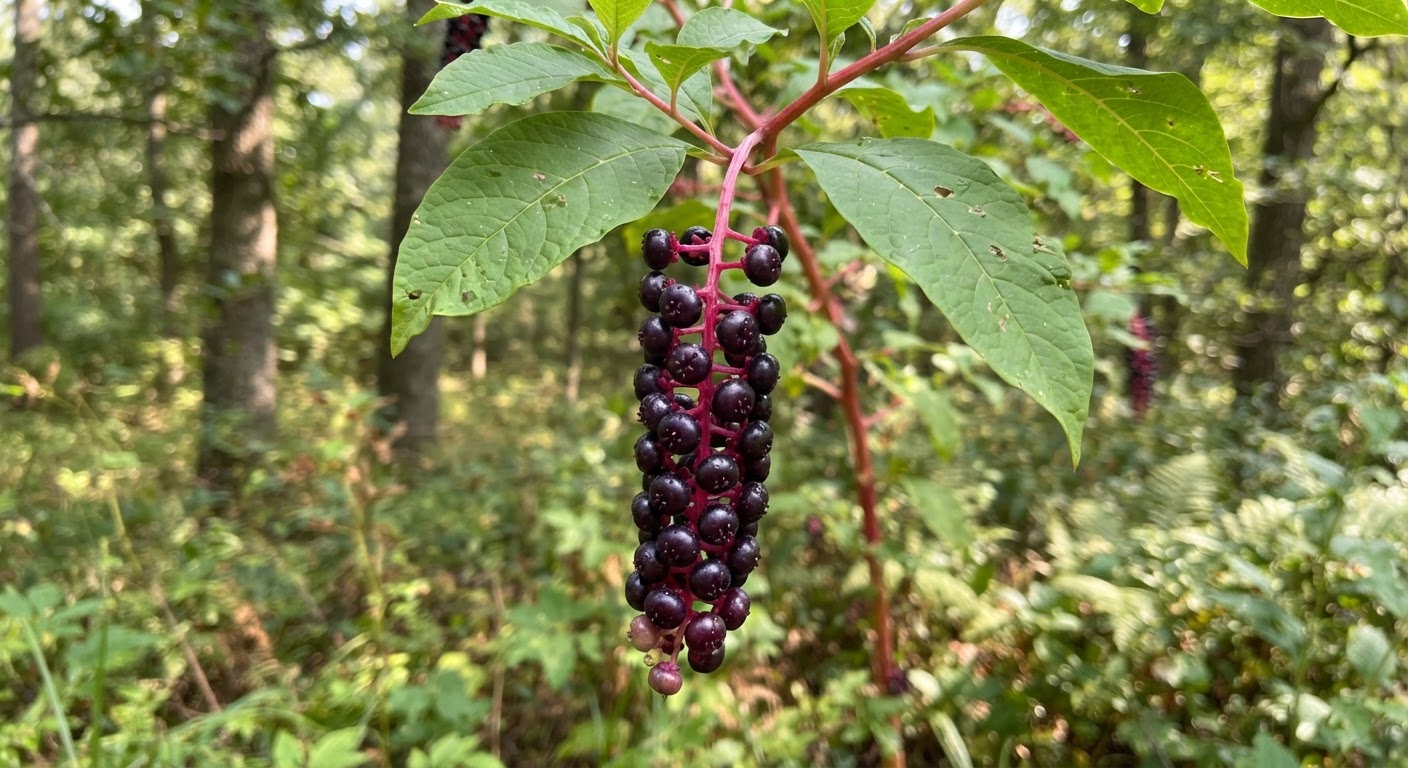
Pokeweed (Phytolacca americana) and elderberry both bear drooping clusters of dark purple berries, and they often grow in the same hedgerows. In late summer the confusion is real — and dangerous, because every part of pokeweed is toxic while ripe elderberries are a legitimate (cooked) food.
The tells:
- The stem is the giveaway. Pokeweed has thick, smooth, magenta-pink stems that look almost unnatural. Elderberry has woody, gray-brown stems with a bumpy texture.
- Cluster shape. Pokeweed berries hang in a long, loose, cigar-shaped cluster. Elderberry clusters are broad and flat-topped, like an umbrella.
- Berry juice. Crush one. Pokeweed juice stains deep purple-red and is famously hard to wash off. Elderberry juice is darker but doesn’t have that same tenacious dye.
One important note: even elderberry isn’t a “graze it raw” food. Unripe elderberries, leaves, and stems contain cyanogenic glycosides. Ripe berries should be cooked before eating.
3. Moonseed vs. Wild Grape
Moonseed (Menispermum canadense) is the most insidious lookalike on this list because it climbs like a grape, fruits in grape-like clusters, and produces berries that are almost the same deep purple. Foragers have died mistaking it for wild grape.
The tells:
- Cut it open — the seed decides. A wild grape contains two to four round, teardrop-shaped seeds. A moonseed contains a single flattened, crescent-shaped seed. That moon-shaped seed is where the name comes from, and it’s the one check you should never skip.
- Tendrils. Grape vines climb with curly tendrils. Moonseed has no tendrils — it wraps its stem around things instead.
- Leaves. Grape leaves are toothed and often lobed. Moonseed leaves are smooth-edged and heart-shaped.
The toxic compound (an alkaloid called dauricine) attacks the nervous system and can be fatal. If you’re harvesting wild grapes, this is the single most important ID check in the entire craft.
4. Bittersweet Nightshade vs. Red Currant
Bittersweet nightshade (Solanum dulcamara) produces clusters of bright red berries that hang on a climbing vine — and in the right light, people read them as red currants.
The tells:
- Transparency. Red currants are translucent — hold one up and you can see the seeds through the skin. Nightshade berries are opaque.
- The calyx again. Nightshade berries carry a small star-shaped calyx at the stem. Currants have a dry, shriveled little crown at the blossom end.
- The plant itself. Bittersweet nightshade is a sprawling vine with purple, star-shaped flowers. Red currant is a shrub with lobed, maple-like leaves.
The toxin is solanine, the same family of compounds found in green potatoes. A few berries cause stomach pain and vomiting; a large dose hits the nervous system.
5. Yew: The Red “Berry” That Isn’t a Berry
Yew (Taxus species) grows as an ornamental hedge everywhere, and its bright red “berries” look like something you could eat. Technically it isn’t a berry at all — it’s a fleshy red cup called an aril wrapped around a seed.
The tell:
- The hole on top. A yew “berry” is a red, open cup with the dark seed visible through a hole at the top. No true berry looks like that.
- The foliage. If you’re near flat, dark-green needles, you’re near a conifer, not a berry bush.
Here’s the trap: the red aril flesh is mildly sweet and mostly harmless, but the seed inside is packed with taxine, a compound that can stop the heart. The safe move is to treat the whole thing as poison — the risk isn’t worth a mouthful of mildly sweet flesh.
6. Daphne vs. Red Currant
Daphne (Daphne mezereum) is a small shrub that produces vivid red berries, often in early summer, right around when people are thinking about currants.
The tells:
- Placement on the stem. Daphne berries sit directly against the bare branch, not hanging in a strung cluster like currants.
- Timing and structure. Daphne fruits appear on a low shrub with narrow, leathery leaves and a strong fragrance in spring. Red currants grow on a cane-like bush and hang in short strings.
Daphne is among the most toxic plants in temperate gardens. The compounds (mezerein and daphnetoxin) cause burning and blistering in the mouth and severe GI damage — a handful of berries can be fatal.
7. Virginia Creeper vs. Wild Grape
Virginia creeper (Parthenocissus quinquefolia) grows side by side with wild grape, clings to the same trees and fences, and produces dark blue-black berries in clusters.
The tells:
- Count the leaflets. Virginia creeper has five leaflets on a single leaf stalk — hence the nickname “five-finger ivy.” Grape has one leaf blade, toothed and lobed.
- How it climbs. Virginia creeper uses flat, sticky adhesive discs at the ends of its tendrils. Grape tendrils are bare coils.
- Berry size. Creeper berries are small and sparse; grapes are bigger and form full clusters.
The berries contain oxalate crystals that burn the mouth and throat and can cause serious GI upset. Not typically fatal, but a miserable experience for a child or pet.
How to Tell Them Apart in 30 Seconds
When you find an unknown berry, run this exact sequence before you even think about tasting:
- Look at the stem, not the berry. Magenta-pink and thick? Walk away. Woody and gray-brown? Keep checking.
- Check the calyx end. A star-shaped calyx at the stem = nightshade family. Stop.
- Crush one berry. Does it leave a staining, paint-like juice? That’s a warning sign with pokeweed.
- Cut it open. One crescent seed = moonseed. Multiple round seeds = grape.
- Read the leaves. Five leaflets, needles, or smooth heart-shaped leaves each rule out the common edibles.
- Ask the habitat. Ornamental hedge, garden bed, or climbing vine? Many of the deadliest berries live exactly where people plant things on purpose.
The golden rule underneath all of it: if you can’t name the plant with 100% certainty — the exact species, not “it looks like a blueberry” — you don’t eat it. No berry is worth a guess.
Summary Tips
- Color is the weakest signal. Red, purple, black, and blue berries are safe and deadly in equal measure.
- The calyx and the seed are the strongest signals. These two details separate almost every pair on this list.
- Single glossy berries with a star-shaped calyx = nightshade family. Treat as poison.
- One crescent-shaped seed inside a “grape” = moonseed. Do not eat.
- Magenta-pink stem = pokeweed, always. No edible common berry has that stem color.
- Conifer needles + red berry = yew. The seed can stop your heart.
- When teaching kids: teach them the structure tells, not just “don’t eat red berries,” because that rule breaks down immediately with safe red raspberries and currants.
Quick Answers: The Short Version
Are there really poisonous berries that look like blueberries? Yes. Deadly nightshade produces glossy black berries that get eaten every year by people who saw “blue” and stopped looking. The star-shaped calyx and single-berry growth are the tells.
What’s the most dangerous berry lookalike? Deadly nightshade and moonseed are the two that kill. Moonseed is especially dangerous because it so closely mimics wild grape.
Is pokeweed always poisonous? All parts are toxic raw, with the root being the most concentrated. Some Southern traditions boil young shoots through multiple water changes, but the berries are never safe to eat.
Can I eat yew berries? No. The red aril flesh is technically less toxic than the seed, but the seed inside will kill you, and breaking one while eating is easy. Treat the whole fruit as poison.
How do I tell elderberry from pokeweed fast? Look at the stem. Pokeweed has smooth magenta-pink stems; elderberry has woody gray-brown stems. That one detail resolves it instantly.
What should I do if someone eats an unknown berry? Don’t wait for symptoms. Call Poison Control immediately, note what the plant looked like (take a photo if you can), and don’t induce vomiting unless a professional tells you to.
When you’re standing in a hedgerow trying to remember whether it’s a five-pointed crown or a star-shaped calyx, a photo reference beats a memory. That’s exactly why I built Edible Plant Identifier — point your camera at a berry, and it compares the plant against known edibles and their toxic lookalikes, flagging the nightshade family, moonseed, and pokeweed instead of just guessing “berry.” It works fully offline, so the identification notes and lookalike warnings are there even when the trail has no signal.