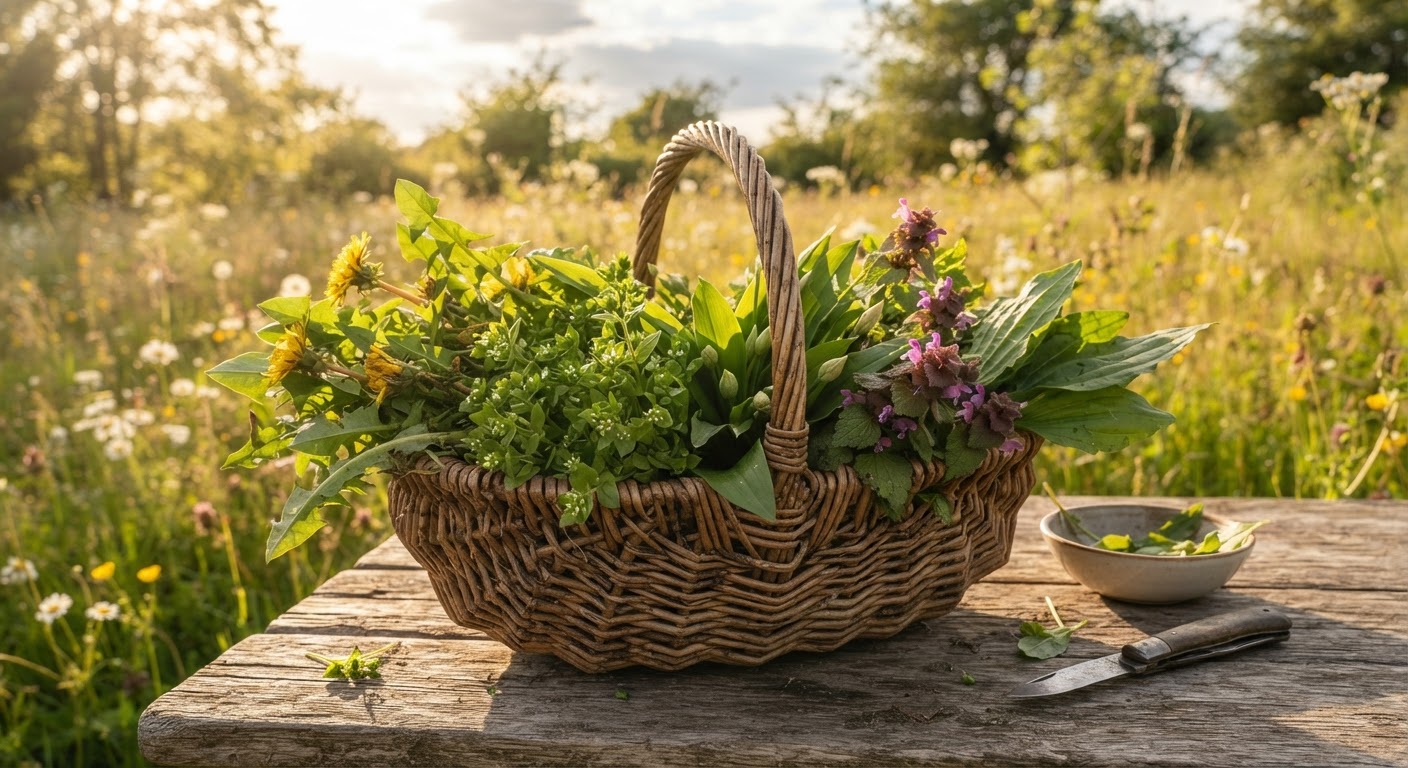
I spent my first foraging season eating exactly zero wild plants.
Not because I couldn’t find them — I found dozens. The problem was simpler than that. Every time I spotted something edible, a follow-up question hit me before my hand reached the stem: Am I absolutely sure? And without a framework for answering that question, I defaulted to the safest option. I walked past everything.
Talking to other foragers since, I’ve learned this is the normal experience. Most beginners spend their first weeks paralyzed by the gap between “I think this is edible” and “I know this is edible.” Field guides don’t help much here — they’re reference tools, not decision frameworks. They tell you what plants look like but not how to build the confidence to pick them.
This guide is the resource I wish I’d had. It covers twelve plants you can reliably find across North America and Europe, organizes them by season so you know what’s available right now, walks through the exact identification steps for each one, and — most importantly — gives you a one-hour plan for your first real harvest. No botany degree required. No mentor needed. Just you, this guide, and whatever patch of green you can reach in an afternoon.
What Makes a Plant “Beginner-Friendly”?
Not all edible wild plants deserve the same spot on your starter list. Some require careful cooking techniques to neutralize toxins. Others have lookalikes so convincing that even experienced foragers pause for a second glance. A true beginner plant checks four boxes — and if it misses even one, it drops to the intermediate tier.
Here’s the framework I use to decide whether a plant earns a spot on a first-season list:
| Criterion | What It Means | Why Beginners Need It |
|---|---|---|
| Unmistakable ID Features | The plant has at least one visual trait no toxic lookalike shares | Removes the “am I sure?” anxiety at the moment of picking |
| Widespread Distribution | Grows abundantly across most temperate regions | You can actually find it near you — not just in a specific national forest |
| No Mandatory Processing | Safe to eat raw or with simple cooking (boiling, sautéing) | New foragers shouldn’t need multi-day acorn leaching on day one |
| Generous Harvest Window | Available for at least 4–6 weeks per year | Gives you time to find it, confirm it, and return for harvest |
Every plant in the seasonal lists below passes all four criteria. If a plant is common but risky (like mushrooms — high lookalike danger) or requires elaborate processing (like acorns, which I’ve included but explicitly flagged), I’ve noted it clearly. The goal isn’t to hide complexity from you; it’s to keep your first few harvests boring and uneventful. Boring is good when you’re eating wild plants.
Personally, I also add an unofficial fifth criterion: the plant should taste good enough that you’d eat it voluntarily, not just for survival cred. Dandelion greens pass the test. Unseasoned cattail shoots? You can keep those.
Your Seasonal Foraging Calendar
This table is your cheat sheet. Bookmark it, screenshot it, tape it to the fridge. Each plant is mapped to the months you’ll find it at peak quality across temperate North America. If you’re in the southern hemisphere, shift everything forward by six months.
| Plant | Spring (Mar–May) | Summer (Jun–Aug) | Fall (Sep–Nov) | Best Part to Harvest | One-Second ID Check |
|---|---|---|---|---|---|
| Dandelion | ✅ Peak leaves | ✅ Flowers | ⚠️ Roots only | Young leaves, flowers | Serrated leaves, hollow stem, milky sap |
| Wild Garlic / Ramps | ✅ Peak leaves | ⚠️ Bulbs | ❌ | Leaves, bulbs | Strong onion-garlic smell when crushed |
| Stinging Nettle | ✅ Peak | ⚠️ Tough | ❌ | Top 4–6 inches of young shoots | Tiny stinging hairs on stem and leaves |
| Chickweed | ✅ Peak | ⚠️ Fading | ❌ | Leaves, stems, flowers | Single line of hair running down one side of stem |
| Lamb’s Quarters | ⚠️ Early | ✅ Peak | ⚠️ Seeding | Young leaves, tender stems | White powdery coating on leaf underside |
| Purslane | ❌ | ✅ Peak | ⚠️ Early fall | Leaves, stems, seeds | Thick, reddish, succulent stems; paddle-shaped leaves |
| Blackberries | ❌ | ✅ Peak fruit | ⚠️ Late | Ripe berries | Thorny canes, aggregate drupelets, white core stays in fruit |
| Elderflower / Elderberry | ❌ | ✅ Flowers | ✅ Berries | Flowers (June), berries (Aug–Sep) | Flat clusters of tiny cream flowers; dark purple berries |
| Acorns | ❌ | ❌ | ✅ Peak | Nuts (require leaching) | Cap attaches at single point; nut sits in cup |
| Rose Hips | ❌ | ❌ | ✅ Peak | Red-orange fruit after first frost | Round-oval hip at tip of stem, remnants of flower at top |
| Wild Grapes | ❌ | ❌ | ✅ Peak fruit | Ripe grapes | Climbing vine with tendrils; grapes in hanging clusters |
| Broadleaf Plantain | ✅ | ✅ | ✅ | Leaves year-round | 5–9 parallel veins, stringy fibers when stem snapped |
A few things to notice in this calendar. Spring owns the leafy greens — dandelion, nettle, chickweed, wild garlic all peak when most garden vegetables haven’t even sprouted. Summer brings the heavy hitters: lamb’s quarters, purslane, berries. Fall is your nut and fruit season. And plantain — the MVP — runs the entire table.
Spring: Where Every Forager Should Start
Spring is when foraging feels the most forgiving. The plants are tender, the weather is pleasant, and most importantly, the toxic lookalikes haven’t fully matured yet. Nettle leaves at 4 inches are unmistakable; nettle leaves at 2 feet can be confused with several unrelated plants. The message is simple: start early in the season, and harvest young growth.
Dandelion (Taraxacum officinale)
If you skip every other plant in this guide, learn dandelion. It grows on every continent except Antarctica. It’s the most recognized “weed” in human history. And yet most people who confidently identify dandelions have never eaten one.
How to identify it: Look for deeply toothed, hairless leaves emerging from a central rosette at ground level. The teeth point backward toward the base — nature gave this plant a built-in arrow system. Break a stem or leaf and white milky sap will bead at the wound. The flower stem is hollow, leafless, and produces exactly one yellow flower head per stalk. No branches, no leaves on the flowering stem — just one straight green tube with a yellow sun at the top.
What to harvest: The youngest inner leaves are your target. These are the small, upright leaves at the center of the rosette, harvested before the flower stalk appears. Once the flower appears, the leaves turn aggressively bitter — still edible, but you’ll need to blanch them to make them palatable. The flowers are excellent when battered and fried, and they also make a respectable country wine. Autumn roots can be roasted and ground for a caffeine-free coffee substitute.
Kitchen move: Sauté young dandelion greens in olive oil with garlic and a splash of lemon juice. The bitterness becomes a background note rather than the main event. Or toss them raw into a salad with sweet components — sliced pear, candied walnuts, vinaigrette — and the bitterness acts like arugula’s more assertive cousin.
Wild Garlic / Ramps (Allium ursinum / Allium tricoccum)
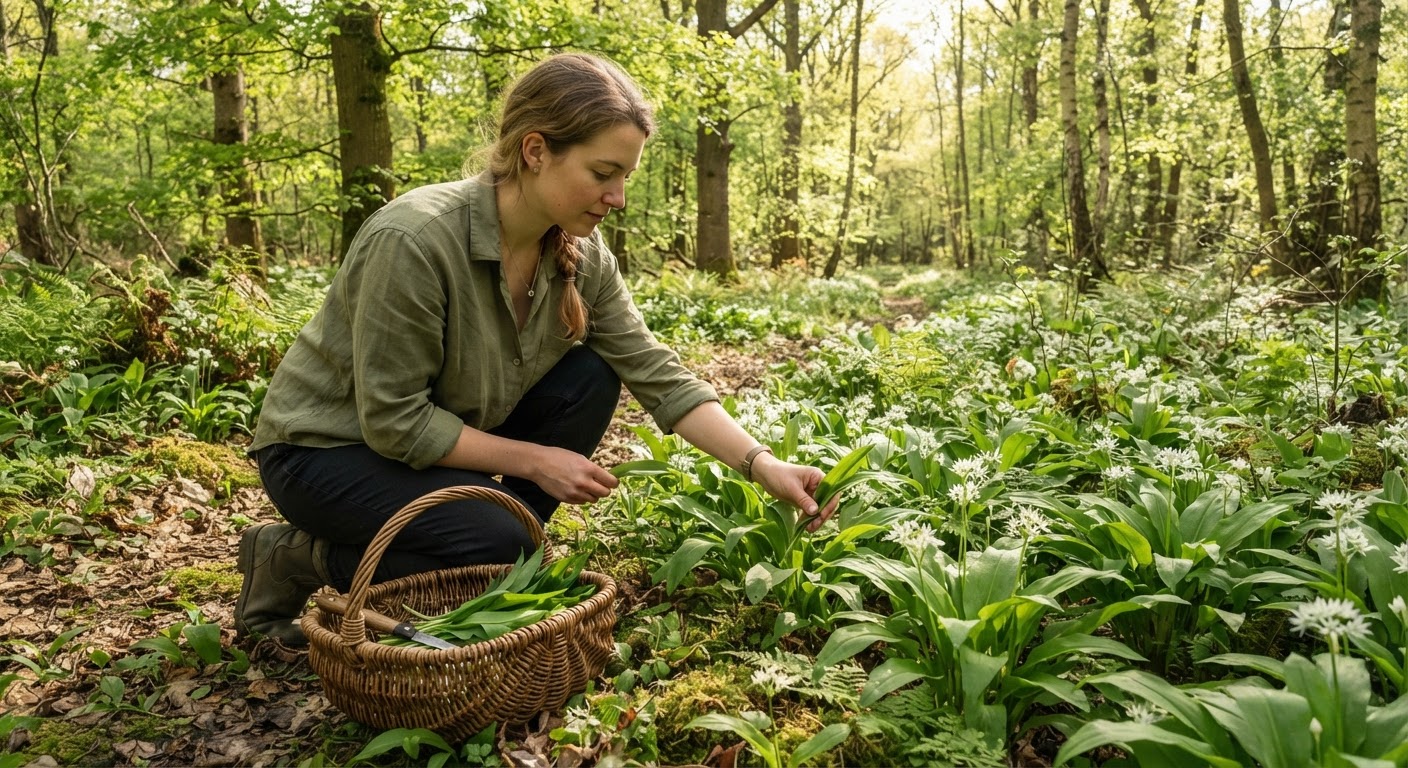
Wild garlic (Europe) and ramps (North America) fill the same ecological and culinary niche: the first strong green flavor after winter, appearing when everything else is still mud-brown. The smell test on these makes identification almost foolproof.
How to identify it: Broad, soft, spear-shaped green leaves, 6–12 inches long, often carpeting entire woodland floors in dense patches. The definitive test: crush a small piece of leaf between your fingers and smell it. If it smells unmistakably of garlic or onion, you’ve got an edible Allium. If it smells like grass or nothing at all, you don’t. This single test rules out the most dangerous lookalike — lily of the valley (Convallaria majalis), which can grow in the same woodland habitat but has absolutely no onion scent.
What to harvest: Take individual leaves, not whole plants. Pick one leaf per plant from scattered individuals — never clear a patch. Ramps in particular grow slowly (7 years from seed to maturity) and overharvesting has wiped out entire populations in the Appalachians. If you’re harvesting bulbs, dig only from large, dense patches and take no more than 1 in 20 plants.
Kitchen move: Chop raw into compound butter and freeze in logs. Slice off rounds through the year and melt over steak, pasta, or roasted potatoes. You’ll taste spring in January.
Stinging Nettle (Urtica dioica)
Yes, it stings. No, that doesn’t matter once you learn one thing: heat destroys the sting in about 30 seconds. Nettle is the most nutritious green on this list — higher in protein than spinach, loaded with iron, calcium, and vitamin C. It tastes like spinach crossed with something indefinably wilder.
How to identify it: Leaves are opposite, heart-shaped at the base tapering to a point, with deeply serrated edges. The stem and leaf undersides are covered in fine, hollow hairs — these are the stingers, each one a tiny hypodermic needle loaded with formic acid and histamine. The stem is square (a trait of the mint family), not round, and strongly grooved on each face.
What to harvest: The top 4–6 inches of young shoots in spring, before the plant flowers. Once nettle flowers (late spring through summer), the leaves develop gritty particles called cystoliths that can irritate the kidneys if consumed in large quantities. Wear gloves — any gloves, even cotton gardening gloves — and use scissors to snip the tops directly into a bag. Don’t harvest from areas that might have been sprayed with herbicides or receive heavy dog traffic.
Kitchen move: Blanch for 60 seconds in boiling salted water, drain, squeeze out excess water, and use exactly as you’d use cooked spinach. Nettle soup with potato and cream is the classic European preparation for a reason — it’s dead simple and tastes like spring distilled into a bowl. Nettle pesto (blanched nettle, pine nuts, parmesan, olive oil, garlic, lemon) freezes beautifully.
Chickweed (Stellaria media)
Chickweed is the plant that made me realize foraging doesn’t have to be an expedition. It grows in garden beds, vegetable patches, the edges of lawns — the same places you’re already working. If you garden, you’ve almost certainly pulled chickweed and thrown it away. Stop doing that.
How to identify it: Small, oval, pointed leaves growing in opposite pairs along thin, sprawling stems. The stems have a single line of fine hair running down one side — here’s the odd part: the line of hair switches sides at each pair of leaves. Break a stem gently and you’ll notice an elastic inner core that stretches before snapping, like a tiny bungee cord. Flowers are tiny, white, and star-shaped with five deeply cleft petals (they look like ten petals at a glance, but they’re five split ones).
What to harvest: The whole above-ground plant — leaves, stems, flowers, all of it. Chickweed is mild, tender, and slightly sweet, with a texture somewhere between lettuce and sprouts. It wilts quickly after picking, so either eat it within a few hours or store it like fresh herbs: stems in water, covered loosely with a plastic bag, in the fridge.
Kitchen move: Use raw as a salad base or sandwich green. It’s delicate enough that cooking destroys most of what makes it pleasant, though it works for a very brief wilt — 30 seconds in a hot pan, nothing more. I toss handfuls into scrambled eggs just before they finish setting.
Summer: The Season of Abundance
By June, you’ve graduated from “scavenging for individual leaves” to “filling baskets faster than you can carry them.” The volume shift is real: a good lamb’s quarters patch can yield 2–3 pounds of greens in 15 minutes. Summer foraging rewards speed and volume more than finesse.
Lamb’s Quarters (Chenopodium album)
If spinach and quinoa had a wild child, this would be it. Lamb’s quarters is in the same family as quinoa and amaranth, and its leaves are nutritionally closer to those superfoods than to any cultivated green. Indigenous peoples across North America cultivated it as a staple food crop long before European contact.
How to identify it: Leaves are diamond-shaped to triangular, with irregularly toothed margins, and they alternate along the stem. The key field marker: the youngest leaves and growing tips are dusted with a white, powdery, almost crystalline coating that looks like fine sugar. Rub it — it’s slightly gritty, completely water-repellent, and it’s your confirmation. No toxic lookalike shares this feature in this combination of leaf shape and habitat.
What to harvest: The top 4–6 inches of each stem, including the tender leaves and growing tips. Older lower leaves become tough and accumulate oxalates (the same compound that makes raw spinach feel chalky on your teeth if you eat too much). Lamb’s quarters volunteers enthusiastically in disturbed soil — garden beds, construction sites, compost piles, farm field edges — which means you need to be extra careful about herbicide exposure.
Kitchen move: Cook like spinach — steam, sauté, or add to soups. The white coating washes off easily under running water. My favorite preparation: sauté with butter, garlic, and a splash of soy sauce until wilted. The leaves cook down dramatically, similar to spinach, so harvest more than you think you need. A full colander yields about two side-dish servings.
Purslane (Portulaca oleracea)
Purslane is a succulent that grows flat against the ground in sidewalk cracks, garden beds, and anywhere humans have compacted the soil. It’s also one of the richest plant sources of omega-3 fatty acids (alpha-linolenic acid) in the world — higher than any cultivated leafy green. It thrives in heat and drought when other greens have bolted or died.
How to identify it: Thick, reddish, fleshy stems that radiate outward from a central root, staying low to the ground. Leaves are paddle-shaped, smooth-edged, about half an inch to an inch long, and unmistakably succulent — they feel cool and plump between your fingers, like a jade plant’s leaves. The stem oozes clear, watery sap when broken. The one dangerous lookalike is spotted spurge (Euphorbia maculata), which also grows flat in sidewalk cracks — but spurge produces white, milky latex when its stem is broken, not clear sap. Snap a stem. Clear sap = purslane. White sap = spurge, do not eat.
What to harvest: The top 3–4 inches of each stem, including leaves and tender tips. Purslane regrows quickly after cutting, so you can revisit the same patch multiple times through summer. It’s mucilaginous — the texture is somewhere between okra and aloe — which some people love and others find off-putting. Cooking reduces the sliminess.
Kitchen move: Purslane shines raw in salads where its crunch and slight lemony tang cut through heavier ingredients — try it with cucumber, feta, and olives in a Greek-style salad. It’s also traditional in Mexican cuisine (verdolagas), stewed with pork and tomatillos. The mucilage thickens soups naturally, like okra without the strings.
Blackberries (Rubus fruticosus aggregate)
I’m including blackberries even though they barely need identification — toddlers can pick blackberries — because there’s a foraging-specific lesson here: location quality matters more than species knowledge. Blackberries growing along a highway shoulder have absorbed months of brake dust, exhaust residue, and road runoff. Blackberries from a hedgerow 50 yards off a quiet country lane are an entirely different food.
What to harvest: Deep black, fully ripe berries that pull away from the plant with zero resistance. If you have to tug, it’s not ready. A ripe blackberry’s drupelets are plump and glossy, and the central core stays attached to the fruit (unlike raspberries, where the core remains on the plant). Harvest into shallow containers — blackberries crush under their own weight if piled more than 3–4 inches deep.
Elderflower (Sambucus nigra)
Elder hits a rare double: the flowers are edible in early summer, and the berries follow in late summer through early fall. Different harvests from the same bush, months apart, with completely different uses in the kitchen.
How to identify it: Look for a shrub or small tree, 6–15 feet tall, with compound leaves of 5–7 toothed leaflets arranged opposite each other. The flower clusters are flat-topped sprays of tiny, creamy-white, five-petaled flowers with a distinctive fragrance — sweet, slightly musky, almost like lychee. Don’t confuse it with water hemlock or giant hogweed, which have similar flat white flower clusters but are herbaceous (die back to the ground each year) and have completely different leaves. Elder has woody stems and opposite compound leaves, which makes it a shrub, not a herb.
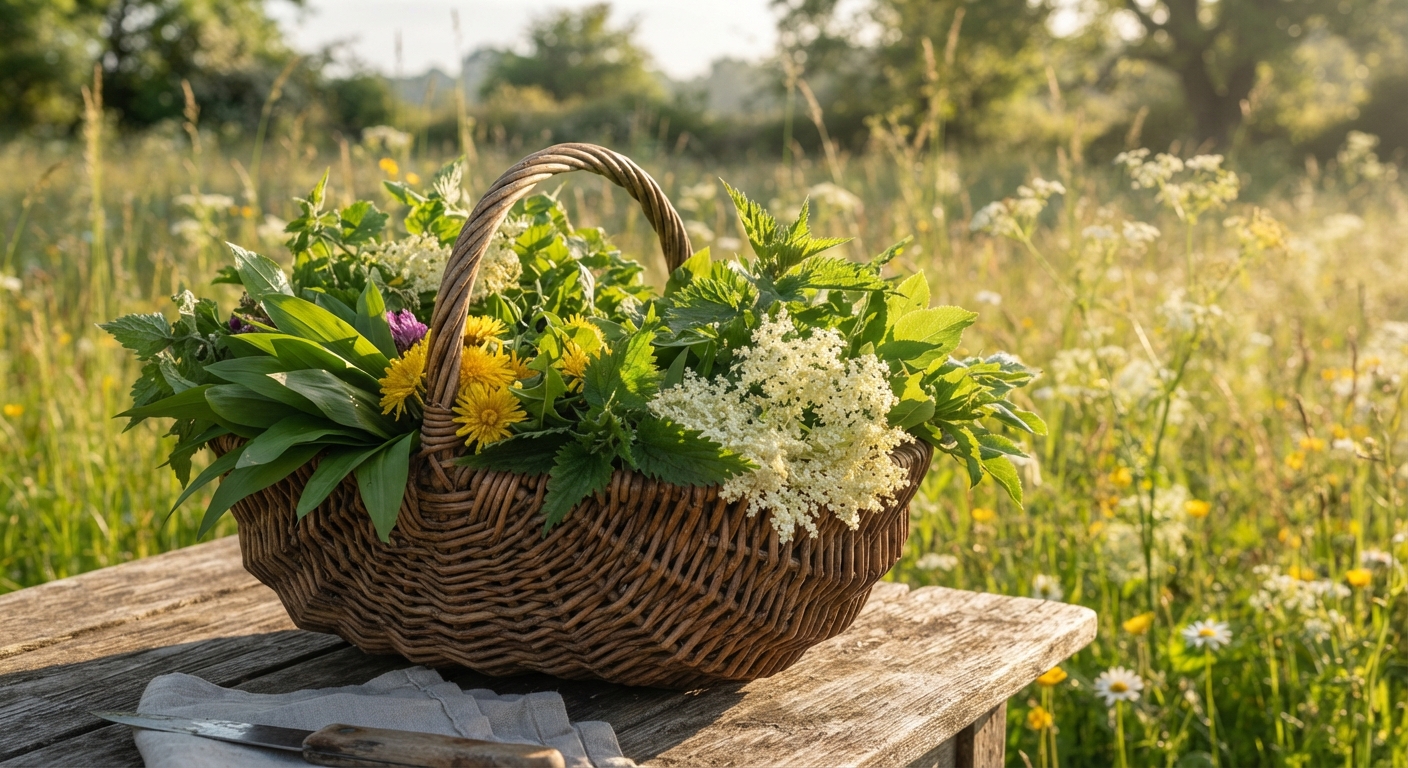
What to harvest: Whole flower heads, snipped just below the cluster. Shake off insects (there will be insects — elderflowers are pollinator magnets), but don’t wash them or you’ll lose the aromatic pollen. Use fresh within 24 hours or dry them for later. Elderflower cordial is the gateway recipe — flowers steeped in sugar syrup with lemon — and it’s better than anything you can buy.
Critical safety note: Raw elderberries, as well as elder leaves, stems, and roots, contain cyanogenic glycosides that can cause nausea and vomiting. Cook elderberries thoroughly before eating — heating neutralizes the compounds. Don’t eat any green part of the plant.
Fall: Harvest Before the Frost
Fall foraging has a different emotional register from spring and summer. The light is lower, the plants are winding down, and there’s a sense of urgency — get it now, or wait until next year. The flavors shift from fresh greens to dense calories: nuts, fruits, and roots.
Acorns (Quercus species)
Acorns sustained human civilizations across North America, Europe, and Asia for millennia before agriculture. Archaeological sites in California show acorn processing dating back 10,000 years, with some indigenous communities deriving up to 50% of their annual calories from acorn flour. The catch: acorns are loaded with tannins that must be leached out before they’re edible. Skip this step and you’ll be spitting bitterness for hours.
How to process: Collect acorns that have fallen recently — avoid any with small holes (weevil exit wounds) or cracks. White oak acorns (rounded lobes on leaves) are lower in tannins than red oak acorns (pointed lobes), so start there. Shell the acorns, chop or grind the nutmeat coarsely, then soak in cold water, changing the water twice daily. Taste a piece after 3–4 days for white oak, 5–7 days for red oak. When the bitterness is gone, drain, dry in a low oven (150°F) for 4–6 hours, and grind into flour. Acorn flour is gluten-free, slightly sweet, nutty, and makes excellent pancakes.
This is the one plant on the list that fails the “no mandatory processing” test. I’m including it because acorns are genuinely abundant, genuinely nutritious, and the processing is time-intensive but not difficult. Start a batch on a Sunday, let it soak through the workweek, and finish the following weekend.
Rose Hips (Rosa species)
The fruit of wild and cultivated roses, rose hips are the highest plant source of vitamin C by weight — 100 grams contain roughly 426 mg, or seven times the vitamin C in an equivalent weight of oranges. During World War II, when citrus imports to Britain were blockaded, the government organized nationwide rose hip collection drives to prevent scurvy.
How to identify and harvest: Look for bright red to orange, round to oval fruits at the tips of rose canes after the flowers have dropped. The best flavor develops after the first frost, which partially breaks down the cell walls and concentrates the sugars. Squeeze a ripe hip — it should yield slightly, not feel rock-hard. Harvest with scissors and gloves (rose thorns are unforgiving).
Kitchen move: Rose hip syrup is the classic preparation — simmer whole hips in water, strain through muslin (this step is crucial; the tiny hairs inside the hip are intestinal irritants), add sugar, and reduce. Drizzle over pancakes, stir into yogurt, or add to sparkling water. Dried rose hips make a tart, vitamin-rich tea that’s particularly good blended with hibiscus.
Wild Grapes (Vitis species)
Wild grapes are smaller and tarter than their cultivated cousins, but they’re packed with more intense flavor — imagine Concord grape concentrate. They hang in loose clusters from climbing vines in forest edges, fence lines, and riverbanks.
What to know: The one genuinely dangerous lookalike here is Canada moonseed (Menispermum canadense), a vine with similar leaves and grape-like fruit clusters. The difference is in the seed: wild grape seeds are round, multiple, and teardrop-shaped. Moonseed has a single, flat, crescent-shaped seed. Crush a single fruit between your fingers before eating from any new patch. If the seed is round, you’re safe. If it’s a flat crescent, spit everything out and rinse your mouth.
Your First Forage: The One-Hour Plan
Reading about plants is not the same as finding them. Here’s a concrete plan that takes you from zero to harvest in sixty minutes.
Minute 0–10: Scout your location. Pick one place — a local park, a friend’s untreated lawn, a nature trail, the unmowed edges of a community garden. Urban and suburban locations are often more productive than deep wilderness; disturbed soil produces more of the “weedy” edibles on this list. Avoid: railroad rights-of-way (persistent herbicides), heavily trafficked dog-walking routes, and the first 50 feet from any road.
Minute 10–20: Find dandelions. You will find them. Every location has dandelions. Pick 10–15 young inner leaves. Congratulations — you’re officially foraging. Put the leaves in a bag or container and feel the small confidence boost of actually having wild food in your hands.
Minute 20–35: Hunt for plantain. Scan the edges of paths, sidewalk cracks, and compacted bare dirt. Find a broadleaf plantain rosette, confirm the parallel veins, pick 5–6 leaves. Your salad now has two ingredients.
Minute 35–50: Search for chickweed. Look in shaded, moist areas — under shrubs, along fence lines, at the base of garden plants. Check the single-line-of-hair test on the stem. Pick a handful.
Minute 50–60: Return home and eat. Wash everything thoroughly in cold water. Make a simple vinaigrette. Toss the dandelion greens (chopped), plantain leaves (sliced into ribbons), and chickweed (whole) together. Add any standard salad ingredients you have. Eat outside if the weather permits.
That’s it. Three plants. One salad. A foundation. Next weekend, add one new plant to your repertoire. In a month, you’ll know six edible species in your immediate area. In a season, twelve. That’s how foraging knowledge actually compounds — not through memorization sprints, but through regular, low-stakes practice.
Pro Tips That Take Most Foragers Years to Learn
These aren’t in most field guides. They’re observations that come from doing this repeatedly, across different locations and seasons, and occasionally getting things wrong.
Tip 1: Take photos of the whole scene, not just the plant. When you find a new edible species, photograph the plant in its habitat — what’s growing around it, the lighting conditions, the soil type, the slope. This builds a mental search image faster than memorizing leaf characteristics. Next time you’re in similar terrain, your brain will flag it: this looks like the place I found chickweed.
Tip 2: The “walk away” rule has a specific trigger. Most foragers say “when in doubt, don’t eat it.” That’s too vague. Here’s a sharper version: if you can’t name two separate, independent identification features that confirm the plant — walk away. “It has serrated leaves” isn’t enough. “It has serrated leaves AND a hollow flowering stem” is. Require two independent data points, not one.
Tip 3: Harvest uphill from roads, not downhill. Road runoff flows downhill. Contaminants concentrate at the lowest point. This seems obvious once stated, but almost no foraging book mentions it. I learned it from a soil scientist, not a forager.
Tip 4: Your first taste of any new wild plant should be cooked, alone, and no more than a tablespoon. Don’t mix new wild foods into complex dishes the first time. Cook it simply (most wild greens benefit from a quick blanch anyway), eat a small portion, and wait 24 hours. This isn’t paranoia — individual allergies and sensitivities to wild plants aren’t well-documented because nobody’s funding that research. You are your own safety study.
Tip 5: The best foraging book is the one about your specific region. A general North American field guide covers 700 species, 650 of which don’t grow anywhere near you. Buy a regional guide covering your state, province, or ecoregion. It will have 100–150 species you might actually encounter, and the identification keys will be calibrated to your local flora.
Frequently Asked Questions
Do I need a permit to forage in public parks?
It depends entirely on where you are. In the United States, most national parks prohibit plant collection entirely. National forests generally allow “incidental” gathering of common plants for personal use without a permit, but rules vary by forest. State and city parks range from “encouraged” to “strictly prohibited” — check the specific park’s website. In the UK, foraging for personal use on common land is generally permitted under the “for the use of oneself” principle in common law, but uprooting any plant without landowner permission is illegal under the Wildlife and Countryside Act 1981.
How do I know if an area has been sprayed with herbicides?
Look for uniform browning, plants dying in straight lines or geometric patterns, or a bluish residue on leaves and soil. Pesticide applicators often use blue dye mixed with herbicides to track where they’ve sprayed. If you see patches of uniformly dead or dying vegetation with no obvious natural cause (drought, flooding, animal grazing), assume spraying. Power line corridors and railroad tracks are sprayed aggressively and frequently — avoid them.
Can I forage in winter?
Yes, but the menu shrinks dramatically. Plantain holds up through mild winters. Rose hips hang on rose canes through deep freezes. Tree bark (pine inner bark, birch cambium) is technically edible but taste-wise it’s survival food, not dinner. Winter is better for studying tree bark, bud patterns, and branch architecture — all skills that will make you faster at identification when spring returns. Think of winter as your botany classroom, not your harvest season.
What’s the one piece of gear I should buy first?
Thin, flexible leather or nitrile-dipped gardening gloves. They protect against nettles, thorns, and the general unknowns of reaching into vegetation. Everything else — baskets, knives, field guides — is secondary. Get gloves that let you feel what you’re touching; bulky welding-style gloves will make you clumsy and frustrated.
How do I get better at plant identification without a mentor?
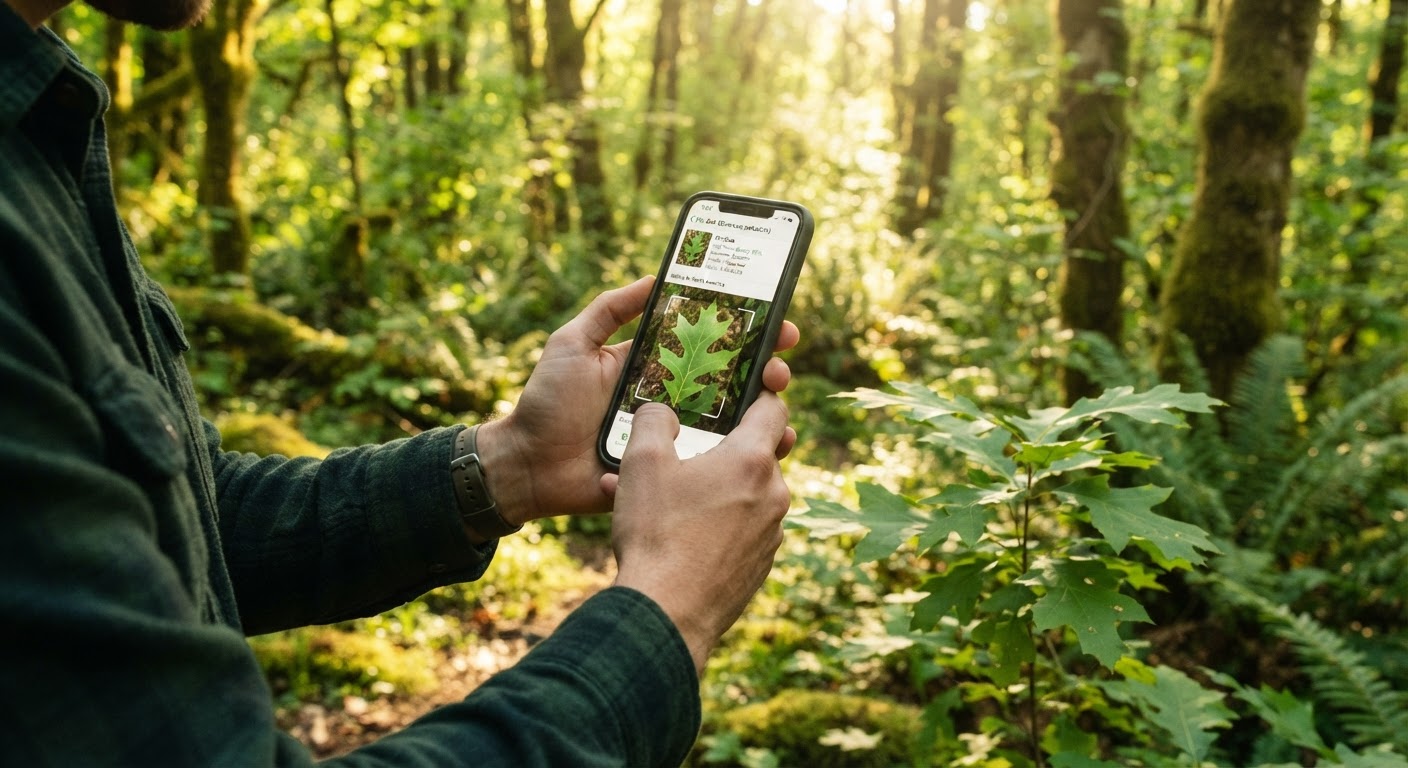
Join iNaturalist (free, web and app). Post clear photos of any plant you find — cultivated, wild, doesn’t matter. The community identifies it, often within hours, and every identification adds to a public dataset that improves plant recognition AI. You’ll learn faster from the feedback loop of “I think this is X” → “Actually, here’s why it’s Y” than from solitary book study. The app also maintains a personal life list of every species you’ve observed, which is genuinely satisfying to scroll through after a few months.
What You Actually Need to Remember
If you read nothing else, take these four things:
- Start with dandelion and plantain. You already know what they look like. They grow everywhere. Pick them, wash them, eat them — that’s your proof of concept that foraging works.
- The smell test catches the deadliest mistakes. Any plant you think might be wild garlic or wild onion? Crush and smell. No onion-garlic odor = not an Allium = do not eat. This one rule alone prevents the most common lethal foraging error.
- Clear sap vs. white sap. When you break a low-growing, succulent-looking stem and white latex oozes out, you’re looking at spurge, not purslane. This rule also applies broadly to the carrot family (Apiaceae), where white sap from cut stems can indicate toxic species.
- Two features, always. Never identify a plant by a single characteristic. Require two independent confirmations before anything goes in your mouth. The brain rushes to conclusions when it’s hungry or excited. Two features is your speed bump.
Foraging isn’t a survival skill you learn for emergencies. It’s a way of paying attention — to seasons, to local ecology, to the fact that food doesn’t have to come from a grocery store. The plants on this list grow in your neighborhood right now. They’ve been there for years while you walked past them. That changes this weekend.