Most foraging guides dump 40 plant names on you and leave you to figure out which ones actually grow near your house. You flip through entries about desert sagebrush while standing in a wet Vermont meadow. You read about alpine berries when you live three miles from the nearest hill.
This guide does the opposite.
Every plant on this list is organized by where you’ll actually find it — your lawn, the trail behind your neighborhood, the creek at the edge of town. No exotic species. No “if you happen to be hiking the Pacific Crest Trail” caveats. Just twelve plants you can walk outside and locate this weekend.
Each entry gives you four things: what to look for (the one feature that can’t be confused), where it grows, how it tastes, and the fastest way to get it on a plate. No botany lectures. No Latin name memorization required.
The 15-Second Rule: Read This Before You Pick Anything
Before we get to the plants, internalize one rule. It’s the difference between a confident harvest and a tentative bite:
If you can’t name three distinct features of the plant you’re holding, put it down.
Not “I think it’s dandelion because the flower is yellow.” That’s one feature. You need three. Yellow flower. Hollow stem with white sap. Deeply toothed leaves that point backward toward the base. Now you’ve got three. Now you can pick it.
This rule catches nearly every foraging mistake before it happens. Poison hemlock has white flowers like wild carrot — but its stem is smooth and purple-spotted while wild carrot’s stem is hairy and green. That’s a single-feature difference. If you only looked at the flower, you’d miss it entirely. Three features close the gap.
Keep this in your back pocket as we work through the list.
🏡 GROUP 1: Your Backyard and Lawn (4 Plants)
The plants in this section don’t require a hike. They’re probably growing through cracks in your driveway right now. Most homeowners spray them. You’re about to eat them instead.
1. Dandelion (Taraxacum officinale)
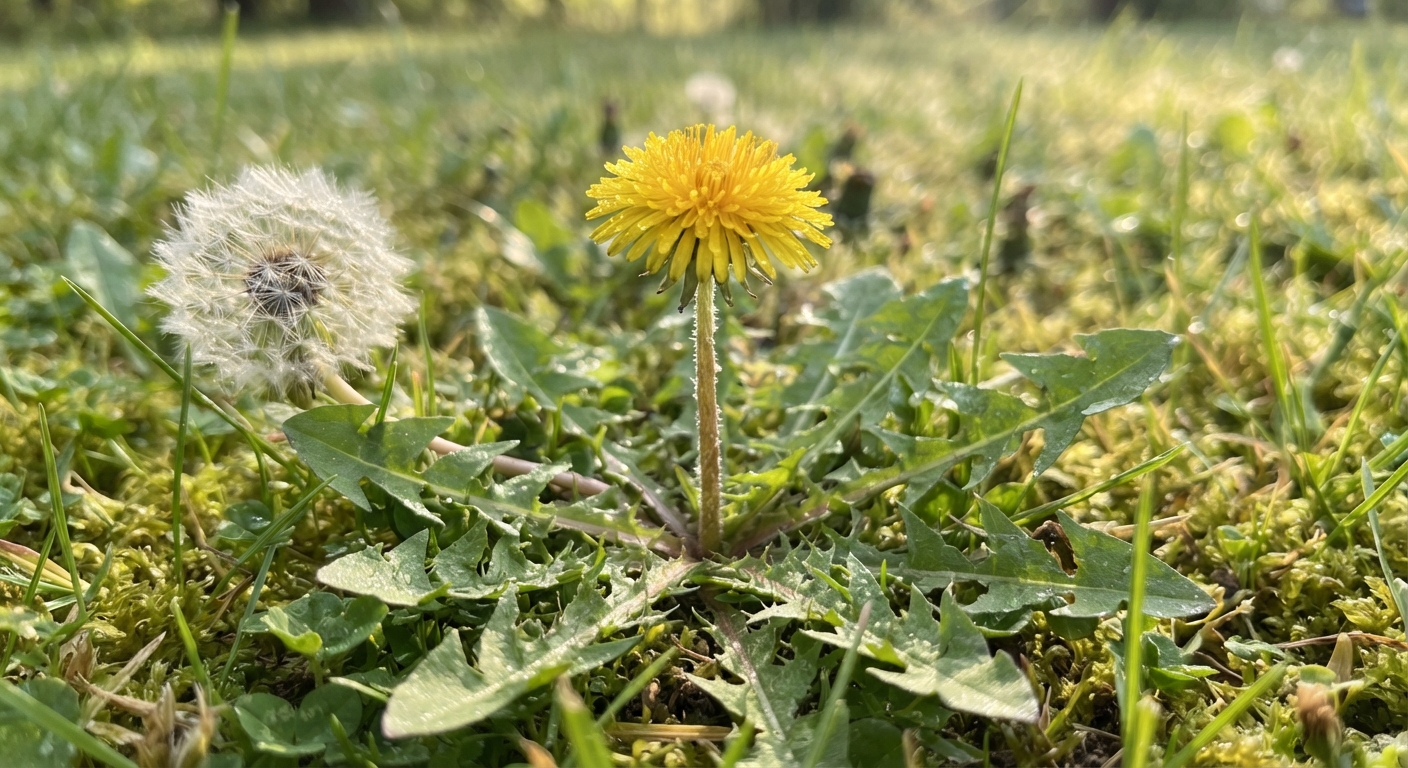
Every part of this plant is edible, and it’s the hardest plant on this list to misidentify. Nobody looks at a dandelion and thinks “hmm, could be hemlock.”
The giveaway: Bright yellow composite flower (made of many tiny petals), hollow stem that oozes white sap when broken, and deeply toothed leaves that form a flat rosette at ground level. The leaves point backward toward the base — if the teeth point forward, you’re looking at a different plant.
Where it grows: Lawns, sidewalk cracks, parks, baseball fields. If grass grows there, dandelion probably does too.
Taste: Young leaves are pleasantly bitter, like arugula with more personality. Older leaves get aggressively bitter — harvest before the flower opens for the mildest greens. Flowers taste faintly sweet and honey-like. Roots can be roasted for a coffee substitute.
Fastest prep: Rinse the leaves, toss with olive oil, lemon juice, and salt. Eat raw. Flowers go straight into salads or get battered and fried.
2. Chickweed (Stellaria media)
Chickweed grows in dense green mats and has one feature that makes it impossible to confuse with anything dangerous when you know what to look for.
The giveaway: Tiny white flowers with five petals so deeply split they look like ten. The stem has a single line of fine hairs running along one side — if you rotate the stem between your fingers, the hairs appear and disappear. No other common lawn plant has this hair pattern.
Where it grows: Damp, shaded spots in lawns and garden beds. It loves disturbed soil and pops up in vegetable patches uninvited.
Taste: Mild and fresh, somewhere between lettuce and corn silk. Zero bitterness. This is the gateway wild green for people who think “wild plant” means “tastes like lawn clippings.”
Fastest prep: Eat it raw in salads or on sandwiches. It wilts fast, so cook it only briefly — 30 seconds in a hot pan with butter is all it needs.
3. Purple Dead Nettle (Lamium purpureum)
This plant looks like it should sting you, but it won’t. The name “dead nettle” means exactly that — it’s a nettle that’s “dead” (can’t sting).
The giveaway: Square stem (roll it between your fingers — you’ll feel the edges), purplish-tinged upper leaves that form a crown near the top, and small pink-purple tube-shaped flowers. Square stem = mint family. The mint family has exactly zero toxic members in North America, which makes this an aggressively safe plant to learn.
Where it grows: Lawns, garden edges, disturbed ground. It appears in early spring and hangs around through fall.
Taste: Mild, slightly minty, a little earthy. The purple upper leaves are the most flavorful part.
Fastest prep: Chop fresh leaves into salads or blend into pesto. It also makes a decent tea — steep a handful of fresh leaves in hot water for five minutes.
4. Broadleaf Plantain (Plantago major)
This is the plant growing in the crack of every sidewalk in North America. It’s not related to banana-plantains. It’s a leafy weed that doubles as a first-aid kit (the crushed leaves soothe bee stings and minor cuts).
The giveaway: Broad, oval leaves with prominent parallel veins running from base to tip, all emerging from a central point at ground level. The flower stalk looks like a skinny green rat-tail shooting straight up from the center.
Where it grows: Literally anywhere humans have walked. Sidewalks, paths, lawns, parking lot edges. It thrives on being stepped on.
Taste: Young leaves taste like mild spinach with a hint of mushroom. Older leaves get stringy — the parallel veins turn into tough fibers that don’t break down when cooked.
Fastest prep: Sauté young leaves in butter with garlic. For older leaves, strip the veins out before cooking — it’s tedious but worth it.
🌳 GROUP 2: Woodland Edges and Trailsides (4 Plants)
These plants need slightly more effort to find but dramatically more flavor when you do. Head to any wooded trail, park with tree cover, or overgrown field edge.
5. Wild Garlic / Field Garlic (Allium vineale)
If it smells like garlic and looks like chives, you’re holding an Allium. This family is one of the safest in the foraging world — the smell test is genuinely reliable.
The giveaway: Thin, hollow, tubular leaves that look like chives. When crushed, they smell unmistakably of garlic or onion. If it doesn’t smell like onion or garlic, it’s not an Allium. Death camas — the toxic lookalike — has flat leaves and zero onion smell.
Where it grows: Fields, lawns, trail edges, forest margins. Often forms dense patches.
Taste: Milder than cultivated garlic. The entire plant — leaves, bulb, and flower stalks — is edible.
Fastest prep: Chop fresh into eggs, soups, or anything that benefits from garlic. The bulbs are small and fiddly to peel; most foragers stick to using the greens.
6. Blackberry / Wild Bramble (Rubus fruticosus)
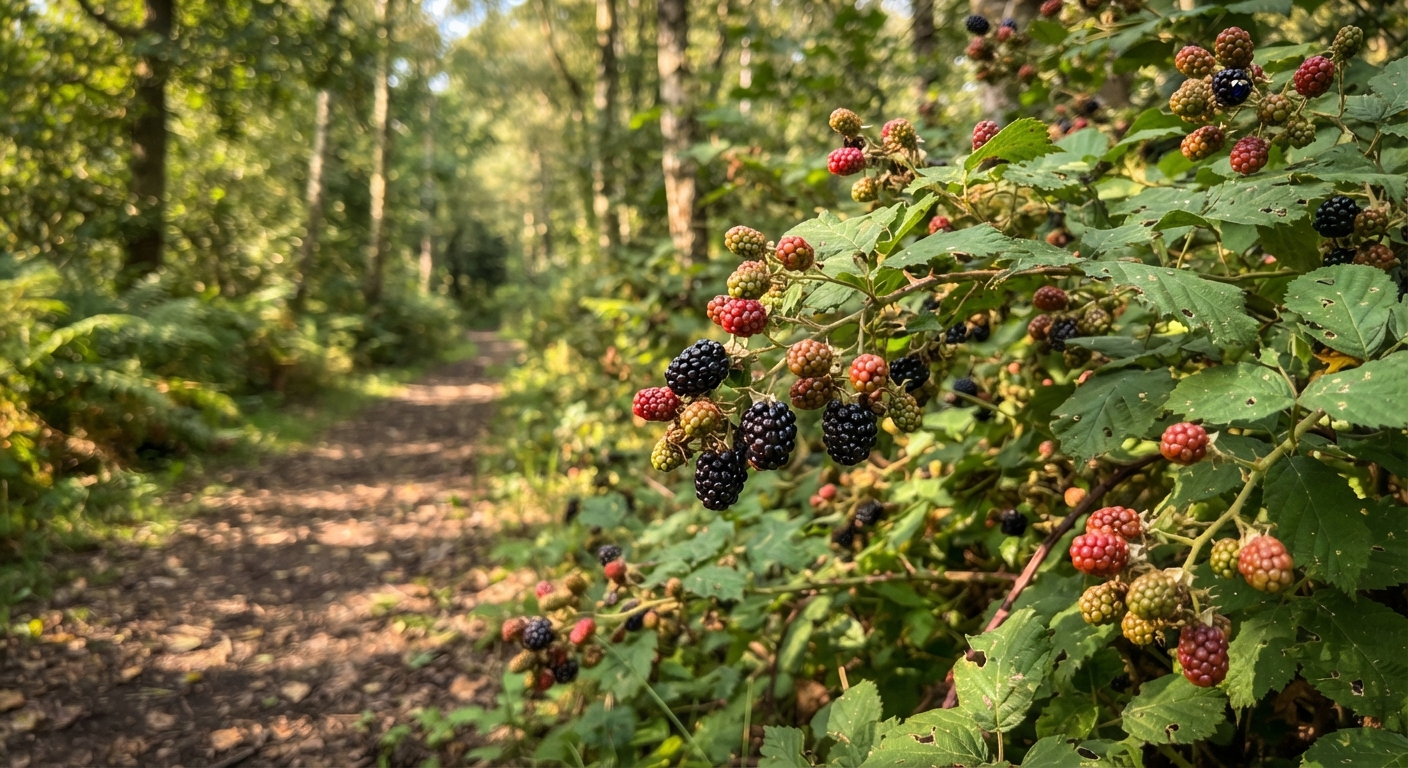
The Rubus genus — blackberries, raspberries, dewberries — contains zero toxic species in North America. The worst thing you’ll eat is an unripe, mouth-puckeringly sour berry.
The giveaway: Compound berries made of small drupelets (those little juicy beads). Thorny, arching canes. Leaves are compound with 3–5 leaflets, serrated edges, and a whitish underside.
Where it grows: Woodland edges, trail sides, abandoned fields, fence lines. Brambles colonize disturbed edges aggressively.
Taste: Ripe blackberries are sweet-tart and juicy. The ones in full sun are sweeter than shade-grown berries. If the berry releases easily from the stem with a gentle tug, it’s ready.
Fastest prep: Eat them straight off the cane. For serious hauls, freeze extras or cook down into jam. One piece of advice: wear long sleeves. Those thorns don’t mess around.
7. Lamb’s Quarters (Chenopodium album)
Also called wild spinach, and for good reason — cooked lamb’s quarters tastes closer to actual spinach than spinach does. This plant is a nutritional heavyweight too, with more calcium and protein per gram than cultivated spinach.
The giveaway: Diamond-shaped or triangular leaves with jagged, toothed edges. The key feature: a powdery white or pinkish coating on the youngest leaves at the growing tip, which looks almost like fine dust or frost. It rubs off when touched and is completely harmless.
Where it grows: Disturbed soil, garden beds, farm field edges, construction sites. It’s an agricultural weed across most of North America.
Taste: Rich, mineral-forward, slightly nutty. Cooked, it’s indistinguishable from good spinach. Raw young leaves work in salads but the texture gets chalky as leaves age.
Fastest prep: Sauté with olive oil and garlic for five minutes. Add a squeeze of lemon. That’s it. You just made a side dish that would cost $8 at a farm-to-table restaurant.
8. Wood Sorrel (Oxalis stricta)
This one looks like clover but tastes like green apple candy. Kids tend to discover wood sorrel before adults do — it’s that distinctive.
The giveaway: Three heart-shaped leaflets per leaf (like clover, but the leaflets have a fold down the middle). Tiny yellow flowers with five petals. The taste is the clincher — if you nibble a leaf and it’s lemony-sour, it’s wood sorrel. If it tastes like nothing, it’s clover.
Where it grows: Woodland edges, shaded lawns, garden beds, trail margins. It likes partial shade and slightly damp soil.
Taste: Bright, lemony, almost sour-apple flavor from oxalic acid. Refreshing on hot days.
Fastest prep: Eat raw in salads, use as a garnish, or steep a handful in cold water for a lemonade-style drink. Don’t cook it — the flavor disappears with heat. A caution worth mentioning: the oxalic acid means you shouldn’t eat bowlfuls of it every day, especially if you have kidney issues. A handful in a salad is perfectly fine.
💧 GROUP 3: Waterside and Damp Soil (3 Plants)
If there’s a creek, pond, drainage ditch, or consistently damp patch of ground near you, these plants are probably there.
9. Stinging Nettle (Urtica dioica)
Yes, it stings. Yes, it’s worth it anyway. Cooking destroys the sting completely — you can eat sautéed nettles by the forkful with zero consequences.
The giveaway: Serrated, dark green leaves growing in opposite pairs on a tall, square-ish stem. The entire plant is covered in fine stinging hairs (trichomes) visible to the naked eye. If you brush against it bare-handed, you’ll feel a burning sensation within seconds — that’s formic acid, the same compound ants use.
Where it grows: Stream banks, damp woodland edges, drainage areas, abandoned barnyards. It loves nitrogen-rich soil, which is why it often grows where animals have been.
Taste: Rich, green, slightly nutty — somewhere between spinach and asparagus. One of the best-tasting wild greens, full stop.
Fastest prep: Wear gloves to harvest the top 4–6 inches of young plants. Blanch in boiling water for 60 seconds (sting neutralized), then sauté with butter and garlic. Nettle soup and nettle pesto are both excellent. The cooking water makes a surprisingly good tea.
10. Watercress (Nasturtium officinale)
Watercress is a supermarket green that also grows wild across much of North America. The wild version tastes spicier and more peppery than the cultivated stuff.
The giveaway: Small, rounded, dark green leaflets arranged in opposite pairs along a hollow stem. Tiny white flowers with four petals arranged in a cross (classic mustard family trait). Grows in dense floating mats in shallow, slow-moving water.
Where it grows: Spring-fed streams, slow creeks, shallow pond edges. It needs clean, moving water — if the water is stagnant or polluted, skip it.
Taste: Peppery and sharp, like arugula with more heat. The kick fades when cooked.
Fastest prep: Raw in salads and sandwiches — this is where it shines. Cooking turns it into a milder green that works well in soups. Critical safety note: Harvest only from clean, flowing water sources. Stagnant water can carry liver fluke parasites. This is not a “grab it from the drainage ditch” plant.
11. Cattail (Typha latifolia)
Cattails produce more edible starch per acre than potatoes. Indigenous peoples across North America relied on them as a staple food. Every part of the plant is useful at some point in the season.
The giveaway: Tall (4–8 feet), reed-like, with a distinctive brown cylindrical flower spike that looks like a hot dog on a stick. No other common wetland plant looks remotely like a mature cattail.
Where it grows: Pond edges, marshes, slow streams, drainage ditches. Anywhere with standing or slow-moving water and full sun.
Taste: Young shoots taste like cucumber. The immature green flower spike (before it turns brown and fluffy) tastes like corn when boiled. The pollen is nutty and works as a flour supplement. The rhizomes are starchy but require processing.
Fastest prep: Peel the outer leaves off young spring shoots and eat the tender white core raw or in stir-fries. Boil green flower spikes for 5 minutes and eat them like corn on the cob with butter. The rhizome starch harvesting is an intermediate-level project — save it for your third or fourth cattail encounter.
🔥 GROUP 4: Bonus — The One You’re Already Stepping On
12. Purslane (Portulaca oleracea)
Purslane has more omega-3 fatty acids than any other leafy green on land. It’s a superfood that most people yank out of their garden and throw away.
The giveaway: Thick, succulent, reddish stems that sprawl flat along the ground. The leaves are small, fleshy, and paddle-shaped — they look like tiny jade plant leaves. When you break a stem, the sap is clear. (Spotted spurge — the toxic lookalike — has milky white sap and thinner, flatter leaves.)
Where it grows: Garden beds, sidewalk cracks, driveway edges. It appears in the hottest months when everything else has bolted, which makes it a reliable mid-summer find.
Taste: Mildly lemony, slightly salty, with a satisfying crunch from the succulent stems. The texture is unusually pleasant — crisp but not fibrous.
Fastest prep: Eat raw in salads. The stems have more crunch than the leaves, so include them. Purslane also pickles beautifully — throw whole sprigs into a jar with vinegar, salt, and garlic.
Quick-Reference: All 12 Plants at a Glance
| # | Plant | Habitat | Season | Flavor | Difficulty | One-Liner |
|---|---|---|---|---|---|---|
| 1 | Dandelion | Lawns, sidewalks | Spring–Fall | Bitter greens, sweet flower | ⭐ Easy | “Arugula’s wild cousin — every part is food” |
| 2 | Chickweed | Damp lawns, gardens | Spring–Fall | Mild, lettuce-like | ⭐ Easy | “The beginner’s confidence-builder green” |
| 3 | Purple Dead Nettle | Lawns, garden edges | Spring–Fall | Mildly minty | ⭐ Easy | “Square stem = safe mint family member” |
| 4 | Broadleaf Plantain | Sidewalks, paths | Spring–Fall | Spinach-mushroom | ⭐ Easy | “Grows where you walk — sauté it anyway” |
| 5 | Wild Garlic | Fields, trail edges | Spring–Fall | Garlic-onion | ⭐ Easy | “Smell test is reliable — no smell, no eat” |
| 6 | Blackberry | Woodland edges, fences | Late Summer | Sweet-tart berries | ⭐ Easy | “Zero toxic lookalikes in North America” |
| 7 | Lamb’s Quarters | Gardens, disturbed soil | Summer–Fall | Spinach, nutty | ⭐ Easy | “Better than actual spinach, nutritionally” |
| 8 | Wood Sorrel | Shaded lawns, trails | Spring–Fall | Lemony, sour-apple | ⭐ Easy | “Taste confirms ID — sour = wood sorrel” |
| 9 | Stinging Nettle | Stream banks, damp edges | Spring–Fall | Rich, spinach-asparagus | ⭐⭐ Medium | “Gloves for harvest, 60-sec blanch to neutralize” |
| 10 | Watercress | Clean flowing streams | Spring–Fall | Peppery, sharp | ⭐⭐ Medium | “Only from clean water — never stagnant” |
| 11 | Cattail | Ponds, marshes | Spring–Fall | Cucumber shoot, corn-like spike | ⭐⭐ Medium | “Hot dog on a stick — shoots, spikes, and pollen” |
| 12 | Purslane | Garden beds, cracks | Summer | Lemony, crunchy | ⭐ Easy | “Omega-3 powerhouse hiding in your garden” |
3 Rules That Catch Every Mistake Before It Reaches Your Mouth
You don’t need to memorize 50 plants to forage safely. You need to follow three rules that apply to every plant on this list.
Rule 1: Positive ID only. Never settle for “probably.” If your internal monologue includes the word “should” — “it should be watercress” — you haven’t identified it yet. Put it down or take photos for later research.
Rule 2: Try just one new plant per outing. The impulse to fill your basket with everything you find is strong. Resist it. If you eat three new wild plants in one meal and one doesn’t agree with you, you won’t know which one was the problem.
Rule 3: Eat a tiny amount first, wait 24 hours. Even with a verified positive ID, your body might not agree with a plant that’s universally considered edible. Some people have individual sensitivities to specific species. Try a spoonful. Wait a full day. If nothing happens, eat the bowlful.
These three rules are boring. They’re also the reason experienced foragers keep foraging while overconfident beginners end up with stories they’d rather not tell.
FAQ
Do I need a field guide or can I just use my phone?
A phone app gets you 80% of the way there. Use it to narrow down candidates, then verify with at least two separate sources before eating. Never trust a single app scan for edibility decisions. For the plants on this list, the descriptions above should be sufficient — they’re chosen specifically because their identification features are unambiguous.
What’s the one plant I should start with?
Dandelion. Zero dangerous lookalikes, grows literally everywhere, and every part is usable. You can find one in 30 seconds, identify it with full confidence, and have it in a salad within five minutes. That first successful harvest is what hooks people.
When is the best time of day to forage?
Early morning, right after the dew dries. Plants are at their crispest and most hydrated. Afternoon heat makes greens wilt faster in your basket. If you’re harvesting flowers, mid-morning is ideal — they’re fully open but not yet stressed by midday sun.
Can I forage in city parks?
Check local regulations first — many city parks prohibit plant removal. That said, dandelions and plantain growing in your own yard or on private property (with permission) are fair game. Avoid plants growing within 50 feet of busy roads due to exhaust residue and road salt.
How do I wash wild plants properly?
Three changes of cold water. Fill a bowl, submerge and agitate, drain, repeat twice more. This removes dirt, bugs, and any surface contaminants. For plants with lots of crevices (like lamb’s quarters), add a splash of vinegar to the first rinse to dislodge stubborn grit.