Wild Plants You Can Eat: The Complete Guide to Edible Plant Parts
Most people who want to eat wild plants hit the same wall within a week. They read a list of names — dandelion, purslane, cattail, clover — and they feel prepared right up until they’re standing in a real meadow staring at a real plant they can’t match to anything on the list. The list doesn’t help in that moment, because the plant in front of them is almost dandelion and sort of like something else, and there’s no photo on the internet that quite settles it.
Here’s the mental shift that fixes this: stop trying to memorize species, and start learning parts. Almost every wild plant you’ll meet is edible in one part and questionable in another — or edible when young and tough when old. When you understand that a leaf, a shoot, a root, a flower, and a fruit all have different rules, you stop needing a perfect species match. You start asking better questions. You start eating.
This guide is built around that idea. We’ll walk through each edible part of a wild plant, the identification cues that actually matter for each one, the season windows, a full step-by-step harvest-to-plate workflow, the lookalikes that cause real trouble, and the pro habits that keep experienced foragers out of the hospital. No jargon, no fake precision, and no claim that any of this replaces a proper field guide and a cautious eye.
Why “Plant Parts” Beats “Plant Names”
A name is a shortcut, and shortcuts only work when you already know the territory. Beginners collect names, then panic when reality doesn’t match. Foragers who’ve been doing this for a while think in categories instead, and those categories sort by part.
Consider the ordinary cattail. Its young shoots taste like a mild cucumber in spring. Its pollen can be collected as flour in summer. Its rhizomes are starchy and edible year-round. Its leaves, once green and tough, are useless for eating — but historically used for weaving. Same plant, five different parts, five different verdicts. If your entire knowledge of cattail is “it’s edible,” you’ll either waste a good root or chew on a fibrous leaf and conclude that wild food tastes terrible.
Parts also govern safety. The most common wild-food injuries don’t come from eating a plant that’s entirely poisonous — they come from eating a part that is poisonous while a different part is fine. Rhubarb leaves versus stalks. Elderberry fruit versus its stems and unripe berries. Pokeweed shoots (properly prepared) versus its root and berries, which are toxic. Understanding parts is not just about finding more food. It’s the single biggest safety upgrade a beginner can make.
One more reason: parts tell you when to go. Leaves peak young. Roots are best after a frost. Flowers last days. Fruits announce themselves. Once you think in parts, the calendar organizes itself, and you stop walking past a perfect patch because you didn’t know its moment had arrived.
The Three-Question Safety Filter
Before any wild plant goes near your mouth, run this filter. It’s short on purpose — a filter you’ll actually use beats a flowchart you’ll skip.
One: Is the plant in the right place? Plants absorb what’s in their soil and water. A perfectly edible lamb’s quarters growing in a drainage ditch beside a highway, or on a lawn the city just treated, is not a safe dinner. Stay away from roadsides, industrial lots, treated lawns, and anything downstream of agriculture. This rule alone prevents more sickness than identification ever will.
Two: Do I have at least two independent confirmations? Not one photo. Not one app result. Two independent sources — a field guide, a second guide, an experienced forager, a reliable app — that agree on the species and on the part. If two sources disagree, the plant is off the menu. Full stop.
Three: Am I confident about the single most dangerous lookalike? Every edible plant has a “twin” you should be able to rule out. If you can’t name what the dangerous version looks like, you don’t know the plant well enough to eat it. We’ll cover the biggest traps later.
If a plant passes all three, you still start small: a quarter-leaf, chewed and held, then a small bite, then wait a few hours. More on that in the workflow section.
Edible Leaves and Greens: The Beginner’s Best Friend
Leaves are where almost everyone starts, and for good reason — they’re abundant, easy to harvest, and they cover a huge share of the “wild plants you can eat” question. The trade-off is that greens are also where the most lookalikes live, so slow down here.
What to look for on a good edible leaf: a texture that’s soft rather than leathery, no milky sap when you break the stem, no strong foul or bitter smell, and growth in a place you’d be comfortable buying vegetables from.
The reliable, widespread greens you can learn first:
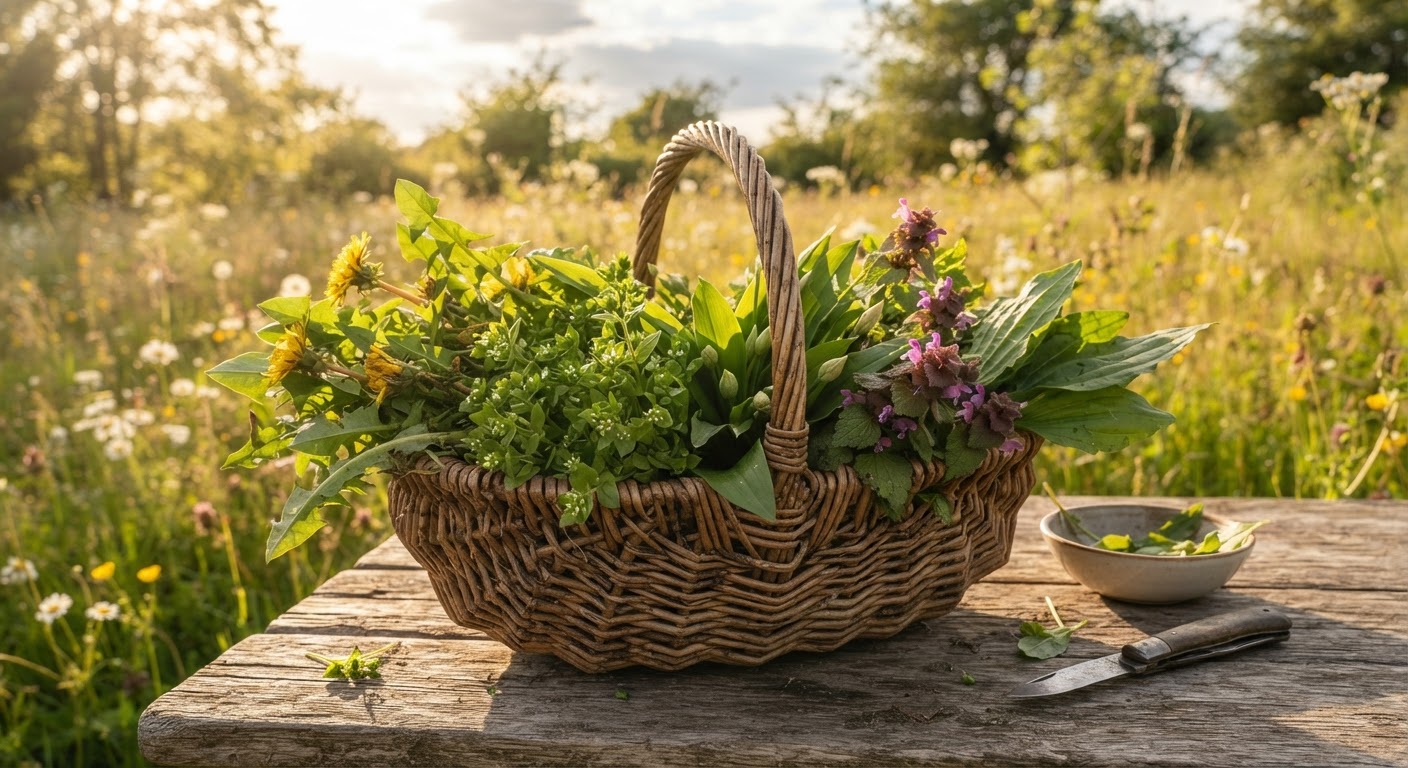
- Dandelion — toothed leaves in a basal rosette, milky sap (harmless here), best before the plant flowers. Young leaves are mild; older ones get bitter.
- Lamb’s quarters — the classic “goosefoot,” with a powdery white coating on new leaves and a leaf shape like a duck’s foot. Tastes like a mild spinach.
- Purslane — thick, fleshy, reddish stems and small succulent leaves. It grows in cracked pavement and vegetable beds. Mildly sour, great raw.
- Chickweed — tiny paired leaves on a thin stem, with a line of hairs running down the stem. Bland and pleasant, best in cool weather.
- Wood sorrel — clover-like leaves that fold at night, with a lemony taste from oxalic acid. Eat a little, not a lot.
- Plantain (the weed, not the banana) — broad oval leaves with parallel veins that stand up in a rosette. Tougher; better young or cooked.
- Wild mustard and garlic mustard — toothed leaves with a peppery bite; garlic mustard smells faintly of garlic when crushed.
How to prepare them without hating them: young greens are salad material. Anything older, or anything with a rough texture, wants heat — a quick blanch, a sauté in fat, or a fold into soup. A squeeze of lemon and a pinch of salt will make almost any wild green taste like it belongs on a plate.
Edible Shoots and Stems: The Spring Window
Shoots are the plant’s springtime push — tender, fast-growing, and usually the mildest-tasting part of anything. The catch is timing. A shoot is edible for a short window, sometimes only a week or two, and then it lignifies into something you couldn’t chew through.
Cattail shoots are the poster child. In early spring, grab the inner core of a young shoot, peel the outer leaves, and you have a crisp, cucumber-like vegetable you can eat raw or slice into a stir-fry. A few weeks later, the same shoot is fibrous and pointless.
Wild asparagus looks exactly like the garden kind — a smooth green spear poking straight out of the ground, sometimes with a purple tinge. If it’s already branched into a bushy fern, you’re too late; the spears were the meal.
Bamboo shoots, knotweed shoots, and the young stems of many mustards all follow the same rule: harvest below the point where the stem starts to harden, and peel away the tough outer layers.
A practical tip that saves a lot of disappointment: snap, don’t cut. A tender shoot snaps cleanly with a satisfying pop. A tough one bends and tears. Your hands are a better ripeness test than your eyes.
Edible Roots, Tubers, and Bulbs: The Stored Energy
Roots are the most underrated part of wild foraging. They’re calorie-dense in a way that leaves simply are not — which matters enormously if you’re ever foraging for real energy rather than a garnish. They’re also the part most people ignore because you have to dig, and digging is work.
The good news: roots are usually best when the plant’s energy is stored below ground — late fall through early spring, or after a frost. In summer, the plant has spent that energy on flowers and the root turns woody.
Cattail rhizomes are the classic survival starch — long, horizontal roots that yield a sweet, starchy flour when dried and pounded. Dandelion root can be roasted and ground as a coffee substitute, or boiled as a bitter vegetable. Burdock produces a long taproot with a smoky, earthy flavor that shines in soups. Jerusalem artichoke (sunchoke) grows wild in many places and forms knobby tubers that roast beautifully.
Two warnings worth more than a paragraph each:
- Never eat an unknown root or bulb raw on a hunch. The deadliest wild-plant mistake in North America and Europe is digging up a bulb that looks like wild onion or garlic but is actually death camas or a toxic lily. Onion-family plants must smell unmistakably of onion or garlic. If it looks like an onion but doesn’t smell like one, leave it in the ground.
- Dig selectively. Take from big, healthy patches, put the soil back, and never clear a stand. A foraged root bed is a garden you didn’t plant — treat it like one.
Edible Flowers: The Part Everyone Misses
Flowers are the most fun part of wild foraging and the easiest to get wrong, because a flower is only edible for a brief window and some very pretty flowers are genuinely dangerous.
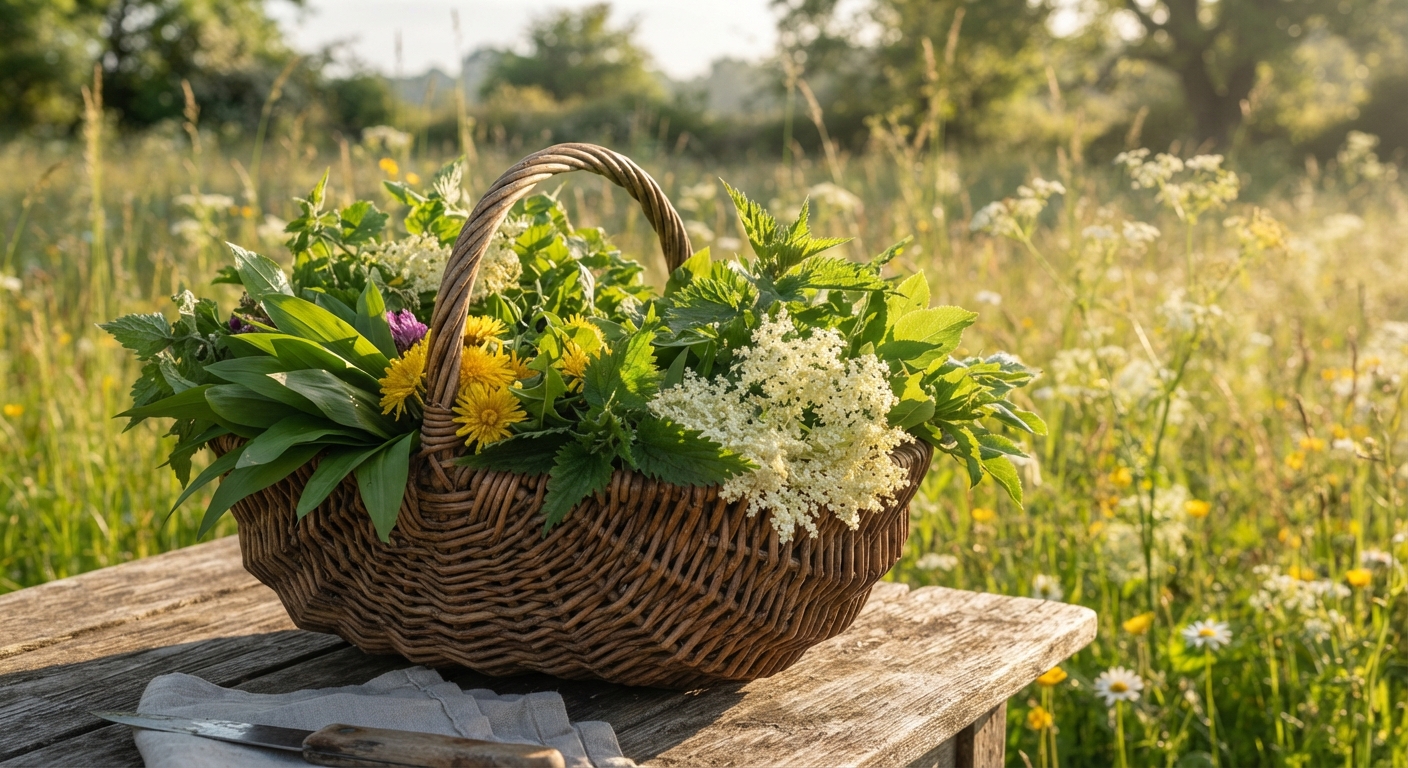
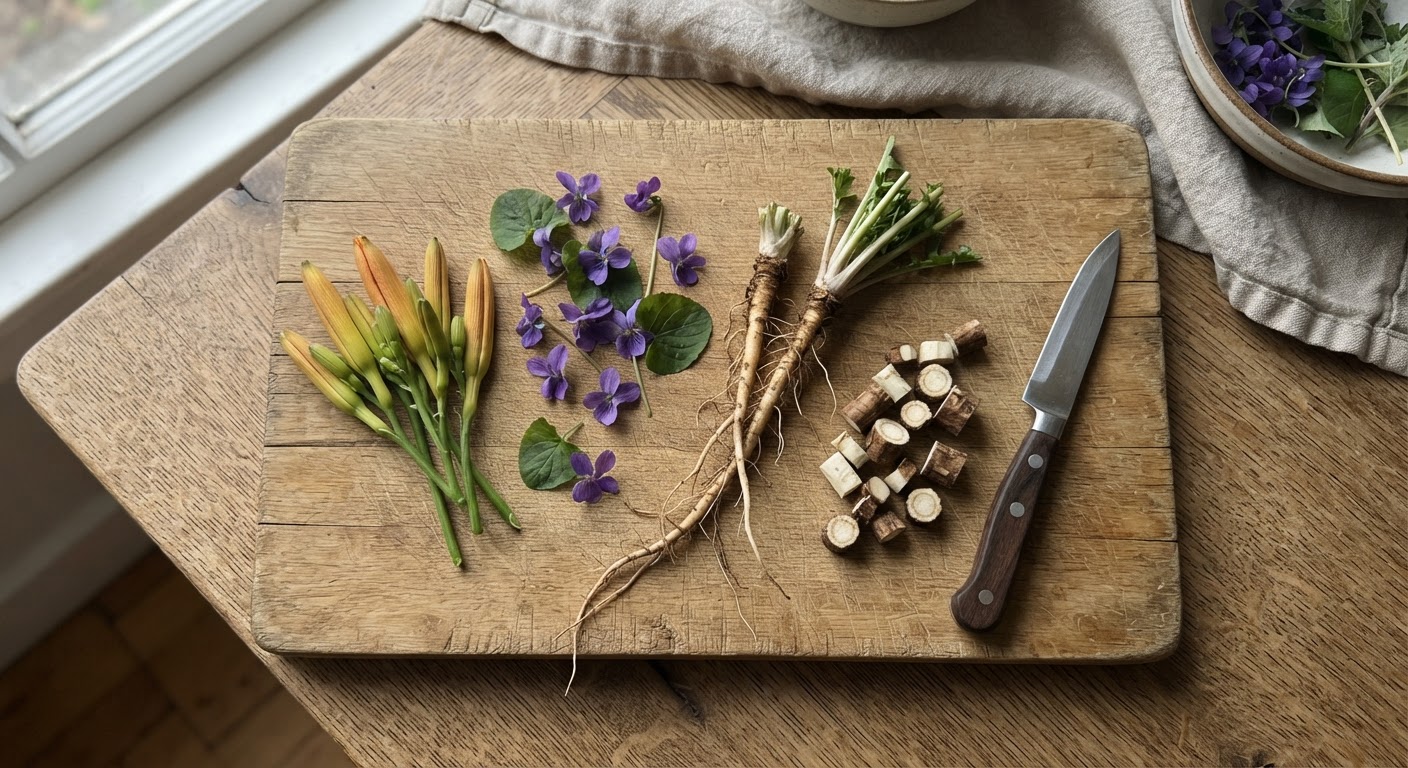
The safe, well-known edibles: dandelion blossoms (sweet and slightly honey-like; batter-fried or made into fritters), clover flowers (the little petals are sweet — a childhood snack for many foragers), violet blossoms (delicate and floral; candied or on salads), daylily buds (taste like a cross between green bean and asparagus), and elderflower (used for syrups and fritters — but never the stems or unripe berries).
The dangerous examples that look harmless: foxglove, monkshood, and lily-of-the-valley are all pretty, all grown in gardens, and all seriously toxic. The lesson isn’t “avoid flowers.” It’s “identify flowers as carefully as you’d identify a mushroom.”
A useful habit: flowers are for flavor and garnish, not calories. Eat them for the experience and the nutrition they add to a meal, not as a food source. That mindset keeps your portions small, which keeps any mistake small too.
Edible Fruits, Berries, Nuts, and Seeds
This category holds the most calories and the most temptation, so it demands the most discipline. A berry is also the one wild food a child might grab without asking, which means every forager should be able to name the few truly deadly berries on sight.
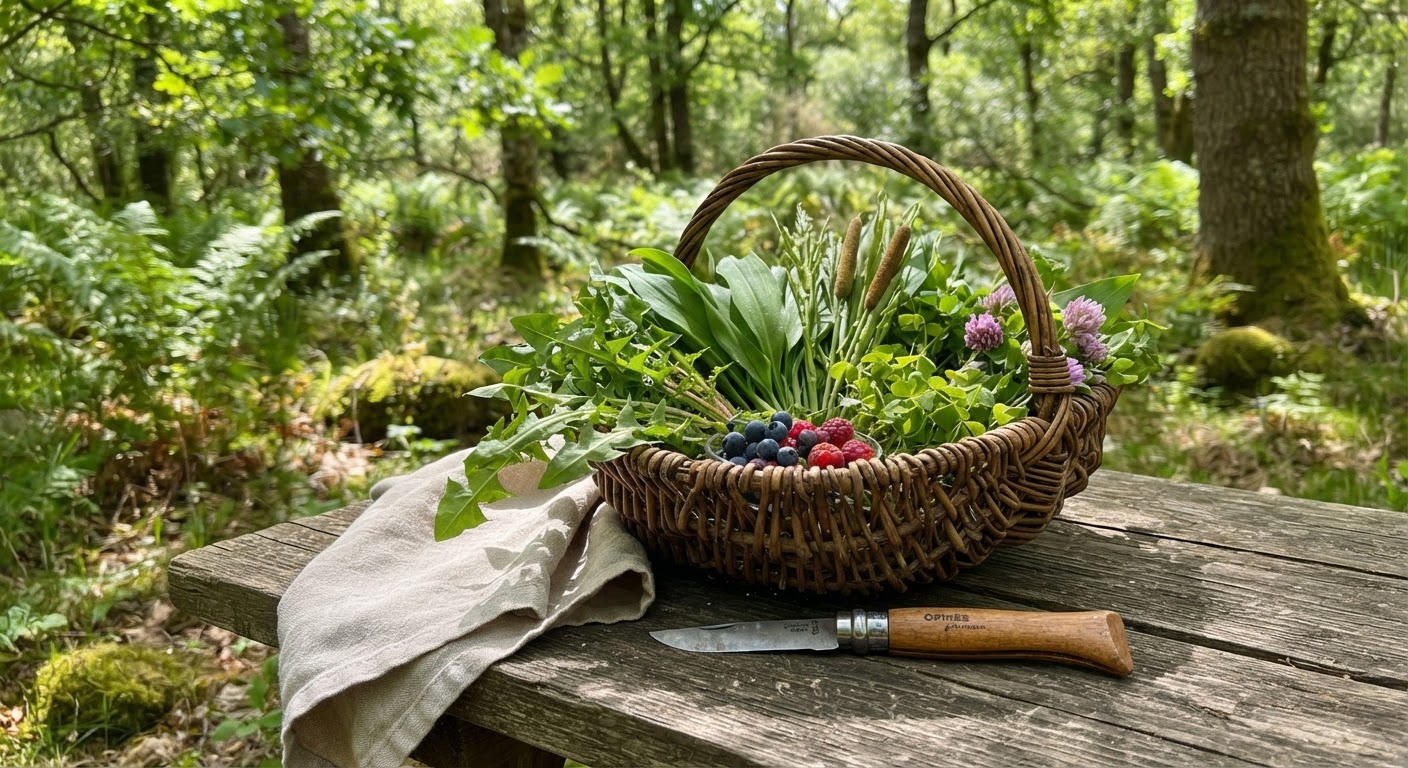
The generally safe wild fruits (learn these first): blackberries and raspberries, wild strawberries, blueberries and huckleberries, elderberries (fully ripe and cooked — raw and unripe elderberries cause illness), Juneberries/serviceberries, and the fruit of hawthorn and crabapple.
The deadly ones to burn into memory: the berries of pokeweed (in the same plant whose shoots are a traditional prepared food — the berries are not), yew (bright red, fleshy, cup-shaped, on a needle-leaf evergreen), and moonseed (looks like wild grape but has a single crescent-shaped seed instead of multiple round ones).
Nuts and seeds reward patience. Acorns are abundant and nutritious but full of tannins — leach them in water until the bitterness is gone. Wild walnuts, hickory nuts, and pine nuts are all worth the effort. Cattail pollen, collected in summer, can be used as a golden flour.
The rule for berries: never eat a berry you can’t name, and never eat a big handful of a berry you’ve only named once. The universal edibility test (a separate discipline covered in depth here) is a last resort, not a shortcut around learning.
Quick reference: what’s edible by part
| Plant part | Best season | Texture when ready | Key safety check |
|---|---|---|---|
| Leaves & greens | Spring, cool weather | Soft, pliable, no milky or foul sap | No dangerous lookalike; clean ground |
| Shoots & stems | Early spring | Snaps cleanly, doesn’t bend | Harvest below the hardening point |
| Roots & tubers | Late fall – early spring | Firm, heavy, not woody | Bulbs must smell of onion/garlic |
| Flowers | Brief window, season-dependent | Fresh, fully open or in bud per species | Rule out toxic ornamentals |
| Fruits & berries | Late summer – fall | Fully ripe, correct color | Never eat unnamed; cook elderberry |
| Nuts & seeds | Fall | Hard shell, sound kernel | Leach tannins (acorns) |
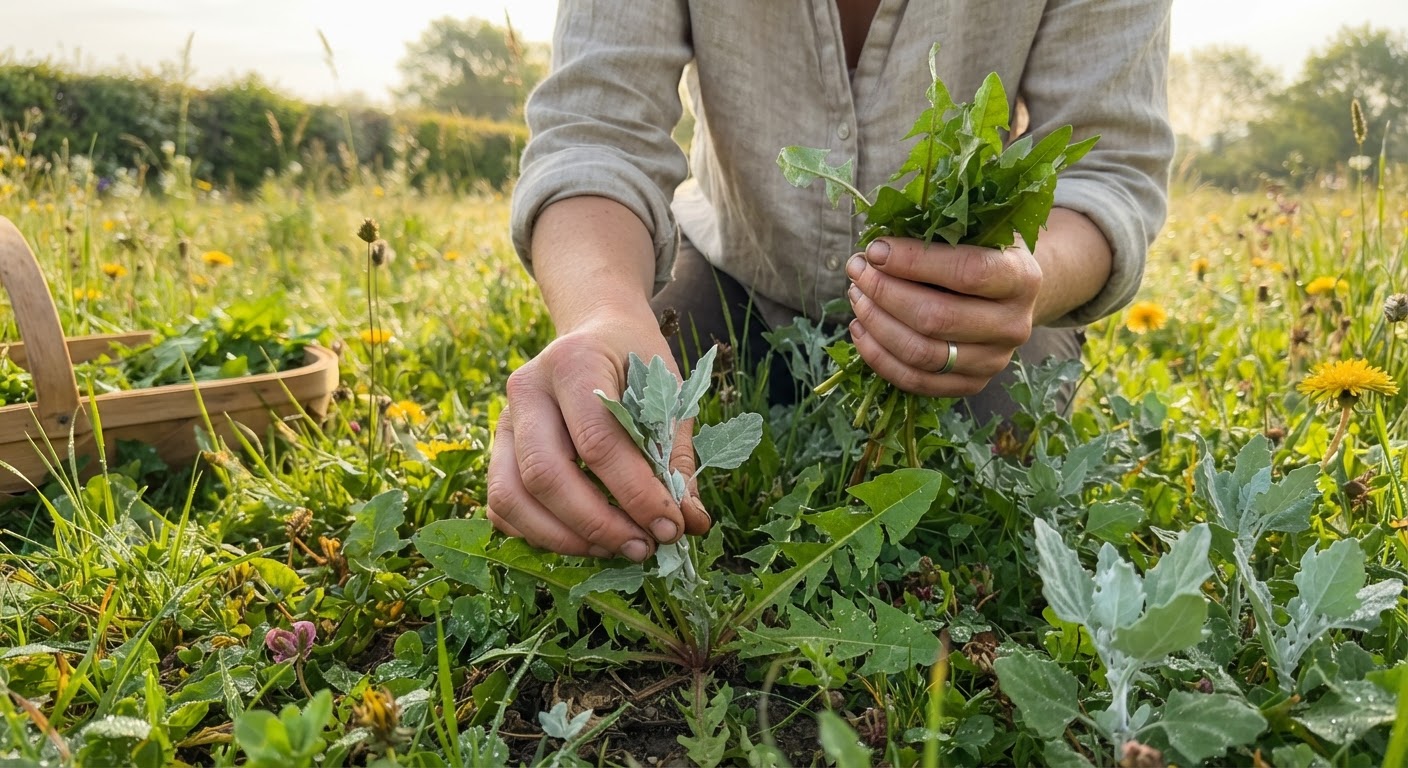
The Season Chart: What to Eat When
Foraging is a calendar, not a scavenger hunt. Here’s how the year breaks down across most temperate regions. Your local dates will shift, but the order of things barely changes.
| Season | Leaves & greens | Shoots & stems | Roots & tubers | Flowers | Fruit, nuts & seeds |
|---|---|---|---|---|---|
| Early spring | Dandelion, chickweed, garlic mustard | Cattail, wild asparagus, knotweed | — | Violet | — |
| Late spring | Lamb’s quarters, purslane (appearing) | Bamboo shoots, mustards | — | Clover, dandelion blossom | Wild strawberry (late) |
| Summer | Purslane, plantain, wood sorrel | Few — most hardened | — | Daylily, elderflower, clover | Cattail pollen, early berries |
| Early fall | Late greens, chickweed returns | — | Dandelion root starting | — | Blackberry, blueberry, elderberry, acorns |
| Late fall & winter | Hardy greens in mild climates | — | Best window: burdock, cattail rhizome, sunchoke | — | Nuts, dried seeds |
The practical takeaway: spring is for tops, fall is for bottoms. If you learn nothing else from this chart, learn that. Spring goes after what the plant is pushing up; fall goes after what the plant is storing down. Winter, in mild climates, is a root and evergreen-green season. Summer is the leanest time for beginners because everything green is rushing to flower — which is exactly when you switch to flowers, pollen, and berries.
Step-by-Step: From Spot to Plate
This is the working workflow. It’s the difference between a safe meal and a stomach ache, and it holds for any wild plant you’ll ever find.
Step 1 — Scout before you pick. Find the patch, look at it from a few feet away, and ask where its water comes from. Is it near a road, a sprayed field, a dog-walking path, or a construction site? Rule out contaminated ground before you harvest. You cannot wash that problem away.
Step 2 — Identify with two sources. Photograph the plant in place, including the stem, the leaf shape, and how the leaves attach. Check the leaf arrangement (opposite? alternate? basal rosette?), the stem (square or round? hairy or smooth?), and the smell when crushed. Then confirm with a second guide. If anything is ambiguous, don’t eat it — there’s always next week.
Step 3 — Check the dangerous twin. Name the lookalike out loud. For a wild-onion bulb, the twin is death camas. For a berry, it’s the local toxic lookalikes. If you can’t name the twin, you skipped a step.
Step 4 — Harvest gently and cleanly. Take only what you’ll eat, snap or cut rather than yank, leave the roots of perennials to regrow, and shake off the dirt. Bring a basket or cloth bag, not a sealed plastic bag — greens sweat and rot fast when sealed.
Step 5 — Taste-test in tiny increments. With a plant that has passed every test, chew a small piece and hold it in your mouth for a moment. If it’s at all bitter, burning, or numb-making, spit it out. Then swallow a small taste, wait several hours, and watch for any reaction before eating more.
Step 6 — Cook to be safe, not just to be fancy. Heat destroys many (not all) plant toxins and improves almost everything. When in doubt, cook. Wash thoroughly, blanch or sauté, and don’t reuse the blanching water for anything you’ll drink.
Step 7 — Log what worked. Keep a note of the plant, the date, the location, and how you prepared it. Next season you’ll know exactly when that patch peaks. This one habit is how beginners turn into reliable foragers in two seasons instead of ten.
Lookalike Traps Worth Knowing by Heart
| Edible plant | Dangerous lookalike | How to tell them apart |
|---|---|---|
| Wild onion / wild garlic | Death camas | Onion smell vs. no smell; camas has grass-like leaves, no onion odor |
| Wild grape | Moonseed | Wild grape has many round seeds; moonseed has one crescent-shaped seed |
| Elderberry fruit | Pokeweed berries | Elderberry is a shrub with white flowers, cooked/ripe only; pokeweed berries are on a red-stemmed herb |
| Wild carrot | Poison hemlock | Hemlock has purple-speckled stems and a musty odor; carrot is hairy-stemmed and carrot-scented |
| Blueberries / bilberries | Various nightshade berries | Edible berries have many tiny seeds, right color when ripe; nightshade berries vary — never guess |
This table is not a substitute for a regional field guide. It’s a reminder that the plants most likely to hurt a new forager are the ones that resemble something they already trust.
Pro Tips From Years of Getting It Wrong
Every one of these came from an actual mistake — mine or someone close enough to learn from.
- Go the same three spots, every week. Beginners chase new locations and never learn a plant’s full lifecycle. Regulars watch the same patch through its whole season and gain far more.
- Forage with a full stomach. Hunger makes you careless and impatient. Eat before you go and you’ll make better calls on every plant.
- The smell test is underrated. Crush a leaf. Onion-family plants announce themselves; musty, foul, or almond smells are alarm bells. Your nose catches things your eyes miss.
- Learn five plants properly, not fifty poorly. Five plants you can identify in your sleep will feed you for years. Fifty plants you half-know will eventually make you sick.
- Respect the “one new thing per meal” rule. Never eat two unfamiliar wild plants in the same sitting. If you react, you’ll never know which one did it.
- Cook with a fat and an acid. Wild greens often taste bitter or bland on their own. Olive oil, butter, or rendered fat, plus lemon or vinegar, transforms most of them.
- Bring more water than you think you need. Digging roots and walking meadows is real exercise.
- Leave the rare ones alone. Just because a plant is edible doesn’t mean it should be harvested. Scarcity in a region means the patch deserves to keep growing.
Questions Foragers Ask Most
Q: Is there one plant that’s always safe to eat? No. There is no universal safe wild plant. Even well-known edibles have parts, seasons, or preparation steps that must be respected. Treat any “always safe” claim as a red flag.
Q: How long before I can trust my own identification? For a small handful of common plants, a season of weekly practice. For the broader catalog, a lifetime — and that’s fine. Nobody needs to know every plant, only the ones they actually eat.
Q: Can apps identify plants for me? They’re genuinely useful as a second opinion, especially offline when you have no signal, but they’re not an authority. Use them to narrow a choice, then confirm with a guide or a person. Treat every app result as a hypothesis, never a verdict.
Q: What if I eat something bad by accident? Stop eating immediately, save a sample or photo of the plant, and contact poison control or emergency services with your location and what you consumed. Don’t wait for symptoms to decide whether it’s serious.
Q: Do I need permission to forage? It depends where you are. Many public lands allow foraging for personal use, many parks forbid it, and all private land requires permission. Learn your local rules before you pick — it protects both the plants and you.
Q: Are wild plants more nutritious than store-bought? Often they’re denser in certain vitamins and minerals because they’re eaten fresh and haven’t been bred for shelf life. But the difference isn’t a reason to take risks. Nutrition is a bonus, not a license to skip identification.
The Real Skill Is Knowing When to Walk Away
Wild plants you can eat are everywhere once you learn to see them by parts rather than by names — a tender shoot in spring, a crisp leaf in the cool months, a starchy root after the first frost, a blossom for a few brief days, a berry or nut in the fall. That knowledge turns ordinary edges, ditches, and meadows into a pantry, and it’s genuinely one of the most satisfying skills a person can learn outdoors.
But the foragers who last aren’t the ones who eat the most unusual plants. They’re the ones who say “not sure, leave it” without regret. Confidence grows slowly and safely; a bad identification can set you back a whole season, or worse. Learn a few plants deeply, respect the calendar, watch your ground, and let the uncertain ones be. The field isn’t going anywhere.
When you’re out on a trail and your phone signal is gone, the difference between a confident meal and a risky guess comes down to having reliable identification at your fingertips. That’s exactly why I built Edible Plant Identifier — point your camera at a leaf, a flower, or a berry and it gives you a fast identification with clear notes and common lookalike warnings, all working fully offline. It won’t replace a field guide or your own judgment, but it’s a genuinely useful second opinion right when you need one — no signal required.
For a deeper dive on turning wild greens into full meals, see our field-to-table vegetables guide, and if you’re heading out this weekend, start with our camping food safety checklist.