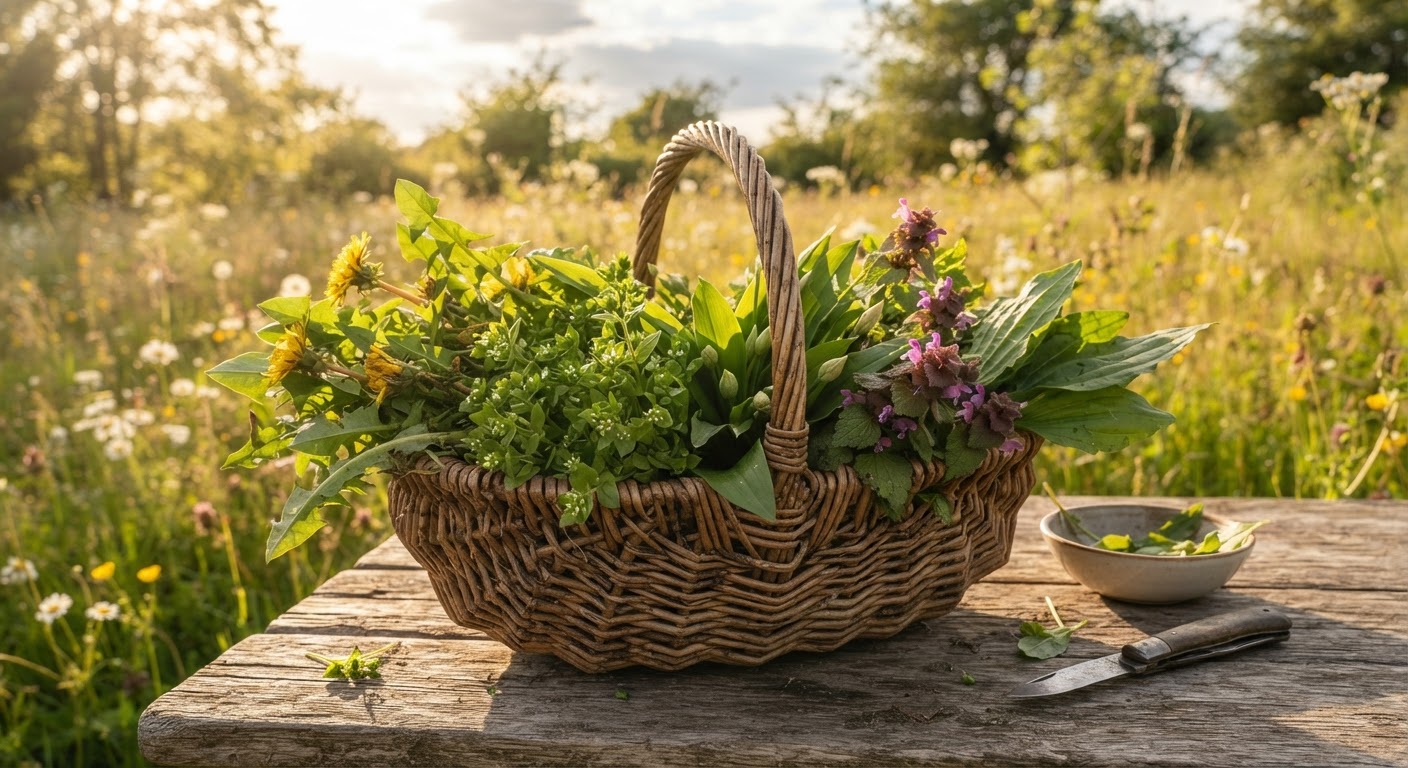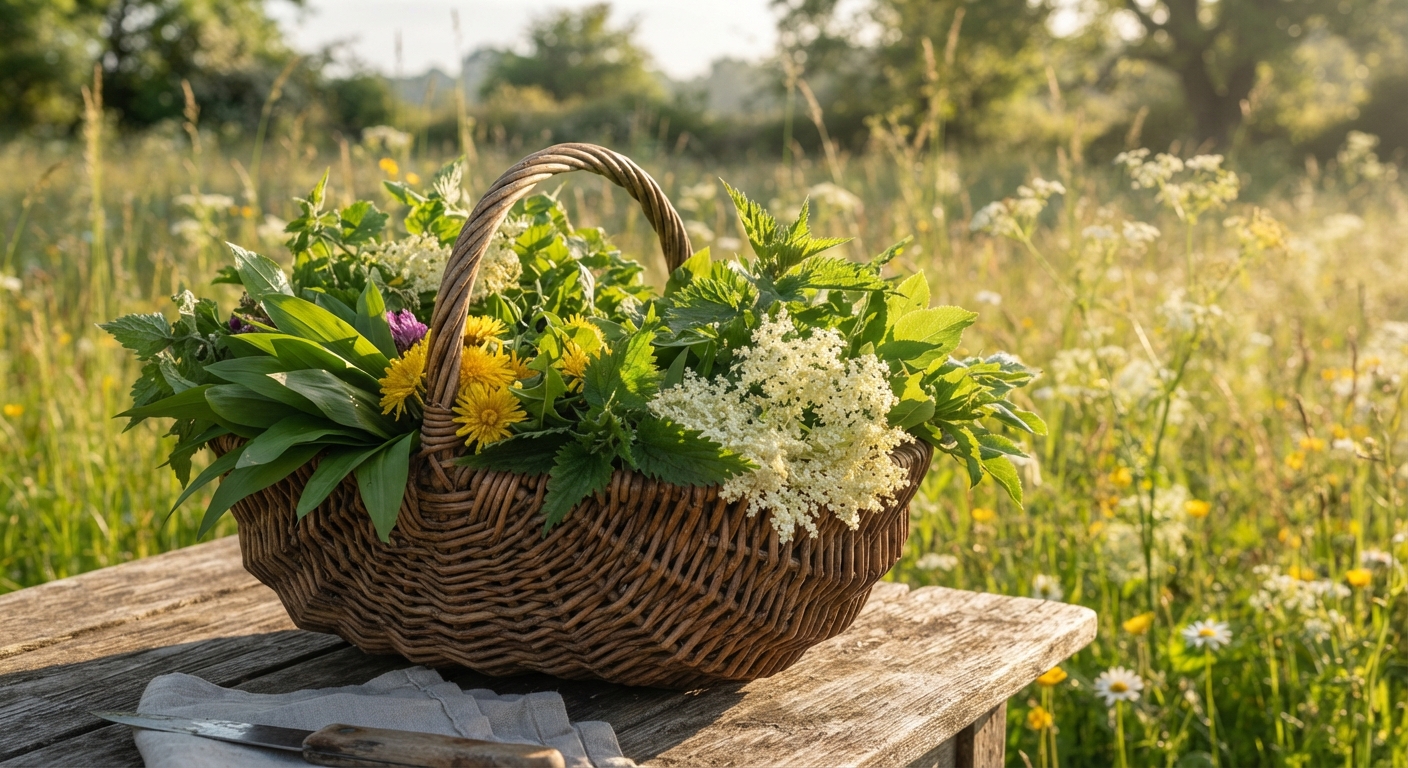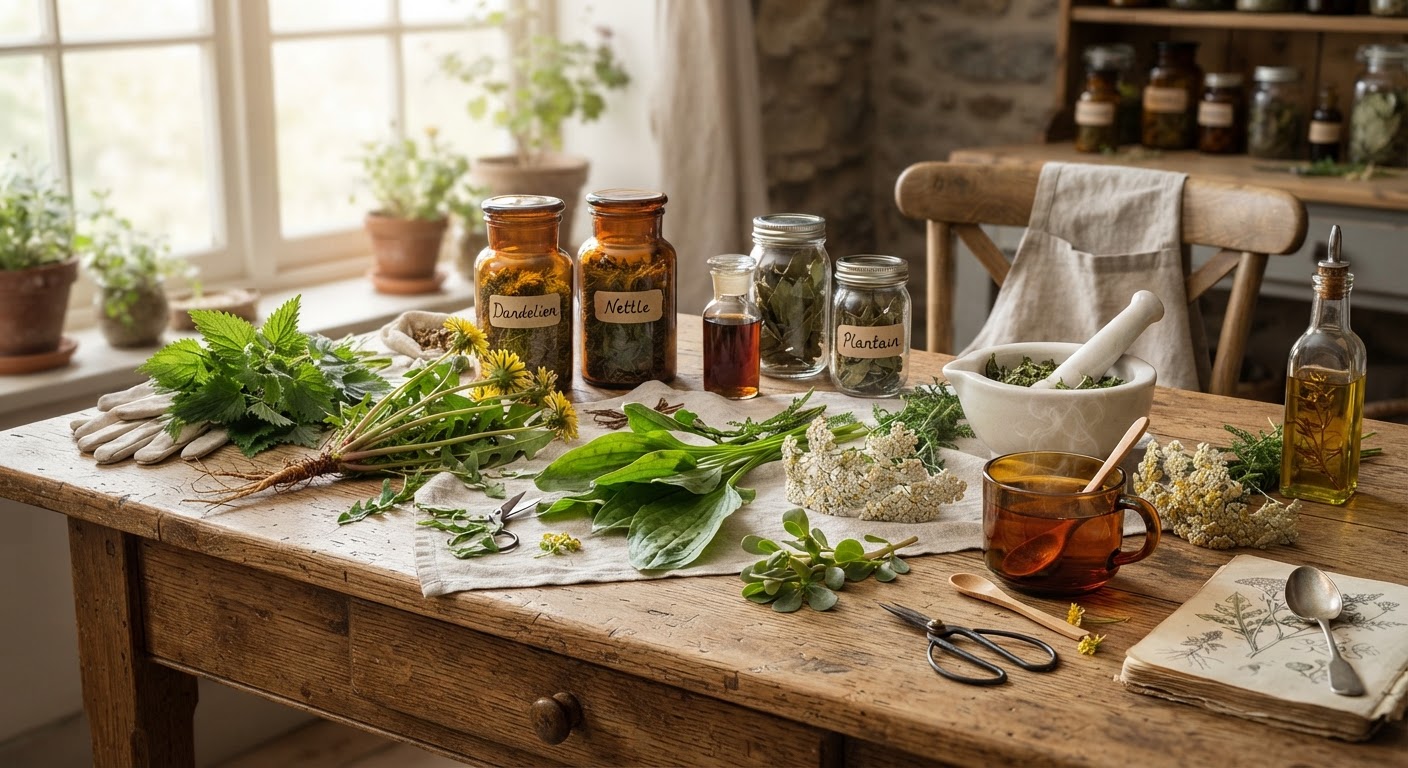
My grandmother kept a single shelf in her kitchen that held both her spice jars and her remedies. Dried ginger sat next to dried mint. Turmeric shared space with something she called “the fever herb.” If someone had a stomach ache, the answer came from the same row of jars that seasoned dinner. The line between food and medicine didn’t exist — not because she was careless, but because the plants themselves had never agreed to such a distinction in the first place.
That old way of thinking is worth revisiting.
Modern culture has sorted plants into tidy buckets: “vegetables” go in the crisper drawer, “medicinal herbs” go in capsules on a supplement shelf. But walk through any patch of wild ground and that categorization falls apart immediately. The dandelion you toss into a salad is a clinically studied liver tonic. The nettle in your soup has more bioavailable iron than the supplement aisle’s best effort. Purslane — the “weed” growing through sidewalk cracks — contains omega-3 fatty acids usually associated with fish oil and is simultaneously a traditional treatment for inflammation.
This guide is about the plants that refuse to be one thing. It covers twelve wild species that serve as both food and medicine, organized by the season you’ll find them, with clear guidance on what parts to use, when to harvest, and how to prepare each for both purposes. If you’ve ever wanted to build a pantry that doubles as a medicine cabinet — one that costs nothing to stock and regenerates itself every year — this is where you start.
Why Wild Plants Bridge Food and Medicine Better Than Anything From a Bottle
There’s a principle in plant chemistry worth understanding before you pick a single leaf: whole-plant synergy.
A dandelion leaf contains vitamin A, vitamin K, calcium, iron, and a group of bitter compounds called sesquiterpene lactones. A dandelion root contains inulin, taraxasterol, and a different profile of the same bitters. Each part of the plant carries a distinct chemical payload — and the plant evolved these compounds to work together, not in isolation.
When you eat a dandelion leaf, you’re consuming the full chemical orchestra. When you take an isolated supplement — a vitamin K capsule, for example — you’re getting a single instrument from that orchestra. Research on whole-plant preparations consistently shows effects that isolated compounds can’t replicate. The bitter compounds in dandelion greens, for instance, trigger digestive enzyme production in ways that simply don’t happen when you take those compounds separately.
This isn’t an argument against modern medicine. It’s an observation about how plants actually work. Wild plants have spent millions of years evolving chemical profiles optimized for survival — and many of those survival compounds just happen to interact usefully with human biology.
The Forager’s Framework: Three Categories Before You Pick
Before getting to specific plants, it helps to sort them into three functional buckets. This framework will save you from the common beginner mistake of treating every useful plant the same way.
Food-First Plants
These plants are primarily food. Their medicinal effects are real but secondary — a bonus layered on top of genuine nutritional value. You harvest them for dinner and the health benefits arrive as a side effect.
Examples: Purslane (omega-3s), lamb’s quarters (mineral density), chickweed (gentle nutrition).
Rule of thumb: Use these liberally in the kitchen. Their medicine is gentle enough that you don’t need to measure doses. A handful in your salad or a side dish is a serving.
Medicine-Forward Plants
These plants have potent medicinal effects that require some respect. You can eat them, but the therapeutic dose often exceeds what you’d comfortably put in a meal. For these, you’ll want to know how to make teas, tinctures, or infused oils.
Examples: Yarrow (wound care, fever management), mullein (respiratory support), elderberry (immune stimulation).
Rule of thumb: Learn the preparation method before you learn the plant. A yarrow leaf in a salad is fine. A yarrow tincture is medicine — different dose, different context, different outcome.
True Dual-Use Plants
These are the stars of this guide. You can cook with them generously and their medicinal effects are significant even at culinary doses. They blur the line completely.
Examples: Dandelion (food and liver support), stinging nettle (food and blood builder), plantain (food and wound care).
Rule of thumb: These are your foundation. Learn two or three of these well before expanding your repertoire.
The Plants: Food, Medicine, and How to Tell Them Apart
This table covers the twelve plants organized by their primary use category. Reference it when you’re trying to decide what to look for on your next walk.
| Plant | Category | Edible Parts | Primary Medicinal Use | Best Season | Beginner-Friendly? |
|---|---|---|---|---|---|
| Dandelion (Taraxacum officinale) | True Dual-Use | Leaves, flowers, roots | Liver and digestive support; mild diuretic | Spring (leaves), Fall (roots) | Yes — unmistakable ID |
| Stinging Nettle (Urtica dioica) | True Dual-Use | Young leaves and stems (cooked) | Blood building (iron), anti-inflammatory, allergy relief | Spring | Yes — the sting confirms ID |
| Broadleaf Plantain (Plantago major) | True Dual-Use | Young leaves | Wound healing, insect bites, skin inflammation | Spring through Fall | Yes — nearly impossible to misidentify |
| Purslane (Portulaca oleracea) | Food-First | Leaves, stems, seeds | Omega-3 anti-inflammatory, digestive soothing | Summer | Yes — clear sap test |
| Yarrow (Achillea millefolium) | Medicine-Forward | Young leaves (sparingly), flowers | Wound care, fever management, digestive aid | Late Spring to Fall | Moderate — hemlock lookalike awareness needed |
| Chickweed (Stellaria media) | Food-First | Leaves, stems, flowers | Gentle skin soother, mild anti-inflammatory | Spring & Fall | Yes — unique stem hair pattern |
| Mullein (Verbascum thapsus) | Medicine-Forward | Leaves (tea), flowers (oil) | Respiratory support, earache relief, cough | Summer to Fall | Yes — unmistakable tall stalk |
| Elderberry (Sambucus nigra) | Medicine-Forward | Berries (cooked), flowers | Immune support, antiviral, cold/flu prevention | Late Summer (berries), Spring (flowers) | Moderate — must cook berries; toxic lookalikes |
| Lamb’s Quarters (Chenopodium album) | Food-First | Leaves, young stems, seeds | Mineral supplementation, gentle detoxification | Late Spring to Fall | Yes — white leaf coating |
| Burdock (Arctium spp.) | True Dual-Use | Roots, young leaf stalks | Blood purifier, skin conditions, digestive bitter | Fall (roots), Spring (stalks) | Moderate — requires digging |
| Wild Rose (Rosa spp.) | Medicine-Forward | Petals, hips (fruit) | Vitamin C, immune support, mild astringent | Summer (petals), Fall (hips) | Yes — roses are recognizable |
| Wood Sorrel (Oxalis spp.) | Food-First | Leaves, flowers | Mild digestive aid, vitamin C, cooling | Spring through Fall | Yes — unmistakable sour taste |
The Spring Trio: Plants That Cleanse, Build, and Restore
Spring is when your body craves green after a winter of heavy food, and these three plants arrive exactly on schedule. They’re the foundation of a dual-use foraging practice — learn them first, master them thoroughly, and the rest of the seasonal calendar will make more sense.
Dandelion: The Complete Plant
Every part of this plant is usable, and each part serves a different purpose.
As food: Young spring leaves (before flowering) are the mildest and best for salads, especially when chopped and dressed with something acidic and fatty — a warm bacon vinaigrette does heavy lifting against the bitterness. The flowers make excellent fritters; dip whole heads in a thin tempura batter and fry for about 30 seconds. The roots, dug in autumn when their inulin content peaks, roast into a credible coffee substitute with a dark, earthy profile that has nothing to do with coffee but everything to do with being good.
As medicine: Dandelion’s bitterness is the point. Those bitter sesquiterpene lactones stimulate bile production in the liver and digestive enzyme secretion throughout the gastrointestinal tract. This is why traditional herbalism uses dandelion as a “liver tonic” and “digestive bitter” — both terms describe the same mechanism. Take dandelion root tincture (see the preparation section below) 15 minutes before meals, or eat a small handful of the greens as a salad first course. The diuretic effect is real but mild; dandelion leaf tea is sometimes called “piss-en-lit” in French folk medicine for a reason, though it’s gentler than pharmaceutical alternatives.
Harvest note: Roots dug in fall contain up to 40% inulin (a prebiotic fiber). Roots dug in spring contain less inulin but more of the bitter medicinal compounds. Choose your season based on your goal.
Stinging Nettle: The Blood Builder
Nettle’s sting is a surprisingly useful feature — it’s so distinctive that it essentially confirms the plant’s identity. No other common plant produces that exact burning sensation, which means beginners can identify nettle with a level of confidence that’s rare in foraging.
As food: Blanch nettle tops in boiling water for 30–60 seconds (this destroys the sting completely), shock in ice water, then use anywhere you’d use spinach. Nettle soup is the classic European spring dish for a reason — the flavor is earthier and more substantial than spinach, with a mineral depth that farmed greens rarely achieve. Nettle pesto, made with the blanched greens, garlic, pine nuts or walnuts, olive oil, and parmesan, freezes beautifully in ice cube trays.
As medicine: Nettle’s mineral profile is what gives it medicinal weight. The iron, calcium, magnesium, and silica in nettle are present in bioavailable forms — meaning your body can actually absorb and use them, unlike the rock-derived minerals in some supplements. Traditional Western herbalism uses nettle as a “blood builder,” especially for people recovering from illness, dealing with anemia, or experiencing heavy menstrual cycles. Drink nettle infusion (not tea — infusion means longer steeping, 4–8 hours) daily for mineral support.
The freeze-dried leaf is also a clinically studied treatment for seasonal allergies, with some studies suggesting it works as a mast-cell stabilizer — preventing histamine release rather than blocking it after the fact like antihistamines do.
Harvest note: Only harvest before the plant flowers. After flowering, nettles develop cystoliths — microscopic calcium carbonate particles that can irritate the urinary tract. The top 4–6 inches of spring growth contain the best flavor-to-fiber ratio.
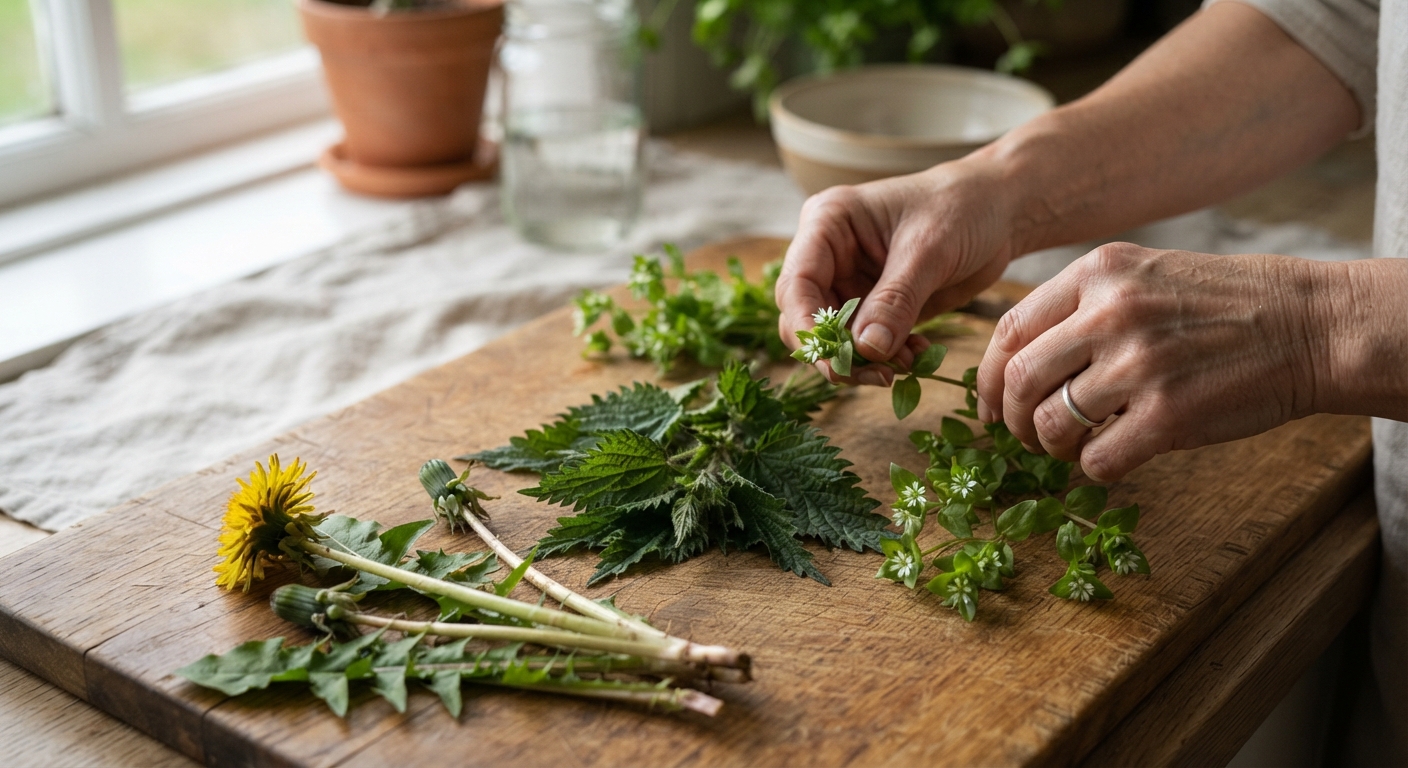
Chickweed: The Gentle One
Chickweed doesn’t command attention the way nettle or dandelion does. It sprawls low, grows in thick mats, and looks like something you’d walk past without a second thought. That’s a mistake.
As food: Chickweed tastes mild, grassy, and slightly sweet — think corn silk or young lettuce. It works raw in salads, wilted into pasta, or blended into green smoothies. It’s one of the few wild greens that genuinely works raw at any growth stage; the texture stays tender even after flowering.
As medicine: Chickweed’s medicinal use is mostly external. A chickweed poultice — just crushed fresh leaves applied directly to the skin — cools inflammation, soothes insect bites, and helps with minor rashes and eczema. The plant contains saponins that create a gentle cleansing effect. For itchy skin, a chickweed-infused oil (fresh leaves steeped in olive oil for 2–3 weeks, strained) is one of the simplest and most effective herbal preparations you can make.
The internal uses are gentler still. Chickweed tea has a mild demulcent effect — it soothes irritated mucous membranes — making it useful during cold season when your throat feels raw, though it won’t impress anyone with dramatic results.
Summer’s Resilient Healers: Plants That Thrive When Everything Else Wilts
Summer is the testing season for wild plants. Many spring greens have bolted, turned bitter, or disappeared entirely. These three species stick around and get stronger.
Purslane: The Omega-3 Weed
Purslane’s omega-3 profile deserves its own paragraph. This plant contains more alpha-linolenic acid (ALA) than any other leafy green tested — levels that approach what you’d expect from fish or flaxseed oil, not from a plant growing through sidewalk cracks. It also delivers vitamin E, vitamin C, and glutathione, an antioxidant that’s relatively rare in dietary sources.
As food: Purslane’s slightly sour, lemony flavor and succulent crunch make it a standout raw ingredient. Toss it into salads with tomato and cucumber. Sauté it briefly with onion and garlic (too long and it turns mucilaginous, like okra — whether that’s a feature or a bug depends on your feelings about okra). It works brilliantly in Mexican and Middle Eastern cooking; the Mexican dish verdolagas con cerdo (purslane with pork in a tomatillo sauce) is worth the effort.
As medicine: The omega-3 content is the headline, but purslane’s traditional use as a cooling, anti-inflammatory food has some basis in its chemistry. It’s been used to soothe digestive inflammation and urinary tract irritation. The fresh juice, applied topically, cools sunburn and minor burns — it’s not a substitute for proper burn care, but it’ll take the sting out while you’re getting to the first aid kit.
The one ID check that matters: Break a stem. Clear sap = purslane (edible). Milky white sap = spurge (toxic). This single test, performed every time, eliminates the only dangerous lookalike. Do not skip it even if you’re certain of the ID.
Yarrow: The Wound Warrior
Yarrow carries its reputation in its scientific name: Achillea, after Achilles, who supposedly used it to treat battlefield wounds. The plant’s ability to stop bleeding — a property herbalists call “styptic” — is real and observable. Crush fresh yarrow leaves and press them onto a minor cut; the bleeding slows noticeably faster than it would on its own.
As food: Go lightly here. Very young yarrow leaves, harvested before the flower stalk appears, can be chopped sparingly into salads — we’re talking a few leaves, not a handful. The flavor is bitter, aromatic, and distinctly medicinal; it tastes like what it does. Yarrow is solidly in the “medicine-forward” category. Nobody makes a yarrow casserole.
As medicine: This is where yarrow earns its place. Three primary applications:
- Wound care: Fresh leaf poultice for minor cuts and scrapes. The astringent and antimicrobial properties work together.
- Fever management: Hot yarrow tea (flowers and leaves) promotes sweating and can help the body’s fever response run its course. Drink it hot, get under blankets, and let the diaphoretic effect do the work. This is a traditional approach — use common sense about when medical attention is necessary.
- Digestive bitter: A few drops of yarrow tincture before meals stimulates digestive secretions, similar to dandelion but with a more aromatic, warming profile.
The identification note worth taking seriously: Yarrow has finely divided, feathery leaves that look nothing like most common plants — but at a distance, it can be confused with poison hemlock in its early growth stages. The difference, once you learn it, is unmistakable: yarrow leaves are deeply dissected and fern-like, with a distinct aromatic smell when crushed. Hemlock leaves are more broadly divided, hairless, and smell unpleasant (often described as “mouse-like”). Purple spots on the stem mean hemlock — walk away. Yarrow stems are green to reddish and hairy. Do not harvest yarrow until you can confidently distinguish the two.
Mullein: The Respiratory Ally
Mullein sends up a tall flowering stalk in its second year that can reach six feet or higher. The large, velvety leaves at the base — soft as flannel, which gives the plant its folk name “flannel leaf” — are what you’re after.
As food: Mullein isn’t food. The leaves are fibrous and unpleasant to eat, even when young. Skip this one for the plate and go straight to medicine.
As medicine: Mullein is a respiratory plant. The leaves, dried and made into tea or smoked (yes, people smoke mullein — it’s an old asthma remedy, though the inhalation of any burning plant material comes with its own risks), help loosen congestion and soothe irritated airways. The mechanism is partly physical: mullein contains mucilage, a slippery substance that coats and calms inflamed mucous membranes in the throat and lungs.
For earaches, mullein flower oil is a traditional remedy with some clinical backing. Infuse fresh mullein flowers in olive oil for 2–3 weeks, strain through a fine cloth, and use a few warmed drops in the ear canal (only if the eardrum is intact — never put anything in an ear with a suspected perforation).
Harvest note: The first-year basal rosette — a flat circle of large, fuzzy leaves close to the ground — is your target for leaf medicine. Second-year plants send up the flower stalk and the basal leaves decline in quality.
The Seasonal Harvest Calendar
Knowing what to pick when is half the battle. This table covers the twelve plants throughout the year.
| Plant | Spring (Mar–May) | Early Summer (Jun–Jul) | Late Summer (Aug–Sep) | Fall (Oct–Nov) | What Part to Harvest |
|---|---|---|---|---|---|
| Dandelion | 🟢 Peak (leaves) | 🟡 Leaves edible but bitter | 🟡 Flowers still available | 🟢 Peak (roots) | Leaves & flowers in spring; roots in fall |
| Stinging Nettle | 🟢 Peak (tops) | 🔴 Past prime — bolted | 🔴 Past prime | 🔴 Dormant | Top 4–6 inches before flowering |
| Plantain | 🟢 Good | 🟢 Peak | 🟢 Good | 🟡 Fading | Young leaves throughout growing season |
| Purslane | 🔴 Not yet emerged | 🟢 Emerging | 🟢 Peak | 🔴 Frost-killed | Whole above-ground plant |
| Yarrow | 🟡 Young leaves | 🟢 Peak (flowers) | 🟢 Good | 🟡 Fading | Flowers and leaves at peak bloom |
| Chickweed | 🟢 Peak | 🔴 Dormant (heat) | 🔴 Dormant | 🟢 Second peak | All above-ground parts |
| Mullein | 🟡 First-year rosettes | 🟡 Leaves OK | 🟢 Peak (flowers) | 🟡 Leaves still good | Leaves year 1; flowers year 2 |
| Elderberry | 🟢 Flowers | 🟡 Green berries (wait) | 🟢 Peak (ripe berries) | 🔴 Past season | Flowers in spring; berries late summer |
| Lamb’s Quarters | 🟢 Emerging | 🟢 Peak | 🟢 Good | 🟡 Fading | Young leaves and tender stems |
| Burdock | 🟢 Leaf stalks | 🟡 Roots OK | 🟡 Roots developing | 🟢 Peak (roots) | Roots in fall; young stalks in spring |
| Wild Rose | 🔴 Not yet | 🟢 Petals | 🔴 Between seasons | 🟢 Peak (hips) | Petals early summer; hips after first frost |
| Wood Sorrel | 🟢 Good | 🟢 Good | 🟢 Good | 🟡 Slowing down | Leaves and flowers |
🟢 = Prime harvest window | 🟡 = Usable but not peak | 🔴 = Avoid or unavailable
From Field to Remedy: Simple Preparations Anyone Can Make
You don’t need a laboratory to turn wild plants into medicine. Four preparation methods cover 90% of what you’ll want to do.
Tea (Infusion)
The simplest preparation — and the one most beginners get wrong.
For leaves and flowers (standard infusion): Pour boiling water over 1–2 teaspoons of dried herb (or 2–3 teaspoons fresh) per cup. Cover immediately — volatile compounds escape with the steam if you leave the cup open. Steep 10–15 minutes. Strain and drink.
For roots, bark, and berries (decoction): Place the plant material in cold water, bring to a boil, reduce heat, and simmer for 15–20 minutes. Roots and barks need sustained heat to release their compounds; a simple steep won’t do it.
For mineral-rich leaves like nettle (long infusion): Pour boiling water over a generous handful of dried nettle leaf (about 1 ounce per quart jar), cap tightly, and let steep at room temperature for 4–8 hours. This extracts minerals that a short steep misses entirely. The result is dark, almost broth-like, and tastes like green earth — in a good way. Drink within 24 hours.
Tincture
A tincture is just a concentrated herbal extract in alcohol. The alcohol pulls out compounds that water can’t reach and preserves the medicine for years.
Basic method: Fill a clean glass jar halfway with chopped fresh herb (or one-third full if using dried herb — dried plant material expands). Cover completely with 80–100 proof vodka. Seal tightly. Store in a dark cabinet for 4–6 weeks, shaking the jar every few days. Strain through cheesecloth or a fine mesh strainer, bottle the liquid in dark glass dropper bottles, and label with the plant name and date.
Dosage for most plants: 1–3 droppers full (about 30–90 drops), 1–3 times daily. Start low.
Plants that tincture particularly well: Dandelion root, yarrow, elderberry, burdock root.
Poultice
The fastest way to get plant medicine where it needs to go — directly on the skin.
Fresh poultice method: Chew or crush a handful of fresh leaves until they release their juice — a mortar and pestle works better than teeth, but teeth work in a pinch when you’re on a trail. Apply the crushed plant material directly to the affected area. Cover with a clean bandage or large leaf (plantain leaves are excellent for this) to hold it in place. Leave for 15–30 minutes.
Plants for poultices: Plantain (insect bites, splinters, minor wounds), chickweed (rashes, itchy skin), yarrow (minor cuts and scrapes).
Infused Oil
Used for salves, massage oils, ear drops (mullein), and first aid preparations.
Basic method: Fill a clean, completely dry jar halfway with chopped fresh herb (wilted overnight to reduce moisture content — water in fresh plant material can cause the oil to spoil). Alternatively, fill the jar one-third full with dried herb. Cover with olive oil, leaving an inch of headspace. Stir to release air bubbles. Cap tightly and place in a warm spot (a sunny windowsill works) for 2–4 weeks. Shake daily. Strain through cheesecloth and store in a dark glass bottle. Shelf life: 6–12 months if stored in a cool, dark place.
Plants for infused oils: Mullein flowers (ear oil), plantain (skin salve base), chickweed (anti-itch oil), yarrow (first aid oil).
The Gray Zone: When “Natural” Doesn’t Mean “Safe”
Wild plants are not inherently safe because they’re natural. Hemlock is natural. So is water hemlock, which killed Socrates. The dose and the plant matter more than the category.
The Rules Worth Following
One new plant at a time. If you’re trying a wild plant for the first time — especially one with medicinal effects — don’t combine it with other new plants on the same day. If you have a reaction, you need to know which plant caused it.
Pregnancy changes everything. Many medicinal plants are contraindicated during pregnancy. Yarrow can stimulate uterine contractions. Dandelion in large amounts may not be safe. Even nettle, gentle as it is, has traditional cautions around pregnancy. If you’re pregnant or nursing, consult someone who specializes in herbal medicine during pregnancy — not a foraging guide.
Medication interactions are real. Dandelion’s diuretic effect can interact with prescription diuretics and lithium. Nettle’s mineral content and mild diuretic action can affect blood pressure medications. Yarrow can interact with blood thinners and stomach acid reducers. If you take prescription medications regularly, talk to a healthcare provider before adding medicinal plants to your routine.
The allergic potential. Anyone can be allergic to anything. Start with small amounts of any new plant. This isn’t paranoia — it’s the same logic that guides the first bite of any new food.
Know when to stop being your own doctor. A plantain poultice on a bug bite is one thing. Using yarrow to treat a deep wound because you want to avoid a doctor is another. Wild plant medicine is excellent for supporting health and managing minor, self-limiting conditions. It is not a substitute for professional medical care when professional medical care is indicated.
Quick Answers to Common Questions
Q: Can I really replace store-bought medicine with wild plants?
No, and anyone who tells you otherwise is selling something. What wild plants can do is support baseline health, help manage minor conditions at home, and reduce your reliance on over-the-counter products for everyday issues. Keep your actual medications. Add wild plants to your toolkit, not as a replacement.
Q: How do I know if I’ve identified a plant correctly?
Use at least three confirming features — never rely on a single characteristic. For dandelion, confirm: jagged leaves, hollow leafless flower stalk, milky sap, single flower per stem. That’s four features. If three match, you’re almost certainly correct. If only one or two match, keep looking.
Q: Do I need to cook medicinal plants before using them?
It depends on the plant. Some work best raw (plantain poultice), some need cooking (nettle), some should never be eaten raw (elderberries). Check each plant individually. The profiles in this guide tell you what’s required.
Q: Where should I never harvest wild plants?
Avoid: roadsides (heavy metal accumulation from exhaust), industrial sites, railroad rights-of-way (herbicide spraying), dog parks, and any area where you don’t know the land use history. Agricultural field edges are questionable unless you know the farmer’s spray schedule. Your own unsprayed backyard, rural woodlands, and conservation areas with foraging-permitted policies are the safest bets.
Q: What’s the single most useful plant to learn first?
Dandelion. It’s everywhere, it’s unmistakable, every part is usable, and it bridges food and medicine better than any other common wild plant. Master dandelion — roots, leaves, and flowers — and you’ve got a model for understanding every other plant on this list.
Q: How do I store medicinal plants long-term?
Dried herbs in airtight glass jars, stored in a dark, cool cabinet, maintain potency for 6–12 months on average. Tinctures in alcohol last 3–5 years. Infused oils last 6–12 months refrigerated. Label everything with the plant name and harvest date. You will forget what’s in that jar — everyone does.
Q: Can I forage medicinal plants in winter?
In temperate climates, winter foraging is limited but not impossible. Dandelion and burdock roots can be dug whenever the ground isn’t frozen. Rose hips persist on the bush through winter and are actually sweeter after freezing. Chickweed sometimes grows through mild winters. Mullein’s first-year basal rosette survives under snow in many regions. Winter foraging requires more effort but rewards persistence.
Building Your Dual-Use Plant Knowledge
The distance between “I know dandelions are edible” and “I have a working wild plant practice” is about a season of consistent effort. Here’s a realistic path:
Month one: Learn dandelion and plantain. They’re everywhere, they’re safe, and between the two of them you can handle a surprising number of minor kitchen and medicine cabinet needs. Dandelion feeds you; plantain patches you up.
Month two: Add nettle (spring) or purslane (summer). You now have four plants that cover nutrition, wound care, inflammation, and mineral supplementation.
Month three: Add one medicine-forward plant — yarrow if you spend time outdoors and want wound care options, mullein if respiratory issues run in your family, elderberry if you want cold and flu season covered.
After six months: You’ll have a seasonal intuition. You’ll know what’s available in April versus August without checking a calendar. You’ll recognize plants at a glance, not because you memorized them but because you’ve seen them in multiple growth stages across multiple seasons.
The plants don’t care whether you call them food or medicine. They just grow. The distinction was always ours, not theirs.
This guide covers traditional and folk uses of wild plants. It is not a substitute for professional medical advice, diagnosis, or treatment. Always consult a qualified healthcare provider before using wild plants as medicine, especially if you are pregnant, nursing, taking prescription medications, or managing a chronic health condition. Plant identification is your responsibility — if you are not 100% certain of a plant’s identity, do not consume it.