Wild Medicinal and Food Plants: A Complete Foraging Guide
Most people who get into foraging learn two separate languages, and they never realize the two words mean almost the same thing. On one shelf sits the field guide to edible plants — dandelion, nettle, plantain, chickweed. On another shelf sits the herbal book — same dandelion, same nettle, same plantain, same chickweed. Two books, one plant, and a beginner standing in the middle wondering which one to follow.
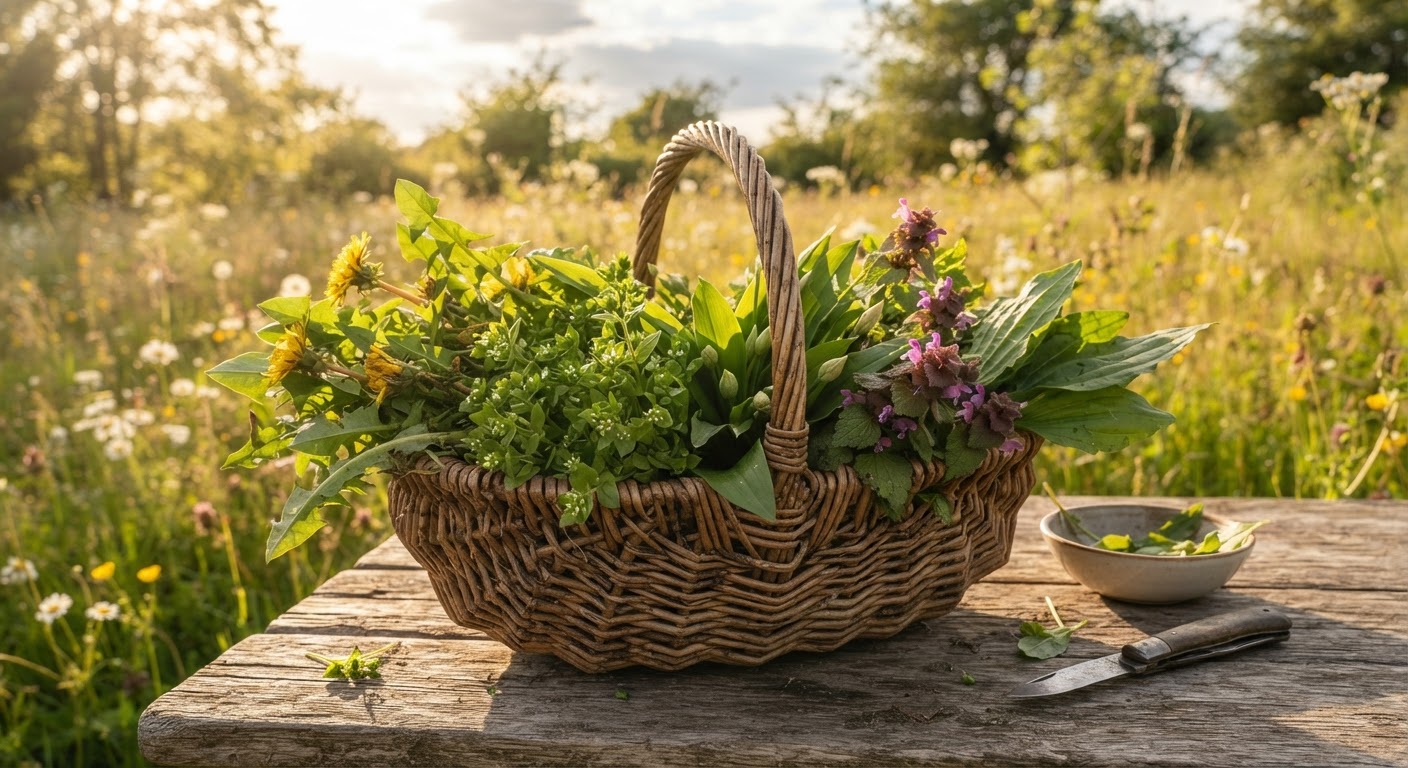
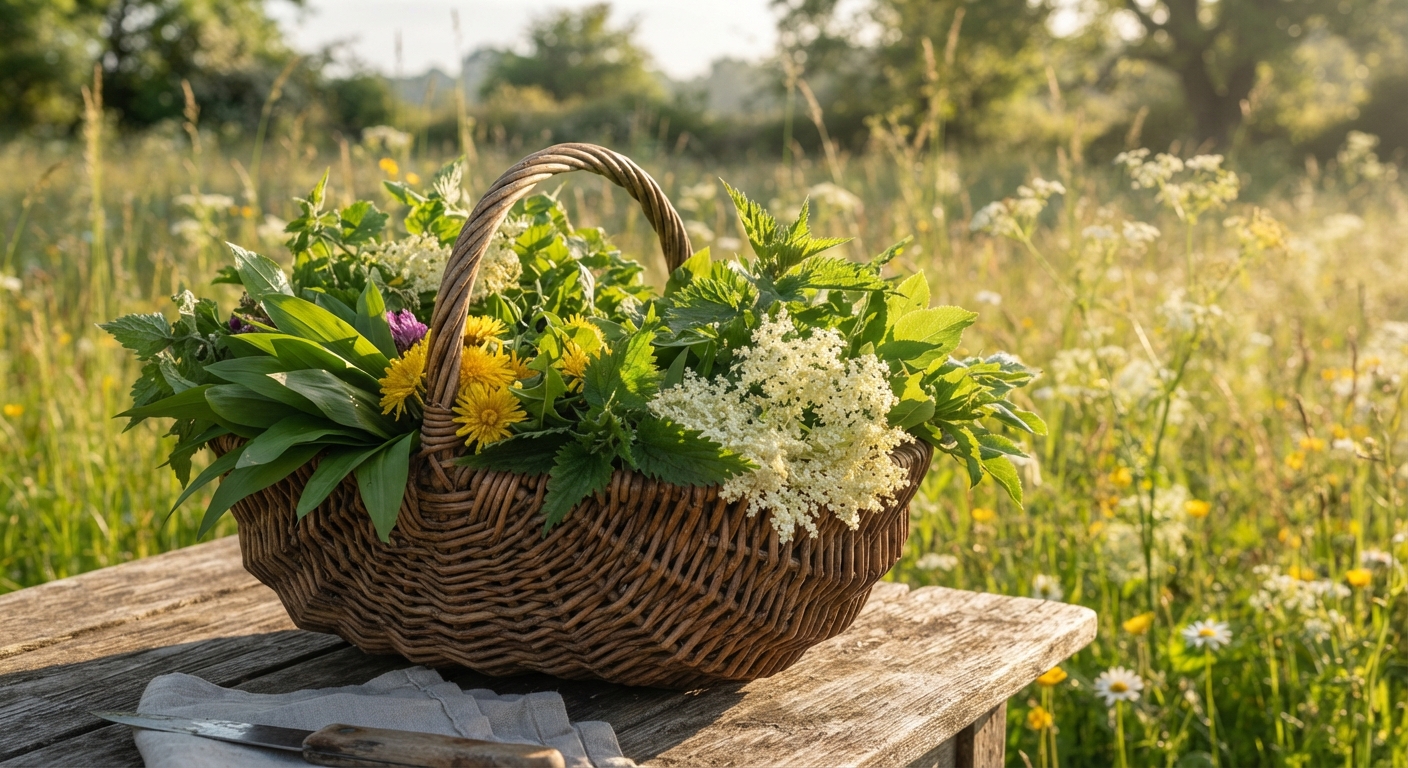
Here’s the thing nobody tells you early enough: for most of human history, there was no split. You ate what grew around you, and the same patch that filled your stomach in spring eased a sore throat, calmed a stomachache, or stopped a cut from bleeding. Food and medicine were the same walk, the same basket, the same hands. The division into “food plants” over here and “medicinal plants” over there is a modern convenience — and it quietly costs you half of what the plants can do.
This guide is about closing that gap. We’ll look at wild plants that genuinely do both jobs, work through a step-by-step identification method built for beginners, cover the timing that decides whether you’re harvesting dinner or a remedy, walk through how to prepare each one for each purpose, and spend real time on the safety line that separates “tonic” from “trouble.” By the end you’ll stop asking “is this edible?” and start asking the better question: edible, medicinal, or both — and for which part?
One honest note up front. Nothing here replaces a proper field guide, a local expert, or a doctor. Plants are powerful, and powerful things deserve respect. Treat this as your map, not your permission slip.
Why “Food” and “Medicine” Are the Same Search
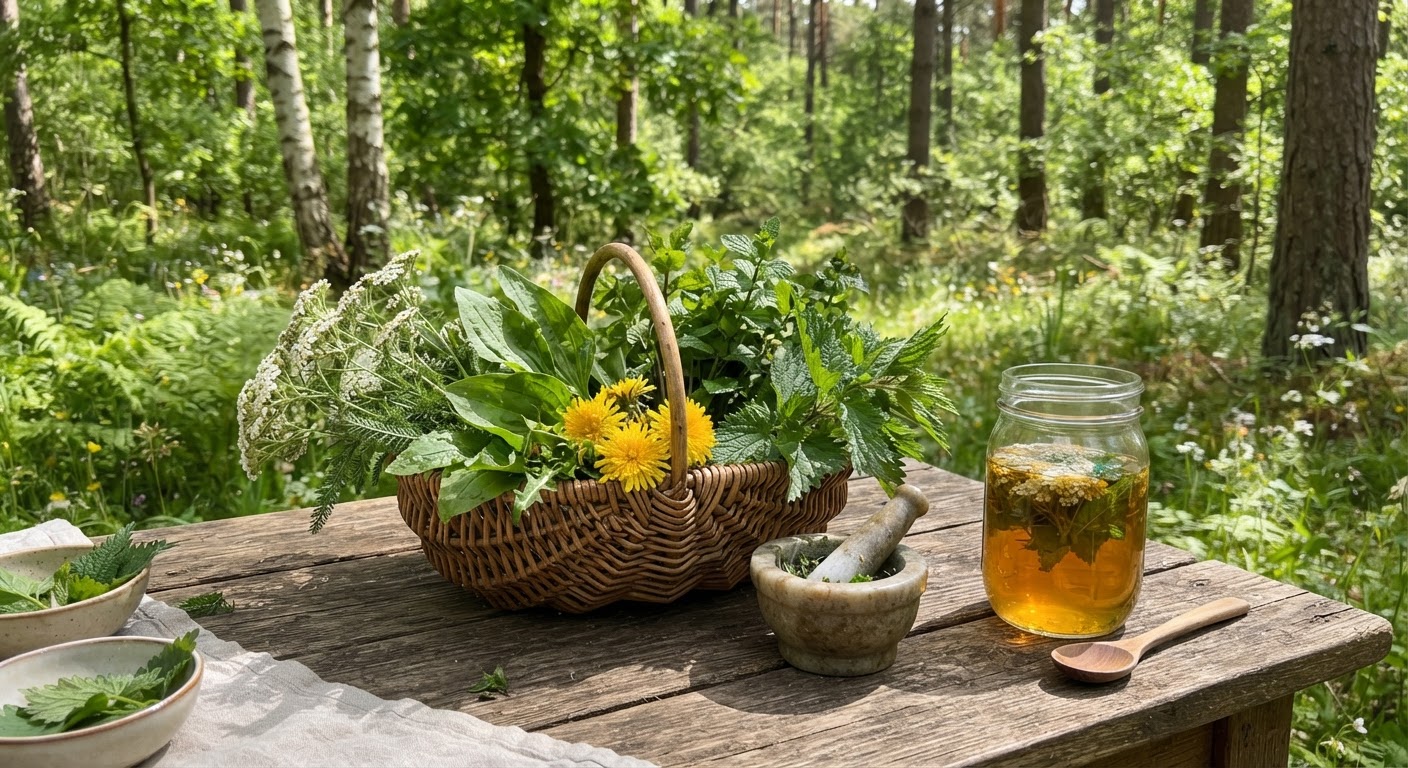
Think about what a plant is actually doing when it makes a bitter leaf, a sticky sap, or an aromatic oil. It isn’t trying to be dinner or a drug. It’s trying to survive — to repel insects, fight infection, and warn off animals that would eat it. Those same chemical defenses are what we call “medicinal compounds” when we use them on purpose.
That single idea explains almost everything confusing about this topic.
- The bitter taste of dandelion root is a defense compound — and it’s the same bitterness that stimulates digestion.
- The sting of nettle is protection — and the same plant is a dense package of iron, calcium, and anti-inflammatory compounds once the sting is neutralized.
- The mucilage that makes mallow leaves feel slippery is the plant holding water — and it’s exactly why a mallow tea coats a raw throat.
So when you forage with both jobs in mind, you’re not learning two systems. You’re learning one plant more completely. The forager who knows the leaf is food and the flower is medicine eats better and packs a tiny pharmacy in the same basket. That’s the whole payoff, and it’s real.
The trap for beginners is the opposite mistake: assuming that because a plant is “medicinal,” it’s automatically safe to munch, or that because it’s “edible,” a strong tea of it must be harmless. Neither is true. Which brings us to the line you never cross.
The Line You Never Cross: Not Every Medicine Is Food
There’s a category of plant that herbalists respect deeply and beginners should not touch: medicine-only plants. These are the ones powerful enough to genuinely help and powerful enough to genuinely hurt. Foxglove gives the heart medicine digitalis and will stop your heart if you guess the dose. Yew yields a chemotherapy compound and is lethal in the wrong amount. Comfrey heals tissue externally and damages the liver internally.
You don’t need these plants. Not as a beginner. Possibly not ever, if your goal is simply to eat well and handle small everyday complaints.
Here’s the working rule that keeps people out of trouble:
- Food-first plants — safe to eat in normal culinary amounts. Medicine is a bonus.
- Food-medicine plants — edible, but with a medicinal dose that’s smaller and needs care. These are the stars of this guide.
- Medicine-only plants — not food. Handle with training or not at all.
Almost everything worth learning as a beginner lives in the first two columns. When a plant wants to be in column three, that’s not a challenge — it’s a boundary. Walking away from a plant is a skill, and it’s one of the most valuable ones you’ll build.
The Three-Column Framework: Sorting Every Plant You Meet
Before you memorize any species, adopt the framework. It turns a chaotic field into a simple filing system, and it means you always know what question you’re answering.
| Column | What it means | How you treat it | Examples |
|---|---|---|---|
| Food | Safe to eat in normal kitchen amounts | Eat freely, cook as you would a vegetable | Chickweed, purslane, lamb’s quarters |
| Food-medicine | Edible, but a “medicinal dose” is a smaller, deliberate amount | Eat as food; use small measured amounts as tea or poultice | Dandelion, plantain, yarrow, mallow, mint |
| Medicine-only | Not food. Strong or toxic compounds | Learn to recognize it, not to use it | Foxglove, yew, comfrey, water hemlock |
The reason this matters is that the same plant can be perfect at one dose and a problem at ten times that dose. Yarrow in a salad is a pleasant herb. A strong pot of yarrow tea every day for a month is a different decision entirely. Sorting plants into columns forces you to think about amount and purpose, not just identity.
Once you’re thinking in columns, the identification itself gets easier, because you now know which parts and which moments to care about.
12 Wild Plants That Are Both Food and Medicine
This is your starter set — common, widespread, and genuinely dual-purpose. All twelve grow in disturbed ground, lawns, field edges, and trailsides across much of North America and Europe, which is exactly where beginners actually walk. Learn these before you chase anything rarer.
| Plant | Edible part | Traditional medicinal use | Key ID cues | ⚠️ Caution |
|---|---|---|---|---|
| Dandelion (Taraxacum) | Young leaves, root, flower buds | Bitter digestive tonic, gentle diuretic | Toothed basal rosette, hollow single stem, milky sap, one yellow flower per stem | Milky sap can irritate skin; bitter in heat |
| Broadleaf plantain (Plantago major) | Young leaves (cook) | Poultice for bites, stings, minor wounds | Oval ribbed leaves, parallel veins, tall seed spike | Wash well; grows in trampled/dirty ground |
| Yarrow (Achillea millefolium) | Young leaves (small amounts) | Stops bleeding, traditional fever herb | Feathery fern-like leaves, flat clusters of tiny white flowers | Avoid in pregnancy; can cause reactions |
| Stinging nettle (Urtica dioica) | Young leaves (cook first) | Nutritive tonic, joint and allergy support | Opposite serrated leaves, square stems, stinging hairs | Must blanch to remove sting; use young tops |
| Wild mint (Mentha spp.) | Leaves | Digestive, calming, cooling | Square stem, opposite leaves, unmistakable mint aroma | Avoid lookalike pennyroyal (toxic) |
| Chickweed (Stellaria media) | Whole young plant | Soothing, nutritive, skin support | Star-shaped white flowers, single line of hairs on stem | Mostly a food; gentle medicine |
| Purslane (Portulaca oleracea) | Leaves and stems | Cooling, omega-3 rich, traditional anti-inflammatory | Fleshy reddish stems, succulent paddle leaves, low mat | High oxalates — eat in moderation |
| Lamb’s quarters (Chenopodium album) | Leaves, seeds | Nutritive tonic | Goosefoot-shaped leaves, mealy white underside | Oxalates — cook, don’t overdo raw |
| Wood sorrel (Oxalis spp.) | Leaves, flowers | Cooling, vitamin C source | Three heart-shaped leaflets, sour lemony taste | Oxalic acid — small amounts only |
| Common mallow (Malva neglecta) | Leaves, flowers, seed pods | Soothing mucilage for throat and irritation | Round scalloped leaves, small pale-pink flowers, slippery feel | Very safe; food-medicine staple |
| Red clover (Trifolium pratense) | Flowers, young leaves | Traditional skin and respiratory support | Three leaflets with pale “V”, round pink flower heads | Avoid excess in pregnancy; interacts with blood thinners |
| Violet (Viola spp.) | Leaves, flowers | Soothing, traditional cough support | Heart-shaped leaves, irregular five-petal flowers | Safe; avoid confusing with lookalikes |
Notice how the “Edible part” column and the “Medicinal use” column rarely point at the same part. That’s not a coincidence — and it’s the next thing worth learning.
Step-by-Step: How to Identify a Dual-Purpose Plant
Identification is the skill everything else depends on. A mistaken ID doesn’t just ruin dinner — it can turn a “remedy” into a poison. Follow this sequence every single time, in order, and don’t skip steps because you’re in a hurry.
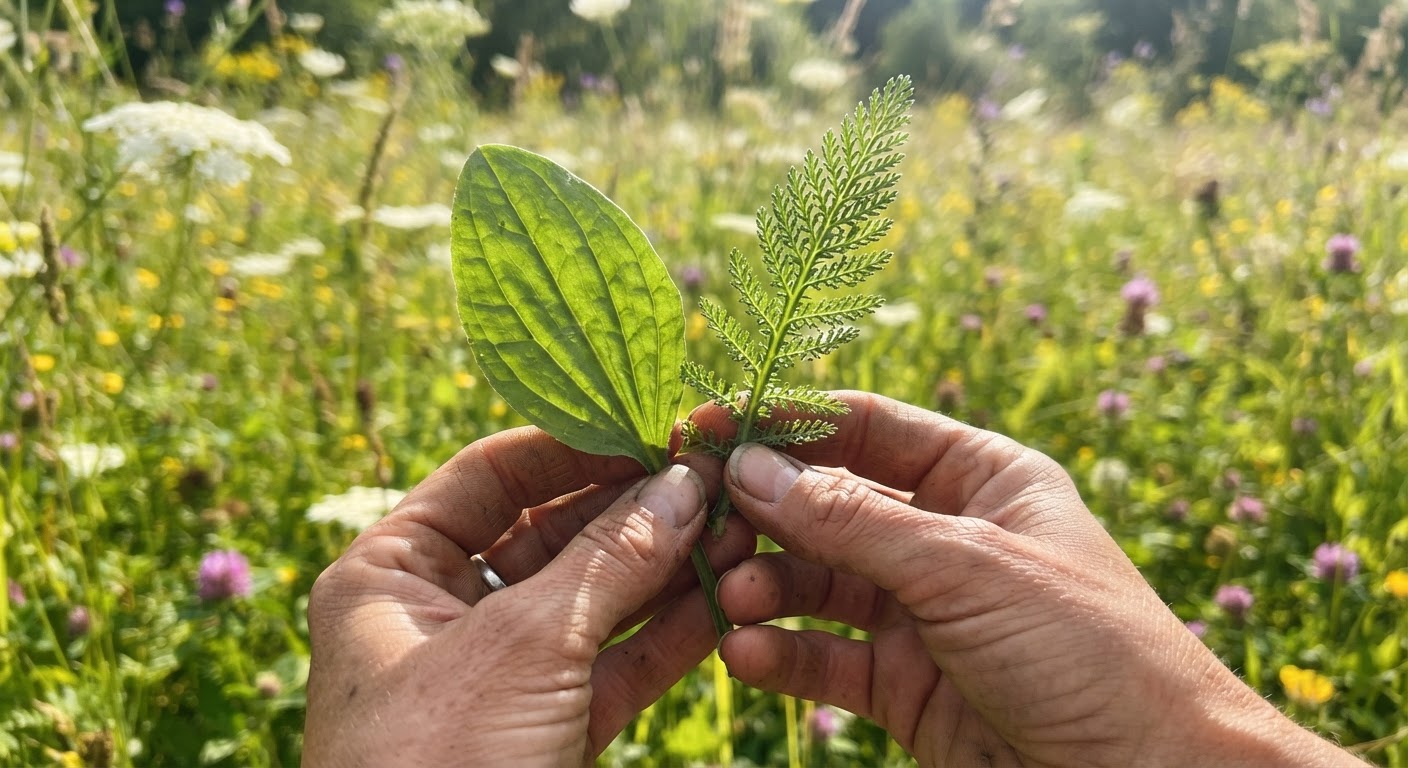
Step 1 — Start with the whole plant, not the leaf. Beginners photograph one leaf and try to match it. That fails constantly, because many unrelated plants have similar leaves. Look at the entire plant: height, growth habit, whether it grows alone or in a mat, whether it’s upright or sprawling.
Step 2 — Check the stem. Is it round or square? Hollow or solid? Hairy, smooth, or spiny? Square stems with opposite leaves shout “mint family.” Hollow single stems on a basal rosette point toward dandelion-type plants. The stem is often the fastest way to route your identification.
Step 3 — Smell it (safely). Crush a leaf between your fingers and smell. Mint is unmistakable. Yarrow is pungent and medicinal. This won’t confirm an ID on its own, but it eliminates a huge number of lookalikes in two seconds.
Step 4 — Look at the flowers and seeds if present. Flower structure is the most reliable ID feature there is. A single yellow flower on a hollow stem, a flat white flower cluster, a tiny five-petal violet — these narrow things down fast.
Step 5 — Confirm with a second source. Never trust one source — not one app, not one book, not one person. Match your plant across at least two independent references before it goes anywhere near your mouth. This is the single habit that separates confident foragers from lucky ones.
Step 6 — Check the ground it grew in. The same plant is clean food in an untouched meadow and questionable in a sprayed roadside ditch, a dog-walking path, or downhill from industrial ground. Location is part of the ID.
Step 7 — Do one plant at a time. Learn one new plant per outing, eat only a small amount the first time, and wait a day to see how your body responds. This is exactly what a cautious forager does — and it’s how you build a personal record of what suits you.
That last point deserves its own emphasis: a small first taste is not paranoia, it’s method. Some people react to perfectly edible plants (the whole aster family catches certain people out). Your response to a plant is part of whether it’s “edible” for you.
Harvest Timing: Same Plant, Different Job
Here’s where food-foraging and medicine-foraging quietly split apart. The part you take and the moment you take it depend entirely on which job you’re doing.
| Plant | Part | Best for food (when / how) | Best for medicine (when / how) |
|---|---|---|---|
| Dandelion | Leaf / Root | Young leaves in early spring, before flowers | Root dug in late autumn, after first frost |
| Nettle | Leaf | Top 4–6 leaves in spring, before seeding | Same tops, dried for winter tea |
| Plantain | Leaf | Young tender leaves in spring | Mature leaves any time for poultice |
| Yarrow | Leaf / Flower | Young leaves sparingly in spring | Flowers at full bloom, dried for tea |
| Mint | Leaf | Any time, freshest in summer | Same leaves, dried or fresh as tea |
| Mallow | Leaf / Flower | Young leaves and flowers in summer | Mucilage-rich leaves for soothing tea |
| Red clover | Flower | Fresh flowers in early bloom, in salads | Flower heads fully open, dried for infusion |
| Wood sorrel | Leaf | Early spring, young and mild | Same, used fresh and sparing |
The pattern underneath is consistent, and once you see it you’ll apply it to plants not on this list:
- Leaves for food want youth. Young equals tender and mild. Old equals fibrous and often more bitter or higher in compounds like oxalates.
- Roots for medicine want the plant’s dormant season. Energy is stored down there in late autumn, which is when roots are most potent.
- Flowers for medicine want full bloom. That’s peak aromatic and active compounds, and it’s when they’re easiest to identify too.
- Mature leaves for external medicine are often fine later in the season, because you’re not eating them — you’re pressing them onto skin.
Get the timing right and the same plant gives you very different tools.
How to Prepare Wild Plants for Food vs Medicine
Preparation is where a lot of good foraging gets wasted. Cook a medicine like a vegetable and you dilute it. Eat a food-plant like a medicine and you may overdo the dose. Here’s the practical split.
For food
1. Clean aggressively. Wild greens carry grit, insect eggs, and sometimes animal residue. Rinse in a large bowl of cold water, lift the greens out, and dump the water — repeat until the water runs clean. Don’t let dirt settle back onto the leaves.
2. Blanch the tough or stingy ones. Nettle, and any leathery green, gets 30–60 seconds in boiling water, then a cold-water shock. This kills nettle’s sting, cuts bitterness, and lowers oxalates. Save the blanching water if you like it — it’s a light mineral broth.
3. Cook to your taste, but respect the plant. Tender greens like chickweed, mallow, and purslane are happy raw or barely wilted. Bitter greens like dandelion and lamb’s quarters improve with a quick sauté in fat, which rounds off the bitterness.
4. Season simply. Wild greens are already more flavorful than grocery store lettuce. Olive oil, lemon, garlic, salt. That’s usually all a good wild dish needs.
For medicine
Infusion (tea) — for leaves and flowers. Pour just-boiled water over dried or fresh leaves and flowers, cover, and steep 10–15 minutes. Covering matters: it traps the aromatic oils that do much of the work. This is the method for mint, chickweed, mallow, violet, and yarrow.
Decoction (simmer) — for roots, seeds, and bark. These are tough and need heat to give up their compounds. Simmer gently in water for 15–20 minutes, covered. This is how you’d work with dandelion root, for example.
Poultice — for external use. Mash or chew fresh leaves (plantain and yarrow are classics), warm them slightly, and apply directly to a clean cut, sting, or bite, then cover. This is external only — never a reason to swallow a plant.
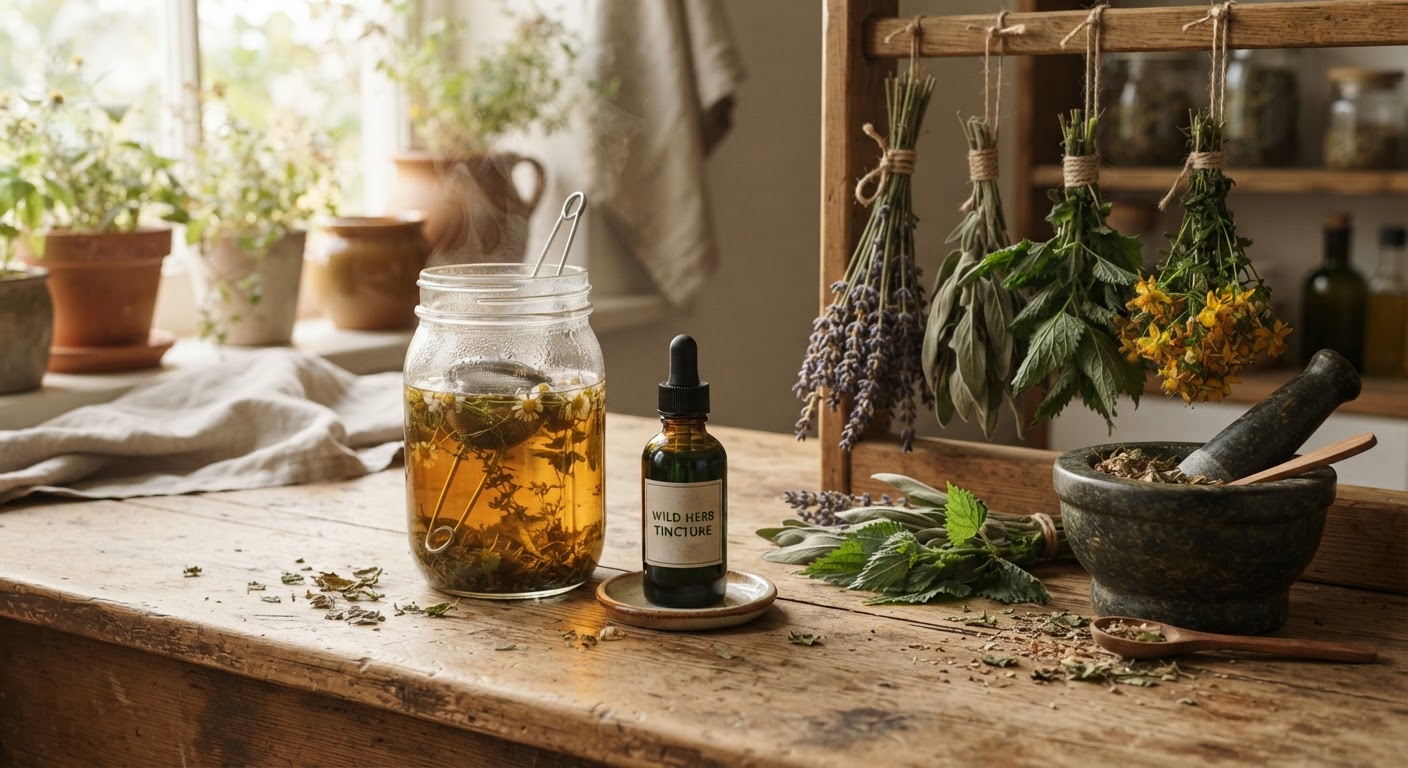
Tincture — for long storage. Chop fresh plant material, cover it completely with high-proof alcohol in a clean jar, seal, and shake daily for two to six weeks. Strain and bottle. Tinctures keep for years, which is why herbalists love them, but they also concentrate the plant — so they demand the most care with dose.
The Start-Low Rule: Dosage Without the Guesswork
Herbalism has one universal safety rule, and it applies whether you learned it from an old book or a modern herbalist: start low, go slow.
A reasonable working approach for a beginner, with any food-medicine plant:
- First time ever: a small taste. A leaf or two. Wait 24 hours.
- Everyday food use: normal kitchen quantities, like you’d use spinach or lettuce.
- Daily tea: one modest cup of a mild herb, one to two times a day, for a few days — not a month.
- Strong teas or tinctures: only with a specific reason, and only for a short, defined period.
- Stop immediately if you get a headache, nausea, a rash, or a racing heart. Your body is telling you something.
And three situations where you don’t self-experiment at all: pregnancy and breastfeeding, children, and anyone on prescription medication. Wild plants interact with drugs the same way medicines do — red clover can affect blood-thinning; nettle can affect blood pressure; many “safe” herbs are not safe in pregnancy. When in doubt, ask a doctor or a qualified herbalist. That’s not overselling caution; it’s the actual boundary.
Season Chart: What to Gather for Food and Medicine
Foraging runs on a calendar, and that calendar looks different depending on whether your goal is dinner or a remedy. Use this as a rough map, then adjust for your own climate zone.
| Season | Best food harvests | Best medicine harvests | What to skip |
|---|---|---|---|
| Early spring | Nettle tops, young dandelion leaves, chickweed, plantain leaves, violet leaves | Nettle (dried for year), violet leaf | Old overwintered leaves — tough |
| Late spring | Lamb’s quarters, purslane, mint, mallow | Yarrow leaf, mint, red clover starting | Any plant bolting to seed — going bitter |
| Summer | Purslane, mallow flowers, mint, wood sorrel | Yarrow flower, red clover flower, plantain leaf | Hot, dusty roadside growth |
| Early autumn | Roots beginning to store energy, seeds | Dandelion root digging begins, seeds for later | Plants past peak; flower heads gone |
| Late autumn / after frost | Dandelion root, any remaining hardy greens | Dandelion root, nettle root | Frozen, mushy greens |
| Winter | Stored dried goods, very few fresh options | Dried teas, tinctures, root preparations | Most fresh foraging — learn, don’t harvest |
The takeaway is simple: spring is for leaves and eating; autumn is for roots and storing. If you’re building a useful wild pantry, you spend spring filling your plate and your drying rack, and autumn digging the roots that carry you through winter.
Safety: The Mistakes That Turn a Remedy Into a Problem
After watching a lot of beginners (and making plenty of these mistakes myself), the same handful of errors keep showing up. Learn them now and skip the lesson.
Mistake 1 — Trusting a single app or a single photo. No identification tool is a guarantee, including any plant app. Use them to narrow things down, then confirm with a real field guide or a person who knows the ground. Apps are a starting point, never a verdict.
Mistake 2 — Confusing a “safe” family with a “safe” plant. The carrot family alone contains both beloved food and some of the deadliest plants in the world (water hemlock). Family resemblance is a warning, not a promise.
Mistake 3 — Eating a plant from a contaminated spot. Roadside, sprayed lawns, downhill of industry, busy dog paths — the plant may be fine and the location may poison you. Where you pick is half of safety.
Mistake 4 — Using the wrong part. Elderberry fruit is food; its stems and unripe berries are not. Rhubarb stalk is food; its leaf is not. Always confirm the part, not just the species.
Mistake 5 — Overdoing a “healthy” daily tea. More is not stronger in a good way. A plant that soothes at one cup can cause problems at ten. Respect dose more than enthusiasm.
Mistake 6 — Assuming medicinal means edible. Foxglove is medicinal in the technical sense and will kill you. The two words overlap, but they are not synonyms.
Mistake 7 — Forgetting your own body. Allergies, sensitivities, and interactions are real. A plant can be “safe” for the internet and still wrong for you.
Pro Tips From Years in the Field
A few habits that took me embarrassingly long to build, offered so they cost you nothing.
- Keep a foraging journal. Date, location, plant, part, how you used it, how you felt. After a year you’ll have your own local field guide, and it’ll be more useful to you than any book, because it’s written about your ground.
- Build a “10 plants I truly know” list before learning an 11th. Depth beats breadth every time in this hobby. Someone who knows ten plants cold eats far more safely than someone who half-recognizes fifty.
- Do the ID twice — once in the field, once at home before you cook. Perspective changes when you’re not standing in the sun trying to make a plant be what you hoped it was.
- Harvest gently. Take a little from many plants rather than everything from one. Leave the biggest and healthiest to seed so your patch comes back next year.
- Learn three standout poisonous plants cold so you can recognize and avoid them anywhere. In most regions, that’s water hemlock, pokeweed (as food vs medicine, it’s a trap), and foxglove. Knowing what not to touch protects you more than knowing what to touch.
FAQ
Are medicinal wild plants automatically safe to eat? No — and this is the most dangerous assumption in the whole hobby. Edible and medicinal overlap, but they aren’t the same thing. Some medicinal plants are powerful precisely because they’re not food-safe. Always sort a plant into the food / food-medicine / medicine-only framework before you do anything with it.
Can I use wild plants instead of seeing a doctor? No. Wild plants can support everyday wellbeing, and some have real traditional uses, but they are not a substitute for medical care, diagnosis, or prescription medicine. If something is seriously wrong, see a professional. Foraging is a supplement to good health habits, never a replacement.
How much of a wild medicinal plant can I eat or drink? For food plants, normal kitchen amounts. For food-medicine plants, start with a small taste, keep daily teas to a modest cup or two for a few days, and stop if anything feels off. Roots and tinctures are more concentrated and deserve more caution. When in doubt, less is the safe direction.
What’s the easiest dual-purpose plant for a total beginner? Broadleaf plantain and common mallow are ideal first plants. Both are widespread, easy to identify, gentle, and genuinely useful as food and as soothing medicine. Dandelion and nettle are the natural next step — slightly more work, much more payoff.
Do I need to cook wild plants before eating them? Some greens are happy raw (chickweed, mallow, purslane, wood sorrel in small amounts). Others should be cooked — nettle must be blanched to remove the sting, and high-oxalate greens like lamb’s quarters are better cooked. When unsure, a quick blanch is the safe default.
Where should I never forage? Roadsides, sprayed lawns, industrial land, train tracks, busy dog paths, and anything downhill from agriculture or dumping. The plant might be perfectly edible while the site makes it unsafe. Clean ground first, plant second.
Is it legal to forage wild plants? It depends entirely on where you are. Many public lands allow foraging for personal use with limits; many parks, nature reserves, and private properties forbid it outright. Check local rules before you pick — knowing the law is part of doing this responsibly.
Can I forage medicinal plants in winter? Fresh food foraging largely shuts down in winter in cold climates, but this is the season for using what you dried and preserved, and for planning next year’s patches. In mild climates, some hardy greens and roots remain available year-round.
Food and Medicine Were Never Two Walks
The plants that feed you and the plants that heal you are, more often than not, the same plants. Once you stop separating them, foraging stops being a novelty hobby and starts being a genuinely useful skill — one where a single basket can hold dinner, a soothing tea for a sore throat, and a poultice for a scraped knee. That’s not a small thing. It’s thousands of years of knowledge, sitting right there in the weeds you walk past every day.
The one thing that stands between you and all of it is confidence in your identification — and that’s the part that’s easy to get wrong when you’re alone, in a hurry, and staring at a leaf you’re only mostly sure about. When you’re out on the trail and the guidebook is back in the car and your signal has dropped to nothing, the difference between a safe harvest and a risky one usually comes down to a second opinion.
That’s exactly the gap I built Edible Plant Identifier to close. Snap a photo of any leaf, flower, or berry and it identifies the plant and tells you what it’s commonly used for — as food, as a traditional remedy, or as something to leave alone — with clear lookalike warnings so you don’t confuse it with a dangerous cousin. It works fully offline, so it’s there when the trail isn’t.