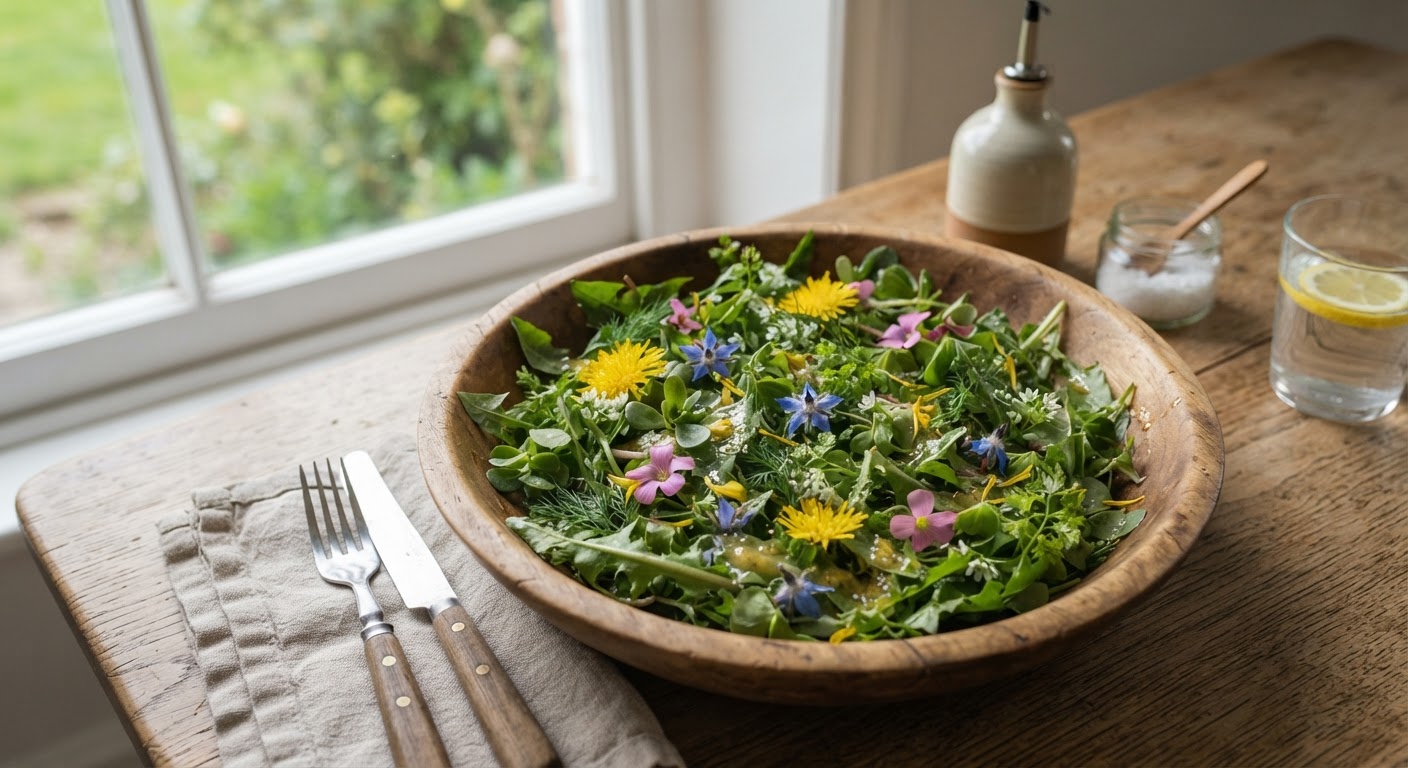
The first wild salad most people make is almost always the last one they want to eat. You grab a handful of dandelion leaves from the yard, toss them with some supermarket vinaigrette, take one bite, and your whole face folds in on itself. Too bitter. Too tough. And just like that, you’ve concluded that wild greens are something survivalists choke down, not something you cook with on a Tuesday.
Here’s the thing: the plants weren’t the problem. The recipe was.
Wild greens don’t behave like lettuce, and that’s the entire insight you need. They’re stronger, more bitter, more textured, and more interesting — which means they reward a completely different approach. Get the balance right and a foraged salad beats anything in a plastic clamshell. Get it wrong and you’re chewing a lawn.
This guide gives you the system, not just a recipe. You’ll learn which wild greens are worth picking for a raw salad, how to balance their flavors so bitterness becomes the good kind, and a build-your-own formula you can run with whatever you find in the field.
One rule sits above everything below, and it never changes: never eat a wild plant you can’t identify with 100% confidence. Cross-check every green against a regional field guide and a trusted photo database before it touches a cutting board. Nothing here replaces that.
Why Most Foraged Salads Fail
Before the fix, the diagnosis. A wild salad usually fails for one of three reasons, and almost every time it’s the first one.
Bitterness overload. Many of the best wild greens — dandelion, chicory, wild mustard — are genuinely bitter. Bitter isn’t bad; coffee and dark chocolate are bitter. But bitterness needs fat, acid, and sweetness to sit on top of, and most people throw raw bitter leaves at a bottled dressing and call it done.
Wrong greens, wrong job. Some wild greens are magnificent raw (chickweed, wood sorrel, purslane). Others are basically inedible raw but wonderful cooked (stinging nettle, older dock). Using the wrong green for a raw salad is the fastest way to ruin it.
Leaf age matters. The same dandelion that’s pleasantly sharp in early spring is aggressively bitter by July. Harvest window changes everything, and most recipes don’t mention it.
Fix all three and a wild salad goes from “interesting experiment” to “I’m making this again on purpose.”
The Flavor System: Five Categories of Wild Greens
Here’s the mental model that makes everything else easy. Instead of memorizing forty plants, sort the ones you find into five flavor buckets. A great salad pulls from at least two or three of them, never just one.
| Flavor Category | What It Tastes Like | Common Wild Greens | How to Use It |
|---|---|---|---|
| Mild & Neutral | Close to lettuce, soft, forgiving | Chickweed, young lamb’s quarters, young violet leaves | The bulk of the salad — use generously as your base |
| Peppery / Spicy | Like arugula or watercress | Wild mustard, wintercress, young watercress, peppergrass | Use as a bold accent, 20–30% of the mix |
| Bitter | Like radicchio or endive, sharp | Young dandelion, chicory, sow thistle, hawkbit | Small amount (10–20%), always balanced with fat + acid |
| Sour / Tangy | Like lemon or green apple | Wood sorrel, sheep sorrel, purslane | A handful brightens everything — nature’s lemon juice |
| Briny / Mineral | Salty, cucumber-like | Purslane, sea purslane, samphire, orache | Adds that savory depth; pairs with creamy dressings |
The single most useful habit: start with a mild base, then layer in one peppery, one bitter, and one sour. That’s the difference between a salad and a pile of leaves. Taste as you go and stop adding bitter the moment it stops being pleasant.
The 6 Best Wild Greens for a Raw Salad
These six earn their place because they’re common, easy to identify, and genuinely good raw. Ranked roughly from mildest to boldest.
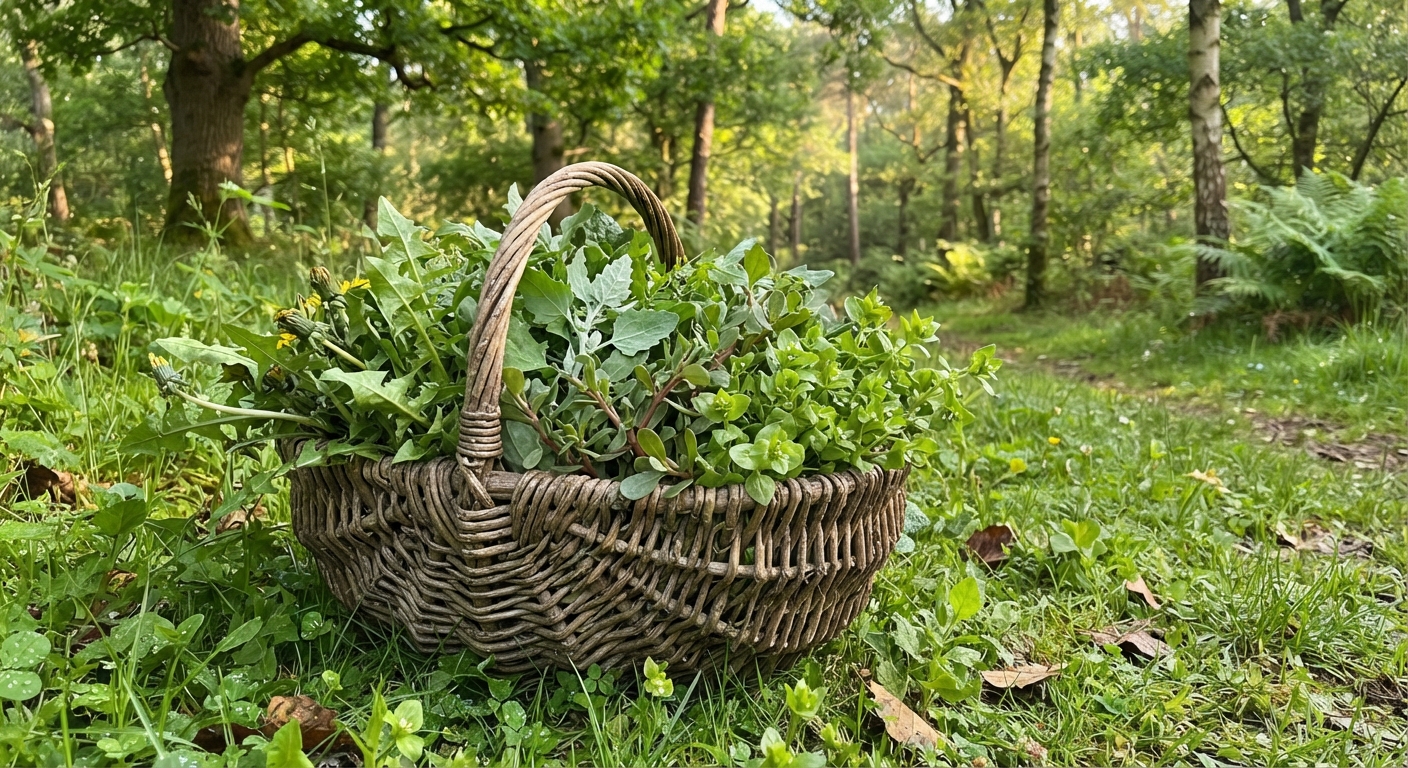
1. Chickweed (Stellaria media). The single best beginner wild salad green in existence. It’s soft, mild, faintly grassy, and grows in cool seasons almost everywhere. Look for tiny white star-shaped flowers and a single line of fine hairs running down one side of the stem. Snip the top few inches and use the whole thing — stems included.
2. Purslane (Portulaca oleracea). Thick, juicy, succulent leaves with a lemony, slightly salty bite. It’s the closest wild thing to a “normal” salad green and thrives in summer when other greens have turned tough. Wash well — it grows low and loves sandy soil. The stems are crunchy and entirely edible.
3. Wood Sorrel (Oxalis spp.). Heart-shaped leaves in groups of three that taste like lemon candy. This is your acid, not your base. Scatter a small handful through any salad and you can skip half the lemon in the dressing. Go easy — it contains oxalic acid, so a little is a garnish, a lot is a kidney stone waiting.
4. Young Lamb’s Quarters (Chenopodium album). Often called wild spinach, and for good reason — tender, mild, faintly nutty, with a subtle powdery sheen on the underside of the leaf. Use the young top leaves raw; the plant gets tougher and more soapy-tasting as it matures. Great as a base mixed 50/50 with chickweed.
5. Young Dandelion (Taraxacum officinale). The classic wild bitter green. Pick the youngest, tenderest inner leaves from a plant that hasn’t flowered yet, ideally in spring or fall. The bitterness is a feature, not a bug — it makes the whole salad taste more complex. Just keep it to a small fraction of the mix and pair it with something creamy or sweet.
6. Wild Mustard (Sinapis / Brassica spp.). Bright yellow flowers, leaves that smell like mustard or horseradish when crushed. Raw, the young leaves bring a peppery heat that rivals arugula. If the leaf tastes too aggressive raw, blanch it for ten seconds and shock it in cold water — the heat mellows instantly.
The Salad Formula: Six Parts, Infinite Variations
Forget memorizing recipes. Remember this formula and you can build a wild salad out of anything you bring home.
Base (60–70%) + Accent (20–30%) + Fat + Acid + Sweet + Crunch
- Base — your mild greens: chickweed, young lamb’s quarters, young violet leaves. This is the bulk and the texture.
- Accent — your bold greens: a little dandelion (bitter), wild mustard (peppery), and wood sorrel (sour). This is the personality.
- Fat — olive oil, nut oil, crumbled cheese, avocado, or a soft egg. Fat is what makes bitterness taste rich instead of harsh.
- Acid — lemon, vinegar, or a squeeze of the sorrel you already picked. Acid brightens and balances.
- Sweet — a drizzle of honey or maple, sliced fruit, or sweet root veg. Sweetness is the counterweight to bitterness.
- Crunch — toasted seeds, nuts, shaved radish, or crispy chickpeas. Texture keeps a soft green salad interesting.
The ratio is forgiving. If your greens taste too bitter, add more fat and sweet, or swap some bitter for mild. If the salad feels flat, add more acid and a pinch of salt. That’s the whole method — taste, adjust, repeat.
5 Wild Greens Salad Recipes to Start With
Each one uses the formula above. They’re ordered from mildest to boldest so you can build confidence as you go.
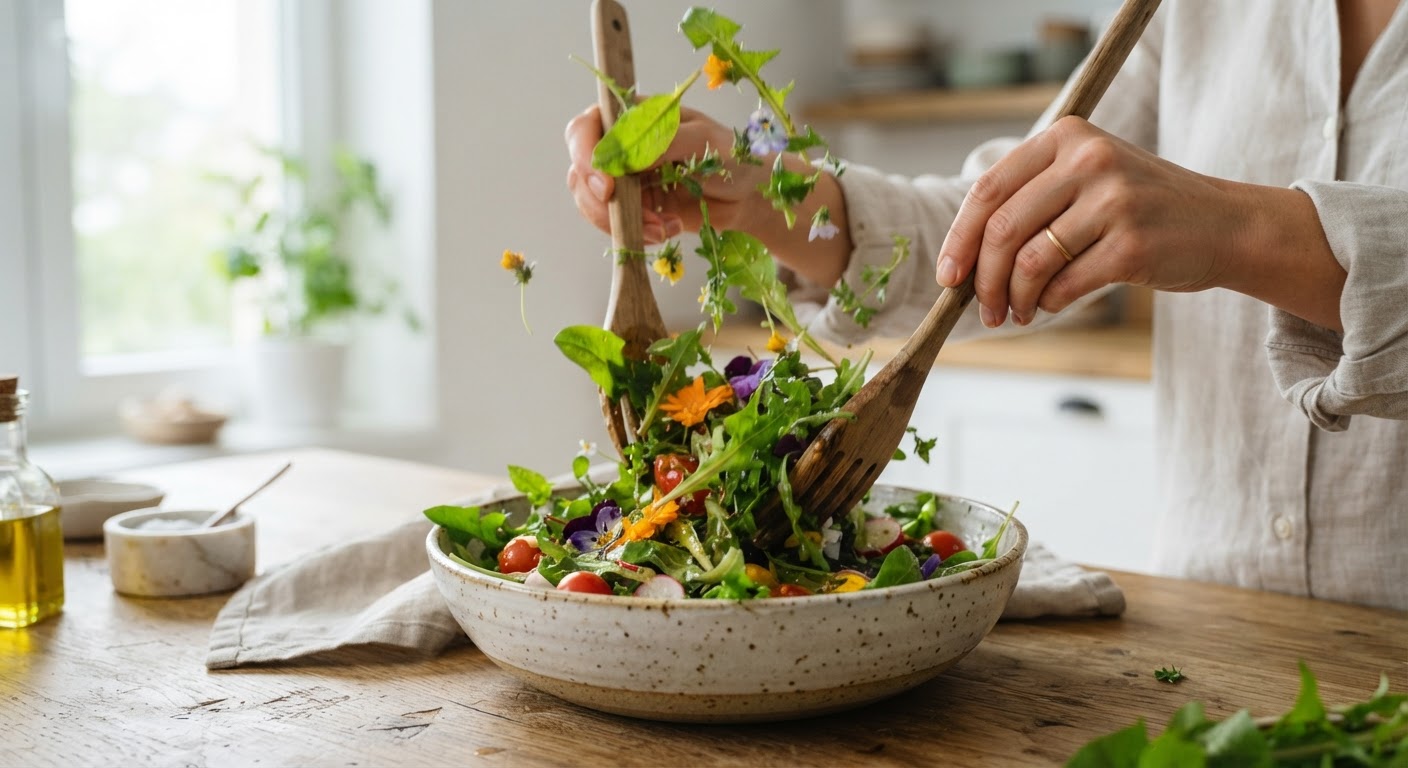
1. Chickweed & Cucumber Salad (mildest, 10 minutes)
The “gateway” salad — tastes almost like a normal one, so it’s the right place to start.
- Base: 3 cups chickweed tips
- Accent: 1/4 cup wood sorrel
- Fat: 2 tbsp olive oil
- Acid: 1 tbsp lemon juice (light — the sorrel brings acid too)
- Sweet: half a sliced cucumber
- Crunch: 1 tbsp toasted sunflower seeds
Toss everything, salt and pepper to taste. The cucumber does the sweet-and-crunch job in one ingredient.
2. Purslane, Tomato & Feta Salad (15 minutes)
Summer’s answer when most greens have gone tough.
- Base: 2 cups purslane, thick stems trimmed
- Accent: a small handful of young dandelion leaves
- Fat: 3 tbsp crumbled feta
- Acid: 1 tbsp red wine vinegar
- Sweet: a pint of halved cherry tomatoes
- Crunch: 2 tbsp toasted pine nuts
The salty feta and sweet tomatoes turn purslane’s lemony bite into something genuinely Mediterranean.
3. Lamb’s Quarters & Peach Salad (12 minutes)
The nutty wild spinach loves fruit.
- Base: 3 cups young lamb’s quarters leaves
- Accent: 1/4 cup wild mustard leaves, torn small
- Fat: 2 tbsp walnut oil
- Acid: 1 tbsp sherry vinegar
- Sweet: one ripe peach, sliced
- Crunch: 2 tbsp chopped toasted walnuts
The peach fat-and-sweet combo makes the mustard’s heat taste intentional rather than aggressive.
4. Dandelion & Warm Bacon Salad (20 minutes)
The classic wilted-dandelion move, done properly. Hot fat is the fastest bitterness tamer there is.
- Base: 4 cups young dandelion leaves
- Accent: 1/4 cup chopped wood sorrel
- Fat: 3 slices bacon, chopped, rendered crisp
- Acid: 2 tbsp cider vinegar stirred into the warm fat
- Sweet: 1 tsp honey whisked into the dressing
- Crunch: the crispy bacon itself, plus a soft-boiled egg if you’re hungry
Pour the hot bacon-vinegar dressing over the greens, toss immediately so the leaves soften just slightly, and serve warm.
5. The “Everything You Found” Wild Salad (15 minutes)
The formula in its purest form, for when you came home with a mixed bag.
- Base: 2 cups chickweed + 1 cup young lamb’s quarters
- Accent: small handful each of dandelion, wild mustard, and wood sorrel
- Fat: 3 tbsp good olive oil
- Acid: juice of half a lemon
- Sweet: 1 tsp maple syrup or honey
- Crunch: toasted seeds or nuts
Taste before you dress. Too bitter? Add a touch more honey and oil. Too dull? More lemon and salt. This is the recipe that teaches you the formula for good.
Dressing Cheat Sheet
A wild salad’s bitterness lives or dies by the dressing. These five cover almost every situation. All make enough for one large salad; shake or whisk until smooth.
| Dressing | Base | Flavor | Best With |
|---|---|---|---|
| Lemon-Honey | 3 tbsp olive oil, 1 tbsp lemon juice, 1 tsp honey, pinch salt | Bright, mildly sweet | Chickweed, lamb’s quarters, mixed mild greens |
| Balsamic-Dijon | 3 tbsp olive oil, 1 tbsp balsamic, 1/2 tsp Dijon, pinch salt | Rich, tangy | Purslane, dandelion, anything bitter |
| Creamy Tahini | 2 tbsp tahini, 2 tbsp water, 1 tbsp lemon, 1 small crushed garlic clove | Nutty, mellow | Dandelion, wild mustard — softens strong greens |
| Warm Bacon | 3 tbsp hot bacon fat, 2 tbsp cider vinegar, 1 tsp honey | Smoky, sweet-tart | Dandelion, chicory, any tough bitter leaf |
| Yogurt-Herb | 3 tbsp plain yogurt, 1 tbsp olive oil, 1 tbsp lemon, chopped herbs | Cool, creamy | Purslane, orache, briny greens |
Rule of thumb: the more bitter the greens, the more fat and sweet your dressing needs. A mild chickweed salad wants a light lemon-honey vinaigrette; a bowl of mature dandelion wants warm bacon fat.
Safety Quick-Reference
Wild salads are safe when you treat identification as the whole job. The checklist:
- Confirm every single plant against two independent sources — a regional field guide plus a trusted photo database.
- Learn the toxic lookalikes before the edible plant. Hemlock looks nothing like chickweed but everything like some carrot-family greens; lily of the valley can be confused with wild garlic.
- Harvest young and clean. Young top leaves, from plants that haven’t flowered, are milder and more tender.
- Forage away from roads, paths, and sprayed lawns. Greenery in a drainage ditch or a treated lawn is not food.
- Avoid high-oxalate greens in large amounts (wood sorrel, sheep sorrel, purslane). A handful is a garnish; a bowlful every day is a habit to reconsider, especially with kidney concerns.
- Skip anything growing where animals graze or where runoff collects.
When in doubt, leave it. A salad isn’t worth the risk, and there’s always another green.
Summary: Your Wild Greens Salad in 60 Seconds
- Start with a mild base — chickweed or young lamb’s quarters.
- Layer in one peppery, one bitter, one sour accent for personality.
- Remember the formula: Base + Accent + Fat + Acid + Sweet + Crunch.
- Bitter greens want more fat and sweet — that’s the whole trick.
- Pick leaves young and clean, away from roads and sprayed lawns.
- Identify with 100% confidence or don’t pick it. No exceptions.
FAQ
Can you eat wild greens raw in a salad? Yes — chickweed, purslane, wood sorrel, young lamb’s quarters, and young dandelion are all good raw. Others, like stinging nettle or older dock, should be cooked first. Match the green to the job.
How do you get the bitterness out of wild greens? You don’t remove it — you balance it. Fat (oil, cheese, egg), acid (lemon, vinegar), and sweetness (honey, fruit) all tame bitterness. You can also blanch tougher leaves for ten seconds, or just pick younger leaves.
What’s the best wild green for beginners? Chickweed. It’s mild, soft, easy to identify, and forgiving in a salad. Start there, then add purslane and wood sorrel as your confidence grows.
When is the best time to harvest wild salad greens? Spring and fall, when leaves are young and tender and before plants flower. Summer is when bitterness and toughness peak, so stick to purslane and other heat-tolerant greens then.
Do I need to cook wild greens before eating them? Only some. Nettle, older dock, and mature mustard should be cooked. Raw-salad greens are the young, tender, mild-to-moderate ones listed above — always washed thoroughly first.