Wild Edible Plants: Reading the Ground Before You Read the Leaves
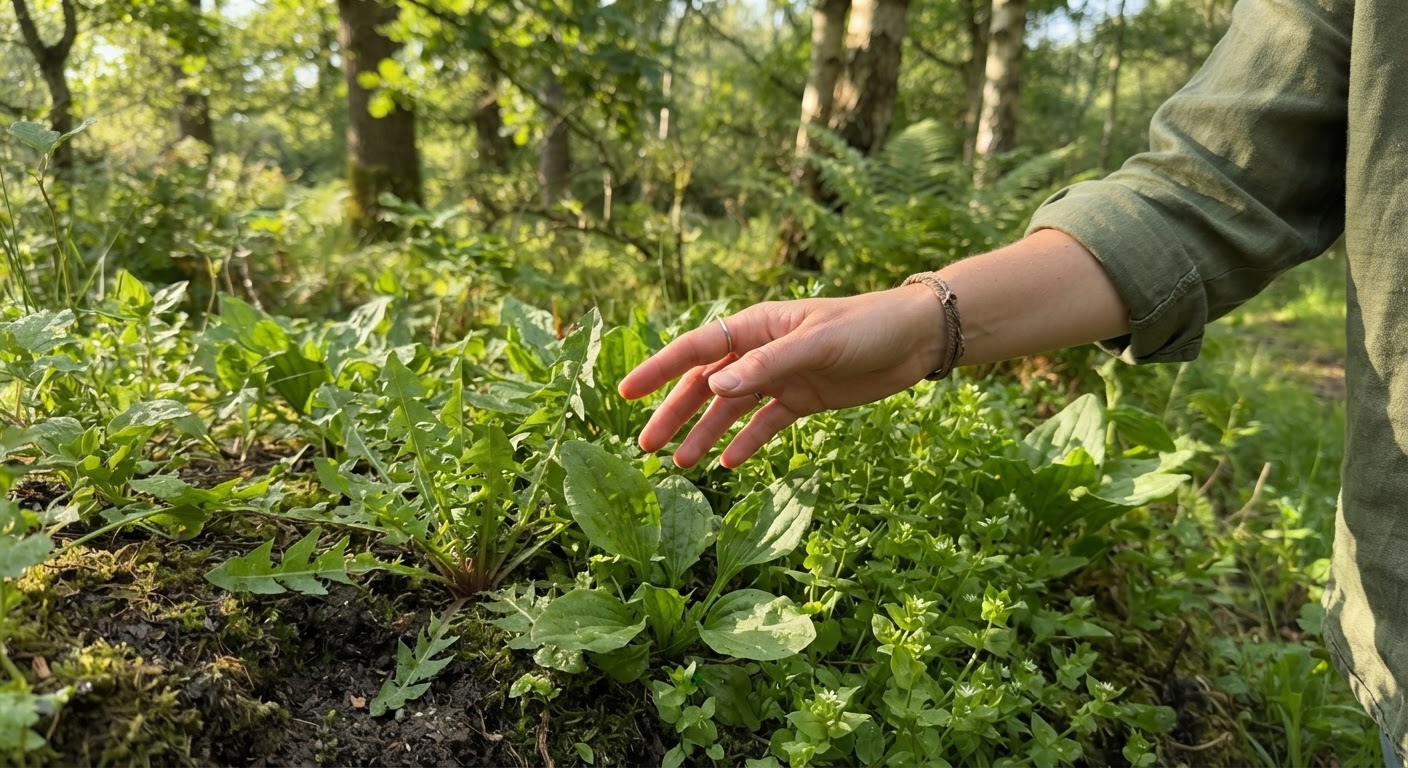
You walk a trail you’ve hiked a dozen times. Nothing looks new. Green stuff, brown stuff, a muddy puddle, the same dead log. Then someone who knows plants walks the same trail and names eleven edible species in ten minutes without breaking stride — because they aren’t seeing “green stuff.” They’re seeing ground types, and each ground type is a short list of likely residents.
That’s the whole skill, and almost nobody teaches it that way. Most wild edible plants content starts with a name: here’s dandelion, here’s cattail, here’s nettle. Memorize forty of those and you’ll still stand in a strange forest with no idea where to look, because you learned nouns instead of a search strategy.
This guide flips the order. Instead of a plant list with a map attached, it’s a map with the plants attached: five ground types you will find almost anywhere in the temperate world, what reliably grows on each, how to confirm an identification before it enters your mouth, and how to harvest without wrecking the patch. If you only ever learn five habitats and eight plants inside them, you’ll out-forage most people who own three field guides.
One rule holds above everything below, and it does not have exceptions for confidence or hunger: if you cannot identify a plant with certainty, it does not go in your mouth. Wild food is a wonderful thing to know and a terrible thing to gamble on.
Why Learning Plants by Name Fails Beginners
Picture the failure mode. February, new forager, phone full of saved reels about edible plants. They walk into a woodland in early spring and see — nothing. No dandelion flowers to recognize, no berries, no seed heads. Every plant is a rosette of green leaves on brown soil, and forty unlabeled rosettes look identical. They go home convinced foraging is for people with better eyes.
Here’s what actually happened: they were searching by appearance in a season when appearance is at its most ambiguous, in a habitat they hadn’t learned to read. The plants were there. The index was missing.
The habitat method fixes this because it runs the search in the opposite direction. You don’t ask “is this plant edible?” You ask “what ground am I on?” — and then you only need to evaluate the short list of plants that grow on that specific ground, in this specific season. It cuts the decision space from thousands of species down to a handful. It also predicts the dangerous plants nearby, which matters more.
There’s a second reason it works. Plants are fiercely loyal to their conditions. Chickweed wants disturbed, moist, nitrogen-rich soil. Cattail wants shallow standing water. Wood sorrel wants shaded woodland edge. Learn the conditions precisely enough and you’re not guessing at identity — you’re checking whether the site is right, and that’s an independent data point no leaf photo app can give you.
Step One: Learn the Five Ground Types
Five habitats cover an enormous share of the common edible species in North America, Europe, and much of the temperate zone. If you live somewhere tropical or arid, the principle transfers even if the species list doesn’t: find the edge, the water, and the disturbed ground, and you’ll find the plants.
| Ground type | Where to look | Reliable edible residents | What it tells you |
|---|---|---|---|
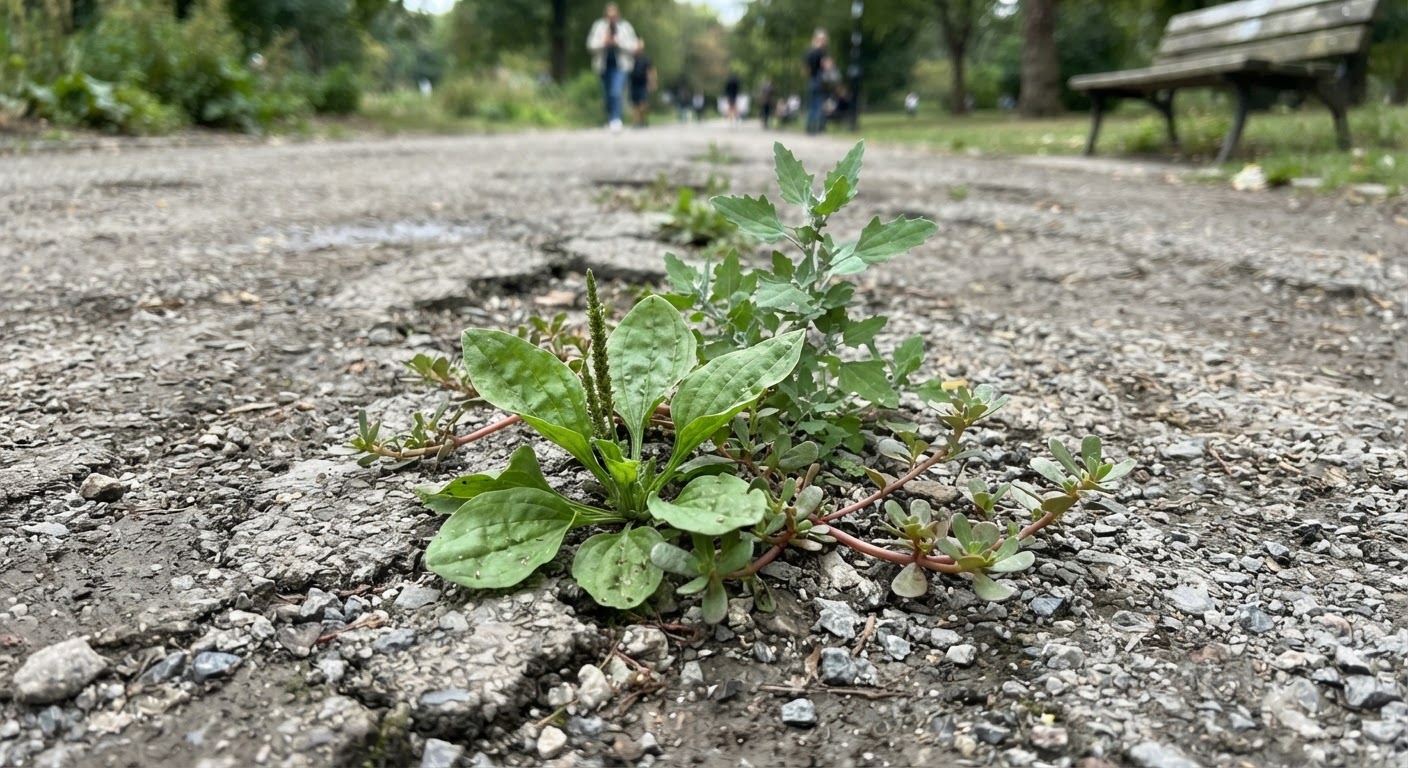
| Disturbed ground | Path edges, gravel, garden beds, cracked pavement, fresh soil piles | Broadleaf plantain, chickweed, purslane, lamb’s quarter | High nitrogen, compacted soil; expect weeds, some of them excellent |
| Woodland edge | Where trees meet open ground, hedgerows, trail margins, sun flecks | Dandelion, wood sorrel, wild garlic/ramps, violets, nettle | The single richest habitat for beginners — light plus moisture |
| Wetland and shore | Pond margins, ditches, slow creeks, marsh | Cattail, watercress, mint, jewelweed | Best calorie source, highest danger — hemlock lives here too |
| Meadow and old field | Untended grass, pasture edges, unmown verges | Yarrow, clover, wild carrot family (avoid), sorrel, plantain | Great volume, but the carrot family is a minefield |
| Conifer and mixed forest | Needle litter, acidic soil, shaded slopes | Pine/spruce needles (tea), wintergreen, acorns at the edge, burdock | Poor for greens, good for tea, roots, and nuts |
Disturbed ground: the beginner’s training ground
This is the habitat to learn first because it’s where you already walk — parking lots, park paths, the scruffy strip between sidewalk and road. It’s also where the most forgiving species live: plants so common that identifying them wrong requires effort.
Broadleaf plantain (Plantago major) grows in flat rosettes with broad oval leaves and five to seven prominent parallel veins running the leaf’s length — veins that don’t branch, which is unusual and memorable. Grab a leaf and pull gently: the veins stay as elastic threads. The flower spike is a thin rat’s-tail of tiny greenish flowers. The unrelated, similarly named “plantain” banana is a coincidence of English, not a plant relationship.
Chickweed (Stellaria media) is the one with a line of fine hairs running down one side of the stem, switching sides at each node. That single feature is worth ten photos. Leaves are small, oval, and succulent; flowers tiny and white with five petals so deeply divided they look like ten. It’s a winter annual — it thrives in cool weather when nothing else is up, which makes it a January and March staple.
Purslane (Portulaca oleracea) sprawls flat with thick, juicy, reddish stems and paddle-shaped succulent leaves. It’s lemony and crunchy and genuinely good. The critical lookalike is spotted spurge (Euphorbia maculata), which also sprawls flat in pavement cracks. The tell: snap the stem. Purslane is thick and wet; spurge is thin, wiry, hairy, and leaks white milky sap. Milky sap means stop. That’s a general rule with very few exceptions, and none worth risking as a beginner.
Woodland edge: the richest habitat
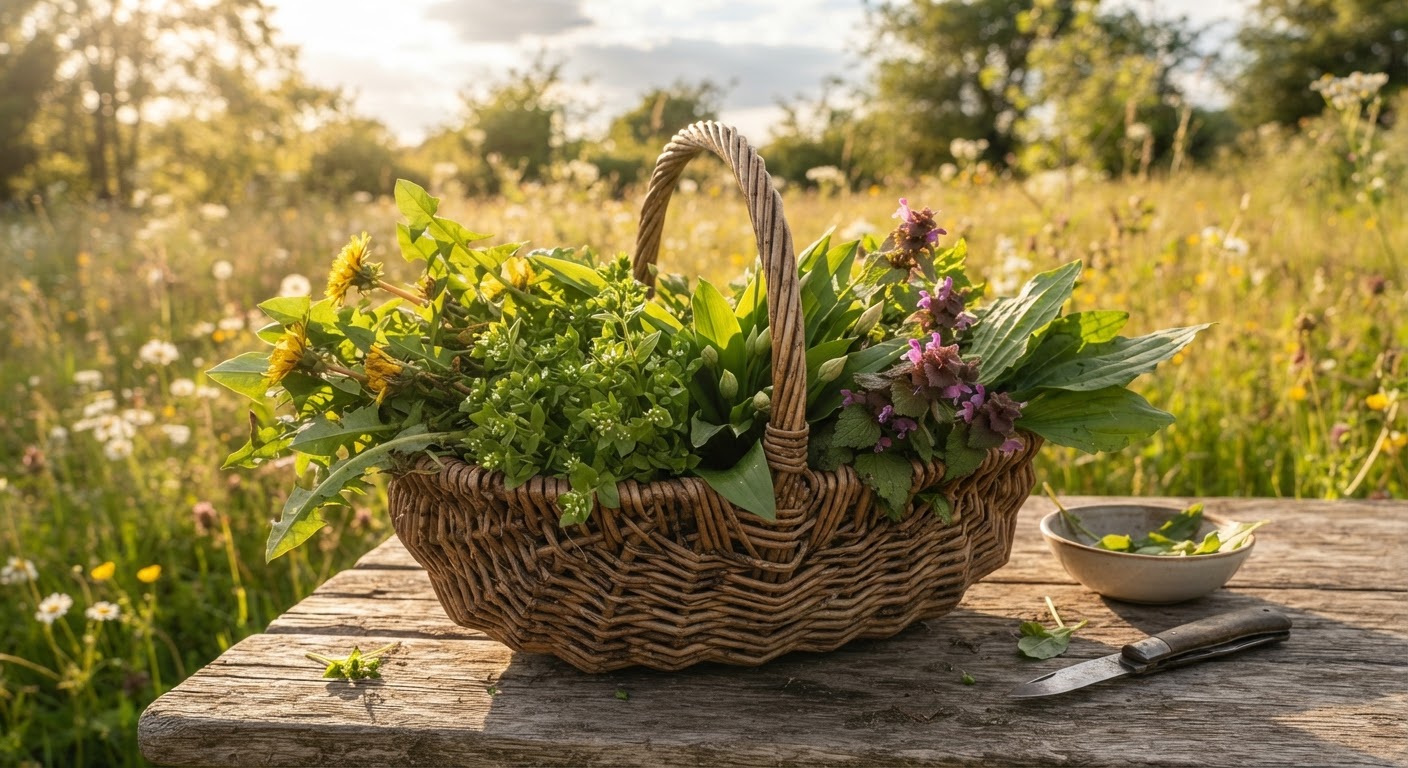
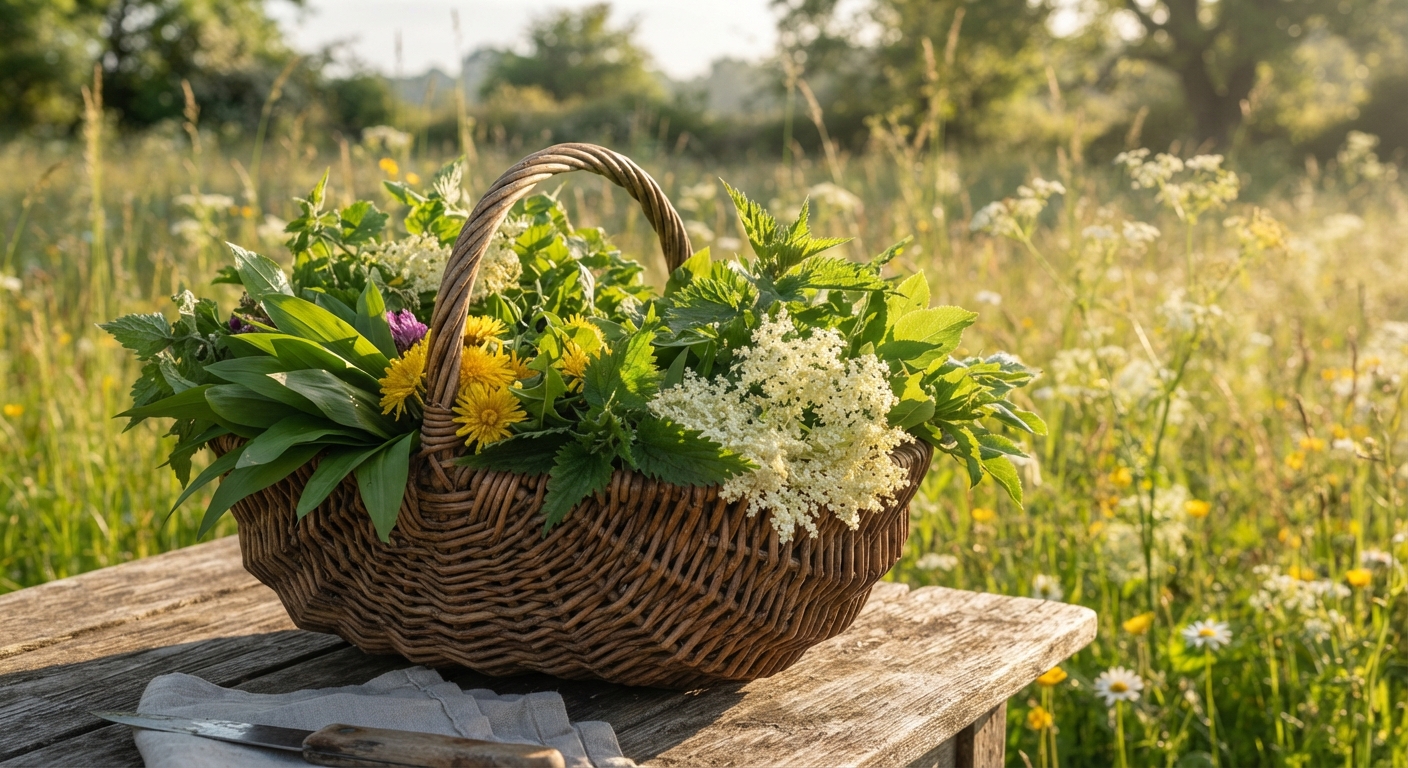
Where trees break into open light, moisture collects, soil is deep, and diversity peaks. This is where a beginner can build a real basket.
Dandelion (Taraxacum officinale) is the gateway plant, but the useful skill is recognizing it in February when there are no flowers — deeply lobed leaves with lobes pointing backward toward the crown, in a flat rosette, with a milky sap in the hollow stem when you break it. The common confusion is cat’s ear (Hypochaeris radicata), whose leaf hairs are stiff and whose lobes are rounder. Cat’s ear is also edible, so the confusion is culinary, not dangerous — which is exactly why dandelion is a sane first plant.
Wood sorrel (Oxalis species) has three heart-shaped leaflets in a clover arrangement that fold down at night, and a sharp, clean, lemony taste from oxalic acid. It’s a flavoring, not a vegetable — handfuls of it will upset your stomach raw, and anyone with kidney stone history, gout, or on blood thinners should keep it to a taste.
Wild garlic and ramps (Allium ursinum, Allium tricoccum) are the most valuable thing on this list and the most dangerous to confuse, because they have deadly lookalikes: lily of the valley and autumn crocus. The single test that saves lives is smell. Pick one leaf, crush it between your fingers. A ramp or wild garlic smells powerfully of garlic, immediately, unmistakably. Lily of the valley smells green and faintly floral. If there is no garlic smell, it is not wild garlic, no matter how right the leaves look — and do not taste it to check.
Wetland and shore: the calorie jackpot
Wild greens are, nutritionally, mostly water and vitamins. A pound of chickweed is roughly 100 calories. Cattail is different — its rhizome is a genuine starch source, one of the few wild plants you can actually live on, and it’s why wetland is worth learning.
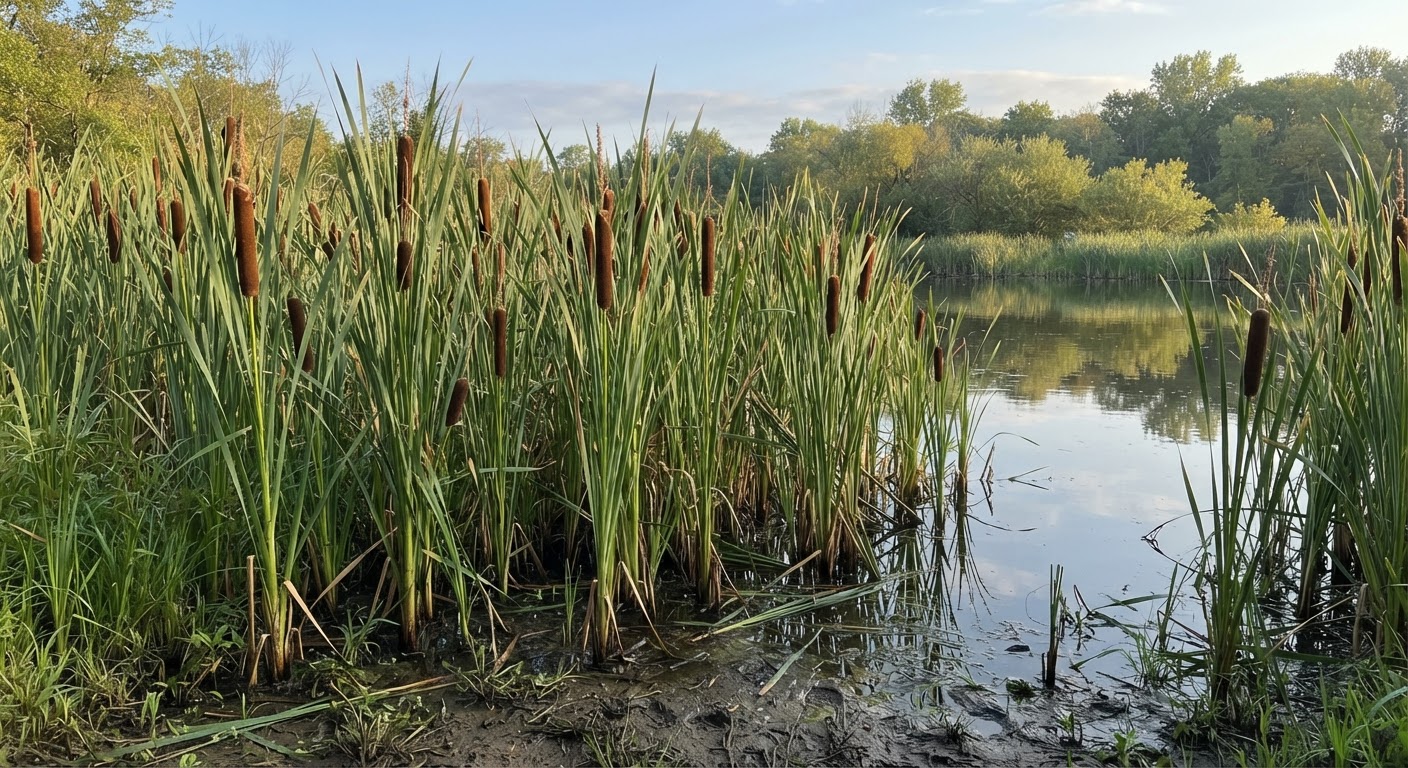
Cattail (Typha) is unmistakable in late summer: nine-foot stalks topped with a brown sausage. The edible parts run the whole year — young shoots in spring (peel to the tender core, tastes like cucumber), pollen in early summer (use it as flour), rhizomes in fall and winter (peel, crush in water, let the starch settle, dry it). The lookalike problem is the yellow flag iris (Iris pseudacorus), toxic, which grows in the same wet ground. Cattail leaves are spongy, D-shaped in cross-section, and pale-dotted at the base with no prominent midrib; iris leaves are flat, stiff, sword-shaped, with a raised midrib and a pinkish base.
One warning that belongs here rather than in a footnote: wetland is where the carrot family does its worst damage. Poison hemlock and water hemlock — both deadly, both easily fatal in small amounts — grow on wet ground, look like wild carrot or parsley, and have hollow stems. Water hemlock’s stems are chambered and often purple-streaked, its roots smell like parsnip. The practical rule for your first two years: no plant from the carrot family, ever. Not to taste, not to test, not to photograph-and-look-up-later. There are fine edible members of that family. They are not your problem.
Meadow and old field
Unmown grass holds clover, yarrow, sheep sorrel, and plantain, and it’s pleasant, easy foraging — but it’s also where the carrot family grows shoulder to shoulder with its deadly relatives. Meadow is a habitat for your third year, not your first weekend. The exception is clover and yarrow, which are distinctive enough to learn early.
Conifer and mixed forest: tea and roots
Greens are scarce under conifers — acidic needle litter, heavy shade. What you get instead is vitamin C from pine and spruce needle tea (steep fresh green needles in hot, not boiling, water for ten minutes; a handful is plenty, and the taste is resinous and piney, an acquired one), acorns at the woodland edge, and burdock root in first-year plants. Never touch yew — bright red fleshy aril on a green needle-bearing shrub. Every part except the aril is lethal, and it’s planted in ordinary gardens.
Step Two: Run the Four-Check Routine
Identification isn’t a moment of recognition, it’s a checklist. Run all four checks in order on any plant you intend to eat. If any check fails or is ambiguous, walk away and come back in a different season with a second reference. Four checks, thirty seconds.
Check one — leaf arrangement and veins. Are leaves opposite each other on the stem, or alternate? Do veins branch like a feather (pinnate) or spread from one point like a hand (palmate)? Veins that don’t branch, like plantain’s, are a strong signal. This check alone eliminates most mistaken identities.
Check two — stem and sap. Snap it. Hollow, solid, square, round, ridged, hairy, smooth? Is the sap clear, milky, watery, or colored? Milky sap is a stop sign in almost every case (dandelion’s is the celebrated exception). Square stems suggest the mint family — good news, since mints are generally safe and aromatic. Hollow stems with purple blotches in wet ground mean hemlock, and you should already be backing away.
Check three — growth habit and habitat. A single stem or a rosette? Sprawling or upright? Does this species actually grow here, at this elevation, in this soil moisture, this time of year? A perfectly plausible identification in the wrong habitat is usually the wrong identification.
Check four — smell and root. Crush a leaf. Garlic, mint, anise, cucumber, or nothing? The garlic smell test is non-negotiable for the allium family. If you can see the root without damaging the plant (a loose one, or a patch you’re thinning), its shape — taproot, fibrous mat, bulb, rhizome — closes the case. Wild carrot’s taproot smells like carrot; hemlock’s doesn’t.
| Check | Question you’re asking | What it rules out | Beginner’s red flag |
|---|---|---|---|
| Leaves | Opposite or alternate? Vein pattern? | Confusion between unrelated families | Any doubt about leaf arrangement |
| Stem & sap | Hollow or solid? Square? Milky? | Hemlock, spurge, nightshade | Milky sap; hollow purple-blotched stem |
| Habit & habitat | Rosette, sprawl, or upright? Right ground? | Wrong-season lookalikes | Right plant, wrong place |
| Smell & root | Crushed-leaf scent, root shape | Wild garlic vs. lily of the valley | No garlic smell on a “ramp” |
Step Three: Cross-Reference Two Independent Sources
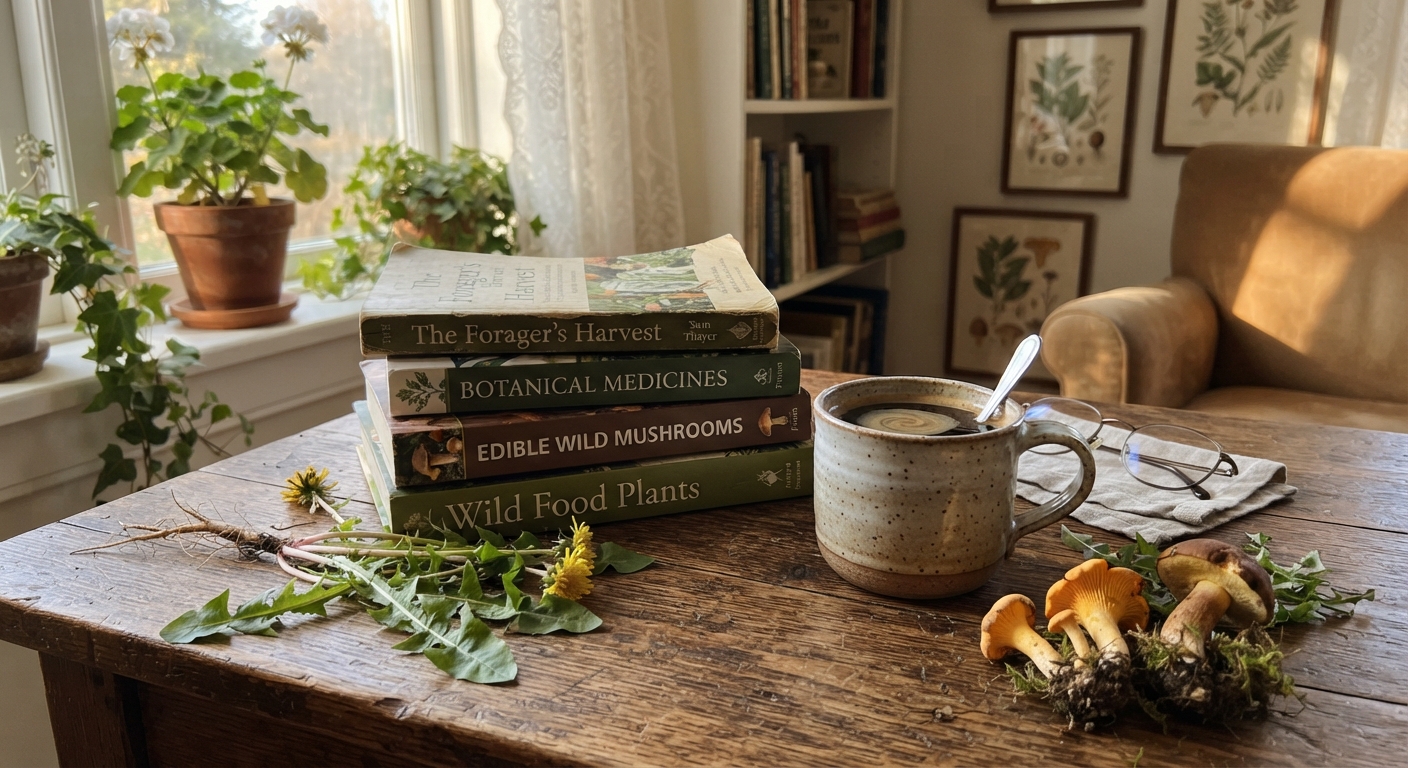
One source is a guess. Two sources that agree is an identification. Practically, that means your own field guide (a cheap regional one beats a glossy continental one) plus a second opinion — a plant ID app, a local foraging group, a botanist neighbor, a county extension office. What makes sources independent is that they don’t derive from the same photos; an app and a Facebook group that both copied the same blog post are one source.
The order matters: identify it yourself from the guide, write down your guess, then check the app. Doing it the other way round — snapping a photo and reading whatever comes back — trains the app, not you, and you’ll never learn the features that make the ID hold up when the signal is bad.
The reason to be fussy is straightforward arithmetic. There are a small number of plant families responsible for most serious poisonings — the carrot family, the nightshade family, the spurge family, and a few bulbs — and a single bad identification in one of them can be fatal. Your baseline error rate doesn’t need to be zero. It needs to be zero on the plants that can kill you, which is why the “learn five habitats” approach insists on learning the dangerous residents of each habitat first.
Step Four: The Edibility Test Is a Last Resort, Not a Hobby
Every foraging guide eventually describes a “universal edibility test”: fast for eight hours, separate the plant into parts, test skin contact, then lips, then tongue, then a small bite held in the mouth, then swallow, waiting eight hours between steps. It’s real, it comes from military survival manuals, and it has a body count.
Why it fails: it does not detect delayed toxins (amatoxins in mushrooms, some alkaloids take days), it does not detect cumulative damage (oxalates, pyrrolizidine alkaloids in some herbs), and it cannot be performed at all on the deadly species — a bite of water hemlock can kill before your eight-hour wait begins. It also requires that you be healthy, hydrated, and calm, which describes approximately nobody in an actual emergency.
So treat it as something to know about rather than something to do. If you ever genuinely need it, you’re in a survival situation where you have no better option, and you should be testing a plant from a habitat whose dangerous residents you already know. In every other circumstance — a hike, a Tuesday afternoon, a curiosity about the weed in your yard — the correct test is a field guide and a second source.
The Edible Parts Matrix
Knowing a plant is edible is half the answer. The other half is which part, when, and how. This table is the one I’d laminate. Note how often cooking is not optional.
| Plant | Edible parts | Best season | Raw or cooked | Prep note |
|---|---|---|---|---|
| Dandelion | Leaf, flower, root | Leaf spring/fall, root fall | Leaf raw young, else cooked | Older leaves bitter; blanch or boil 2 min; root roast as coffee sub |
| Broadleaf plantain | Leaf, seed | Leaf spring–early summer | Young raw, older cooked | Stringy veins — strip or chop fine; seeds thresh from dry spikes |
| Chickweed | Leaf, stem, flower | Late winter–spring | Raw | Whole above-ground plant, chop into salad; wilts fast, use same day |
| Purslane | Leaf, stem | Summer | Raw or lightly cooked | Do not cook long; becomes slime. Great in yogurt or vinegar |
| Lamb’s quarter | Leaf, seed | Spring–early summer | Cooked only | Oxalates and saponins; boil and discard water once |
| Cattail | Shoot, rhizome, pollen | Shoot spring, pollen early summer, rhizome fall–winter | Cooked | Peel shoots to core; leach rhizome starch in water, dry to flour |
| Wild garlic / ramps | Leaf, bulb | Early spring | Raw or cooked | Smell test always; harvest one leaf per bulb, leave the bulb |
| Wood sorrel | Leaf, flower | Spring–summer | Raw, sparingly | Oxalic acid — garnish quantities, not bowlfuls |
| Acorns (white oak) | Nut | Fall | Cooked only, leached | Shell, grind, leach in changes of water until bitterness gone |
| Pine / spruce | Needle (tea) | Year-round | Infused | Hot but not boiling water, 10 min; avoid yew entirely |
Season Chart: What Each Habitat Gives You, Month by Month
Most foraging content is written as though everything happens in spring. It doesn’t. The year has three distinct food economies: spring greens, summer abundance, and the root-and-nut season that actually carries calories.
| Habitat | Spring (Mar–May) | Summer (Jun–Aug) | Fall (Sep–Nov) | Winter (Dec–Feb) |
|---|---|---|---|---|
| Disturbed ground | Chickweed peak, plantain, lamb’s quarter | Purslane peak, plantain seed | Late plantain, lamb’s quarter seed | Chickweed again in mild climates |
| Woodland edge | Ramps/wild garlic, violet, early dandelion | Wood sorrel, nettle (cut back, regrows) | Dandelion root, acorns at the edge, rosehips | Burdock root, dormant rosettes (ID practice) |
| Wetland | Cattail shoots, watercress | Cattail pollen, mint | Cattail rhizome begins | Rhizome continues under ice, best starch |
| Meadow | Yarrow leaf, clover | Clover flower, yarrow flower | Sheep sorrel, plantain | Very little — skip |
| Conifer | Needle tea | Needle tea, wintergreen | Acorns, pine nuts where available | Needle tea, the one reliable winter harvest |
Read the winter row twice. The instinct that “nothing grows in winter” is why most foragers quit in November and come back in April having forgotten everything. Winter is when roots are at their starchiest, when there’s no foliage to hide behind, and when you can see the shape of the land. It’s also when a mild-climate forager can still find chickweed, bittercress, and plantain rosettes — enough to keep the skill warm.
Pro Tips That Only Come From Doing It Badly First
Harvest the third, not the plant. One in three leaves, one in three plants in a patch, never the last one standing. A patch you strip is a patch you can’t return to, and cattail and ramps especially don’t recover from greed.
Location beats species. A perfect dandelion from a roadside verge is a worse meal than a mediocre one from a hillside. Skip anything within thirty feet of a road, anything on a rail corridor, anything on a lawn that gets sprayed or walked by dogs, and anything downstream of a mine or industrial site. Heavy metals and herbicide residue don’t wash off.
Taste the season, not the plant. Young dandelion in April is a salad green; the same plant in July is a bitter punishment. Nettle is tender at six inches and fibrous at two feet. Most “I don’t like wild greens” opinions are actually “I harvested in the wrong month” opinions.
Calories are in the roots. Greens are vitamins and fiber. Rhizomes, tubers, nuts, and seeds are energy. If the goal is a meal that keeps you full, cattail rhizome, burdock, acorns, and lamb’s quarter seed matter more than any salad.
Photograph the whole plant, not the leaf. In the field, take three shots: the rosette from above, the stem and node from the side, and one leaf pulled and laid flat with a coin for scale. That trio lets someone else confirm the ID later, and it’s a better learning record than any single pretty photo.
Learn the poison first. Spend one evening on hemlock, water hemlock, pokeweed, nightshade, spurge, foxglove, and yew. It’s less romantic than learning the edibles, and it’s the single highest-value hour in foraging. The plants you can’t eat are what make the ones you can eat safe.
Keep a failure log. Not the successes — the misses. The rosette you were sure about and weren’t. The patch you misjudged the season on. Errors repeat when they aren’t written down, and a short notebook entry (“marsh edge, June, hollow purple stem — hemlock, not angelica”) is worth more than another saved reel.
Where Foragers Actually Go Wrong: A Diagnostic List
The mistakes are consistent enough to list as a diagnostic.
- Identifying from one feature. “It has three leaves, so it’s clover” is how people eat oxalis, medick, and, occasionally, something worse. Always run all four checks.
- Trusting an app’s first answer. Image ID is a first opinion, not a verdict. The good apps show alternatives and confidence; the bad ones show one confident guess.
- Foraging the carrot family because it smells like carrot. Smell is a check, not a permission slip. Water hemlock root smells edible too.
- Eating a new plant in quantity on the first try. Even a correctly identified edible can upset a system that’s never met it. One leaf, wait a day, then a handful. Wild foods are new chemistry to your gut.
- Raw lamb’s quarter, raw elderberry, raw acorns. All three are commonly foraged and all three need cooking or leaching. “Edible” almost always means “edible after preparation.”
- Ignoring the ground under the plant. The cleanest-looking chickweed in a sprayed park is not clean food. Ask what the soil has been through.
- Harvesting in a hurry, in bad light, while distracted. Most real-world misidentifications happen in the last twenty minutes of a walk, when the light is flat and attention is gone. Stop early.
Field Questions, Answered as Scenarios
“I’m standing in a park in a city. Is there anything here I can actually eat?” Usually yes, and you’re in the easiest habitat to learn. Look at path edges and compacted soil: plantain rosettes with their parallel veins, chickweed’s hair line, purslane sprawling in warm pavement cracks. Check the ground rules first (municipal spraying is real) and stay away from dog-walking corridors. Urban foraging is a legitimate entry point; the constraint is location, not species.
“The app says it’s edible, but I’m not sure. What do I do?” Don’t eat it. That’s the answer, and it’s not a compromise — uncertainty is the actual safety mechanism, and overriding it is how people get hurt. Instead, take the three photos, note the habitat, and get a human to confirm. You lose a snack; you keep everything else.
“How many plants should a beginner actually know?” Eight, well, is more than forty, vaguely. Pick one habitat — the ground you walk daily — and learn five plants in it to the level where you could describe them to someone on the phone: leaf arrangement, stem, sap, smell, season. Then add a habitat. Two years of that and you’ll have fifty plants you actually know, which is a different thing from fifty you’ve read about.
“Are wild greens worth it, calorie-wise?” Honestly, no — not as calories. A big bag of mixed greens is maybe 150 calories. They’re worth it for micronutrients, variety, flavor, and the fact that knowing your ground is a life skill that doesn’t expire. For calories, learn roots and nuts: cattail rhizome, burdock, acorns, pine nuts.
“Can I forage where I’m not allowed to?” Foraging rules vary wildly — legal on some public land, prohibited in many parks, and always ask on private land. It’s worth a two-minute check of local regulations before you fill a bag, because the fine is real and the etiquette matters more: foragers who strip popular spots are why foraging gets banned in them.
“What’s the one thing that would make me safer tomorrow?” Learn to recognize poison hemlock and water hemlock. Not vaguely — properly, with the purple-blotched hollow stem, the chambered root, the carrot-family leaf. Everything else on this page is optional knowledge. That one isn’t.
The Ground Is the Index
Most people come to wild edible plants looking for a list, and the list is the least useful part. What actually transfers — to a new county, a new country, a season you’ve never foraged — is the reading skill: recognizing that this is disturbed nitrogen-rich ground, that this is a wet margin where the carrot family lives, that this is a woodland edge in early spring and therefore a ramps-and-chickweed problem.
That skill builds slowly and then all at once. One day you’ll be walking somewhere entirely unfamiliar and realize you already know what’s likely to be under your feet, and roughly where to look. That’s the moment foraging stops being a hobby with a checklist and becomes a way of seeing ground.
Until then, the discipline that keeps you safe is simple and absolute: identify with certainty, cross-check with a second source, cook what needs cooking, and never let hunger or enthusiasm do the deciding.
When you’re standing over an unfamiliar rosette with a bag in one hand and doubt in the other, a second opinion is worth a lot more than a guess. That’s the gap Edible Plant Identifier was built for — point your camera at a leaf and it gives you a probable species with identification notes and the lookalikes worth worrying about, so you can check its reasoning against your own instead of taking anyone’s word for it. It works offline, which matters precisely where the interesting plants grow. It’s a field companion, not a replacement for a good regional guide or an expert’s eyes — but it’s the difference between walking past a patch and knowing what you’re looking at.