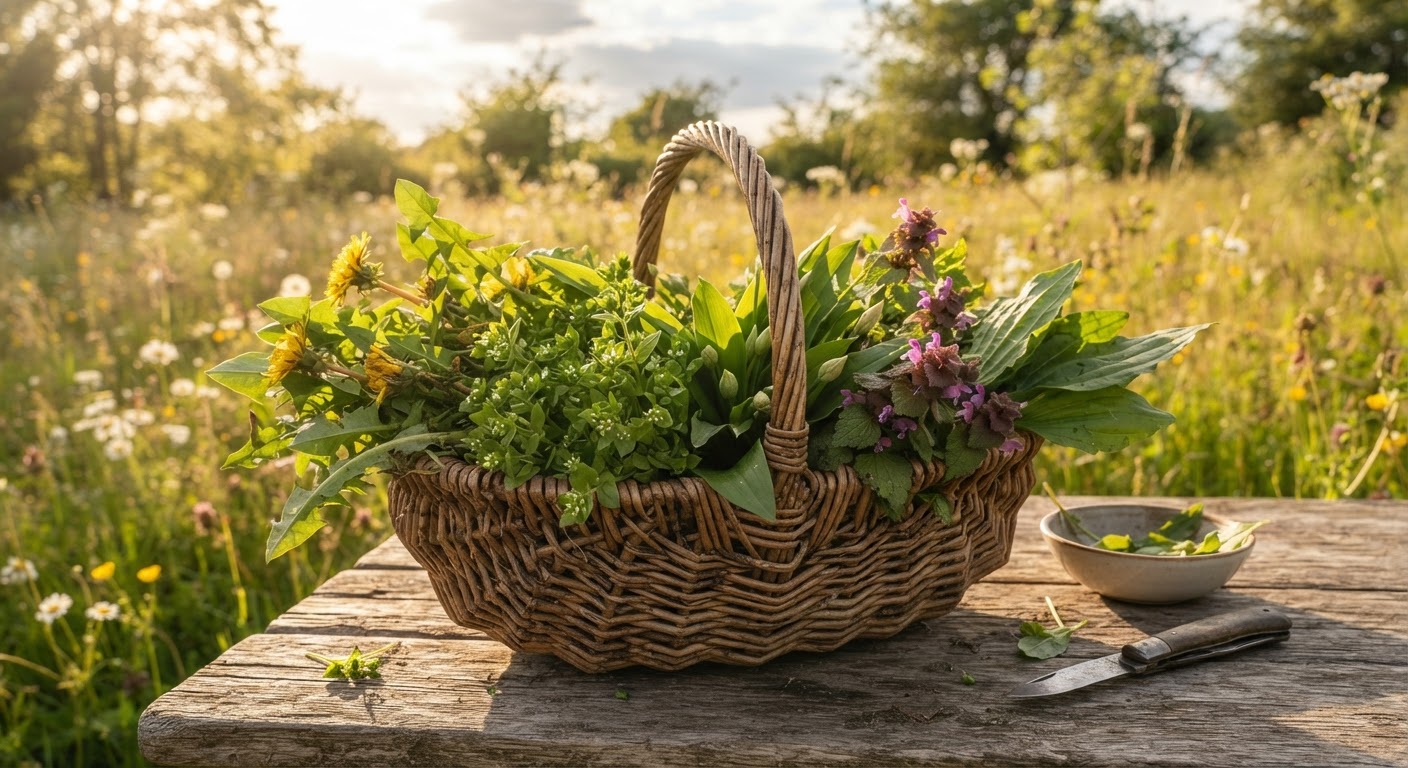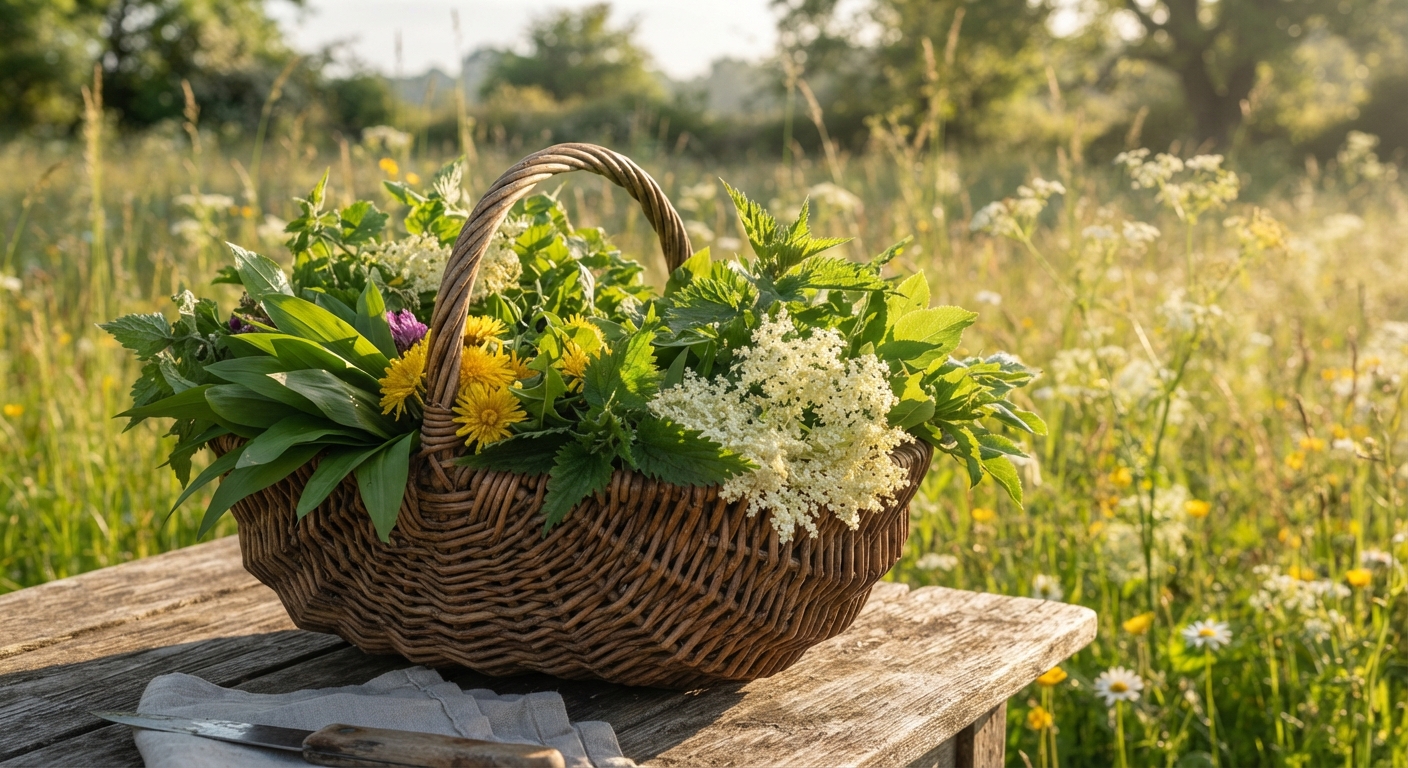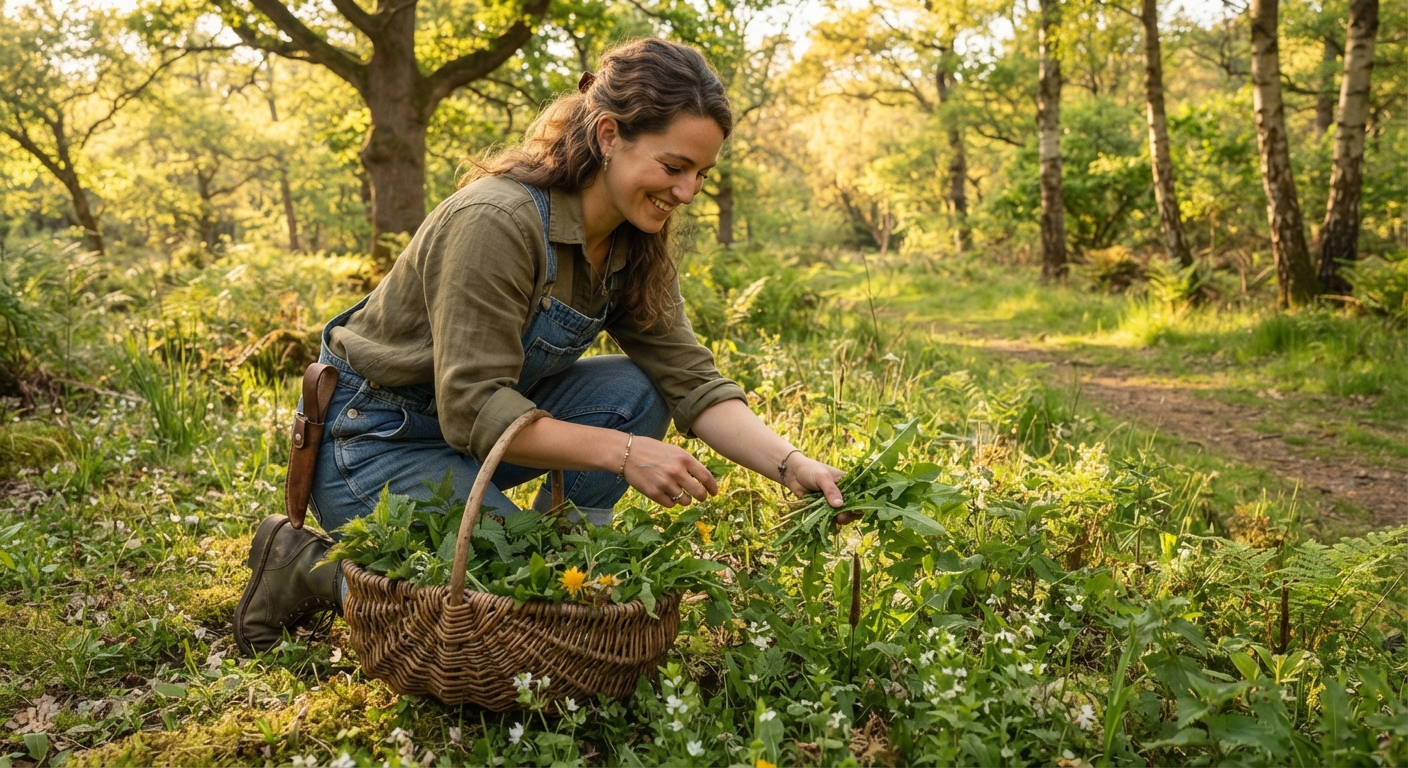
Foraging is the practice of identifying, gathering, and eating wild plants, mushrooms, berries, and other foods that grow without human cultivation. That’s the dictionary definition. In practice, it’s what humans did for roughly 190,000 of the 200,000 years we’ve been around — and what a surprising number of people are rediscovering right now.
The numbers back this up. Google searches for “foraging near me” tripled between 2019 and 2024. Foraging workshops across North America and Europe regularly sell out within hours. Foraging hashtags on TikTok have accumulated billions of views. This isn’t a passing trend — it’s a return to something deeply wired into how we relate to food.
But between the romantic YouTube videos of people wandering through sun-dappled forests with wicker baskets and the reality of actually doing this safely, there’s a gap. This guide closes that gap. Ten things you need to know, explained as directly as possible, so you can go from zero to competent without the common mistakes that land beginners in trouble.
1. The Only Rule That Matters: No Positive ID, No Eating
Before soil types, seasonal calendars, or recipes, there’s one principle that overrides everything else: never put a plant in your mouth unless you can identify it with 100% certainty.
Not 90%. Not “it looks like the picture.” One hundred percent.
Plant misidentification is not a hypothetical risk. In 2023, U.S. poison control centers logged over 5,000 plant-related exposure calls, many involving foragers who confused toxic species with edible ones. Hemlock — the plant that killed Socrates — grows in all 50 states and looks enough like wild carrot (Queen Anne’s lace) that experienced foragers still double-check every stem. Pokeweed shoots look almost identical to wild asparagus in early spring. Death camas bulbs could pass for wild onion if you’re not paying attention to the smell.
The solution isn’t anxiety. It’s a system. For every plant you want to eat, confirm at least three identifying features — leaf shape, stem structure, flower type, smell, season, habitat, or growth pattern. Don’t rely on a single characteristic. Take a photo, bring a sample home, check two different field guides. If even one feature doesn’t match, walk away. The plant will still be there tomorrow. Your organs won’t grow back.
2. You Already Know More Edible Wild Plants Than You Think
Here’s something that surprises most beginners: the plant growing through cracks in your driveway is probably edible.
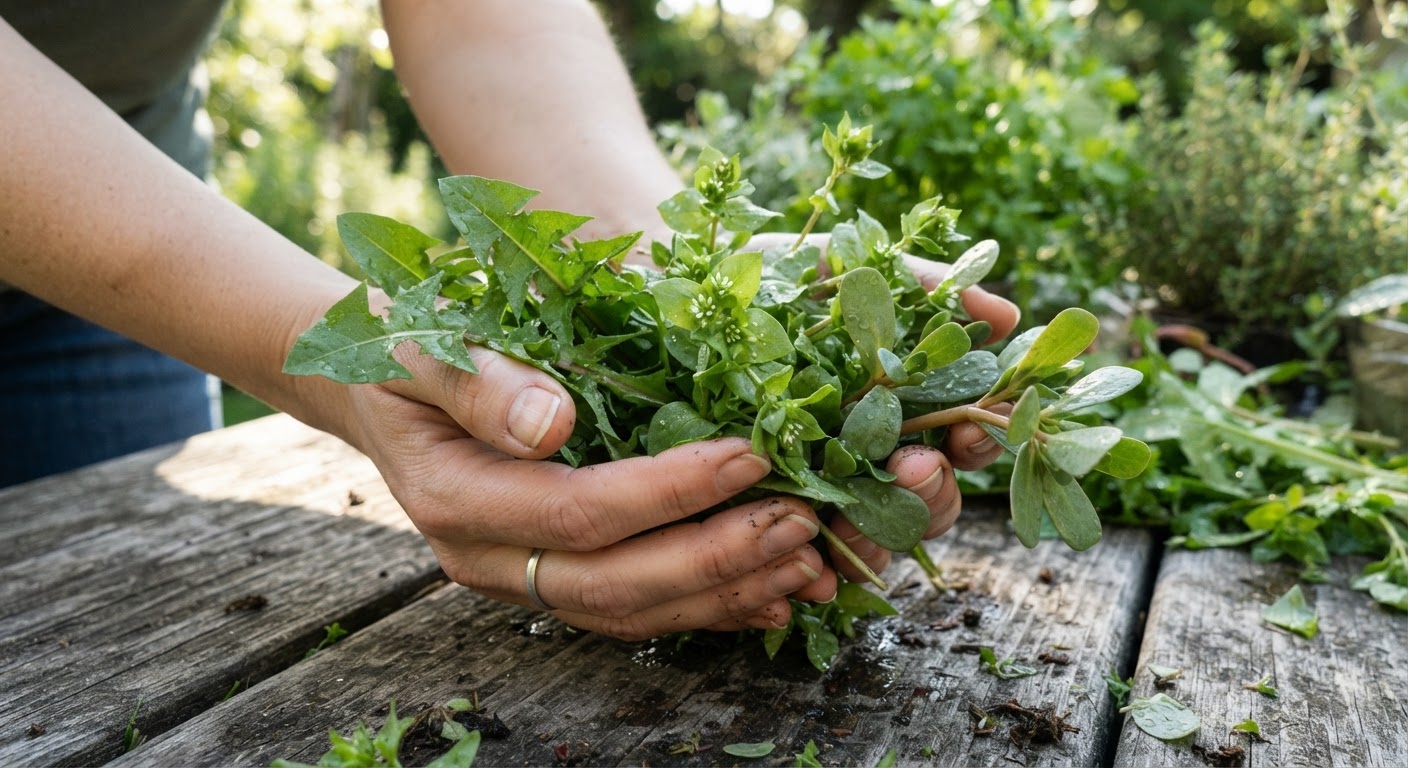
Purslane (Portulaca oleracea) — that fleshy, reddish-stemmed “weed” everyone pulls out of their garden beds — has more omega-3 fatty acids than any other leafy green on record. Dandelion (Taraxacum officinale) — the yellow flower your HOA hates — contains more vitamin A than carrots and more calcium than kale, gram for gram. Chickweed (Stellaria media) grows in damp lawns across the entire northern hemisphere and tastes like mild, tender spinach.
The point isn’t that you should immediately start grazing on your lawn. It’s that edible wild plants aren’t rare or exotic. They’re the common, overlooked species that gardeners curse at and landscapers spray with herbicide. Recognizable plants, in accessible places, with identifiable features that you can learn in an afternoon.
This makes the learning curve dramatically shorter than most people expect. You don’t need to memorize a hundred Latin names before you forage your first meal. Start with five plants. Get comfortable. Then add more.
3. The 5 Safest Plants for Absolute Beginners
Not all wild edibles are created equal when it comes to beginner-friendliness. The safest starter plants share three qualities: they’re abundant, they have no dangerous lookalikes, and they’re easy to identify from multiple features. Here are five that check every box.
Dandelion (Taraxacum officinale). Recognizable to every human over the age of four. Bright yellow composite flower, jagged tooth-shaped leaves, hollow stems that leak white latex sap. Every part is edible: leaves (salads, sautéed), flowers (fritters, wine), roots (roasted as coffee substitute). No toxic lookalikes in North America or Europe.
Stinging Nettle (Urtica dioica). The sting is the identification feature — no other common plant delivers the same immediate, unmistakable sensation. Serrated, heart-shaped leaves growing in opposite pairs on square stems. Cooking neutralizes the sting completely in seconds. More iron than spinach, more protein than most greens. Wear gloves to harvest, then treat it exactly like spinach in the kitchen.
Wild Garlic / Ramps (Allium ursinum and related species). The smell eliminates the risk. Crush a leaf — if it smells unmistakably like garlic or onion, it’s an Allium and it’s edible. If it doesn’t smell, don’t eat it. (This is the one case where a single identification feature is enough, but only because the alternative — plants that look like wild garlic but smell like nothing — are potentially toxic.)
Purslane (Portulaca oleracea). Thick, succulent reddish stems creeping flat along the ground, with small paddle-shaped leaves clustered at the stem tips. Breaks cleanly when bent — stems are crisp and juicy. There’s one lookalike (spurge) that has thinner, wiry stems and leaks white sap when broken. Purslane leaks clear sap. That’s the test.
Wood Sorrel (Oxalis acetosella). Heart-shaped leaflets in groups of three, looking superficially like clover. The giveaway is the taste — a sharp, lemony pop unlike anything else. Small white or yellow flowers. Contains oxalic acid, so eat it in moderation (a handful in a salad, not a bowlful as a main course). Zero dangerous lookalikes when you confirm the three-leaf structure plus the sour taste.
4. Foraging vs. Gardening vs. Grocery Shopping
People framing foraging as a replacement for modern food systems are missing the point. Foraging isn’t a substitute for grocery stores — it’s a complement. The three approaches serve different needs, and understanding what each one offers makes you better at all of them.
| Factor | Foraging | Home Gardening | Grocery Store |
|---|---|---|---|
| Seasonality | Strictly seasonal — each plant has a 2–8 week window | Semi-seasonal with some extension | Available year-round |
| Cost | Free | Seeds, soil, water, tools, time | Market price |
| Nutritional density | Highest — wild plants grow in living soil and are typically more nutrient-dense than cultivated varieties | Moderate to high depending on soil quality | Variable — declines with transport/storage time |
| Pesticide exposure | Zero (if you pick from clean sites) | Depends on your practices | Variable by source |
| Time investment | Walking, identifying, harvesting (1–3 hours per outing) | Weeks to months of growing + daily maintenance | Minutes per trip |
| Biodiversity added to diet | Highest — dozens of species over a year | Moderate — what you choose to plant | Low — limited to commercial crops |
| Learning curve | Steep initially, flattens quickly | Moderate, ongoing | None |
| Reliability | Weather and season dependent | Somewhat weather dependent | Highly reliable |
The sweet spot for most people is a combination: grocery stores for staples and year-round reliability, a garden for the vegetables you eat most often, and foraging for the wild foods you simply can’t buy — ramps in spring, chanterelles in summer, pawpaws in fall. Each one fills gaps the others leave behind.
5. Where to Forage (And Where You Absolutely Shouldn’t)
Location determines both the legality and safety of what you pick. The best spots are often the ones nobody looks at twice.
Good locations:
- Your own backyard or a friend’s property (with permission)
- Public parks where foraging is explicitly permitted (check local regulations)
- National forests (rules vary — U.S. National Forests generally allow small quantities for personal use without a permit)
- Community gardens that allow harvesting
- Rural roadsides at least 50 feet from vehicle traffic
Terrible locations:
- Roadsides within 50 feet of traffic — plants absorb heavy metals and exhaust residue
- Railroad tracks — soil is often contaminated with herbicides and industrial runoff dating back decades
- Conventional farm edges — drift from pesticide spraying is unpredictable
- Brownfield or industrial sites — soil testing is mandatory before even considering these
- Dog parks — for obvious sanitary reasons
- Nature preserves with “no collecting” policies
A good rule of thumb: if the ground looks like something humans have been dumping things on, don’t eat what grows out of it. Plants are hyperaccumulators — they pull minerals, both good and bad, directly from the soil into their tissues. A dandelion growing in clean meadow soil is a superfood. The same dandelion growing in the gravel next to a gas station is a heavy-metal sponge.
6. The Seasonal Calendar in Brief
Foraging isn’t a year-round free-for-all. Each plant has a narrow window, and missing it means waiting until next year. Here’s the rhythm for temperate regions of North America and Europe:
Early Spring (March–April): This is greens season. Stinging nettle is at its tender peak before flowering. Dandelion leaves are less bitter before the plant blooms. Ramps appear for a fleeting 3–4 weeks. Chickweed carpets damp ground everywhere. This is the most forgiving season for beginners — the greens are soft, the weather is pleasant, and everything is growing visibly day by day.
Late Spring (May–June): Flowers and shoots. Elderflowers bloom and need harvesting before they turn to berries. Cattail shoots are at the stage where they peel like leeks. Wild garlic scapes appear as curly green tendrils. Wood sorrel flowers dot forest floors.
Summer (July–August): Berries arrive. Wild raspberries, blackberries, blueberries, and serviceberries all ripen through these months. Purslane becomes abundant in hot, dry spots. Lamb’s quarters hits its stride as a spinach alternative. This is the easiest season for casual foragers — berries are familiar, recognizable, and don’t require cooking.
Fall (September–October): Nuts, roots, and late fruits. Acorns (which need leaching), black walnuts, and hickory nuts drop. Pawpaws ripen. Dandelion roots are at their largest and sweetest for roasting. Rose hips brighten hedgerows with concentrated vitamin C.
Winter (November–February): Slim pickings for beginners, but not nothing. Chickweed continues through mild winters. Rose hips persist on bare branches. Pine needles can be steeped for tea year-round. Conifer tips appear toward late winter.
The pattern is straightforward: greens in spring, berries in summer, nuts in fall, and tea in winter. You don’t need to memorize all of this before your first outing. Just match what’s in season to where you are, pick one plant, and learn it thoroughly.
7. Gear: What to Bring vs. What to Skip
The foraging starter kit costs about $30 and fits in a small backpack. A lot of what’s marketed as “foraging gear” is backpacking equipment with a different label.
Actually useful on every trip:
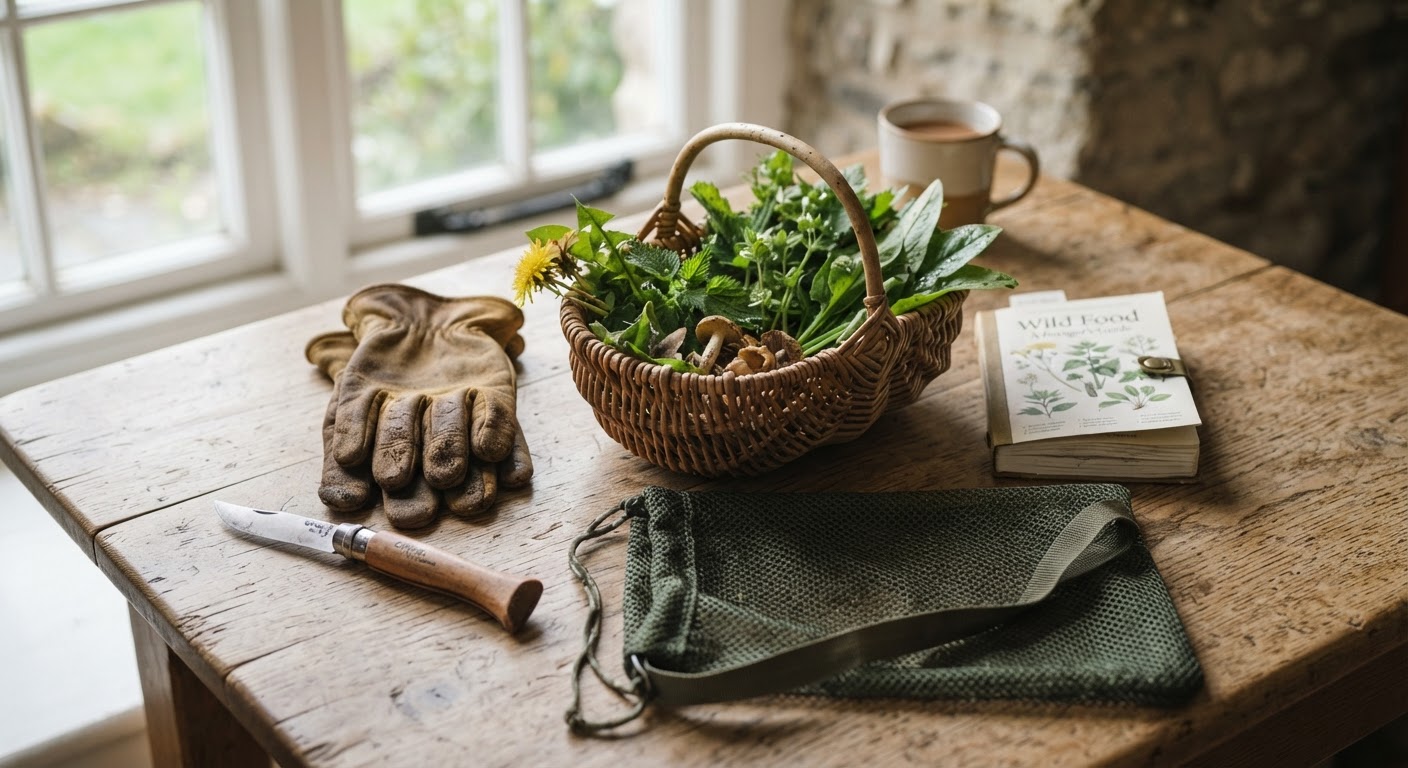
- Cloth or mesh bag (not plastic — plants need airflow or they wilt into slime within an hour)
- Pocket knife or garden snips for clean cuts
- Gardening gloves (nettles don’t care about your pain tolerance)
- Smartphone for photos, GPS marking, and checking references
- Small field guide specific to your region (physical book — batteries die, screens break)
Nice to have for longer outings:
- Basket for delicate berries
- Small trowel for digging roots
- Paper bags for mushrooms (cloth bags crush them)
- Notebook and pen for recording locations
Skip entirely as a beginner:
- Expensive foraging-specific backpacks (a regular daypack works fine)
- “Foraging kits” from Amazon (usually overpriced collections of items you already own)
- Specialized harvesting tools before you know what you’re actually harvesting
8. Harvesting Without Killing the Plant
Sustainability isn’t a nice-to-have in foraging — it’s the entire business model. If you kill the plants, they don’t come back next year. Here’s what responsible harvesting looks like.
For leafy greens: Take no more than one-third of the leaves from any single plant. Leave the growing tip intact so it regenerates. For dandelions and chicory, harvest outer leaves and let the inner crown keep producing.
For roots: Only dig roots when you’re sure the population is abundant. Spread out your harvest — take one plant, skip ten, take another. Fill in the hole you created. This applies doubly to slow-growing perennials like burdock.
For berries and fruit: Leave at least 20% on the plant for wildlife and regeneration. The birds and mammals that eat these fruits spread the seeds — they’re not competition, they’re partners.
For mushrooms: Cut at the base rather than pulling. Carry them in mesh bags so spores drop along your path as you walk. Never clear an entire patch.
The universal rule: If you’re the only person foraging a particular patch, harvest conservatively. If the patch is large and clearly untouched, you can take more generously. Always leave the site looking like nobody was there — pack out everything you brought in.
9. Kitchen Reality: From Field to Plate
Wild plants don’t behave like supermarket produce. They wilt faster, cook differently, and sometimes need a quick treatment that cultivated vegetables don’t require. Here’s what actually works.
Clean immediately after getting home. Fill a large bowl or sink with cold water, submerge everything, and agitate gently. Dirt, bugs, and debris sink. Repeat until the water runs clear. A salad spinner is worth its weight in gold here — wet wild greens go slimy fast.
Blanch bitter greens for 30–60 seconds. Dandelion, chicory, and other bitter greens mellow dramatically after a quick blanch in boiling water followed by an ice bath. Sauté the blanched greens with garlic, olive oil, and a splash of lemon — this is the universal template that makes almost any wild green taste good.
Treat stinging nettle like spinach. Once cooked for 30–60 seconds, the sting disappears completely. Nettle soup (sautéed onion + potato + stock + blanched nettle, blended) is the gateway recipe that converts skeptics. Nettle pesto works too — blanch, blend with garlic, nuts, olive oil, and parmesan.
Purslane needs nothing. Its natural salty-sour crunch makes it an ideal raw salad ingredient. Toss with cucumber, tomato, olive oil, and lemon juice. Don’t cook it — it turns gelatinous.
Wood sorrel is a garnish, not a side dish. Its bright lemony punch works scattered over fish, folded into salads, or blended into sauces. Use it like you’d use fresh lemon zest — small amounts for a sharp accent.
10. The Mindset Shift That Makes Everything Easier
Most beginners approach foraging like a treasure hunt: find the plant, grab the plant, leave. This works once or twice, then gets frustrating when the plants aren’t where they “should” be.
The shift that changes everything: treat foraging like learning a new language, not completing a checklist. You don’t memorize a dictionary on day one of learning Spanish. You learn a few words, use them in real situations, get comfortable, then add more. Foraging works the same way.
Walk into a field without the goal of harvesting anything. Just look. Notice which plants are growing where. Notice how the same dandelion looks different in shade versus sun. Notice that garlic mustard grows along trail edges and chickweed prefers damp, disturbed soil. Do this a few times and patterns emerge. You start seeing the landscape differently — not as a green blur, but as a collection of individual species, each with its own preferences and timing.
The day you walk past a patch of plants and know what three of them are without stopping to check a field guide — even if none of them are edible — is the day foraging stops being a hobby and starts being a skill. From there, the edible ones are just a subset of what you already recognize.
Quick-Reference: What to Pick, When, and How
| Plant | Season | Edible Parts | Preparation | Beginner Safety Rating |
|---|---|---|---|---|
| Dandelion | Spring–Fall | Leaves, flowers, roots | Raw (young leaves), sautéed, tea, fritters | ★★★★★ — No toxic lookalikes |
| Stinging Nettle | Spring | Leaves, stems | Must be cooked — soups, pesto, tea | ★★★★★ — The sting is the ID |
| Wild Garlic/Ramps | Spring | Leaves, bulbs | Raw, cooked, pesto | ★★★★☆ — Confirm smell before eating |
| Purslane | Summer | Leaves, stems | Raw in salads, don’t cook | ★★★★☆ — Check for milky sap (spurge) |
| Wood Sorrel | Spring–Fall | Leaves, flowers | Raw garnish, small amounts | ★★★★★ — Distinctive sour taste |
| Blackberry | Summer | Berries, young leaves | Raw, jams, tea from leaves | ★★★★★ — Familiar to everyone |
| Chickweed | Spring, Fall | Leaves, stems | Raw in salads, light sauté | ★★★★☆ — Confusable with non-toxic lookalikes |
| Lamb’s Quarters | Summer | Leaves | Sautéed like spinach | ★★★★☆ — Distinguished by white powder on underside |
5 Things to Do This Week
- Pick one plant. Don’t try to learn five at once. Dandelion is the obvious starting point — you already recognize it.
- Get a regional field guide. Apps are convenient, but a physical book with your region’s plants builds deeper knowledge. “Botany in a Day” by Thomas Elpel teaches plant families rather than isolated species — a more useful framework long-term.
- Walk your neighborhood with new eyes. Spend 20 minutes identifying (not harvesting) every plant you recognize. Take photos of the ones you don’t.
- Check local foraging groups. Facebook groups and Meetup events for your region connect you with people who know the local plants better than any book. Foraging knowledge is regional — someone who forages in your county is worth more than a general guide.
- Learn one poisonous plant. Counterintuitive but essential. Before you expand beyond dandelion and blackberry, learn what poison hemlock, pokeweed, and water hemlock look like. Knowing the bad actors makes foraging the good ones less stressful.
Frequently Asked Questions
Is foraging legal?
It depends on where you are. In the U.S., foraging on private land requires the landowner’s permission. National Forests generally allow small quantities for personal use without a permit, but rules vary by specific forest. National Parks prohibit foraging almost universally. State and local parks have their own regulations — always check before you pick. In the UK, the Theft Act of 1968 technically makes foraging on someone else’s land illegal without permission, though enforcement for small quantities is rare. Australia and Canada have similar patchworks of rules. The short version: ask first, or forage on land you know you’re allowed to be on.
How do I know if a wild plant is poisonous?
There is no universal test for poison — ignore anyone who tells you otherwise. The so-called “Universal Edibility Test” is a last-resort survival method, not a foraging shortcut. The only reliable way to avoid poisonous plants is positive identification: learn the plant, confirm at least three features, and never eat anything you can’t identify with certainty.
Can I forage in the city?
Yes, with caution. Urban parks, community gardens, and even vacant lots (with owner permission) can yield dandelion, purslane, lamb’s quarters, and chickweed. The main concern in cities is soil contamination — avoid areas near busy roads, old industrial sites, and anywhere with visibly poor soil quality. Above-ground parts (leaves, flowers, berries) carry less contamination risk than roots.
What if I have allergies?
Start small. If you’ve never eaten a wild plant before, try a small amount first and wait 24 hours before eating more. People with ragweed allergies should approach plants in the Asteraceae family (dandelion, chicory, chamomile) cautiously, as cross-reactions are possible. Nettle is in a different plant family and is typically safe for people with common pollen allergies.
Do I need a permit to forage?
In most areas, no — for personal quantities on permitted land. Commercial foraging, large-scale harvesting, and foraging on protected land are different matters. Check with your local parks department, forest service office, or land management bureau for the rules specific to where you plan to go.
What’s the best way to learn foraging without a mentor?
The combination of a regional field guide, YouTube channels from foragers in your plant hardiness zone, and gradual, conservative self-study works for thousands of self-taught foragers. Join online communities (Reddit’s r/foraging is active and generally reliable) where you can post photos for identification confirmation. Attend a guided walk if any are available in your area — even a single outing with someone experienced accelerates learning enormously.
Why do wild plants taste more bitter than grocery store vegetables?
Commercial vegetables have been bred for thousands of generations to reduce bitterness, increase sugar content, and maximize tenderness. Wild plants haven’t been tamed — they still produce the bitter compounds (often defensive chemicals against insects) that their cultivated relatives lost. This isn’t necessarily bad. Many of these bitter compounds — sesquiterpene lactones in dandelion, for example — are the same phytochemicals associated with the plant’s health benefits. Your palate adjusts to the bitterness over time, the same way it adjusts to coffee or dark chocolate.