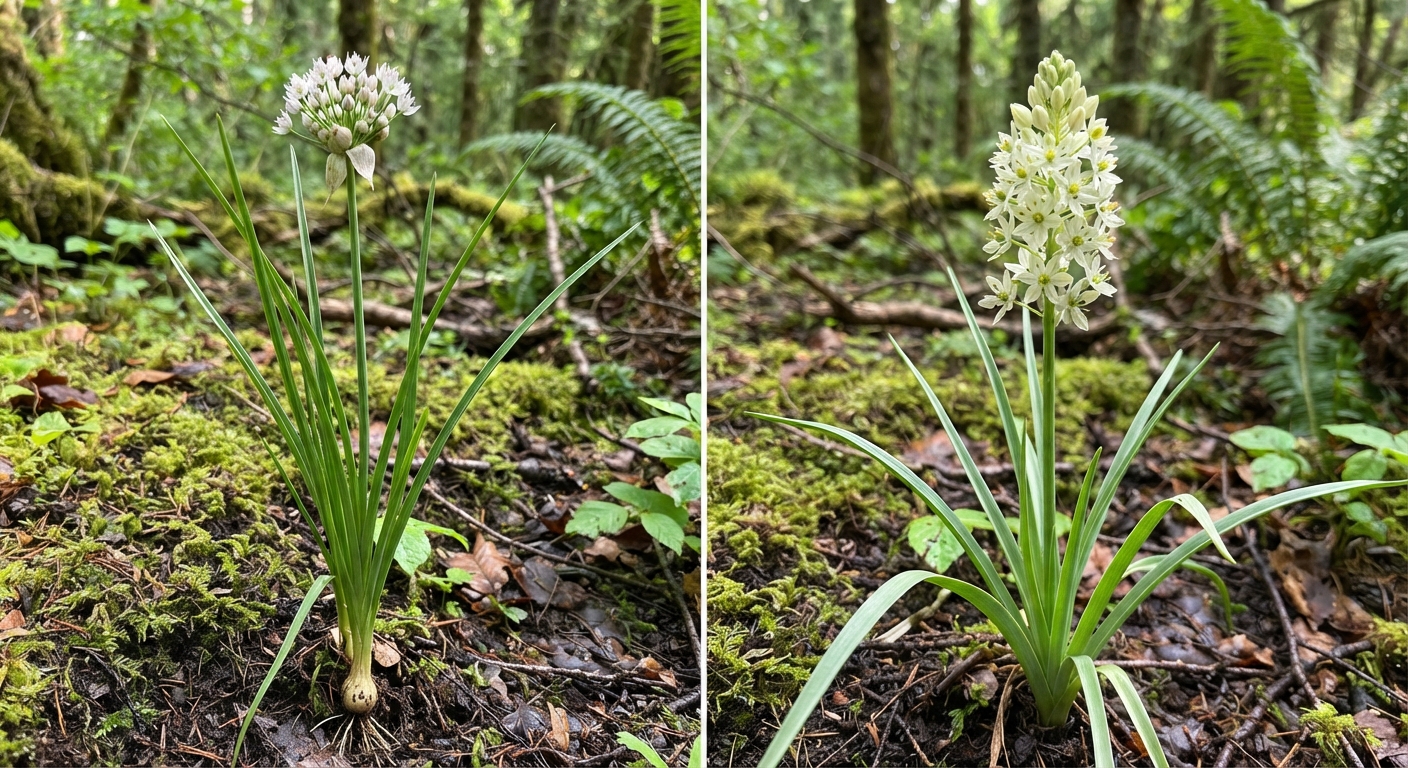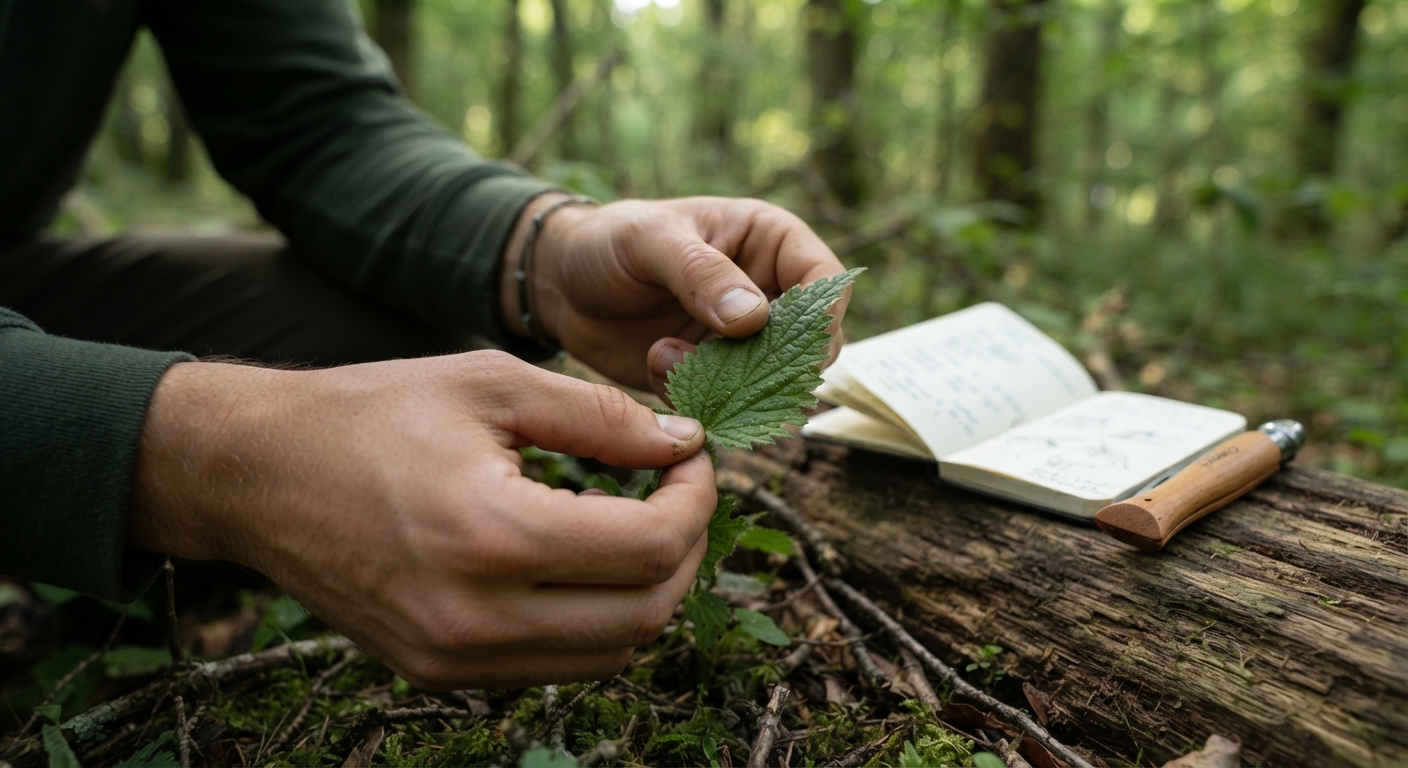
Type “how to test if a wild plant is edible” into any search bar and one answer dominates the results: the Universal Edibility Test. It gets quoted in survival books, repeated on forums, and taught in bushcraft courses with an almost religious certainty. It is also, depending on who you ask, either the single most important plant-safety skill you can learn — or a dangerous relic that gets more people into trouble than it saves.
Both claims have merit, and that’s exactly what makes this topic worth a proper deep-dive. Most articles give you the steps and stop there. This one goes further: where the test came from, the reasoning hidden inside each stage, what it cannot protect you from, and a clear framework for deciding whether running the test is even the right move in the first place.
Let’s start with the part almost nobody bothers to explain.
What the Universal Edibility Test Actually Is — and Where It Came From
The Universal Edibility Test (often abbreviated UET) is a staged protocol for determining whether an unknown plant is safe to eat by exposing your body to it in escalating doses, with observation periods between each stage. You go from rubbing the plant on your skin to touching it to your lips to chewing without swallowing to swallowing a small amount — waiting hours between each step to watch for a reaction.
The logic is brutally simple: if a plant is going to hurt you, you want to find out with the smallest possible exposure, on the least vulnerable part of your body, long before it reaches your stomach.
Where it came from matters. The test traces back to U.S. military survival training, refined through programs like SERE (Survival, Evasion, Resistance, and Escape) and popularized in the Army Survival Manual and later civilian survival literature. Its original audience was not weekend foragers — it was downed pilots and stranded soldiers with no field guide, no phone, and no other option.
That origin story explains both the test’s strengths and its biggest weakness. The UET was never designed to be a good way to find food. It was designed to be a last resort — a structured, risk-minimizing fallback for people who had literally nothing else. When you understand that, the whole conversation around the test changes.
Key distinctions that get blurred in most write-ups:
- The UET tests one plant part at a time, not the whole plant. A plant can have edible leaves and toxic roots (or vice versa).
- It is a time commitment, not a quick check. The full protocol runs roughly 16 hours or more for a single plant part.
- It is never appropriate for mushrooms. Fungi toxins behave differently from plant toxins, and the test cannot detect them safely. If you remember one thing from this article, make it this one.
- A “pass” is a probability, not a guarantee. The test dramatically lowers risk; it does not eliminate it.
With that foundation in place, let’s look at why each step exists — because that’s the part that turns the test from a memorized list into something you actually understand.
The Science Behind Every Stage (What the Manuals Don’t Explain)
Most survival guides present the UET as a list of commands: separate the plant, fast for eight hours, rub it on your skin, and so on. Very few explain why. But once you understand the reasoning, you can adapt the test intelligently instead of following it robotically — and you can spot bad versions of the test floating around the internet.
Stage 1: Separate the plant into parts
Plants concentrate different compounds in different organs. Alkaloids often cluster in roots; cyanogenic glycosides can hide in seeds and young leaves; irritants like calcium oxalate crystals sit in specific tissues. Testing “the plant” as a single unit is meaningless because leaves and roots can have completely different chemistry.
Stage 2: Fast for eight hours (drink only water)
The fasting rule has a specific purpose that’s easy to miss: it gives you a clean baseline. If you’ve been snacking on other foods and then get sick, you won’t know whether the plant caused it or whether it was last night’s questionable leftovers. An empty stomach also means symptoms — nausea, cramping, vomiting — show up faster and are easier to attribute.
Stage 3: The skin-contact test
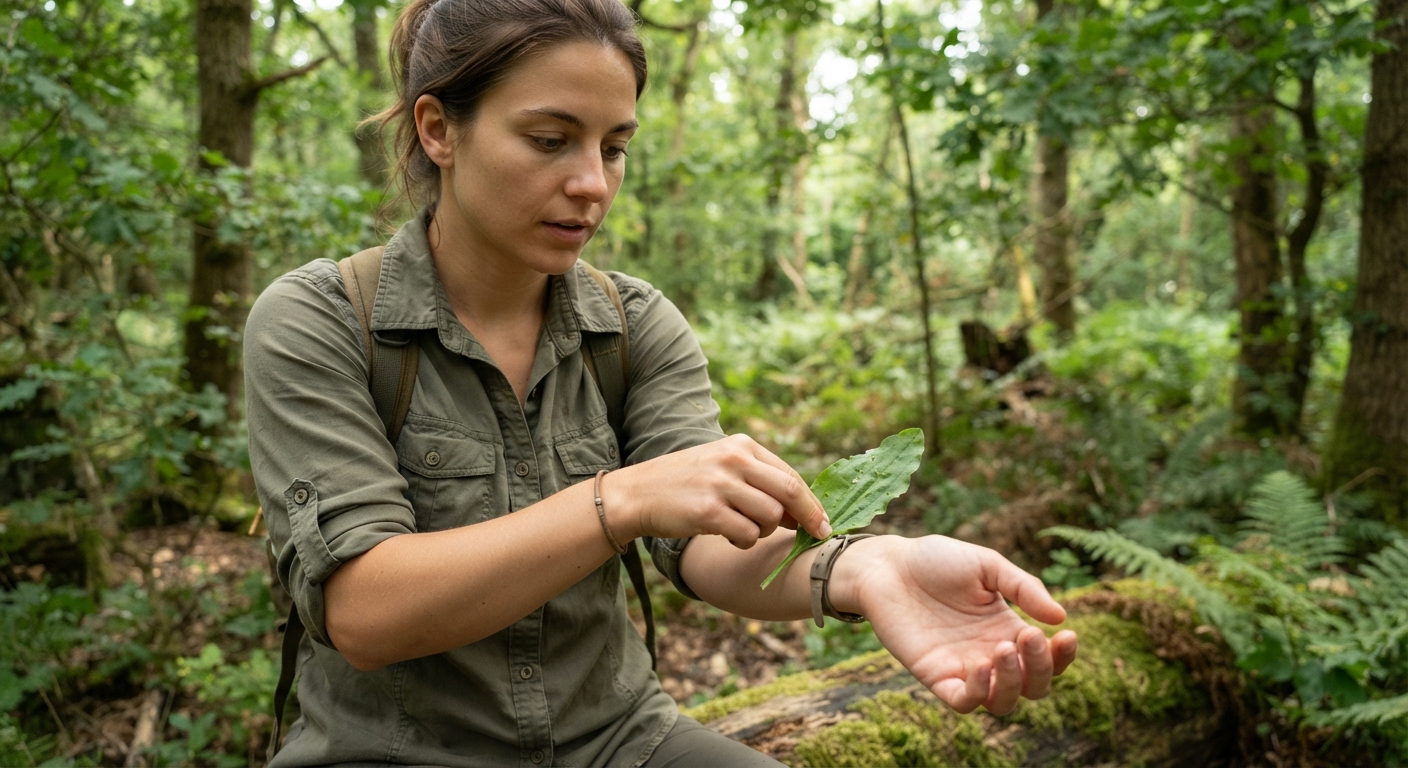
You crush the plant part and rub it on a sensitive patch of skin (inner wrist or elbow). The reasoning here is about route of exposure. Many plant irritants — urushiol from poison ivy, for example — trigger contact dermatitis. By testing on skin first, you detect contact toxins before they ever reach your mouth or gut, where the damage would be far more serious. Fifteen minutes of observation (some guides say longer) is a cheap early-warning system.
Stage 4: The lip and tongue tests
Touching the plant to your lips, then holding a small piece in your mouth, checks for oral irritants. Your lips and mouth are loaded with nerve endings and thin, vascular tissue — far more sensitive than your skin. Oxalates, for instance, will announce themselves as an immediate burning or numbing sensation long before a meaningful dose reaches your system.
Stage 5: The chew-and-spit test
Chewing without swallowing is a middle ground. It releases plant compounds into your saliva and lets you detect bitterness, burning, or numbness — many toxic plants are unpalatably bitter as a defense — while keeping the dose out of your digestive tract. It’s an imperfect filter (not every poison tastes bad), but it’s a useful signal.
Stage 6: Swallow a small amount, then wait
This is the point of no return, and it’s why the dose is deliberately tiny — roughly the size of a fingernail or a small spoonful. You swallow a minimal amount and then wait eight hours, eating and drinking nothing else. That window catches most acute gastrointestinal toxins. The eight-hour wait is not arbitrary; it’s long enough for most fast-acting plant poisons to produce symptoms while you can still respond.
Stage 7: Escalate the dose with continued observation
If no symptoms appear, you eat a slightly larger amount of the same plant part and observe again. The escalation confirms the first result and builds a margin of confidence. The underlying principle is the same one toxicologists use: dose makes the poison. By ramping up slowly, you stay on the safe side of whatever threshold might exist.
The uncomfortable truth buried here: every one of these stages is a compromise. A compound with delayed onset — think certain hepatotoxins or cumulative toxins — can slip through a single 8-hour window undetected. That’s the central weakness of the UET, and we’ll come back to it.
The Full Protocol, Decoded Step by Step
Here is the test laid out as an operational sequence. Treat this as a reference card, not a substitute for judgment.
| Stage | Action | Duration / Waiting Time | What It Detects |
|---|---|---|---|
| 1 | Separate plant into leaves, stems, roots, flowers, seeds | Immediate | Ensures you test one part at a time |
| 2 | Fast — water only, nothing else | 8 hours | Clean baseline for symptom attribution |
| 3 | Crush part, rub on inner wrist or elbow | 15+ minutes | Contact dermatitis / surface irritants |
| 4 | Touch a small piece to outer lip | 3 minutes | Lip-area irritation |
| 5 | Hold a small piece inside mouth | 15 minutes | Oral burning, numbness, bitterness |
| 6 | Chew thoroughly, then spit out | 15 minutes | Oral toxins, unpalatable defenses |
| 7 | Swallow a tiny amount (fingernail-sized) | 8 hours | Acute gastrointestinal toxins |
| 8 | If no symptoms, eat a larger amount | 8+ hours | Confirms earlier result at higher dose |
A few operational notes that trip people up:
- Only test one part of one plant at a time. Mixing parts or plants ruins the attribution logic.
- Test every part you intend to eat separately. Edible leaves say nothing about the roots.
- No shortcuts. Skipping the skin test or shortening the 8-hour wait undermines the whole point of the staging.
- Spit is your friend before the swallow test. If something tastes wrong, stop. Trust the signal.
How the UET Compares to Every Other Option
This is the table most survival guides leave out, and it’s the one that actually helps you decide. The UET is not the only tool for determining edibility — it’s one tool with a specific, narrow use case.
| Method | Speed | Safety | Reliability | Best For |
|---|---|---|---|---|
| Universal Edibility Test | 16+ hours per part | Moderate (reduces, not removes, risk) | Low-moderate | True emergency with no other options |
| Field guide + positive ID | Minutes | High (if ID is certain) | High | Normal foraging with proper knowledge |
| Plant family recognition | Seconds to minutes | High within known families | Moderate-high | Skilled foragers narrowing options |
| Foraging apps (visual ID) | Seconds | Low-moderate | Low-moderate | Suggestion only — never eat on app ID alone |
| Avoid unfamiliar plants entirely | Instant | Highest | N/A | Any non-emergency situation |
The pattern is obvious: the UET is the slowest, least reliable method on the list — and that’s by design. It exists because in a genuine survival scenario, every other method is unavailable. If you have a field guide, a working app, or any real knowledge of the plant, use that instead. The UET is the tool of last resort, not a shortcut.
The Part Survival Manuals Skip: Limitations and Real Risks
Here’s where an honest review has to part ways with the myth-making. The UET has several failure modes that are rarely discussed, and understanding them is what separates responsible knowledge from dangerous overconfidence.
1. Delayed-onset toxins slip through. The test’s observation windows catch acute reactions. Compounds that damage the liver or kidneys over days — or toxins that accumulate with repeated exposure — can pass an 8-hour watch undetected. Amanita mushrooms are the classic example, but certain plants (think pyrrolizidine alkaloids) also do damage over time.
2. Individual sensitivity varies wildly. You might pass a test that would hospitalize someone else. Allergies, existing health conditions, medications, and even your current nutritional state all change how your body responds. A “pass” is specific to you, in that moment.
3. “Edible” does not mean “good for you.” The test tells you whether something is likely not immediately toxic. It says nothing about nutritional value, digestibility, or whether the plant is worth the energy you’ll spend processing it. In a survival context, you can burn more calories testing a plant than you’d gain from eating it.
4. It cannot detect everything. Some risks aren’t chemical at all — parasites, soil contamination, bacterial contamination from water sources. The UET was never built to screen for those.
5. The biggest risk is psychological. The mere existence of the test can create a false sense of security, nudging people to eat things they should leave alone. A novice who “learned the UET” might feel qualified to test and consume plants that an experienced forager would avoid outright.
None of this means the test is useless. It means the test has a specific job, and pretending it does more than that is where the danger lives.
When to Use It — and When to Walk Away
So how do you actually decide? Here’s a simple decision framework that cuts through the noise.
Use the UET only when ALL of these are true:
- You are in a genuine survival situation (not a casual day hike)
- You have no field guide, no working phone, and no reliable plant knowledge
- You have already ruled out the obvious danger signs (milky sap, almond scent, umbrella flower clusters, three-leaf pattern, beans/bulbs/seeds in pods, spines or fine hairs)
- You have 16+ hours and enough water to wait properly
- The plant part is abundant enough to be worth the effort
- It is not a mushroom (ever)
Do NOT use the UET when:
- You can positively identify the plant through any other means
- You’re foraging recreationally or “testing” plants out of curiosity
- The plant shows any of the classic warning signs listed above
- You’re testing fungi, for any reason
- You’re in an area where medical help is reachable (just don’t — go buy food or use a guide)
The short version: the UET is an emergency protocol, not a hobby. If you’re not in an emergency, you have better tools.
Pro Tips from the Field
A few hard-won observations that rarely make it into the official manuals:
Learn the danger-sign families before you learn any test. Knowing how to recognize the Apiaceae (carrot/parsley family, which includes water hemlock), the Solanaceae (nightshades), and toxicodendron relatives (poison ivy, oak, sumac) is worth more in a real emergency than a memorized 13-step protocol. Family recognition is the single highest-leverage foraging safety skill.
Pre-screen with the smell and sap tests. Before you commit to a 16-hour protocol, crush a leaf and smell it. A bitter-almond odor suggests cyanogenic compounds — walk away. Milky or off-colored sap is a red flag in many (not all) species. These two seconds of screening can eliminate obvious risks before you invest hours.
“When in doubt, go hungry.” Survival instructors repeat this for a reason. Your body can survive surprisingly long without food, but a bad plant can kill you in hours. The asymmetry is not even close. In most real emergencies, not eating the unknown plant is the correct survival decision.
Write down your steps and timestamps. In a real survival situation, stress degrades memory. A scribbled note of what you tested, when, and at what dose prevents you from mixing up plants or forgetting an observation window.
Practice the skills you’d actually use. Spend your learning time on plant identification, not on rehearsing the UET. The forager who can reliably ID fifty local plants will never need the test; the one who only knows the test will need it far too often.
Frequently Asked Questions
Is the Universal Edibility Test safe? It reduces risk but does not remove it. It’s a last-resort method designed for people with no better options, and it carries real dangers — including delayed-onset toxins it cannot detect. It is never appropriate for mushrooms.
How long does the Universal Edibility Test take? Roughly 16 hours or more for a single plant part, including the initial 8-hour fast and the 8-hour post-ingestion observation window. Testing multiple parts multiplies the time.
Why do you have to fast before the test? Fasting creates a clean baseline so that any symptoms can be reliably attributed to the plant you’re testing, rather than to something else you ate. It also makes acute symptoms appear faster and more clearly.
Can you use the Universal Edibility Test on mushrooms? No. Under no circumstances. Fungal toxins behave differently from plant toxins and can cause delayed, irreversible organ damage that the test’s observation windows cannot detect.
What are the warning signs you should never test? Milky or discolored sap, an almond-like scent, umbrella-shaped flower clusters, three-leaved growth patterns, beans or seeds inside pods, and spines or fine hairs are all reasons to avoid a plant outright rather than test it.
Is the test better than using a plant identification app? No. If you have any reliable identification method — a field guide, a trusted app combined with human confirmation, or genuine plant knowledge — use that instead. The UET is slower and less reliable than proper identification; it exists for when those options are gone.
Conclusion
The Universal Edibility Test is a fascinating piece of survival doctrine — a genuinely thoughtful, stage-by-stage attempt to squeeze safety out of a fundamentally unsafe situation. Its staged design, from skin contact to tiny ingestion, is a masterclass in risk reduction, and understanding the reasoning behind each step is genuinely valuable knowledge.
But it deserves honest framing, not legend. The test is slow, imperfect, and built for a scenario most of us will never face. Its real lesson is almost paradoxical: the best way to “pass” the Universal Edibility Test is to never need it in the first place — to learn plant identification, recognize dangerous families, and treat unknown plants with the respect they demand.
Learn the test so you understand the principle. Then spend your real effort on the skills that make the test unnecessary. That’s the version of plant safety that actually keeps you alive.