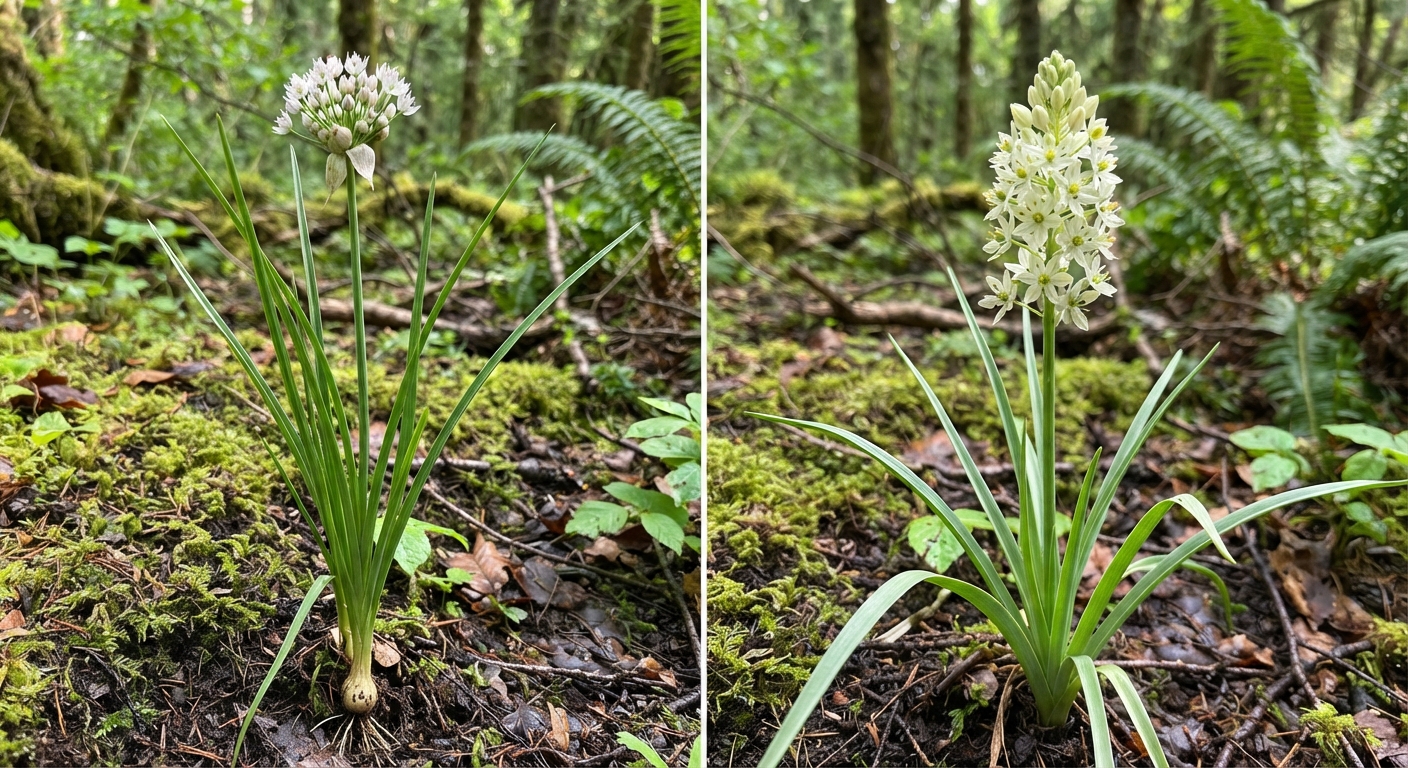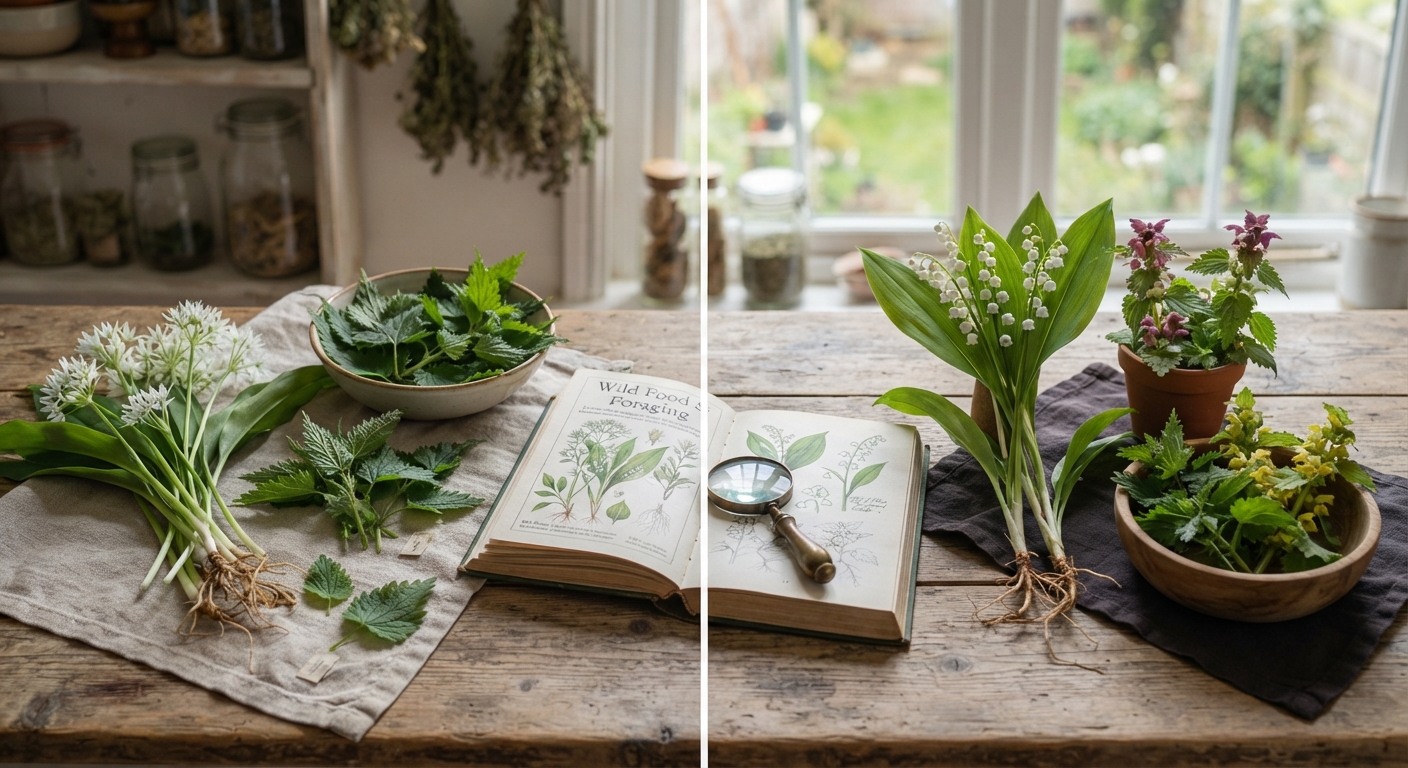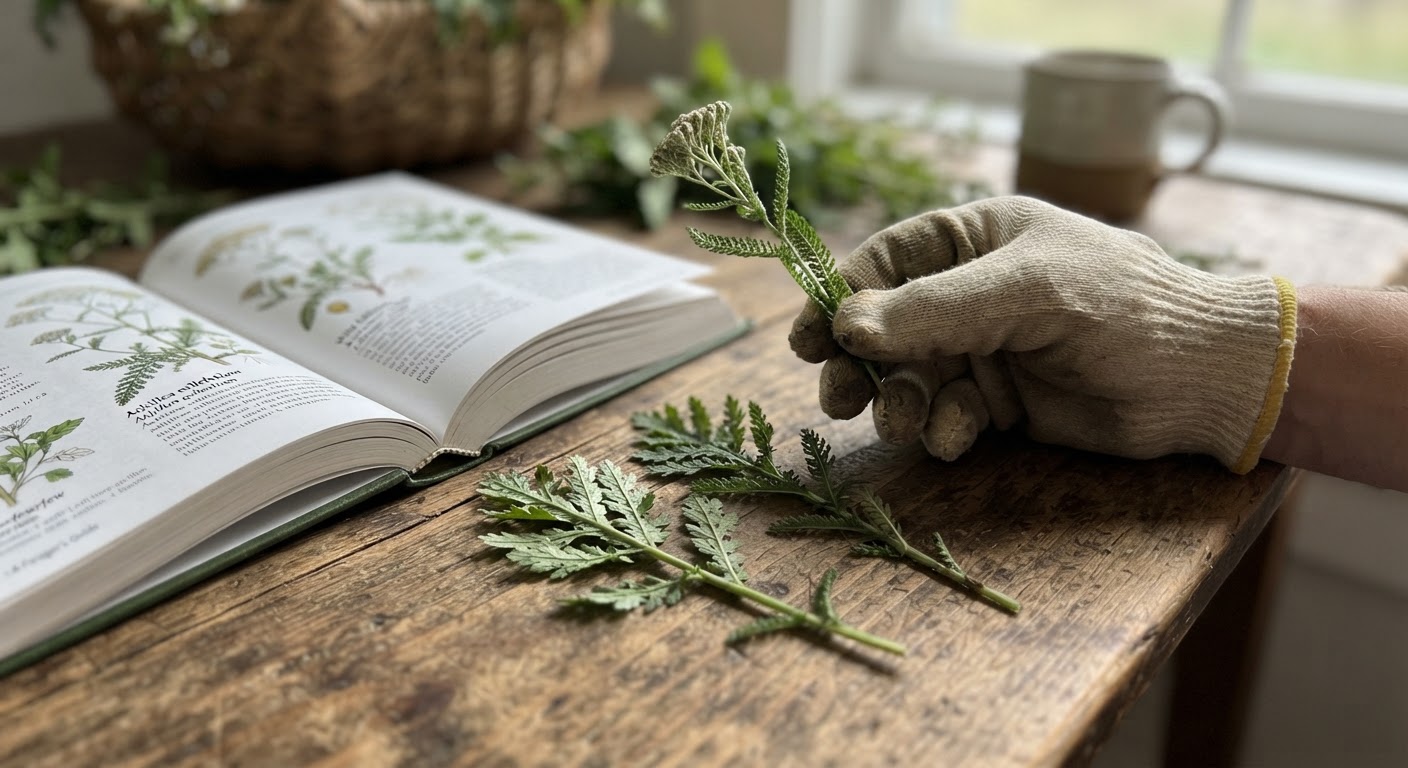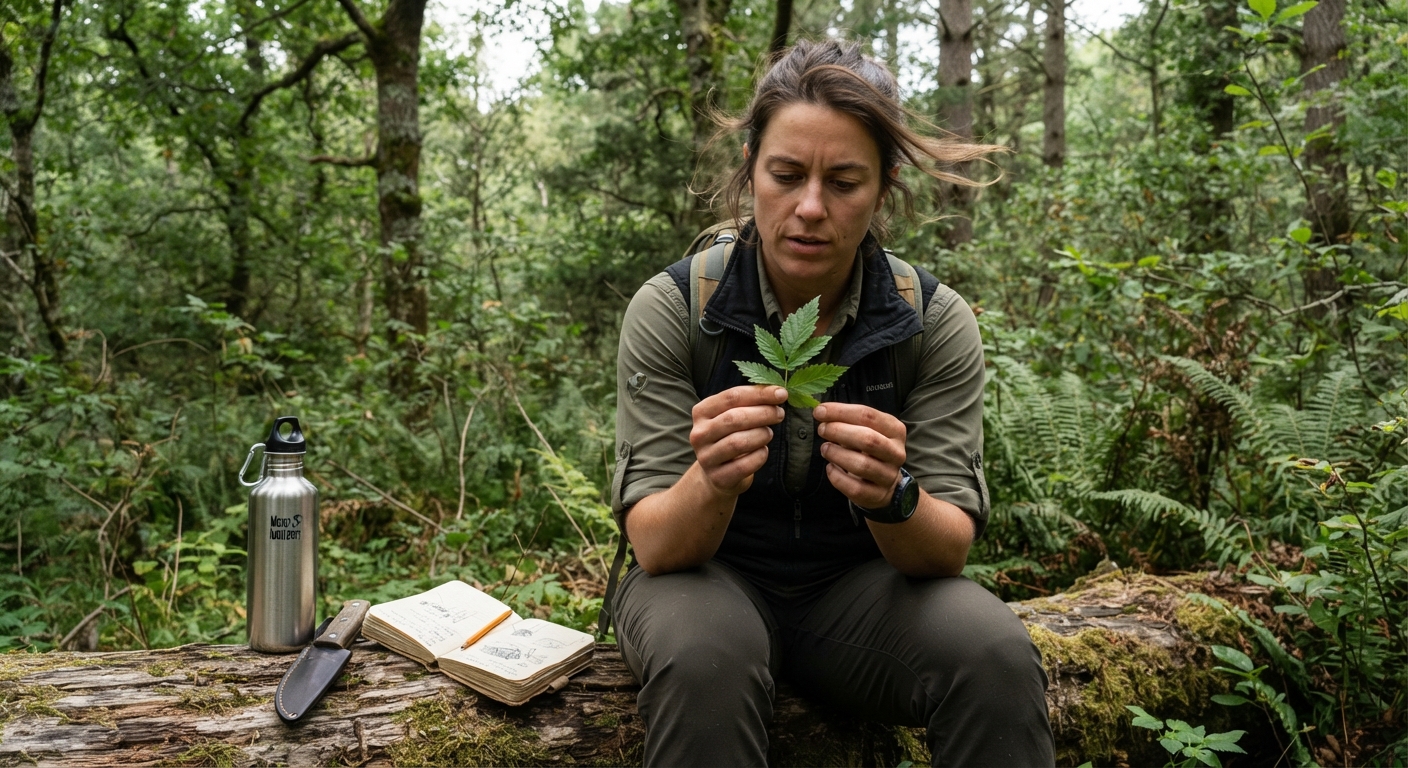
Let’s skip the mythology for a minute and talk about the moment the Universal Edibility Test actually happens.
It is not a fun experiment. It is not a YouTube challenge. The person running this test is usually cold, hungry, out of options, and staring at a plant they’ve never seen before — wondering if it will feed them or hurt them. That’s the only honest frame for everything that follows.
The test itself is simple to describe: you expose your body to an unknown plant in small, escalating doses, waiting between each one to see if something goes wrong. But knowing the steps and running them correctly are two different skills. Most people who “know” the test would still botch it under real pressure, because the details — the timing, the preparation, the discipline of not rushing — are where the test actually lives.
This guide is the practical version. No history lessons, no theory. Just the exact walkthrough, hour by hour, plus the mistakes that quietly wreck the results.
Before we go further, the one warning that overrides everything else: this test is never for mushrooms. Not once, not a small one, not “just to check.” Fungal toxins can destroy your liver days after a clean test. If it’s a fungus, the answer is no, permanently. Keep that in your head before you learn anything else.
Before You Test Anything: The Decision You Have to Make First
Every step of the Universal Edibility Test assumes one thing: you have no better option. No field guide, no working phone, no plant knowledge you trust, no help coming soon.
If any of those resources exist, use them instead. The test is slow, imperfect, and carries real risk — it is the last tool, not the first one. So the genuine first step is not “separate the plant.” It’s asking yourself a hard question: is running this test actually my best move right now?
Run the test only when all of these are true:
- You’re in a genuine survival situation, not a casual hike
- You have no reliable way to identify the plant
- You’ve already screened out the obvious warning signs (we’ll get to those)
- You have at least 16 hours and enough water to wait properly
- The plant part is abundant enough to justify the effort
- It is definitely a plant, and definitely not a mushroom
If even one of those fails, the correct move is usually to not eat the unknown plant. Your body can go weeks without food, but one bad plant can end things in hours. The asymmetry is not close. “Go hungry a little longer” is a survival skill too.
What You Need — and What You Should Skip
The test technically requires almost nothing: the plant, clean water, and patience. But two small preparations make the difference between a reliable result and a guess.
You need:
- Clean water. For the fasting phase and for rinsing plant parts before each step. Contaminated water will wreck your baseline and muddy the results.
- A way to keep time. A watch, a phone with battery (if you have one), or a stick-and-shadow system. The timing is non-negotiable, and stress makes people lose track of hours.
- Something to take notes with. Even a mental checklist helps, but scratch marks on a stick or notes in the dirt work. You need to remember what you tested, when, and at what dose.
- Patience, more than anything. The full test takes roughly 16 hours per plant part. Rushing it defeats the entire purpose.
You can skip:
- Cooking equipment. The test is done on the plant in the state you’d actually eat it. If you plan to cook it, test the cooked version — but for an unknown plant, raw testing of a tiny amount is the standard starting point.
- Fancy tools. No knife required for most steps, though one helps for separating parts.
- A second opinion. By definition, if you had one, you wouldn’t need the test.
The 60-Second Pre-Screen That Can Save You 16 Hours
Before you commit to a full day of testing, spend one minute ruling out the plants that are obviously dangerous. This single habit filters out a large share of the plants that would fail the test anyway — and some that the test itself might miss.
Crush a leaf, look at the sap, and smell it. Then check the shape. Here’s what sends you walking away immediately:
| Warning sign | What to look for | Why it matters |
|---|---|---|
| Milky or off-colored sap | Break a stem or crush a leaf — white, yellow, or unusual sap | Many toxic plants (and spurges) produce colored latex |
| Almond or bitter-almond smell | Crush a leaf and sniff | Suggests cyanogenic compounds (cyanide precursors) |
| Umbrella-shaped flower clusters | Flat or rounded clusters of small flowers on radiating stalks | The carrot family holds poison hemlock and water hemlock |
| Three-leaved pattern | Leaves grouped in threes (with some exceptions) | “Leaves of three, let it be” — poison ivy and relatives |
| Beans, bulbs, or seeds in pods | Legume-style pods, onion-like bulbs | Several are toxic or easy to confuse with toxic lookalikes |
| Spines, fine hairs, or thorns | Visible bristles or stinging hairs | Often an irritant defense; not always toxic but a warning |
| Burning or numbing on touch | Any tingling when handling | Contact irritants like calcium oxalate crystals |
Two of these deserve emphasis, because they’re the ones people skip when they’re hungry. The smell test costs you nothing — crush the leaf, smell it, and if it smells like bitter almonds, you’re done with that plant. And the umbrella cluster is the single most important shape to recognize, because the carrot family contains some of the deadliest plants on the continent, and they look deceptively harmless.
If the plant passes all of these, it’s still not “safe” — it’s just “worth testing.” Keep that distinction clear.
The Full Walkthrough, Hour by Hour
Here is the test as an actual sequence, with the real timings. Treat each line as a hard step — skip one and you’re no longer running the test, you’re just gambling with extra steps.
Step 1 — Separate the plant (5 minutes)
A plant can have edible leaves and toxic roots, or vice versa. Never test “the plant” as a single thing. Split it into parts: leaves, stems, roots, flowers, seeds. Pick one part to test — the one you’d actually want to eat, or the most abundant. Set the rest aside. You’ll test each part separately if you proceed.
Step 2 — Fast for eight hours (the baseline)
Water only. Nothing else — no snacks, no tea, no “just a berry.” The fast gives you a clean baseline so that if symptoms appear later, you can attribute them to the test plant and not to whatever else you ate. It also makes acute symptoms show up faster and clearer on an empty stomach.
Step 3 — The skin test (15+ minutes)
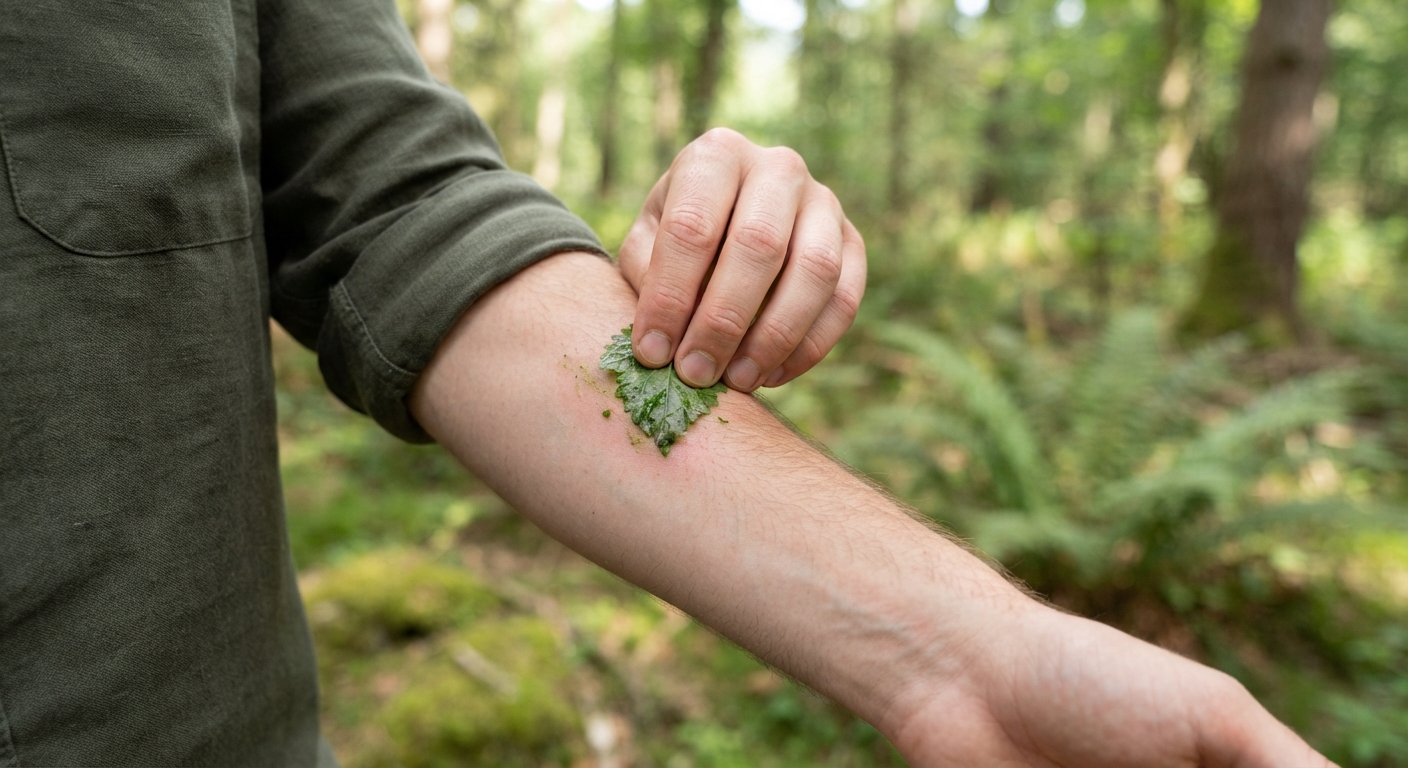
Crush the plant part to release its contents, then rub it on a thin, sensitive patch of skin — inner wrist or inner elbow. Wait at least 15 minutes. Watch for redness, itching, burning, or a rash. This catches contact irritants before they reach your mouth, where the damage would be far worse.
Step 4 — The lip test (3 minutes)
Touch a small piece to your outer lip. Hold it there, or rest a small piece against the lip for about 3 minutes. Your lips are far more sensitive than your skin. Any burning, tingling, or numbness means stop.
Step 5 — The mouth test (15 minutes)
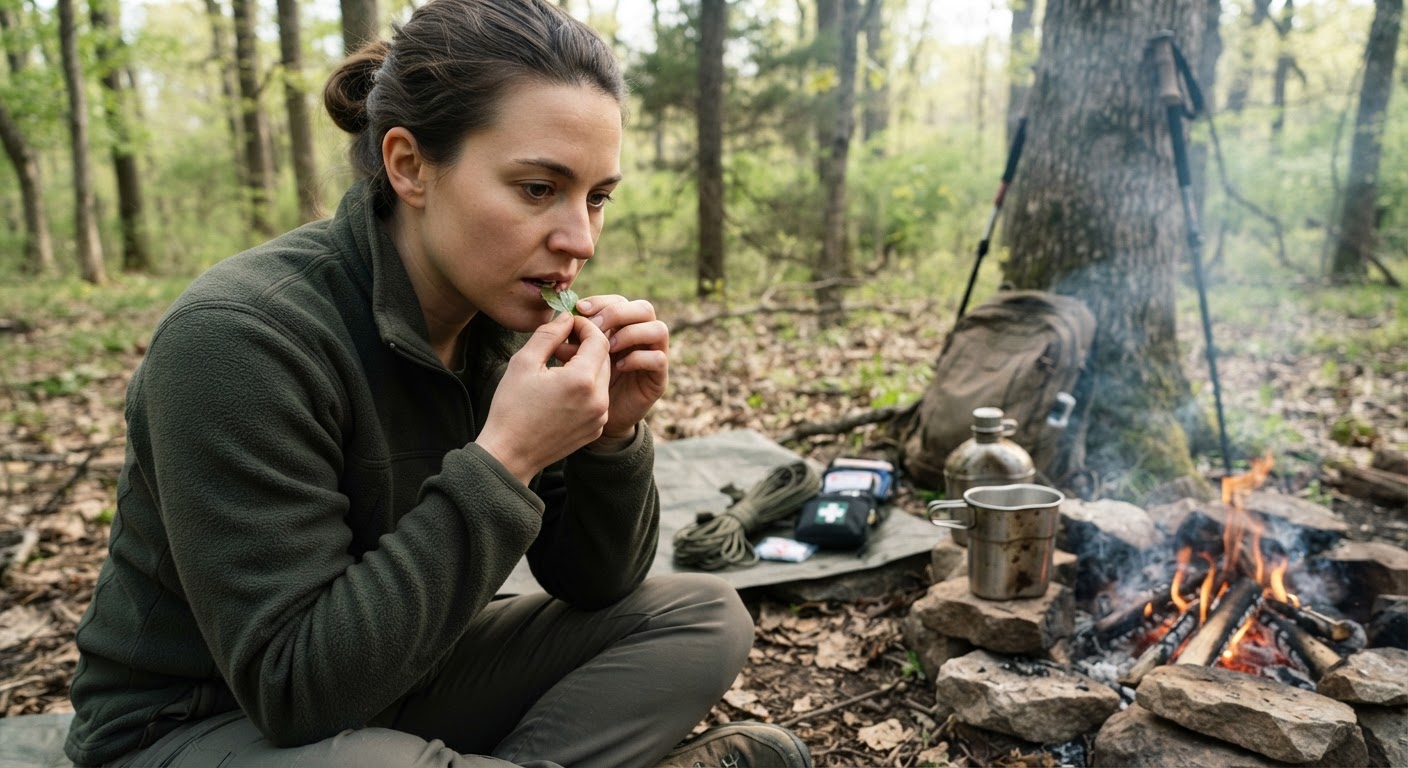
Place a small piece inside your mouth but do not chew or swallow yet. Hold it for 15 minutes. This checks for oral irritation — the burning or numbing that oxalates and other irritants produce. Spit it out the moment anything feels off.
Step 6 — The chew-and-spit test (15 minutes)
Chew the piece thoroughly, then spit it all out. Don’t swallow. This releases plant compounds into your saliva and lets you detect bitterness, burning, or numbness. Many toxic plants are aggressively bitter — not all, but many. If it tastes wrong, trust it and stop.
Step 7 — Swallow a tiny amount, then wait (8 hours)
This is the point of no return. Swallow a deliberately small amount — roughly the size of a fingernail or a small spoonful. Then eat and drink nothing else for eight full hours. Watch for nausea, cramping, vomiting, diarrhea, or anything unusual. This window catches most fast-acting gastrointestinal toxins.
Step 8 — Escalate and observe again (8+ hours)
If nothing happened, eat a slightly larger amount of the same plant part and wait again. This confirms the first result at a higher dose and builds a margin of confidence. The principle is the one toxicologists live by: the dose makes the poison. You’re climbing toward a normal portion slowly, staying on the safe side of whatever threshold might exist.
| Stage | What you do | Minimum wait | What it catches |
|---|---|---|---|
| Separate | Split plant into leaves/stems/roots/flowers/seeds, pick one part | 5 min | Ensures you test one part at a time |
| Fast | Water only, nothing else | 8 hours | Clean baseline for symptom attribution |
| Skin | Crush and rub on inner wrist or elbow | 15 min | Contact irritants, dermatitis |
| Lip | Touch small piece to outer lip | 3 min | Lip-area irritation |
| Mouth | Hold piece in mouth, no chewing/swallowing | 15 min | Oral burning, numbness |
| Chew & spit | Chew thoroughly, spit out | 15 min | Bitterness, oral toxins |
| Swallow | Eat a fingernail-sized amount | 8 hours | Acute gastrointestinal toxins |
| Escalate | Eat a larger amount of same part | 8+ hours | Confirms result at higher dose |
A Worked Example: Running the Test on One Unknown Plant
It helps to see the whole thing as one continuous story instead of eight disconnected steps. Imagine a green, leafy plant growing in damp soil at the edge of a clearing. It has broad, oval leaves and a hollow stem, no obvious flowers at the moment, and it doesn’t match anything you recognize.
Hour 0 — Pre-screen. You crush a leaf. No milky sap — the sap runs clear and watery. You sniff: no almond smell, just a mild green, almost cucumber-like scent. The leaves are broad and oval, not in threes, no umbrella flower clusters, no spines, no pods. It passes the pre-screen. Worth testing.
Hour 0–8 — Fast. You drink water, keep your notes straight, and don’t touch any other food. You note the time.
Hour 8 — Skin test. You crush a leaf and rub it on your inner wrist. Fifteen minutes pass. Nothing — no redness, no itch. You note the result.
Hour 8:15 — Lip test. You hold a small piece against your lip for three minutes. No tingling. Good.
Hour 8:20 — Mouth test. A piece goes in your mouth, unchewed. Fifteen minutes. No burning, no numbness. You spit it out.
Hour 8:35 — Chew and spit. You chew a piece thoroughly. The flavor is mild, slightly grassy, faintly sweet — nothing bitter, nothing acrid. You spit it out and wait fifteen minutes. Still nothing.
Hour 9 — Swallow. You swallow a fingernail-sized piece. Then you wait. Eight hours. You drink water, stay put, and keep watching the clock. No nausea, no cramps, no vomiting.
Hour 17 — Escalate. You eat a small spoonful of the leaves. You wait again. If the next eight hours stay quiet, you have a plant that is probably not acutely toxic — at least for you, at this dose, in this moment.
That’s the test, end to end. Notice how much of it is simply waiting. The skill isn’t in the actions — it’s in not rushing them.
Where People Get It Wrong
The test’s reputation suffers because people run it badly and then blame the test. Here are the most common failures, in rough order of how often they happen.
Skipping the fast. If you’ve been eating other food, you can’t tell whether the nausea came from the plant or from yesterday’s leftovers. The whole attribution logic collapses. This is the most common shortcut and the one that most reliably invalidates the result.
Testing the whole plant instead of one part. Edible leaves mean nothing about toxic roots. Mixing parts destroys the “one variable at a time” logic that makes the test meaningful.
Shortening the 8-hour windows. The wait isn’t a suggestion. Toxins need time to produce symptoms, and an empty stomach plus an 8-hour watch is the minimum that catches most acute reactions. Cutting it to two hours because you’re impatient is how people get hurt.
Rushing through a mild reaction. A little itching, a little tingling, a slight burn — these are the test working. They are stop signs, not “maybe it’ll pass” moments. Any reaction at any stage means you halt and do not proceed.
Testing something you could have identified. If a field guide or a knowledgeable person is available, the test is the wrong tool. It’s slower and less reliable than positive identification. Use the better tool when it exists.
Ignoring the pre-screen. The 60-second smell-and-sap check filters out a lot of danger for free. Skipping it means spending 16 hours on a plant that a crushed leaf and a sniff could have ruled out in a minute.
Pro Tips
A few things that rarely make it into the official write-ups, learned from watching people run this under real conditions.
Learn the danger families before you ever need the test. The single highest-leverage survival skill is recognizing the carrot family (poison hemlock, water hemlock), the nightshades, and poison ivy’s relatives. If you can spot those on sight, you may never need the test at all — and if you do, you’ll screen faster.
Write down your steps and timestamps. Stress destroys memory. A scratch note of what you tested, when, and at what dose prevents you from mixing up plants or forgetting a window. It costs nothing and could be the difference between a clean result and a dangerous guess.
Test the part you’d actually eat, in the form you’d eat it. If you’d boil it, test it boiled. Raw testing a plant you intend to cook gives you incomplete information, because cooking changes the chemistry.
“When in doubt, spit it out” applies at every stage. The taste test, the lip test, the skin test — any negative signal is a full stop. There is no “try a little more to be sure” once your body gives you a warning.
Treat a pass as a probability, not a certificate. A clean test says this plant is probably not acutely toxic to you right now. It says nothing about delayed or cumulative toxins, allergies, or long-term effects. A pass lowers risk; it doesn’t erase it.
Straight Answers to Hard Questions
| Question | The honest answer | Why it matters |
|---|---|---|
| How long does the full test take? | Roughly 16 hours per plant part, including the 8-hour fast and the 8-hour post-swallow wait | The timing is the test; cut it and the result means nothing |
| Can I test mushrooms? | Never. Not once, not a small amount | Fungal toxins can hit days later and are often fatal |
| Why the 8-hour fast? | It gives you a clean baseline so symptoms can be attributed to the plant | Without it, you can’t tell what made you sick |
| Is a passing test a guarantee? | No. It’s a probability, not a certificate | Delayed and cumulative toxins can slip through |
| What’s the first thing to do before testing? | A 60-second pre-screen: sap, smell, and shape | It filters out obvious danger for free |
| Is the test better than a field guide? | No. Positive ID is faster and more reliable | The test is for when you have nothing else |
| What if I feel a mild reaction? | Stop immediately and do not proceed | A reaction is the test working, not a hurdle to push through |
Conclusion
The Universal Edibility Test is not a party trick and not a shortcut. It’s a structured way to make a bad situation slightly less dangerous — a last-resort protocol built on one idea: if a plant is going to hurt you, find out with the smallest possible exposure, long before it reaches your stomach.
The value of learning it isn’t that you’ll run it often. It’s that you’ll understand why the discipline matters — why you separate the plant, why you fast, why you wait eight hours, why a single mild reaction means stop. That discipline is the same one behind all good foraging: caution, patience, and the humility to walk away when you’re not sure.
Learn the danger-sign families first. Learn to identify plants properly. And keep the test in your back pocket for the one day you genuinely have no other choice — the day you’ll be glad you took the time to learn it right.