Survival Food in the Forest for Beginners: A Complete Guide
Most survival food advice starts in the wrong place. It hands a hungry beginner a list of forty or fifty edible plants and says, “memorize these,” as if the person standing in the woods with an empty stomach and a dead phone is going to recall plant number thirty-seven by its Latin name. What an actual beginner needs is the opposite: a very short list of plants that are hard to get wrong, plus a clear order of what to do first, second, and third.
That’s what this guide gives you. It assumes you know almost nothing about wild plants, that you’re tired and possibly cold, and that the stakes are real. You won’t leave here knowing every edible in the forest — but you’ll leave knowing the few that matter most, how to find them, and how to avoid the mistakes that turn a hungry night into a hospital trip.
Why Beginners Struggle With Forest Food (And What Actually Works)
Before the plant list, let’s be honest about the situation, because it changes every decision that follows. A beginner lost or stranded in the forest is not dealing with a “foraging” problem. Foraging is a relaxed weekend hobby — you wander, you identify, you pick a few interesting things. Survival food is the opposite: you’re burning energy, you’re stressed, and stress does something specific to your brain. It makes you want to move, to do something, to grab the first green thing that looks edible.
That impulse is the real danger. In a survival situation, the plants that hurt people are rarely exotic. They’re the common ones that look “close enough” to something safe. And a stressed, hungry person is exactly the person who decides “close enough” is fine.
So the whole approach flips. Instead of trying to learn many plants, you learn a few plants cold. Instead of wandering and hoping, you work a short, repeatable method. And instead of treating plants as your first priority, you treat them as your second — because before food, you need water and a clear head.
Keep that frame as we go through everything below. The plants on this list earn their place for one reason only: a tired beginner can identify them with high confidence, and that confidence is the difference between a meal and a mistake.
The Shortlist: 7 Plants a Beginner Can Actually Rely On
Here’s the whole shortlist in one place. These are the plants I’d want a complete beginner to know before any others, chosen for how easy they are to identify and how widely they grow. “Prep” is the one column you cannot skip — some of these are toxic or painful if eaten raw.
| Plant | What you eat | Best season | Prep required | Why it’s on the list |
|---|---|---|---|---|
| Cattail | Shoots, young flower spikes, pollen, rhizomes | Spring to fall (rhizomes fall–winter) | Cook shoots; boil/roast rhizomes | “Supermarket of the swamp” — nothing dangerous looks like it |
| Dandelion | Leaves, flowers, roots | Spring to fall | None (bitter raw; blanch to soften) | Grows everywhere; easy to ID; nothing toxic mimics it |
| Stinging nettle | Young leaves and tops | Spring to early summer | Must cook or dry to kill the sting | High nutrition, abundant in wet soils |
| Clover | Leaves and flowers | Spring to fall | None | Common, mild, and beginner-proof |
| Plantain (broadleaf) | Young leaves | Spring to fall | None (older leaves get tough) | Ubiquitous lawn and trailside plant |
| Acorns (oak) | Nuts, after leaching | Fall | Must leach tannins; then roast/grind | Real calories and carbs — rare in the wild |
| Pine | Inner bark, needles (tea) | Year-round | Peel cambium; steep needles | Emergency carbs and vitamin C in any season |
Notice what’s not on this list: no mushrooms, no berries, nothing from the carrot/parsley family, nothing that has a deadly lookalike. That’s deliberate. A beginner’s survival shortlist should be boring, common, and safe — not exciting and risky. Excitement is how you end up in the emergency room.
The Step-by-Step Method: What to Do First, Second, and Third
Here’s the working method, in the order it should actually run. Skip a step and the whole thing gets harder.
Step 1: Secure water and read your energy budget first
This feels like it has nothing to do with food, and it’s the most important step on the list. Here’s why: your body can go weeks without food but only days without water, and dehydration makes every subsequent decision worse. A dehydrated brain misidentifies plants. A dehydrated body can’t process food properly anyway.
So before you think about eating anything, find water — a stream, a spring, a pond — and make a plan to make it safe (boiling, filtering, or at minimum choosing the clearest running water you can find). Then take an honest look at your energy budget. If you’re within a few hours of a trail or road, the smartest “survival food” decision is often to not spend energy foraging and just walk out. Foraging burns calories and time. It’s worth it when you’re genuinely stuck, not when you’re mildly peckish and a mile from help.
Step 2: Apply the “name it or leave it” rule
This is the single rule that keeps beginners alive, and it’s non-negotiable. You only eat a plant if you can name it with certainty — the exact species, matched across several features, not just “it looks like a dandelion.” If there’s any doubt, any “probably,” any “close enough,” you leave it.
The reason this rule is brutal is that it removes the most common killer: the one-feature guess. A leaf that looks right is not an identification. You need leaf shape, growth habit, the whole plant, and ideally the flower or fruit to confirm. If even one feature doesn’t line up, it’s not that plant, and it stays on the ground.
I’ll say this plainly because it’s the whole ballgame: no plant is worth a guess. In a survival situation, a missed meal is survivable. A misidentified plant is not.
Step 3: Start with the greens you can’t confuse
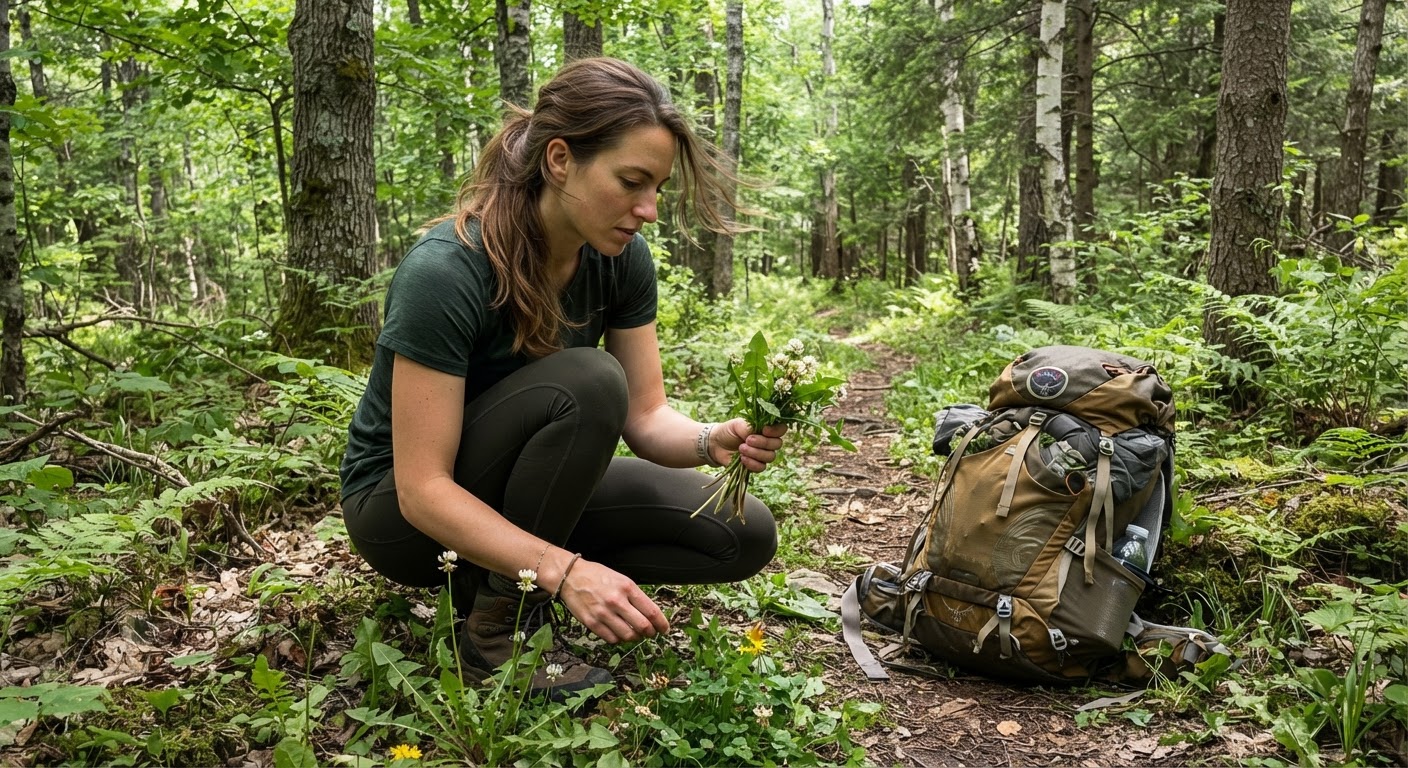
When you do start eating, begin with the low-risk, high-abundance greens — the plants that don’t have a dangerous twin. Cattail, dandelion, clover, and plantain are your foundation, and here’s why each one is beginner-safe:
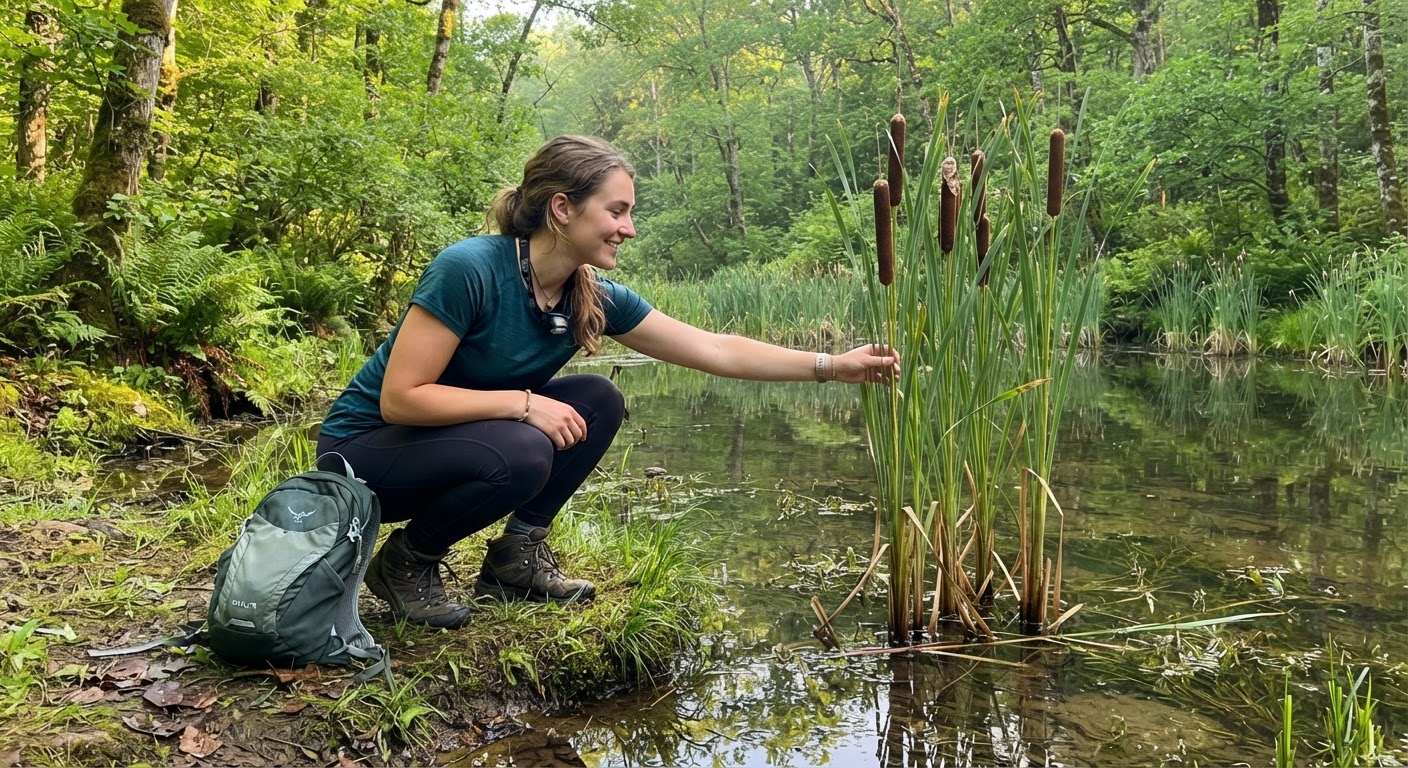
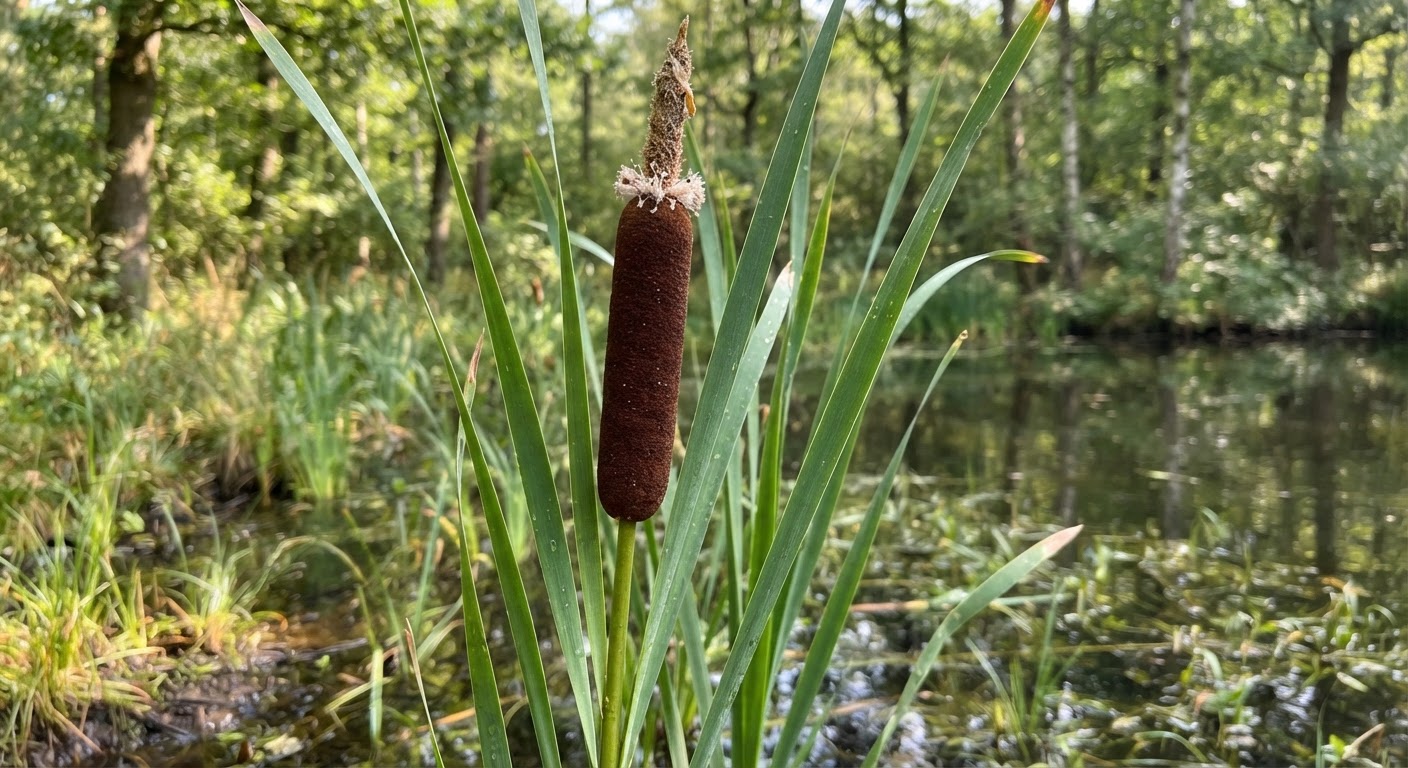
- Cattail has a look nobody confuses with anything toxic — the brown, cigar-shaped seed head on a tall stalk is unmistakable. It’s sometimes called the “supermarket of the swamp” because nearly every part is edible at some point in the year.
- Dandelion is the plant everyone already knows. The toothed leaves, hollow stem, and single yellow flower on each stalk add up to an ID that’s hard to fumble.
- Clover and plantain are the humble lawn weeds you’ve seen your whole life. They’re mild, common, and about as low-stakes as wild food gets.
Greens like these won’t fill you up on their own — they’re mostly water and fiber — but they give you vitamins, minerals, and the psychological boost of eating something. That matters more than you’d think when you’re stressed.
Step 4: Add real calories (this is where it gets serious)
Greens are the warm-up. If you’re going to be out there for more than a day, you need actual calories — carbohydrates and fat — and those are harder to find in the wild. This is where acorns, cattail rhizomes, and pine come in, and where most beginners give up too early.
Acorns are the crown jewel of wild calories. An oak tree in fall can drop hundreds of pounds of nuts, each one packed with carbs and fat.
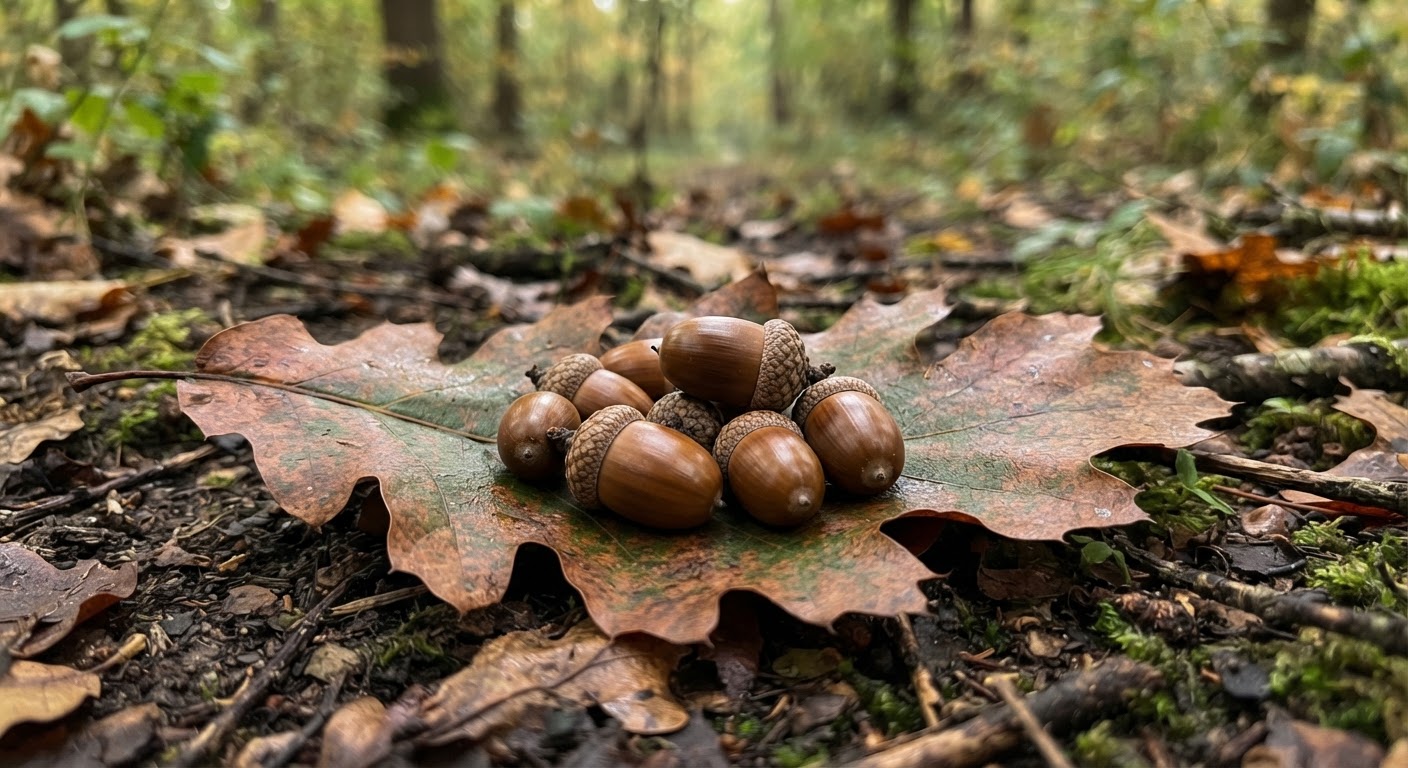 The catch is the tannins — bitter compounds that are toxic in quantity and make raw acorns taste terrible. The fix is leaching: shell the acorns, crush or chop them, and soak them in repeated changes of cold water (or boil them in several changes) until the water runs clear and the bitterness is gone. Once leached, they can be roasted and eaten, or ground into a rough flour. It’s labor-intensive, but it’s the closest thing a forest has to a reliable carb source.
Cattail rhizomes — the thick, starchy roots that run horizontally in the mud — are another real energy source, best harvested in fall and winter when the plant has stored starch. Dig them up, wash off the mud, and peel the outer layer. The starchy core can be eaten, but it’s tough and fibrous, so the practical method is to chew it to release the starch and spit out the fiber, or to pound the rhizomes in water and let the starch settle out.
Pine is the emergency fallback. The soft inner bark (the cambium layer, just under the rough outer bark) can be peeled and eaten raw or dried and pounded into a flour-like powder — it’s a genuine survival food, if not a delicious one. Pine needles, meanwhile, make a vitamin-C-rich tea that’s been used for centuries to stave off scurvy. Just steep the needles in hot water; don’t boil them hard, or the vitamin C breaks down.
Step 5: Prep it right before you eat it
This is the step that separates “edible” from “safe to eat right now.” A surprising number of wild plants need preparation before they’re food, and skipping it is how people get sick from plants that are technically edible.
The big three prep rules for a beginner:
- Cook your nettles. Stinging nettle delivers a dose of formic acid and histamine through tiny hairs on the leaves and stem. Cooking — blanching, boiling, or sautéing — destroys the sting in seconds. Raw nettle is not a fun experience.
- Leach your acorns. We covered this above, but it bears repeating because it’s the difference between a calorie source and a stomachache. Never eat raw acorns.
- Wash everything, and cook what’s questionable. Wild greens grow where animals live, and “animals” includes everything from deer to rodents. A rinse removes surface grime and parasites. When you have fire, cooking is almost always the safer call — it kills surface bacteria and softens tough plant fiber.
The rule of thumb: if you don’t know how a plant needs to be prepared, you don’t eat it. “Edible” without a prep method is just a guess with extra steps.
What to Harvest by Season
Wild food is a moving target. The same forest offers completely different food in spring and fall, and a beginner who knows when to look has a huge advantage. Here’s the seasonal map for the shortlist above.
| Season | Your best bets | What to look for | Notes |
|---|---|---|---|
| Spring | Nettle tops, cattail shoots, dandelion leaves, clover | Tender new growth, young shoots in wet soil | Best time for tender greens; nettle sting is at full strength, so cook it |
| Summer | Cattail pollen and young spikes, dandelion, clover, plantain | Flower spikes, pollen heads | Greens get tougher and more bitter as heat sets in |
| Fall | Acorns, cattail rhizomes (start), pine | Oak trees dropping nuts, muddy pond edges | Acorns are the season’s big calorie score; leach them well |
| Winter | Cattail rhizomes, pine needles and inner bark | Dig rhizomes before the ground freezes hard | Food is scarce; lean on stored plant energy and pine |
The pattern worth internalizing: spring and summer give you greens, fall gives you calories, winter gives you whatever you stored and the evergreen emergency foods. If you’re stranded, your best food strategy depends entirely on which season you’re in — so learn to read the season as carefully as you read the plants.
Pro Tips From the Trail
These are the details that only come from actually doing this, the things a field guide won’t tell you. They’ll change how you’d actually work a survival food situation.
Learn the plants before you need them. This sounds obvious, but it’s the tip that saves people. The time to learn what a cattail looks like is on a casual hike in good weather, not while your stomach is growling in the rain. A few weekend walks spent identifying just the seven plants above is worth more than a hundred survival videos watched in an armchair.
Carry a water plan and a fire plan, not just a plant list. Food is third on the priority list for a reason. Water and warmth kill faster than hunger. A working lighter, a way to purify water, and a space blanket will do more for your survival than any number of memorized plants.
Don’t burn more calories than you gain. Foraging is physical work. Digging cattail rhizomes out of cold mud can cost you more energy than the starch gives back, especially in winter. Be strategic: harvest abundant, easy food first, and don’t chase a handful of calories through a swamp if you’re already exhausted.
Pick the abundant, boring plant over the rare, exciting one. Beginners are drawn to novelty — the unfamiliar berry, the interesting-looking mushroom. Resist it. The dandelion you see everywhere is a better survival food than the exotic-looking thing you can’t name, every single time.
If you’re not sure, the answer is already no. This is the “name it or leave it” rule again, stated as a reflex. Cultivate it until it’s automatic, because in the moment, when you’re hungry and tired, your brain will argue for “probably fine.” The reflex has to be louder.
Teach your group the same seven plants. If you’re out with others, survival food is a group problem. Everyone in the party should know the shortlist and the rule. One person’s knowledge is fragile; shared knowledge is a safety net.
Field Questions From First-Time Foragers
“What’s the absolute first plant I should learn?”
Cattail. It grows near water across most of the temperate world, it’s nearly impossible to confuse with anything dangerous, and it feeds you in multiple seasons and multiple ways — shoots, pollen, and starchy rhizomes. If you only learn one plant, learn cattail.
“How do I know a plant is safe if I have no signal and no guide?”
You don’t, unless you already know the plant. This is the hard truth that most survival advice dances around. With no signal, no guide, and no prior knowledge, you have exactly two safe options: eat only the plants you can positively identify from memory, or run the universal edibility test — a slow, 16-hour emergency procedure that’s a genuine last resort. There is no reliable way to eyeball safety on an unknown plant.
“Are berries and mushrooms safe for a beginner?”
No, and you should treat both as off-limits. Berries have deadly lookalikes that fool experienced people, and mushrooms are a category with essentially zero margin for error — a mistaken mushroom can taste fine and destroy your liver over the next three days. A beginner’s survival food comes from greens, roots, and nuts, not from berries and fungus.
“How much wild food do I actually need to eat?”
Less than you think, for the first day or two. In a short survival window, food is mostly a morale and energy issue, not a life-or-death one — you can survive weeks without food. Your real needs are water, warmth, and not doing anything reckless. Eat the easy greens for morale and vitamins, and only invest the heavy effort (acorns, rhizomes) if you’re looking at multiple days out.
“Can I eat the same plants as the animals I see?”
No. Birds eat poison ivy berries and pokeweed berries without harm, and deer browse on plants that would make a human violently ill. Animals have different digestive systems and liver enzymes, which means an animal’s diet tells you nothing about what’s safe for you. The only reference that matters is a positive identification of a known human food.
“What if I eat the wrong plant by accident?”
Stop eating immediately, note what the plant looked like (a photo helps if you can take one), drink clean water, and don’t induce vomiting unless a medical professional tells you to. If you can reach help or have any way to contact Poison Control, do it right away — don’t wait for symptoms. If you’re truly isolated, rest, stay hydrated, and monitor yourself closely, because symptoms from some plant toxins take hours to appear.
Know the Forest Before It Knows You’re Hungry
Survival food in the forest isn’t really about plants. It’s about preparation — knowing a handful of safe, common plants before you’re ever in a position to need them, and having the discipline to walk away from anything you can’t name with certainty. The person who does best in a survival situation isn’t the one who memorized the most plants. It’s the one who knows a few plants cold, respects the “name it or leave it” rule, and keeps their head when they’re hungry.
That’s the whole philosophy in one line: learn a little, learn it perfectly, and never guess. If you internalize nothing else from this guide, internalize that.
When you’re out on a trail with no signal and you spot something green, the difference between “I think that’s edible” and “I know that plant” is everything. That’s exactly why I built Edible Plant Identifier — point your camera at any leaf and it helps you identify what you’re looking at, with clear notes and lookalike warnings, so you’re not working from memory alone. It works fully offline, which is the only place this stuff actually matters. It won’t replace real field knowledge or expert advice, but it’s a fast, honest second opinion when you’re standing in the woods trying to be sure.