Camping Without Food? How to Forage Safely (Complete Guide)
Here’s the scene nobody plans for: you packed for two nights, a storm rolled in, the trail out flooded, and now you’re on day three with an empty food bag and a long, slow walk back to the trailhead. Or maybe it’s simpler than that — you grabbed the tent but forgot the cooler, and the nearest store is a two-hour drive.
Whatever got you here, the fix isn’t to panic and start nibbling on random leaves. The fix is a process. Foraging when you’re genuinely out of food is a different game from weekend foraging for fun, because now the stakes are higher and so is the temptation to take shortcuts. That’s exactly when shortcuts get people sick.
This guide walks you through the whole thing in order, like a mentor talking you through it around a campfire. I’ll show you which plants to trust, which lookalikes have sent people to the hospital, how to test something you’re not sure about, and how to prepare what you gather so it actually helps instead of hurting.
Why “Camping Without Food” Is More Dangerous Than It Sounds
Before the plants, one honest framing, because it changes how you act.
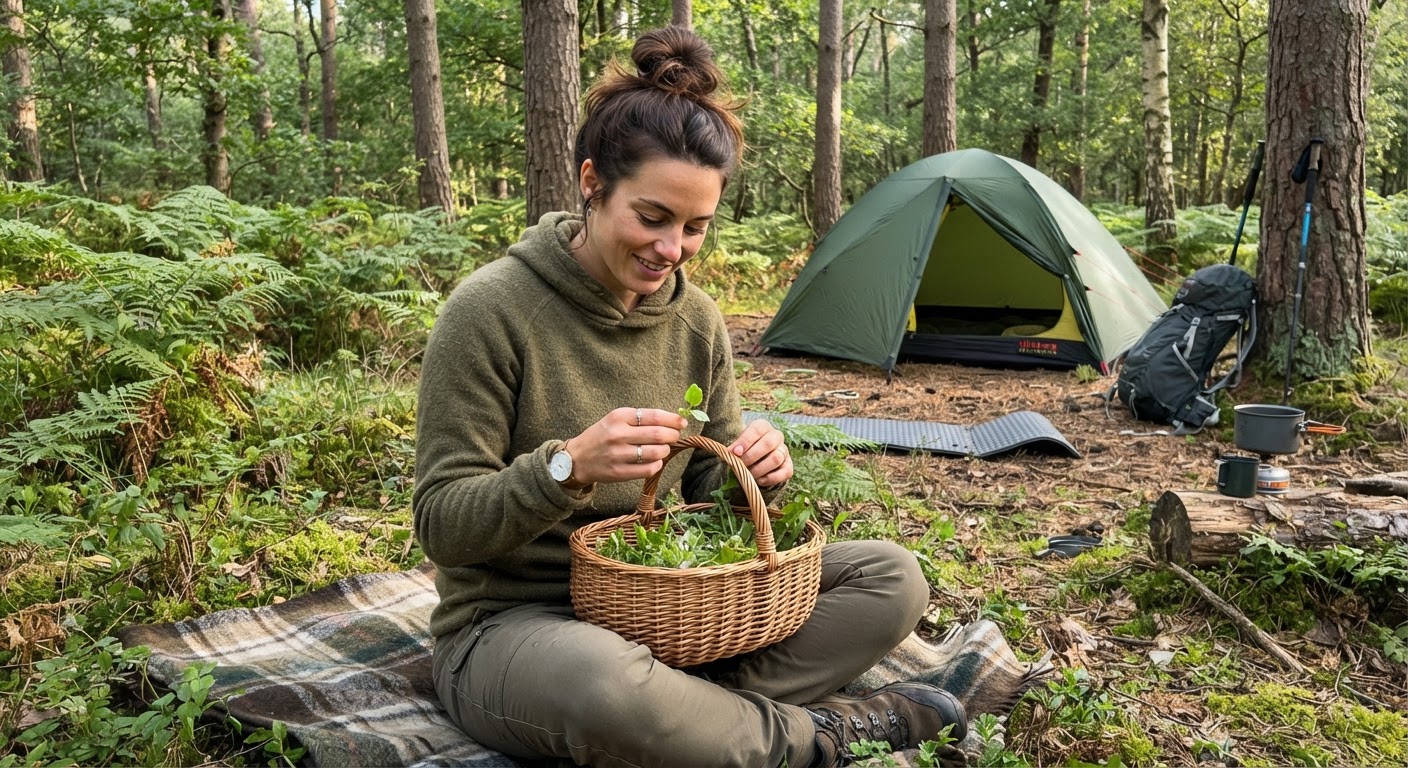
Foraging is not a calorie rescue. A full cup of dandelion greens is roughly 25 calories. Clover, chickweed, plantain — all in the same tiny range. If you’re burning 3,000-plus calories a day hiking and carrying a pack, no amount of wild salad closes that gap. What wild food does give you is vitamins, minerals, some fiber, a little energy, and — just as important — the psychological boost of not feeling like you’re starving.
That means your real job when food runs out has three parts, in this order:
- Stay hydrated and warm. Water kills you faster than hunger, and cold burns calories you don’t have.
- Conserve energy. Slow down. Rest more. Don’t burn 800 calories digging for 80 calories of roots.
- Forage smart, not desperately. Eat only what you can identify with certainty, and treat foraging as a supplement while you walk out.
Keep that order in your head. Most foraging emergencies go sideways because someone panicked, ate something unidentifiable, or wasted their last energy scrambling after a plant that wasn’t worth it.
The Golden Rule Before You Forage Anything
Say it with me, because this one rule prevents more poisonings than every plant ID trick combined:
If you cannot identify a plant with 100% certainty, you do not eat it. Ever.
Not “it looks like the picture I saw once.” Not “my cousin’s friend eats it.” Not “animals eat it, so it must be fine” — deer eat plants that would wreck you, and birds eat berries that are straight-up toxic to humans.
“Pretty sure” is not a food group. When you’re hungry, “pretty sure” gets upgraded to “good enough” in your own head. That’s the danger. Hunger is a liar, and it will talk you into eating something your gut is quietly warning you about.
So the rule is absolute: certainty or nothing. A missed meal is uncomfortable. A wrong plant can be fatal, and you’re probably hours from help.
Step-by-Step: How to Forage Safely When You’re Out of Food
Here’s the full process, in the order you should actually follow it. Don’t skip ahead to the plants — the first two steps matter more than the rest.
Step 1: Secure Your Water First
You can survive weeks without food. You get roughly three days without water, and far less if you’re sweating on a trail. Foraging while dehydrated is also genuinely dangerous, because dehydration muddies your judgment, and muddy judgment is how people eat the wrong thing.
Before you gather a single leaf:
- Find a water source — a stream, spring, or lake.
- Purify it. Boil for at least one minute (three minutes above 6,000 feet elevation). A filter or purification tablets work too.
- Drink until your urine runs pale. If it’s dark, you’re behind and need to catch up.
Water handled, you can think clearly. Now foraging becomes a careful supplement instead of a desperate gamble.
Step 2: Read the Habitat You’re Standing In
Different environments offer different safe foods, and knowing where you are narrows the field massively. This is the shortcut most guides skip.
- Near water (streams, lakes, marsh edges): Cattail, watercress, and mint family plants are common. Cattail is your best friend here — more on it below.
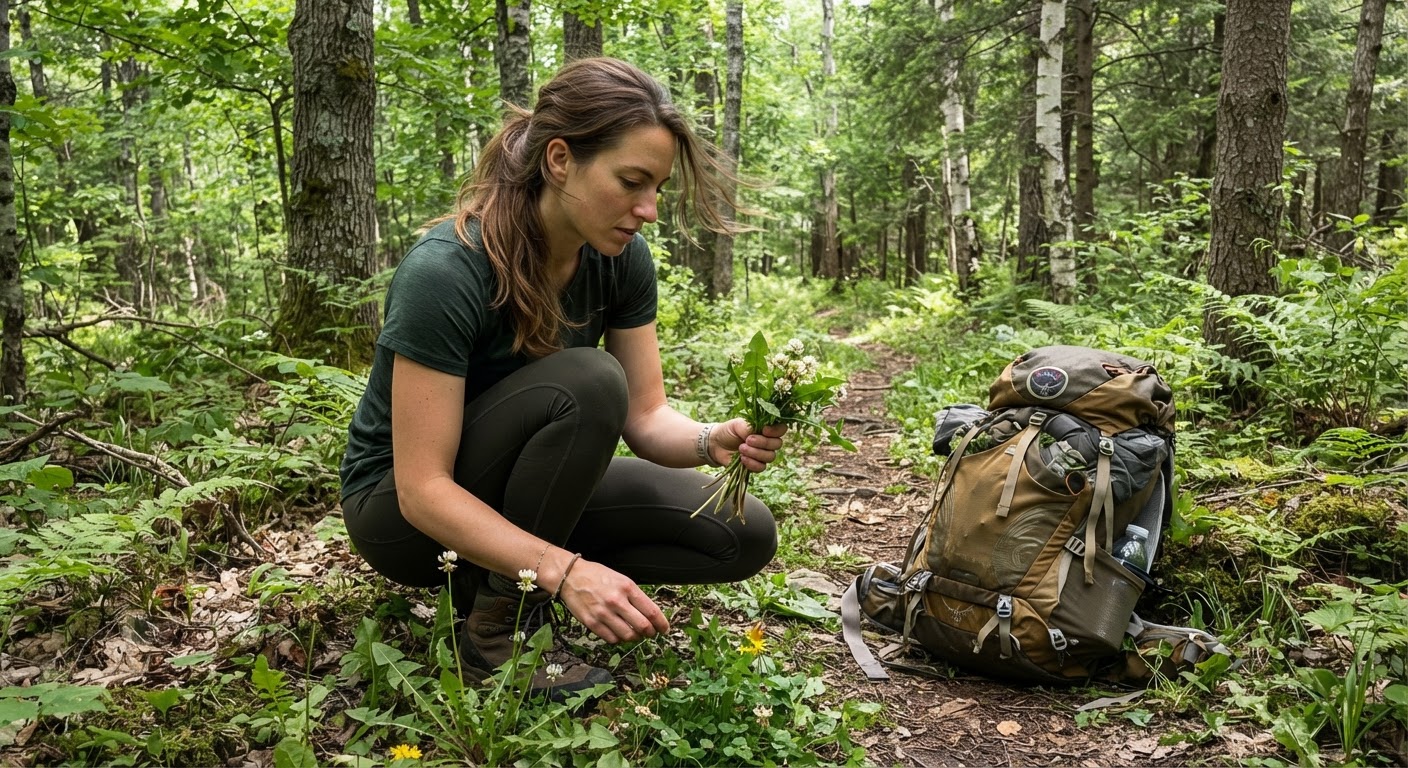
- Open meadow or lawn edge: Dandelion, clover, plantain, chickweed. The “lawn weeds” are the safest beginner category on Earth.
- Forest floor: Berries (with caution), pine trees (needles for tea), and the occasional chickweed patch.
- Rocky or dry slopes: Slim pickings. Pine and rose hips, mostly.
Matching plant to habitat is a huge safety filter. If you think you see watercress growing on a dry hillside, that’s not watercress — watercress only grows in running water. If something “edible-looking” is thriving somewhere its known species would never grow, your ID is wrong.
Step 3: Lock Onto the 5 Beginner-Safe Plants
When you’re hungry and stressed, your memory shrinks. So don’t try to recall a 40-plant field guide. Lock five plants into your head that are easy to identify and hard to confuse. These are the “if I only remember five things” list.
| Plant | Key ID Features | Edible Part | Prep | One Warning |
|---|---|---|---|---|
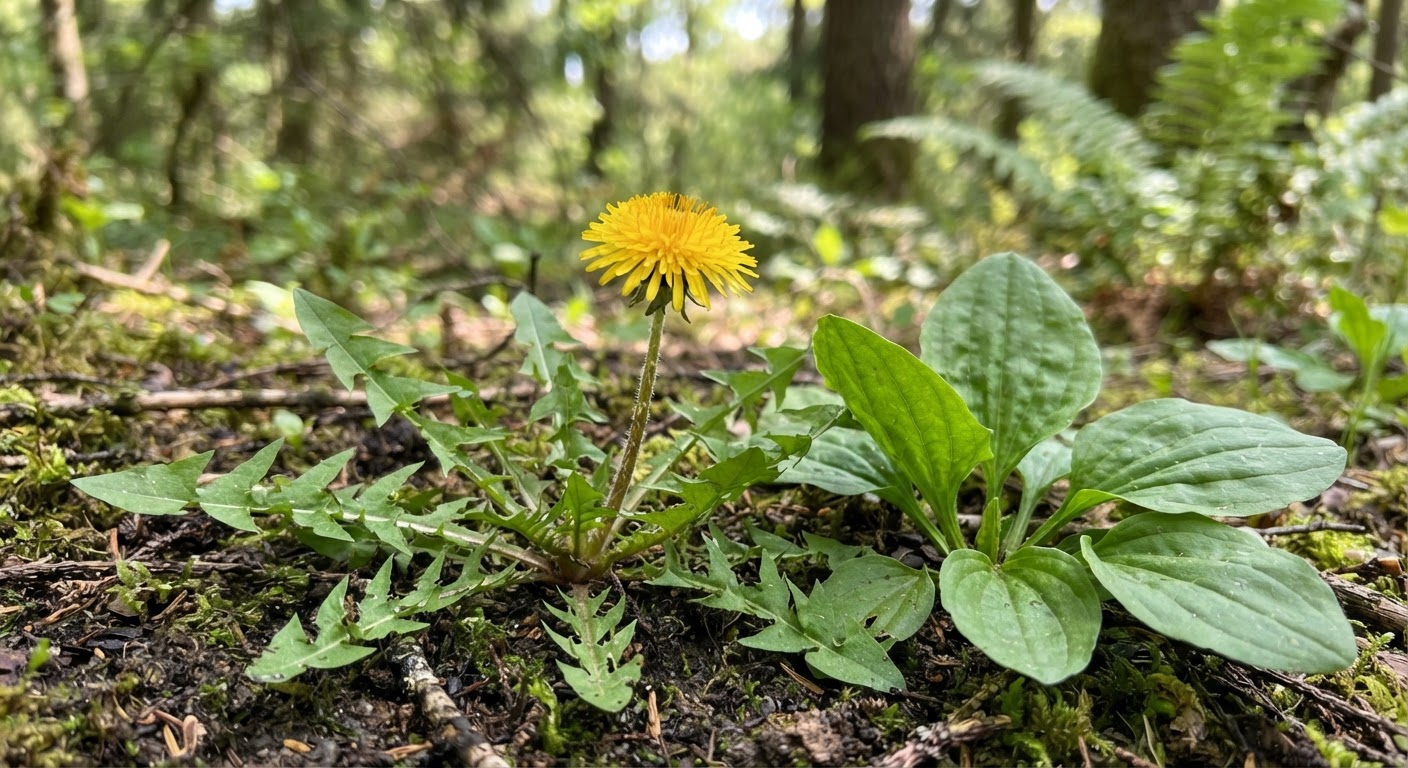
| Dandelion | Single yellow flower, toothed leaves, hollow stem with milky sap | Leaves, flowers, root | Leaves best young; boil older leaves | Only pick from areas you’re sure aren’t sprayed |
| Cattail | Tall brown “hot dog” seed head, flat grass-like leaves, always in/near water | Shoots, pollen, roots | Peel shoots; boil or roast roots | Only from clean water; avoid muddy, stagnant pools |
| Clover | Three leaflets, often with pale crescent marks; white or pink round flower | Leaves, flowers | Eat raw in small amounts or lightly cooked | Eat in moderation — raw clover can cause bloating |
| Broadleaf plantain | Broad oval leaves with strong parallel ribs, low to ground | Young leaves | Boil older, tough leaves | Don’t confuse with lily of the valley (toxic) |
| Pine | Evergreen with needles in bundles | Needles (for vitamin C tea) | Steep needles in hot water, don’t eat the needles | Avoid yew (flat needles, red berries — deadly) |
These five cover water edges, meadows, and forest — which is most campsites. Master the look of each before you ever need them, and you’ll be dramatically safer the day you actually run out of food.
Step 4: Run the Lookalike Check
Every beginner-safe plant has a toxic twin. This is where foraging kills people, so read this table twice. The rule is simple: if the toxic lookalike is even remotely possible, you skip the plant unless you can confidently rule it out.
| Safe Plant | Toxic Lookalike | How to Tell Them Apart |
|---|---|---|
| Wild carrot (Queen Anne’s lace) | Poison hemlock | Hemlock has purple blotches on a smooth stem and a foul smell; wild carrot stem is hairy and smells like carrot |
| Wild garlic / onion | Death camas, lily of the valley | Garlic/onion smells unmistakably of onion or garlic; if it has no smell, it’s toxic |
| Raspberry / blackberry | None deadly, but some lookalikes are inedible | Compound berries (raspberry, blackberry, mulberry) are almost always safe; avoid any that don’t cluster this way |
| Wild strawberry | Mock strawberry | Mock strawberry has yellow flowers and tasteless fruit; real wild strawberry has white flowers and tastes sweet |
| Watercress | Water hemlock (roots), fool’s watercress | Watercress grows in running water with peppery taste; hemlock leaves are more divided and the plant has hollow, chambered roots |
If you can’t nail the difference in the field, you don’t eat it. Full stop. A smelly test (the garlic/onion one) is one of the few reliable shortcuts in foraging — if it doesn’t smell like onion or garlic, it isn’t, and it could be death camas.
Step 5: Use the Taste Test Only as a Last Resort
If you’re stuck, alone, and considering an unknown plant because you’re truly desperate, the Universal Edibility Test exists. But understand this clearly: it is a last resort, it takes a full day, and it only tests one part of one plant at a time. It will not reliably protect you against the most dangerous plants, and it does not apply to mushrooms or anything with an almond smell (a sign of cyanide).
The abbreviated version, only for true emergencies:
- Choose a plant that’s abundant and not showing signs of disease.
- Separate it into parts — leaf, stem, root, flower.
- Test one part only. Rub a small piece on your inner wrist, wait 15 minutes for a reaction.
- Touch it to your lip, wait 15 minutes. Then your tongue, wait 15 minutes.
- Chew a tiny piece and hold it in your mouth 15 minutes without swallowing.
- Swallow a small amount, then wait 8 hours. No symptoms? That part is likely tolerable.
- Don’t test another plant the same day.
Honestly? If you have any realistic chance of walking out instead, do that. The taste test is for survival situations with no other option, not a “camping without food” convenience.
Step 6: Prepare It Right
How you prepare a plant is often the difference between food and a stomachache. Several safe plants are only safe after cooking.
- Boil tough or bitter greens (dandelion, plantain) to soften them and cut bitterness. Change the water once if you can.
- Cook anything starchy (cattail roots, burdock) — raw starches are hard to digest.
- Nettles lose their sting the moment they hit boiling water; never eat them raw.
- Steep, don’t eat, pine needles. The needles themselves aren’t digestible; the tea is the prize.
Cooking also kills surface bacteria and parasites, which matters when you’re already run down and hungry. When in doubt, cook it.
Step 7: Ration What You Gather
You found a good patch. The instinct is to eat everything now. Don’t.
Eat a small portion, wait an hour or two, and see how your body reacts. A new wild food can cause cramps or digestive upset even when it’s safe — your gut isn’t used to it. If you gorge on a whole basket of raw clover after three days of empty rations, you’ll spend the night doubled over, and that’s energy and water you can’t spare.
Small, slow, and cooked is the winning formula.
What’s Safe to Forage, Season by Season
Availability changes everything. A plant that’s tender and delicious in spring can be woody and bitter by late summer. Here’s your quick seasonal map for temperate regions.
| Season | Best Bets | Notes |
|---|---|---|
| Spring | Dandelion, chickweed, young nettles, cattail shoots, wild garlic | Peak season for tender greens; most beginner-friendly window |
| Summer | Berries (raspberry, blackberry, blueberry), clover, purslane, plantain | Berries are your best calorie return; learn the compound-berry rule |
| Fall | Rose hips, acorns (after leaching), late berries, burdock root | Acorns need long soaking/leaching — effort-intensive but real calories |
| Winter | Pine needle tea, rose hips, cattail roots | Sparse; rely on evergreens and starchy roots near water |
If you’re camping in fall or winter, temper your expectations. Winter foraging is mostly tea and roots, not meals. Spring and summer are where the safe, easy calories live.
Pro Tips From the Field
A handful of things I’ve learned the hard way, condensed:
- Forage as you walk, don’t stop and dig. Gathering a fistful of greens you pass costs almost nothing. Digging roots for an hour costs calories you can’t replace. Movement is your friend.
- Avoid roadsides, trail edges, and sprayed lawns. Exhaust residue and herbicides concentrate in exactly the spots that look convenient. Clean, wild, uphill-of-any-road is the rule.
- Wash what you can. Even clean-looking streams carry things you don’t want. A quick rinse plus cooking solves most of it.
- Berries in clusters are your friend. Raspberries, blackberries, and mulberries — the “aggregate” berries — are among the safest wild fruits. Single berries on a stem deserve more caution.
- Don’t eat anything that’s slimy, milky-sapped, or bitter unless you’ve positively identified it as one of your known-safe plants. Bitterness is often a warning.
- Mushrooms are off the table in a survival foraging situation unless you’re a genuine expert. The risk-to-reward ratio is the worst in all of foraging.
- Keep a note (or a photo) of what you ate and where. If you do react, this is the single most useful piece of information for a doctor.
FAQ: Your Most-Likely Questions, Answered by Situation
“I’m not sure about a plant — should I risk it?” No. Certainty or nothing. The single most common thread in foraging poisonings is “I thought it was probably fine.” Probably doesn’t keep you safe; it just makes the story sadder.
“I forgot my food but there’s a gas station 20 minutes away.” Go to the gas station. Foraging is your fallback when leaving isn’t an option, not a recreational challenge when a sandwich is available.
“Can I eat mushrooms if I cook them thoroughly?” Cooking destroys bacteria and some toxins, but it does nothing for the deadliest mushroom toxins like amatoxins. If you’re not a trained identifier, leave every mushroom alone.
“What if a plant looks exactly like a picture in my guide?” Good — now confirm the habitat, the smell, the stem, and the growing season all match too. One matching feature is a guess; five matching features is an ID.
“I ate something and now my stomach hurts. Now what?” Stop eating it. Drink clean water. Rest. If you get vomiting, diarrhea, dizziness, or breathing trouble, this is an emergency — get to help immediately and, if possible, bring a sample of the plant with you.
“How long can I actually survive on foraged food?” Indefinitely, in the sense that the food keeps you from being totally empty — but you’ll lose weight and energy fast on greens alone. Forage to supplement and stay functional while you get back to real food, not to replace it permanently.
The Bottom Line
Camping without food feels like an emergency, and it kind of is — but the correct response isn’t panic, and it definitely isn’t eating the first green thing you see. It’s a calm, ordered process: water first, conserve energy, then forage only what you can identify with absolute certainty.
Remember the five plants, run the lookalike check, cook what you gather, and eat small portions slowly. If you hold those lines, foraging can turn a bad trip from dangerous into merely uncomfortable. Break them, and you’ve traded an empty stomach for a much bigger problem.
And here’s the honest truth about the whole situation: the best foraging safety tool is the one you practice before you’re hungry. That’s exactly why I built Edible Plant Identifier — point your camera at a leaf, and it gives you a clear identification with lookalike warnings, so you’re not squinting at a field guide by flashlight while your stomach growls. It works fully offline, which is the only kind of tool that actually helps when you’re camping without food and there’s no signal for miles.