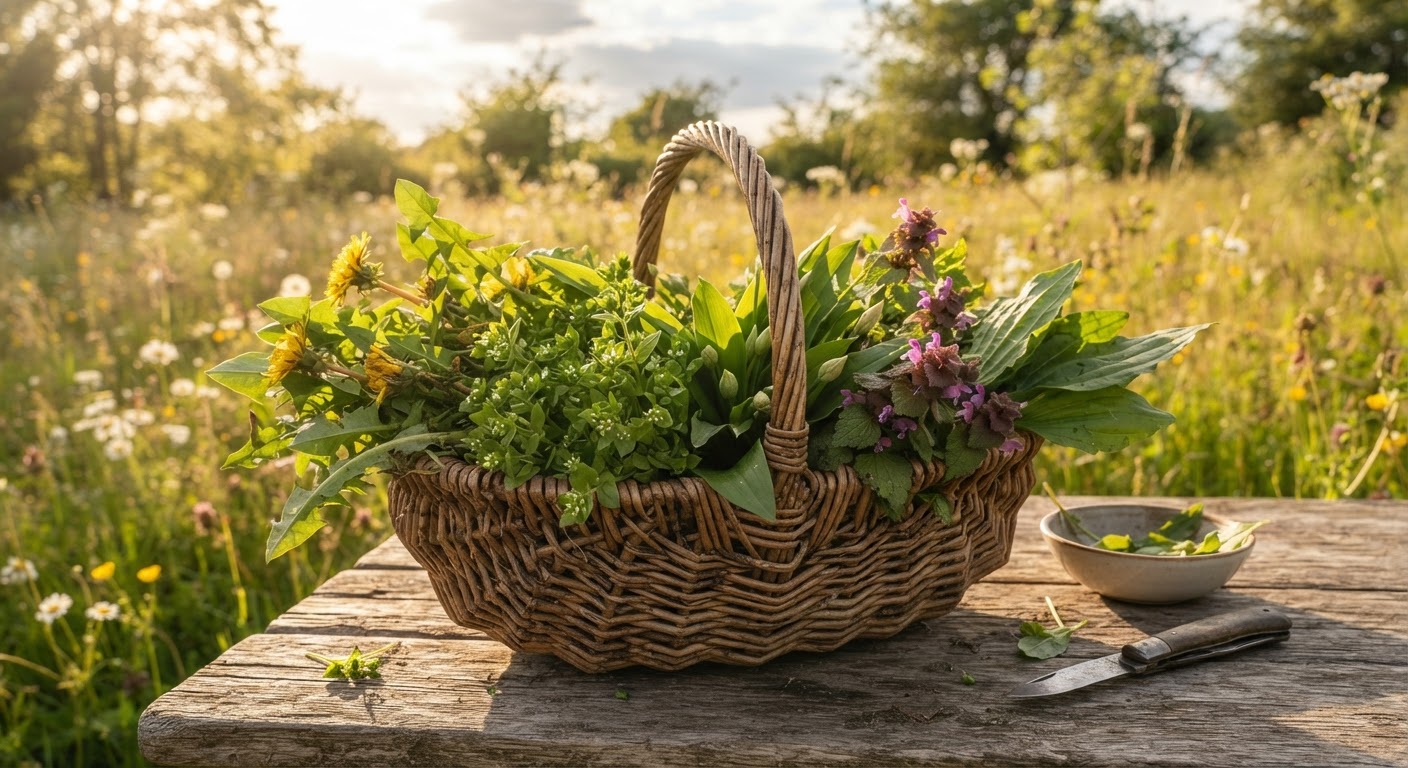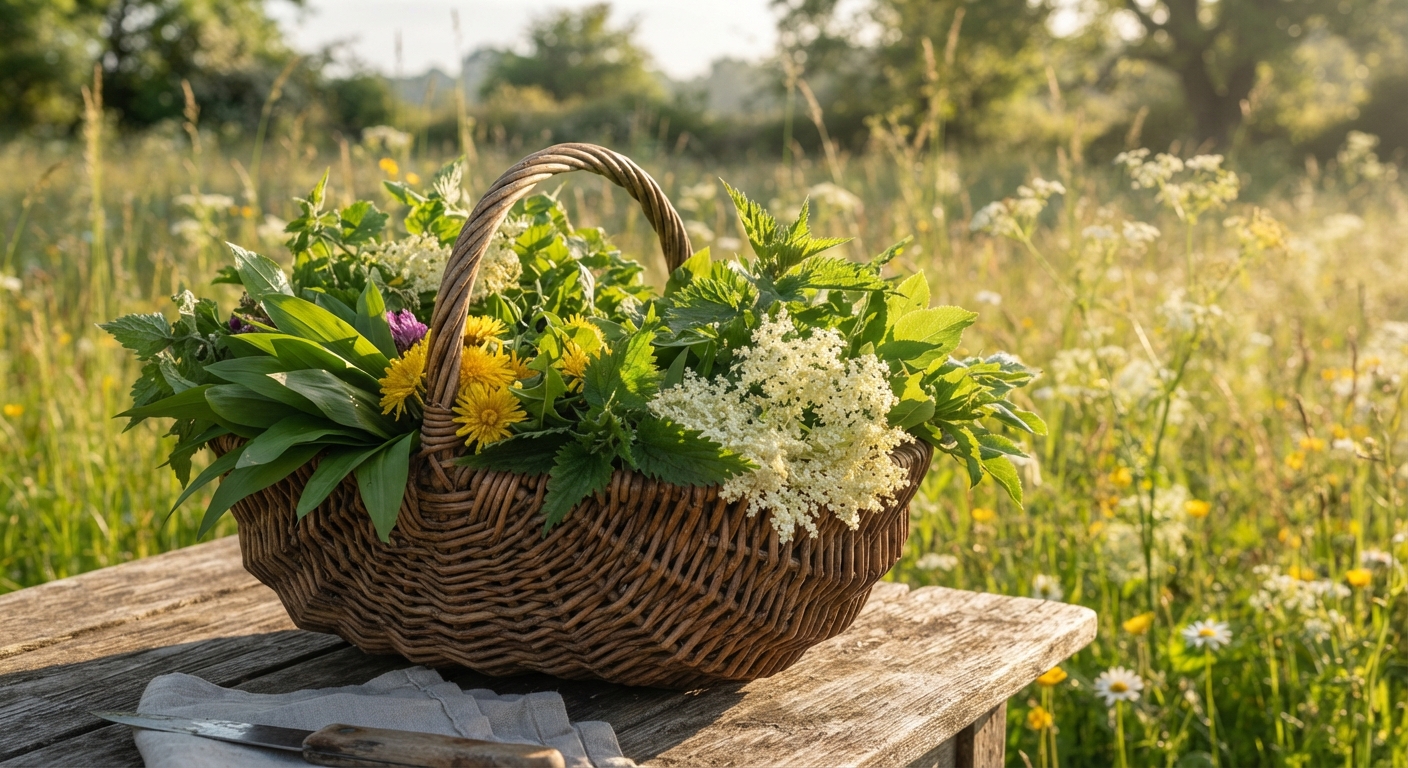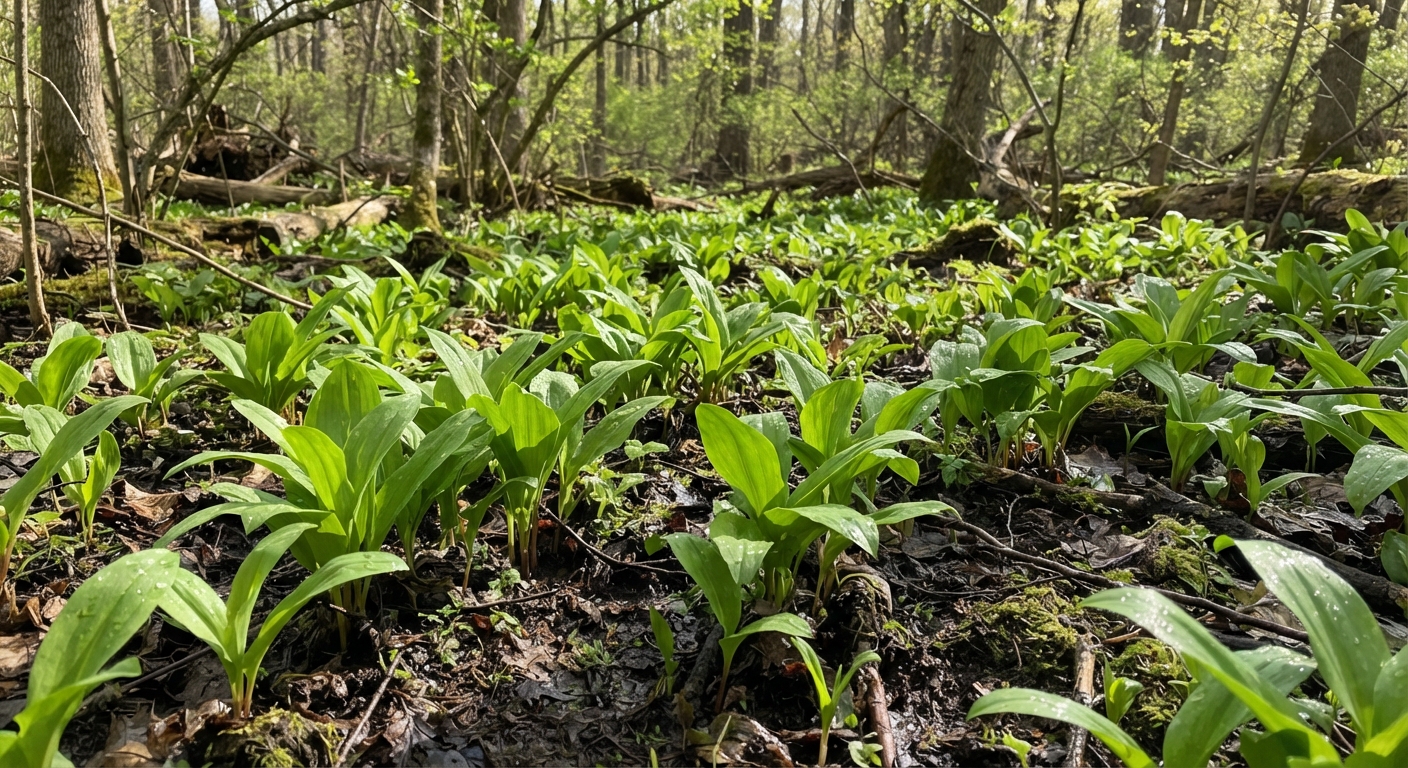
There’s a moment in early spring — mid-April where I forage in the Mid-Atlantic — when the forest floor shifts from brown to green overnight. The trees haven’t leafed out yet, so sunlight pours through bare branches onto soil that’s been thawing for weeks. You catch something sharp on the air, somewhere between garlic and fresh-cut grass. The ramps are up.
That smell hooks most people. But foragers keep coming back for reasons beyond flavor. Ramps mark the true beginning of the foraging year — the first real sign after months of root vegetables and pantry stores that the wild pantry is open again.
They’re also one of the few wild foods with genuine culinary celebrity — restaurant menus, $20 a pound at farmers markets, the kind of obsession usually reserved for truffles and morels. That popularity cuts both ways. More people want to find them. The patches that took decades to establish can vanish in a single overzealous harvest.
This guide covers everything: finding your first patch, identifying ramps without second-guessing yourself, harvesting so they’ll be there next year, and getting them from forest floor to dinner plate without wasting a single leaf.
What Ramps Actually Are — And Why They’re Not Just “Wild Onions”
Before you spend a weekend hunting for them, it helps to understand what you’re looking at. Ramps (Allium tricoccum) belong to the allium family — same genus as onions, garlic, leeks, shallots, and chives. That family resemblance is strong, but ramps occupy their own lane in terms of flavor, growth pattern, and habitat.
A ramp plant has two or three broad, smooth leaves that emerge from a white bulb underground. The leaves look nothing like the tubular, hollow leaves of wild onion or the flat, grass-like blades of wild garlic. They’re wide — two to four inches across — with a texture closer to lily of the valley foliage than anything onion-like. The bulb is slim, white, and wrapped in a papery sheath, perched just below the soil surface on top of a cluster of shallow roots.
Bite into a raw ramp leaf and you get garlic heat up front, then an almost-sweet green onion finish. The bulb is sharper and can make your eyes water if you chew it straight. Cooked ramps mellow dramatically — the garlic sharpness rounds out, the sweetness comes forward, and everything softens into something you’d happily eat by the forkful.
Quick clarification: in Appalachia and most of the eastern US, “ramps” and “wild leeks” mean Allium tricoccum. In the UK and Europe, “wild garlic” usually means Allium ursinum — a related species with smaller leaves and star-shaped flowers. In the American West, “wild onions” are typically Allium canadense or Allium vineale. When reading foraging advice online, confirm which species the writer is actually talking about.
The Seasonal Window: When and Where Ramps Appear
Ramps operate on a tight schedule. In most of their range, you get about four to six weeks from the first leaf emergence until the leaves start yellowing and dying back. Miss that window and you miss the plant entirely — ramps go completely dormant by early summer, leaving no visible trace above ground until the following spring.
Regional Season Chart
This table covers the approximate harvest window for the major ramp-growing regions. Actual dates shift by a week or two depending on elevation, aspect, and how severe the winter was.
| Region | First Leaves Emerge | Peak Harvest | Leaves Begin Yellowing | Notes |
|---|---|---|---|---|
| Southern Appalachia (GA, SC, NC, TN) | Late February – Early March | Mid-March – Early April | Late April | Earliest ramps in the country; south-facing slopes wake up first |
| Mid-Atlantic (VA, WV, MD, PA) | Late March – Early April | Mid-April – Early May | Mid-May | The heart of ramp country; largest and most abundant patches |
| Northeast (NY, VT, NH, ME) | Mid-April | Late April – Mid-May | Late May – Early June | Later start, but cooler spring temps extend the season slightly |
| Midwest / Great Lakes (OH, MI, WI, MN) | Mid-April | Late April – Mid-May | Late May | Richer soil in hardwood forests produces larger bulbs |
| Quebec / Ontario | Late April – Early May | Mid-May – Early June | Mid-June | Shortest season but high-elevation patches can linger |
The pattern is consistent: ramps need the soil to thaw, they need sunlight to reach the forest floor before the canopy closes, and they need consistent moisture. That combination happens in early spring and doesn’t last long.
Finding the Right Habitat
If you’re looking for your first ramp patch, stop checking sunny meadows and roadsides. Ramps are woodland obligates — they need shade, rich soil, and consistent moisture. Here’s what to look for:
Tree cover: Hardwood forests dominated by maple, beech, birch, oak, and basswood. Ramps thrive under deciduous trees because they complete their entire above-ground life cycle before the canopy leafs out and blocks the sun. Conifer forests are generally too acidic and too shaded.
Moisture: Ramps love damp but not soggy conditions — north-facing slopes, creek bottoms, seepage areas, and the base of hillsides where water collects. The soil should feel damp, but there shouldn’t be standing water.
Elevation: In the southern range, look higher — 2,500 to 4,500 feet. In the north, ramps grow happily from sea level to about 3,000 feet.
Companion plants: If you see trout lily, bloodroot, trillium, blue cohosh, or Dutchman’s breeches blooming, you’re in the right neighborhood. These spring ephemerals share the same habitat preferences as ramps and often grow side by side with them.
The single best tip I can give a new ramp hunter: find a north-facing slope in a mature hardwood forest with a creek at the bottom, and walk it slowly in early spring. The ramps will usually be concentrated on the lower third of the slope, where moisture accumulates and the leaf litter is deepest. Patches often follow the contour lines of a hillside, spreading horizontally along the slope rather than climbing straight up.
Identification Deep Dive: How to Be 100% Sure
Ramp identification is straightforward once you know what to look for — but there are lookalikes, and some of them can hurt you. The good news is that the checks are simple and unambiguous. If you go through all of them, there’s no room for doubt.
The Multi-Sense ID Protocol
Use your eyes, fingers, and nose. One check isn’t enough. All three together make misidentification nearly impossible.
Visual Check (What You See)
Ramp leaves are broad, smooth, and lance-shaped — two to four inches wide, six to ten inches long, with smooth (entire) edges and parallel veins running from base to tip. The leaves emerge directly from the bulb, not from a central stalk. The stem (actually a leaf sheath) is deep burgundy or reddish-purple on the lower portion, fading to green higher up near the leaf blade.
The bulb is white with a papery, thin outer layer. It’s small — typically the diameter of a pencil or slightly thicker — and sits just below the soil surface, often with the top third visible if you brush away leaf litter.
Touch Check (What You Feel)
Run your fingers along a leaf. It should feel smooth, pliable, and slightly rubbery — similar to the texture of a hosta leaf or a tulip leaf. There are no hairs, no serrations on the edges, and no rough texture on either the top or bottom surface. The leaf should bend without snapping or cracking.
Gently tug on a leaf. If it tears easily and the plant doesn’t pull up readily, that’s a positive sign — ramps have shallow, threadlike roots that let go with minimal resistance.
Smell Check (What You Smell)
This is your failsafe. Crush a small piece of leaf between your thumb and forefinger and inhale. Ramps smell unmistakably like garlic and onion — pungent, sharp, and immediate. If you crush a leaf and smell nothing, or grass, or anything vaguely plant-like, you are not holding a ramp. Put it down. No toxic lookalike in North America has an allium scent.
Lookalikes: What You Might Mistake for Ramps
Three plants commonly get confused with ramps, and two of them are dangerous. The comparison table below covers the decisive markers.
| Plant | Leaves | Stem/Bulb | Smell When Crushed | Edibility |
|---|---|---|---|---|
| Ramps (Allium tricoccum) | Broad (2–4“), smooth, parallel veins, 2–3 per plant | Red/purple at base, white bulb with papery skin | Strong garlic-onion | Fully edible, delicious |
| Lily of the Valley (Convallaria majalis) | Similar width, but stiffer, more upright, deeper veins | Green throughout, no bulb — grows from rhizome | Grassy, slightly sweet, NO garlic | TOXIC — contains cardiac glycosides |
| False Hellebore (Veratrum viride) | Heavily pleated/ribbed, much longer, emerges folded | Thick, fleshy, no bulb, no red/purple coloring | No garlic smell, bitter | TOXIC — contains steroidal alkaloids |
| Trout Lily (Erythronium americanum) | Mottled purple-brown patches, narrower, single leaf (young plants) | Very small corm, white but no papery skin | Faint, vegetal, NO garlic | Edible but small — not worth harvesting |
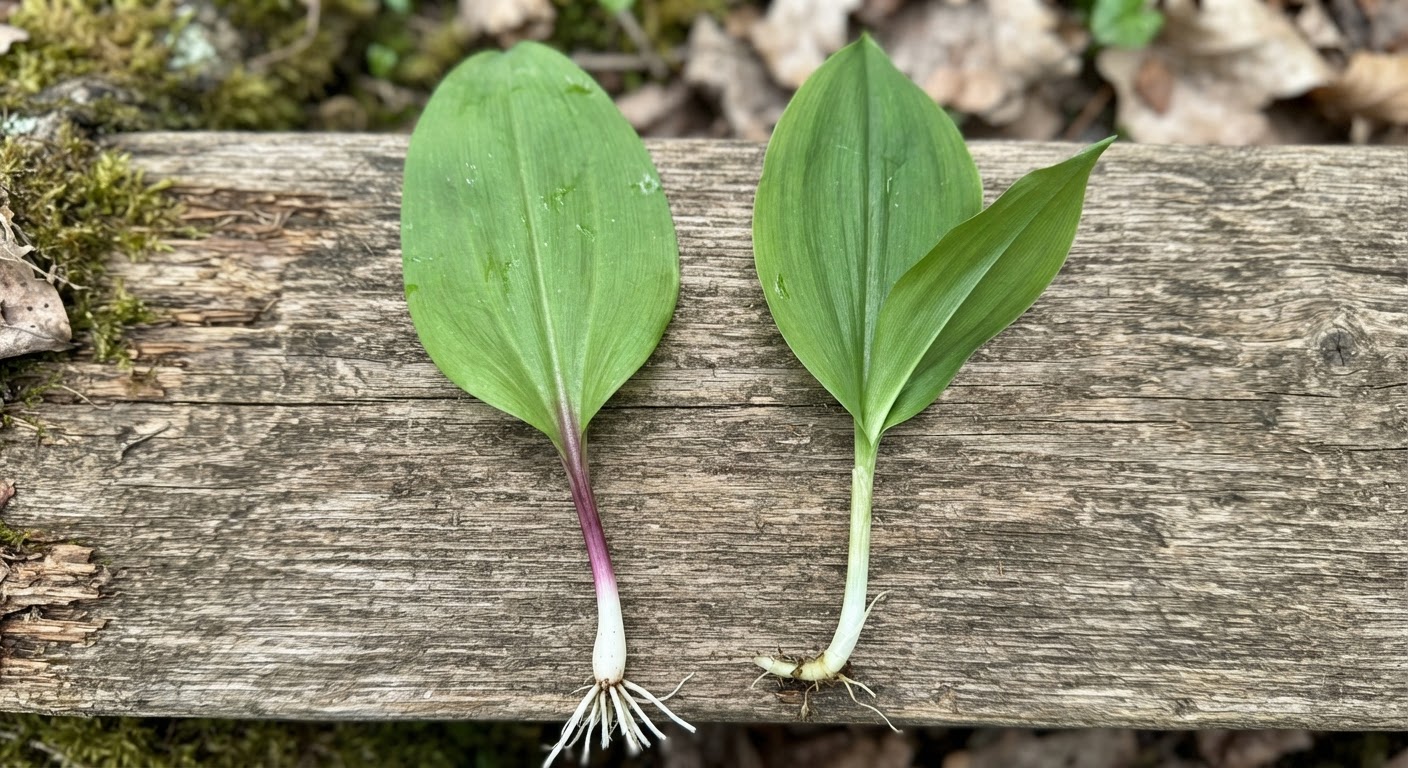
The lily of the valley mix-up deserves special attention because it’s the most common and the most dangerous. Both plants emerge at the same time in the same forests. Both have broad, smooth green leaves. The difference is that lily of the valley leaves are stiffer, emerge from an underground rhizome (not a bulb), have a completely green base with no red or purple, and — crucially — produce zero garlic smell when crushed.
One habit worth building: always confirm the smell check even when you’re “obviously” looking at ramps. It takes two seconds and builds the kind of automatic safety reflex that catches mistakes before they happen. The day you skip it because you’re “sure” is the day you wish you hadn’t.
The Ethical Harvesting Framework
Here’s the part of the guide that matters most for the long term — more than identification skills, more than recipe ideas. Ramp patches are fragile. A single patch can take five to seven years to recover from one aggressive harvest, and commercial-scale harvesting has already wiped out ramps from large portions of their historical range in Quebec, parts of New England, and the Smoky Mountains.
The One-Leaf Rule
The most sustainable way to harvest ramps is also the simplest: take one leaf per plant, leave the bulb in the ground. The plant continues photosynthesizing through the remaining leaf (or leaves), stores enough energy in the bulb to survive dormancy, and pushes up new growth the following spring. You get the ramp flavor — the leaves carry most of the garlic-onion punch anyway — and the patch stays healthy.
Use a sharp knife or scissors. Cut the leaf cleanly about an inch above the soil line. Don’t tear or yank. A clean cut heals quickly; a torn base invites rot and disease.
If you’re harvesting bulbs (sparingly, only from large, abundant patches), follow these rules:
Take no more than 5% of any patch. A hundred ramp plants means no more than five bulbs. Seeds take 6–18 months to germinate, then 5–7 years for the plant to reach maturity. When you dig a bulb, you’re removing years of growth in seconds.
Dig gently. Use a small trowel inserted three to four inches from the bulb and lever gently. Neighboring ramp roots are interwoven — aggressive digging tears them up.
Rotate patches. With three good patches, visit each every third year, giving the other two full seasons to recover.
Why Sustainable Harvesting Matters
Ramps grow slowly. Seeds sit in the soil for a year and a half before a leaf pushes through. A seedling takes five to seven years to flower. When you see a hillside carpeted in ramp leaves, you’re looking at decades of accumulation — it can vanish in a single weekend if a group fills their backpacks.
Several states have responded with restrictions. Quebec banned commercial ramp harvesting in 1995. Great Smoky Mountains National Park prohibits collection. North Carolina restricts harvesting on public lands. The best way to keep ramps accessible is to harvest like they’re already limited — because in many places, they are.
From Woods to Kitchen: Cleaning, Storing, and Cooking
You found a patch, you harvested responsibly, and now you’re standing in your kitchen with a bag of dirty ramps. Here’s the practical side that most guides skip straight past.
Cleaning Without Ruining Them
Ramps come out of the ground with soil on the roots, grit in the leaf sheaths, and sometimes slime from leaf litter. Fill a large bowl with cold water, swish the ramps vigorously for thirty seconds, let the grit sink, then lift them out. Repeat until the water runs clear — usually two to four rounds.
Trim the roots off with scissors (edible but tough), peel the outermost bulb layer if it’s slimy, and pat dry.
Storage Options and Shelf Life
Ramps wilt within days — treat them like fresh greens, not onions.
Refrigerator: Wrap unwashed ramps in a damp paper towel, tuck into a loose plastic bag, stash in the crisper. Good for 5–7 days. Don’t seal the bag — trapped moisture accelerates rot.
Freezing: Blanch leaves for 10 seconds in boiling water, then ice bath. Bulbs get 30 seconds. Pat dry, bag, and freeze. Keeps 8–12 months. Perfect for soups and sautés.
Compound butter: Chop raw ramps, mix into room-temperature butter with salt, roll into a parchment log, and freeze. Slice off rounds for eggs, steak, potatoes — you’ll wish you made triple.
Pickled bulbs: Pack bulbs in a jar, cover with hot brine (equal parts vinegar and water, plus salt, sugar, mustard seed). Ready in a week, lasts months in the fridge.
Cooking Ramps: Keep It Simple
Ramps are good raw, briefly cooked, or slow-cooked. The only mistake: cooking leaves past wilt — they turn to slime.
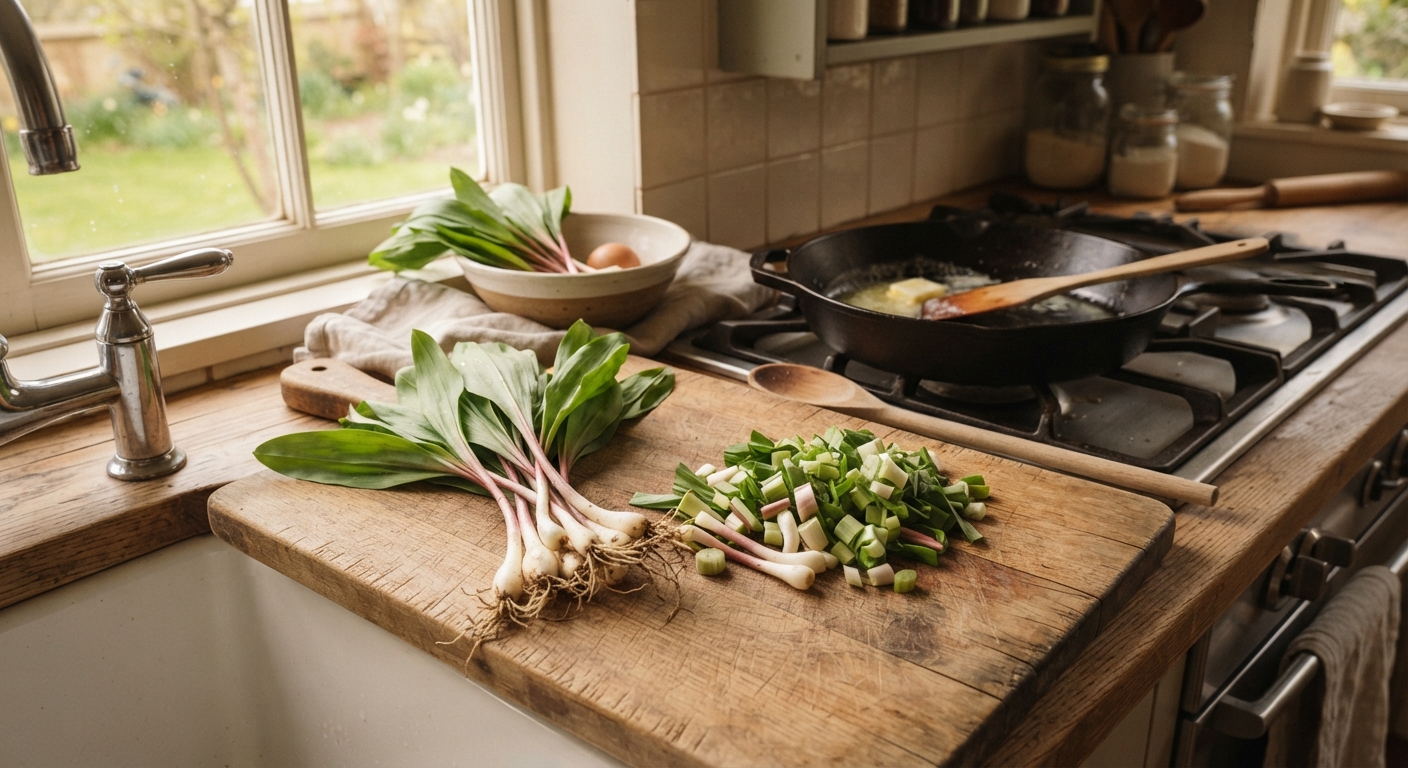
Quick sauté (2–3 min): Butter or olive oil, bulbs first (30 extra seconds), then leaves just until wilted. Salt, pepper, done. Serve with steak, on toast with a fried egg, or in scrambled eggs.
Grilled whole: Olive oil, salt, pepper, one minute per side on a hot grill. Lemon juice to finish. The char adds smoky depth.
Pesto: Blend ramp leaves with olive oil, walnuts or pine nuts, Parmesan, lemon juice, and salt. Freezes beautifully. Use on pasta, sandwiches, or as salad dressing.
Pro Tips from the Field
These are the things you figure out after a few seasons.
Mark your patches when they’re visible. Ramps go dormant by June — no trace above ground. Drop a pin on your phone with a note about date, patch size, and direction approached from. In dense forest, GPS drifts 30–50 feet, so add a landmark: “30 paces downhill from the fallen oak with bracket fungus.”
Bring a mesh bag, not plastic. Ramps wilt fast without airflow. A mesh foraging bag lets them breathe, and debris falls through the bottom instead of grinding into your harvest.
South-facing slopes come earliest. They get more sun, soil warms faster — ramps emerge a week to ten days earlier than north-facing slopes. Use this to extend your season: south faces early, east/west mid-season, north faces last.
Paper beats phone for field notes. Batteries die, screens crack, wet fingers don’t work on touchscreens. A small waterproof notebook and pencil document your patches, dates, and observations without fail.
Leave small patches alone. If you find fewer than twenty plants, don’t touch them. Five bulbs from twenty plants is 25% of the population. Mark it, move on. Twenty plants becomes two hundred in a decade if undisturbed. It becomes zero if harvested annually.
Questions I Get From New Foragers
I found a plant that looks exactly like ramps but has no garlic smell. What is it?
Most likely lily of the valley (Convallaria majalis). Contains cardiac glycosides — irregular heartbeat, nausea, cardiac arrest in significant doses. No garlic smell = do not eat, period.
Can I transplant ramps to my own property?
Yes, and it’s one of the best ways to create a personal supply without pressuring wild populations. Dig small clumps (3–5 bulbs) from a large, healthy patch in early spring, keeping soil around roots. Transplant immediately into shaded, rich, damp soil under deciduous trees. Ramps often sulk for the first season, then settle in and spread. Nurseries also sell nursery-propagated ramp bulbs if you’re starting from scratch.
Are ramp leaves and bulbs equally edible?
Yes — the entire plant from leaf tip to root tip is edible. The threadlike roots below the bulb are tedious to clean and taste muddy; most people trim them off. Leaves, stem/sheath, and bulb all have different textures and intensity but are all good.
Why do my ramps taste bitter?
Two common causes: you harvested too late (leaves turn bitter as plants go dormant), or you overcooked them (leaves get bitter past the wilt stage). Harvest during green-leaf stage and treat the leaves like spinach, not kale.
Can you eat ramps raw? Like, just pick one and chew it?
Absolutely. A fresh spring ramp leaf eaten raw, right there in the woods, is one of the great pleasures of foraging. The flavor is sharp, garlicky, and surprisingly sweet on the finish. Just rinse off any obvious dirt first — wild animal droppings are a real concern in the same damp habitats where ramps grow.
How do I know if a ramp patch is healthy enough to harvest from?
A healthy patch has plants of mixed sizes (not just large adults), covers at least several square yards, and has areas of clearly young or seedling plants at the edges. If the patch looks uniformly large with no smaller plants, it may be a declining population where younger plants are being harvested before they can mature. If you see bare soil in the middle of the patch instead of plants, that’s a sign of past overharvesting. Err on the side of leaving it alone more than you think you need to.
Is there any state where harvesting ramps is illegal?
Harvesting on private land without permission is illegal everywhere. On public land, regulations vary dramatically. Great Smoky Mountains National Park prohibits all ramp collection. National Forests in North Carolina require permits for harvesting more than a small personal-use quantity. Quebec prohibits commercial harvest entirely. A growing number of states and provinces are tightening restrictions. Check your local regulations before harvesting on public land — the rules change faster than most foraging books get updated.
The Thing Most Guides Won’t Say Out Loud
Ramps are not hard to find. Once you know the habitat and the season, you’ll spot them easily. What’s actually hard — and what separates a skilled forager from someone who just reads about foraging — is the discipline to walk past the small patches, to take a leaf instead of digging the bulb even when nobody’s watching, and to accept that some of the best patches are best left untouched.
The woods don’t need another person who knows how to find ramps. The woods need more people who know how to find ramps and choose to leave more than they take.
Go find your patch this spring. Crush a leaf between your fingers and breathe in that sharp, wild garlic smell. Take a few leaves home, cook them simply, and taste the forest waking up. Then mark your spot on the map, scatter some leaves over the bare soil you left behind, and walk out knowing the ramps will be there next year — and the year after that, and the year after that — for the same reason you’ll be back: because some things are worth waiting for.