The man who taught me to forage almost died twice. Both times, he wasn’t lost, starving, or stranded. He was standing in his own backyard, picking what he was sure was wild carrot.
The first time, a neighbor who happened to know plants saw the purple blotches on the stem and knocked the greens out of his hand. The second time, he caught it himself — right before it went into the soup pot. Both near-misses were poison hemlock, a plant that looks almost exactly like the wild carrot it grows beside.
That’s the thing nobody tells you when you start foraging: the danger isn’t a scary-looking plant with skull-and-crossbones leaves. The danger is a plant that looks delicious. It sits right next to the safe one, borrows its shape, and waits for you to trust your eyes instead of your training.
This guide is about the lookalikes — the poisonous plants that mimic edible ones closely enough to fool a confident beginner. I’ll walk you through the pairs that matter most, the one or two details that separate them, and a repeatable field protocol you can run in under a minute before anything touches your lips.
Everything below starts from one rule: never eat a wild plant you can’t identify with 100% confidence. No article, app, or photo replaces a regional field guide and time spent with someone who knows the plants in your area.
The Lookalike Pairs That Put People in the Hospital
Not all lookalikes are equal. A few pairs cause the overwhelming majority of poisonings each year because the edible side is common, popular, and easy to “recognize.” Learn these six first. They cover most of the realistic risk you’ll face as a beginner.
Wild Carrot vs. Poison Hemlock
This is the big one — the pair responsible for more foraging poisonings than any other in North America.
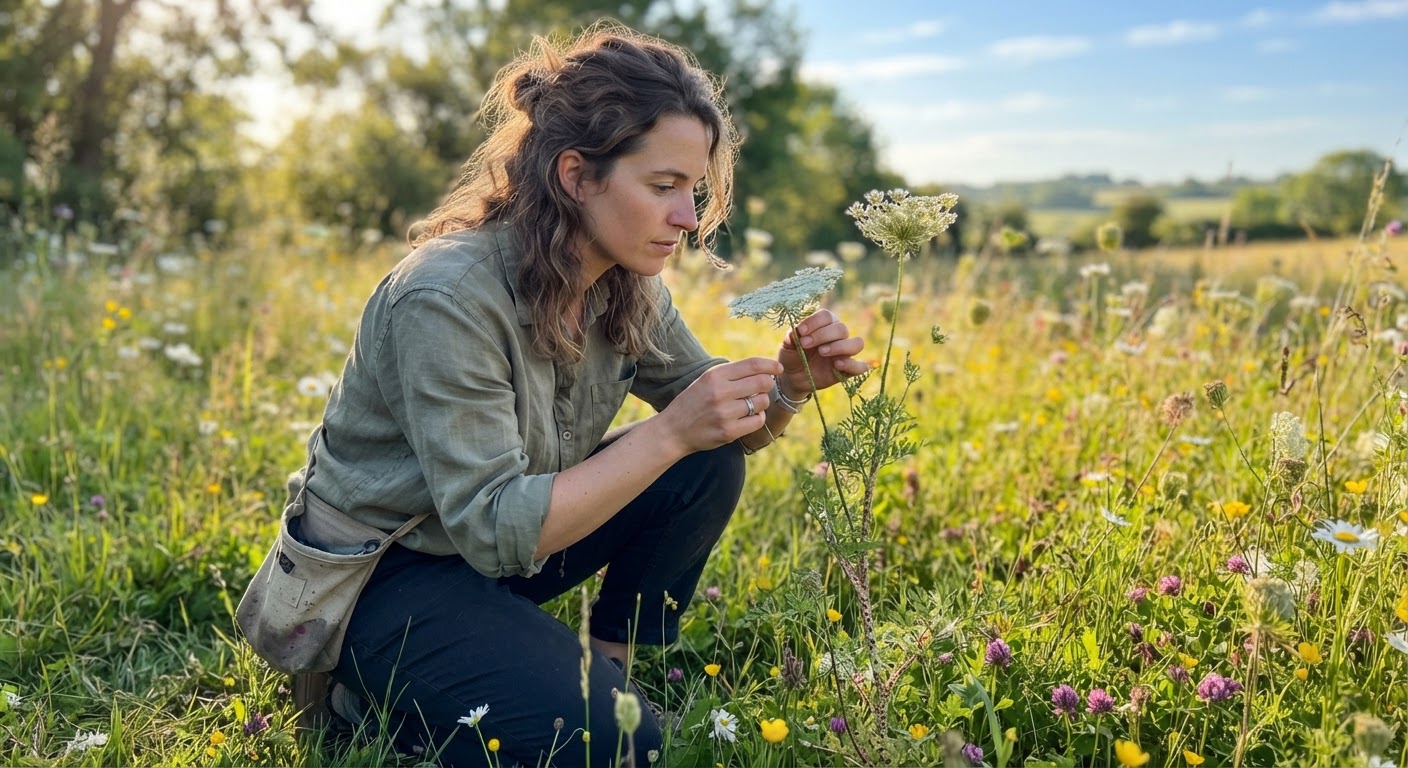
Wild carrot (Daucus carota), also called Queen Anne’s lace, has a hairy stem, smells faintly of carrot when you crush it, and often carries a single dark red or purple floret in the center of its white flower head. It grows a modest two to three feet tall.
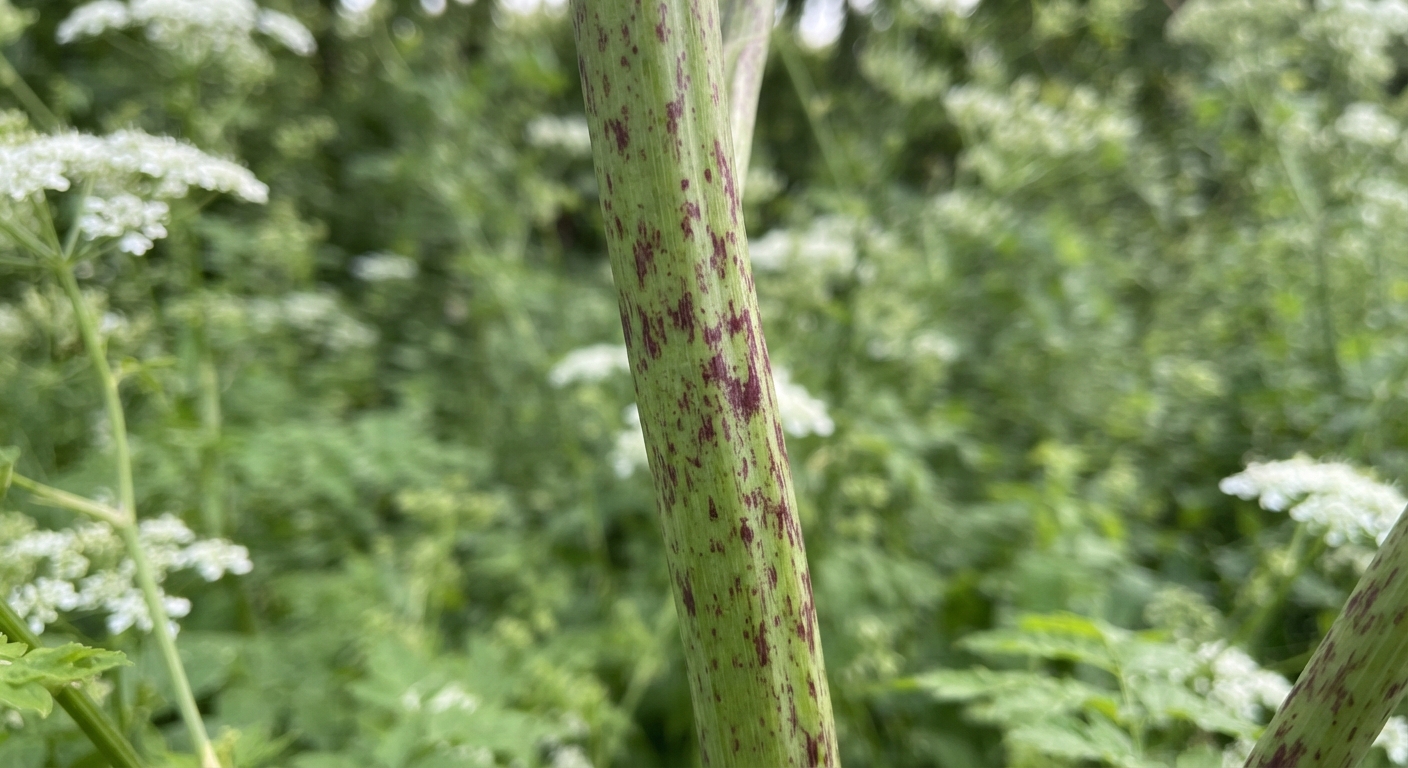
Poison hemlock (Conium maculatum) is a completely different story. It reaches six to eight feet, has a smooth stem streaked with purple-red blotches, and gives off a musty, unpleasant odor when crushed — some people compare it to mouse urine. Every part of the plant contains coniine, an alkaloid that paralyzes your respiratory muscles. Even a small amount can be fatal.
The tell that saves people: rubbed stem + color. Wild carrot stems are hairy and green. Hemlock stems are smooth with purple blotches. If the stem is tall, smooth, and spotted purple, walk away.
Wild Onion vs. Death Camas
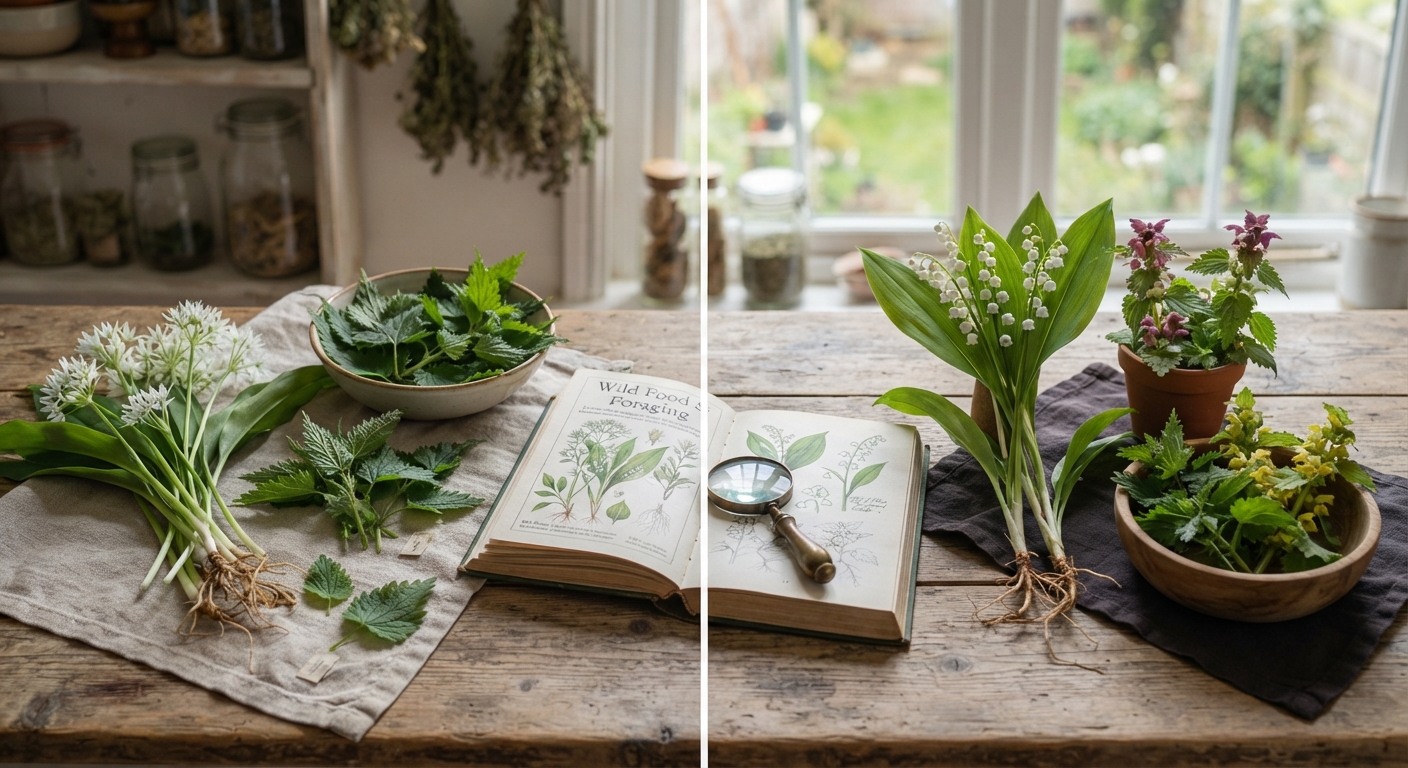
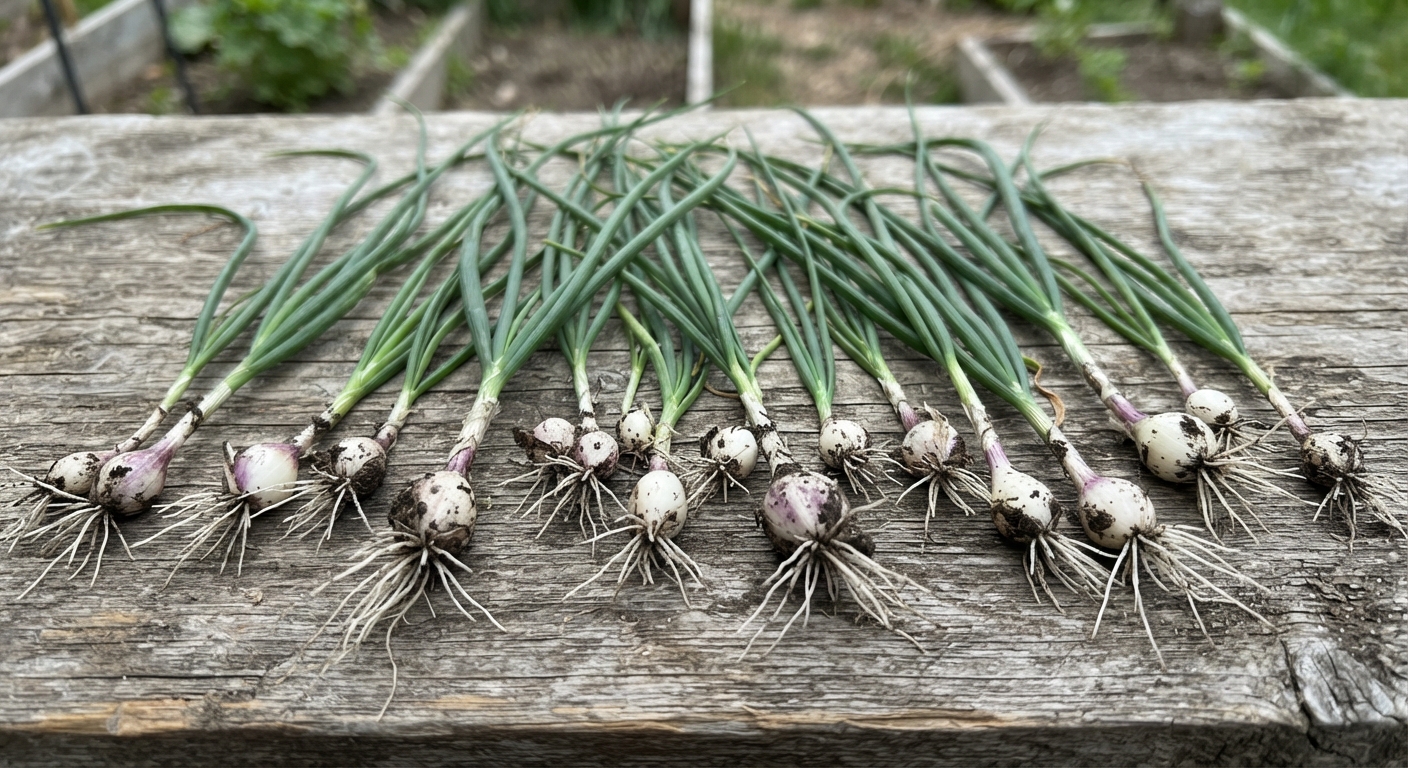
Wild onions and wild garlic (Allium species) are some of the easiest, safest plants to learn — if you use your nose. They smell unmistakably of onion or garlic, in every part, from the leaves down to the bulb.
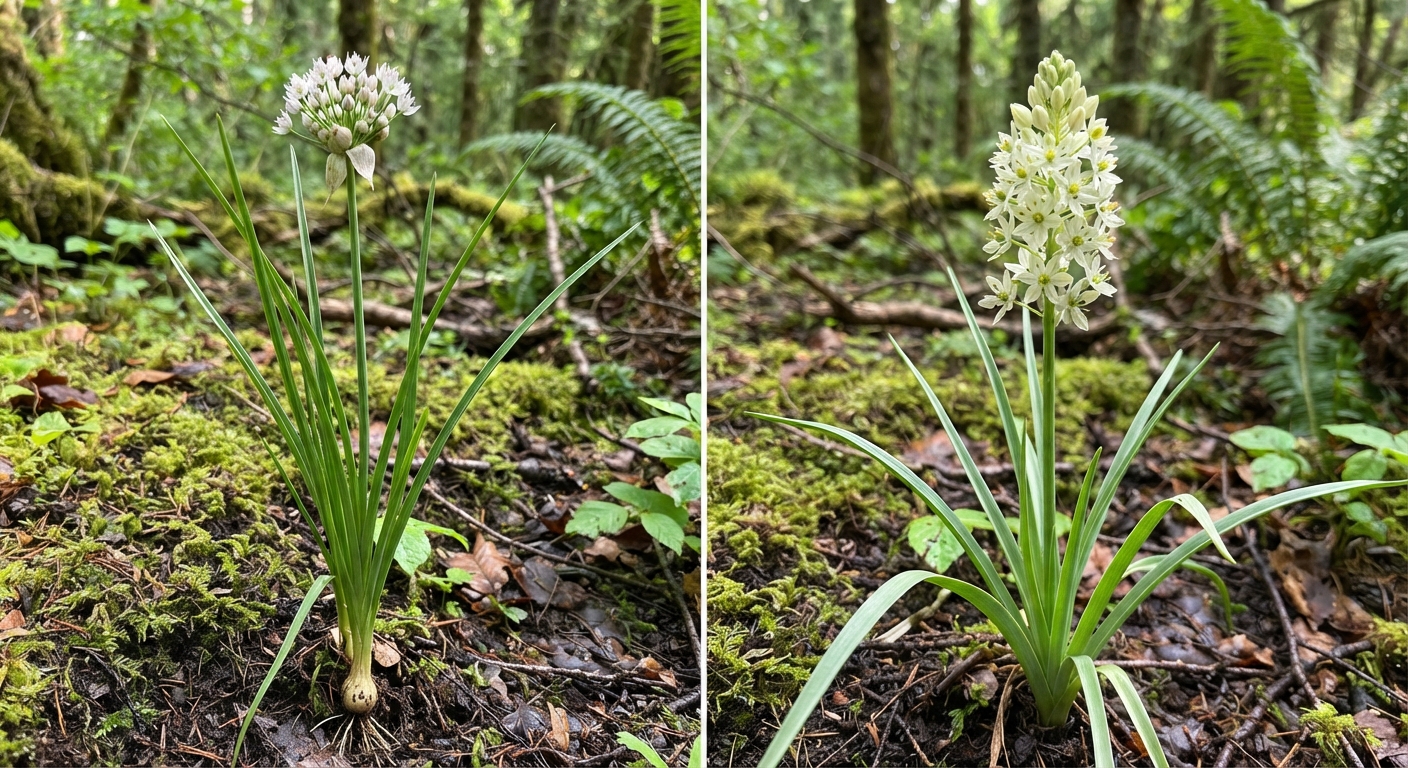
Death camas (Toxicoscordion venenosum, formerly Zigadenus) is a bulb plant that grows in the same meadows and looks enough like an onion to fool you — at a glance. Its leaves are grass-like, its bulb sits in the ground, and it flowers in a spike of cream-colored blossoms. What it does not do is smell like onion. Not even a little.
Death camas contains zygacine, a steroidal alkaloid that drops blood pressure and slows the heart. Livestock die from it every year; people have too.
The tell is so simple it’s a mantra: no onion smell, no onion. If you pick something that looks like a wild onion but can’t smell onion or garlic, it is not an onion, and it is not safe. Smell is the test — never skip it just because the leaves “look right.”
Wild Grape vs. Canada Moonseed
Wild grapes (Vitis species) are abundant, sweet, and mostly foolproof — until you meet their mimic.
Canada moonseed (Menispermum canadense) is a climbing vine with leaves that resemble grape leaves and clusters of dark, grape-sized berries. It grows in the same fence lines and woodland edges. The berries contain dauricine, a toxic alkaloid, and they are not something to gamble on.
The two tells are decisive. Wild grapevines have tendrils — the thin, curling threads they use to climb. Moonseed has none. And the seed is the dead giveaway: cut a berry open. A grape has one to four round or teardrop-shaped seeds. A moonseed has a single seed shaped like a crescent moon — which is where the name comes from.
Open a few berries before you commit. The seed shape settles it instantly.
Elderberry vs. Pokeberry
Elderberry (Sambucus species) is a favorite for syrup and jam. Pokeberry (Phytolacca americana) is a lookalike that shows up at the edges of the same fields, and every part of it is toxic — especially the roots and seeds.
They’re easier to separate than people assume. Elderberry is a woody shrub with compound leaves and broad, flat clusters of tiny dark berries that droop when ripe. Its stems are woody and often have a hollow or pithy center.
Pokeberry is an herbaceous perennial — think giant green weed, not a bush. Its stems are smooth, thick, and famously magenta or reddish, and the berries hang in long, drooping racemes on pink stalks. The berries look glossy and dark but sit on those distinctive pink stems.
A quick rhyme many foragers use: elder on wood, poke on pink. Woody stems with flat berry clusters? Elder. Pink stems with hanging berry chains? Poke. When in doubt, leave it — raw elderberries are mildly toxic too, so neither plant is one to rush.
Morels vs. False Morels
Mushroom people, listen up — this is your pair. The morel (Morchella species) is one of the most coveted wild foods there is. The false morel (Gyromitra species) is its dangerous twin.
The difference is structural. A true morel is hollow all the way through, from the tip of its honeycombed cap down through the stem. The cap is attached to the stem and covered in distinct pits and ridges, like a sponge.
A false morel has a cap that looks more like a wrinkled brain than a honeycomb, and — critically — it is not hollow. Slice it lengthwise and you’ll find chambers or cottony fibers inside. False morels contain gyromitrin, which your body converts into monomethylhydrazine, a compound best known as rocket fuel. It can destroy your liver and kill you.
The rule: slice every morel in half, lengthwise, before cooking. Hollow from cap to stem = morel. Solid or chambered = discard.
Purslane vs. Spotted Spurge
This one is small but it matters, because purslane (Portulaca oleracea) is a common, nutritious “weed” that grows in driveways and garden beds — exactly where its mimic lives.
Purslane has thick, succulent, paddle-shaped leaves on reddish stems, and its sap runs clear.
Spotted spurge (Euphorbia maculata) grows flat along the ground with thinner leaves, often with a reddish spot in the middle of each leaf. Break a stem and it bleeds milky white sap — a latex that irritates skin and is toxic if eaten.
The tell: milky white sap means no. Purslane’s sap is clear; spurge’s is white and milky. This same “milky sap” warning applies across the Euphorbia family, which is worth treating as a blanket rule.
Here’s the whole six-pair lesson compressed into one strip of paper you could keep in your pocket:
| You think you found | The deadly mimic | The one tell that settles it |
|---|---|---|
| Wild carrot | Poison hemlock | Smooth stem with purple blotches = hemlock; hairy green stem = carrot |
| Wild onion/garlic | Death camas | No onion or garlic smell = not an onion, not safe |
| Wild grape | Canada moonseed | No tendrils + single crescent-shaped seed = moonseed |
| Elderberry | Pokeberry | Woody shrub + flat berry clusters = elder; pink stems + hanging chains = poke |
| Morel | False morel | Hollow from cap to stem = morel; solid or chambered = discard |
| Purslane | Spotted spurge | Milky white sap = spurge; clear sap = purslane |
Notice the pattern: every single tell is something you do — smell, slice, break, rub — not something you glance at from three feet away. That’s the real secret.
A Field Protocol: The Four Checks Before You Pick
Identification isn’t a single glance — it’s a sequence. Run these four checks in order, every time, and the lookalikes above stop being a threat. This takes less than a minute once it’s habit.
Check 1 — Smell. Crush a leaf or stem and smell it. The onion rule lives here: if it’s supposed to be an onion or garlic and doesn’t smell like one, it’s not one. Many other plants reveal themselves by scent too — hemlock’s mustiness, mint’s sharpness, fennel’s licorice. Your nose catches what your eyes gloss over.
Check 2 — Stem and sap. Look at the stem. Hairy or smooth? Spotted or plain? Then break it and watch the sap. Milky white latex is a red flag across the board. A hollow stem means something very different for a morel (good) than for a hemlock (bad) — so combine this with the next check rather than relying on it alone.
Check 3 — Structure. Count the features that can’t easily be faked: tendrils on a grapevine, the single crescent seed inside a moonseed berry, pink stems on a pokeberry, the hollow interior of a true morel, the flat cluster versus hanging chain of berries. Structure is the most reliable signal you have because mimics rarely copy it perfectly.
Check 4 — Confidence. This is the one people skip, and it’s the one that saves lives. Ask yourself: would I bet real money on this ID? If the answer is anything less than an unqualified yes, you don’t pick it. Cross-check against a regional field guide and at least one trusted photo source. If the plant is wet, damaged, young, or out of season — conditions that blur ID features — the answer is automatically no.
Risk Tiers: What to Learn First, What to Avoid Forever
Not all foraging skills deserve equal attention. Here’s how I’d organize your learning so you build safety before you build your menu.
| Tier | Plants | Advice |
|---|---|---|
| 1 — Learn first | Wild onion/garlic (smell-tested), dandelion, chickweed, plantain, purslane (clear sap), wild blackberry/raspberry | High confidence, low risk, abundant. Master the smell and sap tests here. |
| 2 — Learn with a mentor | Wild carrot, elderberry, wild grape, morels, ramps, cattail | Safe once you can run the four checks cold. Learn these with an experienced forager in person. |
| 3 — Expert only | Water hemlock family, wild parsnip (handled carefully), amanita mushrooms, wild carrot’s tall white umbel relatives | The lookalikes here are too subtle or too deadly for a beginner. Observe, don’t eat. |
| Never | Anything you can’t identify 100%, any “maybe,” any plant with milky sap you can’t name | If doubt exists at all, it’s not food. Period. |
Here’s the uncomfortable truth embedded in that table: the plants in Tier 3 grow right next to the plants in Tier 1. Poison hemlock loves the same sunny, disturbed soil as wild carrot. Death camas shares its meadow with wild onion. Tier matters less than the four checks — but it tells you where to spend your first hundred hours.
Pro Tips From Someone Who’s Made the Mistakes
These aren’t from a textbook. They’re the habits that kept me (and a few people I’ve taught) out of trouble.
Harvest the leaf, not the field. When a plant has a deadly lookalike, they often grow together. Hemlock and wild carrot will tangle in the same patch. Pick one stem at a time, check that stem, and don’t grab a fistful — one bad stem in a handful contaminates the rest.
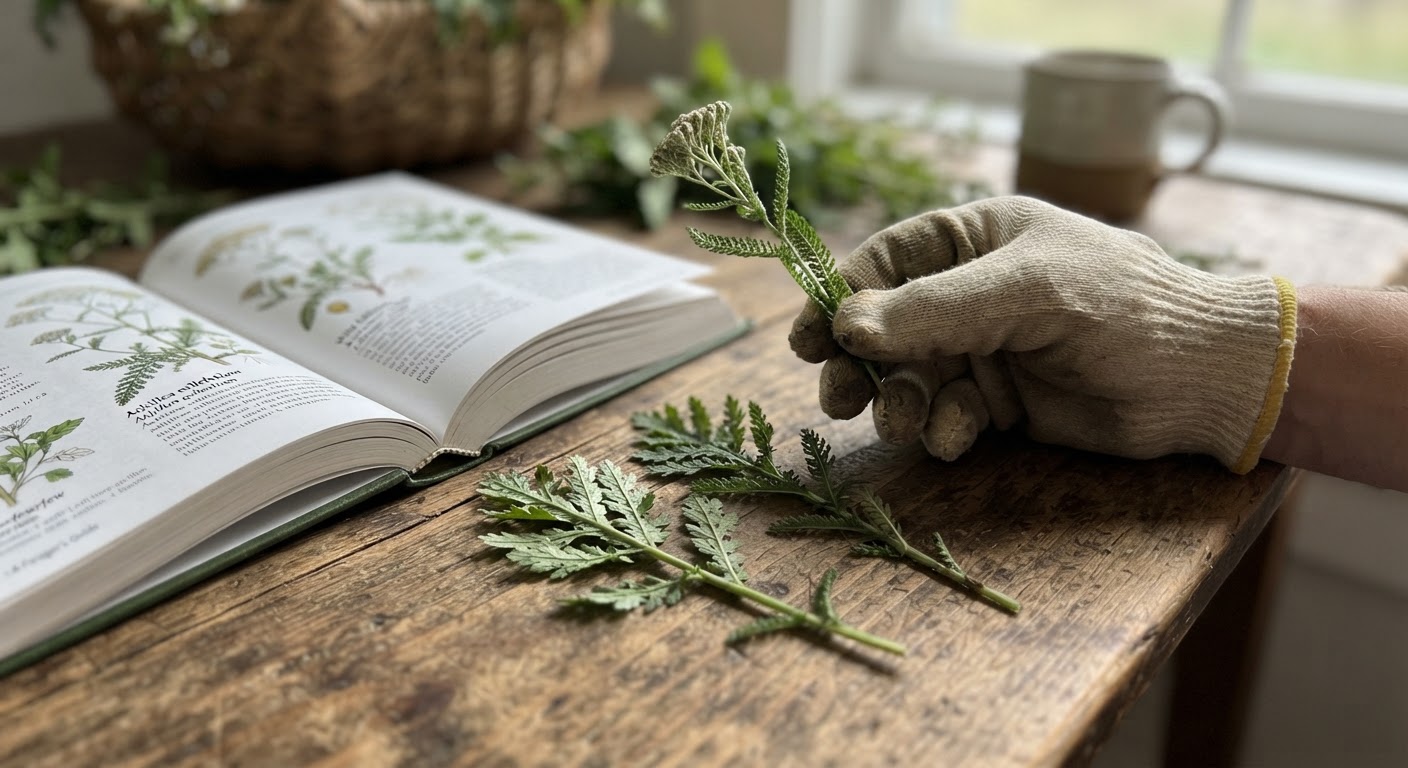
Never ID from a single photo. A single picture shows one angle, one stage of growth, one lighting condition. Poisonous plants are masters of looking “close enough.” You need a field guide with multiple photos per plant — leaf, stem, flower, fruit, and root.
Learn the deadly ones before the tasty ones. Most beginners do it backwards: they learn ten edible plants, then absorb lookalikes as afterthoughts. Flip it. If you learn hemlock’s purple blotches and death camas’s lack of smell first, every safe plant you add later gets a built-in safety net.
Watch the season. Plants change shape as they grow. A young hemlock hasn’t fully developed its height, and a young pokeberry might not show pink yet. If a plant is at an awkward growth stage — too young, too dry, too late — treat it as unidentified.
Teach someone else out loud. The fastest way to find the holes in your own knowledge is to explain it. Say the tells aloud while you check: “Stem’s hairy, smells like carrot, red floret in the middle — that’s wild carrot.” If you stumble or mumble a step, you don’t know it yet.
Keep a “no” journal. Write down every plant you didn’t pick and why. A month in, you’ll have a personal list of the exact lookalikes in your area — and the muscle memory to catch them.
If You Think You’ve Made a Mistake
Act on suspicion, not on certainty. If there’s any chance you or someone with you ate a lookalike, don’t wait for symptoms to confirm it — some of the worst toxins (hemlock, death camas) can take hours to show, and by then treatment is harder.
- Stop eating and set aside a sample of the exact plant, plus a photo if you have one. This helps medical staff and poison control identify it fast.
- Call your local poison control center immediately (in the U.S., 1-800-222-1222; elsewhere, use your national emergency/poison number). They’d rather take ten “it’s probably fine” calls than one too-late call.
- Don’t induce vomiting unless a poison control specialist or doctor tells you to. Some toxins do more damage coming back up.
- Don’t rely on the plant’s appearance to reassure yourself. Remember the whole point of this guide: the dangerous ones look like the safe ones.
This is not medical advice, and it’s not a substitute for calling professionals. But the one piece of it I want you to keep forever is this: when in doubt, treat it as an emergency. Embarrassment is cheap. A delayed call is not.
Questions I Actually Get
Rather than a generic FAQ, here are the five questions people ask me most — with the short answer and the reason it matters.
“Can I just use a plant ID app instead of all this?” Short answer: no, not as your only check. Apps are a useful second opinion, but they misidentify lookalikes often enough — and the stakes are a hospital visit, not a wrong turn. Use an app to suggest, then confirm with a field guide and the four checks.
“Is the universal edibility test a safe shortcut?” No. The universal edibility test is a last-resort survival technique, not a foraging method. It’s slow, unpleasant, and misses delayed toxins like those in mushrooms and some roots. It is not a replacement for identification, and using it casually is a good way to get hurt.
“If I cook a poisonous plant, does it become safe?” Usually not. Boiling can reduce some toxins in some plants, but many of the worst — hemlock’s coniine, death camas’s zygacine, moonseed’s dauricine — survive cooking. Never assume heat fixes a misidentification.
“Are the berries or just the leaves dangerous?” It varies, which is exactly why guessing is dangerous. Hemlock is toxic in every part. Pokeberry’s danger concentrates in the roots and seeds. Death camas is deadly in the bulb. Don’t memorize “which part is safe” — memorize the whole plant as off-limits until proven otherwise.
“How many plants do I really need to memorize before foraging?” Honestly? You need to fully know a handful — and recognize the deadly lookalikes of those plants. Ten solid IDs with their lookalikes beats fifty shaky ones. Depth over breadth, every time.
The Bottom Line
Foraging isn’t dangerous because edible plants are hard to find. It’s dangerous because poisonous plants are good at pretending to be edible ones. The problem is rarely “I can’t identify this plant.” It’s “I’m sure I can identify this plant.”
The fix is boring but it works: learn the lookalikes before the foods, run the same four checks every time, and let doubt be a full stop rather than a hesitation. Smell the onion. Rub the stem. Slice the morel. Open the berry. These tiny habits, repeated thousands of times, are what separate a lifetime of free salads from a trip to the emergency room.
The plants will still be there tomorrow. Pick only what you know — and the knowing is the whole craft.
This article is for education only and is not a substitute for professional identification. Always confirm wild plants with a regional field guide and an experienced local forager before eating anything.