In 2023, poison control centers across the United States logged over 5,000 calls related to wild plant misidentification. Not because people were careless. Not because they skipped their field guide. Most of those callers had done exactly what every foraging book tells you to do — they checked the leaves, they verified the flowers, they consulted a reference.
They still got it wrong.
Here’s the hard truth about foraging: identification guides train you to recognize the edible plant, not to rule out its toxic twin. You learn what wild carrot looks like, but you don’t spend equal time learning what poison hemlock looks like. Your brain builds a search image for “edible” without building the corresponding search image for “dangerous.”
This guide takes the opposite approach. For seven of the most commonly confused plant pairs, you’ll learn the one decisive marker that separates safe from deadly — not a long botanical checklist, but the single difference that you can check in under thirty seconds. Screenshot the comparison table at the end. Keep it on your phone. It might matter more than your field guide.
The 30-Second Rule
Before we get into the pairs, a principle worth tattooing on your brain: if you can’t name the toxic lookalike for a plant you’re about to harvest, you haven’t identified it yet.
Positive identification isn’t just recognizing what something is. It’s also ruling out what it isn’t. Every edible on this list has a dangerous doppelganger. If you can’t describe the difference between them with your eyes closed, put the plant down and come back with more information. That’s not paranoia — it’s the standard trained mycologists use for mushrooms, and there’s no reason it shouldn’t apply to plants too.
Each entry below follows the same format: the edible plant, the poisonous lookalike, the one field marker you need, and why the visual confusion happens so often.
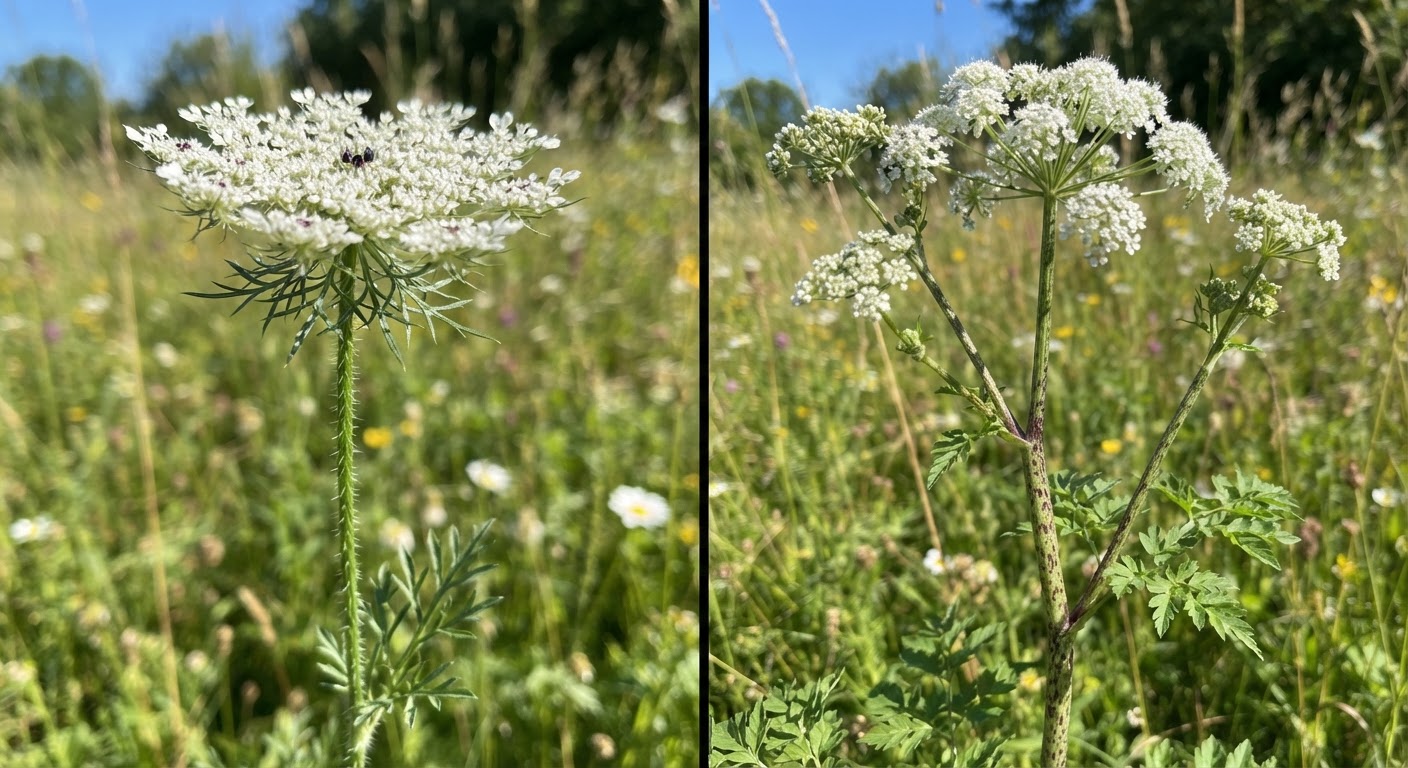
1. Wild Carrot (Queen Anne’s Lace) vs. Poison Hemlock
The confusion: Both have white, umbrella-shaped flower clusters on tall stems. Both grow in similar habitats — roadsides, field edges, disturbed soil. Both flower at roughly the same time in midsummer. To an untrained eye from ten feet away, they’re the same plant.
The decisive marker: Look at the stem. Wild carrot stems are hairy and solid green. Poison hemlock stems are smooth and hairless, with distinctive purple blotches or streaks. If you see purple on the stem of anything resembling wild carrot, walk away. There are no exceptions to this rule in North America or Europe.
Secondary check — the smell: Crush a small piece of wild carrot leaf between your fingers and it should smell like carrots. Poison hemlock smells musty, almost like mouse urine. But never rely solely on smell — your nose can become desensitized, and crushing hemlock leaves transfers toxic alkaloids to your skin.
What’s at stake: Hemlock contains coniine and other piperidine alkaloids that cause ascending paralysis. Your legs go numb first, then your arms, then your diaphragm. You stay conscious the entire time. Socrates died exactly this way. A piece of hemlock root the size of a walnut can kill an adult.
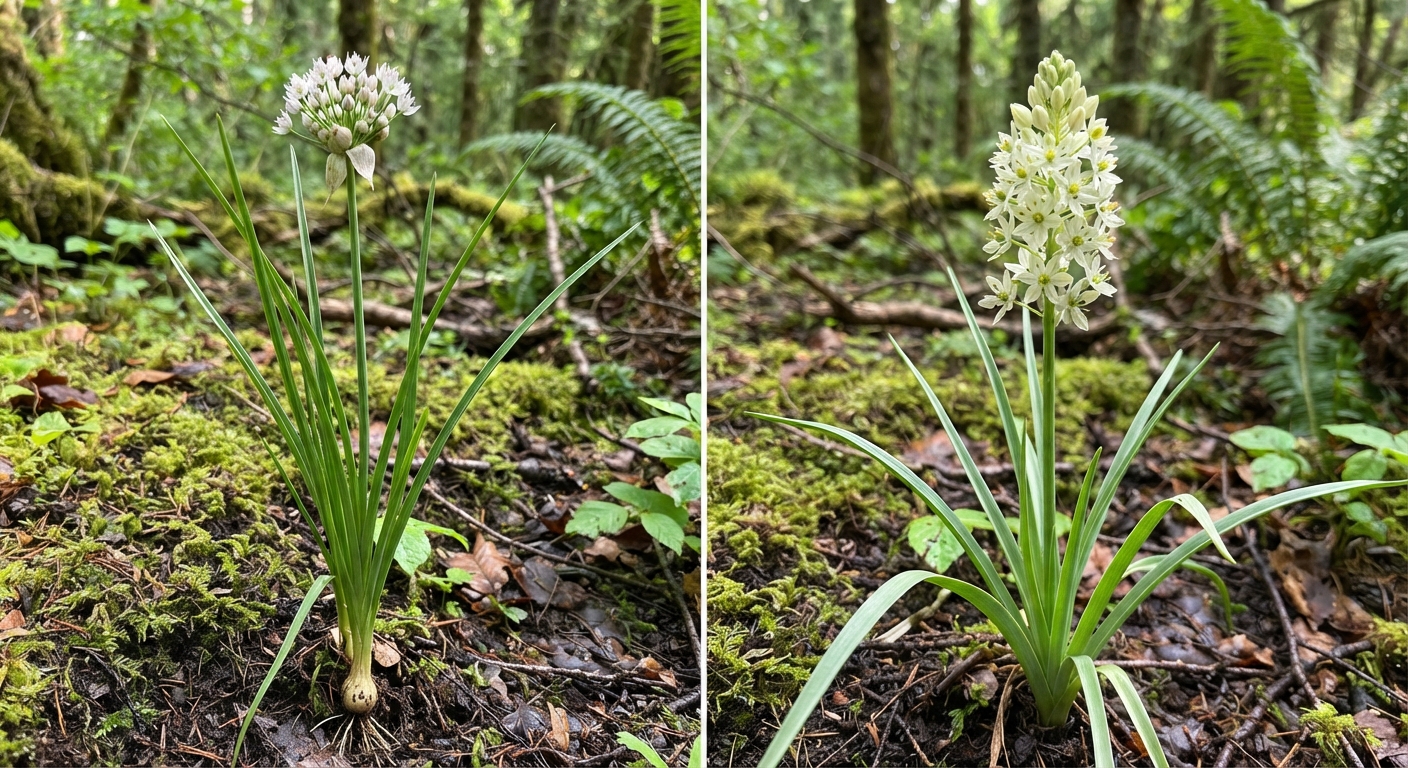
2. Wild Onion / Wild Garlic vs. Death Camas
The confusion: Both sprout from bulbs. Both produce narrow, grass-like leaves in early spring. Both grow in meadows and open woodlands across western North America. In late spring, their flowering stalks emerge from the same kind of basal leaf cluster.
The decisive marker: The bulb. Wild onion bulbs have the papery, layered outer skin you’d expect from any onion, and they smell unmistakably like onion or garlic when crushed. Death camas bulbs lack the papery layers, look more like a small, smooth-skinned bulb or corm, and — this is the critical part — they have no onion smell whatsoever.
The deadly detail most guides skip: The flowers don’t overlap in bloom time, so you can’t always rely on them. And when the plants are young shoots in early spring, before flowers emerge, the leaves look nearly identical. This is when most poisonings happen. Foragers see what looks like wild onion shoots in March, pull up the bulb, and miss the lack of onion scent because they didn’t check it.
What’s at stake: Death camas contains zygacine, a steroidal alkaloid that attacks the nervous system. Symptoms include vomiting, slowed heartbeat, plummeting blood pressure, and — in severe cases — respiratory failure. Cattle and sheep die from it regularly in rangeland. You are not tougher than a cow.
3. True Morel vs. False Morel
The confusion: Both are spring mushrooms with ridged, brain-like caps. Both appear around the same time — typically April through early June in northern regions. Both grow in similar woodland habitats near dead or dying trees.
The decisive marker: Cut it in half from top to bottom. A true morel is completely hollow from the tip of the cap all the way down through the stem — like a single continuous chamber. A false morel (Gyromitra species) has a chambered, stuffed, or cottony interior — the cap attaches to the stem at the top, and the inside looks like a series of irregular pockets, not one clean cavity.
Visual bonus check: True morel caps have a regular honeycomb pattern — distinct pits and ridges that look like a structured grid. False morel caps are more wrinkled, lobed, or brain-like without the organized pit pattern.
What’s at stake: False morels contain gyromitrin, which your body metabolizes into monomethylhydrazine — literally rocket fuel. It destroys your liver and kidneys. Some people eat false morels after parboiling them multiple times (it’s a traditional food in parts of Scandinavia), but the toxin is volatile, meaning you can inhale enough during the cooking process to get sick. There is no margin here worth testing.
4. Dandelion vs. Cat’s Ear (and Hawkweeds)
The confusion: Dandelions have yellow composite flowers and toothed leaves. So do at least a dozen lookalikes — cat’s ear, several hawkweeds, and sow thistle. They all produce a basal rosette of leaves and a yellow dandelion-like bloom on a leafless stalk. In spring, when everything is young and green, telling them apart by leaf alone is genuinely difficult.
The difference that settles it: Dandelions produce one flower per stalk, and the stalk is completely hollow and leafless. Squeeze it — it should feel like a drinking straw. Cat’s ear and hawkweeds produce multiple flowers on branching, solid (or partially solid) stems. If you see a stem branching into multiple buds, it’s not a dandelion.
The leaf check: Dandelion leaves have teeth that point backward toward the base of the plant. Cat’s ear leaves are hairy on both sides and the teeth point in multiple directions. Hawkweed leaves are often hairier underneath with a whitish underside.
What’s at stake: Cat’s ear and most hawkweeds are technically edible, just bitter and less pleasant than dandelion. The real danger is habit formation — if you get comfortable eating “yellow composite flowers” without verifying, you’ll eventually grab something actually toxic like groundsel or ragwort, which contain liver-damaging pyrrolizidine alkaloids.
5. Wild Grape vs. Canadian Moonseed
The confusion: Both are climbing vines with similar leaves. Both produce clusters of purple berries in late summer and early fall. Both grow in similar habitats — woodland edges, fence rows, stream banks. At a glance, a moonseed vine looks exactly like a wild grape vine.
The decisive marker: The seed. Wild grape seeds are round, teardrop-shaped, and multiple per fruit — the classic grape seed you’ve seen a thousand times. Canadian moonseed produces a single, flat, crescent-shaped seed that looks like a flattened disc with a curved edge. Cut the berry open. One seed or several? Flat or round? This is not a subtle difference once you know to look for it.
The leaf check — less reliable: Wild grape leaves have serrated edges with pointed teeth. Moonseed leaves may have smoother margins or more rounded teeth. But leaf shape varies with age and growing conditions. Don’t bet your liver on leaf margins.
The taste check — do NOT use this: Some old guides say to taste a tiny amount because moonseed is bitter. This is terrible advice. Moonseed contains dauricine, a toxin that can cause seizures and cardiac arrest. Don’t put things in your mouth to identify them.
What’s at stake: Moonseed poisoning leads to convulsions, paralysis, and potentially fatal cardiac effects. The berries look close enough to wild grapes that children are particularly at risk — they see purple berries on a vine and eat them.
6. Fiddlehead Ferns (Ostrich Fern) vs. Bracken Fern
The confusion: Young fern shoots — fiddleheads — are a celebrated spring wild edible across North America. Ostrich fern fiddleheads are the gold standard: tender, asparagus-like, and widely foraged. But multiple fern species produce fiddleheads in spring, and not all are safe.
The decisive marker: Ostrich fern fiddleheads have a deep, U-shaped groove running down the inside of the stem (like celery). They are covered in papery, brown, onion-skin-like scales that brush off easily. The stem is smooth and succulent.
Bracken fern fiddleheads have no groove — the stem is round. They are fuzzy or hairy, not papery. The fiddlehead itself is more loosely curled with a different silhouette.
Secondary markers: Ostrich ferns grow in a distinctive “vase” or crown shape, with all fronds emerging from a central point. By late spring, the mature fronds are unmistakable — tall, ostrich-plume shaped fronds that narrow dramatically at the base.
What’s at stake: Bracken fern contains ptaquiloside, a carcinogen linked to stomach and esophageal cancer in populations that consume it regularly. It’s not an immediate poison — it’s a cumulative carcinogen. But cooking doesn’t fully destroy it, and young fiddleheads contain the highest concentrations. The risk is dose-dependent, but given that ostrich fern has zero risk when properly identified, there’s no reason to play the odds.
7. Sweet Almond vs. Bitter Almond (Wild)
The confusion: Sweet almonds are the domesticated nuts we all eat. Bitter almonds grow wild and look nearly identical — same tree, same nut shape, same woody shell. In parts of the Mediterranean and Central Asia, wild almond trees are common, and foragers sometimes crack them open expecting the familiar nut.
The decisive marker — and why you shouldn’t bother: You can’t reliably tell sweet almonds from bitter almonds by appearance alone. The difference is chemical: bitter almonds contain amygdalin, a cyanogenic glycoside that your body converts to hydrogen cyanide. Sweet almonds have negligible amounts. The smell test works — bitter almonds smell strongly of almond extract (benzaldehyde, a cyanide breakdown product) — but by the time you’ve crushed and smelled it, you’ve already handled cyanogenic material.
The practical rule: Don’t forage wild almonds. Just don’t. The domesticated sweet almond is the result of thousands of years of selective breeding for low-amygdalin trees. Wild trees haven’t been screened. Eating 10–15 bitter almonds can kill a child; 50 can kill an adult. There are easier ways to get calories in the wild.
The Side-by-Side Field Cheat Sheet
This table covers the quickest, most reliable discriminator for each pair. Screenshot it.
| Edible Plant | Toxic Lookalike | The Decisive Difference | Check Takes | Risk Level |
|---|---|---|---|---|
| Wild Carrot | Poison Hemlock | Hairy green stem vs. smooth stem with purple blotches | 5 seconds | ☠️☠️☠️ Fatal |
| Wild Onion/Garlic | Death Camas | Papery onion-skin bulb + onion smell vs. smooth bulb, no smell | 5 seconds | ☠️☠️☠️ Fatal |
| True Morel | False Morel | Hollow inside (cut lengthwise) vs. chambered/stuffed interior | 10 seconds | ☠️☠️ Organ failure |
| Dandelion | Cat’s Ear / Hawkweeds | One flower per hollow stalk vs. multiple flowers on solid stems | 5 seconds | ⚠️ Habit risk |
| Wild Grape | Canadian Moonseed | Multiple round seeds vs. one flat crescent seed | 10 seconds | ☠️☠️ Fatal |
| Ostrich Fern Fiddlehead | Bracken Fern | U-shaped stem groove + papery scales vs. round, fuzzy stem | 10 seconds | ☠️ Carcinogenic |
| Sweet Almond | Bitter Almond (Wild) | No visual difference — don’t forage wild almonds | N/A | ☠️☠️☠️ Fatal |
Five Habits That Keep You Out of the Emergency Room
These aren’t plant identification tips. They’re behavioral habits — the meta-skills that experienced foragers develop over years of close calls and observed mistakes.
1. Never forage hungry. This sounds trivial. It’s not. When you’re hungry, your brain lowers its threshold for certainty. “Probably” starts to feel like “definitely.” Eat before you go out. The plants will still be there.
2. Run the checklist on every single specimen, not just the first one. The most common failure mode: you correctly identify a patch of wild garlic, then twenty feet away you pull up a plant that looks the same without checking the bulb. One death camas in a bag of wild onions is all it takes.
3. When in doubt, photograph it and walk away. A phone camera is the most underrated foraging tool. Take clear photos of the whole plant, a close-up of the stem, and a close-up of any flowers or fruit. Post to a foraging identification group. Wait for multiple confirmations. There will be more of that plant tomorrow.
4. Build your knowledge one plant at a time. The “learn 20 edible plants this season” approach is how people get hurt. Pick two. Learn the edible AND its toxic lookalikes. Forage those two for an entire season. Add one or two more next year. Being able to identify three plants with 100% confidence beats being able to identify thirty plants with 80% confidence.
5. Accept that some foods aren’t worth the identification risk. Wild almonds. Wild carrots before flowering. Any small white mushroom. Some plants sit in a risk/reward dead zone where the calories aren’t worth the hospital bill. Foraging isn’t a survival competition — it’s okay to let the hard cases go.
What to Do If You Realize You’ve Made a Mistake
If you eat something and then realize it might be the wrong plant:
- Don’t wait for symptoms. Some plant toxins — amatoxins from mushrooms, pyrrolizidine alkaloids from weeds — don’t produce immediate symptoms. By the time you feel sick, the damage is done.
- Call poison control immediately: 1-800-222-1222 (US). They have plant toxicologists on staff.
- Bring the plant with you. Put the remaining plant material in a sealed bag. The hospital needs to know exactly what you ate, not “a white mushroom” or “some kind of carrot-like plant.”
- Don’t induce vomiting unless instructed to. Some toxins cause more damage on the way back up.
- Take a photo of the location where you picked it. Knowing the habitat confirms identification.
Frequently Asked Questions
Can I build immunity to plant toxins by eating small amounts?
No. This is a dangerous myth. Some toxins — like cyanogenic glycosides in bitter almonds — have a threshold effect where your body can detoxify small amounts. But others — like amatoxins in death cap mushrooms — are cumulative and cause irreversible damage at ANY dose. You cannot “train” your body to handle hemlock alkaloids or moonseed toxins. This line of thinking kills people.
What’s the most commonly misidentified foraging plant?
Wild carrot vs. poison hemlock, by a wide margin. Poison control data consistently shows it as the top plant-related foraging mistake in North America. The stem check (hair vs. purple blotches) would prevent nearly all of these cases.
Are there apps that can reliably tell toxic plants from edible ones?
No. Plant identification apps (PlantSnap, iNaturalist, PictureThis) are useful for narrowing down possibilities, but they make mistakes — especially with plants in the same family. The difference between wild carrot and poison hemlock is sometimes reduced to a “92% match” confidence score in the app. That 8% is the problem. Use apps as a starting point, never as the final word.
How do I teach kids about poisonous plants without scaring them away from nature?
Give them positive rules rather than fear-based ones. “We only taste plants after an adult has checked three things: the stem, the flower, and the smell” is better than “don’t touch anything, everything is dangerous.” Teach the interesting distinctions — kids remember “purple blotches mean danger” better than they remember “never eat wild plants.”
Is foraging even worth the risk?
The statistics put this in perspective: far more people are hospitalized annually from eating improperly stored grocery store food than from foraging mistakes. The risk is real but highly concentrated — it’s not evenly distributed across all foraging activities. If you stick to easily identifiable plants (dandelions, morels, wild onions with a bulb check), learn the toxic lookalikes for each one, and follow the 30-second rule, foraging is no more dangerous than driving to the grocery store. The problem is that foraging culture sometimes projects a casual, “just grab what looks good” attitude that doesn’t match the actual stakes.
Bottom Line
You don’t need a botany degree to forage safely. You need a short list. The seven pairs above cover the vast majority of dangerous plant misidentifications that actually happen to real people in North America.
Learn them. Not “read about them once and vaguely remember” — actually learn them. Test yourself: can you describe the stem difference between wild carrot and poison hemlock right now without scrolling up? Can you explain why the interior of a true morel looks different from a false morel?
If the answer is no, that’s fine. It just means you’re not ready to forage those plants yet. There’s no deadline. The berries don’t care what month it is.
Grab your phone, screenshot the comparison table, and start with one pair this weekend. One plant, one lookalike, one decisive marker. Master it. Then pick the next one. That’s how people who have been foraging for twenty years still do it — one confident identification at a time.