In August 2023, four members of an Oregon family were airlifted to a hospital after eating what they believed was wild carrot root. They’d consulted a field guide. They’d checked the root against pictures online. But the plant in their basket was Conium maculatum — poison hemlock, the same species used to execute Socrates in 399 BCE. All four survived, but only because an off-duty paramedic driving past recognized the symptoms and called emergency services within the hour.
Foraging has exploded. TikTok videos tagged #foraging have crossed billions of views. Weekend workshops sell out months in advance. But alongside that enthusiasm sits a quieter number: the American Association of Poison Control Centers handled over 3,500 plant-related exposure calls in a recent year, with foraging misidentification accounting for a growing percentage of cases that ended in hospitalization.
The problem isn’t that foragers are reckless. It’s that nature is a better mimic than most beginners expect. Several of the most commonly foraged edible plants have near-identical toxic counterparts — plants that grow in the same soil, at the same time of year, with leaves and flowers that could fool someone who glanced at a field guide once and headed out with a basket.
Here are seven of the most dangerous lookalike pairs in North American and European foraging — how to tell them apart, which field tests actually work, and what’s at stake if you get it wrong.
Quick Reference: The Seven Deadly Lookalike Pairs
| # | Edible Plant | Toxic Lookalike | Primary Risk | Mistake Likelihood |
|---|---|---|---|---|
| 1 | Wild Carrot (Queen Anne’s Lace) | Poison Hemlock | Fatal if ingested | High — same habitat, similar leaves |
| 2 | Wild Garlic / Field Garlic | Death Camas | Fatal if ingested | Moderate — smell test is definitive |
| 3 | Wild Blueberries | Pokeweed Berries | Severe GI distress, potentially fatal for children | Low, but berries are tempting |
| 4 | Wild Fennel / Dill | Poison Hemlock (young) | Fatal if ingested | Moderate — young hemlock mimics fennel |
| 5 | Wild Grapes | Moonseed | Potentially fatal — neurotoxic | Low to moderate — fruit clusters differ |
| 6 | Purslane | Spurge | Vomiting, diarrhea, mouth pain | Very high for beginners — grows in same spots |
| 7 | Morel Mushrooms | False Morels | Liver toxicity, can be fatal | Moderate — season and habitat completely overlap |
1. Wild Carrot (Daucus carota) vs Poison Hemlock (Conium maculatum)
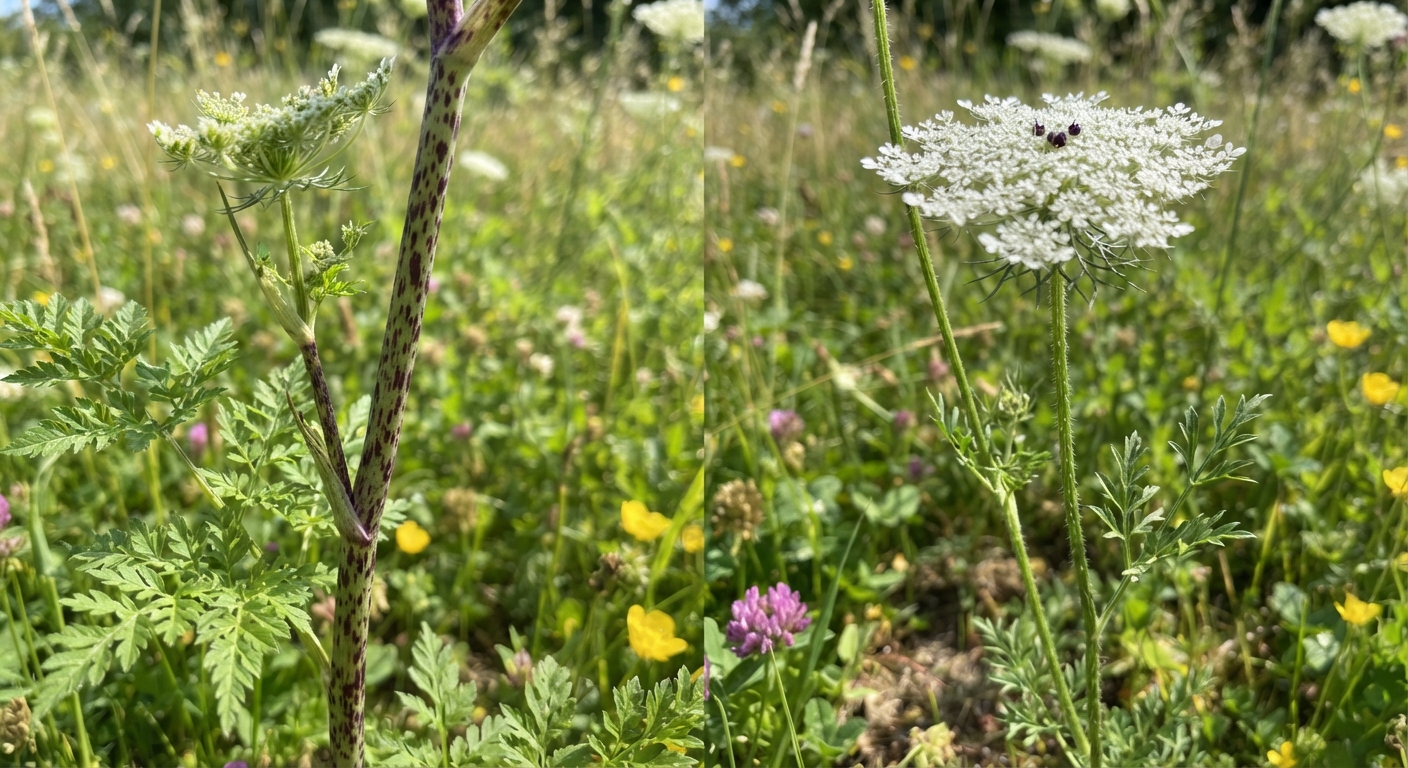
This is the pair that kills people every year. Both are tall, white-flowered members of the Apiaceae family. Both grow along roadsides, in ditches, and at field edges. Both appear in late spring through summer. And at twenty feet, they look almost indistinguishable.
The edible plant — Wild Carrot: Also called Queen Anne’s Lace. Delicate white flower clusters shaped like a flat umbrella — botanists call this a compound umbel. The stem is hairy. Rub your fingers up and down the stem and you’ll feel unmistakable fuzz. Crush a leaf: it smells exactly like carrot. The flower cluster often has a single tiny dark purple floret at its center — the “queen’s drop of blood” from folklore, though this isn’t present on every specimen. The root is pale, tapered, and smells distinctly of carrot when scratched.
The toxic lookalike — Poison Hemlock: White flower clusters that are more rounded and loosely arranged than wild carrot’s flat-topped blooms. The stem is smooth and hairless — this is the single most important difference — and marked with distinctive purple blotches or streaks, especially toward the base. When crushed, the leaves smell musty, stale, or faintly like mouse urine — never like carrot. Hemlock grows significantly taller, often 3–8 feet, while wild carrot tops out around 3 feet.
Reliable field test: Run your fingers down the stem. Hairy = carrot (safe). Smooth with purple blotches = hemlock (deadly). Three seconds. No ambiguity.
What’s at stake: Poison hemlock contains coniine, a neurotoxin that causes progressive ascending paralysis. Respiratory failure typically occurs within 2–3 hours of ingestion. There is no antidote — treatment is purely supportive, involving mechanical ventilation until the toxin clears the system. The lethal dose for an adult is approximately 6–8 fresh leaves. A child can die from a single bite of the root.
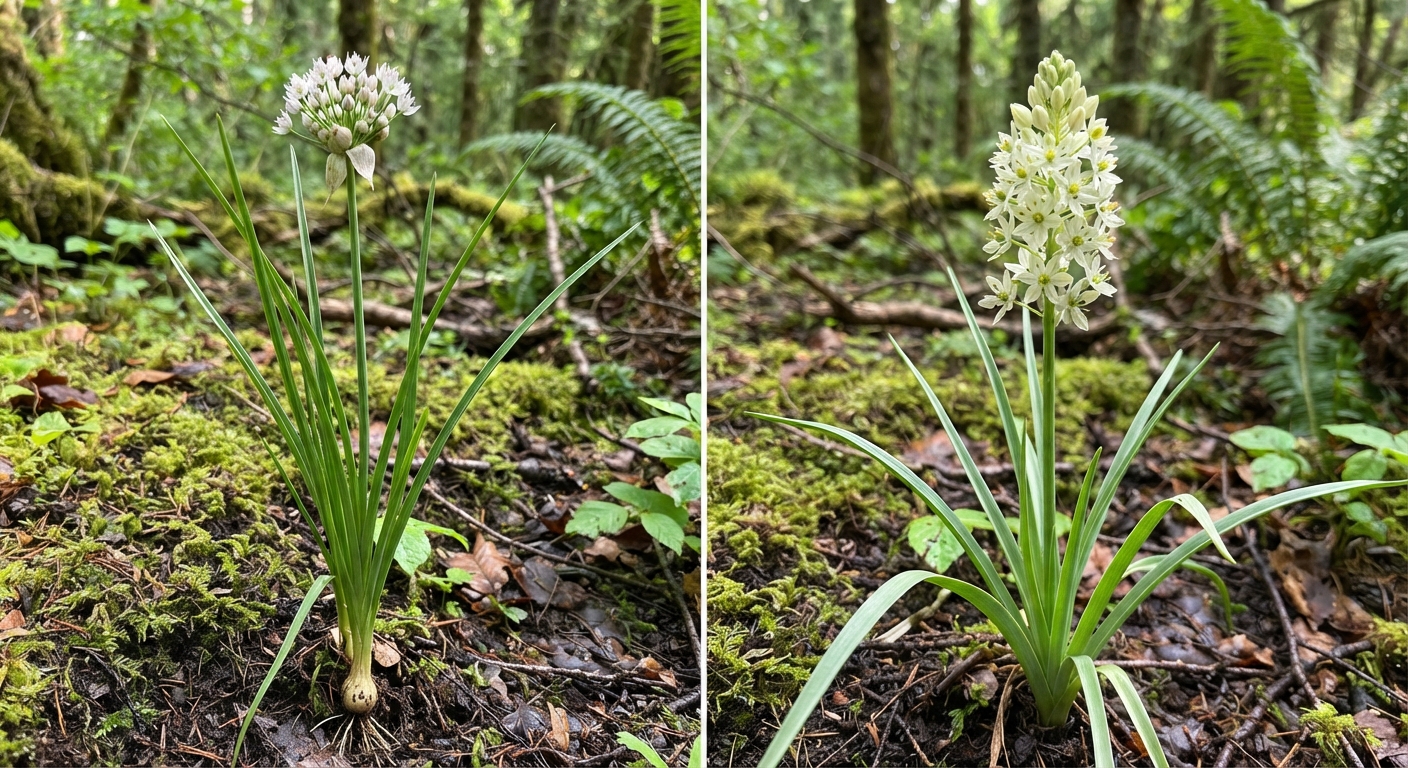
2. Wild Garlic (Allium species) vs Death Camas (Toxicoscordion / Zigadenus)
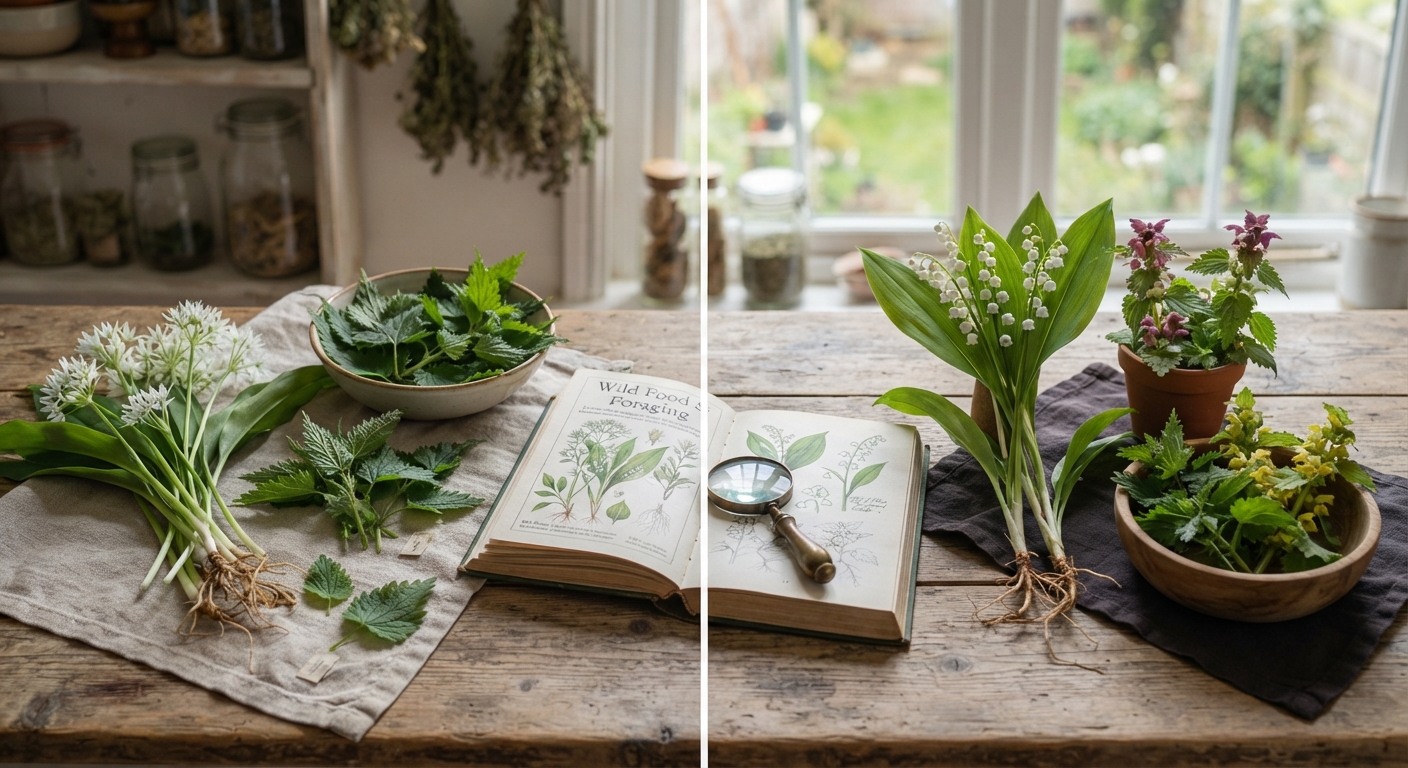
The edible plant — Wild Garlic: This is the easiest safe identification in foraging. Crush any part of the plant between your fingers. If you smell garlic — unmistakable, pungent, makes-your-eyes-water garlic — it’s an Allium species and it’s safe. Wild garlic (Allium ursinum, also called ramsons) has broad, flat, lance-shaped leaves. Field garlic (Allium vineale) has thin, tubular, hollow leaves similar to chives. Both smell like garlic. Both are edible — leaves, bulbs, flowers, everything.
The toxic lookalike — Death Camas: The leaves look similar — particularly in early spring, before flowers appear, when all you can see is a cluster of narrow green leaves emerging from the soil. But death camas leaves produce absolutely no garlic odor when crushed. The flowers (when present) are cream-colored and grow in a dense spike, not the loose star-shaped cluster of wild garlic. This plant is most dangerous in March and April — exactly when wild garlic foragers are most active — because the leaves alone are the only visible cue.
Reliable field test: Pick a leaf. Crush it. Smell it. Garlic scent = safe. No scent or grassy/vegetal = do not eat. This is the single most reliable plant identification test in all of foraging.
The rule you cannot break: “No smell, no eat.” No exceptions. Ever.
What’s at stake: Death camas contains zygacine, a steroidal alkaloid that causes nausea, vomiting, dangerously slowed heart rate, hypotension, and in severe cases, cardiac arrest. Deaths are rare with modern medical intervention, but documented fatalities exist among foragers in remote areas and from historical grazing incidents where livestock consumed death camas mixed with wild onion.
3. Wild Blueberries (Vaccinium species) vs Pokeweed Berries (Phytolacca americana)
This one is less about genuine botanical confusion and more about carelessness — but the consequences are real, especially for children.
The edible plant — Wild Blueberries: Small, round berries with a five-pointed crown (the calyx) at the base of each fruit. Grow on low, woody shrubs, typically under 3 feet tall. The fruit is blue-purple with a powdery white bloom on the skin. The flesh inside is pale green-white. The flavor is sweet-tart and immediately familiar.
The toxic lookalike — Pokeweed: Dark purple-black berries growing in distinctive drooping clusters on thick, bright magenta stems. Pokeweed is a tall herbaceous plant — not a shrub — often reaching 6–8 feet by late summer. The berries are slightly flattened, with indented tops, growing in long chains (racemes) rather than scattered individually along branches. Break a berry open: pokeweed juice stains skin and fabric an intense magenta-purple. Blueberry juice is pale.
Reliable field test: Look at the plant, not just the berry. If it’s taller than you and the berries hang in drooping clusters from neon-magenta stems, that’s pokeweed. No blueberry on Earth grows that way.
What’s at stake: Pokeweed contains phytolaccatoxin and phytolaccigenin. Raw berries cause burning mouth and throat pain, intense vomiting, and diarrhea that can lead to dangerous dehydration. The CDC has documented multiple pediatric fatalities involving pokeweed berries. Young pokeweed shoots are traditionally eaten as “poke sallet” in parts of the American South — but only after multiple changes of boiling water to leach out water-soluble toxins. That’s an advanced-level food for people who learned the process from someone experienced.
4. Wild Fennel (Foeniculum vulgare) vs Young Poison Hemlock (Conium maculatum)
Experienced foragers harvest wild fennel without a second thought. The risk sits squarely with intermediate foragers who have learned “feathery leaves = fennel family” but haven’t encountered young poison hemlock — which, before its purple blotches fully develop and before it towers head-high, looks genuinely similar.
The edible plant — Wild Fennel: Soft, thread-like, feathery leaves that release an intense licorice or anise scent when crushed between your palms. The stem is solid, distinctly ridged, and uniformly pale green — no purple anywhere. Wild fennel naturalized across much of North America after escaping from gardens. The leaves, stalks, pollen, seeds, and bulbous base are all edible. Yellow flower clusters appear in late summer.
The toxic lookalike — Young Poison Hemlock: Also produces finely divided, fern-like foliage — but crush a leaf and the smell is musty, stale, faintly unpleasant, not remotely like licorice. Even young plants show hints of purple at the stem nodes or faint blotching. Hemlock stems are smooth and round, while fennel stems are ridged with distinct grooves you can feel with your fingernail.
This same confusion risk applies to wild dill, which also has feathery leaves — and the same smell rule protects you there too.
Reliable field test: Crush a handful of leaves between both palms and inhale. Licorice or anise scent = fennel family, safe. Musty, mousy, or neutral smell = hemlock, deadly. This takes one second and works every time.
5. Wild Grapes (Vitis species) vs Moonseed (Menispermum canadense)
Not the most common mix-up, but one of the most tragic when it happens — because moonseed fruit looks genuinely appetizing, and it frequently grows intertwined with actual wild grape vines.
The edible plant — Wild Grapes: Round berries in loose, dangling clusters, each containing 2–4 pear-shaped seeds. The vine has shredding, peeling bark and uses forked tendrils to climb. Leaves are large, heart-shaped, with toothed edges. Wild grapes grow across most of temperate North America and are excellent for jams, jellies, and wine.
The toxic lookalike — Moonseed: Berries look like grapes but grow in small, tight bunches of just 3–6 fruits each — not the larger, looser clusters of wild grapes. The definitive difference: cut a fruit open. Moonseed contains a single crescent-moon-shaped seed. Wild grapes have multiple oval seeds. The vine lacks tendrils entirely, and its leaves are more rounded with smoother margins.
Reliable field test: Two quick checks. Crush a berry — grape juice is pale greenish-yellow; moonseed juice is nearly clear. Then check the seed: one crescent = moonseed (toxic). Multiple ovals = grape (edible).
What’s at stake: Moonseed contains dauricine, an alkaloid that can cause seizures, convulsions, and respiratory paralysis. Multiple poisonings and at least one confirmed fatality exist in medical literature. This plant is not to be gambled with.
6. Purslane (Portulaca oleracea) vs Spurge (Euphorbia species)
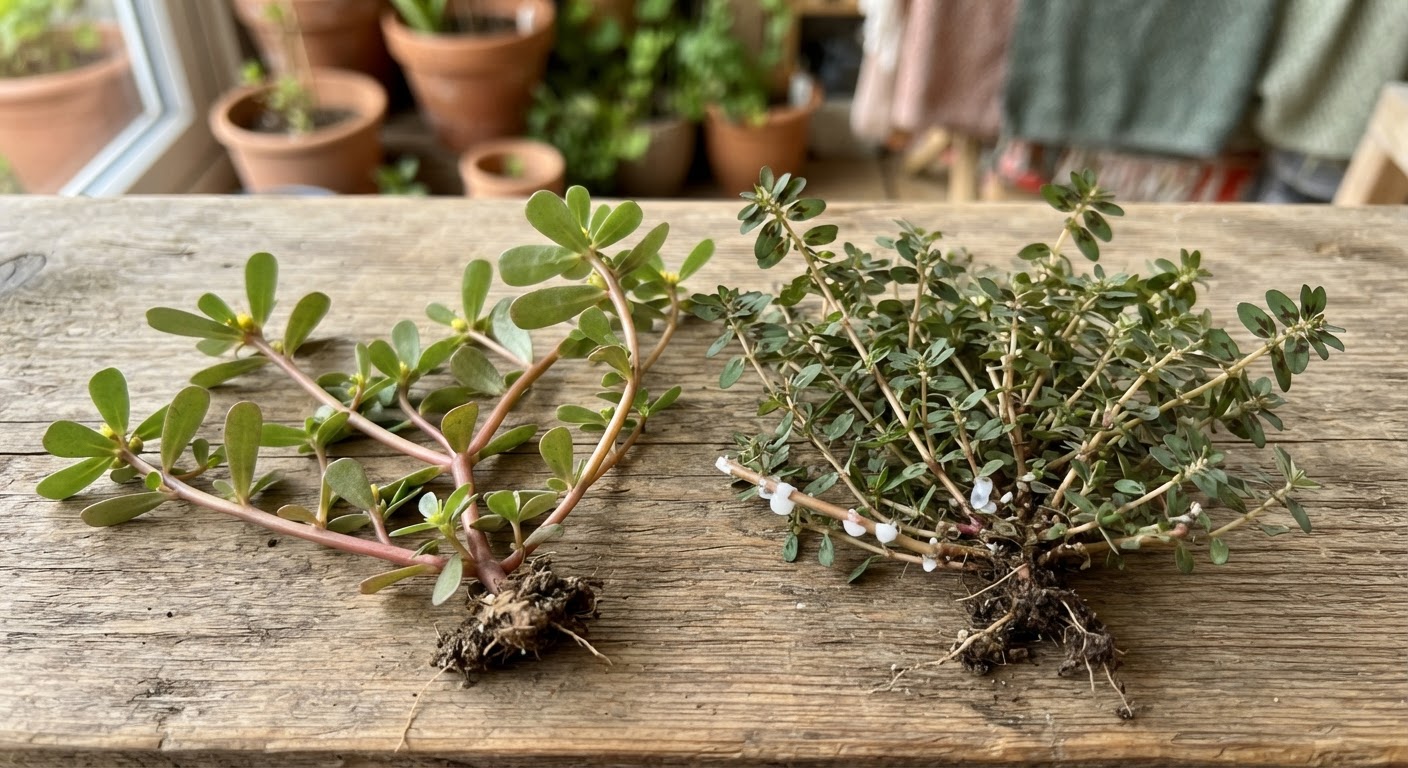
This is the most commonly misidentified pair in urban and suburban foraging — partly because they grow in exactly the same places (sidewalk cracks, dry garden beds, compacted soil), and partly because new foragers learn “thick little leaves = purslane” without knowing the toxic twin exists.
The edible plant — Purslane: A low-growing succulent with thick, reddish-brown stems radiating from a central taproot. Leaves are paddle-shaped, thick, smooth, and rubbery to the touch. The plant creeps horizontally and rarely rises more than an inch above the soil. Tiny yellow flowers open only in direct sunlight and are easy to miss. When you snap a stem, the sap is clear and watery.
The toxic lookalike — Spurge: Also low-growing, also small-leaved — but the leaves are thinner, flatter, often arranged in opposite pairs (purslane leaves alternate), and grow on thin, green stems — not thick, succulent, reddish ones. The definitive difference: break a stem. Spurge immediately oozes white, milky latex sap. Purslane never does. If you see white sap, you’re looking at spurge, and you don’t eat it.
Reliable field test: Pinch and snap a stem. White sap = spurge, toxic. Clear sap = purslane, edible. This test is 100% reliable and takes less than two seconds.
What’s at stake: Spurge sap contains diterpene esters that cause immediate burning mouth pain, throat irritation, vomiting, and diarrhea. The sap also causes contact dermatitis — wash your hands thoroughly if you touch it. Purslane and spurge frequently grow within inches of each other. Foragers who harvest purslane by the handful without checking individual stems are the ones who end up with spurge in the bowl. Check every stem.
7. Morel Mushrooms (Morchella species) vs False Morels (Gyromitra species)
Technically fungi, not plants — but no foraging safety discussion is complete without this pair. Morels sell for $30–$50 per pound fresh. False morels send people to the emergency room every spring.
The edible — True Morels: The cap is a single, fully hollow chamber attached completely to the stem. Slice one lengthwise: it’s hollow from the very tip to the very base, like a bell with no internal structures. The cap surface has a distinct honeycomb pattern — organized pits and ridges, not random wrinkles. The cap is fully fused to the stem at its base.
The toxic — False Morels (Gyromitra species): The cap is lumpy, wrinkled, and brain-like — but not honeycombed. Slice one lengthwise: the interior is chambered, filled with cotton-like fibers or irregular pockets, not continuously hollow. The cap is often attached only at the apex of the stem, draping down like a skirt rather than being fully fused.
Reliable field test: Cut it in half from top to bottom with your pocket knife. Hollow from tip to stem base = true morel. Chambered, cottony, or filled inside = false morel. Five seconds of work that separates a $50 meal from a hospital admission.
What’s at stake: False morels contain gyromitrin, which your body metabolizes into monomethylhydrazine — a compound also found in rocket fuel. It’s a potent liver toxin. Symptoms can be delayed 6–12 hours after eating and include vomiting, severe headache, jaundice, and in serious cases, liver failure requiring transplant. Cooking does NOT reliably neutralize gyromitrin, and some European traditions of parboiling false morels are not a safety guarantee — sensitivity varies dramatically between individuals, and the toxin content varies by region and season. Do not experiment.
Danger Assessment Matrix
Here’s how each pair ranks across the risk factors that matter in the field — not theoretical similarity, but real-world probability of getting it wrong.
| Lookalike Pair | Visual Overlap | Habitat Sharing | Fatal Potential | Beginner Risk | Field Test Reliability |
|---|---|---|---|---|---|
| Wild Carrot vs Hemlock | ★★★★★ | ★★★★★ | ☠️☠️☠️☠️☠️ | Very High | ✅ Stem hair check |
| Garlic vs Death Camas | ★★★★ | ★★★ | ☠️☠️☠️☠️ | Moderate-High | ✅ Smell test |
| Blueberries vs Pokeweed | ★★ | ★★ | ☠️☠️☠️ | Low-Moderate | ✅ Plant structure |
| Fennel vs Young Hemlock | ★★★★ | ★★★★ | ☠️☠️☠️☠️☠️ | High | ✅ Licorice smell |
| Wild Grape vs Moonseed | ★★★ | ★★★ | ☠️☠️☠️☠️ | Low-Moderate | ✅ Seed shape |
| Purslane vs Spurge | ★★★★ | ★★★★★ | ☠️☠️ | Very High | ✅ Sap color |
| Morel vs False Morel | ★★★ | ★★★★ | ☠️☠️☠️☠️ | Moderate-High | ✅ Hollow cross-section |
Every single one of these pairs has a field test that takes under five seconds. The knowledge exists. The question is whether you use it every time.
Five Rules Experienced Foragers Follow — No Exceptions
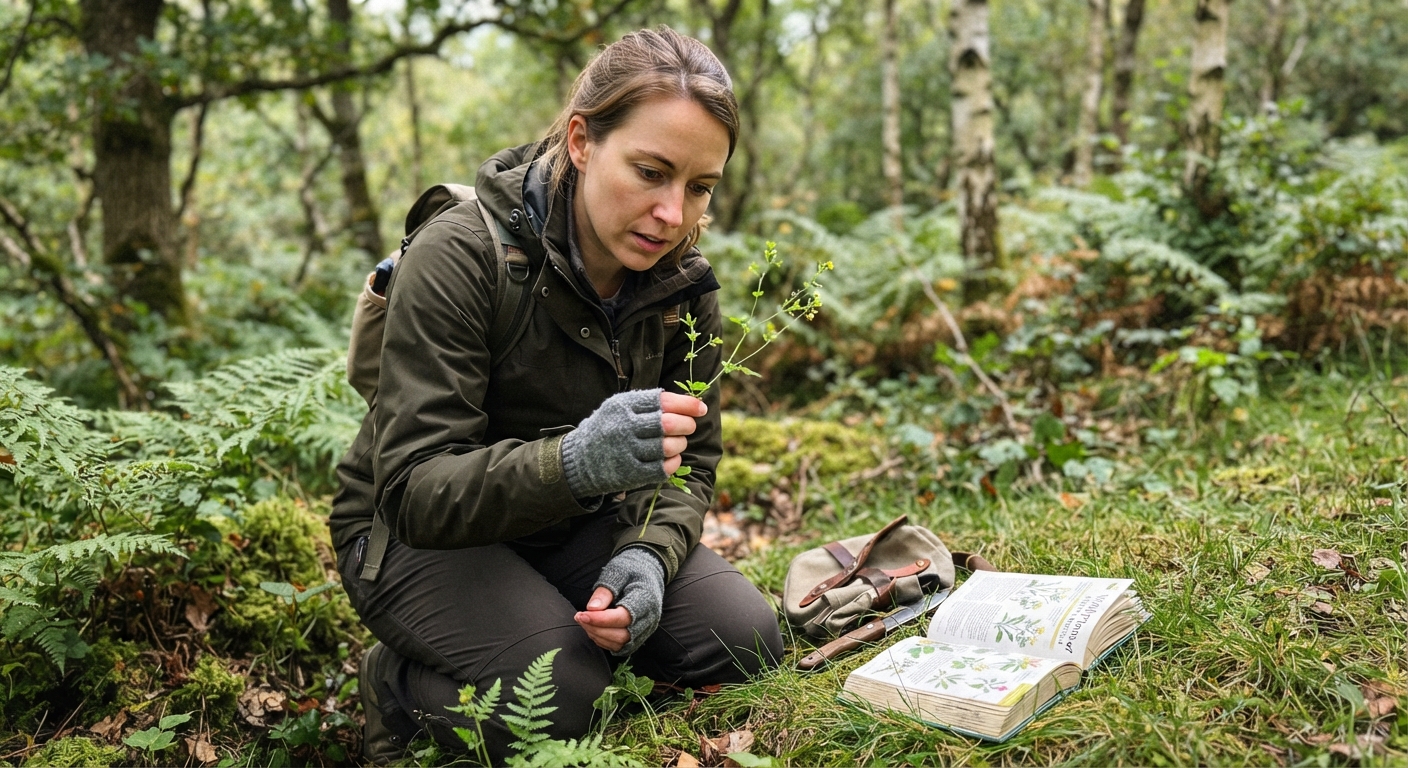
The field tests in this guide work. But tests only protect you if you run them — every time, no shortcuts, no “I’ve picked this a hundred times.” Here are the rules that foragers with decades of experience follow without exception.
1. Never eat anything you cannot identify with 100% confidence.
“Pretty sure” and “probably” are not food safety standards. If there is any doubt — any hesitation at all — the answer is no. The plants will be there tomorrow. Your liver won’t grow back.
2. Use at least two identification features. One of them must specifically rule out the toxic lookalike.
If your entire ID strategy is “green leaves with white flowers,” you have not identified the plant. You need to know both what your target looks like AND what its dangerous twin looks like — and confirm your plant matches the safe one on both counts.
3. Run the field test. Every time.
Stem hairs for wild carrot. Crush-and-smell for wild garlic and fennel. Stem-snap-and-sap-check for purslane. Slice-in-half for morels. These are not optional verification steps for beginners. Experienced foragers run them on every single harvest because a single mistake cancels a lifetime of correct IDs.
4. Start with the plants that have no toxic lookalikes.
Dandelion. Stinging nettle. Cattail. Broadleaf plantain. These plants have zero genuinely dangerous lookalikes in North America or Europe, and they’re abundant. Spend a full season on these before you even consider harvesting wild carrot or fennel. Building your pattern recognition on safe plants makes the risky ones dramatically easier to identify later.
5. If anything feels off, take a photo, go home, and come back.
Your subconscious sometimes registers details your conscious mind hasn’t processed yet — a subtle stem color, a growth pattern that doesn’t quite match, a texture that feels wrong. If something nags at you, take clear photos, go home, check multiple sources, and return the next day. Foraging is not a limited-time offer. The plants will wait.
Frequently Asked Questions
Can I trust plant identification apps for foraging?
Apps like iNaturalist, Seek, and PlantNet are useful tools for narrowing down possibilities — but they should never serve as your sole confirmation before eating something. AI plant identification accuracy varies significantly between species, lighting conditions, and growth stages. Multiple studies have found that even the best apps misidentify toxic Apiaceae-family plants (the carrot family, which includes hemlock) at rates between 5% and 20%. Use apps to get suggestions, then verify with a physical field guide and at least one hands-on field test. No exceptions.
Which toxic lookalike causes the most emergency room visits in the United States?
Poison hemlock, by a significant margin. It grows in all 48 contiguous states, matches the general appearance of several commonly foraged edible plants, and tends to be harvested by people who are foraging for the first or second time — exactly when overconfidence is highest and field-test habits aren’t yet automatic. Poison control centers field hemlock-related calls every spring without fail.
How fast do symptoms appear after eating a toxic plant?
The timeline varies dramatically by toxin — and this matters for diagnosis. Hemlock (coniine) and death camas (zygacine) cause symptoms within 30–60 minutes. Pokeweed berries cause immediate burning. But false morels (gyromitrin) can delay symptoms by 6–12 hours — plenty of time to finish dinner, go to bed, and wake up in a medical crisis. The latency period is itself a diagnostic clue: if someone falls ill hours after a wild meal, emergency doctors need to know exactly what was on the plate.
Is there a universal visual rule for spotting toxic plants?
No, and folk rules like “red berries are poisonous” or “milky sap means toxic” or “compound leaves are dangerous” are dangerously unreliable. Red raspberries and strawberries are edible. Dandelion has milky sap and is edible. Clover has compound leaves and is edible. Water hemlock — one of the most lethal plants in North America — has white flowers and compound leaves with no alarming visual markers. You must identify each plant individually. There is no shortcut.
The bottom line: Every plant in this guide has a reliable field test that takes less than five seconds. The difference between a great foraging meal and a hospital visit is not knowledge — it’s whether you bother to run the test every single time.