In 2022, U.S. poison control centers logged over 45,000 plant exposure cases. The majority were not toddlers eating random houseplants — they were adults who misidentified something in the wild. These aren’t people who ignored advice. Most of them carried field guides. Most of them felt confident. And nearly all of them made the same category of mistake: they found a plant that looked edible and stopped looking the moment it matched one feature they recognized.
The problem with poisonous plants isn’t that they’re mysterious and hard to spot. It’s the opposite. The dangerous ones look familiar. They look like something you’ve eaten before — wild carrot, wild grape, wild garlic — and your brain fills in the gaps. Once your brain decides “this is probably the edible one,” your eyes stop checking. That’s the moment things go wrong.
This guide covers eight of the most dangerous lookalike pairs in North American foraging — the ones where getting it wrong sends you to the hospital. Every pair includes the single identification feature that separates safe from toxic, the shared habitat where both grow, and exactly what happens if you pick the wrong plant.
At a Glance: The Danger Scale
Not all identification mistakes are created equal. Some will make you uncomfortable for a few hours. Others will shut down your respiratory system before you reach the hospital. Here’s how these eight pairs stack up:
| # | Edible Plant | Toxic Twin | Danger Level | One-Second Differentiator |
|---|---|---|---|---|
| 1 | Wild Carrot (Queen Anne’s Lace) | Poison Hemlock | ☠️☠️☠️☠️☠️ Fatal | Hairy stem vs smooth, purple-blotched stem |
| 2 | Wild Grape | Canada Moonseed | ☠️☠️☠️☠️ Lethal | Multiple round seeds vs single flat crescent seed |
| 3 | Wild Garlic / Wild Onion | Death Camas | ☠️☠️☠️☠️ Lethal | Smells like onion/garlic vs smells like grass |
| 4 | Wild Blueberry | Pokeweed Berry | ☠️☠️☠️ Severe | 5-pointed crown on berry base vs absent |
| 5 | Wild Parsley / Chervil | Fool’s Parsley | ☠️☠️☠️ Severe | Short/no bracts vs long drooping bracts under flowers |
| 6 | Purslane | Spotted Spurge | ☠️☠️ Moderate | Clear sap from broken stem vs white milky latex |
| 7 | Wild Strawberry | Mock Strawberry | ⚠️ Harmless | White flower petals vs yellow; fruits hang down vs point up |
| 8 | Sweet Almond | Bitter Almond / Wild Prunus | ☠️☠️☠️☠️ Lethal | Sweet nutty scent vs sharp cyanide/almond-extract odor |
Use this table as your pocket checklist. The sections below walk through each pair in enough detail that you can walk into a field and separate safe from dangerous in under 30 seconds.
1. Wild Carrot vs Poison Hemlock — The One That Kills Most Often
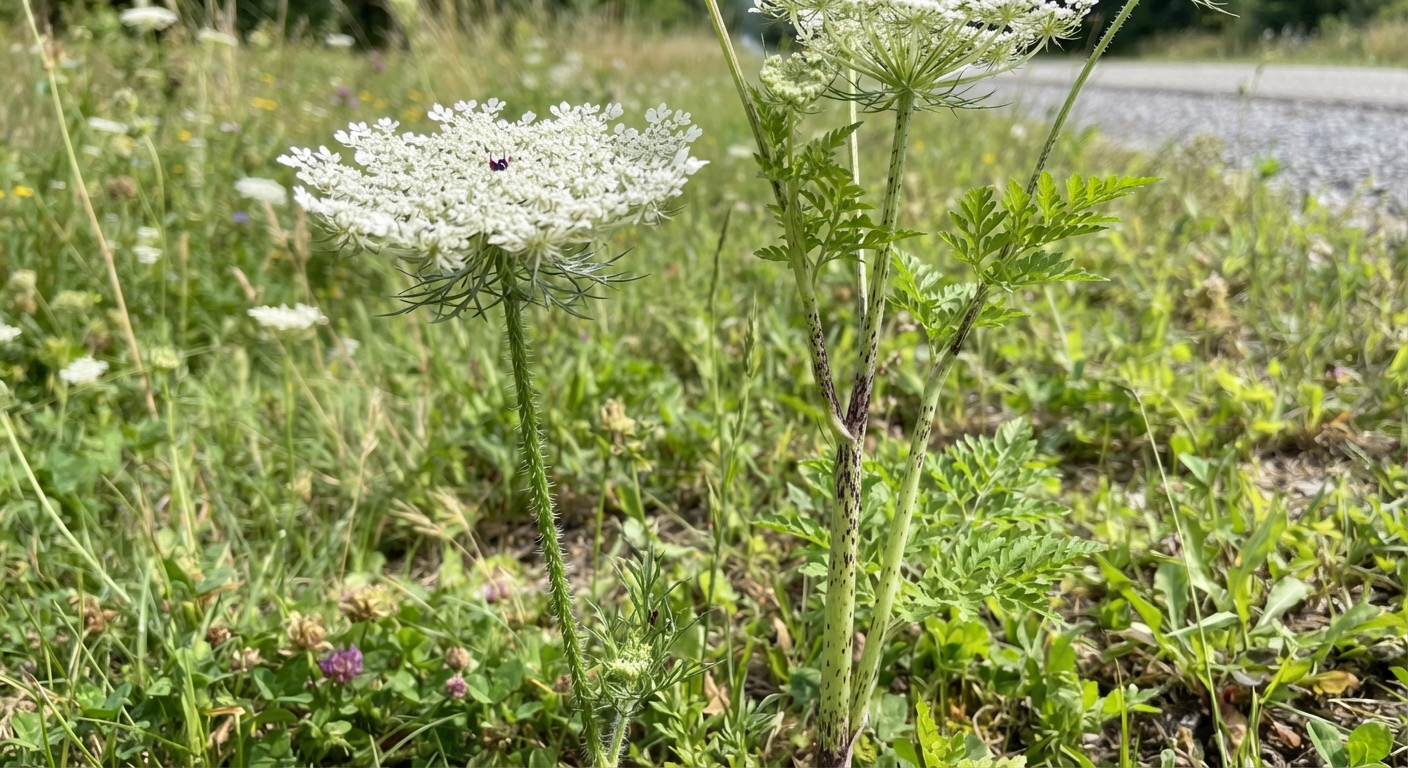
This is the heavyweight. Poison hemlock (Conium maculatum) kills people every year because it grows exactly where wild carrot (Daucus carota) grows: roadsides, field edges, disturbed soil, the neglected corner of your yard. Both stand 3–6 feet tall. Both produce white umbrella-shaped flower clusters that look like lace doilies. Both have finely divided, fern-like leaves. And they bloom at the same time — mid-summer — often within arm’s reach of each other.
The stem tells you everything. Wild carrot has a hairy, solid-green stem — rub your finger along it and you’ll feel fuzz, like peach skin. Poison hemlock has a smooth, completely hairless stem with distinctive purple blotches and streaks. There is no hair on a hemlock stem. None. If the stem is smooth and has purple marks anywhere on it, you are looking at hemlock. Do not touch your face after handling it, and wash your hands thoroughly.
Secondary check: Wild carrot often (not always) has a tiny dark purple floret in the dead center of its white umbel — picture a single black dot in the middle of a white doily. Hemlock never has this. Wild carrot also smells like carrot when you crush the leaves. Hemlock smells musty and unpleasant, comparable to mouse urine. Do not crush hemlock leaves near your face — the sap can irritate skin and mucous membranes.
What happens if you eat poison hemlock: Symptoms appear within 30 minutes to 2 hours. Burning mouth, nausea, vomiting, confusion, dizziness, and then — the hallmark sign — ascending paralysis. Your feet go numb first, then your legs, then everything below your neck. Consciousness remains intact the entire time. Death comes from respiratory failure as the diaphragm stops working. There is no antidote. Treatment is strictly supportive: mechanical ventilation and activated charcoal if caught within the first hour. One or two leaves can kill a child. A small handful is enough to kill an adult.
Conium contains coniine and related piperidine alkaloids — neurotoxins that block neuromuscular transmission by binding to nicotinic acetylcholine receptors. The mechanism is similar to curare but the onset is slower, which means victims often don’t connect the symptoms to something they ate until paralysis has already begun.
2. Wild Grapes vs Canada Moonseed — The Single-Seed Test
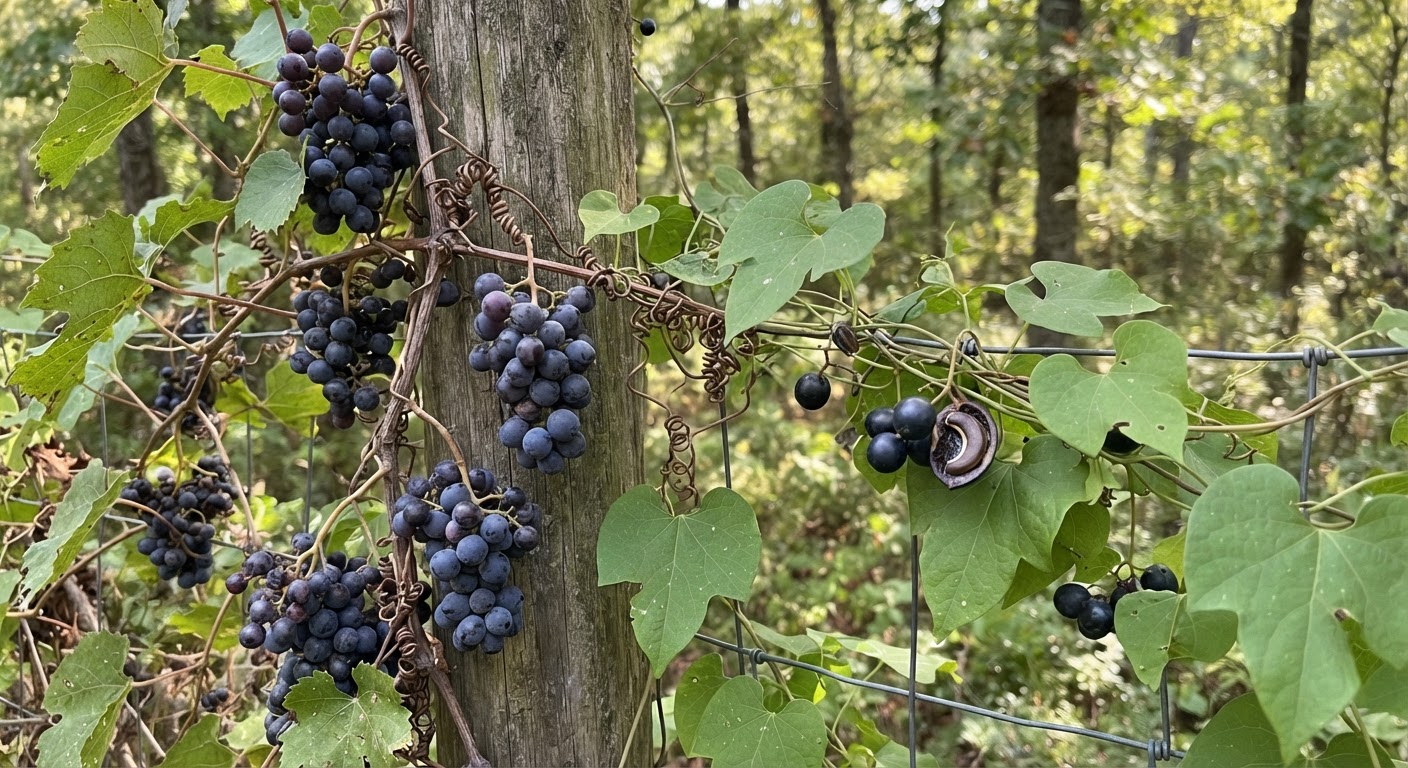
Wild grapes (Vitis species) are one of the most satisfying wild harvests — thick clusters of purple fruit hanging from vines along forest edges, fence lines, and riverbanks. The problem is that Canada moonseed (Menispermum canadense) occupies the same habitats, grows on a similar-looking vine, and produces clusters of dark purple berries that look nearly identical from three feet away. They overlap in range across the eastern half of North America and fruit at the same time in late summer and early fall.
Cut one berry open. That’s the entire test. Wild grapes contain 2–4 round, pear-shaped seeds. Moonseed contains exactly one seed, and it’s flat and shaped like a crescent moon — hence the name. If you slice a berry and see a single crescent-shaped seed, spit everything out immediately and rinse your mouth with water. There is zero ambiguity here. The seed shape is completely different.
Additional tells: Grape vines have tendrils — thin, curly, spring-like structures that wrap around branches and fences for support. Moonseed vines have no tendrils at all; they twine their entire stem around supports instead. Grape leaves are distinctly toothed along the edges with a classic heart shape at the base. Moonseed leaves are smooth-edged or shallowly lobed, often more rounded, though leaf shape alone is not reliable enough for a beginner to stake a meal on.
What happens if you eat moonseed: Moonseed contains dauricine, an isoquinoline alkaloid with convulsant properties. Symptoms include nausea, vomiting, severe abdominal pain, and in significant doses, seizures and respiratory depression. The berries taste intensely bitter — your mouth will usually alert you before your brain catches up, which is why fatalities are uncommon. People rarely eat more than one or two. But do not count on the bitterness as your only safety net. A child might swallow before tasting.
3. Wild Garlic vs Death Camas — Smell Before You Pick
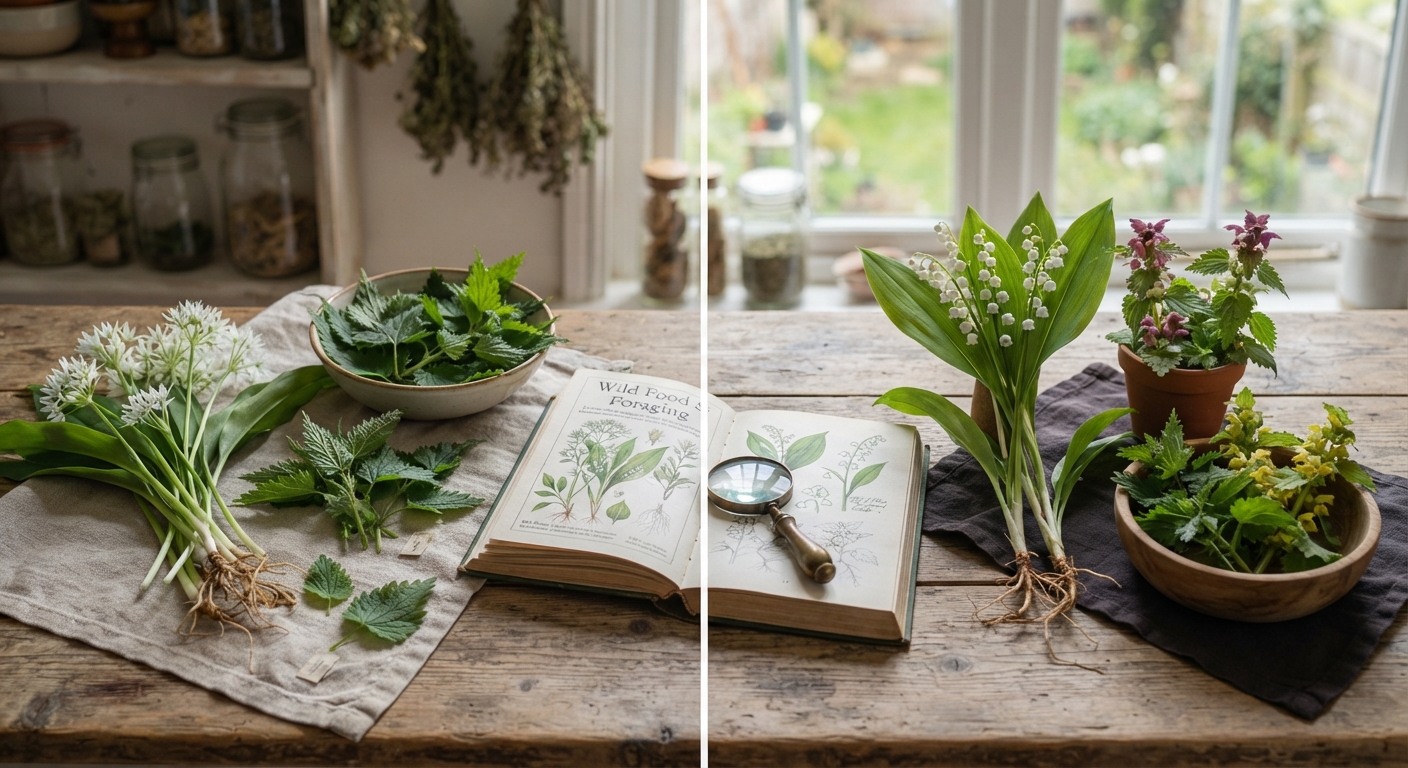
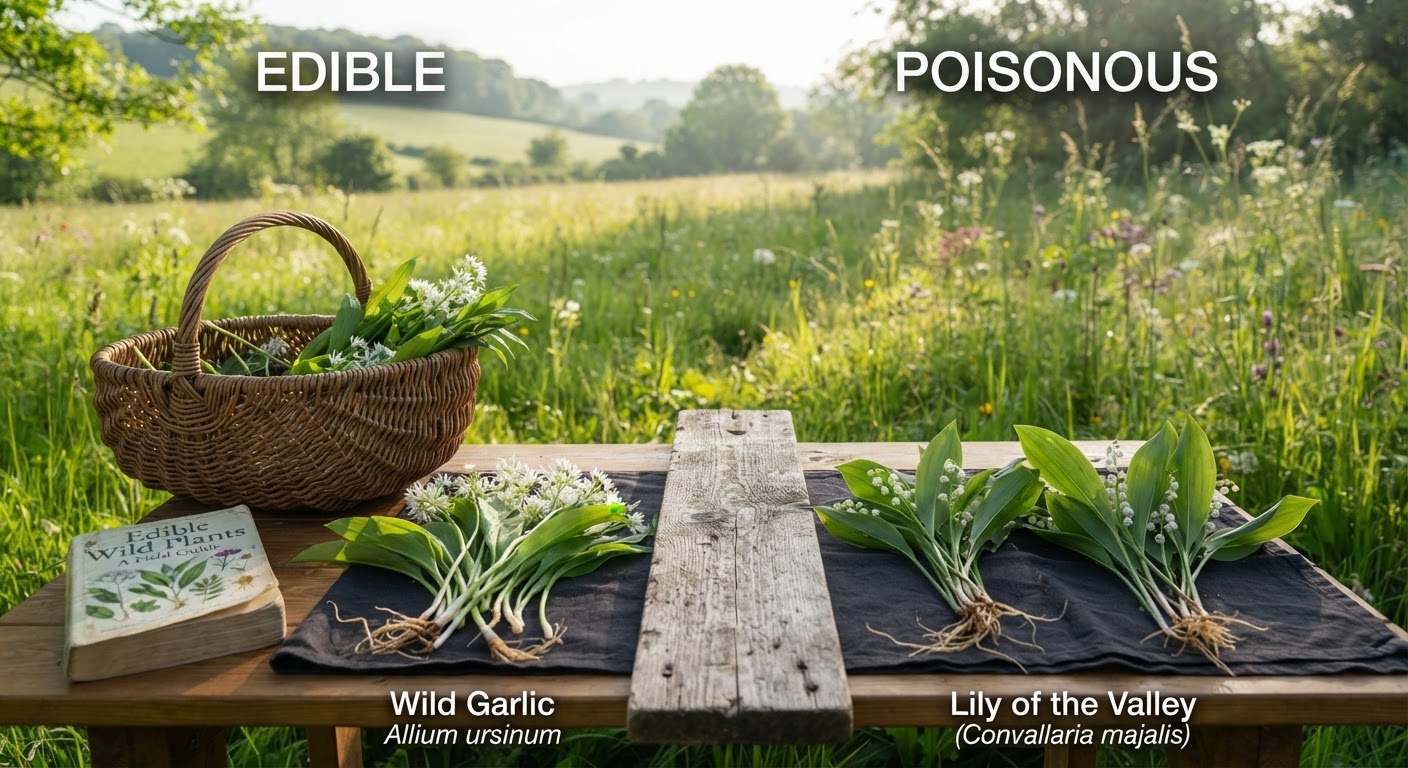
Wild onions and wild garlic (various Allium species) are among the first plants beginner foragers learn. They’re abundant, easy to recognize by their tall grass-like leaves, and unmistakable once you smell them. That last part — once you smell them — is the part that saves lives.
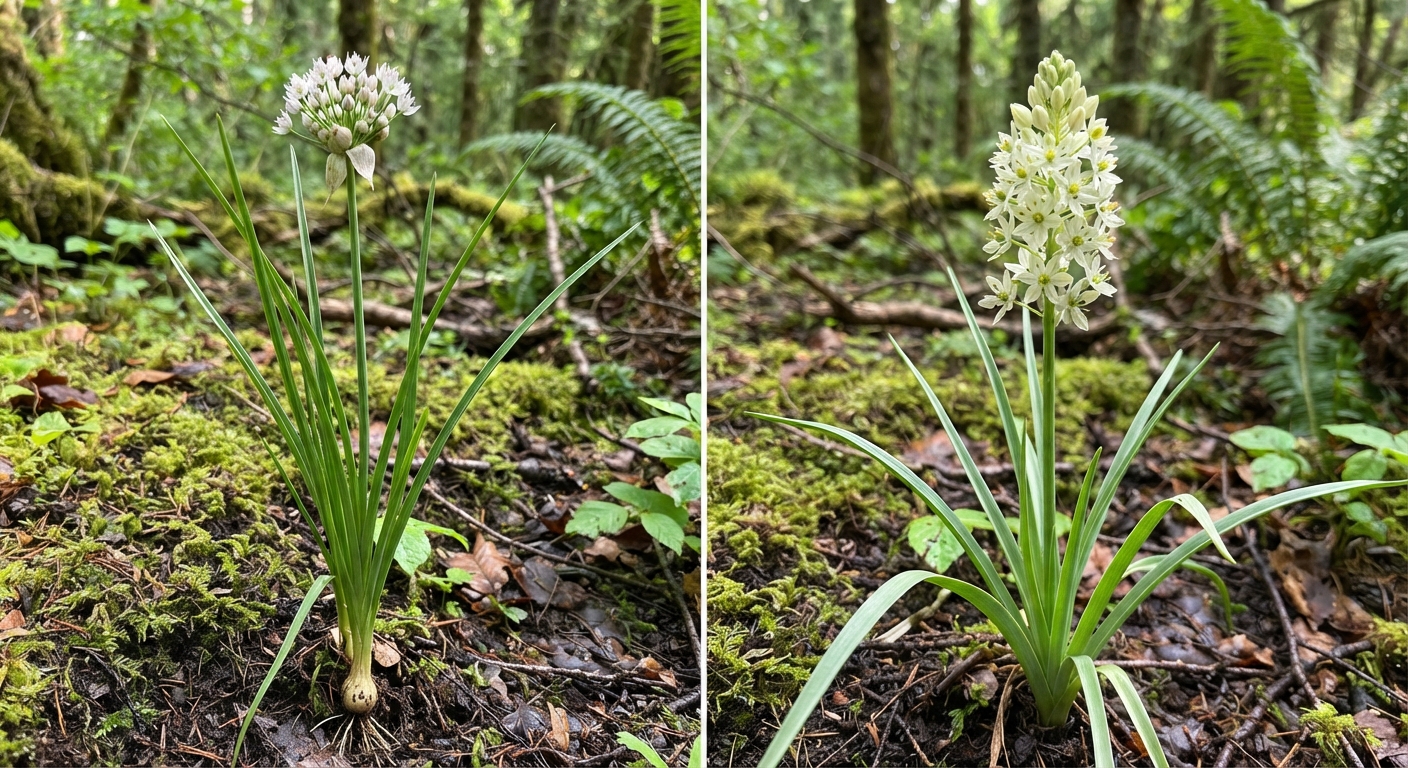
Death camas (Toxicoscordion venenosum and related Zigadenus species) grows in meadows, prairies, and open woodlands across much of North America. Its leaves look like wild onion leaves: long, slender, grass-like, clustered at the base. The underground bulbs look similar too — layered, papery outer skin, vaguely onion-shaped. Both plants often grow in the same fields at the same time of year, and pulling up a bulb for identification can dislodge both species together.
Smell the crushed leaf or bulb. Wild garlic and wild onion emit an unmistakable onion-garlic scent the moment tissue is broken. Death camas smells like nothing. Or grass. There is no overlap. There is no “well, maybe there’s a faint onion note if I really concentrate.” If your nose doesn’t register onion or garlic, you are not holding an Allium, and you should not eat it.
What happens if you eat death camas: Death camas contains zygacine and other steroidal alkaloids that attack the nervous and cardiovascular systems. Symptoms begin with severe nausea, vomiting, diarrhea, and abdominal pain, progressing to slowed heart rate, plummeting blood pressure, muscle tremors, and in severe cases, coma and death. Livestock losses from death camas are extensively documented in western rangelands — cattle and sheep succumb to it regularly. A human eating a handful of bulbs faces the same outcome.
4. Wild Blueberry vs Pokeweed Berry — The Crown Check
Wild blueberries (Vaccinium species) grow on low shrubs throughout North America and are one of the safest beginner foraging targets — identifiable, abundant, and delicious. But pokeweed (Phytolacca americana) produces dark purple berries on plants that can grow in the same disturbed-edge habitats where lowbush blueberries thrive, especially across the eastern and southern United States.
Check for the crown. Every wild blueberry has a distinctive 5-pointed star-shaped crown (the calyx) on the bottom of the fruit — a tiny raised pattern at the base where the flower attached. It’s visible to the naked eye and consistent across every Vaccinium species. Pokeweed berries have no crown. They’re completely smooth and round at the base.
Secondary check: Pokeweed berries grow in dense, drooping clusters from a bright magenta-pink stem — the stem color alone is usually enough to identify pokeweed from 20 feet away. Blueberries grow singly or in small loose groups along woody brown-green stems. If you see a hot-pink stem holding a cluster of dark berries, you’re looking at pokeweed, not blueberries. Walk away.
What happens if you eat pokeweed berries: Pokeweed contains phytolaccatoxin and phytolaccigenin, which cause intense gastrointestinal distress — violent vomiting, diarrhea, abdominal cramping — usually within 2–6 hours of ingestion. The root is the most toxic part and can be fatal. Children are especially vulnerable to pokeweed berry poisoning because the dark clusters look like edible fruit at eye level. While some traditional southern cooks prepare young pokeweed shoots through an elaborate three-boil water-change process (pokeweed “sallet”), the berries are never safe to eat raw under any circumstances.
5. Wild Chervil vs Fool’s Parsley — Check Under the Flowers
Wild chervil (Anthriscus sylvestris), also called cow parsley, is a delicate edible herb in the carrot family with lacy white umbels and fern-like foliage. Fool’s parsley (Aethusa cynapium) earned its name across centuries of honest mistakes — it mimics wild chervil so thoroughly that distinguishing them requires a deliberate check, not a casual glance. Both belong to the Apiaceae family, bloom in late spring through summer, and colonize hedgerows, field margins, and woodland edges from coast to coast.
Look under the flower cluster. Flip the umbel and check the underside. Fool’s parsley has long, thin green bracts (leaf-like appendages) that hang downward from beneath the white flower head — imagine small green whiskers drooping under the white lace. Wild chervil typically has very short bracts or none at all in the same position. This is a reliable structural difference visible from mid-spring through the end of flowering.
Smell check: Crush a leaf gently. Wild chervil gives off a mild, pleasant, faintly anise-like fragrance. Fool’s parsley smells unpleasant and acrid — you’ll notice something is off immediately if you’re comparing the two. Stem check: wild chervil is softly hairy, occasionally showing purple coloration at the leaf nodes but never the all-over purple blotching of hemlock. Fool’s parsley stems are smooth and hairless.
What happens if you eat fool’s parsley: Fool’s parsley contains aethusin, a polyacetylene toxin structurally related to the compounds in water hemlock. Symptoms include burning sensations in the mouth and throat, nausea, vomiting, and abdominal pain. Fatalities are rare in modern times but well documented in historical records, particularly in Europe where the plant was mistaken for true parsley in home gardens.
6. Purslane vs Spotted Spurge — Break the Stem
Common purslane (Portulaca oleracea) is one of the most nutritious wild greens available anywhere — loaded with omega-3 fatty acids (more than any other land plant), vitamin A, vitamin C, and magnesium. It grows flat against the ground with fleshy, succulent-like leaves and thick reddish stems. Spotted spurge (Euphorbia maculata) also grows flat against the ground, also has small leaves, and also colonizes the cracks in driveways, sidewalks, and garden beds. The two plants frequently grow intertwined with each other in the same square foot of soil.
Break a stem and watch the sap. Purslane exudes clear, watery sap when the stem is snapped. Spotted spurge exudes white, milky latex — thick and opaque, like watered-down Elmer’s glue. That white sap is your red flag. Across the entire Euphorbia family, milky latex means toxic.
Visual confirmation: Spotted spurge leaves often (not always) have a small dark reddish spot in the center. Purslane leaves are uniformly green with a waxy, glossy coating. Purslane stems are thick, fleshy, and break cleanly with a satisfying snap like a succulent. Spurge stems are thin, wiry, and often slightly hairy — they bend before they break.
What happens if you eat spurge: Spotted spurge contains diterpene esters that aggressively irritate mucous membranes. Eating even a small amount causes burning sensations in the mouth and throat, followed by nausea, vomiting, and diarrhea. The white latex is also a skin irritant — wash your hands immediately after handling spurge and keep it away from your eyes. Not typically fatal, but unpleasant enough to send plenty of people to urgent care.
7. Wild Strawberry vs Mock Strawberry — The Least Dangerous Mistake
This pair won’t put you in the hospital, but it belongs on this list because mock strawberry (Potentilla indica) is the single most common “false success” that beginner foragers experience. It looks exactly like a wild strawberry. It grows exactly where wild strawberries grow — lawns, garden edges, trail margins, disturbed soil. And it tastes like absolutely nothing. Watery, bland, and crushing when you’ve been hunting for 30 minutes.
Flower color is definitive. Wild strawberries (Fragaria species) bloom with white petals and yellow centers. Mock strawberries bloom with yellow petals. If the plant you’re looking at has yellow flowers, it’s mock strawberry. No exceptions in North America.
Berry orientation seals it. Wild strawberry fruits hang downward, drooping toward the ground on their slender stems. Mock strawberry fruits point straight upward, sticking into the air like tiny red flags. Once you notice the difference, it becomes impossible to unsee. Upward berries = mock. Downward berries = real.
Mock strawberries are technically edible — they won’t hurt you. The lesson here is that even harmless misidentifications cost you harvest time and erode your confidence. A forager who keeps eating mock strawberries thinking they just haven’t found the “good ones” yet is a forager who hasn’t learned to check flower color.
8. Sweet Almond vs Bitter Almond — The Danger in the Seed
Wild and semi-wild relatives in the Prunus genus — including certain apricot varieties, wild peaches, cherry laurel, and bitter almond — produce seeds containing amygdalin. When crushed and digested, amygdalin breaks down into hydrogen cyanide. Sweet almonds (Prunus dulcis var. dulcis) have been selectively bred over thousands of years to contain negligible amygdalin. Bitter almonds (Prunus dulcis var. amara) and their wild relatives have not been bred for safety.
Crush and smell. Bitter almonds release a sharp, pungent, synthetic-almond-extract scent — it’s cyanide, and your nose registers it unmistakably. Sweet almonds smell warm, nutty, and pleasant. The difference is dramatic and instant.
Context matters more here than field identification. Wild bitter almonds are rarely sold as food in North America, but foragers in Mediterranean climates and parts of Central Asia may encounter wild Prunus trees. More relevant to the average person: apricot kernels, cherry pits, and peach pits are sometimes promoted in alternative health circles as cancer treatments or “vitamin B17” supplements. They are not treatments. They are sources of cyanide. Multiple cases of cyanide poisoning from apricot kernel consumption appear in medical literature every year.
What happens if you eat bitter almonds: Amygdalin converts to hydrogen cyanide in the digestive tract. Symptoms begin with headache, dizziness, confusion, and rapid breathing, escalating to vomiting, convulsions, loss of consciousness, and cardiac arrest. As few as 5–10 bitter almonds can kill a child. 50–70 can kill an adult. An antidote protocol exists (hydroxocobalamin combined with sodium thiosulfate), but it must be administered rapidly — cyanide poisoning progresses fast once symptoms appear.
If You Forget Everything Else: The 3 Rules
You don’t need to memorize every detail of all eight pairs. You need three habits.
Rule 1: Never Identify by a Single Feature. The stem looks right but you’re unsure about the leaf underside? Don’t eat it. The berry color matches but the vine has no tendrils? Put it down. Expert foragers cross-reference at least two — usually three — independent features before eating anything they haven’t positively identified before. One matching feature is a coincidence. Two is a pattern worth investigating. Three is an identification you can act on.
Rule 2: Smell, Break, Look — Execute in That Order. Smell the crushed leaf first (catches death camas, fool’s parsley, hemlock). Break the stem to check sap (catches spurge, confirms purslane). Then look at the bottom of the fruit or the underside of the leaf for the structural details you miss at a glance (catches moonseed, pokeweed, mock strawberry). Most toxic plants expose themselves in steps one and two, before your mouth ever enters the equation.
Rule 3: The Carrot and Lily Families Get Triple the Scrutiny. The Apiaceae (carrot/parsley) family contains poison hemlock, water hemlock, and fool’s parsley — three of the deadliest plants on the continent. The lily family includes death camas. If you’re foraging anything that remotely resembles a carrot, parsley, wild onion, or wild garlic, the rule is simple: every additional minute you spend on identification is worth more than an hour of research on any other plant family. These are not plants you identify in a hurry.
Quick FAQ
Can a plant ID app reliably distinguish toxic lookalikes from edible plants?
No. Even the most accurate plant identification apps — iNaturalist, PlantNet, PictureThis — carry error rates of 5–15% for species-level ID under good conditions. In partial shade, with damaged leaves, or when the plant isn’t flowering, that rate climbs higher. Use apps as a starting point to narrow down what something might be, not as a final authority on whether it’s safe to eat. Human cross-reference with a field guide is non-negotiable.
Is it possible to build tolerance to plant toxins by consuming small amounts gradually?
This idea has no scientific basis for the neurotoxic, cardiotoxic, and cytotoxic compounds in these plants. Hemlock, death camas, moonseed, and their relatives do not trigger tolerance pathways. Eating small amounts causes cumulative damage; it doesn’t build resistance. The “microdosing for immunity” concept applies to a narrow set of specific allergens and certain mushroom preparations under controlled medical protocols — it has zero application to the plants on this list.
What should I do if I suspect I’ve eaten a toxic plant?
Call poison control immediately: 1-800-222-1222 (United States). Do not wait for symptoms. Do not try to induce vomiting unless poison control explicitly instructs you to do so — some toxins cause additional damage on the way back up. Take a clear photo of the entire plant. Note the time you ate it and the approximate quantity. Bring the photo and a sealed sample of the plant to the emergency department. The sooner toxicologists can identify the species, the better your treatment options.
Are there any genuinely beginner-proof plants with zero dangerous lookalikes?
Dandelion, chickweed, and cattails come as close as anything in the plant kingdom. Dandelion’s combination of deeply toothed leaves, hollow leafless stem, and single yellow flower per stalk is not fully replicated by any toxic species. Chickweed’s single line of fine hairs running down only one side of the stem distinguishes it from every dangerous ground-cover lookalike. Mature cattails in their brown-cigar seed-head stage are functionally unmistakable. Start here. Build identification habits. Then work outward.
The plants on this list aren’t rare. You’ve almost certainly walked past hemlock on a highway embankment and moonseed on a woodland edge without noticing either one. They’re common because the habitats foragers explore — field margins, trail edges, disturbed ground, riverbanks — are exactly where these species thrive.
The point is not to make the woods feel dangerous. It’s to make your identification process specific. The gap between wild carrot and poison hemlock is a hairy stem. The gap between wild grape and moonseed is the shape of a seed smaller than your fingernail. These are learnable details.
The foragers who stay safe aren’t the ones with the most expensive gear. They’re the ones who, consistently, check the stem, crush the leaf, cut open the fruit, and ask themselves: what’s the one thing about this plant I might be wrong about? — before anything goes near their mouth.