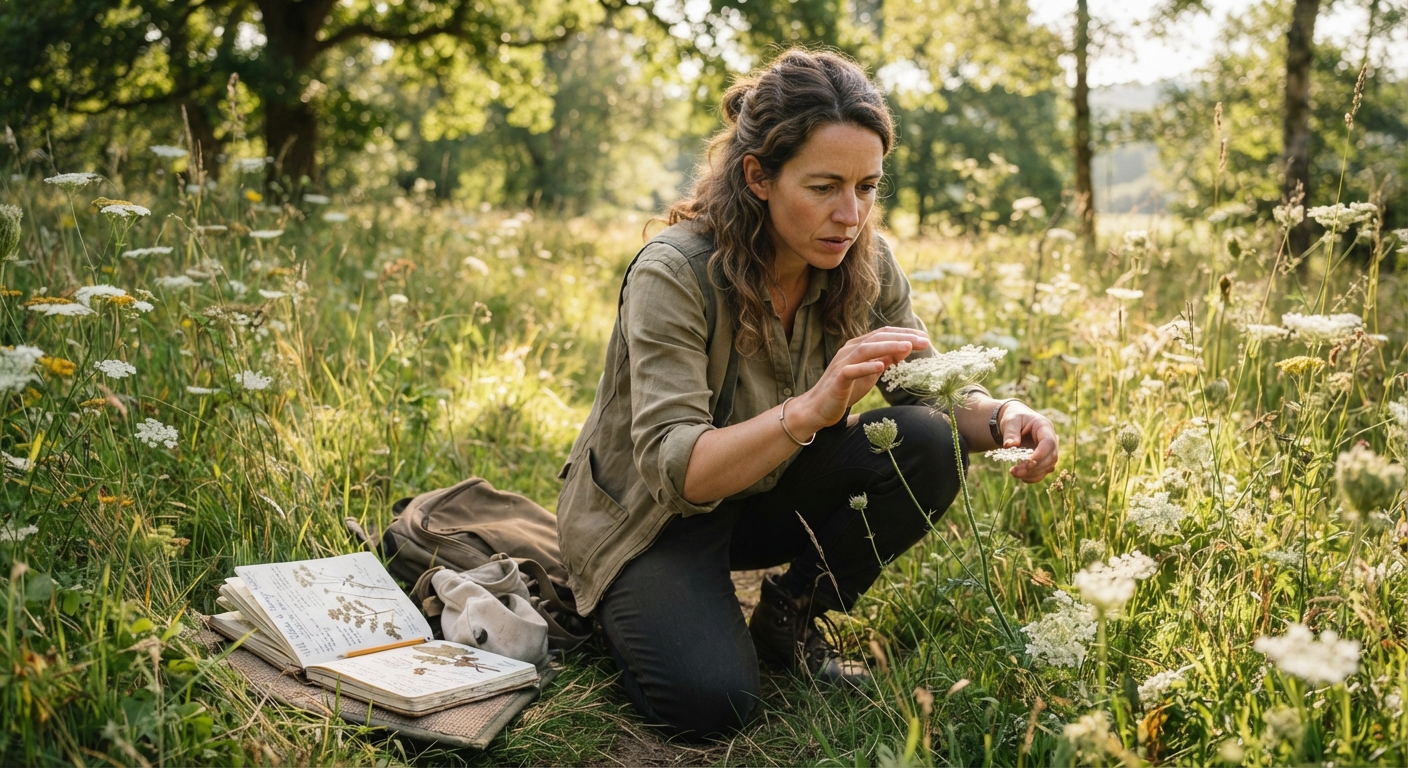
You’re standing at the edge of a meadow in late spring. The plant in front of you checks every box on your mental checklist — fern-like leaves, white flowers in umbrella-shaped clusters, growing in a sunny spot just off the trail. Your basket is half full. You’ve been foraging for two seasons. You know what wild carrot looks like.
And yet, something makes you pause. Your hand hovers above the stem without closing around it. A faint unease, the kind that comes from knowing — somewhere in the back of your mind — that a plant that looks exactly like this one has killed people.
Most foraging accidents don’t happen because someone failed to identify a plant. They happen because someone identified it confidently and incorrectly. The difference matters.
This guide isn’t another list of plant pairs to memorize. It’s a system — a repeatable, field-tested protocol that walks you from “I think this is it” to “I know this is it.” Once you internalize the steps, you’ll move through the woods with a different kind of awareness. Not fear. Not paranoia. Just clarity.
The Real Cost of Getting It Wrong
Let’s set the stakes, because they’re higher than most foraging books are willing to say out loud.
In North America alone, the plants most commonly involved in serious foraging poisonings share one trait: they all have edible lookalikes. Water hemlock (Cicuta maculata) is widely considered the most violently toxic plant on the continent — a mouthful of the root can trigger seizures within 30 minutes — and it grows in the exact same habitats as wild parsnip and watercress. Death camas bulbs sit right alongside wild onion patches. Poison hemlock nests comfortably next to wild carrot.
The emergency room data tells a consistent story. According to the American Association of Poison Control Centers’ annual reports, plant exposures resulting in moderate to major outcomes overwhelmingly involve species from just three plant families:
| Plant Family | Common Toxic Members | Edible Lookalikes | Primary Danger |
|---|---|---|---|
| Apiaceae (Carrot Family) | Poison hemlock, water hemlock, fool’s parsley | Wild carrot, wild parsnip, wild chervil | Neurotoxins causing respiratory failure |
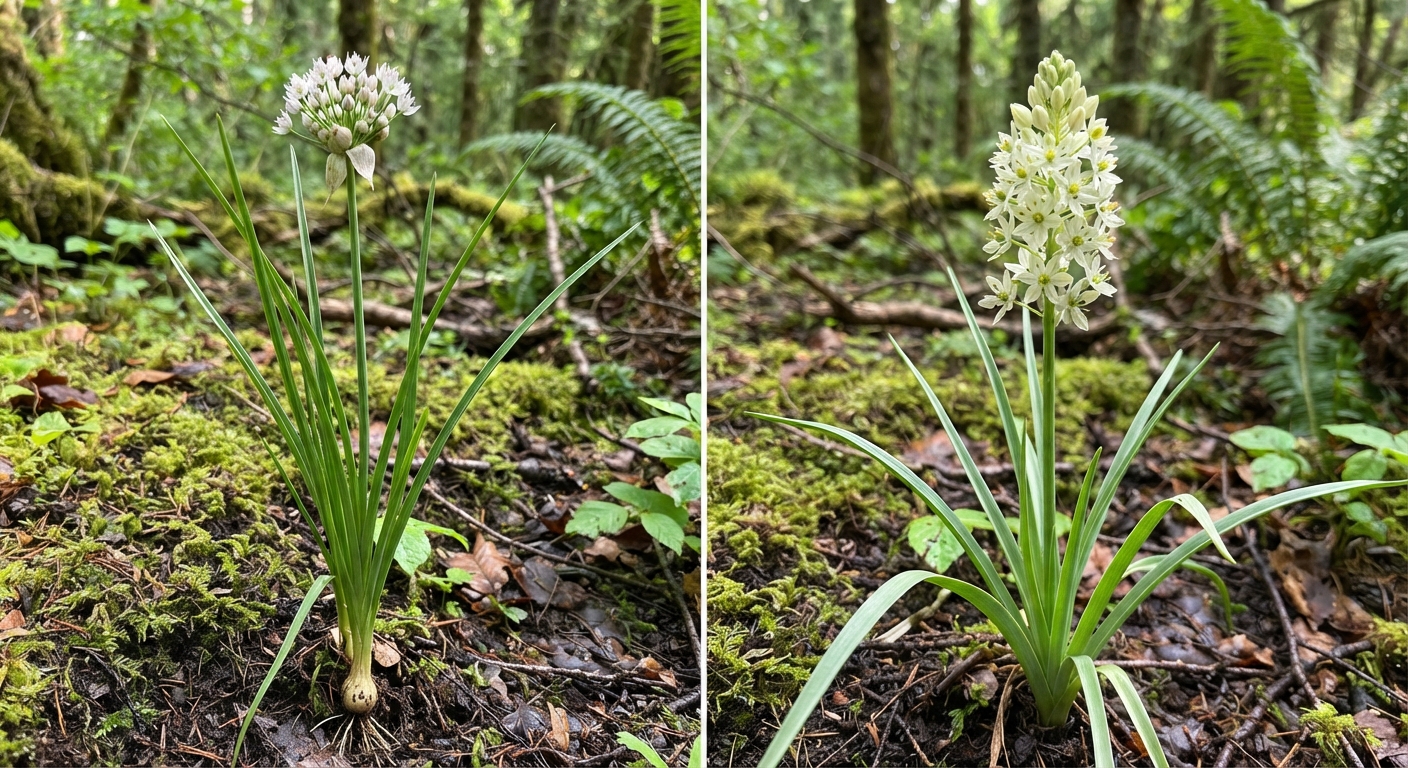
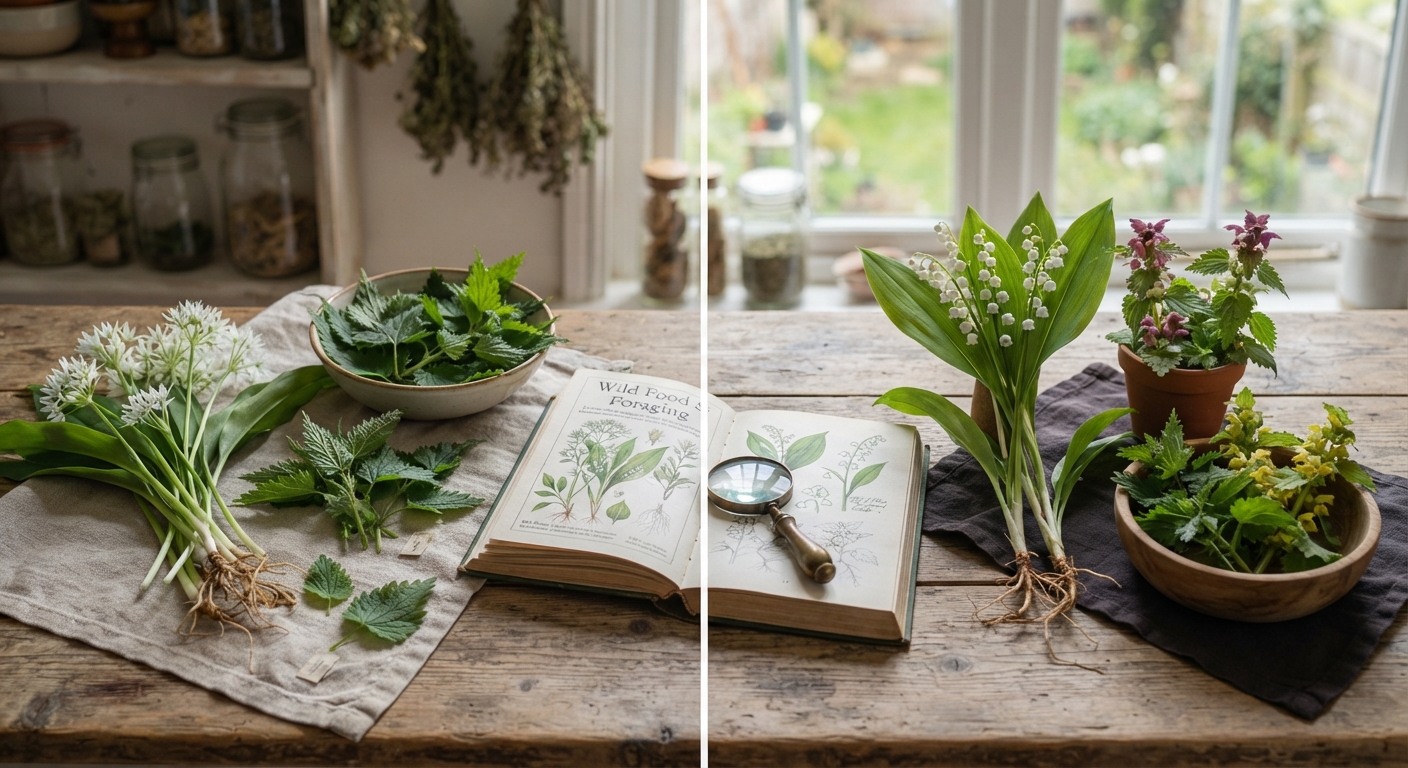
| Liliaceae (Lily Family) | Death camas, false hellebore | Wild onion, wild garlic, ramps | Alkaloids causing cardiac symptoms |
| Solanaceae (Nightshade Family) | Deadly nightshade, black nightshade, bittersweet | Wild blueberries, huckleberries, wild tomatoes | Tropane alkaloids and solanine |
Notice the pattern? These aren’t obscure plants from remote wilderness. They’re common. They grow along trails, in parks, at the edges of backyards. The proximity to human activity is part of what makes them dangerous — they show up where beginners are most likely to forage.
But here’s what the statistics don’t capture: nearly every documented foraging poisoning involved someone who knew the edible plant well but didn’t know the toxic lookalike at all. The gap isn’t knowledge of the good plants. The gap is knowledge of the bad ones.
The Framework — Understanding WHY Lookalikes Work
Before we get into the step-by-step system, you need to understand something about your own brain, because it’s working against you in the field.
Humans are visual pattern matchers. We evolved to recognize food at a glance — ripe fruit against green leaves, the right kind of mushroom poking through leaf litter. This ability kept our ancestors alive, but it has a critical flaw: it prioritizes speed and pattern completion over accuracy.
When you look at a white umbel of flowers on a tall stalk with divided leaves, your brain doesn’t do a detailed botanical analysis. It runs a fast pattern match: “Looks like wild carrot → edible.” The match happens in milliseconds, and once your brain has filed the plant under “edible,” it becomes surprisingly difficult to override that classification — even when contradictory evidence is staring you in the face.
This is called confirmation bias, and it’s the primary cognitive failure behind foraging accidents. You see what you expect to see. The purple blotches on the stem register as shadows. The absence of hair on the stalk gets rationalized as “maybe this variety is smoother.” Your brain fills in the gaps.
The system I’m about to describe is designed to interrupt that fast pattern match and replace it with a deliberate verification sequence. Think of it as installing a circuit breaker between “I recognize this” and “I’m putting it in my mouth.”
Step 1: Learn Plant Families Before Individual Species
Most beginners try to learn plants one at a time — dandelion on Monday, chickweed on Tuesday, lamb’s quarters on Wednesday. That’s like learning vocabulary words without understanding grammar. You’ll recognize individual words, but you won’t understand how the language works.
A far more effective approach is to learn plant families first. Once you understand what makes something an Apiaceae versus a Lamiaceae versus an Asteraceae, you’ve unlocked the ability to categorize any new plant you encounter — and more importantly, to recognize when something belongs to a family that contains dangerous members.
The Families Every Forager Must Know
Apiaceae (Carrot/Parsley Family) The single most important family to learn, period. Characterized by umbrella-shaped flower clusters (umbels), hollow stems, and often finely divided leaves. This family contains both beloved edibles (carrot, parsley, dill, fennel, parsnip) and the deadliest plants in North America (poison hemlock, water hemlock). Personal rule: never eat any Apiaceae plant unless you are 100% certain of genus and species. Most experienced foragers I know avoid wild Apiaceae entirely for their first few years.
Lamiaceae (Mint Family) Square stems, opposite leaves, often aromatic. Contains virtually no toxic species, which makes it the safest family for beginners to explore. Wild mint, dead nettle, henbit, lemon balm — all Lamiaceae, all safe. If you find a plant with a square stem and it smells like mint or herbs, you’re in friendly territory.
Asteraceae (Daisy/Sunflower Family) Composite flowers (what looks like a single flower is actually hundreds of tiny flowers clustered together). This family is enormous and includes dandelions, chicory, sunflowers, and lettuce — but also some toxic members like tansy and ragwort. Learning this family means learning to distinguish the safe majority from the handful of troublemakers.
Brassicaceae (Mustard Family) Four petals arranged in a cross shape, often with a peppery or mustardy taste. Almost all members are edible (garlic mustard, shepherd’s purse, watercress, wild radish), though some can accumulate nitrates in certain conditions. The distinctive four-petal cross is one of the easiest family markers to learn.
The Family-First Method in Practice
When you encounter an unfamiliar plant, your first question shouldn’t be “What plant is this?” It should be “What family is this?” Once you’ve placed it in a family, you immediately know the safety profile. Apiaceae? Red alert — proceed with extreme caution. Lamiaceae? Relax — but still verify.
This single mental habit will prevent more mistakes than any amount of species-level memorization.
Step 2: The Seven-Point Physical Inspection
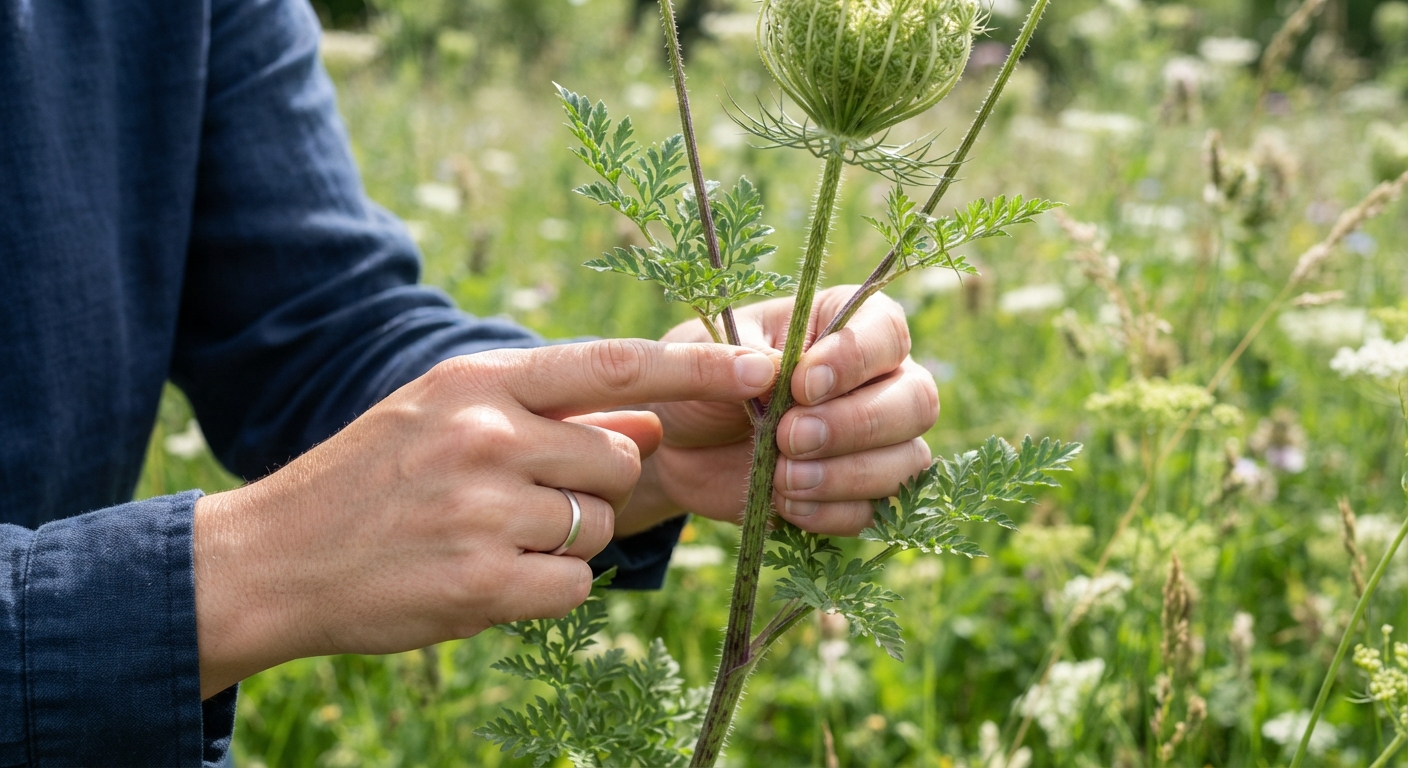
Once you’ve identified the plant family, you need a systematic inspection routine — not just “check the leaves and flowers,” but a specific sequence of seven features that leaves no room for assumption. Run through these seven points in order. If any single point doesn’t match your reference, stop. Do not proceed.
| Checkpoint | What to Look For | Why It Matters | Common Mistake |
|---|---|---|---|
| 1. Stem | Color, texture, shape. Is it hairy or smooth? Grooved or round? Spotted or solid? | Stem characteristics are among the most reliable ID markers and don’t change much across seasons | Skipping stem check because “the flowers look right” |
| 2. Leaf Arrangement | Alternate, opposite, or whorled? Basal rosette or stem leaves? | Arrangement pattern is a stable family-level identifier | Looking at leaf shape without checking how leaves attach to stem |
| 3. Leaf Details | Simple or compound? Margin type (smooth, serrated, lobed)? Hair on underside? | Compound vs. simple leaves distinguish some of the most dangerous pairs | Assuming all “carrot-like” leaves belong to wild carrot |
| 4. Flower Structure | Number of petals? Arrangement (umbel, raceme, spike, solitary)? Color? | Flower structure is the most definitive botanical identifier | Misidentifying composite flowers as simple flowers |
| 5. Flower Bracts | Are there bracts under the flower head? Under each individual flower? | The presence or absence of bracts is the single best marker for separating wild carrot from poison hemlock | Never learning what bracts are in the first place |
| 6. Smell | Crush a small leaf between fingers and smell. Carroty? Minty? Musty? Foul? | Aromatic compounds are often family-specific and unmistakable once learned | Smelling from a distance instead of crushing and bringing to nose |
| 7. Root/Bulb | Shape, color, smell of underground part. Separate cloves in bulb? Tuberous? Fibrous? | When safe to excavate, underground parts are definitive — wild onion smells like onion, death camas does not | Unearthing without smell-testing immediately |
Here’s what this looks like in practice, using the wild carrot vs. poison hemlock pair — the most common and dangerous confusion in North American foraging:
Wild Carrot (Daucus carota) checkpoint results:
- Stem: Solid green, finely hairy, no spots → ✓
- Leaf arrangement: Alternate, compound → ✓
- Leaf details: Finely divided (3-pinnate), hairy underside → ✓
- Flower structure: White umbel, often with single dark purple floret in center → ✓
- Flower bracts: Present and prominent (3-forked bracts underneath) → ✓
- Smell: Distinctly carrot-like when crushed → ✓
- Root: Small, pale, smells unmistakably of carrot → ✓
Poison Hemlock (Conium maculatum) checkpoint results:
- Stem: Smooth, hollow, purple blotches → ✗ RED FLAG
- Leaf arrangement: Alternate, compound → ✓
- Leaf details: Finely divided, hairless, might have musty odor → ✗
- Flower structure: White umbel, no dark central floret → ✗
- Flower bracts: Absent or minimal → ✗
- Smell: Musty, mouse-like, unpleasant → ✗
- Root: White, parsnip-like, no carrot smell → ✗
A plant that passes checkpoint 1 but fails checkpoint 6? Stop. A plant that passes checkpoints 1-5 but the bracts at checkpoint 5 are ambiguous? Stop. The system only works when you treat every failure as a hard no.
Step 3: Cross-Reference Against the Deadly Dozen
Even after your physical inspection checks out, you need to explicitly rule out the toxic plants that could plausibly be confused with what you’re holding. This step is about negative identification — proving what a plant is not.
The table below covers the high-stakes lookalike pairs that cause the most emergency room visits. Memorize the “Key Differentiator” column more than anything else. These are the field markers that work fast, even in suboptimal conditions:
| Edible Plant | Toxic Lookalike | Key Differentiator | Are You Sure? Test |
|---|---|---|---|
| Wild carrot (Daucus carota) | Poison hemlock (Conium maculatum) | Wild carrot has HAIRY stems; hemlock is smooth with purple blotches | Run your finger up the stem — hairy = edible, smooth = danger |
| Wild onion/garlic (Allium spp.) | Death camas (Toxicoscordion spp.) | Wild onion smells like onion when crushed; death camas has no odor | Crush leaf and smell — no onion smell = do not eat |
| Wild grape (Vitis spp.) | Canadian moonseed (Menispermum canadense) | Grape seeds are teardrop-shaped; moonseed has a single crescent-shaped seed | Squeeze a fruit and check seed shape |
| True morels (Morchella spp.) | False morels (Gyromitra spp.) | True morels are completely hollow stem-to-cap; false morels are chambered or cotton-filled inside | Slice lengthwise — hollow throughout = safe |
| Dandelion (Taraxacum officinale) | Various lookalikes (hawkweeds, cat’s ear) | Dandelion has unbranched hollow stem with single flower; lookalikes have branched, solid stems | Check stem branching — single flower per stem = dandelion |
| Blueberries (Vaccinium spp.) | Pokeweed berries (Phytolacca americana) | Blueberries have a 5-pointed crown on the end; pokeweed berries are smooth with no crown | Look for the crown — no crown, no eat |
| Fiddlehead ferns (ostrich fern) | Bracken fern, other ferns | Ostrich fern has a deep U-shaped groove on the inside of the stalk and papery brown scales | Roll stem between fingers — smooth and grooved = edible |
| Wild strawberry (Fragaria spp.) | Mock strawberry (Potentilla indica) | Wild strawberries are white inside with seeds embedded in flesh; mock strawberries are white inside with seeds on surface | Cut in half — embedded seeds = real strawberry |
| Sweet almonds | Bitter almonds (wild) | Sweet almonds contain negligible cyanide; bitter almonds contain high levels of amygdalin | If it tastes intensely bitter and “almond-extract”-like, spit it out immediately |
| Elderberry (Sambucus spp.) | Water hemlock, pokeweed | Elderberries grow in flat-topped or rounded clusters on woody shrubs; hemlock/pokeweed have completely different growth forms | Verify growth form — woody shrub with compound leaves, not herbaceous |
| Purslane (Portulaca oleracea) | Spurge (Euphorbia spp.) | Purslane stems are succulent and clear sap; spurge stems are wiry with milky white sap | Break stem — milky sap = toxic spurge |
| Chickweed (Stellaria media) | Scarlet pimpernel (Anagallis arvensis) | Chickweed has a single line of hairs along one side of the stem; scarlet pimpernel is hairless with square stems | Run finger along stem — single hair line = chickweed |
One frequent question: “Do I really need to check all twelve pairs every time I forage?” The answer is no — only the pairs relevant to what you’re harvesting. If you’re going after wild onions, you need to know death camas intimately. If you’re picking elderberries, water hemlock and pokeweed are your cross-reference targets. The deadly dozen isn’t a daily checklist. It’s the safety net that catches the specific pair that could kill you.
Step 4: Environment and Season Verification
A plant that looks right in the wrong habitat is a plant you haven’t identified. A plant that looks right in the wrong season is the same story. Context matters.
Habitat Cross-Check
Every plant has a preferred habitat. Wild carrot loves dry, sunny, disturbed soil — roadsides, field edges, abandoned lots. Water hemlock, by contrast, requires wet soil — stream banks, marshes, drainage ditches. If you find what looks like wild carrot growing with its roots in standing water, that’s not wild carrot.
Before harvesting, ask:
- Is this plant growing where I’d expect this species to grow?
- What’s the soil moisture level? Shade pattern? Elevation?
- Are there indicator species nearby that confirm the habitat type?
Seasonal Verification
A toxic plant can look completely different in April versus August. The young spring shoots of poison hemlock are low, fern-like rosettes that bear almost no resemblance to the towering, white-flowered stalks of midsummer. If you learned to identify poison hemlock in July, you might not recognize it in April — and vice versa.
The only reliable approach is to learn each dangerous species in all its seasonal forms. Find them in spring, revisit that spot in summer, come back in autumn. Take photos. Build your own seasonal reference library. There’s no shortcut.
The “Stop If” List
Pause — and seriously reconsider — if any of these are true:
- You’ve never seen this plant in this season before
- The plant is growing outside its described habitat
- Any single physical feature doesn’t match your reference
- You feel even a flicker of doubt (your subconscious sometimes catches what your conscious mind misses)
- You’re tired, hungry, rushed, or showing off for someone
- You’re foraging in a new region with unfamiliar species
The Universal Edibility Protocol — What the Military Gets Right
You’ve probably heard of the Universal Edibility Test — the step-by-step protocol taught in military survival manuals for testing unknown plants. It involves rubbing the plant on your skin, then lips, then gums, then a tiny taste, with waiting periods between each step.
Here’s what they don’t emphasize enough: the Universal Edibility Test is a survival tool of absolute last resort. It’s designed for someone who is genuinely starving in a situation with no other options. It is not a shortcut for identifying plants you’re unsure about. It is not a substitute for proper identification. Using it recreationally is like testing mushrooms by feeding them to your neighbor’s dog — irresponsible and potentially lethal.
The protocol also has critical limitations that survival manuals rarely discuss:
- It won’t detect cumulative toxins that build up with repeated exposure
- It won’t catch carcinogens or long-term organ damage
- It can produce false negatives for toxins that require metabolic activation
- Some toxic reactions don’t manifest until 6-12 hours after ingestion
For recreational foraging, the Universal Edibility Test should never enter your decision-making process. There is exactly one protocol that matters: positive identification to species level, every time, no exceptions.
Building Confidence Without Building Complacency
I’ve been foraging for over a decade, and I’ve made every mistake that doesn’t put you in the hospital. Grabbed chickweed with a few sprigs of something else mixed in. Misjudged how bitter a late-season dandelion could be. Assumed a plant was “close enough” to the field guide picture without running through every identification point.
The foragers I respect most share one quality: they treat every harvest day like it’s their first. They run through their checklist even on plants they’ve picked a hundred times. They keep learning new species in the dangerous families. They’re not anxious about it — it’s just the rhythm they’ve built.
Practical Habits That Compound
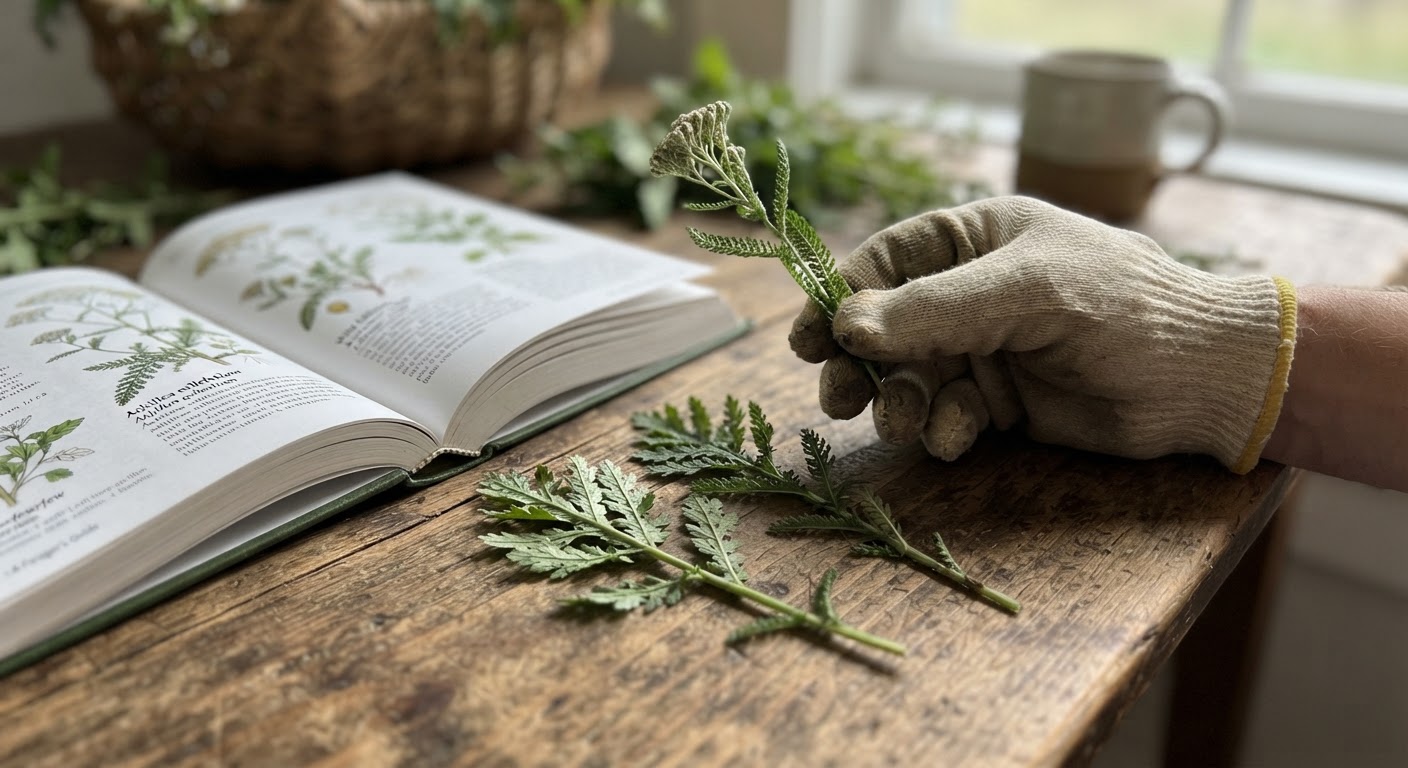
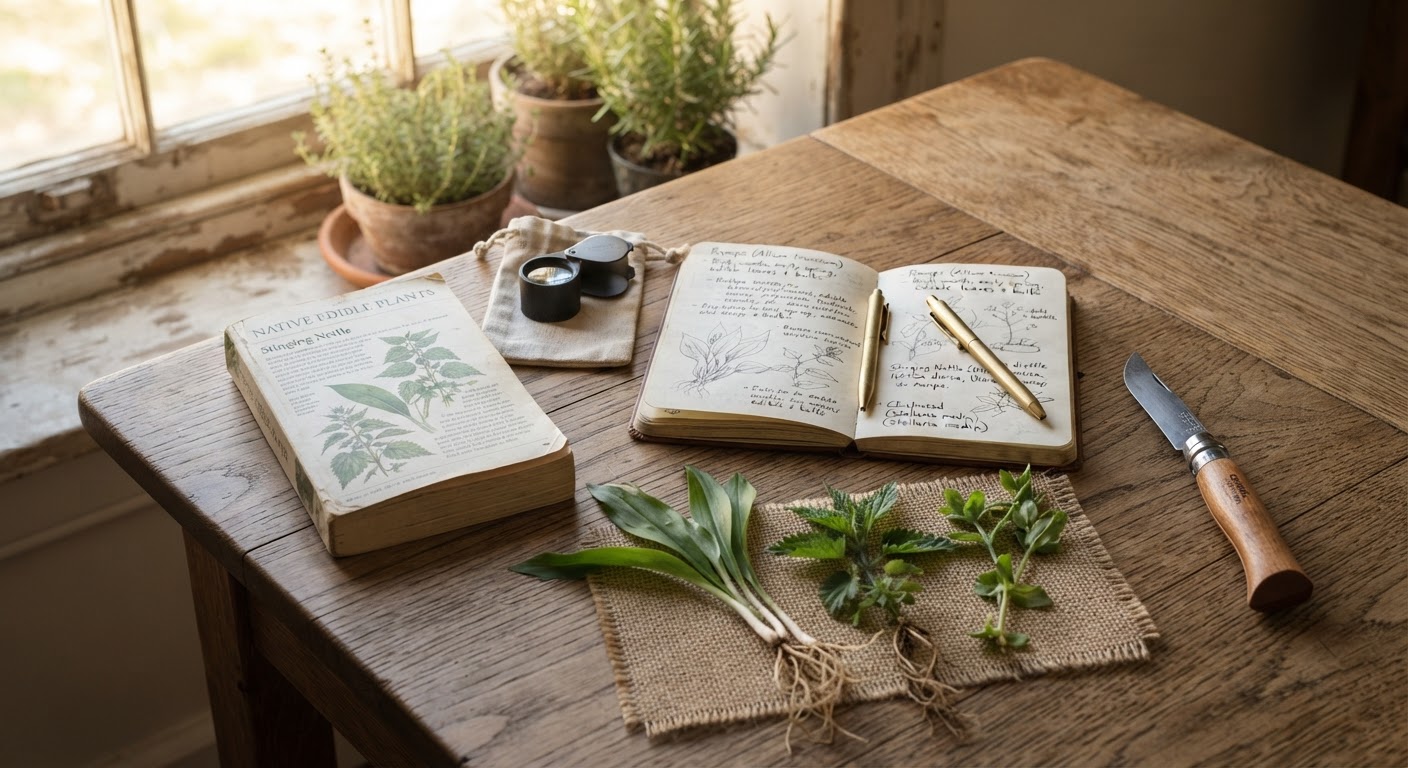
Keep a foraging journal. Write down what you harvested, where, when, and how you identified it. Include what you ruled out. Over time, this journal becomes your most valuable reference — more useful than any published field guide because it’s tied to your specific region and seasons.
Use multiple field guides. No single guide is comprehensive. Cross-reference at least two or three sources for any plant you plan to eat. If the descriptions don’t align perfectly, figure out why before harvesting.
Join a local foraging group. There are identification nuances that no book can capture — the way a plant smells at a specific stage, the way light hits the stem at a certain angle. Learning from experienced foragers in your specific ecosystem is irreplaceable.
Review your mistakes publicly. If you misidentify something and catch it, tell someone. Write it down. The foraging community needs more “here’s what went wrong” stories and fewer “look at my perfect basket” photos. Mistakes are the tuition you pay for expertise.
Practice negative identification. On every foraging walk, spend at least a few minutes actively identifying toxic plants in your area. Find poison hemlock. Find death camas. Find false morels. Getting comfortable recognizing danger is just as important as recognizing food.
Field Notes: Questions Real Beginners Ask
These are the questions I get at every foraging workshop I’ve ever taught. No one asks them publicly. Everyone wonders.
“What if I’m 90% sure?”
Then you’re 0% eating it. There’s no partial credit in foraging safety. “Probably” isn’t good enough when the downside is organ failure.
“How many plants do I realistically need to memorize before I can forage safely?”
Start with five — but know all five cold, including their toxic lookalikes and seasonal variations. Five plants you can identify with your eyes closed, in rain, in bad light, at any time of year. Quality of knowledge over quantity.
“Is there an app that can replace all of this?”
No. Plant ID apps are tools, not solutions. They work by image recognition, which is probabilistic — they give you a “likely match,” not a definitive identification. Use apps to narrow down possibilities, then do the manual verification yourself. Apps miss the subtle markers (stem hair, smell, root shape) that make the difference between safe and deadly.
“What if I’ve eaten a plant before but now I’m second-guessing myself?”
This happens to everyone. Something about the plant looks slightly off, or the season is different, or your spider sense is tingling. Listen to it. Skip the harvest. Come back with a second opinion. No meal is worth the anxiety — or worse.
“Do experienced foragers really run through a full checklist every time?”
The honest answer is that the checklist becomes internalized. After enough repetitions, you don’t consciously think “step one: check the stem” — your eyes automatically go to the stem because your brain has been trained to look there first. But yes, the sequence is still happening, just at a subconscious level. Until you reach that point, keep the checklist explicit.
“What’s the one plant I should absolutely, positively never mess with?”
Any member of the Apiaceae family that you can’t identify to species level with 100% confidence. If there’s even a whisper of doubt about whether that white umbel is wild carrot or poison hemlock — or if you’re in a region where water hemlock grows — walk away. The stakes are genuinely life and death.
Putting It All Together: Your Personal Safety Protocol
You now have a complete system. Here’s how it flows in the field:
- Encounter an unfamiliar plant → Identify the plant family first. Apiaceae = high alert.
- Run the seven-point inspection → Stem, leaf arrangement, leaf details, flower structure, bracts, smell, root. One failure = stop.
- Cross-reference against known toxic lookalikes → If the plant resembles something in the deadly dozen table, verify the key differentiator explicitly.
- Check habitat and season → Is this plant growing where and when it should be?
- Apply the “any doubt” rule → If anything feels off, document it and move on. Come back with someone more experienced.
This system won’t make you a faster forager. It’ll make you a slower one — deliberately, intentionally slower. That’s the point. Speed is the enemy of accuracy, and accuracy is the only thing that matters when you’re deciding whether to put something in your body.
The confidence you build through this process isn’t the reckless kind. It’s the quiet, earned confidence of knowing that you’ve done the work — that you can walk into a meadow and know, with genuine certainty, which plants are food and which ones are something else entirely.
A final note: this guide is a starting point, not an endpoint. Seek out local experts, take a hands-on workshop, spend time in the field with people who know more than you do. There’s no substitute for in-person mentorship, especially in your first seasons. The plants in your specific region deserve your specific attention. Happy foraging — and stay safe out there.