The American Association of Poison Control Centers logs roughly 50,000 plant exposure cases every year. Most are kids. A surprising chunk are adults — foragers who were “pretty sure.” The gap between pretty sure and certain is measured in hospital beds.
You don’t need to memorize every toxic plant in North America. That’s a fool’s errand — there are hundreds. What you need is a tight list of the serious ones: the plants that can actually hospitalize or kill you, plus a reliable method for telling them apart from the edible species they mimic.
This guide covers both. Eight plants, their deadliest lookalikes, and the field marks that separate dinner from disaster.
Know These 8 Plants or Stay Out of the Woods
1. Poison Hemlock (Conium maculatum)
What it does: Paralyzes your respiratory muscles. You stay fully conscious while you stop breathing. This is the plant that killed Socrates.
Where it grows: Everywhere — roadsides, stream banks, meadows, vacant lots. All 48 contiguous US states and most of Canada. It’s aggressively invasive and spreading fast.
Key field marks:
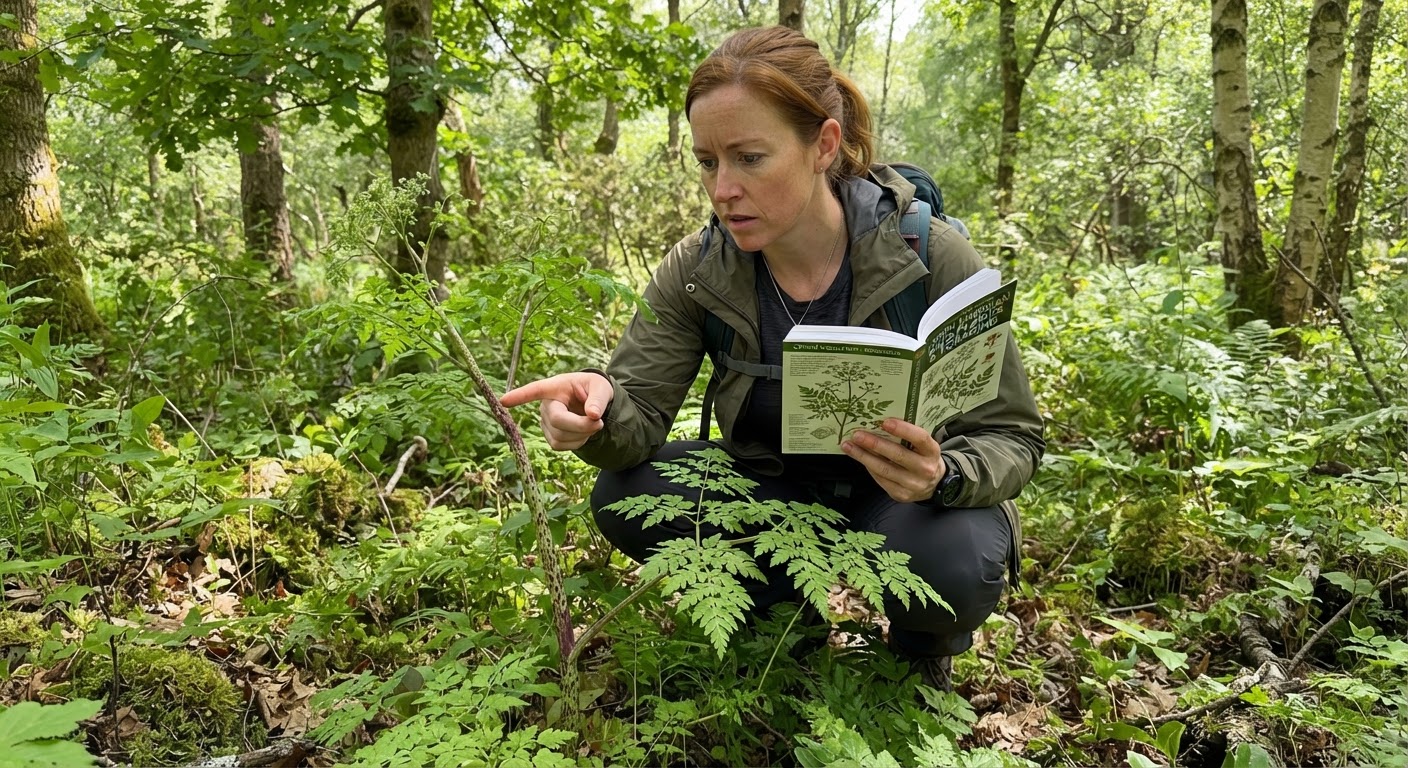
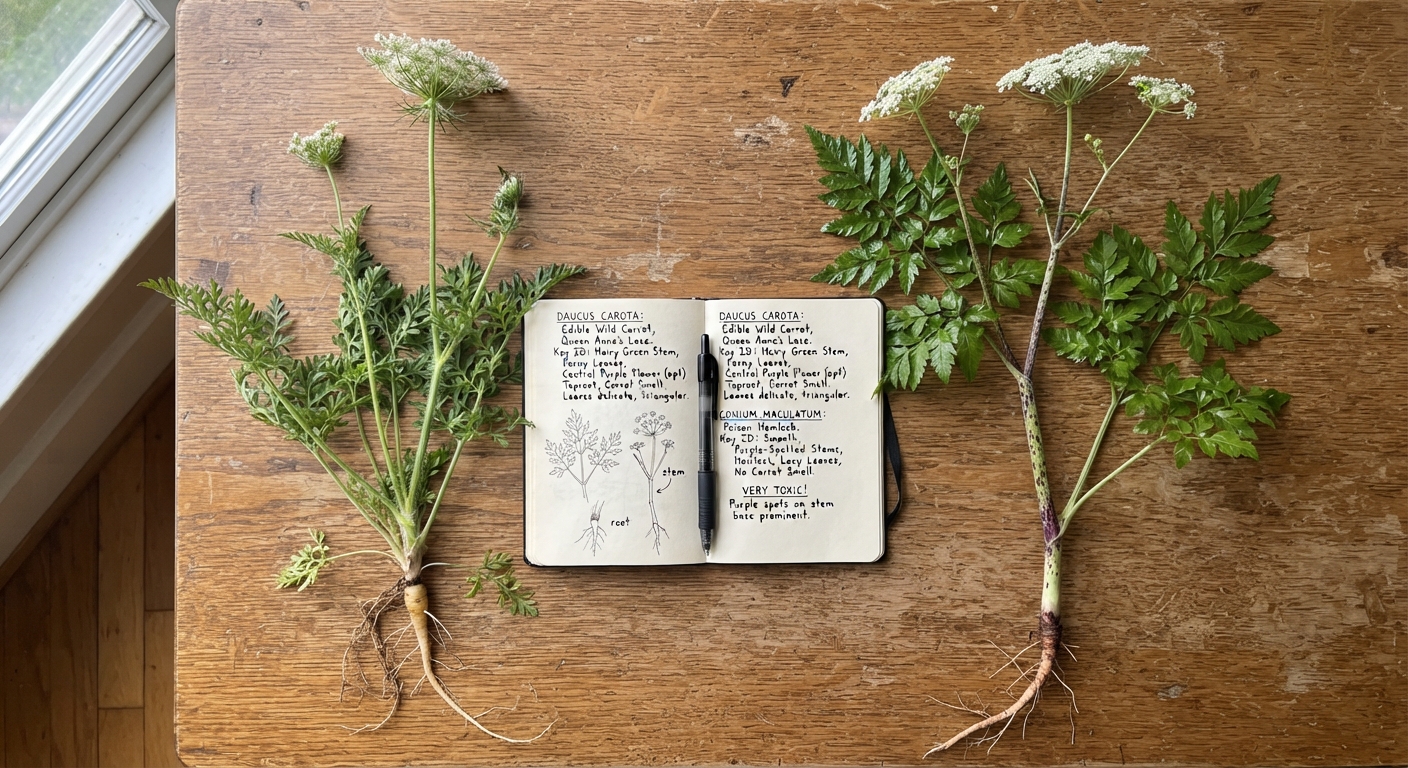
- Smooth, completely hairless stems with purple-red blotches — this is your #1 tell, no exceptions
- Grows 4–8 feet tall, towering over most lookalikes
- Fern-like leaves that smell musty and unpleasant when crushed (think mouse urine, not carrot)
- Tiny white flowers arranged in flat, umbrella-shaped clusters called umbels
Deadliest lookalike for: Wild carrot (Queen Anne’s lace, Daucus carota). Both have lacy white flowers and fern-like leaves — at a glance they’re nearly identical. The life-saving difference: wild carrot stems are hairy with no purple spots. Hemlock stems are smooth as glass with those purple blotches. Touch the stem. If it feels like a clean-shaven cucumber with purple stains, back away.
2. Water Hemlock (Cicuta maculata)
What it does: Triggers violent, uncontrollable seizures within 15–60 minutes of ingestion. Widely considered the most violently toxic plant on the continent. A root chunk the size of a walnut can kill a full-grown cow.
Where it grows: Marshes, wet meadows, stream banks, pond edges — anywhere the soil stays consistently damp.
Key field marks:
- Thick, chambered root base that looks like stacked potato slices when you cut it open — this structure is unique and diagnostic
- Veins in the leaflets run to the notches between teeth (not to the tips of the teeth) — unique among carrot-family plants and a reliable field identifier
- Small white flower clusters, similar to hemlock but usually more rounded and less flat
- Smooth stems with a waxy coating, sometimes purple-tinted near the base
Deadliest lookalike for: Water parsnip, wild celery, and wild parsnip — all edible carrot-family plants that grow in the same wet habitats. The root structure is your single best differentiator: no edible lookalike has the chambered, hollow root arrangement of water hemlock. The leaf vein pattern (veins to notches, not tips) confirms it in the field without digging.
3. Pokeweed (Phytolacca americana)
What it does: Every part is toxic — roots, stems, leaves, and especially mature berries. Causes severe nausea, vomiting, bloody diarrhea, and respiratory depression. Some traditional Southern cooks prepare very young pokeweed shoots through repeated boiling and water changes. This is not a beginner’s project. The margin for error between safe preparation and a hospital trip is razor-thin.
Where it grows: Disturbed soil everywhere — fence lines, old lots, woodland edges, backyards. Ubiquitous throughout the eastern US and steadily expanding westward.
Key field marks:
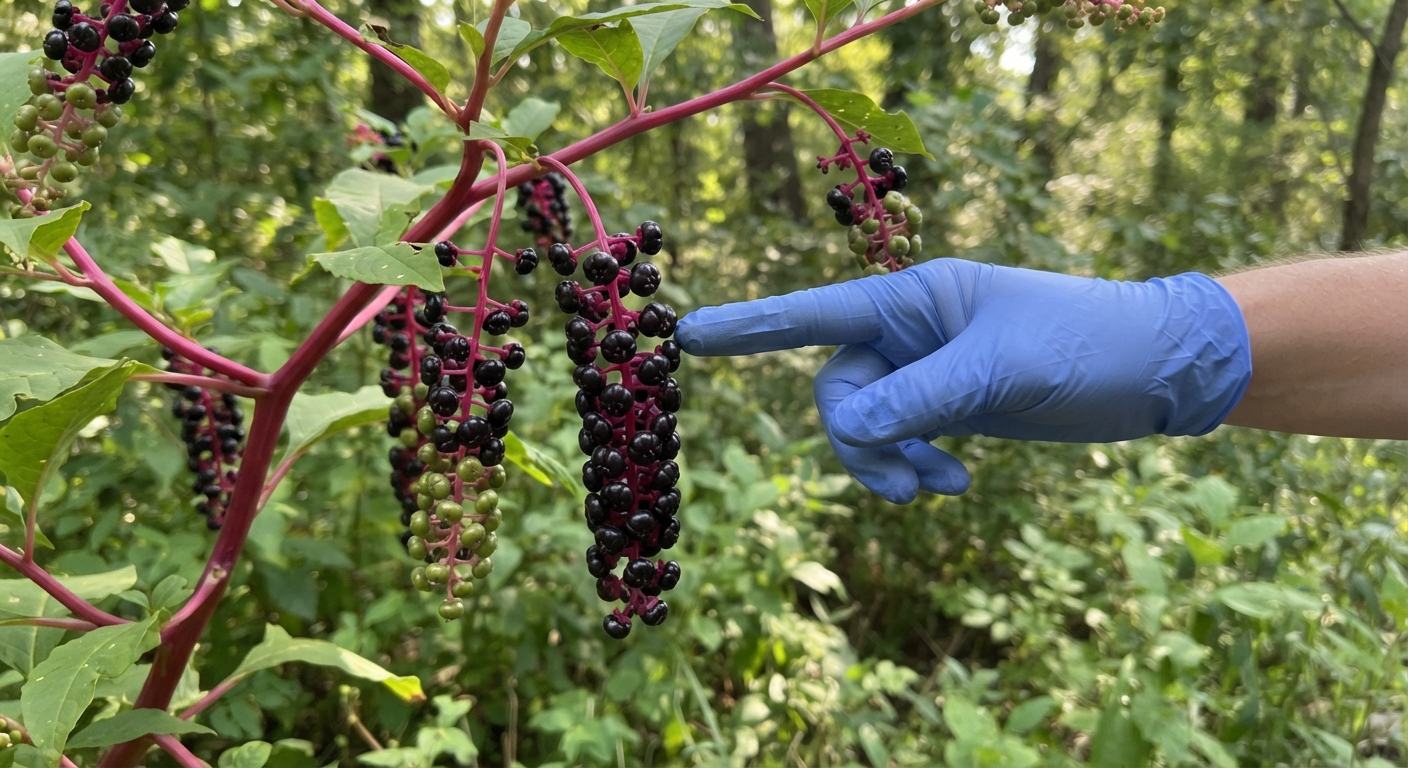
- Bright magenta-pink stems — absolutely unmistakable once you’ve seen them in person
- Large, smooth, oval leaves reaching up to 12 inches long
- Drooping, grape-like clusters of dark purple-black berries in late summer that stain everything they touch
- Can shoot up 6–10 feet tall in a single growing season
Deadliest lookalike for: Young pokeweed shoots (which some people insist are edible after exhaustive boiling). The trap: young pokeweed doesn’t look like the mature plant. The pink stem is subtle or absent on new shoots. Beginners hear “pokeweed is edible if cooked properly” and assume the whole mature plant with berries is fair game. It’s not. Skip pokeweed entirely unless you’re learning from someone who has prepared it for years.
4. Foxglove (Digitalis purpurea)
What it does: Contains cardiac glycosides, primarily digitalis. At precisely measured pharmaceutical doses, it treats heart failure. At foraging doses — where you have no measurement — it stops the heart. Even water from a vase that held cut foxglove flowers has caused cardiac symptoms.
Where it grows: Gardens, woodland edges, roadsides. Escaped ornamental, widespread throughout temperate North America.
Key field marks:
- Tall, dramatic spike of tubular purple-pink bell-shaped flowers, each speckled inside (the “fox’s glove” pattern)
- Large, soft, velvety leaves forming a basal rosette — the rosette stage is when misidentification happens
- Individual flowers are roughly 2 inches long, hanging downward along the top portion of the stalk
- Also appears in white and pale yellow cultivars
Deadliest lookalike for: Comfrey (Symphytum officinale). Both form large, fuzzy basal rosettes that look similar before flowering. Comfrey leaves are more elongated, rough-textured, and bristly. Foxglove leaves are broader, distinctly softer, and velvety to the touch. If the plant is flowering, there’s zero confusion — foxglove’s bell-studded spire looks nothing like comfrey’s drooping clusters.
5. Deadly Nightshade (Atropa belladonna)
What it does: Delivers atropine, scopolamine, and hyoscyamine — three anticholinergic alkaloids that dilate pupils, cause hallucinations, spike heart rate, and lead to coma at sufficient doses. The name “belladonna” (“beautiful woman”) comes from Renaissance-era use of diluted berry juice as a cosmetic pupil dilator. The name “deadly nightshade” is the more honest one.
Where it grows: Woodland edges, hedgerows, disturbed areas. More densely distributed in Europe, but naturalized across parts of North America.
Key field marks:
- Solitary, bell-shaped purple-brown flowers with five pointed, slightly recurved lobes
- Shiny, jet-black berries the size of small cherries, each nestled in a distinctive star-shaped calyx
- Dull green, oval leaves arranged alternately along branched stems
- Shrubby growth habit, typically reaching 3–4 feet
Deadliest lookalike for: Wild blueberries and huckleberries. The black berries are close enough in size and color that children are the most frequent victims. Key separator: nightshade berries grow singly from leaf axils with that star-shaped calyx underneath. Blueberries grow in clusters with a small crown, never a star. If in doubt, look for the star.
6. White Snakeroot (Ageratina altissima)
What it does: Contains tremetol, a toxin that passes through cow’s milk unchanged. In the early 1800s, “milk sickness” killed thousands of settlers across the Midwest — including Nancy Hanks Lincoln, Abraham Lincoln’s mother. Modern pasteurization doesn’t destroy tremetol; the only protection is keeping livestock away from this plant.
Where it grows: Shaded woodlands, forest edges, and partially shaded roadsides. Eastern and central North America.
Key field marks:
- Opposite, sharply toothed leaves with long stalks (petioles) — the opposite leaf arrangement is a reliable characteristic
- Flat-topped clusters of small, fuzzy white flowers that bloom late summer through fall
- Smooth stem reaching 2–4 feet tall
- Leaves are broadly oval with pointed tips and pronounced serration along the edges
Deadliest lookalike for: Boneset and late-flowering thoroughwort (both medicinal plants, not typically eaten). The real danger is for people who keep livestock — cows grazing snakeroot produce toxic milk for days afterward. For foragers, the practical takeaway is recognizing it so you can flag it if you see it near a homestead or small farm.
7. Monkshood (Aconitum napellus)
What it does: Aconitine — one of the most potent plant toxins ever characterized. It can absorb through unbroken skin. Gardeners have been hospitalized after handling monkshood bare-handed for an afternoon. Tingling and numbness spread from the contact point, followed by vomiting, then cardiac arrhythmia. Aconitine is so efficient at disrupting sodium channels in nerve cells that there is no antidote — treatment is purely supportive.
Where it grows: Gardens (extremely popular ornamental perennial), mountain meadows, stream banks. Common throughout temperate zones.
Key field marks:
- Tall spires of deep, vivid blue-purple flowers, each shaped like a helmet or monk’s hood
- Deeply divided, palmate leaves with narrow, finger-like segments — distinctive even without flowers
- Grows 3–4 feet tall with stiff, upright stems that rarely need staking
- Blooms mid to late summer
Deadliest lookalike for: Larkspur (Delphinium). Both produce tall spikes of blue flowers, and both are toxic — monkshood far more so. Monkshood flowers wear a hood; larkspur flowers have a backward-pointing spur. The practical rule: don’t eat either one, and wear gloves if you’re gardening around monkshood.
8. Castor Bean (Ricinus communis)
What it does: Produces ricin. Roughly 6,000 times more toxic than cyanide by weight. Chewing and swallowing just 4–8 seeds can be fatal for an adult. The toxin works by shutting down protein synthesis inside cells — once it starts, there’s no cellular mechanism to reverse it.
Where it grows: Gardens (planted as a dramatic ornamental), waste areas, roadsides. Common across the southern US and increasingly in warmer regions. Huge, tropical-looking leaves make it a popular landscaping choice.
Key field marks:
- Massive, star-shaped leaves with 5–12 pointed lobes — looks like a giant, glossy maple leaf on steroids
- Red or green hollow stems
- Spiny, bright red seed pods that split open when mature
- Seeds are beautifully mottled brown and white, bean-shaped, roughly the size of a pinky fingernail
Lookalike concern: The plant is distinctive enough that it’s rarely confused for anything edible in the field. The danger is mainly to children — the seeds are decorative and bean-like, and curious kids put things in their mouths. If you have castor bean plants in your garden and small children, remove the plants or at minimum cut off all seed pods before they mature.
The Lookalike Trap: 5 Side-by-Side Comparisons That Save Lives
The most dangerous plant in the woods isn’t the weird-looking one you’ve never seen before. It’s the one you think you recognize but don’t. Below are the five pairs that cause the most poisonings year after year.
| Poisonous Plant | Edible Lookalike | The One Feature That Separates Them | Risk |
|---|---|---|---|
| Poison Hemlock | Wild Carrot (Queen Anne’s Lace) | Hemlock stems = smooth + purple blotches. Wild carrot stems = hairy + solid green. Touch the stem. | 🔴 Fatal |
| Water Hemlock | Wild Parsnip / Water Parsnip | Water hemlock leaf veins go to the notches between teeth. Wild parsnip veins go to the tips of teeth. Vein destination is visual and reliable. | 🔴 Fatal |
| Foxglove | Comfrey | Foxglove leaves = broad, soft, velvety. Comfrey leaves = elongated, rough, bristly. Once flowering, the difference is obvious — foxglove has a tall spire of bell-shaped blooms. | 🔴 Dangerous |
| Deadly Nightshade | Wild Blueberry | Nightshade = single berries from leaf axils with a star-shaped calyx at the base. Blueberry = clustered berries with a small crown, no star anywhere. | 🔴 Fatal |
| Pokeweed (mature) | Wild Grape / Elderberry | Pokeweed berries hang in drooping clusters from bright pink stems. Grape clusters hang from brown woody vines. Elderberry grows on shrub branches. No pink stems, no pokeweed. | 🟡 Serious |
The universal rule buried in this table: If you’re looking at a plant with umbrella-shaped white flower clusters and compound, fern-like leaves — the carrot family, Apiaceae — and you can’t identify it to species with total certainty, leave it. This single plant family contains water hemlock, poison hemlock, and fool’s parsley. It also contains wild carrot, parsnip, celery, and dill. For a beginner, the risk-to-reward math on this family is terrible. Master everything else first.
Three Universal Red Flags: Category Rules That Catch Most Toxic Plants
You can’t memorize every toxic species. But plant toxicity follows patterns. Learn these three rules and you’ll catch the vast majority of dangerous plants without ever needing to know their names.
🔴 Red Flag #1: Umbrella-Shaped White Flowers + Fern-Like Leaves
This is the carrot family (Apiaceae), and it deserves its own warning category. More deadly plants live here than in any other plant family accessible to foragers.
Action: If you see this flower-leaf combination and you’re not 100% sure of the species — including having checked the stem for hairs vs. purple spots — do not touch the plant. The potential cost of being wrong (respiratory paralysis, violent seizures) is not worth any foraged ingredient.
🔴 Red Flag #2: Shiny Black Berries or Clustered Bright Red Berries
Abundant small berries exist for one evolutionary purpose: to be eaten by birds that disperse the seeds. The plant does not care whether you’re a bird or a human. Some are safe (elderberries, blueberries). Some kill you (baneberry, nightshade, pokeweed).
Action: Black and bright red are the most common warning colors for toxic wild fruits. Do not eat wild berries unless you’ve positively identified the species against multiple sources. “It looks like a blueberry” is not identification. Children are the highest-risk group here — teach them the rule early.
🔴 Red Flag #3: Milky, White, or Colored Sap
Many toxic plants ooze latex-like sap when you snap a stem or leaf. Milky sap combined with umbrella-shaped flowers (Red Flag #1) should stop you dead in your tracks.
Caveat: Not every plant with milky sap is toxic. Dandelions produce white latex and are perfectly edible. Fig sap is milky and can cause photosensitivity, but the fruit is safe. The red flag is a combination signal — milky sap plus unfamiliar plant equals don’t eat. Use it as a “pause and verify” trigger, not a standalone rule.
What to Do If Someone Eats a Toxic Plant: The Quick Checklist
Symptoms can take anywhere from 15 minutes (water hemlock) to several hours or even days (certain alkaloids, mushroom amatoxins) to appear. Do not wait for symptoms. Act on knowledge, not on observation.
| Timeline | Action |
|---|---|
| Right now | Spit out any remaining plant material. Rinse mouth thoroughly with water. Do not induce vomiting unless a poison control specialist explicitly tells you to — some toxins cause more damage on the way back up. |
| Within 5 minutes | Call Poison Control: 1-800-222-1222 (US, 24/7). Collect a sample of the plant in a sealed plastic bag. Photograph the plant in its growing location if you’re still near it — multiple angles, including flowers, leaves, stem, and the surrounding habitat. |
| If symptoms appear | Note the exact time symptoms started and what they are. If breathing becomes labored, seizures begin, or consciousness is altered, call 911 immediately — don’t wait for poison control’s callback. |
| At the hospital | Hand over the sealed plant sample. Tell the medical team: what plant (if you know), roughly how much was swallowed, when it was swallowed, and what symptoms appeared at what time. This information changes treatment decisions. |
What you should not do:
- Do not assume “it’s been an hour, I’m probably fine.” Some toxins (pyrrolizidine alkaloids, certain mushroom amatoxins) cause delayed organ damage that doesn’t show symptoms for 24–72 hours. By then, treatment options are limited.
- Do not administer activated charcoal, milk, or home remedies without explicit guidance from a medical professional. Some toxins interact dangerously with common emetics and absorbents.
Bottom Line: What to Actually Carry Into the Field
You just read about eight dangerous plants, five comparison traps, and three universal warning patterns. Here’s what actually matters when you’re walking through the woods with a basket:
- Touch the stem. Every time. Hemlock = smooth with purple blotches. Wild carrot = hairy green. This single habit catches the #1 plant that sends foragers to the ER.
- Avoid the entire carrot family for your first year. There are hundreds of safe, delicious wild foods — dandelions, lamb’s quarters, chickweed, cattails, wild berries — that don’t share a family with the continent’s deadliest plants. Forage those instead while you build identification skills on low-risk species.
- Berries are not a beginner food, with a few exceptions. Blackberries, raspberries, and mulberries are safe entry points because their compound-fruit structure is genuinely unique. Everything else — wait until you have real confidence.
- Take photos, not chances. If you’re uncertain, document the plant from multiple angles (top, side, stem, leaf underside, surrounding habitat) and identify it to certainty at home. The foraged meal can always wait. The hospital trip can’t be undone.
⚡ Rapid Answers to Common Questions
“Can a plant identification app tell me if something is safe?” Apps misidentify plants 5–20% of the time depending on species, photo angle, and growth stage. For a plant you plan to eat, that failure rate is completely unacceptable. Use apps for curiosity and learning. Never for edible/poisonous decisions.
“What plant sends the most foragers to the ER?” Poison hemlock. It looks nearly identical to wild carrot at a casual glance, it grows absolutely everywhere, and its toxicity is unforgiving. One root, chewed and swallowed, can be fatal.
“Is it true you can test a plant’s safety on your skin first?” No. This is a persistent and dangerous myth. Some toxins (aconitine in monkshood) absorb through unbroken skin. Others (urushiol in poison ivy) produce delayed reactions that tell you nothing about edibility. There is no universal skin safety test for wild plants. Do not attempt one.
“If my chickens eat a plant and seem fine, is it safe for me?” Animal tolerance does not equal human tolerance. Birds eat poison ivy berries without issue. Goats browse poison hemlock. Deer graze on plants that would destroy your liver. You share digestive physiology with none of these animals. Their safety tells you nothing about yours.
“How long after eating a toxic plant do symptoms appear?” Anywhere from 15 minutes (water hemlock, which causes nearly immediate seizures) to 72+ hours (certain mushroom and plant alkaloids that silently damage organs before symptoms emerge). The wide range is exactly why you never wait to see what happens. If you know you ate something questionable, call poison control immediately.
“Are any poisonous plants also medicinal if used correctly?” Several — foxglove yields digitalis for heart patients, nightshade yields atropine for eye surgery, and Pacific yew yields paclitaxel for cancer treatment. These are pharmaceutical extractions performed under precise laboratory conditions with exact dosing. Backyard preparation of the same plants offers none of those safeguards. Do not self-medicate with wild plants.
Identification information verified against regional field guides as of July 2026. Plant toxicity and distribution may vary by location. Always cross-reference with at least two trusted sources and consult experienced local foragers.