A friend of mine — someone who has been foraging for six years — walked into a patch of what he was sure was wild carrot last July. Tall, white umbel flowers, fern-like leaves, exactly where he expected to find Queen Anne’s lace. He bent down, snapped a stem, and almost brought it to his nose for the characteristic carrot scent.
His hiking partner grabbed his wrist. The stem was smooth. Completely hairless. With faint purple blotches.
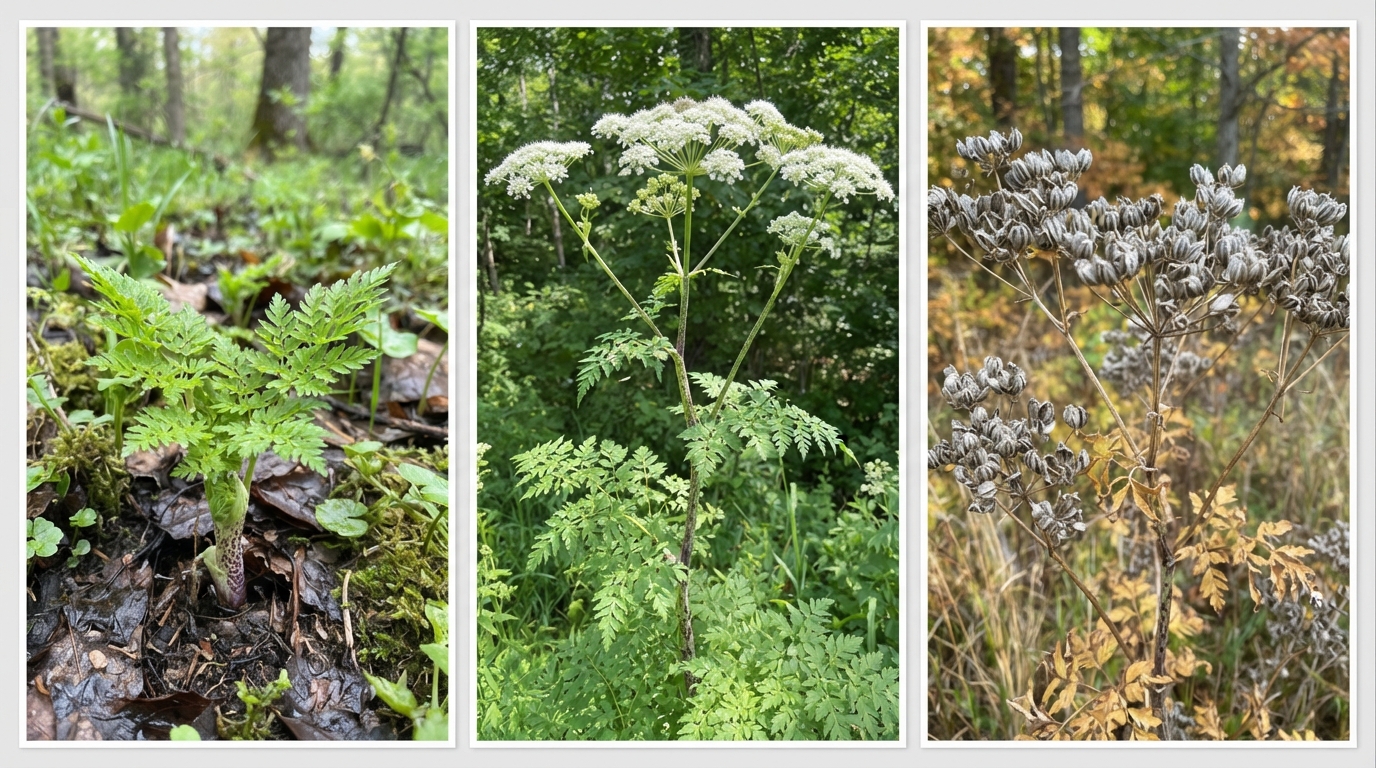
That half-second intervention almost certainly saved his life. What shook him wasn’t the near miss itself — it was the fact that he had identified this exact plant correctly dozens of times in spring, when the stems were young and the purple blotches were more prominent. But in July, at peak flowering, the mature hemlock looked different enough that his brain slotted it into the “familiar edible” category without running the full checklist.
This is the seasonal trap, and it’s responsible for more foraging poisonings than complete misidentification ever will be. You can memorize every plant pair in your field guide and still get caught when the same plant shows up wearing a different outfit in a different month.
The Seasonal Trap — Why Time of Year Changes Everything
Botanists studying plant morphology have documented something that should be obvious but rarely gets emphasized in foraging books: a single toxic plant can present three or four completely different visual profiles across a growing season. The young spring shoot of poison hemlock looks nothing like the towering flowering stalk of midsummer, which looks nothing like the dried seed head of late autumn.
Your brain, meanwhile, is a pattern-matching machine that prioritizes speed over accuracy. When you’ve seen wild carrot in full bloom a hundred times, your visual system learns to trigger “edible” on tall + white umbel + roadside. It stops checking the stem. The hair. The smell. The bracts. This is called confirmation bias, and in foraging, it’s the difference between dinner and the emergency room.
Here is what the seasonal deception landscape actually looks like across a full year:
| Season | What’s Growing | How Toxic Plants Hide | Highest-Risk Mistake | Safety Priority |
|---|---|---|---|---|
| Early Spring (Mar–Apr) | Young shoots, emerging leaves, root vegetables | Toxic shoots resemble edible greens; roots of dormant poisonous perennials look like wild carrots and parsnips | Digging up water hemlock roots thinking they’re wild parsnip | Learn Apiaceae root ID or skip wild roots entirely |
| Late Spring (May–Jun) | Rapid leaf growth, early flowers | Poisonous plants in the carrot family produce leaf rosettes identical to edible parsley and chervil | Grabbing hemlock leaves for wild herb salad | Never harvest Apiaceae family plants by leaves alone |
| Summer (Jul–Aug) | Peak flowers, developing berries | Full bloom umbels of hemlock/water hemlock look like wild carrot and wild parsnip flowers; green berries developing | Misidentifying flowering stalks of toxic plants as edible umbellifers | Stem and bract check on every single umbel plant |
| Late Summer (Aug–Sep) | Ripe berries, mature foliage | Poisonous berries (pokeweed, nightshade, moonseed) ripen alongside wild grapes and blueberries | Children and novice foragers picking toxic berries | Learn the crown/crescent-seed test for all wild berries |
| Fall (Oct–Nov) | Seeds, nuts, late mushrooms, roots | Dried seed heads and tubers of toxic plants look like edible wild seeds and root vegetables | Collecting water hemlock seed heads for “wild spice” or digging dormant toxic roots | Skip all wild Apiaceae seeds unless you’re an expert |
| Winter (Dec–Feb) | Dormant perennials, evergreen plants | Dead stalks and bare vines of toxic species are nearly impossible to identify; some evergreens (yew) are deadly | Grazing on evergreen shrubs or digging “mystery roots” from frozen ground | Don’t eat anything you can’t positively identify — dead of winter is not the time to experiment |
The pattern is clear: every season has its own signature danger, and most foragers only study what plants look like during their prime harvesting window. If you only know what hemlock looks like in July, you won’t recognize it in April.
Spring Dangers — Young Shoots and Roots That Fool Everyone
Spring is when most foraging injuries happen, and here’s why: everything is young, tender, and half-formed. The visual markers you rely on — flower color, mature leaf shape, seed structure — haven’t developed yet. All you have is a green shoot poking out of the ground, and green shoots look remarkably similar across dozens of unrelated species.
The Root Problem
Water hemlock (Cicuta maculata) is considered the most violently toxic plant in North America. A piece of root the size of a walnut can kill an adult in under three hours. In spring, people dig up what they think are wild parsnips or wild carrots — the roots are pale, fleshy, and taproot-shaped — and the young above-ground growth hasn’t yet formed the distinctive compound umbel flowers or veined leaves that would warn them off.
The terrifying detail most guides gloss over: water hemlock roots smell sweet. Not musty like poison hemlock. Sweet, almost like parsnip. The smell test that works for distinguishing wild carrot from poison hemlock (carrot-like vs musty) does not work for water hemlock versus wild parsnip.
Spring Shoot Confusion
Pokeweed (Phytolacca americana) shoots emerge in early spring looking almost exactly like asparagus — thick, fleshy, green-purple spears pushing through last year’s leaf litter. Some old-timers actually do eat very young pokeweed shoots after boiling them in multiple changes of water, a practice called “poke sallet.” But the margin for error is razor-thin: harvest too late, skip a water change, or eat the wrong part, and you’re consuming phytolaccatoxin and lectins that cause violent gastrointestinal distress, respiratory depression, and in severe cases, death.
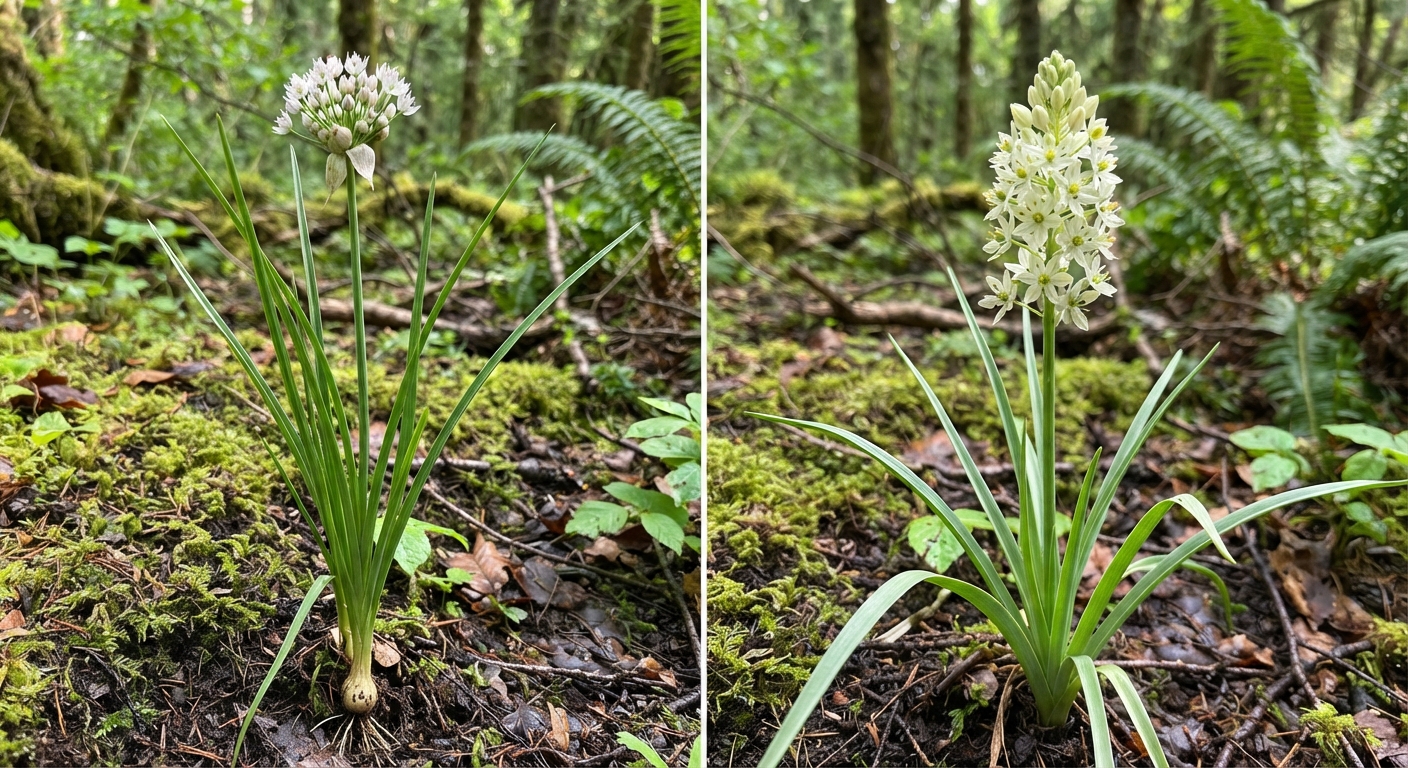
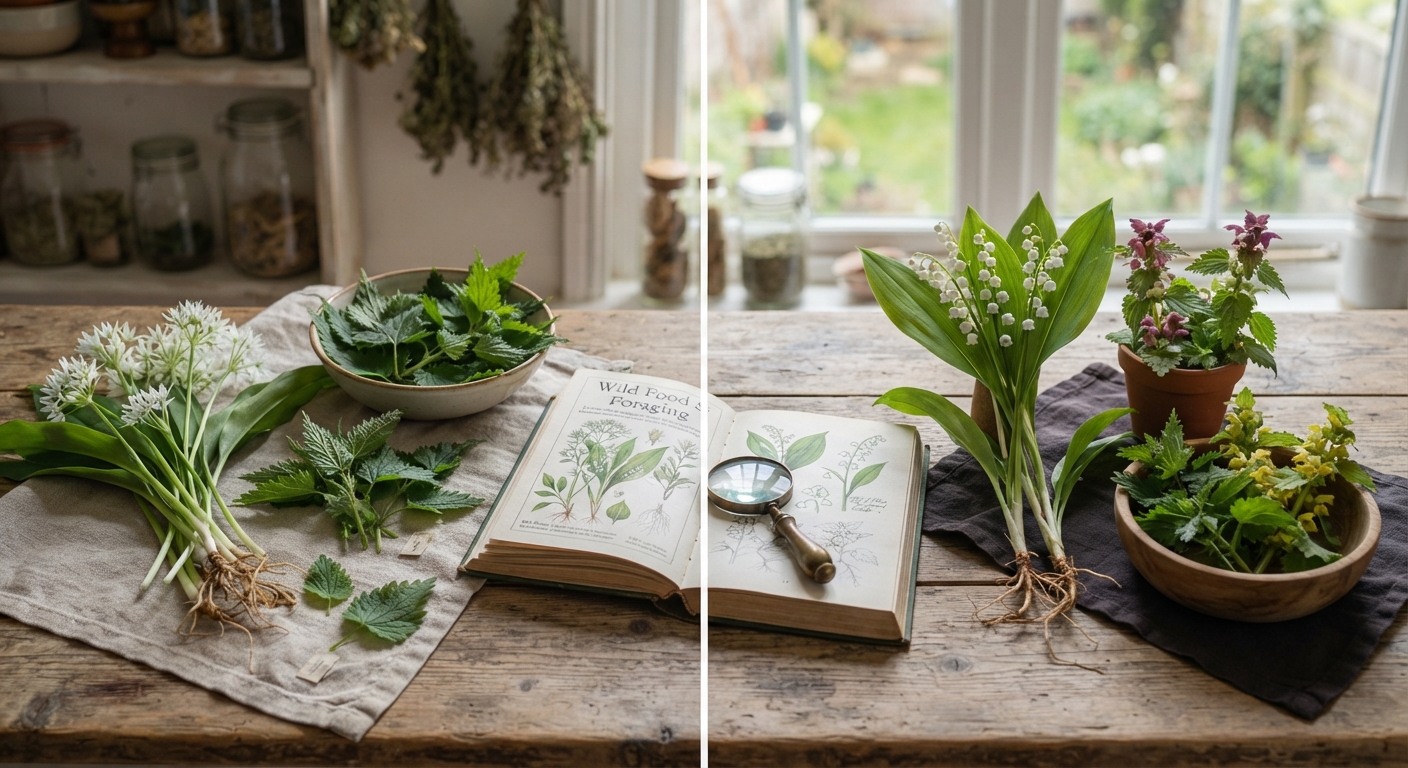
False hellebore (Veratrum species) shoots look like skunk cabbage in their curled, bright-green emergence — and some foragers mistake them for wild leeks or ramps. False hellebore contains steroidal alkaloids that cause severe nausea, vomiting, slowed heart rate, and dangerous drops in blood pressure. Multiple hikers are hospitalized every spring after mistaking these shoots for edible wild onions.
The Spring Safety Rule
If you can’t see flowers, mature leaves, and a stem you can cross-reference against at least two field guides, don’t harvest it in spring. The risk-reward ratio of spring root and shoot foraging is the worst of any season. Wait until the plant has fully leafed out and started flowering before making any identification decision — and by “flowering,” I mean you can see the actual flower structure, not just buds.
Summer Deceptions — Berries, Blooms, and Peak-Growth Confusion
Summer is simultaneously the easiest and most dangerous season for plant identification. Plants are in their most recognizable form — full foliage, open flowers, developing fruit — but they’re also at their most abundant, and abundance breeds carelessness. When you’re surrounded by a hundred flowering plants in a single meadow, the temptation to speed through your ID checklist is overwhelming.
The Berry Window
The late-summer berry season is the single deadliest period for foraging mistakes, and children are disproportionately affected because they’re more likely to eat colorful berries on impulse. Three pairs deserve your complete attention:
Wild blueberries vs pokeweed berries: Wild blueberries have a five-pointed crown on the base — a tiny star-shaped calyx remnant that looks like a miniature crown. Pokeweed berries hang in grape-like clusters from bright magenta stems and lack this crown entirely. Pokeweed also stains your fingers purple-black when crushed; blueberries stain blue. But the most dangerous error is grabbing a handful of mixed plants and not inspecting each berry individually.
Wild grapes vs Canada moonseed: Both produce clusters of dark purple fruit on woody vines in late summer. Moonseed has a single crescent-shaped seed inside each berry. Wild grapes have two to four round, tear-shaped seeds. The difference is invisible from the outside. You must crush every berry between your fingers and look at the seed before eating from an unfamiliar vine. Moonseed tastes bitter and unpleasant even in tiny amounts — but by the time you taste it, you’ve already swallowed a berry containing dauricine, an alkaloid that can cause convulsions and respiratory failure.
Wild cherries vs black nightshade: Wild black cherry (Prunus serotina) produces individual fruits on a central stem (raceme), each with a single large pit. Black nightshade (Solanum nigrum) produces clusters of small berries at branching nodes, each containing dozens of tiny seeds. The confusion usually happens with children who see “small dark berries” and don’t distinguish between the two.
The Flower Trap
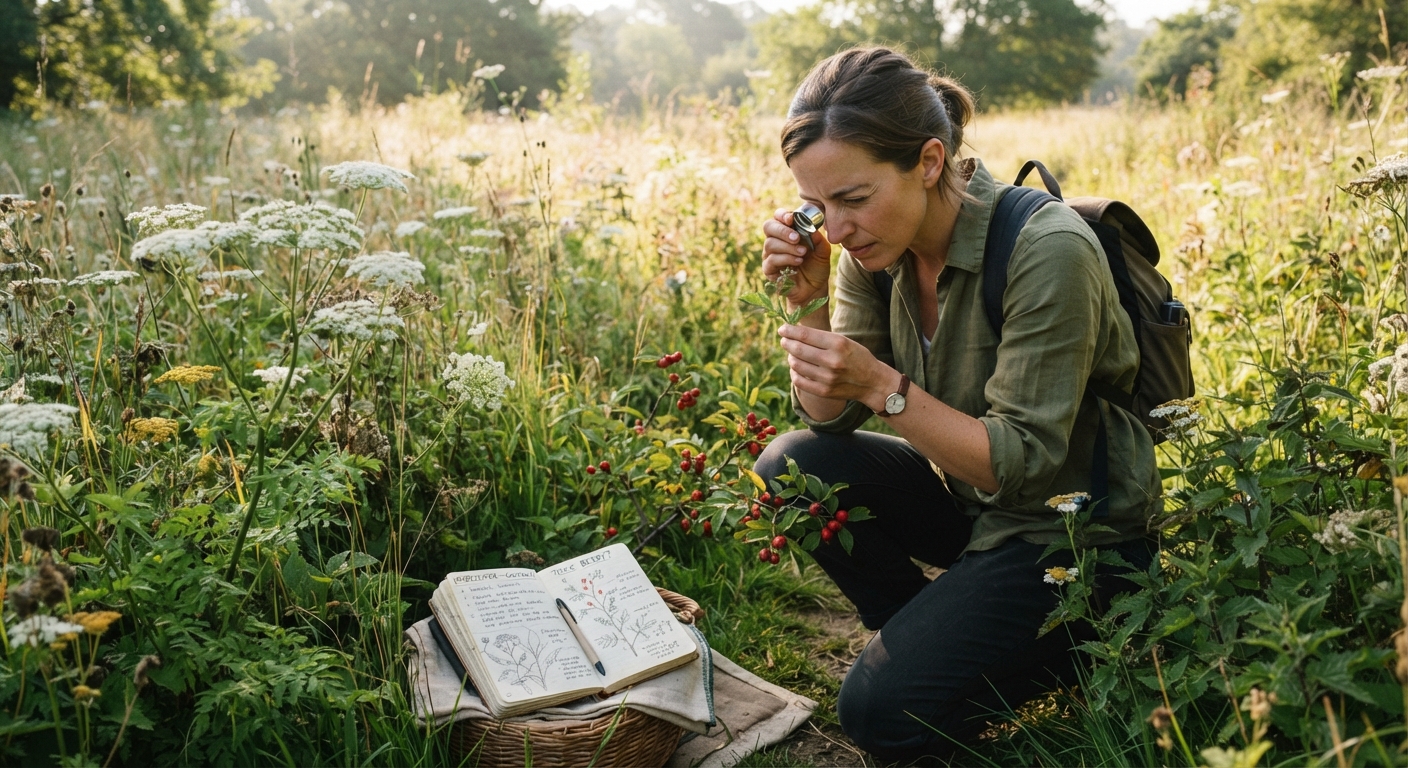
Summer is when the carrot family (Apiaceae) is in full bloom, and this is where things get statistically dangerous. The Apiaceae family contains celery, carrot, dill, fennel, parsley, and parsnip — all perfectly safe. It also contains poison hemlock, water hemlock, fool’s parsley, and giant hogweed — some of which can kill you or leave permanent scars.
The family resemblance is so strong that even botanists use technical features — ribbed fruit structure, bract morphology, stem cross-section — to separate species. The white, umbrella-shaped flower cluster is the one feature that tells you almost nothing about safety.
One practical shortcut that works across the entire family: characteristic odor. Carrot smells like carrot. Dill smells like dill. Fennel smells like anise. If an Apiaceae plant has no distinctive culinary odor when you crush a leaf (away from your face), assume it’s toxic and walk away. This isn’t foolproof — water hemlock can smell sweet — but it eliminates poison hemlock (musty/mousy), fool’s parsley (unpleasant), and giant hogweed (no distinctive odor) from your list.
Fall Hazards — Seeds, Late Fruit, and Hidden Roots
Fall is when foragers shift from greens and berries to nuts, seeds, roots, and mushrooms. It’s also when toxic plants allocate their chemical defenses into seeds and storage roots — the exact parts you’re most likely to harvest.
Seed Head Deception
By October, poison hemlock and water hemlock have dried into brown, hollow stalks topped with umbels of seeds. These dried seed heads look nearly identical to wild carrot seed heads, wild fennel seeds, and dill seeds. People collect them for “wild spice blends” or herbal tea without realizing they’ve just harvested enough coniine or cicutoxin to kill several people.
The dried stalks also pose a different kind of risk: hollow hemlock stems are sometimes used by campers as improvised drinking straws or pea-shooters for kids. Even this level of oral contact — sucking on a hemlock stem — has caused poisoning cases.
Late-Season Root Harvesting
Fall is peak root-harvesting season for edible plants like burdock, wild carrot, chicory, and Jerusalem artichoke. It’s also when water hemlock roots are at their largest and most toxic. A water hemlock root pulled from muddy soil in autumn might weigh over a pound and look indistinguishable from wild parsnip at first glance.
The only reliable field test: slice the root lengthwise. Water hemlock roots often (not always) show horizontal chambers or air pockets when cut open — they look like a series of stacked hollow discs. Wild parsnip and wild carrot roots are solid and uniformly colored throughout. If you see chambers, chambers filled with yellowish oily liquid, or any internal structure that isn’t solid white-to-cream flesh, discard it immediately and wash your knife and hands.
The Mushroom Wildcard
I’ll keep this brief because mushroom identification deserves its own guide, but fall mushroom foraging introduces an entirely separate category of danger. Several deadly Amanita species look like edible field mushrooms in their button stage — before the cap has opened and before the characteristic volva (cup at the base) and ring (annulus) are visible. Young Amanita buttons have fooled experienced mushroom hunters who assumed they were looking at immature Agaricus (field mushroom) or puffballs before cutting them open.
If you forage mushrooms, slice every single one vertically through the center before cooking. An Amanita button will show the outline of an unexpanded cap, gills, stem, and universal veil — a complete mushroom packed inside what looks like a solid white ball.
The 6-Point Field Verification Checklist — Run This Every Time
All of the seasonal warnings above boil down to a single protocol. This isn’t academic theory. It’s the checklist I run on every unfamiliar plant before it goes into my basket, and I run a condensed version even on plants I’ve harvested a hundred times — because the seasonal trap doesn’t care about your experience level.
1. Positive Identification (Not “Looks Like”)
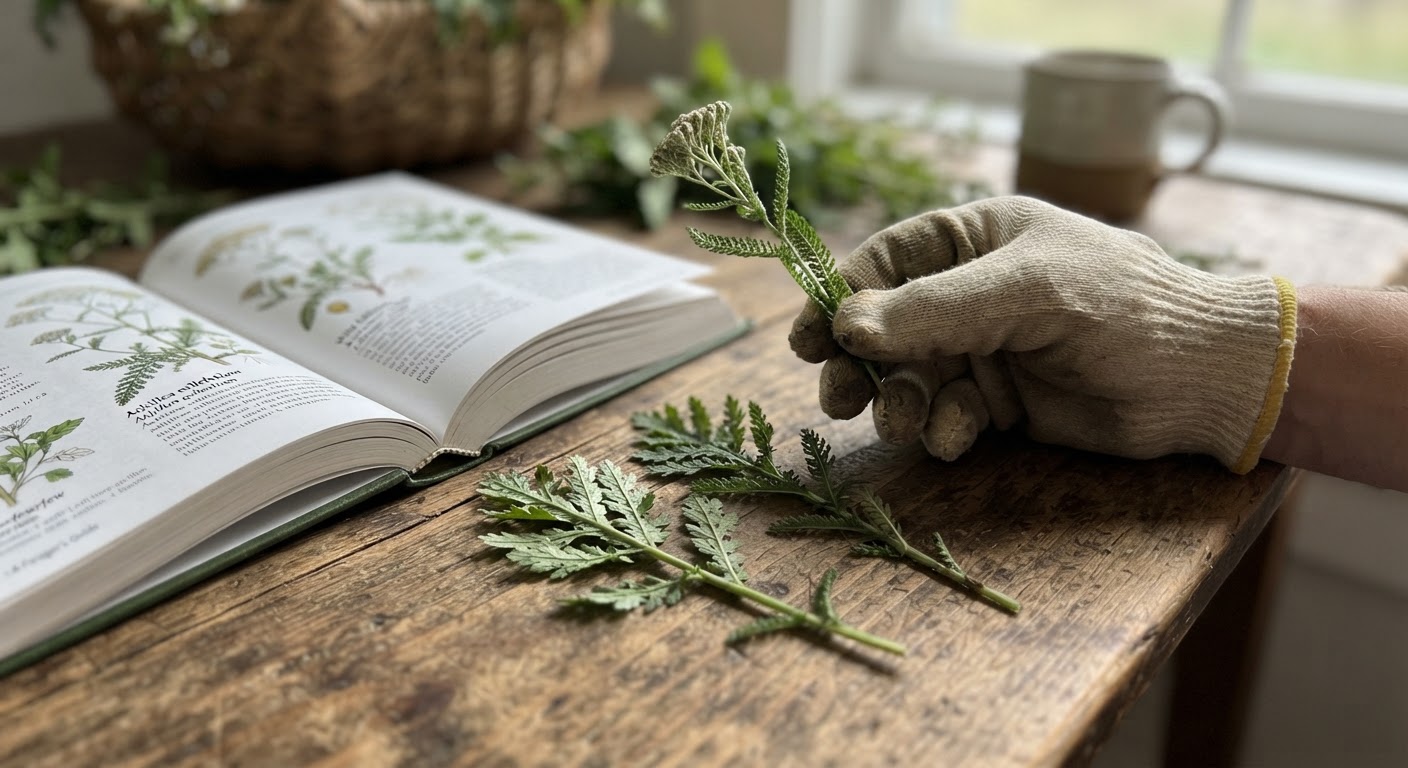
Can you name the exact species — genus and species — with confidence? “Looks like wild carrot” is not identification. “Daucus carota, confirmed by hairy stem, carrot-scented crushed leaf, and three-forked bracts beneath the umbel” is identification. If you can’t write down the Latin name and three confirming features, keep walking.
2. Seasonal Cross-Reference
Have you seen this plant at this exact growth stage before? If you’ve only identified pokeweed with berries in September, you don’t know what pokeweed looks like as a spring shoot. Re-identify any plant that’s at a growth stage you haven’t personally confirmed before. This single rule would prevent most misidentification poisonings.
3. The Stem-and-Sap Check
Break or crush a stem. What does the sap look like? Clear? Milky white? Yellow? What color is the stem cross-section? Is the stem hairy, smooth, ribbed, hollow? Write down three stem characteristics. For the Apiaceae family, the stem is often more diagnostic than the flower or leaf.
4. The Smell Test (At Arm’s Length)
Crush a small leaf or stem piece between your fingers and smell it from at least six inches away. Do not bring it to your nose. What do you smell? Carrot? Anise? Musty? Almond? No scent at all? An almond or peach-pit smell means cyanogenic glycosides — don’t eat it. Musty or mousy means alkaloids — don’t eat it. No distinctive scent from an Apiaceae plant is a red flag.
5. The Tiny-Touch Taste Test (Spit, Don’t Swallow)
Place a fragment the size of a rice grain on the tip of your tongue for two seconds, then spit it out completely. Is it bitter? Burning? Numbing? Soapy? Any unpleasant or medicinal sensation is a stop signal. Rinse your mouth with water afterward. Never do this with mushrooms, unknown berries, or any plant you suspect might be in the Apiaceae family.
6. The Second-Opinion Rule
If you’re alone, take a clear photo of the entire plant (roots, stem, leaves, flowers, fruit) and send it to someone who forages in your region before eating. If you’re with a group, have someone else run the same six-step checklist independently. Two people rarely make the same identification mistake on the same plant.
Plant Family Safety Card
Here’s a quick-reference field card covering the families most likely to produce dangerous lookalikes. Screenshot this, print it, or scribble it into the back of your field guide:
| Plant Family | Edible Members | Deadly Members | Best Single Field Test | Never Confuse With |
|---|---|---|---|---|
| Apiaceae (Carrot/Parsley) | Wild carrot, wild parsnip, dill, fennel, celery | Poison hemlock, water hemlock, fool’s parsley, giant hogweed | Hairy stem + carrot smell = safe. Smooth/purple stem OR no smell = stop. | Any Apiaceae with a smooth or purple-blotched stem |
| Solanaceae (Nightshade) | Tomato, potato (cultivated), pepper | Deadly nightshade, black nightshade, bittersweet nightshade, jimsonweed | Cultivated only — wild Solanaceae should be treated as toxic by default | Never eat wild Solanaceae berries without expert confirmation |
| Liliaceae (Lily/Onion) | Wild garlic, wild onion, ramps, wild leek | Death camas, false hellebore, lily of the valley | Onion/garlic smell when crushed = safe. Grass-like or no smell = danger. | Any “wild onion” that doesn’t smell like onion |
| Fabaceae (Pea/Bean) | Wild pea, vetch, clover, alfalfa | Rosary pea (abrin — extremely toxic), lupine (alkaloids in seeds) | Most are safe — but never eat brightly colored seeds from pods | Rosary pea seeds (red with black spot — one seed can kill) |
| Vitaceae (Grape) | Wild grape, fox grape, muscadine | Canada moonseed (Menispermaceae — different family, similar appearance) | Round multiple seeds = grape. Single crescent seed = moonseed. | Any wild grape-like berry with a single seed |
| Rosaceae (Rose/Apple) | Wild strawberry, blackberry, raspberry, wild apple, wild cherry | Bitter almond, some Prunus species (cyanide in seeds/pits) | Fleshy fruit generally safe; avoid eating seeds, pits, or wilted leaves | Cyanide-containing pits and seeds — don’t chew or swallow them |
When Things Go Wrong — Recognition, Response, Recovery
Even with perfect protocols, accidents happen. Someone in your group eats the wrong berry. Your identification misses something. A child grabs a handful of pokeweed before you can stop them. The next fifteen minutes determine the outcome.
Know What You’re Dealing With
Different plant toxins hit the body on different timelines. Recognizing the pattern speeds up treatment because you can tell the ER exactly what category of toxin they’re dealing with:
| Toxin Category | Example Plants | Onset Time | First Symptoms | Critical Action | What NOT to Do |
|---|---|---|---|---|---|
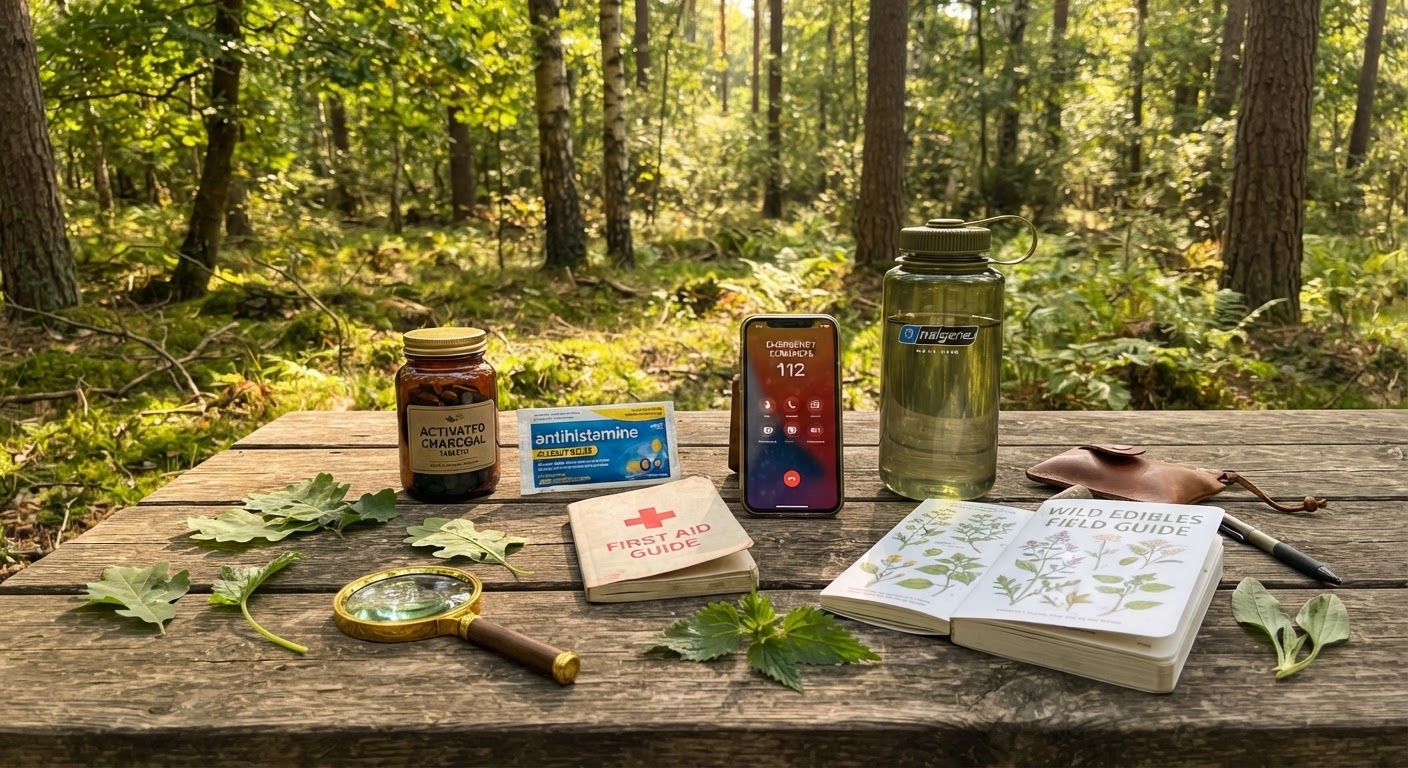
| Alkaloids (coniine, cicutoxin, atropine) | Poison hemlock, water hemlock, deadly nightshade | 15 min–2 hours | Burning mouth, nausea, confusion, dilated pupils, tremors, paralysis | Call 911 immediately. Activated charcoal within 1 hour if conscious. | Do NOT induce vomiting — aspiration risk with neurological toxins. Do not give water if swallowing is impaired. |
| Glycosides (cyanogenic, cardiac) | Wild cherry pits, bitter almond, foxglove, lily of the valley | 30 min–3 hours | Cherry-red skin, rapid then slow heartbeat, headache, confusion | 911 immediately. Cyanide antidote kit at hospital. | Do NOT wait for symptoms to “pass.” Cyanide and cardiac glycosides can cause delayed cardiac arrest. |
| Lectins & Phytotoxins (ricin, abrin, phytolaccatoxin) | Castor bean, rosary pea, pokeweed | 2–6 hours | Severe vomiting, bloody diarrhea, abdominal pain, dehydration | ER immediately. aggressive IV fluid resuscitation. | Do NOT assume vomiting means it’s “out of your system.” Lectins bind to intestinal walls and continue damaging tissue. |
| Oxalates (calcium oxalate crystals) | Jack-in-the-pulpit, dumb cane, philodendron, rhubarb leaves | Immediate–2 hours | Intense burning in mouth/throat, swelling, difficulty swallowing, throat constriction | ER if breathing is affected. Cold water or milk to rinse mouth. | Do NOT induce vomiting. Oxalate crystals cause mechanical damage — vomiting re-injures the esophagus. |
| Contact Toxins (furanocoumarins, urushiol) | Giant hogweed, poison ivy, poison oak, stinging nettle | Minutes–48 hours | Rash, blisters, burning, photosensitivity (hogweed causes severe UV-activated burns) | Wash affected skin with soap and cold water immediately. Avoid sun exposure for 48 hours if hogweed. | Do NOT use hot water — it opens pores and spreads urushiol. Do NOT pop blisters — risk of infection. |
The Golden Hour Protocol
If someone in your foraging group ingests an unknown plant:
- Stop eating immediately. Remove any remaining plant material from their mouth.
- Save the plant. Put the remaining plant — whole, including roots, stems, leaves, and any fruit — into a sealed bag. This is what the ER will use to identify the toxin.
- Photograph the plant in place before uprooting it. The habitat context helps toxicologists.
- Call Poison Control (US: 1-800-222-1222) while heading to medical care. They can identify the plant from your description and tell the ER what to prepare.
- Do not induce vomiting unless Poison Control specifically tells you to. With many plant toxins, vomiting makes things worse.
- Note the time of ingestion and any symptom progression. Write it down. You’ll be asked for this timeline.
Questions I Get at Every Foraging Workshop
After the field walks and the identification drills, when everyone’s sitting around eating wild-greens pesto on crackers, the same questions come up every single time. Here they are, answered the way I answer them in person.
“Can I just use a plant ID app instead of learning all this?”
I love plant ID apps. I use them myself — as a starting point, never as the final word. Apps like iNaturalist, PlantNet, and Seek are trained on user-submitted photos, which means they’re only as accurate as the community that verifies the IDs. They’re especially unreliable with young plants, partial shots (leaves only, no flowers), and rare species. Use an app to narrow down the possibilities, then run your six-point checklist. An app gives you a suggestion. The checklist gives you a decision.
“What’s the one plant I should absolutely never mess with no matter what?”
If I had to pick one plant family to blacklist for beginners, it’s the Apiaceae — the carrot family. Every single year, someone foraging in North America eats poison hemlock or water hemlock thinking it’s wild carrot, wild parsnip, or wild fennel. Some of them don’t survive. The family resemblance across Apiaceae is so strong that you can spend an entire summer studying them and still hesitate. Until you’ve foraged for at least two full seasons and can identify poison hemlock, water hemlock, and giant hogweed at every growth stage, treat every white-umbel roadside plant as “look, don’t touch.”
“What about plants that are only toxic when raw? Does cooking fix everything?”
Cooking neutralizes some plant toxins but not others. Boiling in multiple changes of water can leach out water-soluble toxins like the oxalates in pokeweed — but it does nothing to alkaloids like coniine in poison hemlock, which are heat-stable. Baking or roasting actually concentrates some toxins by driving off water. Never assume cooking makes a plant safe. Different toxins respond differently to heat, and you need to know which category you’re dealing with before you turn on the stove.
“How do I teach my kids about poisonous plants without scaring them away from nature?”
This is the question I get from parents more than any other. My approach: frame it as a game of “expert detective.” Kids love being the one who knows something important. Teach them three never-eat rules — never eat any berry without showing an adult the crown on the base, never eat any plant that smells like almonds, never eat any plant with white umbrella flowers. That’s it. Three rules. When they spot one of those, they get to be the expert who warns the group. Make them the hero of the safety story, not the victim of a scary lesson. My seven-year-old niece can now spot poison hemlock from the back seat of a moving car and announces it with more pride than she shows for her school grades.
“Is it true that birds eating a berry means it’s safe for humans?”
No. This is one of the most persistent and dangerous myths in foraging. Birds and mammals have completely different digestive systems and different tolerances for plant toxins. Birds eat pokeweed berries, poison ivy berries, and nightshade berries regularly. Their digestive tracts process these seeds without absorbing the toxins, and they lack the receptor sites that many plant alkaloids target in mammals. If anything, seeing a plant covered in bird droppings below berries should make you more careful — the birds are dispersing seeds from a plant that mammals evolved to avoid.
The Bottom Line — Build Your Safety Net Before You Need It
Here’s what I want you to take away from everything above: the plants aren’t trying to trick you. They’re not malevolent. They evolved chemical defenses over millions of years to avoid being eaten by insects and mammals, and the resemblance between toxic and edible species is usually a coincidence of family relationships, not mimicry. The fault isn’t in the plants. It’s in the shortcut-seeking brain that says “close enough” when the consequences of “close enough” can be catastrophic.
The antidote isn’t fear. It’s protocol. Build a personal identification system that doesn’t rely on memorizing what a plant looks like at one moment in one season. Use the six-point checklist. Cross-reference with another forager when you can. Keep a logbook of what you harvest, when, and from where — over time, that log becomes more valuable than any field guide because it’s calibrated to your specific region, your specific seasons, and your specific foraging spots.
I’ve been doing this for years, and I still run the stem check on every single carrot-family plant I encounter. I still crush a grape between my fingers to check the seed shape before I eat from an unfamiliar vine. The goal isn’t to get good enough to skip the checks. The goal is to get fast enough that the checks become automatic.
Foraging is the most rewarding way to connect with the landscape around you. It’s also a practice where the stakes for shortcuts are final. Build the habits now, in the slow season, when you’re reading and studying — so that when you’re standing in a July meadow with a basket in one hand and an unknown plant in the other, the checklist runs itself.
Stay curious. Stay methodical. And never, ever trust a smooth-stemmed carrot.