Oyster Mushroom Foraging: The Complete Guide to Finding, Identifying, and Cooking Wild Pleurotus
If I could only recommend one mushroom for beginners to hunt, it would be the oyster mushroom. No contest. Here’s why: oyster mushrooms are abundant across North America and Europe, they grow year-round in many regions, they have distinctive features that make identification relatively straightforward, and — perhaps most importantly — they’re absolutely delicious.
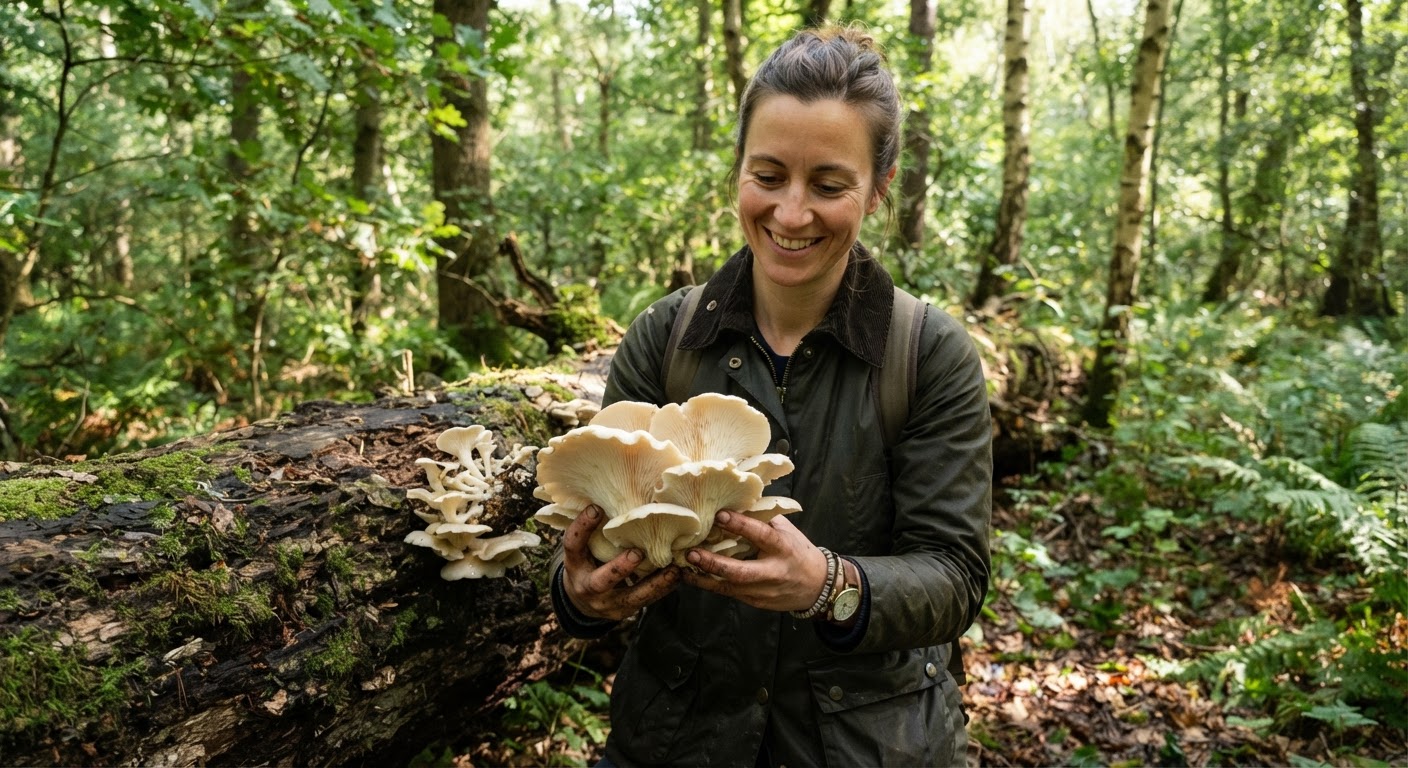
I’ve been foraging oyster mushrooms for over a decade, and they still surprise me. I’ve found them growing on dead elm trees in city parks, bursting from old cottonwood logs along riverbanks, and once — memorably — covering an entire fallen oak after a rainy autumn week. The patch weighed nearly twelve pounds.
This guide covers everything I’ve learned about finding, identifying, and cooking wild oyster mushrooms. Whether you’re brand new to mushroom hunting or you’ve already got a few chanterelle seasons under your belt, you’ll find practical field-tested advice here.
What Are Oyster Mushrooms?
Oyster mushrooms belong to the genus Pleurotus, a group of wood-decaying fungi found on every continent except Antarctica. The name comes from their resemblance to oysters — both in shape and, some say, in their subtle seafood-like flavor when cooked.
There are several species foragers commonly encounter:
| Species | Common Name | When to Find | Key Feature |
|---|---|---|---|
| Pleurotus ostreatus | Pearl oyster | Fall through early spring | Pale gray-brown caps, white gills |
| Pleurotus pulmonarius | Summer oyster | Late spring through summer | Lighter color, smaller, prefers warmer weather |
| Pleurotus citrinopileatus | Golden oyster | Summer through fall | Bright yellow caps, unmistakable color |
| Pleurotus eryngii | King oyster | Fall through winter | Thick stem, small cap, grows from roots |
| Pleurotus dryinus | Veiled oyster | Summer through fall | Partial veil on young specimens |
| Pleurotus populinus | Aspen oyster | Spring through early summer | Grows specifically on aspen and cottonwood |
The pearl oyster (P. ostreatus) is the species you’ll most likely encounter in the wild. It’s also the one cultivated commercially, so if you’ve bought “oyster mushrooms” at a grocery store, you already know what to look for.
Understanding Their Ecological Role
Oyster mushrooms are saprotrophic, meaning they feed on dead or dying wood. They play a critical role in forest ecosystems by breaking down lignin and cellulose — the tough structural compounds in wood — and returning nutrients to the soil.
This ecological preference tells you exactly where to search. Oyster mushrooms aren’t mycorrhizal like chanterelles or porcini, which form symbiotic relationships with living tree roots. You won’t find oysters scattered across the forest floor. You’ll find them on wood — specifically dead or dying hardwoods.
Where to Find Oyster Mushrooms
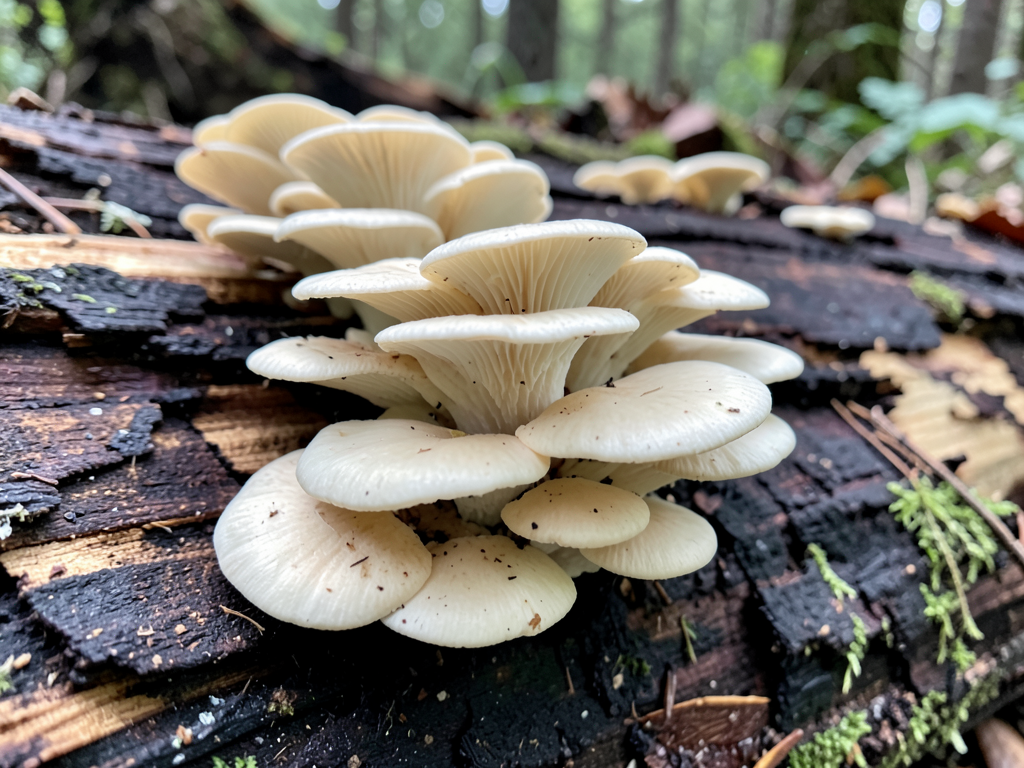
Knowing where to look eliminates about 80% of the guesswork. Here’s what decades of field experience has taught me about oyster mushroom habitat.
Preferred Tree Species
Oyster mushrooms favor hardwoods over conifers. The trees I’ve had the most consistent success with:
- Elm — By far the most reliable host. Dead standing elms and recently fallen elms are oyster magnets, especially in riparian zones.
- Cottonwood and Aspen — Particularly in western North America. Cottonwood logs along riverbanks are incredibly productive.
- Oak — Older dead oaks with bark still attached often produce large flushes.
- Maple — Especially sugar maple and box elder.
- Beech — In northeastern forests.
- Willow — Along streams and in wet meadows.
The Time Factor
Here’s something most guides don’t emphasize enough: timing matters just as much as location. Oyster mushrooms appear after rain when temperatures are moderate. A dry spell followed by a good soaking rain is the ideal trigger.
For pearl oysters (P. ostreatus), the sweet spot is when daytime highs are between 50°F and 65°F (10°C–18°C). This means:
- Fall: Late September through November in most temperate regions — peak season.
- Winter: In milder climates (USDA zones 7–9), oysters fruit throughout winter, often after warm spells between cold snaps.
- Early spring: March through April, before trees leaf out — an underrated window.
Summer oyster mushrooms (P. pulmonarius) fill in the warm-weather gap, fruiting from May through August when nights stay above 60°F.
Where to Actually Walk
Don’t wander aimlessly through the woods. Target these specific habitats:
- Floodplains and river bottoms — Cottonwoods, elms, and willows in these areas are oyster mushroom factories.
- Old logging roads — Disturbed areas with dead hardwoods.
- Recent windfalls — Trees that fell 1–3 years ago are in prime decomposition stage.
- Urban parks and greenbelts — City parks with mature hardwoods often harbor oysters. I’ve found them growing on dead elms in downtown Denver.
- The edge effect — Forest edges, where trees receive more wind and light, seem to produce more mushrooms than deep interior forest.
A Note on Seasonality
One of the best things about oyster mushrooms is that you can find them almost year-round. In my area (USDA zone 6), I start checking cottonwood logs in late March, switch to summer oysters near rivers in June, hit peak pearl oyster season in October, and continue finding them on warm winter days through February. Very few edible mushrooms offer that kind of window.
How to Identify Oyster Mushrooms
Identification is where most beginners get nervous — and rightfully so. Mushroom misidentification can have serious consequences. But oyster mushrooms have a combination of features that, taken together, make them one of the easier wild mushrooms to identify with confidence.
The Diagnostic Checklist
Run through these six features every time you find a candidate:
1. Growth Habit — Shelf-Like Clusters on Wood
Oyster mushrooms grow in overlapping, shelf-like clusters directly on wood. They don’t grow solitary. They don’t grow from soil. If you find a single mushroom standing upright from the ground with a central stem, it’s not an oyster mushroom.
Look for clusters of multiple caps emerging from a single point, like a fan of playing cards.
2. The Cap — Shell or Fan-Shaped
Caps are typically 2–8 inches (5–20 cm) across, shaped like an oyster shell or a fan. The margin is often somewhat wavy or lobed when mature. Young specimens have a more inrolled margin. Colors range from pale grayish-brown to cream to tan. Golden oysters are bright yellow — there’s no mistaking them.
3. The Gills — Decurrent and White to Cream
This is the single most important identification feature. Oyster mushroom gills run down the stem (technically called “decurrent” attachment). They don’t stop at the cap margin. They continue down onto the stubby stem, sometimes all the way to the point of attachment.
The gills should be white to cream-colored, close together, and should not bruise or change color when handled.
4. The Stem — Eccentric, Short, or Absent
Oyster mushrooms have stems that are off-center (eccentric), very short, or sometimes completely absent. The cap attaches almost directly to the wood. When a stem is present, it’s typically thick, white, and fuzzy at the base.
5. Spore Print — White to Pale Lilac
Take a spore print. Place a mature cap gills-down on a piece of dark paper (or half-black, half-white paper), cover with a bowl, and wait 4–8 hours. Oyster mushrooms produce a white to pale lilac-gray spore print. This is a critical safety step because several potential lookalikes produce different-colored spores.
6. Smell — Mildly Mushroomy with a Hint of Anise
Fresh oyster mushrooms have a pleasant, mild mushroom aroma, often with a faint note of anise or licorice. They should never smell foul, fishy, or chemical.
The “All Features” Rule
No single feature identifies an oyster mushroom. You need the full combination: shelf-like clusters on wood + oyster-shaped caps + decurrent white gills + eccentric stem + white spore print + mild smell. If all six align, you can be confident. If even one doesn’t match, walk away.
Dangerous Lookalikes to Know
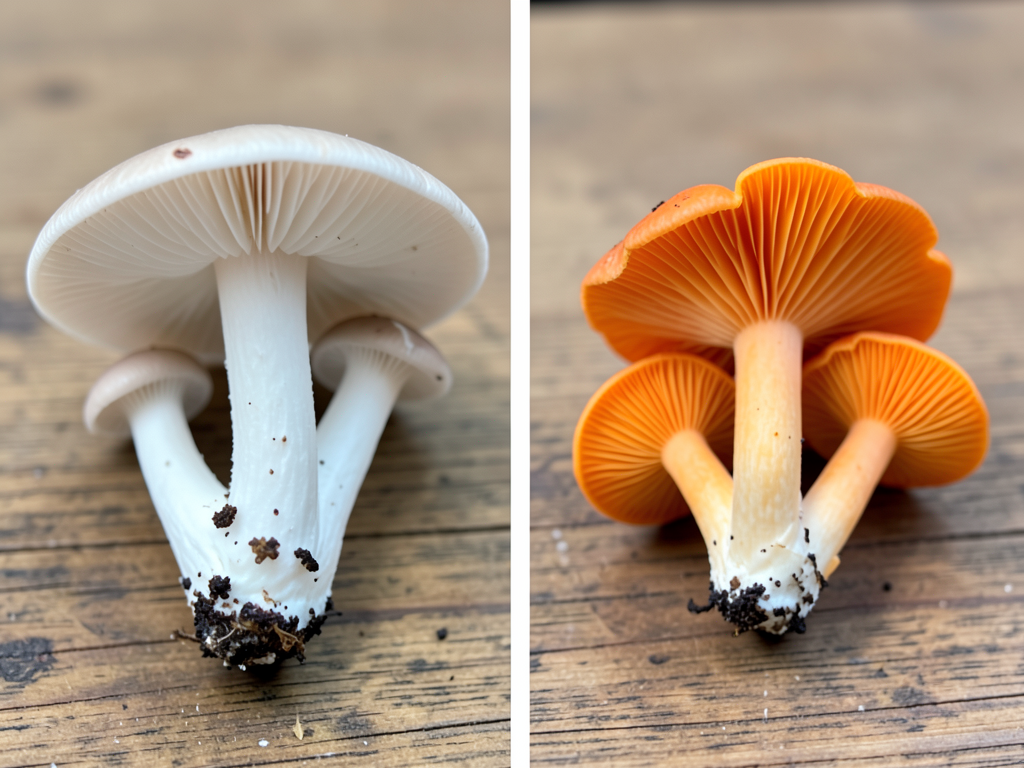
This is the section that keeps people safe. Read it carefully.
The Jack-O’-Lantern Mushroom (Omphalotus olearius)
This is the most important lookalike to learn — and the one that has poisoned people who didn’t do their homework.
| Feature | Oyster Mushroom | Jack-O’-Lantern |
|---|---|---|
| Habitat | On dead/dying hardwoods | At base of oaks or on buried wood |
| Gills | Run down stem (decurrent) | Stop at stem, sharply defined |
| Color | Pale to gray-brown | Bright orange to orange-yellow |
| Spore print | White to pale lilac | Yellow to cream |
| Bioluminescence | None | Gills glow faintly green in total darkness |
| Taste | Mild, pleasant | Acrid, bitter |
Jack-o’-lanterns are poisonous — they’ll give you severe gastrointestinal distress, vomiting, and diarrhea for 24–48 hours. They won’t kill you, but you’ll wish they had.
The spore print is your definitive test. White spores = oyster. Yellow spores = jack-o’-lantern. Don’t skip this step.
Angel Wings (Pleurocybella porrigens)
Angel wings look strikingly similar to oyster mushrooms — white, shelf-like, growing on wood. They were historically considered edible, but a series of fatal poisonings in Japan in 2004 linked them to acute encephalopathy in elderly patients with kidney problems.
Key differences:
- Angel wings are pure white (not grayish or brownish).
- They’re thinner and more fragile than oyster mushrooms.
- They grow primarily on conifer wood (especially hemlock), not hardwoods.
- The flesh is notably thinner and more translucent.
My rule: if it’s pure white and growing on conifer wood, I pass. Not worth the risk.
Crepidotus Species
Several Crepidotus species are small, brown-spored fungi that grow on wood and can superficially resemble small oyster mushrooms. Key differences:
- Much smaller, typically under 1.5 inches across.
- Brown spore print (critical differentiator).
- Cap surface often fuzzy or hairy.
The Golden Rule
When in doubt, take a spore print and compare ALL features. If anything gives you pause, take photos and consult an experienced forager or a reputable online identification group. No mushroom is worth a trip to the emergency room.
How to Harvest Oyster Mushrooms
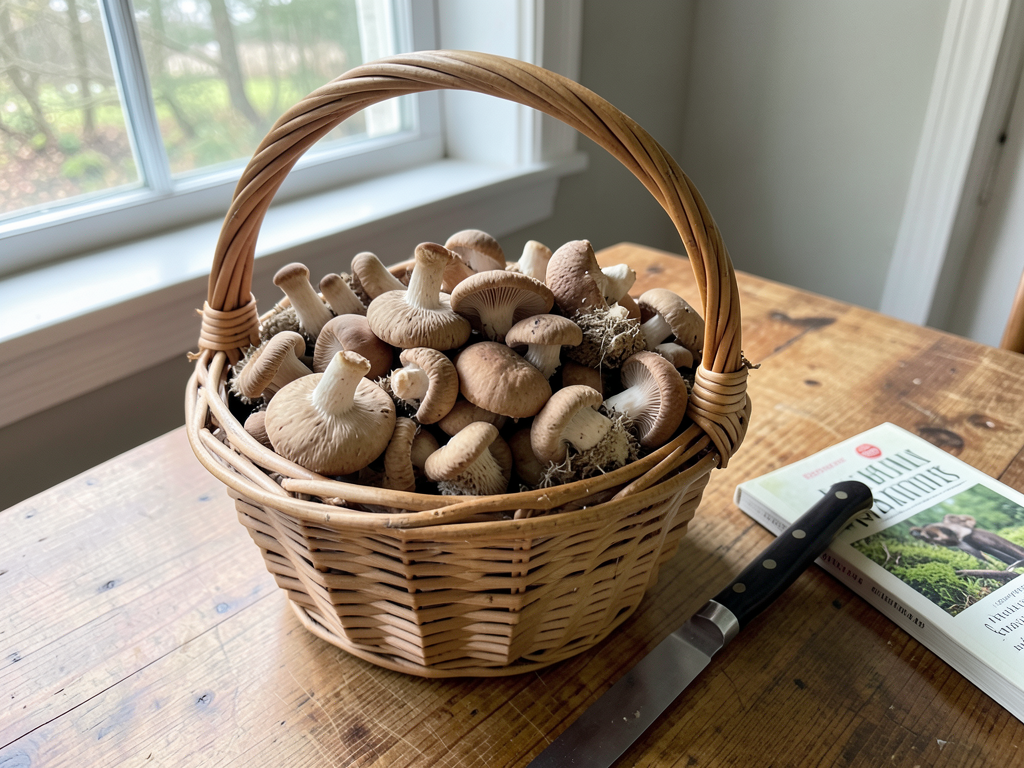
Harvesting oyster mushrooms is straightforward, but a few techniques make a big difference in quality and sustainability.
The Twist-and-Pull Method
For oyster mushrooms growing on logs or standing dead trees, grip the entire cluster at the base and gently twist while pulling. Oyster mushrooms are softer than most wild mushrooms and will release fairly easily. Avoid using a knife to cut through the base — the remaining stem tissue can rot and reduce future flushes.
What to Leave Behind
- Tiny pins: Leave developing primordia (baby mushrooms) to grow. They’ll double in size in 24–48 hours.
- Old, waterlogged specimens: Mushrooms that are slimy, bug-infested, or starting to decay aren’t worth collecting.
- Part of the cluster: If the cluster is large, harvest the prime specimens and leave the smaller ones for later or for wildlife.
The Right Container
Use a basket or mesh bag — never plastic. Oyster mushrooms need airflow. In a plastic bag, they’ll steam, turn slimy, and spoil within hours. A wicker basket or reusable mesh produce bag keeps them fresh and allows spores to drop as you walk, potentially seeding new patches.
Storage Timeline
- At room temperature: Use within 12–24 hours.
- In the refrigerator: Place in a paper bag (not plastic) in the crisper drawer. Use within 3–5 days.
- For longer storage: Oyster mushrooms dry beautifully in a dehydrator at 110°F for 6–8 hours. Dried oysters rehydrate with a 15-minute soak in warm water and retain excellent texture.
A Note on Sustainable Harvesting
Oyster mushrooms are remarkably resilient. They fruit prolifically and regenerate quickly. That said, always leave something behind: enough to sporulate, enough for wildlife, enough for the next forager. Take what you’ll actually use. A 12-pound haul is exciting until you realize you can’t possibly eat it all before it spoils.
Cleaning and Preparing Oyster Mushrooms
Oyster mushrooms are among the easiest wild mushrooms to clean because they don’t trap nearly as much debris as, say, morels or chanterelles.
Cleaning Method
- Dry brush first: Use a soft brush or paper towel to gently remove any visible debris, bark fragments, or insects.
- Quick rinse if needed: If the mushrooms have significant grit, a quick rinse under cold running water is fine. Contrary to persistent myth, mushrooms don’t “absorb” significant water during a brief rinse.
- Pat dry: Blot with a clean kitchen towel.
- Trim the base: Cut off the tough, woody attachment point where the cluster connected to the wood.
That’s it. Don’t soak them, don’t peel them, don’t overcomplicate it.
The Stem Question
Oyster mushroom stems are edible but can be tough, especially in larger, more mature specimens. For young oysters, the entire mushroom is tender. For larger ones, I separate the caps from the stems. Stems can be sliced thin and cooked longer, or dried and powdered to use as an umami seasoning.
How to Cook Oyster Mushrooms
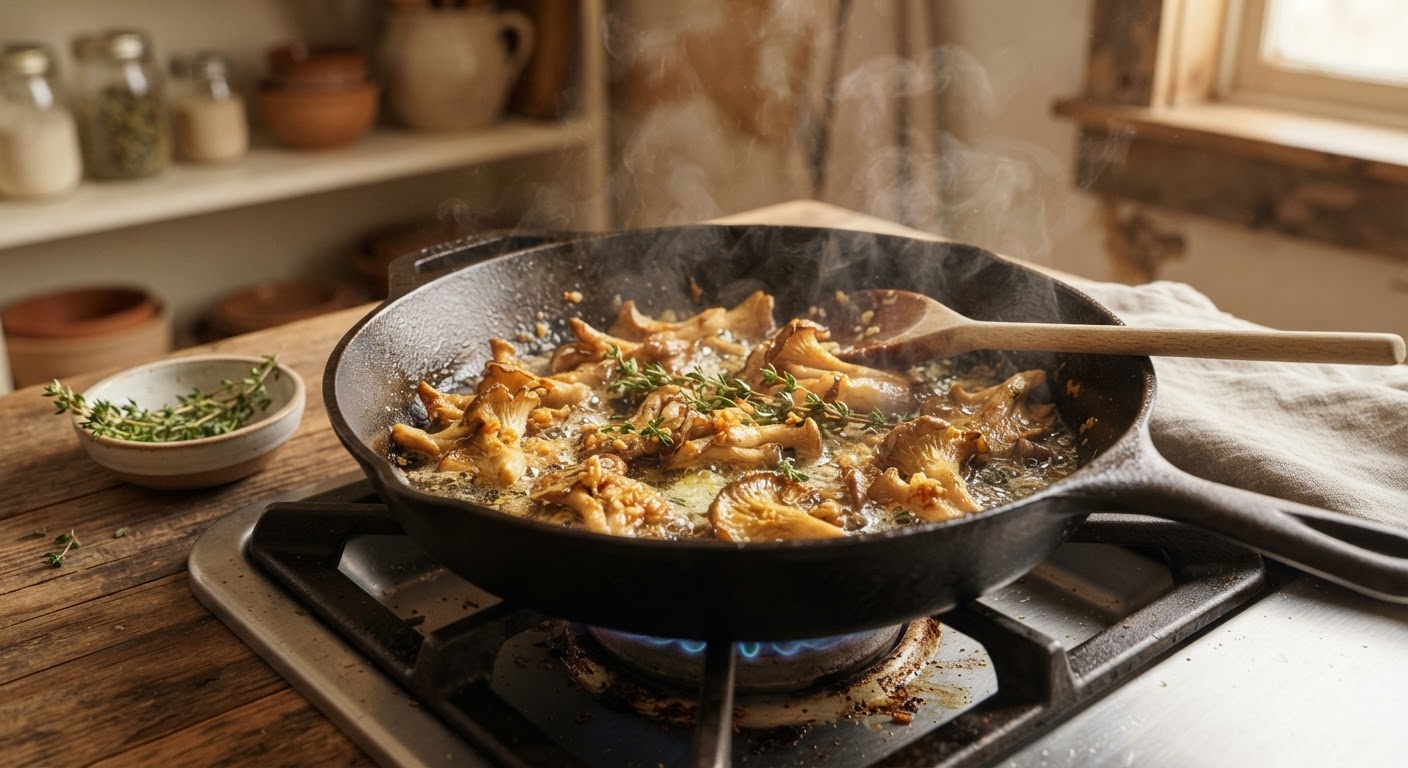
This is the payoff. Wild oyster mushrooms have a mild, savory flavor with a hint of sweetness and that subtle seafood note that gives them their name. Their texture is tender yet meaty — they hold up beautifully in cooking.
The Golden Rule of Cooking Oyster Mushrooms
High heat, don’t crowd the pan. This is the mistake most people make. They pile mushrooms into a cold pan, the mushrooms release water, and they end up steaming in their own liquid. The result is rubbery, sad mushrooms.
Instead: heat your pan over medium-high heat, add oil or butter, and add mushrooms in a single layer with space between pieces. Let them sear undisturbed for 2–3 minutes before stirring. They’ll develop golden-brown edges and a rich, nutty flavor.
Simple Garlic Butter Oysters (The Best Introduction)
The simplest preparation is often the best:
- Heat 2 tablespoons butter and 1 tablespoon olive oil in a large skillet over medium-high.
- Add sliced oyster mushrooms in a single layer. Don’t stir for 2 minutes.
- Flip, add 3 minced garlic cloves and a pinch of salt. Cook 2 more minutes.
- Add fresh thyme and a squeeze of lemon. Serve immediately.
This takes about 7 minutes total and it’s better than most restaurant mushroom dishes I’ve eaten.
Other Cooking Methods
- Roasted: Toss with olive oil, salt, and pepper. Roast at 425°F for 15–20 minutes until crispy-edged.
- Grilled: Whole oyster mushroom clusters take well to the grill. Brush with oil, grill over medium heat for 3–4 minutes per side.
- Soups and stews: Add during the last 10 minutes of cooking to preserve texture.
- “Pulled pork” style: Shred larger oyster mushroom clusters, season with barbecue spices, and roast until crispy. Makes an excellent plant-based sandwich.
- Cream sauce: Sauté mushrooms first, then add cream, Parmesan, and pasta water for an incredible pasta dish.
Flavor Pairings
Oyster mushrooms work beautifully with: garlic, butter, thyme, rosemary, parsley, shallots, white wine, soy sauce, sesame oil, cream, Parmesan, lemon, black pepper, and smoked paprika. Their mild flavor makes them incredibly versatile.
Common Mistakes Beginners Make
Learn from my errors and those I’ve seen other foragers make:
-
Not checking the tree species — Finding a shelf-like mushroom on conifer wood and assuming it’s an oyster. Angel wings grow on conifers. Oysters grow on hardwoods. Pay attention.
-
Skipping the spore print — “It looks right” is not a safety protocol. Spore prints take 4 hours. A trip to the ER takes a lot longer.
-
Harvesting waterlogged specimens — After days of heavy rain, oyster mushrooms absorb water and become mushy and flavorless. Wait 24 hours after rain stops for the best quality.
-
Storing in plastic — This ruins them faster than anything else. Always use paper bags or breathable containers.
-
Crowding the pan — Steaming instead of searing produces a slimy texture that puts people off wild mushrooms forever.
-
Confusing old specimens — Oyster mushrooms that are past their prime can look significantly different from fresh ones — faded color, upturned margins, tougher texture. When in doubt, leave it.
Frequently Asked Questions
Can oyster mushrooms be eaten raw?
Technically yes, but I don’t recommend it. Raw oyster mushrooms contain small amounts of compounds that can cause mild gastric upset in some people. Cooking also improves flavor and digestibility. Always cook wild mushrooms.
Do oyster mushrooms grow on the same tree every year?
Often, yes. Oyster mushrooms will fruit repeatedly from the same log or stump for 2–4 years until the wood’s nutrients are exhausted. Mark productive spots on a map or GPS — they’re worth revisiting.
How can I tell if oyster mushrooms have gone bad?
Slimy texture, sour or fishy smell, visible mold, or dark discoloration are all signs of spoilage. Fresh oyster mushrooms should feel dry to slightly moist, not wet, and should smell pleasantly mushroomy.
Are there any poisonous oyster mushroom lookalikes in the UK/Europe?
Yes — the ghost fungus (Omphalotus nidiformis) in Australia and parts of Asia (bioluminescent, toxic), and angel wings (Pleurocybella porrigens) in Europe and North America. Always use the full identification checklist.
Can I cultivate oyster mushrooms from wild specimens?
Absolutely. Oyster mushrooms are among the easiest mushrooms to cultivate. You can clone wild specimens onto agar, expand to grain spawn, and fruit on pasteurized straw, coffee grounds, or hardwood sawdust. What you harvest from the wild can become an endless supply at home.
What’s the best time of day to forage oyster mushrooms?
Morning, ideally after a night of moderate temperatures and high humidity. Mushrooms are plump and fresh early in the day. By afternoon, especially in sunny spots, they can start drying out or becoming bug-infested.
Why are my oyster mushrooms bitter after cooking?
Bitterness typically comes from one of two things: either you’ve accidentally collected a lookalike (jack-o’-lanterns are distinctly bitter), or you’ve overcooked the mushrooms. Pearl oysters can develop slight bitterness at very high, prolonged heat. Medium-high heat for 4–6 minutes total is the sweet spot.
Key Takeaways
Oyster mushroom foraging is one of the most accessible entry points into wild mushroom hunting. Here’s what to remember:
- Look for shelf-like clusters on dead hardwoods — elm, cottonwood, oak, and maple are your best bets.
- Fall is peak season, but you can find oysters year-round in many regions.
- Use the full 6-point checklist: growth habit, cap shape, decurrent gills, stem type, white spore print, and mild smell.
- Jack-o’-lantern mushrooms are the most dangerous lookalike — verify with a spore print.
- Cook with high heat in a single layer for the best texture and flavor.
- Mark your spots — productive logs fruit for years.
Start with the identification basics, build confidence with a few successful finds, and soon you’ll be the person other foragers ask for oyster mushroom tips. There’s nothing quite like pulling up to a dead elm and seeing those pale caps fanning out from the trunk — except maybe eating them 30 minutes later, still warm from the pan.
Happy foraging.
Always consult multiple reliable field guides and, when possible, learn from experienced local foragers before consuming any wild mushroom. When in doubt, throw it out.