Spinach costs $3.99 a bunch at the grocery store. Lambsquarters — a plant that beats spinach on protein, calcium, vitamin A, and vitamin C — is probably growing through a crack in your driveway right now, for free.
This isn’t one of those “eat weeds to save money” gimmicks where the food is edible but not enjoyable. Lambsquarters (Chenopodium album) is legitimately good. It tastes like spinach with a slightly nuttier, more mineral-rich edge. It doesn’t go slimy when you cook it. And the nutritional profile reads like someone designed it in a lab: more calcium than cow’s milk by dry weight, more vitamin A than carrots, and protein levels that embarrass most leafy greens.
The only problem? Most people pull it out and throw it in the compost.
Here are eight reasons to stop doing that — plus the cooking methods, harvesting rules, and mistakes to avoid.
Quick ID: Spotting Lambsquarters in 30 Seconds
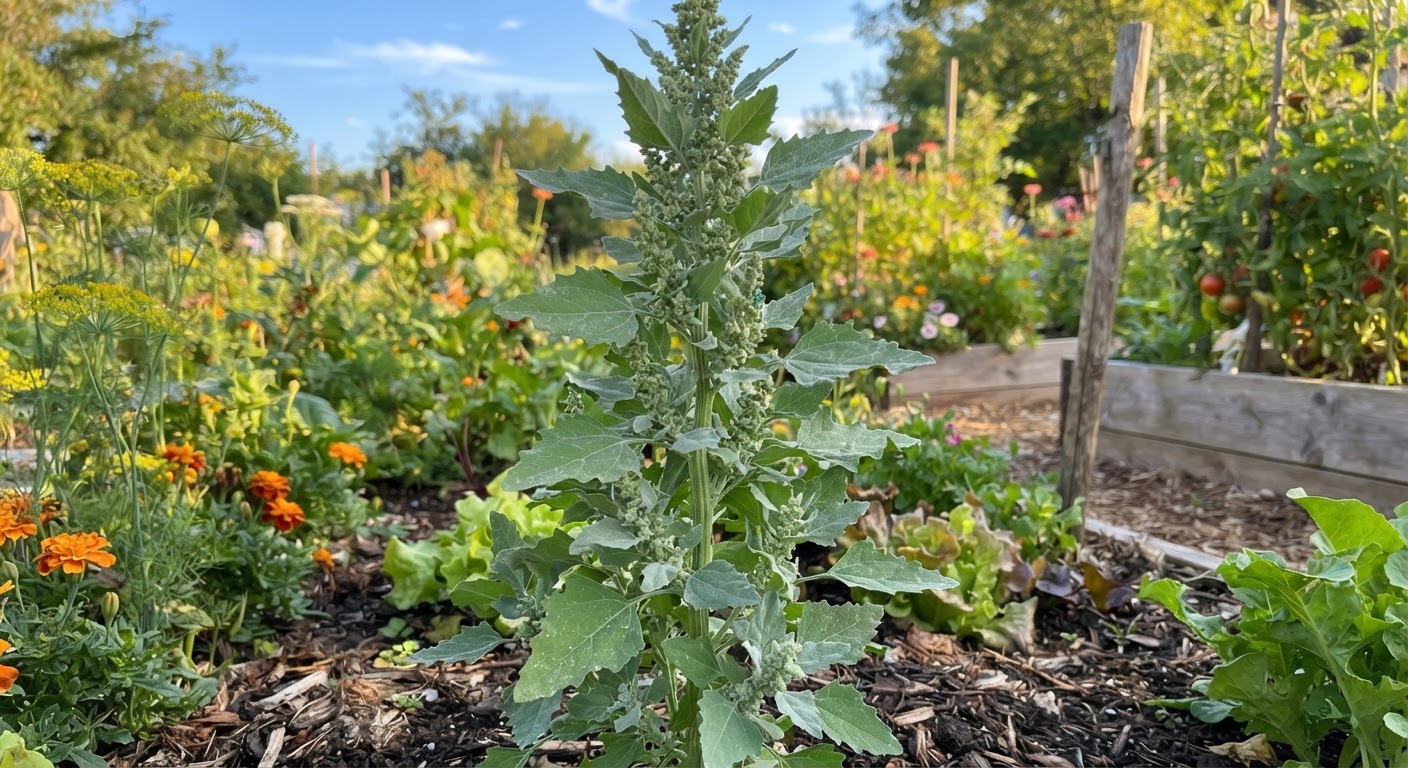
Before we get into the reasons, here’s what you’re looking for. Lambsquarters is one of the easier wild plants to identify because it has a distinctive feature that’s hard to miss.
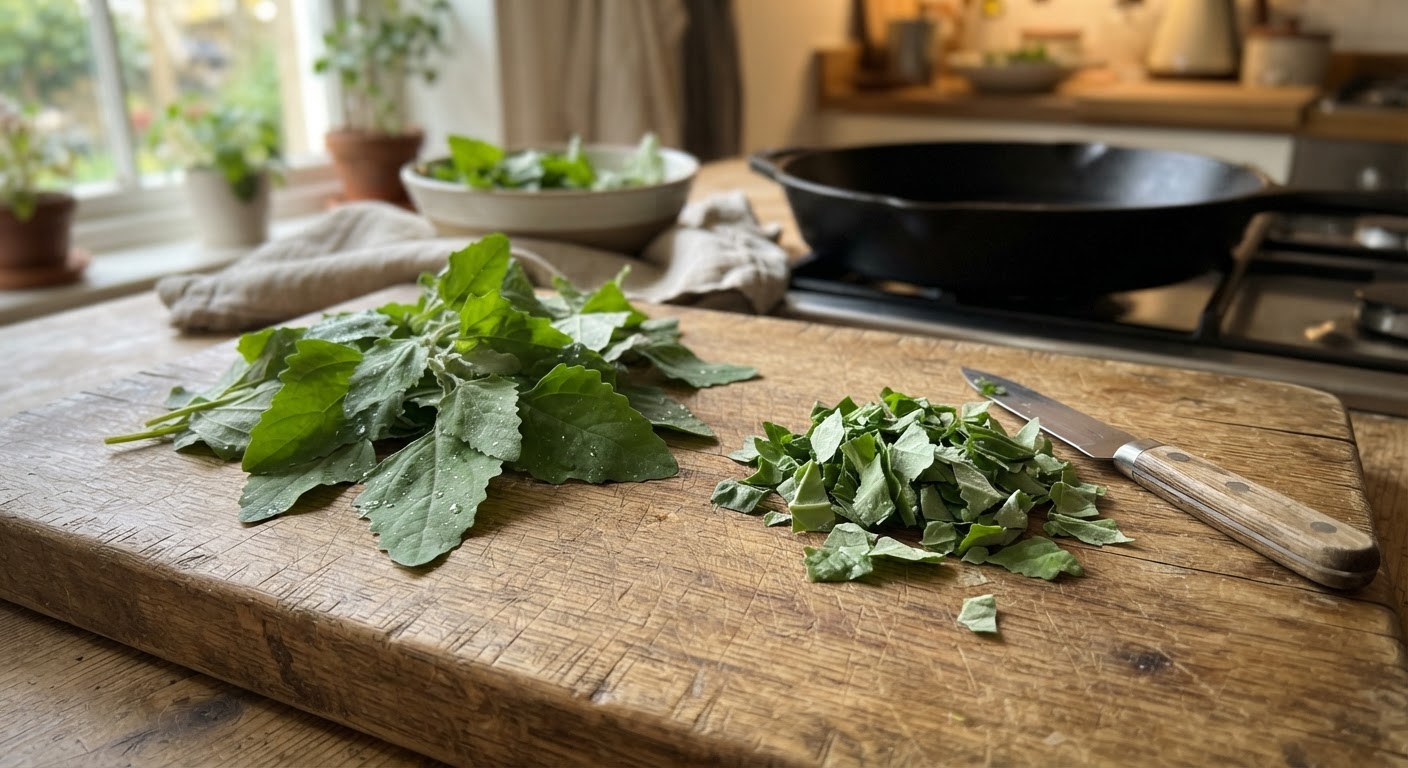
The telltale marker: The youngest leaves at the top of the plant look like they’ve been dusted with fine, crystalline powder. This powdery coating — technically a layer of microscopic wax particles — gives the center of the plant a silvery, almost frosted appearance. Touch it: it feels slightly gritty but isn’t sticky. No other common backyard weed has this exact look.
The rest of the plant:
- Leaves: Diamond or goosefoot-shaped (hence the family name “goosefoot”), with lightly toothed edges. Older leaves lower on the plant can reach 3–4 inches long. Young leaves toward the top are smaller, narrower, and more heavily dusted.
- Stem: Upright, grooved, often streaked with reddish or magenta vertical lines — especially near the base and at leaf junctions.
- Height: Typically 2–5 feet tall in good soil. I’ve seen them push past 6 feet in gardens with rich, compost-heavy soil.
- Flowers: Tight clusters of tiny greenish-white buds at the top of the plant that develop into minuscule black seeds by late summer.
- Where: Sunny, disturbed soil. Gardens, farm fields, construction sites, sidewalk edges, compost piles. If the ground has been turned recently and gets good sun, lambsquarters will find it.
The only lookalike worth worrying about: Black nightshade (Solanum nigrum) can superficially resemble young lambsquarters, but the nightshade has smooth (not dusty) leaves, white star-shaped flowers (not greenish clusters), and eventually produces small black berries. Check the leaf coating — no powder, no lambsquarters.
8 Reasons Lambsquarters Earns a Permanent Spot on Your Plate
1. The Nutrition Numbers Are Genuinely Embarrassing for Store-Bought Greens
This isn’t marketing copy. The USDA’s own food composition database confirms it. Here’s how lambsquarters stacks up against spinach and kale per 100 grams of raw leaf:
| Nutrient | Lambsquarters | Spinach | Kale | Winner |
|---|---|---|---|---|
| Protein | 4.2 g | 2.9 g | 2.9 g | 🏆 Lambsquarters (45% more) |
| Calcium | 309 mg | 99 mg | 254 mg | 🏆 Lambsquarters (3× spinach) |
| Vitamin A | 11,600 IU | 9,377 IU | 4,812 IU | 🏆 Lambsquarters |
| Vitamin C | 80 mg | 28 mg | 93 mg | 🏆 Kale (by 16%) |
| Iron | 1.2 mg | 2.7 mg | 1.6 mg | 🏆 Spinach (but lambsquarters still respectable) |
| Vitamin K | 494 µg | 483 µg | 705 µg | 🏆 Kale |
| Fiber | 4.0 g | 2.2 g | 4.1 g | 🏆 Kale (essentially tied) |
| Riboflavin (B2) | 0.44 mg | 0.19 mg | 0.35 mg | 🏆 Lambsquarters (2× spinach) |
Look at the calcium number for a second: 309 mg. That’s roughly equal to a glass of milk. From a plant most people spray with Roundup. The B-vitamin content is equally striking — lambsquarters delivers more riboflavin per 100g than almost any cultivated leafy green.
2. It Tastes Better Than Most “Health Foods”
“Nutritious” and “tastes good” rarely occupy the same sentence for wild greens. Bitter, tough, stringy — these words haunt the edible weeds category.
Lambsquarters breaks the pattern. Raw leaves have a mild, spinach-crossed-with-pea-shoots flavor — earthy, slightly nutty, with none of the aggressive bitterness you get from dandelion greens or curly dock. Cooked, the flavor deepens into something closer to chard or beet greens, but smoother. It doesn’t have the metallic oxalic tang that puts people off cooked spinach.
If someone who’s never eaten a wild plant in their life sat down to a plate of sautéed lambsquarters, they’d assume it was an expensive farmers’ market green — not something you pulled from behind the garage.
3. You Don’t Have to Hunt for It
Some wild edibles require effort. Morels demand specific forest conditions and the patience of a monk. Ramps only appear for a few weeks in spring and are increasingly overharvested. Watercress needs clean, moving water.
Lambsquarters? It shows up wherever humans have disturbed the soil. Gardens, raised beds, the edges of parking lots, the strip of dirt between a sidewalk and a building foundation. It’s a pioneer species — first on the scene after soil gets turned — and it thrives in the exact same conditions as the vegetables you’re already growing.
In my garden, lambsquarters pops up every June between the tomato plants and along the fence line. I let the biggest ones grow alongside the cultivated crops. They ask for exactly nothing — no water, no fertilizer, no pest management — and produce more edible leaf mass per square foot than anything I intentionally planted.
4. You Can Harvest It for Months
Most wild greens have a narrow window. Nettles: harvest before they flower in spring, or they get gritty and fibrous. Fiddleheads: you’ve got maybe two weeks before the fronds unfurl and the harvestable stage ends.
Lambsquarters gives you a generous season. The first tender shoots emerge in late spring. You can keep harvesting the young top leaves all summer long, as long as you don’t strip the plant bare. The leaves stay tender and usable until the plant starts producing seeds in late summer to early fall.
The trick: Pinch off just the top 4–6 inches of each stalk — the newest growth. These tips contain the most tender leaves and the least fibrous stem. Think of it like harvesting basil: you’re pruning the plant in a way that encourages it to keep producing.
5. The Seeds Are Edible Too
Most foraging articles about lambsquarters stop at the leaves. That’s only half the story.
Each plant produces thousands of tiny black seeds — roughly the size of poppy seeds — in late summer and early fall. These seeds are edible raw or cooked and have been used as a grain substitute for literally thousands of years. Archaeological digs across Europe and North America consistently find lambsquarters seeds in ancient food storage pits alongside cultivated grains.
What they taste like: Mildly nutty, reminiscent of quinoa — which makes sense, because quinoa is in the same plant family (Amaranthaceae). The seeds can be ground into flour, boiled into a porridge, or toasted and sprinkled over salads.
How to collect them: Wait until the seed clusters turn brown and papery. Bend a stalk over a paper bag and shake. The ripe seeds drop right out. A single large plant can yield a cup or more. Sift out the chaff with a fine mesh strainer, and you’re done.
6. It Freezes Better Than Store-Bought Spinach
Frozen spinach turns into a sad, watery brick. If you’ve ever thawed a bag of supermarket frozen spinach and watched it collapse into mush, you know the disappointment.
Lambsquarters handles freezing differently. Blanch the leaves in boiling water for 60 seconds, plunge into ice water, squeeze out the excess moisture, and pack into freezer bags. When you thaw it months later, the leaves hold their shape significantly better than spinach. The slightly thicker leaf structure — that succulent, waxy quality that helps the plant survive drought — also helps it survive the freezer.
I keep a dedicated freezer drawer just for blanched wild greens. Lambsquarters takes up more real estate in there than anything else, because it’s the one green that comes out of the freezer looking and tasting close to fresh.
7. It’s a Foraging “Training Wheels” Plant
When you’re learning to forage, confidence matters. Your first positive identification — the one where you’re genuinely certain you’ve got the right plant — is a milestone.
Lambsquarters is ideal for this because the identification markers are so visual. That silvery-dusty coating on the growing tips? Unmistakable once you’ve seen it. The diamond-shaped leaves with the white-mealy underside? No other common weed combines all of these features.
Compare this to something like wild carrot, which requires differentiation from poison hemlock — a plant that can kill you. Lambsquarters has no toxic lookalike that a reasonable person would confuse with it. The black nightshade mentioned earlier is the closest visual match, and even then, the powdery coating immediately rules it out.
For a beginner: learn lambsquarters first. Get a win under your belt. Then move on to more challenging identifications.
8. The Environmental Case Is Hard to Argue With
Every bite of lambsquarters you eat is food that required zero agricultural inputs. No diesel-powered tractors, no irrigation systems, no synthetic fertilizers, no plastic packaging, no refrigerated transport across three states.
One study from the University of California found that lambsquarters growing as a “weed” in conventional tomato fields produced more edible biomass per acre than the tomatoes themselves — with no additional water, fertilizer, or pest control. The plant is simply that efficient at converting sunlight and soil nutrients into edible tissue.
The carbon footprint of a sauté pan full of lambsquarters from your backyard is approximately zero. The carbon footprint of the spinach it replaced involves industrial agriculture, cold-chain logistics, and corporate distribution networks. This doesn’t mean you should stop buying spinach. It means the weed in your garden is doing something objectively better.
3 Ways People Get Lambsquarters Wrong (Don’t Do These)
Mistake 1: Eating It Raw by the Bowlful
Lambsquarters contains oxalic acid — the same compound that gives spinach its slightly astringent quality. In small amounts, it’s irrelevant. If you sit down to a giant raw lambsquarters salad every day for a month, you might start noticing some mineral absorption issues, particularly with calcium.
The fix is simple: blanch or cook it. A 60-second dunk in boiling water eliminates most of the oxalic acid. If you have a history of kidney stones, stick to cooked lambsquarters. Everyone else: a handful of raw leaves in a mixed salad is fine. Just don’t make it the main event.
Mistake 2: Harvesting from Questionable Soil
Lambsquarters is what botanists call a “hyperaccumulator” — it’s unusually good at pulling minerals and heavy metals from the soil. This is part of what makes it so nutritious in clean soil. It’s also what makes it a potential problem in contaminated soil.
Never harvest from:
- Roadsides within 50 feet of traffic (lead and cadmium from exhaust settle in the soil)
- Former industrial sites or brownfields
- Railroad rights-of-way (legacy herbicide contamination is common)
- Conventionally farmed field edges (pesticide drift)
- Areas where the soil looks stained, oily, or smells chemical
Stick to your own garden, a friend’s organic garden, or wild areas well away from roads and industry. If you’re foraging on public land, choose spots at least 100 feet from any road.
Mistake 3: Cooking the Tough Lower Leaves the Same Way as the Tender Tops
Not all lambsquarters leaves are created equal. The top 6–8 inches of the plant produce tender, quick-cooking leaves. The older leaves at the bottom of the stalk are perfectly edible but tougher and more fibrous — they need longer cooking.
How to handle this: Strip the leaves from the stems (the thick lower stems are too fibrous to eat). Use the tender upper leaves for quick sautés, stir-fries, and anything where the greens cook in under 3 minutes. Use the older leaves for soups, stews, and dishes with longer simmering times. Or blanch the older leaves for 2–3 minutes in salted water before adding them to whatever you’re making.
How to Harvest Lambsquarters (Without Killing the Plant)
- Use scissors or pinch with your fingers. Clean cuts heal faster than torn, ragged breaks. Pinch just above a leaf node so the plant can branch out from that point.
- Take no more than one-third of any single plant. Leave enough leaf surface for photosynthesis — the plant needs energy to keep producing.
- Harvest from plants that haven’t flowered yet. Once the flower clusters form at the top, the leaves become slightly more bitter. Still edible, but not at their peak.
- Collect in the morning. Like most leafy greens, lambsquarters leaves are crisper and more hydrated early in the day before the sun hits them.
- Bring a paper bag or cloth sack. Plastic bags trap moisture and heat, turning your harvest into a wilted mess within 20 minutes on a warm day.
- Check the leaf undersides. Lambsquarters occasionally hosts tiny aphids — harmless but unappealing in your dinner. A quick visual check and a thorough rinse at home solves this.
5 Ways to Cook Lambsquarters That Actually Work
1. Quick Garlic Sauté (The Gateway Recipe)
Heat olive oil in a pan over medium-high heat. Add minced garlic and a pinch of red pepper flakes. Once the garlic is fragrant (30 seconds), throw in a big handful of lambsquarters leaves. Season with salt. Toss for 90 seconds until wilted. Finish with a squeeze of lemon juice.
This is the recipe that converts skeptics. It takes three minutes from start to finish and tastes like something you’d pay $12 for at a farm-to-table restaurant.
2. Wild Greens and Potato Frittata
Blanch a packed cup of lambsquarters for 60 seconds. Squeeze out the water and chop roughly. Whisk 6 eggs with salt, pepper, and a splash of milk. Sauté diced onion and cubed cooked potato in a cast iron skillet until golden. Add the greens, pour in the eggs, and cook on low until the edges set. Finish under the broiler for 3–4 minutes until puffed and golden on top.
3. Lambsquarters Pesto
Blanch 2 packed cups of lambsquarters, squeeze dry. Blend with 1/3 cup toasted walnuts (or pine nuts), 2 cloves garlic, 1/2 cup olive oil, and 1/3 cup grated parmesan. Salt to taste. This freezes beautifully — freeze in ice cube trays for single-serving portions.
The pesto has an earthier, more complex flavor than basil pesto. It works on pasta, spread on sandwiches, or thinned with a little pasta water as a sauce.
4. Simple Blanched Side Dish
Boil salted water. Drop in lambsquarters leaves. Cook for exactly 60 seconds. Drain and plunge into ice water. Squeeze out the water, toss with sesame oil, soy sauce, and toasted sesame seeds. This is the Korean namul method applied to wild greens, and it couldn’t be simpler.
5. Lambsquarters and Lentil Soup
Sauté onion, carrot, and celery in olive oil until soft. Add garlic, cumin, and a bay leaf. Pour in vegetable broth and a cup of rinsed brown lentils. Simmer 20–25 minutes until lentils are tender. Stir in a big handful of chopped lambsquarters leaves during the last 5 minutes of cooking. The greens wilt into the soup and add a savory depth that lentils alone don’t achieve.
Quick Answers to Common Questions
Can I eat lambsquarters raw? Yes, in moderation. A handful of raw leaves in a salad is fine. But lambsquarters contains oxalic acid, so blanching or cooking is recommended — especially if you eat it regularly or have a history of kidney issues.
What does lambsquarters taste like? Think spinach crossed with mild chard and a hint of nuttiness. It’s less bitter than kale, less astringent than raw spinach, and doesn’t have the metallic aftertaste some people get from cooked chard.
Where does lambsquarters grow? Everywhere with disturbed, sunny soil. Gardens, farm fields, vacant lots, sidewalk edges, construction sites, compost piles. It thrives in all 50 US states and most temperate regions worldwide.
How do I know it’s lambsquarters and not something else? Check for the silvery-dusty coating on the youngest top leaves. If the center of the plant looks like it’s been sprinkled with fine white powder, you’ve found lambsquarters. No other common weed has this feature.
Can I eat the seeds? Yes. Collect the tiny black seeds in late summer by shaking the dried flower heads over a bag. Use them like quinoa — cook as a grain, grind into flour, or toast and sprinkle on salads.
Is lambsquarters the same as wild spinach? “Wild spinach” is a common nickname, and it’s fitting — the taste and nutritional profile are very similar. But they’re different species. Lambsquarters is Chenopodium album; spinach is Spinacia oleracea. They’re in different plant families.
Does cooking lambsquarters reduce the nutrients? Some vitamin C is lost to heat — that’s true of any cooked green. But cooking actually makes the calcium and iron more bioavailable by breaking down oxalates. The net nutritional outcome is positive for most people.
The Bottom Line
Lambsquarters is free food that out-nutrients most of the greens you’re paying for. It’s easy to identify, abundant throughout the growing season, versatile in the kitchen, and forgiving for beginners. The only real barrier is the mental one — reframing a “weed” as an ingredient.
So the next time you’re pulling lambsquarters out of your garden, stop at one plant. Take those dusty-green leaves inside instead of tossing them in the compost. Sauté them with garlic and olive oil. Taste what you’ve been throwing away.
You might start leaving more of them in the garden next year — on purpose.