You’ve spent an hour identifying wild blackberries with 100% certainty. The bush is loaded. Your hands are stained purple. Then a park ranger’s truck pulls up, and suddenly your perfect foraging afternoon has a legal question mark hanging over it.
Is foraging legal? Short answer: it depends entirely on where you’re standing. The same dandelion greens that are free for the picking in your backyard could land you a fine in a national park, a misdemeanor charge on private land without permission, or be completely unrestricted in your local city park.
This guide cuts through the confusion. No legal jargon, no endless statutes — just what you actually need to know broken down by land type and country.
The Quick Answer: Foraging Legality by Land Type
Here’s your at-a-glance reference. Keep this table bookmarked on your phone for when you’re standing in a field wondering if you can pick what’s in front of you.
| Land Type | Legal Status (USA) | What You Need | Risk Level |
|---|---|---|---|
| Your own property | ✅ Fully legal | Nothing | None |
| Private land (someone else’s) | ⚠️ Conditional | Written or verbal permission | High without permission — trespassing charges possible |
| National Parks (USA) | ❌ Illegal | N/A (prohibited in most cases) | Very high — federal fines apply |
| National Forests (USA) | ✅ Often allowed | Check local ranger district; some require free permits | Low with permit |
| State Parks | ⚠️ Varies by state | Check state-specific rules | Medium — fines vary |
| Bureau of Land Management (BLM) | ✅ Generally allowed | Personal-use limits apply (usually “reasonable amount”) | Low |
| City/county parks | ⚠️ Varies | Check municipal codes; many allow limited foraging | Low to medium |
| Roadsides / rights-of-way | ⚠️ Gray area | Generally frowned upon; some states prohibit it | Medium |
| Nature reserves / conservation land | ❌ Usually prohibited | N/A (protected status) | High |
| Public rights of way (UK) | ✅ Allowed (for personal use) | The “four F’s” rule applies — fruit, foliage, fungi, flowers for personal use only | Low (but check local bylaws) |
Foraging on Public Land: What “Allowed” Actually Means
“Public land” sounds like it belongs to everyone, so picking a few plants should be fine, right? Not quite. Public land in the US comes in several flavors, each with different rules.
National Forests — Your Best Bet
National Forests are hands-down the most foraging-friendly federal lands. Under the Forest Products Free Use Policy, you can harvest small quantities of many wild edibles — mushrooms, berries, nuts, greens — without a permit, as long as it’s clearly for personal consumption.
The magic word is “personal.” If you’re filling a small basket for tonight’s dinner, you’re covered. If you’re loading up a pickup truck bed to sell at a farmer’s market, you need a commercial permit — and you’ll pay for it.
The one catch: Some high-traffic national forests require a free personal-use permit for mushrooms. It costs nothing but creates a paper trail that helps the Forest Service manage pressure on popular picking spots. Check the ranger district website before you go. A two-minute search saves you a conversation you don’t want to have.
BLM Land — Wide Open, Within Reason
Bureau of Land Management territory covers roughly 245 million acres, mostly in western states. Foraging rules here are some of the most relaxed on public land. The operating principle is “reasonable personal use” — gather what you’ll eat, don’t strip an area bare, and don’t dig up entire plants unless you’re targeting something invasive.
BLM land is where you’ll find foragers harvesting piñon nuts in Nevada, morels in Oregon burn scars, and prickly pear fruit across the Southwest. No permit, no hassle, just common sense.
The National Park Problem
Here’s where many beginners trip up. Foraging in national parks is almost universally prohibited. The National Park Service mission is preservation — every plant, mushroom, and berry is protected as part of the ecosystem. Removing them, even in small amounts, is treated as resource theft.
The fines are not symbolic. In Yellowstone, removing plants or mushrooms can trigger penalties up to $5,000 and six months in jail. Similar rules apply at Yosemite, Great Smoky Mountains, and essentially every NPS unit with the word “National Park” in its name.
The handful of exceptions prove the rule: some Alaska national parks allow subsistence gathering by indigenous communities, and a few parks allow limited berry picking along designated trails. Unless you’ve confirmed an exception in writing from the park superintendent, assume it’s off-limits.
Private Land: The One Rule That Matters
Foraging on private land boils down to a single word: permission.
Walking onto someone’s property to pick plants without asking is trespassing, plain and simple. It doesn’t matter if the land looks “abandoned,” if there’s no fence, or if the blackberry bushes are spilling over the property line. No permission = legal trouble.
How to Ask (Without Making It Weird)
Most landowners are surprisingly open to foragers who ask politely. The key is framing your request as respectful and low-impact:
- Knock on the door, introduce yourself. “Hi, I’m a local forager and I noticed you have a lot of [mushrooms/berries/nettles] growing along your back field. Would you mind if I picked some for personal use?”
- Specify exactly what you want, where, and how much. Landowners worry about liability and property damage. Reassure them on both fronts.
- Offer to share. “I’d be happy to bring you some if you’d like.” This turns a request into a transaction — and dramatically improves your odds.
- Accept “no” gracefully. Some people have bad experiences with trespassers. A polite exit leaves the door open for next time.
One practical tip: landowners with large acreage — farms, ranches, rural properties — tend to be the most receptive. They usually have more land than they actively use and fewer concerns about strangers near their home.
Country-by-Country: Foraging Laws Outside the US
Foraging legality varies dramatically across borders. Here’s a rapid-fire breakdown:
| Country | General Status | Key Details |
|---|---|---|
| United Kingdom | ✅ Largely legal | The “forager’s four F’s” — fruit, foliage, fungi, and flowers — can be harvested from public rights of way for personal use. Uprooting any plant without landowner permission is illegal under the Wildlife and Countryside Act. |
| Canada | ⚠️ Varies by province | Crown land generally allows personal foraging. Provincial and national parks vary — Banff and Jasper prohibit it, while many provincial parks have designated foraging zones. |
| Australia | ⚠️ Strictly regulated | Foraging on Crown land and national parks is largely prohibited. Some states allow limited collection in state forests with a permit. Indigenous foraging rights are protected in certain areas. |
| Germany | ✅ Moderate freedom | Foraging on public land is broadly permitted for personal use. Some regions restrict mushroom picking to 1–2 kg per person per day. Protected species lists apply. |
| Sweden | ✅ Very permissive | Allemansrätten (the “everyman’s right”) allows foraging on any land — public or private — as long as you don’t damage property, disturb residents, or harvest protected species. |
| France | ⚠️ Local rules apply | Foraging is generally tolerated on public land, but many communes have specific bylaws. Some regions require permits for mushroom picking during peak season. |
| Japan | ❌ Highly restricted | Most forested areas are privately owned or classified as protected. Foraging without explicit permission is treated as theft or poaching. |
If you’re foraging in a country not listed above, the safest starting assumption is “ask first.” Most countries default to protecting their wild resources — permissive foraging laws like Sweden’s are the exception, not the rule.
State Parks: The Most Confusing Category
State parks sit in a legal gray zone that frustrates even experienced foragers. Unlike national parks (uniformly protected) or national forests (uniformly permissive), state parks are managed by 50 different agencies with 50 different rulebooks.
The pattern: Roughly half of US states allow some foraging in their parks, typically limited to berries and mushrooms. The other half prohibit it entirely, mirroring national park policy. Here’s a snapshot:
- California State Parks: Prohibits removal of any natural feature, including plants and mushrooms.
- New York State Parks: Prohibits plant collection in most parks; limited exceptions for certain edible fungi in specific units.
- Michigan State Parks: Allows berry and mushroom picking for personal consumption in most parks.
- Colorado State Parks: Generally prohibits plant removal, though individual parks may set their own rules.
- Oregon State Parks: Allows limited berry and mushroom picking in most parks for personal use only.
How to check your state: Search “[your state] state parks foraging rules” or call the park office directly. A 2-minute phone call beats a $200 fine every time.
5 Common Legal Mistakes Foragers Make
These are the traps that catch people — often experienced foragers who should know better.
1. Assuming “Public Land” Means “Anything Goes”
Public land is a category, not a permission slip. A county park, a state forest, a BLM parcel, and a national monument all fall under “public land” but operate under completely different rules. The single most common violation is treating them as interchangeable.
2. Foraging Along Roadsides Without Checking
Those elderberry bushes lining the highway? Beyond the legal question of whether the right-of-way allows harvesting, there’s a safety issue: roadside plants absorb heavy metals and chemical runoff. But legally, many states prohibit foraging in highway rights-of-way for liability reasons. You’re not just picking berries — in some jurisdictions, you’re trespassing on state transportation land.
3. Uprooting Plants on Land Where Only “Picking” Is Allowed
Many laws distinguish between picking (taking fruit, leaves, or above-ground parts) and uprooting (digging out the entire plant). Picking may be legal; uprooting is frequently a separate violation with steeper penalties. Read the fine print. In the UK, the Wildlife and Countryside Act makes it explicitly illegal to uproot any wild plant without landowner permission — even on land where picking is allowed.
4. Harvesting Protected or Threatened Species
Even on land where foraging is legal, protected species are off-limits by default. Ginseng is the classic example — heavily regulated across its entire range due to overharvesting. But the list extends further than most foragers realize: certain orchid species, ramps in some regions, and even specific mushroom varieties carry protected status in parts of their range. Your state’s Department of Natural Resources website maintains the current list.
5. Selling Without a Commercial Permit
The line between personal use and commercial activity is where enforcement gets aggressive. Selling foraged mushrooms at a restaurant or farmers’ market without a commercial permit converts a low-risk personal activity into a regulated business — often with requirements for liability insurance, food safety certifications, and harvest tracking. A few states (notably Michigan and Oregon) have well-established commercial foraging permit systems. Most don’t, which effectively means commercial foraging isn’t legally viable without navigating a regulatory maze.
How to Check Local Rules in 5 Minutes
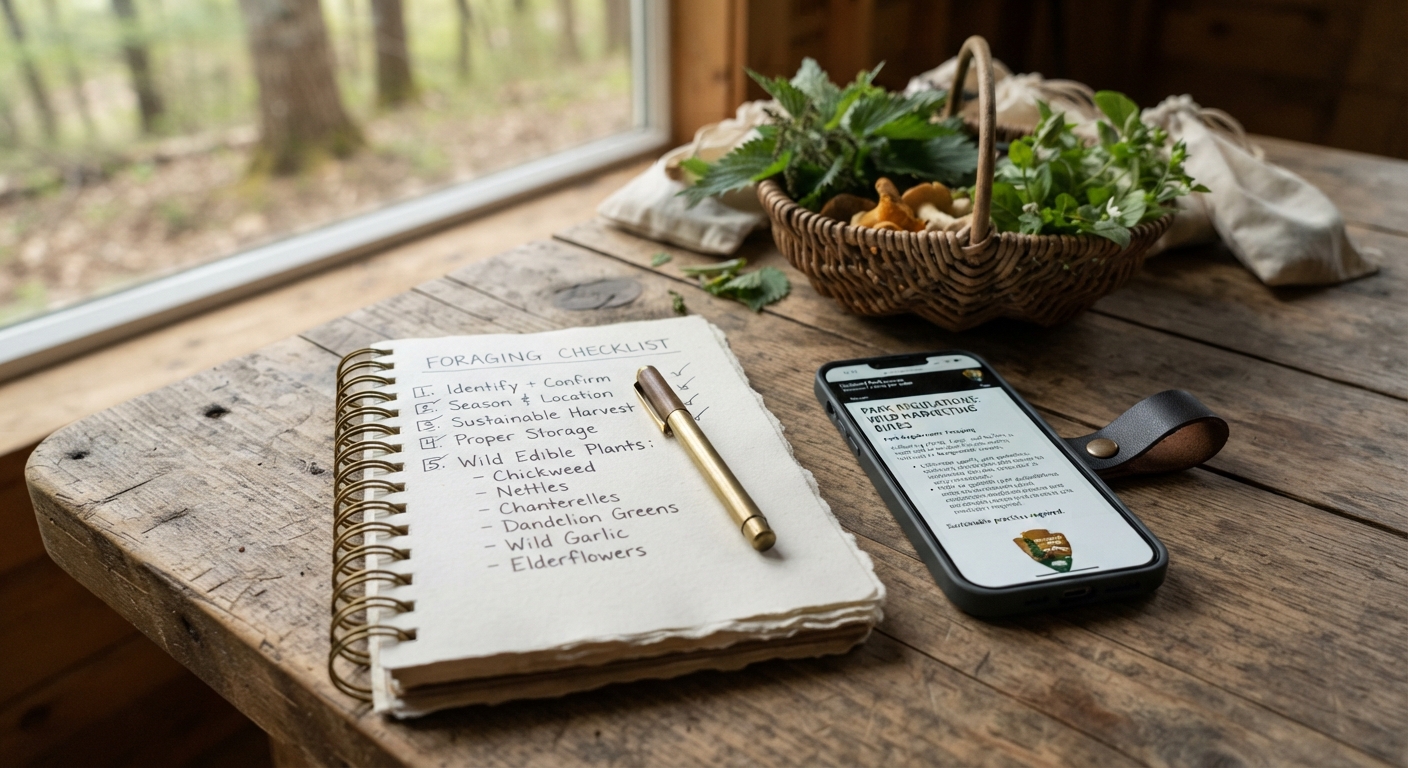
Before you head out, run through this checklist:
-
Google: “[your location] foraging regulations.” Add your county and state for specificity. The first few results will likely be your state DNR or parks department page.
-
Check the land manager’s website. If you’re heading to a specific forest, park, or BLM area, the managing agency’s site has the final word. Look for “rules and regulations,” “visitor information,” or “permits.”
-
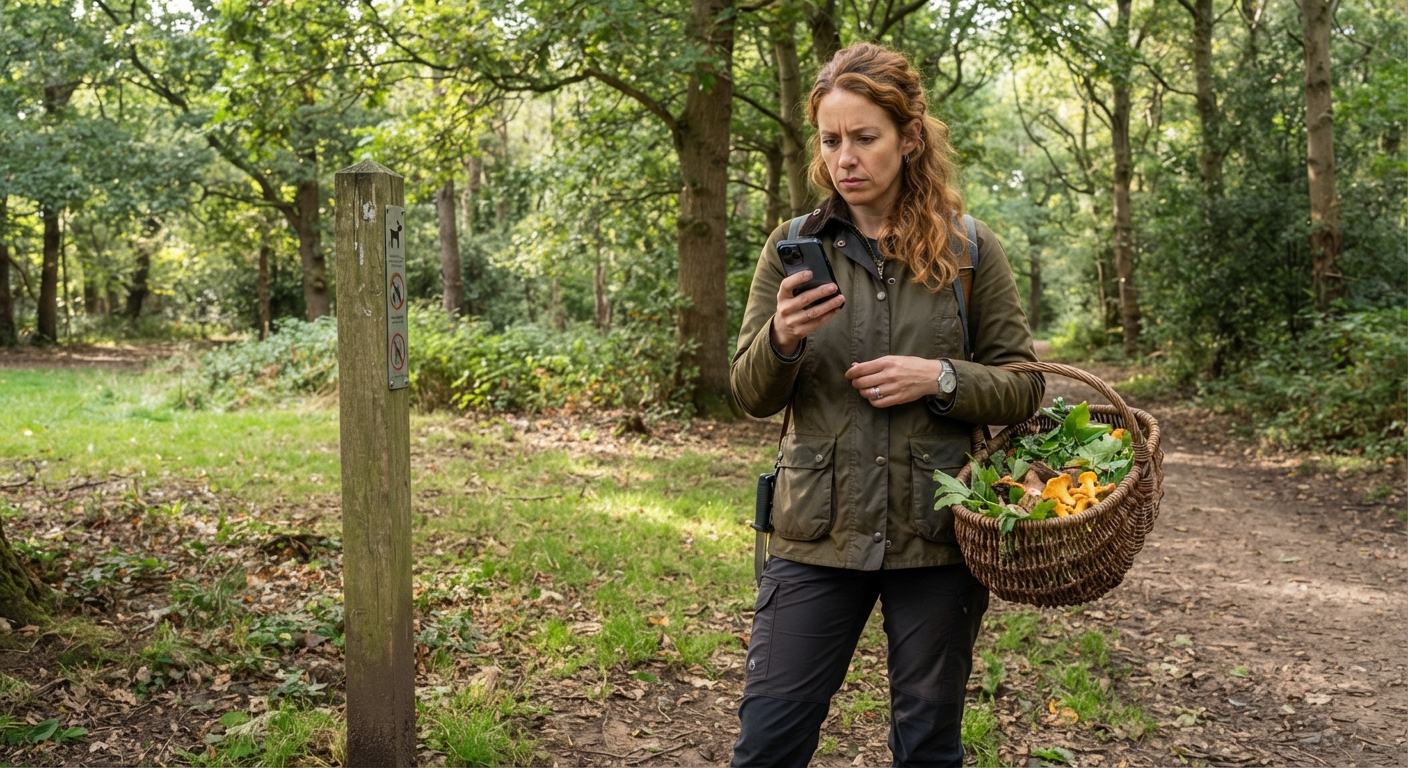
Call the ranger station. This is the underrated power move. A 60-second call — “Hi, I’m planning to pick some wild berries for personal use this weekend. Do I need a permit?” — gives you an answer directly from the people who’d write the ticket.
-
Check iNaturalist for protected species. Before you harvest anything, cross-reference your target species on iNaturalist or your state’s protected species list. A plant being abundant in your area doesn’t mean it’s legal to harvest.
-
When in doubt, don’t pick. The worst-case scenario isn’t missing a meal — it’s a fine, a court date, or damaging a fragile ecosystem. Foraging is a patient person’s hobby.
FAQ
Can I forage in city parks?
Depends on the city. Some urban areas — Portland, Seattle, Austin — have municipal codes that explicitly allow or even encourage limited foraging. Others prohibit it entirely under general park rules against “removing vegetation.” Check your city’s parks department website.
Do I need a permit to forage on BLM land?
For personal use: generally no. For commercial harvesting: yes, you need a special forest products permit. Some high-demand areas (popular morel spots in Oregon, for example) may require free personal-use permits even for recreational picking.
Is foraging legal on the side of the road?
Legally, it’s a gray area at best. Most highway rights-of-way are managed by state transportation departments that prohibit unauthorized access. Beyond legality, roadside plants absorb vehicle exhaust, brake dust, and chemical runoff — they’re not what you want in your salad.
Are there apps that tell you foraging legality by location?
Not reliably. Apps like iNaturalist and Seek can help with plant identification, but no app currently maps foraging legality in real time. Regulations change, and legal boundaries don’t map neatly to GPS coordinates. Always verify with official sources.
What’s the penalty for illegal foraging?
Ranges from a warning to a federal misdemeanor. National Park violations can trigger fines up to $5,000. State-level fines typically range from $50–$500. In countries with strict conservation laws (parts of Europe, Japan), penalties can include criminal charges.
Does foraging law apply to invasive species?
Sometimes — and this is one of the few areas where the law works in foragers’ favor. Many land managers actively encourage the removal of invasive edible species like garlic mustard, Japanese knotweed, and autumn olive. Some parks even organize volunteer removal events. If you’re targeting invasives, check with the land manager — you might get an enthusiastic green light.
Can I forage on conservation easement land?
Generally no. Conservation easements exist specifically to protect natural resources, and harvesting — even for personal use — typically conflicts with the easement’s purpose. These aren’t public lands in the traditional sense. Tread carefully.
The Bottom Line
Foraging legality isn’t complicated once you know the framework:
- Your land: Free and clear.
- Someone else’s land: Ask permission, every time.
- National Parks: Don’t. Just don’t.
- National Forests and BLM: Usually fine for personal use — double-check with the ranger district.
- State and city parks: Look it up before you go. Two minutes of searching beats a fine.
- Outside the US: Laws vary wildly. Research your destination, not your assumption.
The foragers who stay out of trouble share one habit: they check the rules before they check the plants. It takes five minutes. It costs nothing. And it means the only thing you come home with is dinner — not a citation.
Have questions about foraging in your specific area? Drop a comment below — local regulations change and your experience might help the next reader.