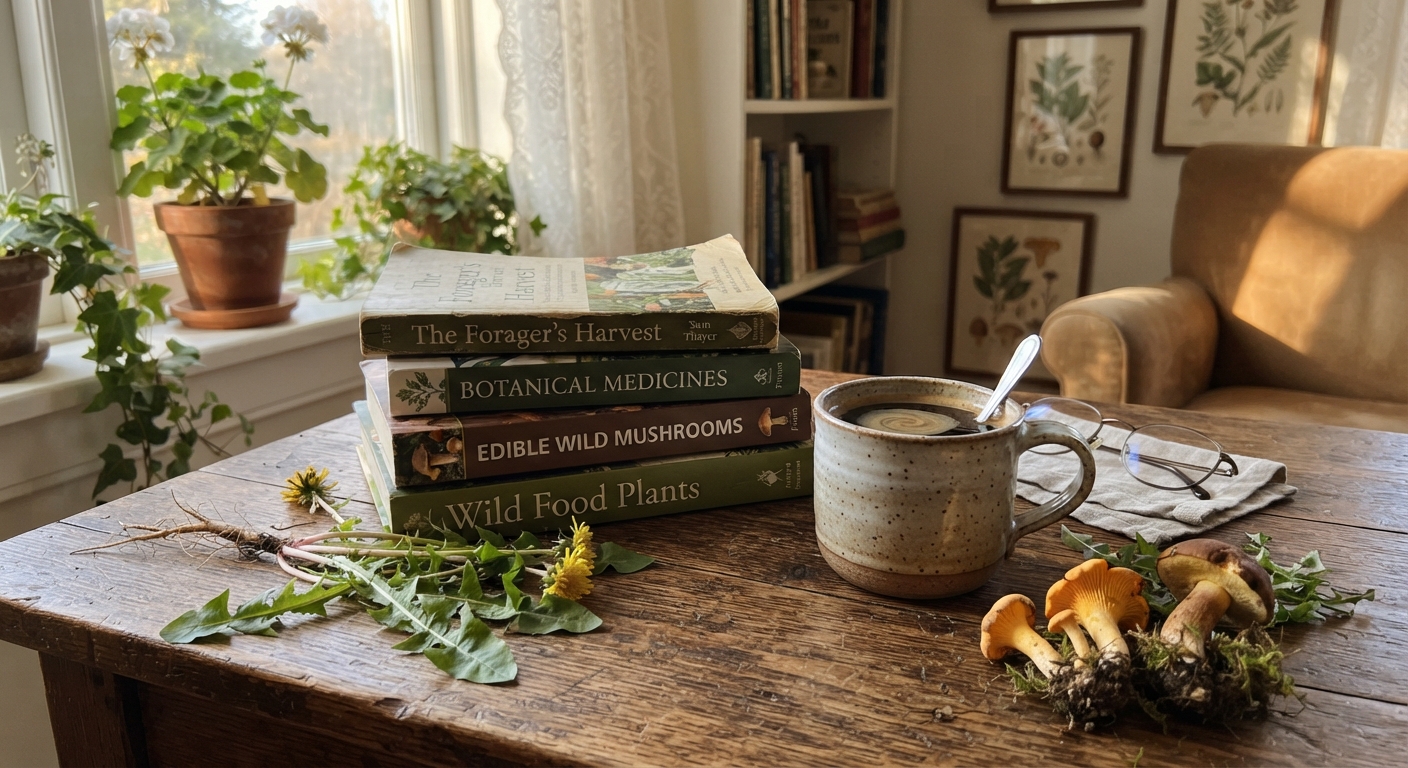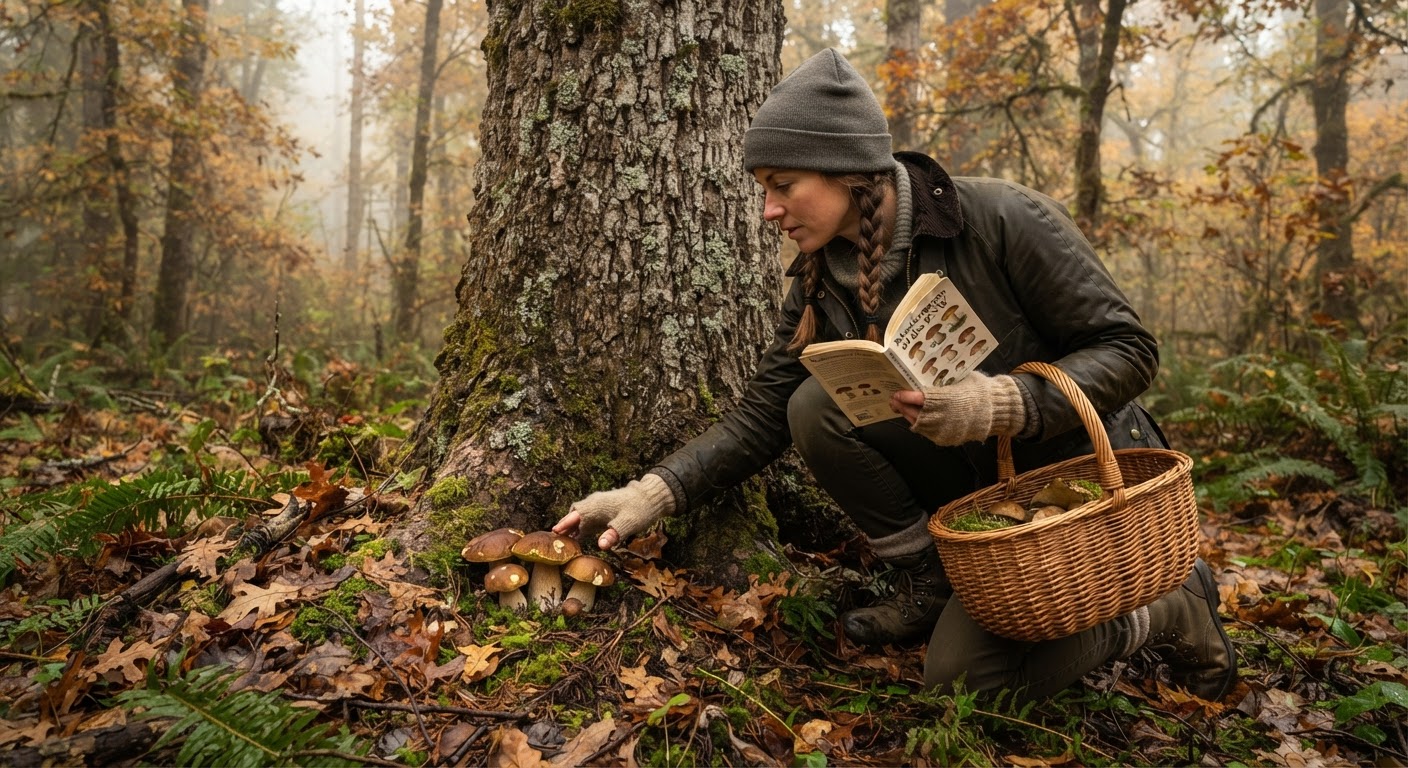
Let me be blunt: mushroom foraging is the one area of wild food where “pretty sure” can kill you.
Plants can make you sick. A wrong mushroom can destroy your liver in 72 hours — silently, irreversibly, with zero symptoms until it’s too late for treatment. Every experienced mushroom forager knows someone who knows someone who made a fatal mistake. This isn’t fearmongering. It’s the reality that makes mushroom identification the single most disciplined skill in all of foraging.
But here’s what the scary warnings don’t tell you: mushroom identification is also one of the most learnable skills in foraging. Unlike plants — which can have dozens of regional variations, hybrid species, and confusing seasonal forms — mushrooms follow binary rules. A mushroom either has pores or it has gills. A cap is either convex or flat. A spore print is either white, brown, pink, or black. There’s no “kind of” or “looks similar.” The features are discrete and testable.
What makes mushroom identification dangerous isn’t that it’s hard. It’s that most beginners don’t follow a system — they pattern-match from memory, and the human brain is terrible at remembering fine details it’s only seen in a book.
This guide gives you the system. Five steps, in order, every time. Follow them, and you’ll never accidentally eat a destroying angel.
Why Mushroom Identification Is Fundamentally Different from Plant Identification
Before we dive into the steps, you need to understand what makes mushrooms unique — because the mental model most foragers bring from plant identification will get you in trouble.
Mushrooms are not plants. They’re the fruiting bodies of underground fungal networks. What you see above ground is temporary — it emerges, releases spores, and decays within days or weeks. The actual organism lives year-round beneath the soil or inside dead wood.
This matters for identification because:
- Mushrooms change appearance dramatically as they mature. A young button-stage mushroom can look completely different from the same species 48 hours later — cap shape shifts, gills darken, the ring on the stem may dissolve. If your field guide shows only a mature specimen and you’re looking at a young one, you have a mismatch.
- Color is unreliable. Rain, sun exposure, age, and soil chemistry all shift mushroom coloration. A chanterelle that’s bright orange in one forest might be pale yellow in another. Relying on color alone is one of the most common beginner mistakes.
- You cannot taste-test mushrooms for safety. Unlike plants, where a tiny nibble and spit test is relatively low-risk for most species, mushroom toxins can be lethal in microscopic amounts. Never, ever put an unidentified mushroom in your mouth.
- The entire mushroom matters for identification — not just the cap. The base of the stem, the presence or absence of a ring, the way the gills attach to the stem, and even the color of the flesh when cut are all diagnostic features you’ll miss if you just glance at the top.
Bottom line: In plant identification, you can sometimes get away with matching a leaf shape and flower color. In mushroom identification, you need to examine the entire organism from top to bottom — literally. The five-step system below makes this systematic.
The Universal Mushroom Identification System: 5 Steps
Every mushroom identification — whether you’re holding a morel or something you’ve never seen before — follows the same sequence. Skip a step and you increase your risk. Do all five and you’ll either confirm edibility or know exactly why you should walk away.
Step 1 — Read the Substrate (Where It’s Growing)
Before you even touch the mushroom, look at what it’s growing on. This single observation eliminates half the possibilities instantly.
Wood vs. Ground
Some mushrooms only grow on living or dead wood (chicken of the woods, lion’s mane, oyster mushrooms). Others only grow from soil (chanterelles, porcini, morels). A mushroom growing from a living tree trunk cannot be a chanterelle, no matter how orange it looks.
Tree Association
Many edible mushrooms have specific tree partners. Morels associate with elm, ash, and apple trees in the eastern US, and with conifers in the west. Chanterelles partner with oaks and conifers. If you find what looks like a chanterelle growing from a dead log in an open field with no trees nearby, you’re not holding a chanterelle.
Check the base carefully. Some mushrooms appear to grow from soil but are actually growing from buried wood — dig gently around the base with your finger to confirm.
Key substrate questions to ask every time:
- Is it on living wood, dead wood, or soil?
- If on/near a tree, what species of tree?
- Is it growing alone, in a cluster, or in a fairy ring?
- What other plants and mushrooms are nearby?
Step 2 — Analyze the Cap
Once you’ve noted the substrate, look at the top of the mushroom.
Cap shape changes with age but follows predictable patterns: convex (dome-shaped), flat, depressed (sunken center), umbonate (with a central bump), or funnel-shaped.
Cap surface tells you about texture: is it smooth, scaly, slimy, dry, velvety, or cracked?
Cap margin (the edge) can be smooth, striated (lined), or inrolled.
Color — note it, but don’t rely on it. Document the color and then move on to structural features.
Size — measure the diameter. A giant puffball can reach basketball size. A galerina (deadly) rarely exceeds 5 cm. Size narrows the field significantly.
Step 3 — Examine the Underside (Gills, Pores, or Teeth)
Flip the mushroom over. This is where most identification mistakes happen, because the underside tells you more than the top ever will.
Mushrooms fall into three underside categories:
| Underside Type | Appearance | Examples (Edible) | Examples (Toxic) |
|---|---|---|---|
| Gills | Thin blade-like structures radiating from stem to cap edge | Oyster mushrooms, shiitake | Destroying angel, death cap, galerina |
| Pores | Sponge-like surface of tiny holes | Porcini (king bolete), suillus | Satan’s bolete (some boletes are toxic) |
| Teeth/Spines | Hanging tooth-like projections | Lion’s mane, hedgehog mushroom | None common (toothed mushrooms are generally safe) |
If it has gills, examine how they attach to the stem:
- Free gills — gills don’t touch the stem at all (common in Amanita — the deadliest genus)
- Attached gills — gills connect to the stem
- Decurrent gills — gills run down the stem
Free gills + a bulbous base + a ring on the stem = potential Amanita. Stop and be extremely careful. This combination alone should make any beginner walk away until they’ve gained significant experience.
Step 4 — Study the Stem and Base
Dig the entire mushroom out of the ground — don’t just snap it at the base. The most important identifying features of deadly Amanita species are often hidden underground.
What to check on the stem:
- Ring (annulus) — A skirt-like ring of tissue around the upper stem. Present on many Amanita species. May fall off with age, so look for remnants.
- Volva (cup at the base) — A sac-like structure at the very base of the stem, often buried. This is the hallmark of Amanita species, including the death cap and destroying angel. If you see a volva, you’re dealing with an Amanita — and while some Amanitas are edible (like Caesar’s mushroom), beginners should never mess with this genus.
- Stem texture — Smooth, fibrous, scaly, or reticulated (net-like pattern)?
- Hollow vs. solid — Cut the stem in half lengthwise. Morels are hollow from tip to base. False morels are solid or cottony inside.
- Color changes when cut — Some boletes bruise blue instantly when cut. Some of these are toxic, some aren’t — but the color change is a key ID feature.
Step 5 — Take a Spore Print (The Decision Maker)
A spore print reveals the color of the mushroom’s microscopic spores — and spore color is one of the most reliable identification features you can get.
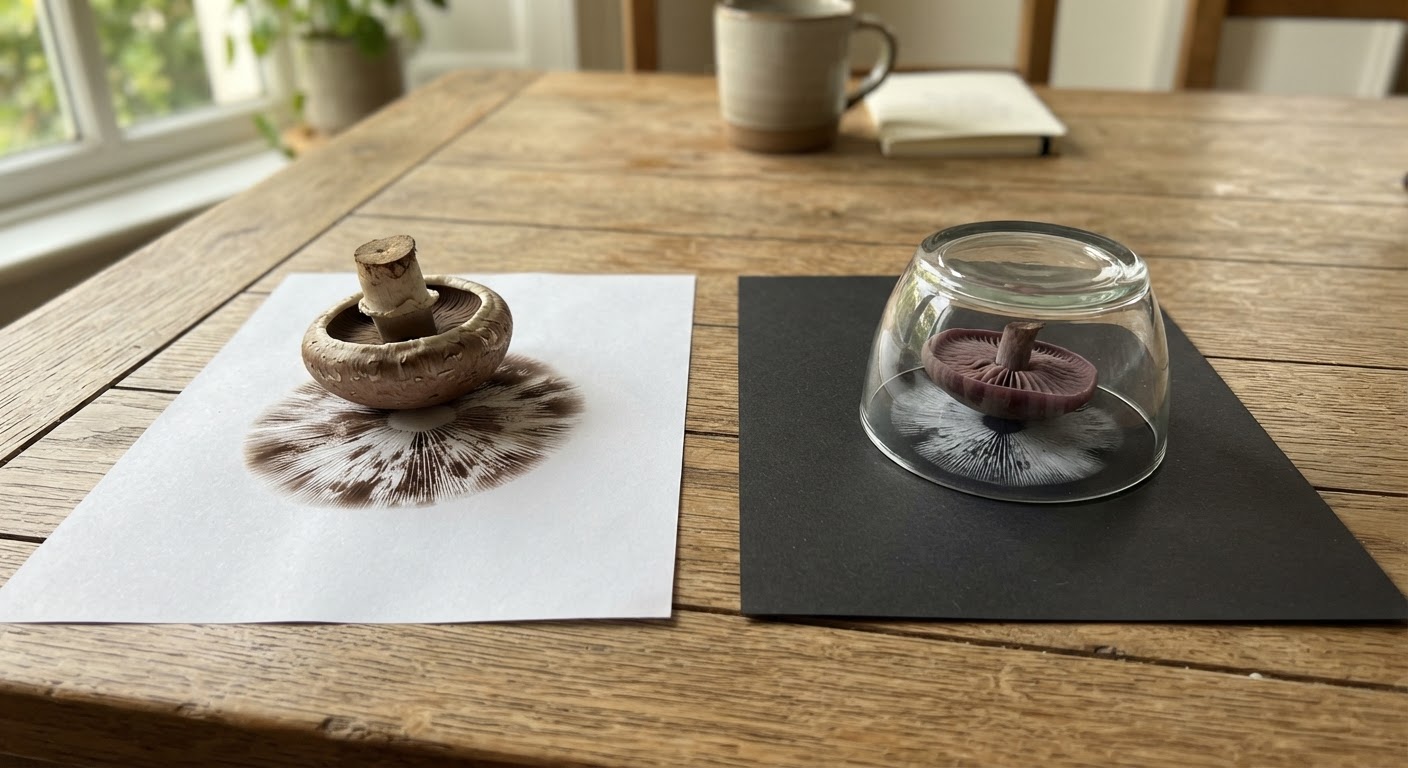
How to take a spore print:
- Remove the stem from a mature mushroom cap.
- Place the cap gill-side (or pore-side) down on a piece of paper.
- Use both white paper and black paper — some spore colors (white, cream) are invisible on white paper, and dark spores disappear on black. Tape the two sheets together side by side for a dual-background print.
- Cover with a bowl or glass to prevent air currents from blowing spores away.
- Wait 4–12 hours. Most good prints develop within 6–8 hours.
- Lift the cap carefully — the spores will have fallen in a radial pattern matching the gill arrangement.
Why spore color matters:
| Spore Color | What It Tells You |
|---|---|
| White or cream | Could be Amanita (potentially deadly), could be an edible Agaricus. The spore print alone doesn’t tell you — but combined with other features, it narrows things down. |
| Brown to dark brown | Common in many edible agarics and also in the deadly Galerina. Brown spores alone don’t mean safety. |
| Pink to salmon | Characteristic of some Entoloma species (some toxic) and Pluteus (mostly edible but not choice). |
| Black to dark purple-brown | Classic for Coprinus (inky caps — some edible, some problematic with alcohol) and Stropharia. |
| Yellow to olive-brown | Typical of Agaricus species, including the common store mushroom — but also some mildly toxic Agaricus relatives. |
| Rusty brown | The signature of Gymnopilus and Cortinarius — both genera contain toxic species. |
A spore print won’t give you a species name by itself. But when combined with the four steps above — substrate, cap, underside, and stem features — it’s often the final piece that turns “I think this is X” into “I know this is X.”
The 5-Step Field Checklist
Print this table, laminate it, and keep it in your foraging bag. Run through every item before you consider eating any wild mushroom.
| Step | What to Check | Key Questions | Red Flags |
|---|---|---|---|
| 1. Substrate | What it’s growing on | Wood or soil? Which tree species nearby? Alone or clustered? | Growing on wrong substrate for suspected species |
| 2. Cap | Shape, surface, margin, color, size | Convex or flat? Smooth or scaly? Diameter? | Color doesn’t match; size is wrong for species |
| 3. Underside | Gills, pores, or teeth | How do gills attach to stem? Pore size and color? | Free gills + ring + volva = possible Amanita |
| 4. Stem & Base | Ring, volva, texture, interior | Hollow or solid? Bruising color? Buried volva present? | Any sign of a volva cup at the base |
| 5. Spore Print | Spore color on dual paper | White, brown, pink, black, or rusty? | Spore color doesn’t match expected species |
5 Beginner-Safe Edible Mushrooms Worth Learning First
When you’re starting out, don’t try to learn everything. Pick three to five mushrooms with unmistakable features and no deadly lookalikes. Master them completely. Here are the five I recommend.
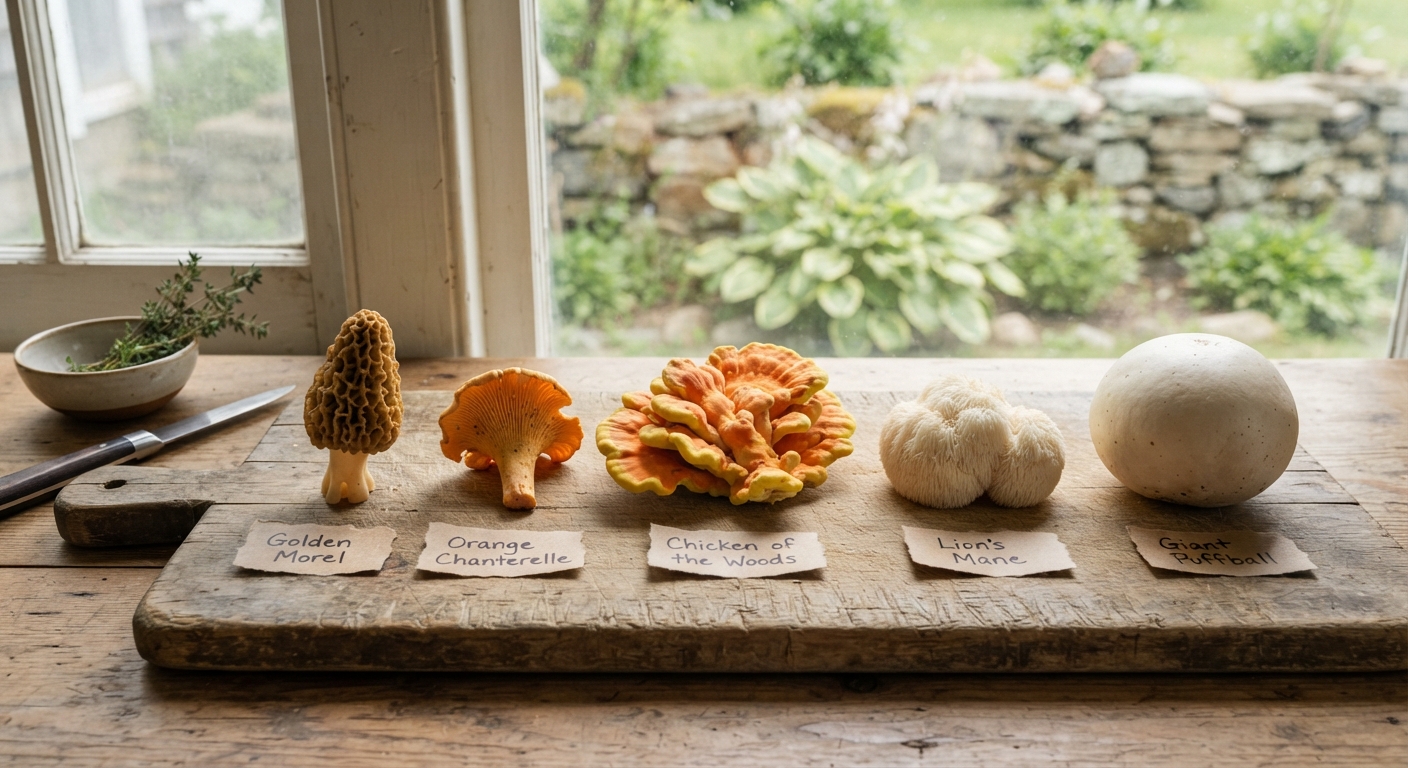
1. Morel (Morchella species)
Morels are the gateway mushroom for most foragers, and for good reason. Their honeycomb cap structure is unlike anything else in the woods — once you’ve seen a real morel, you won’t confuse it.
Key identification features:
- Cap is fully honeycombed with deep pits and ridges
- The cap attaches directly to the stem — there’s no overhang or skirt
- Entire mushroom is completely hollow from tip to base when sliced lengthwise
- Color ranges from tan to dark brown to nearly black depending on species
- Found in spring (March–May in most regions), often near dying elms, old apple orchards, and burned areas
The lookalike to know: False morels (Gyromitra) have wrinkled, brain-like caps — not honeycombed — and are solid or chambered inside, never fully hollow.
The golden rule for morels: Slice every single one in half lengthwise before cooking. Hollow = safe. Solid or cottony interior = throw it away.
2. Chicken of the Woods (Laetiporus species)
This mushroom genuinely tastes like chicken when cooked. It’s bright orange and yellow, grows in shelf-like clusters on trees, and has zero gills — only tiny pores on the underside.
Key identification features:
- Bright orange to yellow-orange overlapping shelf brackets
- Pore surface underneath, not gills
- Grows exclusively on living or dead hardwood trees (oak is common)
- No stem — the brackets attach directly to the wood
- Fresh specimens are soft and fleshy, not woody
The one caution: Some people have allergic reactions to chicken of the woods, especially when it’s growing on conifers or eucalyptus. Start with a small portion the first time. Always cook thoroughly.
3. Lion’s Mane (Hericium erinaceus)
This is arguably the safest edible mushroom to start with. It has no lookalikes. None. If you find a white, shaggy, tooth-covered mass growing on a hardwood tree, you have lion’s mane (or one of its equally edible Hericium relatives).
Key identification features:
- Round to oval white mass of hanging spines (teeth) that look like a frozen waterfall
- Grows on dead or dying hardwood trees, especially beech and oak
- No cap, no stem, no gills — just a solid mass of soft spines
- Turns slightly yellowish with age
- Found late summer through fall
4. Chanterelle (Cantharellus species)
Chanterelles are prized for their fruity aroma and golden color, but they’re also a good beginner mushroom because their identification features are specific and testable.
Key identification features:
- Golden yellow to orange color — can be pale in shade
- Instead of true gills, chanterelles have blunt, forked ridges that run down the stem
- These ridges are part of the mushroom flesh — you can’t separate them from the cap like true gills
- Fruity, apricot-like smell (this is surprisingly reliable)
- Grows from soil near oak and conifer trees, never directly on wood
- White interior flesh when cut
The lookalike to know: Jack-o’-lantern mushrooms (Omphalotus) are the dangerous chanterelle imposter. They grow in dense clusters on wood (chanterelles grow singly or in loose groups from soil), have true sharp gills (not blunt ridges), and glow faintly in the dark. Jack-o’-lanterns will make you violently ill.
5. Giant Puffball (Calvatia gigantea)
When mature, a giant puffball looks like a volleyball sitting in a field. When young and edible, the interior is pure white and marshmallow-soft.
Key identification features:
- Large, round, white ball without any visible stem, gills, or cap
- Interior is solid white throughout — no outline of a developing mushroom inside
- Grows in fields, lawns, and open woods
- Can reach enormous sizes — 20 to 50 cm across
The mandatory safety step: Slice every puffball in half from top to bottom. If you see any outline of a developing mushroom shape inside (gills, stem, cap), you’re holding a young Amanita in its egg stage — potentially deadly. Pure white and featureless throughout = safe. Any internal structure = discard immediately.
Quick-Reference Comparison Table
| Mushroom | Season | Habitat | Key ID Feature | Toxic Lookalike | Beginner Confidence |
|---|---|---|---|---|---|
| Morel | Spring | Near elm, ash, apple; burned areas | Honeycomb cap, hollow inside | False morel (Gyromitra) | ⭐⭐⭐⭐ |
| Chicken of the Woods | Summer–Fall | Living/dead hardwood trees | Bright orange shelves, pores underneath | None (but test for allergy) | ⭐⭐⭐⭐⭐ |
| Lion’s Mane | Late Summer–Fall | Dead hardwood trees | White shaggy teeth, no cap/stem | None | ⭐⭐⭐⭐⭐ |
| Chanterelle | Summer–Fall | Soil near oak/conifer | Forked ridges (not gills), fruity smell | Jack-o’-lantern (Omphalotus) | ⭐⭐⭐⭐ |
| Giant Puffball | Late Summer–Fall | Fields, lawns | Large white ball, solid white interior | Young Amanita egg (slice to check) | ⭐⭐⭐⭐ |
The Deadly Three: Mushrooms You Must Never Misidentify
Every forager should memorize these three. Not because you’ll seek them out, but because they’re common, widespread, and responsible for the vast majority of fatal mushroom poisonings worldwide.
Death Cap (Amanita phalloides)
Responsible for over 90% of mushroom-related fatalities globally. One cap contains enough amatoxin to kill an adult. Symptoms don’t appear for 6–24 hours — by then, liver damage is already underway and irreversible without a transplant.
Key features: Pale green to olive cap, white gills, white stem with a skirt-like ring, distinct cup (volva) at the base. Found near oak trees. Often mistaken for edible Agaricus species by inexperienced foragers.
Destroying Angel (Amanita bisporigera and relatives)
Pure white and beautiful — and just as deadly as the death cap. Same amatoxin poisoning mechanism: delayed symptoms, irreversible liver failure.
Key features: Entirely white mushroom — cap, gills, stem, ring, and volva. Found in mixed woodlands. The combination of white spore print, free white gills, ring on stem, and bulbous base with volva is the unmistakable Amanita signature.
Deadly Galerina (Galerina marginata)
This small brown mushroom grows on rotting wood and looks deceptively similar to several edible species. It contains the same amatoxins as death caps but in a much smaller package.
Key features: Small (2–5 cm), brown cap, brown gills, rusty brown spore print, thin ring on stem, grows in clusters on dead wood. Sometimes mistaken for edible honey mushrooms or velvet foot mushrooms.
Safe vs. Deadly Lookalike Comparison
| Edible | Deadly Lookalike | How to Tell Them Apart |
|---|---|---|
| Morel (Morchella) | False morel (Gyromitra) | Morel is hollow; false morel is solid/chambered. Morel has honeycomb cap; false morel has wrinkled brain-like cap. |
| Chanterelle (Cantharellus) | Jack-o’-lantern (Omphalotus) | Chanterelle has blunt forked ridges; jack-o’-lantern has sharp true gills. Chanterelle grows from soil; jack-o’-lantern grows in clusters on wood. |
| Giant puffball (Calvatia) | Young destroying angel (Amanita) | Puffball interior is solid white; Amanita egg shows outline of cap and stem inside when sliced. |
| Field mushroom (Agaricus) | Death cap (Amanita) | Edible Agaricus has pink-to-brown gills; death cap has pure white gills. Death cap has volva at base; Agaricus does not. |
| Honey mushroom (Armillaria) | Deadly galerina (Galerina) | Honey mushroom has white to cream spore print; galerina has rusty brown spore print. |
Pro Tips from the Field
These aren’t in the textbooks. They’re things you learn after seasons of walking through woods with a basket.
Tip 1 — Photograph everything before you pick. Take pictures of the mushroom in its habitat, from multiple angles, before disturbing it. If you can’t identify it later, those habitat photos will be more valuable than photos of a picked mushroom on your kitchen counter. Trees in the background matter.
Tip 2 — Keep unknown specimens separate. Never mix unidentified mushrooms with ones you plan to eat. A single fragment of a deadly galerina in your chanterelle basket could be catastrophic. I carry brown paper bags — one per species — and label them immediately with location and date.
Tip 3 — Learn one mushroom per season, not ten per year. The foragers I know who’ve never been sick are the ones who spent their first spring learning only morels, their first summer learning only chanterelles, and their first fall learning only lion’s mane. After three seasons, you know three mushrooms cold. After five years, you know fifteen. There’s no rush.
Tip 4 — Join a local mycological society. Apps and books are tools, but nothing replaces walking through the woods with someone who has twenty years of local experience. Mycological societies run guided forays, and many are free. They’ll show you mushrooms in context that no book can replicate.
Tip 5 — The “triple-confirm” rule. Before eating any wild mushroom, identify it three separate times using three different methods. Example: (1) Key it out in your field guide, (2) confirm with a spore print, (3) post clear photos on a reputable mushroom identification forum and get at least two expert confirmations. Never eat based on a single source.
Tip 6 — Insects don’t prove edibility. I’ve watched beginners insist a mushroom is safe because “something’s been eating it.” Slugs, squirrels, and insects can safely consume mushrooms that would kill a human. Their digestive systems are fundamentally different from ours.
Tip 7 — Cook everything. Even edible mushrooms can cause digestive upset when eaten raw. Heat breaks down chitin in fungal cell walls (making nutrients bioavailable) and neutralizes mild toxins present in some otherwise-edible species. There is no safe wild mushroom to eat raw.
Frequently Asked Questions
Q: Can I use an app to identify mushrooms?
Apps like iNaturalist and Seek can point you in the right direction, but never rely on an app as your sole identification method. AI image recognition for mushrooms has improved but still makes dangerous errors — misidentifying deadly galerinas as edible honey mushrooms, or death caps as field mushrooms. Apps are a starting point, not a conclusion. Always confirm with a field guide, spore print, and ideally an experienced human.
Q: Is the “if animals eat it, it’s safe” rule true?
No. This is one of the most persistent — and dangerous — foraging myths. Squirrels, deer, slugs, and insects regularly consume mushrooms that contain amatoxins lethal to humans. Different species have different liver enzymes. What’s safe for a rabbit can destroy your liver.
Q: Does cooking destroy mushroom toxins?
It depends on the toxin. Heat-neutralizes some compounds (like the hydrazines in false morels — but the fumes themselves are toxic, so even that’s risky). Amatoxins — the lethal compounds in death caps and destroying angels — are heat-stable. Boiling, frying, or grilling will not make them safe. If you’re not 100% certain of the species, cooking changes nothing.
Q: Why do I need to dig up the entire mushroom?
The most important identification feature of deadly Amanita species — the volva (cup at the base) — is often buried underground. If you snap the mushroom at ground level, you miss it entirely. A death cap without its volva looks a lot like an edible mushroom to an untrained eye. Dig gently around the base and extract the entire stem intact.
Q: What should I do if I think I’ve eaten a poisonous mushroom?
Don’t wait for symptoms. Go to an emergency room immediately and bring a sample of the mushroom you ate. Call poison control. Take photos of the mushroom if you have them. Amatoxin poisoning has a 6–24 hour asymptomatic window before liver damage begins — every hour matters. This is not a wait-and-see situation.
Q: How can I learn without risking my life?
Join a local mycological society and attend guided forays. These groups exist in most regions and welcome beginners. You’ll handle mushrooms, learn identification features hands-on, and build confidence with expert supervision. When you do forage alone, bring mushrooms home for identification practice — but don’t eat anything until you’ve had it confirmed by someone with more experience. Think of your first year as purely educational. The mushrooms will still be there next year.
The Most Important Rule
If you take one thing from this guide, make it this:
Never eat a mushroom you can’t identify with absolute certainty using at least three independent confirming features.
Not “it looks like the picture.” Not “an app said so.” Not “my friend thinks it’s safe.” Three independent features — substrate, underside type, spore print color, stem structure, habitat — all aligning perfectly with the species you believe you have. If even one feature doesn’t match, walk away.
Mushroom foraging rewards patience and punishes shortcuts. The forest has been producing mushrooms for millions of years. They’ll be there next week, next month, next season. Take your time. Build your knowledge species by species. And never let enthusiasm override the system.
Because the goal isn’t just finding wild food. The goal is coming home.