A friend of mine once texted me a photo of a mushroom with the caption: “This is a morel, right? I’m about to cook it.”
It was not a morel. It was a Gyromitra — a false morel that contains monomethylhydrazine, the same compound used in rocket fuel. For reference: cooking doesn’t neutralize it. The toxin vaporizes and you inhale it. People have ended up in intensive care from standing over a pot of boiling Gyromitra.
He didn’t eat it. He waited for my reply. That single decision — pause before eating — is the difference between a great foraged dinner and a medical emergency.
Here’s the thing about foraging safety: it’s not about memorizing every toxic plant on the continent. That’s impossible. There are too many, and regional variation makes universal lists unreliable. What actually keeps you safe is a system of rules that works regardless of where you live or what you’re foraging. Follow the system, and you can forage for decades without an incident.
This guide gives you that system.
The Safety Snapshot: Quick-Reference Table
Bookmark this table. Screenshot it. If you remember nothing else from this guide, these ten rules cover 99% of foraging emergencies.
| # | Rule | Why It Matters | Non-Negotiable? |
|---|---|---|---|
| 1 | 100% positive ID before eating | The gap between “pretty sure” and “certain” is where people get poisoned | ✅ Yes |
| 2 | Cross-reference 3+ features | Single-feature ID is how hemlock gets mistaken for wild carrot | ✅ Yes |
| 3 | Avoid carrot-family plants as a beginner | Contains the deadliest lookalikes in North America — hemlock, water hemlock, fool’s parsley | ✅ Strongly advised |
| 4 | Cook wild mushrooms | Even edible mushrooms cause GI distress raw; some toxins break down only with heat | ✅ Yes |
| 5 | One new plant per outing | Cognitive overload causes identification errors — your brain can’t process 5 new species at once | Recommended |
| 6 | Avoid foraging near roads, sprayed areas, or polluted water | Plants absorb heavy metals, pesticides, and runoff — location matters as much as species | ✅ Yes |
| 7 | Small taste test first | Individual allergies exist; even dandelions can trigger reactions in sensitive people | Recommended |
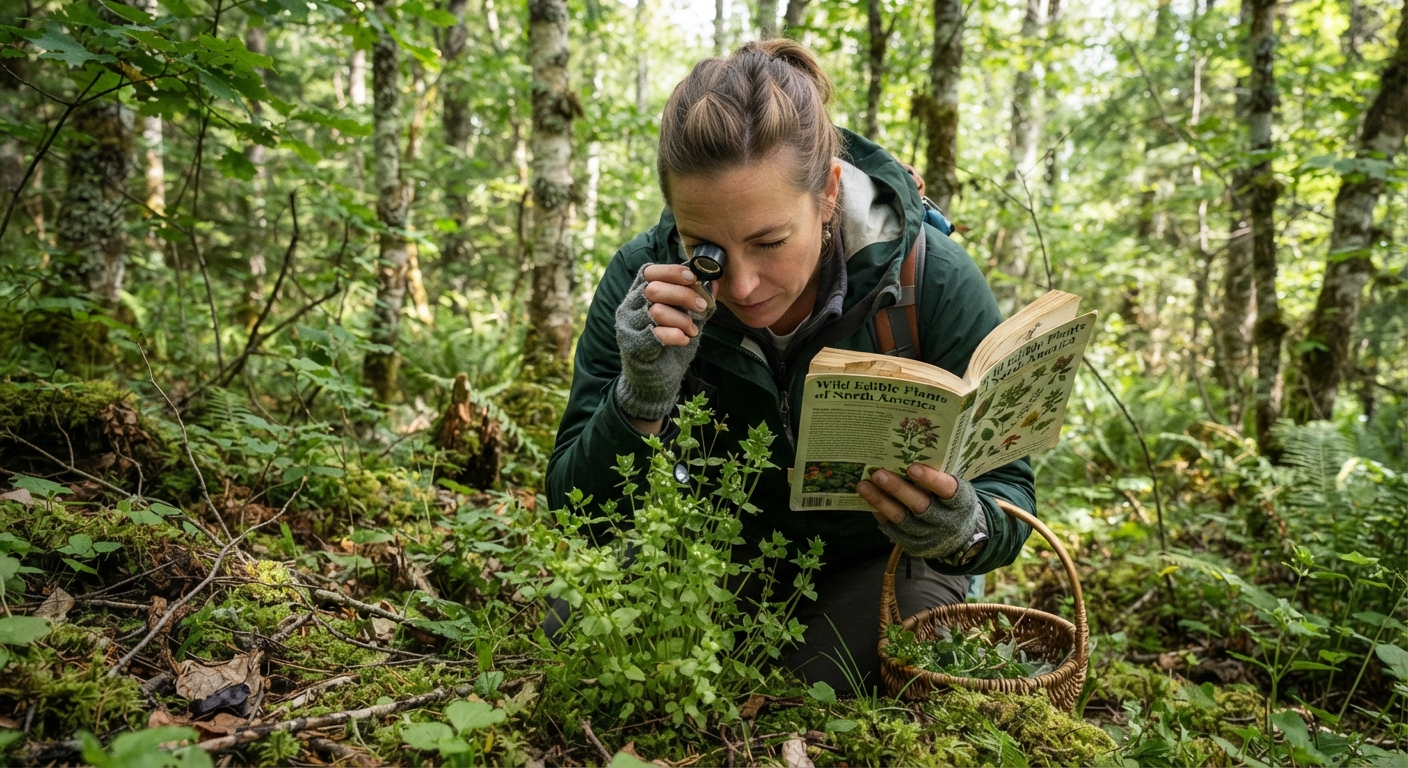
| 8 | Carry a physical field guide (not just an app) | Phones die, apps lose signal, AI plant ID hallucinates — paper doesn’t | ✅ Yes |
| 9 | Tell someone where you’re going and when you’ll be back | Falls, snake bites, and getting lost happen. Someone needs to know where to look | Recommended |
| 10 | Keep a sample of what you ate | If something goes wrong, the ER needs to know what plant to treat for — a sample saves time | ✅ Yes |
Rules 1–3: The Identification Trinity
These three rules work together. Skip one and the safety net has holes.
Rule #1: 100% Positive Identification — No Exceptions
“Pretty sure” is the most dangerous phrase in foraging. Every single foraging poisoning I’ve read about — every documented case, every ER visit, every fatality — involved someone who was “pretty sure.”
The math is brutal. If you’re 95% sure about a plant and you eat it 100 times, you have a 99.4% chance of being fine. But if you forage 100 different plants over a summer and you’re “95% sure” about each one, the probability of at least one misidentification approaches 99.4%. That’s not odds you want.
What counts as “100% positive ID”:
- You can name the plant’s scientific name (not just a common name, which varies by region)
- You’ve checked its identification against at least two sources (guidebook + trusted website, or guidebook + experienced forager)
- You can describe at least three distinct features that separate it from its closest lookalikes
- You’ve confirmed the plant matches its description at the current growth stage — a plant that’s edible as a young shoot might be toxic in flower
What doesn’t count as positive ID:
- “It looks just like the picture in the app”
- “My friend told me it was edible”
- “I saw someone on TikTok eating it”
- “The plant ID app said 87% match”
Apps are tools, not authorities. They’re a starting point for investigation, never the final word.
Rule #2: The Three-Feature Minimum
Plants don’t have one defining characteristic. They have clusters of them. The rule: confirm at least three independent features before harvesting.
For plants, those features typically include:
- Leaf arrangement and shape — alternate vs. opposite, simple vs. compound, margin type, attachment to stem
- Stem characteristics — round vs. square, hairy vs. smooth, hollow vs. solid, color, presence of sap
- Flower structure — number of petals, arrangement, color, presence of bracts
- Growth habit and habitat — growing conditions, companion species, elevation, season
- Smell and taste (with caution)* — aromatic properties, bitterness
*The taste test has its own safety protocol: crush a tiny piece, rub it on your inner wrist, wait 15 minutes. If no reaction, touch to your lip, wait 15 minutes. If no reaction, place a pea-sized piece on your tongue, chew briefly, and spit it out. This is called the Universal Edibility Test — useful in survival situations, but for day-to-day foraging, just stick with reliable field identification.
⚠️ This does NOT apply to mushrooms or berries you can’t positively identify. Some toxins absorb through mucous membranes. Never taste-test something you haven’t already narrowed down to a known edible family.
The Lookalike Problem: A Comparison Table
More foraging poisonings happen from misidentifying lookalikes than from eating outright unknown plants. Here are the most dangerous pairs to know:
| Edible Plant | Dangerous Lookalike | Key Difference | Risk Level |
|---|---|---|---|
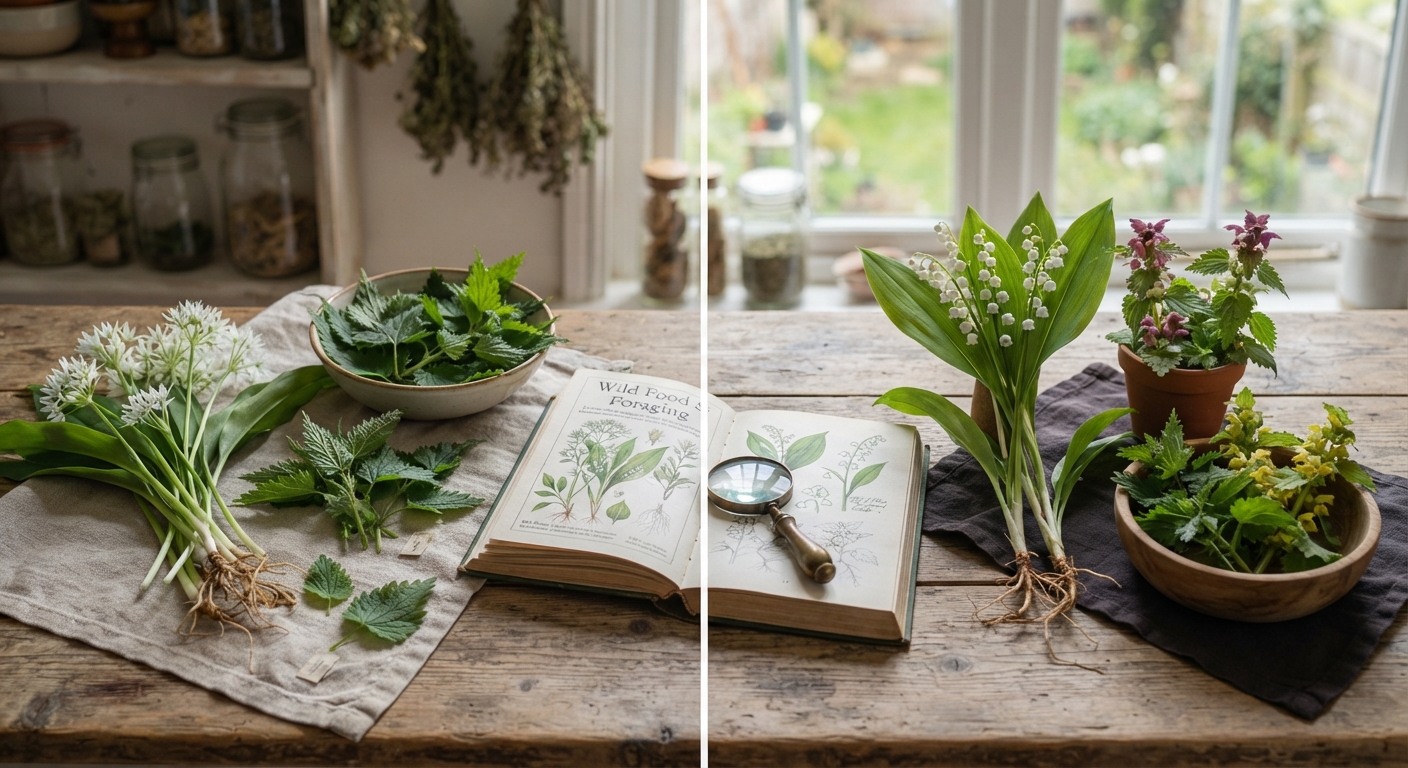
| Wild Carrot (Daucus carota) | Poison Hemlock (Conium maculatum) | Wild carrot has hairy stems, often a single dark red flower in the center of the umbel, smells like carrots. Hemlock has smooth, purple-spotted stems and smells musty/rank when crushed. | ☠️ FATAL |
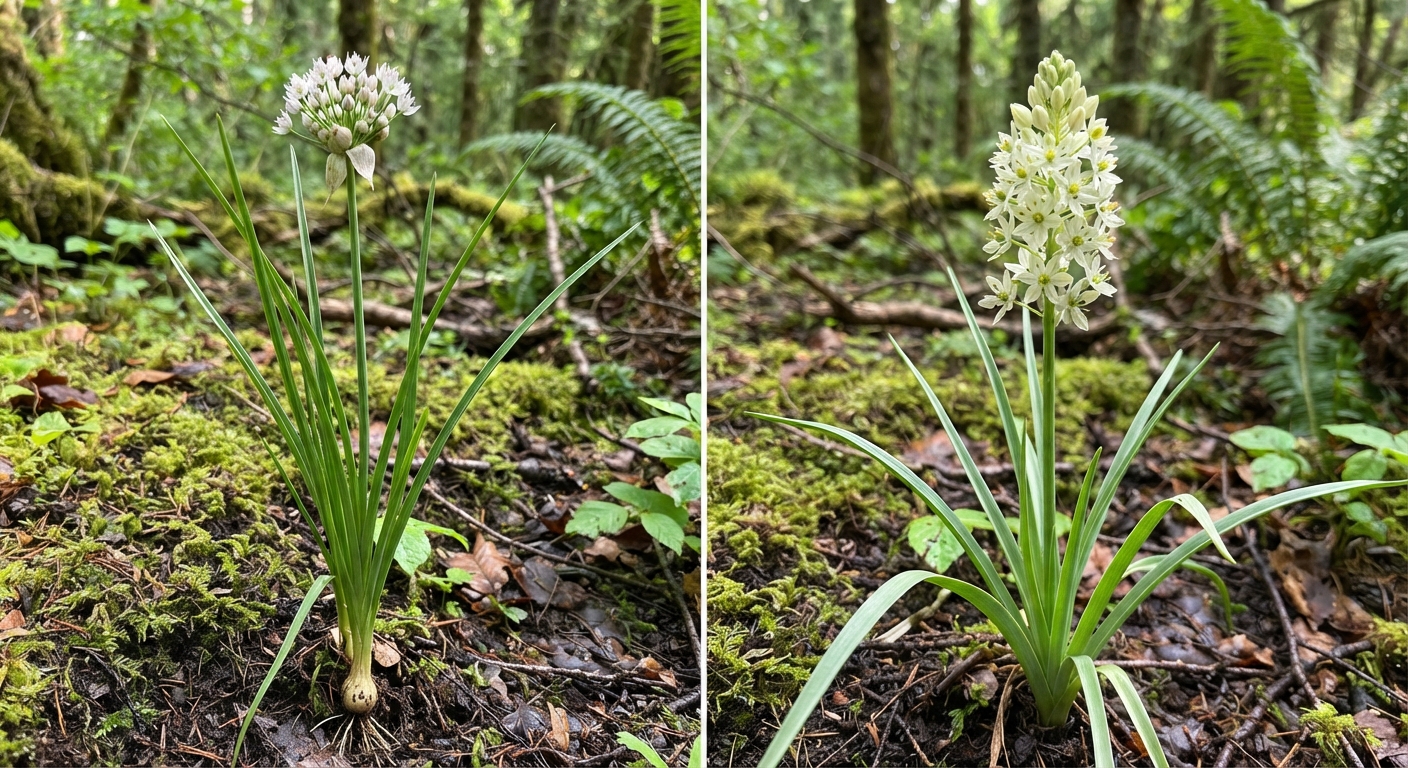
| Wild Garlic (Allium spp.) | Death Camas (Toxicoscordion venenosum) | Wild garlic smells unmistakably like garlic or onion when crushed. Death camas has no onion odor — zero, none, not even subtle. | ☠️ FATAL |
| Wild Strawberry (Fragaria vesca) | Mock Strawberry (Potentilla indica) | True wild strawberry has white flowers, fruit pointing down, seeds embedded in the surface. Mock strawberry has yellow flowers, fruit pointing up, seeds protruding. | Low — mock strawberry is edible but tasteless |
| Morel Mushroom (Morchella spp.) | False Morel (Gyromitra spp.) | True morels are completely hollow from stem tip to cap tip when sliced lengthwise. False morels have a cottony or chambered interior. | ☠️ SEVERE |
| Blueberry (Vaccinium spp.) | Tutsan / St. John’s Wort Berry (Hypericum androsaemum) | Blueberries have a five-pointed crown on the bottom and soft seeds. Tutsan berries have no crown, hard seeds, and red juice that stains fingers. | Moderate — causes GI distress |
| Elderberry (Sambucus nigra/canadensis) | Pokeweed (Phytolacca americana) | Elderberries grow in flat-topped or dome-shaped clusters on woody shrubs. Pokeweed berries hang in long grape-like clusters from a magenta stem on a non-woody plant. | ☠️ SEVERE (pokeweed root, seeds, and raw berries are toxic) |
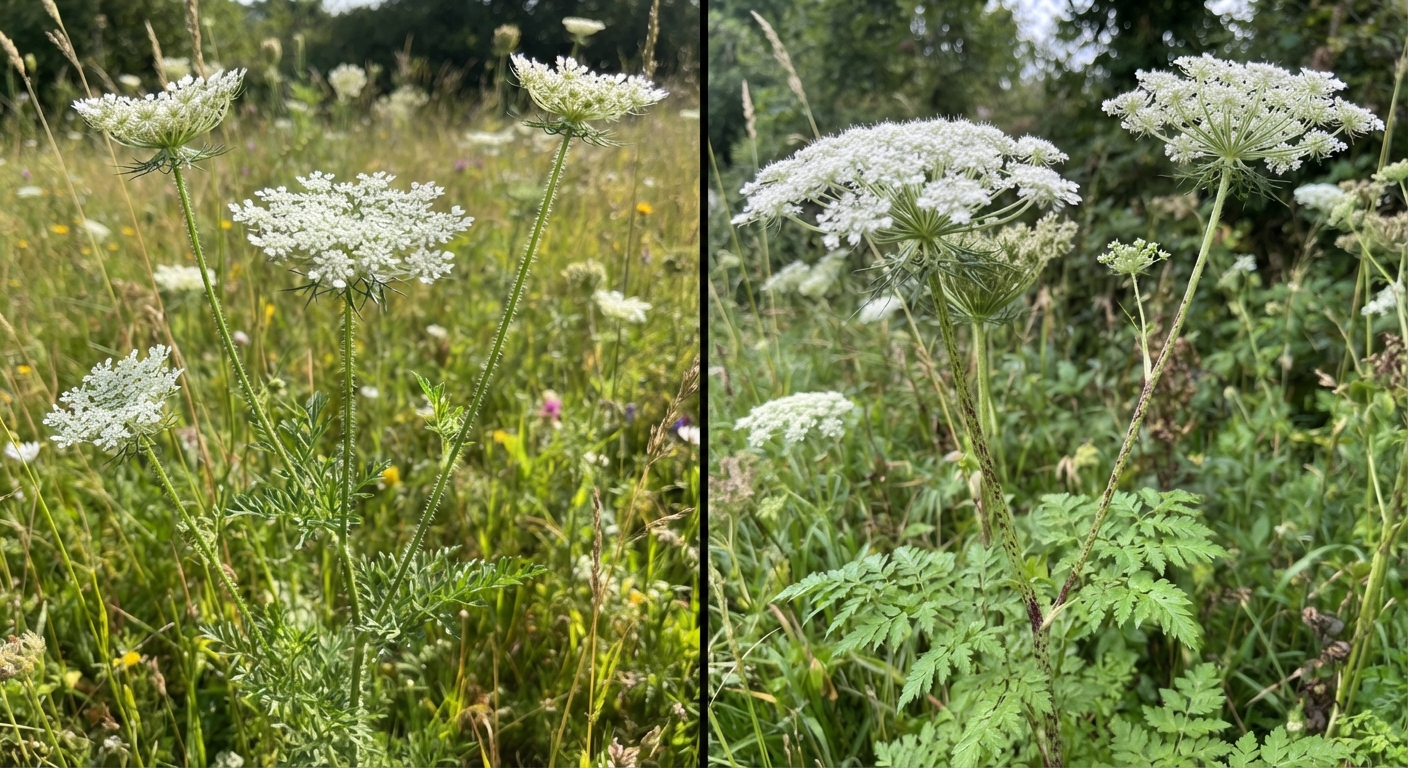
The pattern is clear: the deadly ones all require you to check more than one feature. Smell for wild garlic. Stem texture for wild carrot. Interior structure for morels. The plants that kill people all have one thing in common — someone stopped checking after the first feature matched.
Rule #3: Stay Away From the Carrot Family (For Your First Year)
The Apiaceae family — carrots, parsley, celery, and their wild relatives — includes some of the best wild edibles on the continent. It also includes poison hemlock, water hemlock, and fool’s parsley. These plants are so dangerous that the family botanist who first classified water hemlock in detail was himself poisoned by it.
For your first full year of foraging, skip the carrot family entirely. There are hundreds of edible plants with zero fatal lookalikes. Wild carrot, wild parsnip, and sweet cicely can wait. The risk-to-reward ratio isn’t there for beginners.
If you must identify an Apiaceae plant, the non-negotiable checks include:
- Stem texture (hairy vs. smooth)
- Stem markings (purple spots = hemlock, walk away)
- Presence or absence of a sheath at leaf base
- Smell when crushed
- Habitat (water hemlock grows in wet soil — if you’re near a stream and see an Apiaceae plant, extra caution)
This is the one plant family where getting it wrong can kill you in under three hours. Respect it.
Rules 4–6: Harvest Smart, Stay Healthy
Rule #4: Cook Your Wild Mushrooms
Even the most beloved edible mushrooms — morels, chanterelles, porcinis — contain compounds that can cause gastrointestinal distress when eaten raw. Some, like honey mushrooms (Armillaria spp.), are actively toxic until thoroughly cooked.
The rule for wild mushrooms: cook everything. Sautéing for 5–10 minutes is the minimum. Some species need parboiling first (discard the water, then cook). If you’re new to mushroom foraging, cook every wild mushroom you harvest — no exceptions. That includes mushrooms you plan to freeze or preserve.
Rule #5: One New Plant Per Outing
Your brain can only process so much new information in the field. Trying to learn five new plants on a single walk means you’ll learn none of them well. The result: a vague familiarity that feels like knowledge but crumbles under pressure.
Pick one plant before each outing. Study its identification features, lookalikes, seasonal timing, and preferred habitat. Go out and find it. Take photos. Compare to your field guide. Then pick one more on the next trip.
After ten outings, you’ll have ten plants you can identify with 100% confidence — versus fifty you’re “pretty sure” about.
Rule #6: Location Is an Ingredient
Plants absorb what’s in their environment. A perfectly identified dandelion growing in a crack next to a highway has been soaking up brake dust, tire particles, and exhaust residue for its entire life. A patch of watercress downstream from agricultural runoff might carry pesticide residues. Urban lots sometimes sit on soil that was used as an informal dumping ground for decades before grass covered it over.
Safe foraging locations in order of preference:
| Priority | Location Type | Why |
|---|---|---|
| 1st | Your own unsprayed yard or garden | You control what goes into the soil — no guessing |
| 2nd | Organic farms (with permission) | Regular soil testing, no synthetic pesticides |
| 3rd | Deep forest away from roads, trails, and agriculture | Minimal human contamination, rich soil ecology |
| 4th | Public parks (verify no spraying) | Convenient but check with maintenance staff about pesticide schedules |
| 5th | Roadsides, railroad edges, industrial lots | Avoid. These are collection points for decades of contamination |
Distance guidelines:
- At least 50 feet from roads with light traffic
- At least 100 feet from highways and busy roads
- Never forage from railroad rights-of-way (herbicides are applied aggressively, and the soil contains creosote and heavy metals)
- Avoid plants growing directly under power lines (utility companies spray defoliants)
Rules 7–10: The Backup Systems
These rules exist so that if your identification fails, you have a safety net.
Rule #7: The Small Taste Test
Even with a 100% positive ID, your body might not agree. Food allergies and sensitivities exist for wild plants just like they do for peanuts or shellfish. Some people react to plants that are perfectly safe for everyone else.
The protocol for any new wild food:
- Eat a thumbnail-sized portion
- Wait 30–60 minutes
- If no reaction (itching, swelling, difficulty breathing, GI distress), eat a larger portion
- Wait another few hours before making it a meal
This catches individual sensitivities before they become emergencies.
Rule #8: Carry Paper, Not Just Pixels
Phone batteries die. Apps lose signal in remote areas. AI plant identification tools have been documented hallucinating identifications — confidently naming toxic plants as edible with no warning. One 2023 study tested five popular plant ID apps against known toxic species and found that every single app misidentified at least one toxic plant as edible.
Carry a physical field guide specific to your region. Peterson, Audubon, Lone Pine, and regional university press guides are all reliable. The weight in your pack is worth the certainty.
If you use an app, treat it as step one of a three-step process: app suggests → field guide confirms → experienced forager verifies (when learning). Skip any step and you’re gambling.
Rule #9: The Buddy System — Or At Least a Check-In
Foraging often means walking off-trail into uneven terrain. A twisted ankle three miles from your car becomes a serious problem if nobody knows you’re there. Snake bites, falls, allergic reactions — these things happen to experienced outdoors people all the time.
Minimum safety: tell someone exactly where you’re going and when you expect to return. Share a pin if you’re parking at a trailhead. If you’re not back within an hour of your expected return, they should come looking.
Better: bring a friend. Two sets of eyes catch identification errors that one might miss. Plus, it’s more fun.
Rule #10: Keep a Sample
If you do have a bad reaction — from a misidentified plant, an individual allergy, or contamination you couldn’t see — the emergency room needs to know what you ate. Stomach contents take time to analyze. A physical sample of the plant you consumed lets a toxicologist identify it within minutes.
Keep a small specimen in a sealed bag in your foraging kit. If nothing goes wrong, you can discard it. If something does, it could be the difference between targeted treatment and guesswork.
What to Carry: The Foraging Safety Kit
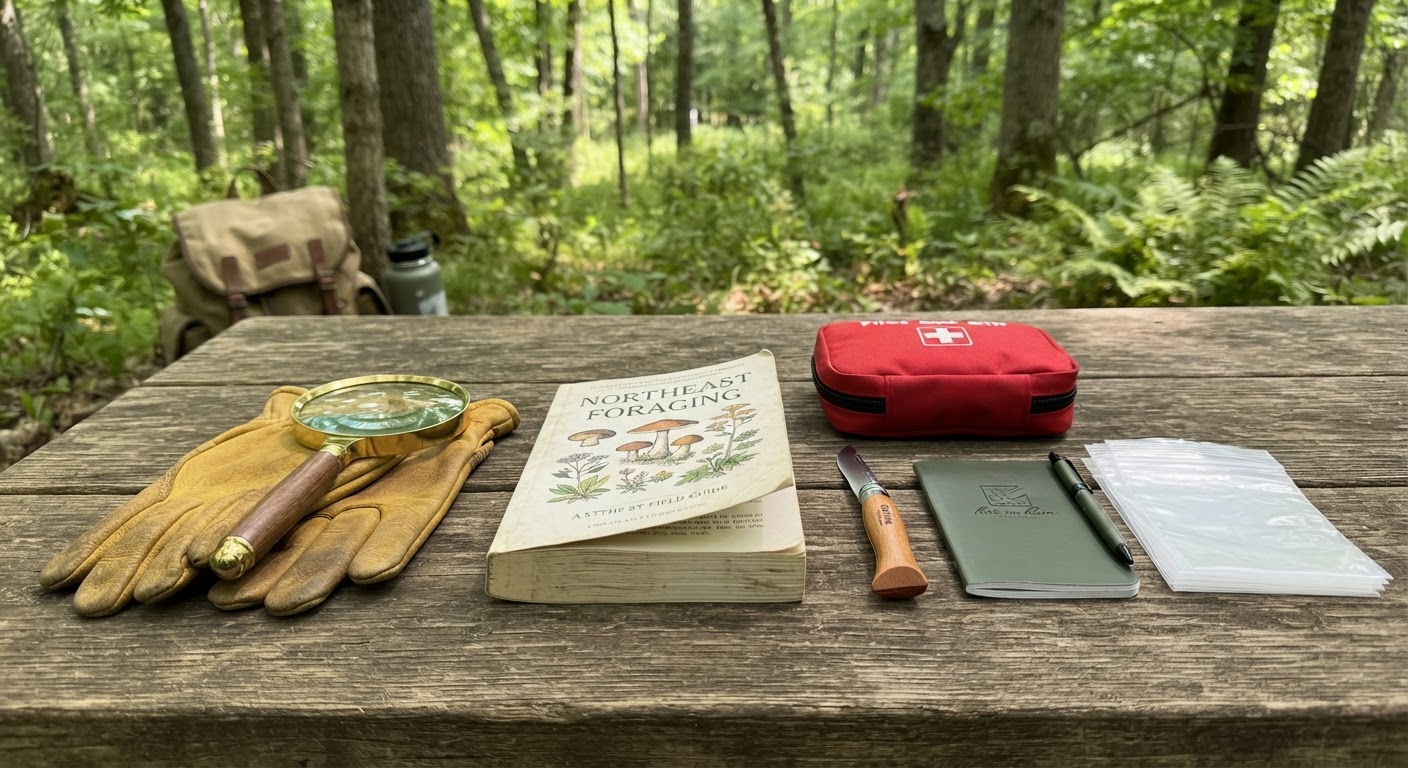
Here’s exactly what belongs in your foraging bag for safety. This isn’t the complete foraging kit (which includes digging tools, bags, and harvest containers) — this is just the safety essentials.
| Item | Purpose | Priority |
|---|---|---|
| Regional field guide | Primary identification tool | 🔴 Essential |
| Sharp knife or scissors | Clean cuts reduce plant damage; knife for mushroom stem inspection | 🔴 Essential |
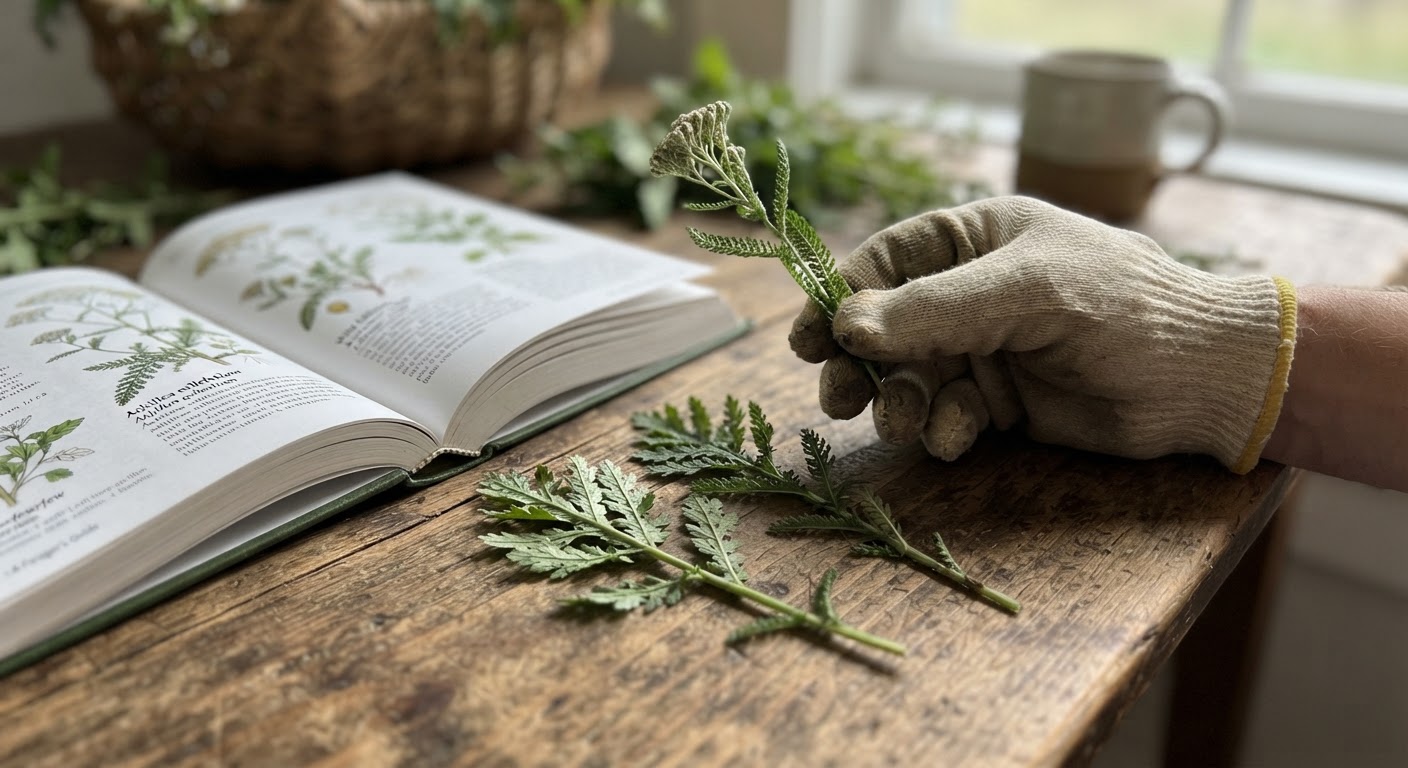
| Gloves (leather or nitrile) | Protection from thorns, stinging plants, and handling unknown specimens | 🔴 Essential |
| Small first aid kit | Cuts, scrapes, insect stings happen | 🔴 Essential |
| Phone (charged + battery pack) | GPS, emergency calls, photo documentation | 🔴 Essential |
| Water + snack | Dehydration impairs judgment | 🟡 Important |
| Small ziplock bags | Sample storage (Rule #10), separating different species | 🟡 Important |
| Small notebook + pen | Sketching features you’re unsure about; noting locations | 🟡 Important |
| Hand lens / magnifying glass (10x) | Examining leaf hairs, flower structure, mushroom gills | 🟢 Nice to have |
| Whistle | If you fall or get lost, a whistle carries further than shouting | 🟢 Nice to have |
| Headlamp | Light fades fast in forests; getting caught in the dark on rough terrain is dangerous | 🟢 Nice to have |
The Universal Decision Flowchart
When you find something and think it might be edible, work through these questions in order. Any “no” or “not sure” means don’t eat it.
Step 1: Can I identify this plant to the species level (scientific name)?
- No → Take photos, research later, do not eat.
- Yes → Go to Step 2.
Step 2: Does this plant have any poisonous lookalikes? Can I name them?
- Not sure → Take photos, research later, do not eat.
- Yes, and I’ve checked against them → Go to Step 3.
Step 3: Have I confirmed at least 3 independent identification features?
- No → Do not eat. Find more features.
- Yes → Go to Step 4.
Step 4: Is the plant growing in a safe location? (50+ ft from roads, no visible spraying, not in polluted water)
- No → Do not harvest. Find a cleaner specimen.
- Yes → Go to Step 5.
Step 5: Is the plant at the right growth stage for consumption?
- No → Do not eat. Some plants are only edible at specific stages.
- Yes → Go to Step 6.
Step 6: Do I know the correct preparation method for this species? (cooked vs. raw, parboiling required, parts to discard)
- No → Research preparation first, then return.
- Yes → Harvest in moderation. Keep a sample. Do a small taste test first.
Common Foraging Safety Mistakes (And How to Fix Them)
Every experienced forager has made at least a few of these. Learn from other people’s mistakes instead of your own.
| Mistake | Why It Happens | How to Avoid It |
|---|---|---|
| Trusting common names | “Queen Anne’s lace” sounds safe; it’s also what many people call poison hemlock before they know the difference | Always learn the scientific name, at minimum the genus |
| Foraging mushrooms without spore prints | Beginners often skip spore color, which is a primary diagnostic feature | Take spore prints for every new mushroom species — it’s 4 hours of waiting that can prevent a lifetime of regret |
| Eating fruits from plants you can’t identify | Berries look harmless; some of the most poisonous plants on the continent produce attractive berries | The “birds eat them so they’re safe” rule is FALSE — birds tolerate compounds that kill humans (e.g., pokeweed berries) |
| Foraging at dusk or in bad light | Color is a key ID feature; dusk distorts it | Forage only in good daylight. Use a headlamp only for the walk back, not for plant ID |
| Assuming “organic-looking” means unsprayed | Many municipalities and HOAs spray herbicides without posting signs | When in doubt, ask. Parks departments and land managers will usually tell you their spraying schedule if you call |
| Overconfidence after a few successes | Early success with dandelions and blackberries creates a false sense of ID skill | Keep the one-new-plant-per-outing rule for at least your first full year. Hubris is the most common cause of foraging injury |
Frequently Asked Questions
Can I trust plant identification apps to tell me what’s safe to eat?
No, not as your only source. Plant ID apps are useful as a first-pass tool — they can narrow down possibilities and give you a genus to research. But every major app has misidentified toxic plants as edible in controlled tests. Always confirm with a physical field guide and, when learning, a knowledgeable human forager.
What should I do if I think I ate something poisonous?
Call Poison Control immediately: 1-800-222-1222 (US). Do not wait for symptoms. Do not try to induce vomiting unless Poison Control tells you to. Bring a sample of what you ate to the ER. Time is the critical factor — most plant poisonings are survivable with prompt treatment.
Are there any plants that can hurt me just from touching them?
Yes. Giant hogweed (Heracleum mantegazzianum) causes severe phototoxic burns — sap on skin + sunlight = third-degree burn blisters. Poison ivy, oak, and sumac cause allergic reactions in most people. Wild parsnip sap causes burns similar to hogweed. Always wear gloves when handling unknown plants.
Is it safer to forage in remote wilderness than in urban parks?
Not necessarily. Wilderness areas aren’t sprayed with pesticides, which is good — but they’re also far from help if something goes wrong, and you’re more likely to encounter terrain hazards. Urban parks have more human contamination risk but are closer to medical care. There’s no perfectly safe location — adapt your safety protocols to the risks of where you’re foraging.
How do I know if a mushroom is safe without eating it?
The only reliable method is positive species identification. All the folk tests — “if it tarnishes silver,” “if animals eat it,” “if the skin peels” — are dangerously wrong. There is no universal mushroom safety test. You must identify the species or don’t eat it.
Should infants, pregnant women, or immunocompromised people eat foraged food?
Extra caution is warranted. Pregnant women should avoid wild plants from the carrot family (some contain compounds that can affect pregnancy) and any foraged food from questionable locations. Immunocompromised individuals should cook everything thoroughly and avoid raw wild greens. When in doubt, consult a doctor familiar with your specific situation.
Summary: Print This, Save It
The 10 rules, compressed:
- ID to 100% certainty — no “pretty sure”
- Confirm 3+ independent features every time
- Skip the carrot family for year one
- Cook all wild mushrooms
- Learn one new plant per trip
- Forage clean locations only
- Taste-test small amounts first
- Carry a physical field guide
- Someone knows where you are
- Keep a sample of everything you eat
If you remember nothing else:
- Positive ID > everything else
- If you’re not certain, you’re not eating
- Poison Control’s number: 1-800-222-1222
- A photo of what you ate saves lives in the ER
Foraging is one of the most rewarding skills you can learn. It connects you to your local ecosystem, puts genuinely free food on your table, and teaches you to see landscapes differently. The safety system above isn’t meant to scare you away from it — it’s meant to make sure you’re still foraging twenty years from now, with nothing but good stories and great meals to show for it.
Last updated: July 2026. Safety information reviewed against current toxicology guidance. Always consult regional resources for location-specific risks.