There’s a plant sitting in your yard right now that has more calcium than kale, more beta-carotene than carrots, more iron than spinach, and more potassium than bananas. It grows on every continent except Antarctica. You’ve probably mowed it, pulled it, or sprayed it with chemicals at some point. You might even have a bag of it sitting in your fridge right now from the grocery store — where it sells for $3.99 a bunch under the name “dandelion greens.”
But here’s where it gets interesting: the dandelion greens at Whole Foods only scratch the surface of what this plant can do. Most people don’t realize that every single part of a dandelion is edible — roots, leaves, flowers, stems, even the unopened flower buds. And each part has its own season, its own flavor profile, and its own set of culinary possibilities.
If you’ve ever wondered “how do you actually eat a dandelion?” — not just toss a few bitter leaves in a salad, but really eat it like food — this guide is your answer. We’re going part by part, season by season, method by method. No romanticism. No survivalist posturing. Just practical, tested information on turning the world’s most common weed into genuinely good meals.
The Dandelion Reality Check: What You’re Actually Working With
Before we get into techniques, let’s clear up the most common misconception: dandelions are not uniformly bitter. The bitterness level depends almost entirely on three factors — the part you’re eating, the time of year, and how you prepare it. Blindly grabbing any dandelion leaf, any time of year, and eating it raw is like judging all apples by a Granny Smith. Some dandelion greens are genuinely sweet, with no more bitterness than arugula. Others will make you pucker. The difference is knowing what to pick when.
The bitterness compound is sesquiterpene lactones — the same family of compounds that gives chicory, radicchio, and artichokes their characteristic bite. It’s not a toxin. It’s not dangerous. In fact, those bitter compounds stimulate digestive enzyme production and bile flow, which is why dandelion has been used as a digestive bitter in traditional medicine for centuries. The bitterness is a feature, not a bug — but it’s one you can control.
Here’s a quick chemistry primer that’ll save you months of trial and error: bitterness concentrates in the white latex sap that flows through every part of the plant. That sap is most abundant in older leaves, in leaves exposed to full sun, and in leaves harvested during or after flowering. Young leaves harvested in early spring, before the flower stalks appear, contain significantly less of it. Leaves from plants growing in partial shade are milder than those in blazing sun. And — this is the game-changer — you can physically remove a large portion of that bitter sap through a simple blanching technique we’ll cover in the processing section.
Know Your Plant: The “Five Finger” Dandelion Identification Method
Before you eat anything, you need to be 100% certain you’ve got a dandelion. It seems obvious — everyone knows what a dandelion looks like — but there are several lookalikes, and some of them will give you an upset stomach if you mistake them for the real thing.
The “five finger” method is how experienced foragers confirm a dandelion ID. Run through these five checks, and if all five match, you’re holding Taraxacum officinale:
The Five Confirmations
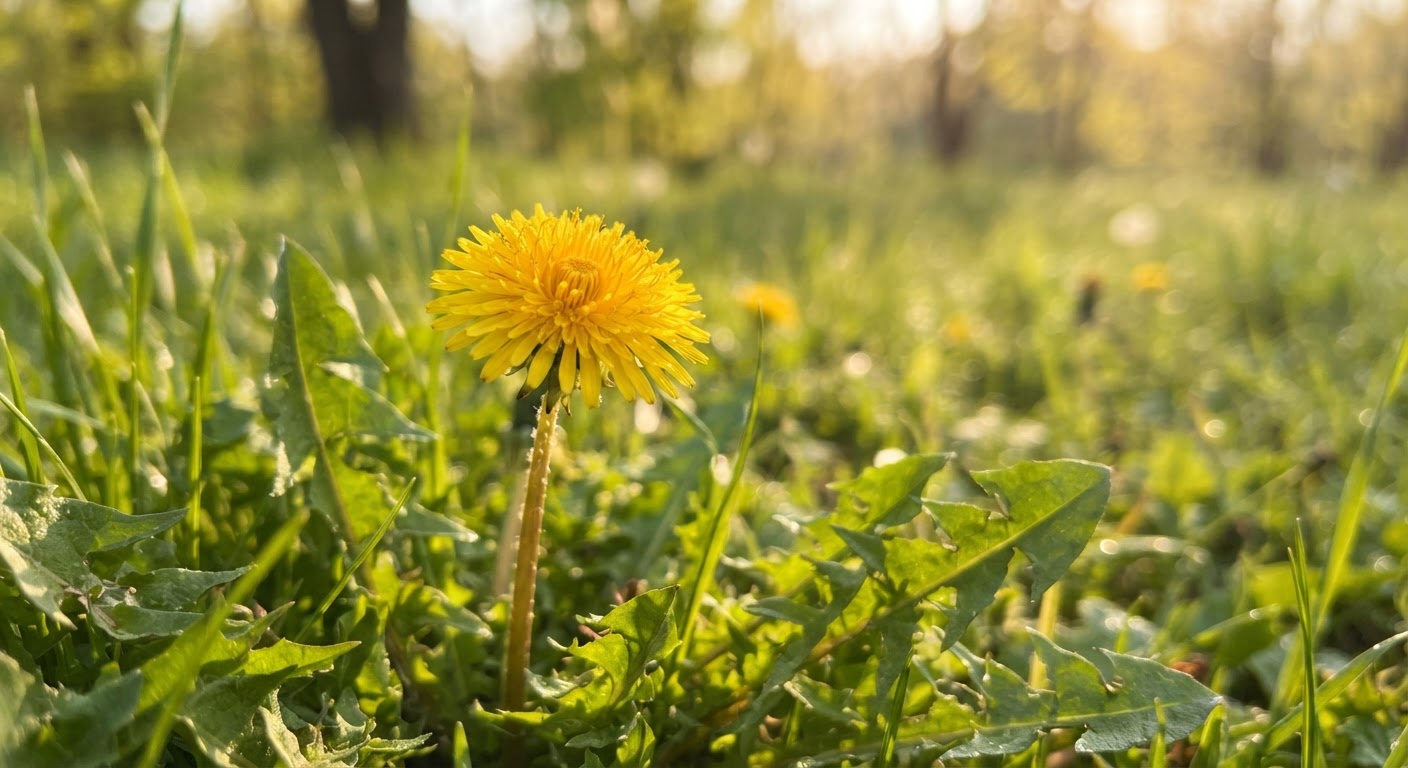
1. Leaves grow in a flat rosette directly from the ground. There is no central stem. Every leaf emerges from a single crown at soil level. If you see leaves branching off a tall stem, it’s not a dandelion — you might be looking at sow thistle or wild lettuce.
2. Leaves are deeply toothed, and the teeth point downward toward the base. This is where the name comes from — dent de lion, “lion’s tooth” in French. The lobes are triangular, jagged, and they angle back toward the center of the plant. If the leaf edges are smooth, wavy, or have teeth pointing outward or upward, keep looking.
3. Each flower sits on a single, hollow, unbranched stem. Break the stem. Is it hollow? Does milky white sap ooze out? If yes, keep going. If the stem is solid, branched, or has multiple flowers on one stalk, it’s a lookalike — likely hawkweed or cat’s ear.
4. The sap is white and milky, not clear or absent. Snap a leaf at the base. White latex should bead up immediately. This sap is slightly staining — it’ll turn brown on your fingers after a few minutes. Dandelion is one of several plants in the Asteraceae family that produce this latex, so sap alone isn’t definitive, but combined with the other four checks, it seals the ID.
5. There are no hairs on the leaves or stems. Dandelion leaves are smooth and hairless — the botanical term is glabrous. Many lookalikes have fine hairs, especially on the underside of leaves. Run your finger along the leaf. If it feels fuzzy, bristly, or sandpapery, you’re holding something else.
Dandelion vs. Common Lookalikes
This is the table I wish someone had handed me on my first foraging walk. If you can confidently rule out these four plants, you’ll never misidentify a dandelion again:
| Feature | Dandelion (Taraxacum officinale) | Sow Thistle (Sonchus spp.) | Cat’s Ear (Hypochaeris radicata) | Wild Lettuce (Lactuca spp.) | Hawkweed (Hieracium spp.) |
|---|---|---|---|---|---|
| Stem | Single, hollow, smooth, unbranched | Hollow, branched, taller | Solid, wiry, branched, slightly rough | Hollow but thicker, often branched | Solid, wiry, branched, hairy |
| Flowers per stem | One | Multiple (clustered at top) | Multiple on branched stems | Multiple small flowers | Multiple small flowers on branched stems |
| Leaf hairs | None — smooth and glossy | Slightly prickly on edges | Distinct hairs, especially underside | Usually smooth, sometimes prickly midrib | Distinct hairs on both sides |
| Leaf shape | Deeply toothed, teeth point downward | Variable, often clasping stem, teeth point outward | Rounded lobes, less deeply cut | Variable, often with a row of spines on midrib underside | Often oval or lance-shaped, mildly toothed |
| Sap color | Milky white | Milky white | Milky white | Milky white | Milky white |
| Rosette | Flat to the ground | More upright growth | Flat to the ground | Upright, taller | Flat to the ground |
| Edible? | ✅ Entirely edible | ✅ Edible (milder) | ⚠️ Edible but often more bitter | ⚠️ Edible but medicinal | ⚠️ Not recommended |
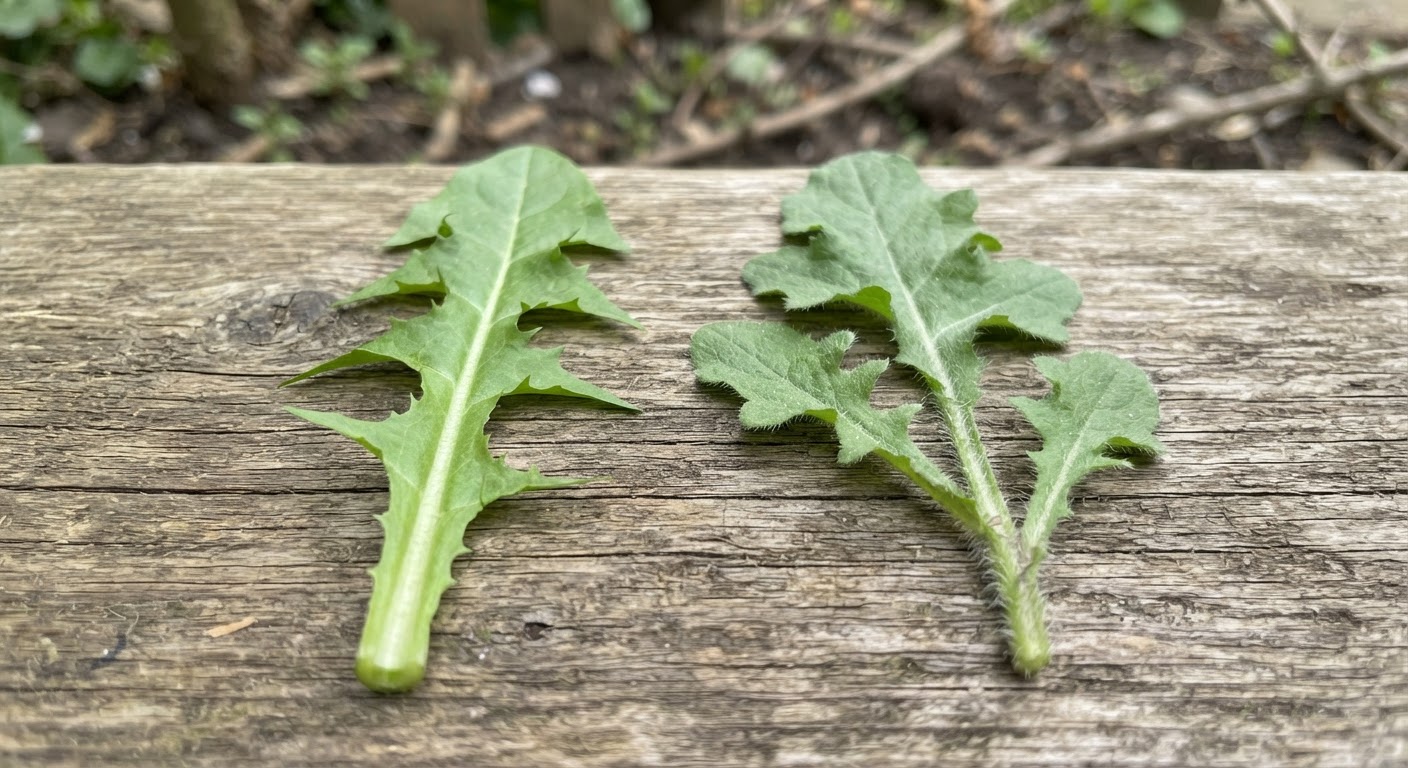
One safety note worth emphasizing: if you’ve confirmed it’s a dandelion, you’re safe. There are no poisonous dandelion lookalikes in North America that pass all five checks. The plants commonly mistaken for dandelion — sow thistle, cat’s ear, wild lettuce — are all technically edible as well, though they won’t give you the same culinary experience. The real danger is not the plant itself but where it’s growing. More on that in the safety section below.
The Seasonal Harvest Calendar: What to Pick, When, and Why It Matters
Dandelion is a year-round plant in most temperate climates, but the part you want to eat shifts dramatically with the seasons. Harvest the wrong part in the wrong month and you’ll wonder why anyone bothers. Time it right and you’ll understand why this plant has been cultivated as food for thousands of years.
| Season | What to Harvest | Flavor Profile | Best Use | Harvesting Tip |
|---|---|---|---|---|
| Early Spring (Feb–April) | Young basal leaves | Mild, slightly sweet, nutty — comparable to arugula | Raw in salads, pesto, smoothies | Harvest before flower stalks appear. These are the prized “spring greens” that command $4/bunch at farmers markets. |
| Late Spring (April–May) | Unopened flower buds | Pea-like, earthy, slightly nutty | Sautéed in butter, pickled like capers, stir-fries | Pick tightly closed buds still nestled in the crown. They should feel firm, not squishy. |
| Early Summer (May–June) | Fully opened flowers | Mildly sweet, pollen-like, floral | Fritters, wine, syrup, salad garnish | Harvest mid-morning when flowers are fully open and dry. Use the same day — they wilt fast. |
| Mid-Summer (June–July) | Mature leaves | Noticeably bitter — more intense | Cooked dishes, braised greens, soups | Blanch first to reduce bitterness (see technique below). Leaves with flower stalks present are strongest. |
| Late Summer (Aug–Sept) | Leaves (second flush) | Milder again as heat stress fades | Mixed into cooked dishes, dried for tea | After summer’s peak, plants often push out fresh growth. These secondary leaves are less bitter than mid-summer ones. |
| Fall (Oct–Nov) | Roots (first-year plants preferred) | Earthy, nutty, slightly sweet when roasted | Roasted root “coffee,” roasted vegetable medley, broth | Dig after a good rain when soil is soft. First-year roots are tender and sweeter; second-year roots are woodier. |
| Winter (Dec–Jan) | Roots; forced/blanched indoor greens | Roots: rich, roasty. Indoor greens: pale, mild, almost sweet | Root coffee; forced winter greens from stored roots | Dig roots before ground freezes. Pot them indoors in damp sand in darkness — they’ll produce pale, tender leaves in 2–3 weeks. |
The single most important seasonal rule: harvest dandelion greens before the flowers open. Once that yellow bloom appears, the leaves turn bitter within days. If you see flowers, you’ve got about a 3–5 day window where the buds and flowers are at peak quality, but the leaves have already passed their prime for raw eating. Think of it as a trade-off — you get flowers and buds in spring, tender leaves in early spring and late summer, and roots in fall.
From Bitter to Better: Processing Techniques That Actually Work
Raw dandelion greens can be divisive. Some people love the bitter kick. Others — and I’d wager most newcomers — find it overwhelming. The good news is that bitterness is not a fixed property of the plant. It’s a variable you can control with a few simple kitchen techniques.
Technique 1: The 30-Minute Cold Water Soak
This is the gentlest method and the one that preserves the most nutrients. Submerge clean dandelion leaves in a bowl of cold water with a teaspoon of salt dissolved in it. Let them sit for 30 minutes, then drain, rinse, and pat dry.
What it does: the salt water draws out some of the water-soluble bitter compounds through osmosis. It doesn’t eliminate bitterness — you’re looking at maybe a 20–30% reduction — but it noticeably softens the bite while keeping the leaves crisp and raw. This is your best option if you want raw dandelion greens in a salad and don’t mind a little bitterness for character.
Technique 2: The 60-Second Blanch
Bring a pot of water to a rolling boil. Drop the dandelion leaves in for exactly 60 seconds — no more, no less. Immediately transfer them to a bowl of ice water to stop the cooking. Squeeze out the excess water with your hands.
What it does: blanching physically ruptures the plant cells and leaches bitter compounds directly into the water. A 60-second blanch removes roughly 60–70% of the bitterness. The leaves will be wilted but still retain texture, color, and a significant portion of their nutrients. This is the technique for sautéed greens, pasta dishes, quiches, and anywhere you’d use cooked spinach.
Critical detail: discard the blanching water. Don’t use it for stock or cooking — it’ll be intensely bitter. I learned this the hard way trying to make rice with blanching water. The rice was inedible.
Technique 3: The Double-Boil (for Very Bitter Summer Greens)
If you’re working with mid-summer leaves that have already flowered and taste aggressively bitter, the double-boil is your nuclear option. Blanch the greens for 60 seconds in boiling water, drain, then blanch them again in a fresh pot of boiling water for another 30–45 seconds. Ice bath, squeeze dry.
What it does: removes up to 85% of bitterness and produces greens so mild that picky eaters won’t detect any dandelion flavor at all. The trade-off is significant nutrient loss — you’re leaching water-soluble vitamins with each boil. Use this only for older, tougher leaves harvested at the wrong time of year. It’s better to eat twice-blanched dandelion greens with reduced nutrients than to not eat them at all.
Technique 4: The Fat Mask (Adults-Only Method)
This isn’t a bitterness-removal technique but a bitterness-balancing one. Bitterness receptors on the human tongue are partially blocked by fat. This is why bitter greens pair so beautifully with olive oil, bacon, butter, cheese, and eggs. When in doubt, add fat.
What it does: doesn’t remove any bitterness, but makes it taste balanced and pleasant. A splash of good olive oil, a sprinkle of Parmesan, a squeeze of lemon — suddenly the bitterness reads as “complex” rather than “harsh.” This is the Mediterranean approach. Italians have been eating bitter wild chicories dressed in olive oil and anchovy for millennia, and they’re not wrong.
Cooking Methods: How Heat Transforms Dandelion
Dandelion greens behave differently under different cooking methods. Here’s what to expect from each approach:
Sautéing (the classic): Heat olive oil in a pan over medium-high heat. Add minced garlic and a pinch of red pepper flakes. Once fragrant (30 seconds), add blanched dandelion greens. Sauté for 3–4 minutes, turning frequently, until the greens are wilted and the edges start to crisp slightly. Finish with lemon juice and salt. This method produces tender, savory greens with crispy edges — the gateway dish for dandelion skeptics.
Braising (for tough leaves): For mature leaves, braising is the move. Sauté aromatics (onion, garlic, maybe some chopped bacon), add the blanched greens, pour in enough broth to come halfway up the greens, cover, and simmer on low for 15–20 minutes. The long, gentle cooking dissolves tough fibers and allows the greens to absorb the braising liquid’s flavor. Finish uncovered to reduce the liquid to a glaze. This is basically collard greens technique applied to dandelion, and it works beautifully.
Stir-frying (quick and hot): Dandelion greens hold up surprisingly well to high-heat stir-frying. Get your wok screaming hot, add oil, toss in the greens with garlic and ginger, and stir-fry for no more than 60–90 seconds. The greens should be wilted but still bright green. A splash of soy sauce and sesame oil at the end. The slight bitterness cuts through the richness of the oil and soy in a really satisfying way.
Roasting (for roots only): Clean dandelion roots thoroughly — they’ll be muddy. Scrub them like you’d scrub a carrot. Chop into 1-inch pieces, toss with olive oil and salt, and roast at 400°F for 25–30 minutes until golden brown and tender. They taste like a cross between a carrot and a parsnip, with an earthy, nutty quality. Or, for dandelion root “coffee,” roast the roots at 350°F for about 40–50 minutes until they’re dark brown and snap crisply. Grind and brew like coffee.
Baking (for flower fritters and petals): Dandelion flowers make fantastic fritters — dip whole flower heads in a simple batter (flour, egg, milk, salt) and pan-fry until golden. You can also separate the yellow petals from the green base (tedious but worth it) and fold them into muffin batter, quick breads, or pancake mix for a subtle floral sweetness and a beautiful golden fleck throughout.
The Complete Parts Guide: How to Eat Every Bit of a Dandelion
The Leaves (Spring & Fall Harvest)
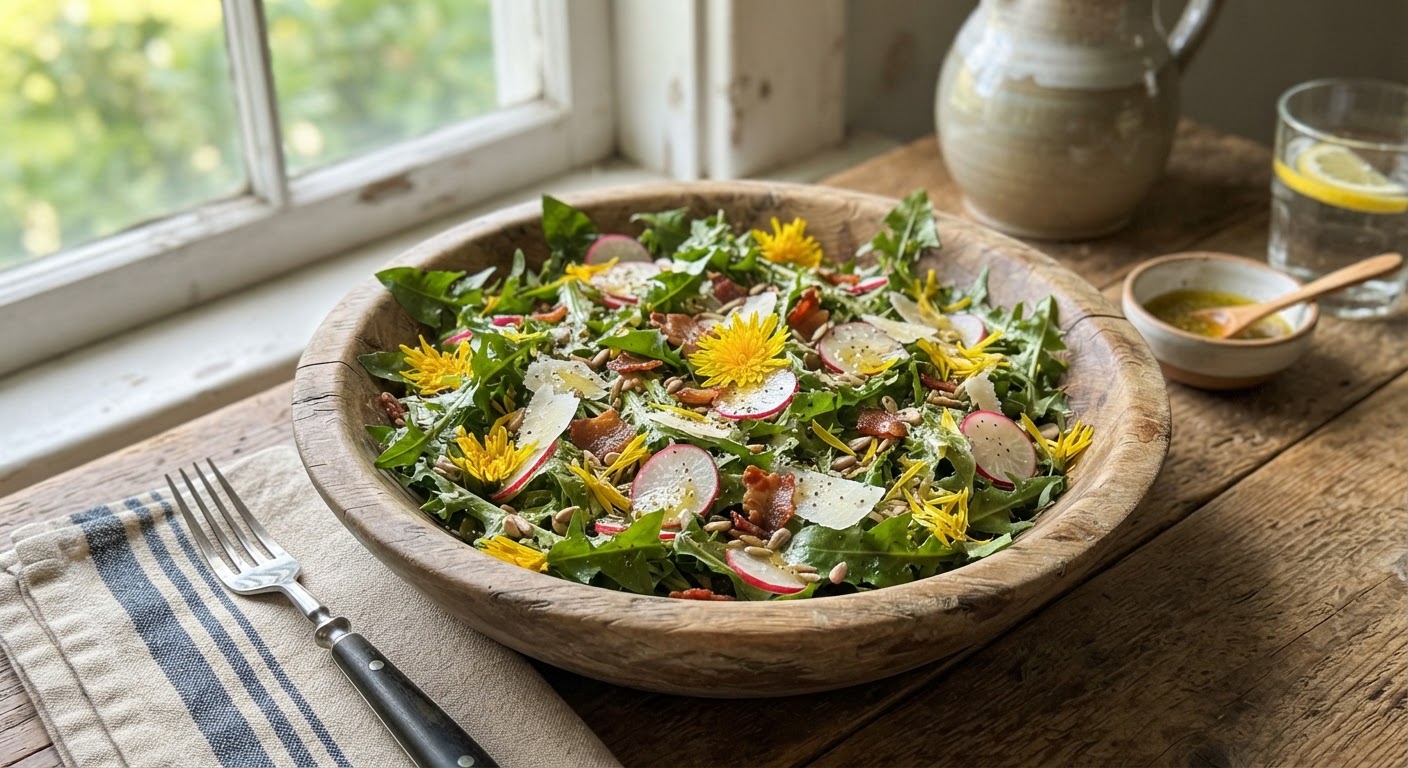
The workhorse part of the plant. Young spring leaves are your raw ingredient — salads, pestos, sandwich greens, smoothies. Blanched leaves are your cooked ingredient — anywhere spinach goes, dandelion can follow. Try them in:
- Dandelion Pesto: Blanch leaves for 60 seconds, squeeze dry, then process with garlic, toasted walnuts or pine nuts, Parmesan, olive oil, lemon juice, and salt. The blanching step is non-negotiable — raw dandelion pesto is aggressively bitter. Blanched dandelion pesto is nutty, complex, and arguably more interesting than basil pesto.
- Dandelion Spanakopita: Replace spinach with blanched dandelion greens in any spanakopita or greens pie recipe. The bitterness cuts through the rich feta and buttery phyllo perfectly.
- Garlicky Dandelion Greens on Toast: Sauté blanched greens with garlic, olive oil, and chili flakes. Pile onto toasted sourdough. Top with a fried egg. This is a five-minute meal that’ll convert dandelion skeptics.
The Flowers (Late Spring Harvest)
Dandelion flowers are mild, slightly sweet, and have a texture that ranges from delicate (petals only) to substantial (whole flower heads). They’re the most approachable part of the plant for newcomers.
- Dandelion Fritters: The classic. Dip whole flower heads (green base and all) in a thin batter, fry in butter or oil until golden. Sprinkle with powdered sugar or drizzle with honey. They taste like fried mushrooms crossed with zucchini flowers. Kids love these.
- Dandelion Wine: This is a project — it takes months — but the result is one of the most distinctive homemade wines you’ll ever taste. It’s floral, honeyed, and surprisingly complex. Worth doing at least once.
- Dandelion Petal Syrup: Separate the yellow petals from the bitter green base (this is the tedious part), steep in simple syrup, strain, and you’ve got a golden, floral syrup that’s incredible in cocktails, over pancakes, or drizzled on vanilla ice cream.
- Dandelion Petal Butter: Cream softened butter with dandelion petals and a pinch of salt. Roll into a log, chill, and slice into rounds. It melts over grilled steak, roasted vegetables, or warm bread and adds this beautiful yellow color and subtle floral note.
The Roots (Fall Harvest)
Dandelion roots are the most labor-intensive part to harvest — you’re digging into soil, sometimes clay-heavy soil, to extract a taproot that can go 6–12 inches deep. But the reward is worth it.
- Dandelion Root Coffee: The most famous root preparation. Wash roots, chop, roast at 350°F until dark and brittle, grind, brew. It’s dark, roasty, and earthy — no caffeine, but it has chicory-like richness. Dandelion root coffee is a legitimate coffee substitute, not a novelty. It’s been commercially produced and sold for over a century.
- Roasted Dandelion Root Vegetables: Treat fresh roots like any root vegetable — roast with carrots, parsnips, and potatoes. They add an earthy depth that plain potatoes can’t provide.
- Dandelion Root Tea (non-roasted): Slice clean roots thin and dry them at low heat. Steep in hot water for a mild, slightly sweet, nutty tea. The dried roots last for months in an airtight jar.
The Buds (Late Spring Harvest)
The unopened flower buds, still nestled deep in the crown, are a delicacy that most foragers overlook. They taste remarkably like green peas or young artichoke hearts.
- Dandelion Bud Capers: Pick firm, tightly closed buds. Blanch for 30 seconds, then pack into a jar with vinegar, salt, and spices (peppercorns, garlic, bay leaf). Refrigerate for at least 1 week. They pickle beautifully and work anywhere you’d use capers — in pasta puttanesca, on bagels with lox, in tartar sauce, scattered over roasted vegetables.
- Butter-Sautéed Buds: Simply sauté fresh buds in butter with a pinch of salt until tender. They pop in your mouth like miniature artichoke hearts. Serve as a side dish or fold into scrambled eggs.
The Nutrition Numbers: How Dandelion Stacks Up Against Supermarket Greens
This is the part that makes dandelion evangelists out of casual foragers. The numbers speak for themselves — dandelion greens are, calorie for calorie, one of the most nutrient-dense foods on the planet.
| Nutrient (per 100g raw) | Dandelion Greens | Kale | Spinach | Arugula | Why It Matters |
|---|---|---|---|---|---|
| Vitamin A (RAE) | 508 µg (56% DV) | 241 µg (27% DV) | 469 µg (52% DV) | 119 µg (13% DV) | Vision, immune function, skin health |
| Vitamin C | 35 mg (39% DV) | 93 mg (103% DV) | 28 mg (31% DV) | 15 mg (17% DV) | Immune system, collagen production, iron absorption |
| Vitamin K | 778 µg (648% DV) | 390 µg (325% DV) | 483 µg (403% DV) | 109 µg (91% DV) | Blood clotting, bone density — dandelion is one of the richest sources on Earth |
| Calcium | 187 mg (14% DV) | 72 mg (6% DV) | 99 mg (8% DV) | 160 mg (12% DV) | Bone health; dandelion beats kale, spinach, AND arugula |
| Iron | 3.1 mg (17% DV) | 1.6 mg (9% DV) | 2.7 mg (15% DV) | 1.5 mg (8% DV) | Oxygen transport, energy metabolism |
| Potassium | 397 mg | 348 mg | 558 mg | 369 mg | Blood pressure regulation, muscle function |
| Magnesium | 36 mg | 33 mg | 79 mg | 47 mg | Sleep, muscle relaxation, over 300 enzyme reactions |
| Fiber | 3.5 g | 4.1 g | 2.2 g | 1.6 g | Digestion, blood sugar regulation, satiety |
| Protein | 2.7 g | 2.9 g | 2.9 g | 2.6 g | Comparable to other leafy greens |
| Beta-carotene | 5,854 µg | 2,873 µg | 5,626 µg | 1,424 µg | Antioxidant, precursor to Vitamin A; dandelion is exceptionally high |
Source: USDA FoodData Central. DV = Daily Value based on a 2,000-calorie diet.
Two numbers that jump out immediately: Vitamin K content that’s nearly double kale’s and calcium content higher than any common supermarket green. Dandelion greens aren’t just edible — they’re objectively one of the most nutritious things you can put on a plate. And they’re free. Growing in your yard. Right now.
An important note on oxalates: dandelion greens contain oxalic acid (roughly 1.5–2g per 100g), similar to spinach. For most people, this is not a concern. If you’re prone to calcium oxalate kidney stones, eat dandelion greens in moderation, pair them with calcium-rich foods (the calcium binds oxalates in the gut), or stick to blanched greens (which lose some oxalates to the cooking water). This is the same advice doctors give for spinach — it’s not unique to dandelion.
Safety Rules That Every Dandelion Forager Must Follow
Foraging dandelions is low-risk compared to mushroom hunting, but there are real dangers that come from the location, not the plant.
Rule 1: Never Harvest from Treated Lawns
This is the single most important safety rule in dandelion foraging. If a lawn has been treated with herbicides, pesticides, or synthetic fertilizers — and frankly, any lawn that looks like a golf course has been treated — do not eat anything from it. The dandelions growing there have absorbed whatever chemicals were applied. Glyphosate (Roundup), 2,4-D, dicamba — these are common lawn herbicides, and none of them are food-safe. The dandelion doesn’t care. It’ll grow happily in contaminated soil. You’ll be the one who pays the price.
How to check: if the lawn has no weeds other than a few dandelions, it’s treated. If the grass is unnaturally uniform and free of clover, plantain, or crabgrass, it’s treated. If there are little white flags from a lawn care company, it’s treated. Harvest from organic gardens, wild meadows, unmowed field edges, or your own untreated yard.
Rule 2: Avoid Roadsides Within 30 Feet of Traffic
Plants growing on busy road shoulders accumulate heavy metals and vehicle exhaust residue. The classic foraging safety rule is “30 feet from any road, 100 feet from any highway.” Dandelions are bioaccumulators — their deep taproots pull minerals (including lead and cadmium) from deep in the soil. On roadsides where decades of leaded gasoline and brake dust have contaminated the soil, those roots are pulling up metals along with nutrients.
Rule 3: Dog Parks and Heavy Pet Areas Are Off-Limits
This one doesn’t need much explanation. Dandelions growing at shin-height to dogs in a popular dog-walking area are not going to be clean. Stick to areas without heavy animal traffic.
Rule 4: The Bitter Sap Is Not Poisonous — But Some People Are Sensitive
The milky white latex in dandelion stems can cause contact dermatitis in sensitive individuals, similar to latex allergies. If you’re allergic to latex gloves, approach dandelion with caution. For everyone else, the sap might temporarily stain your fingers brown, but it’s harmless.
Rule 5: Introduce Dandelion Slowly if You’re New to It
Dandelion greens are a prebiotic (they feed your gut bacteria) and a digestive bitter (they stimulate bile production). If your digestive system isn’t used to wild greens, eating a giant bowl of raw dandelion salad can cause gas, bloating, or loose stools. Start with a small serving — a handful of leaves in a mixed salad — and work your way up as your system adjusts.
The “Ask a Forager” Q&A
Rather than a static FAQ at the bottom, here are the questions I actually get asked — by students, by readers, by people who spot me harvesting in the park — with the straight answers:
“Can I just grab dandelion greens from my yard and throw them in a smoothie?”
You can — and lots of people do — but two caveats. One, make sure your yard is untreated (see Safety Rule 1 above). Two, start with a small amount. Raw dandelion greens are potent, and a blender full of them is going to be intensely bitter and potentially rough on an unprepared digestive system. Start with 3–4 leaves alongside your usual smoothie ingredients. If you like it, scale up. If the bitterness is too much, blanch the greens first.
“How do I make dandelion greens less bitter without cooking them?”
The cold salt-water soak (Technique 1 above) is your only option for raw greens. But honestly? If you genuinely don’t like bitter flavors, raw dandelion might never be your thing — and that’s fine. Blanch them. It takes 60 seconds and completely transforms the experience. There’s no moral victory in choking down raw bitter greens. Cook them in a way you enjoy.
“What about the white sap — isn’t that poisonous?”
No. The white sap is latex, and it’s present in many edible plants in the Asteraceae family (lettuce produce it too, if you snap a stem — you’ve just never noticed because we eat tender lettuce). Dandelion latex is not toxic. It can cause skin irritation in latex-sensitive people and it tastes bitter, which is why removing it through blanching improves flavor, but it will not harm you.
“Can I eat dandelion flowers raw?”
Yes. The petals are mild and sweet. The green bracts at the base of the flower are bitter — not harmful, but not pleasant raw. If you’re tossing petals into a salad, separate them from the green base. If you’re making fritters, the whole flower head goes in — the cooking and batter balance the bitterness.
“How do I store dandelion greens so they last?”
Treat them like any delicate green. Wash and thoroughly dry (a salad spinner is ideal), wrap in paper towels, store in a loose plastic bag or produce bag in the fridge. They’ll keep for 3–4 days. Blanched and squeezed greens can be frozen for months — portion them into balls, wrap in plastic, and freeze. Pull out a ball whenever you need greens for a cooked dish.
“Is dandelion root coffee actually good, or is it just a novelty?”
It’s genuinely good — if you like the taste of chicory or dark-roasted coffee. It won’t trick a coffee connoisseur, but it has its own complex, roasty character. The surprise is that it’s a legitimate prebiotic and liver tonic backed by traditional use spanning multiple continents. Roast the roots until they’re dark and brittle (lighter roasts taste vegetal). Grind fine. Brew like coffee. Add milk and sugar if you want — it holds up to both.
Wrapping Up: The Plant That Keeps Giving
Dandelion is not a “survival food” — it’s not something you eat when you’re lost in the woods. It’s something you eat because it’s one of the most nutritious, versatile, and accessible foods available, and because learning to use it fundamentally changes how you look at the plants around you.
Start small. Next spring, when the first dandelion leaves push through the soil, pick five or six young ones before the flowers appear. Blanch them for 60 seconds. Sauté them in olive oil with garlic and a pinch of salt. Eat them on toast with a fried egg. That’s it. That’s the gateway.
From there, it’s a short walk to pesto, fritters, root coffee, pickled buds, and flower syrups. The plant that you used to pull out of your lawn becomes the ingredient you look forward to each spring.
And somewhere along the way, you stop seeing weeds and start seeing food everywhere. That mental shift — more than any individual recipe or technique — is what foraging is really about.