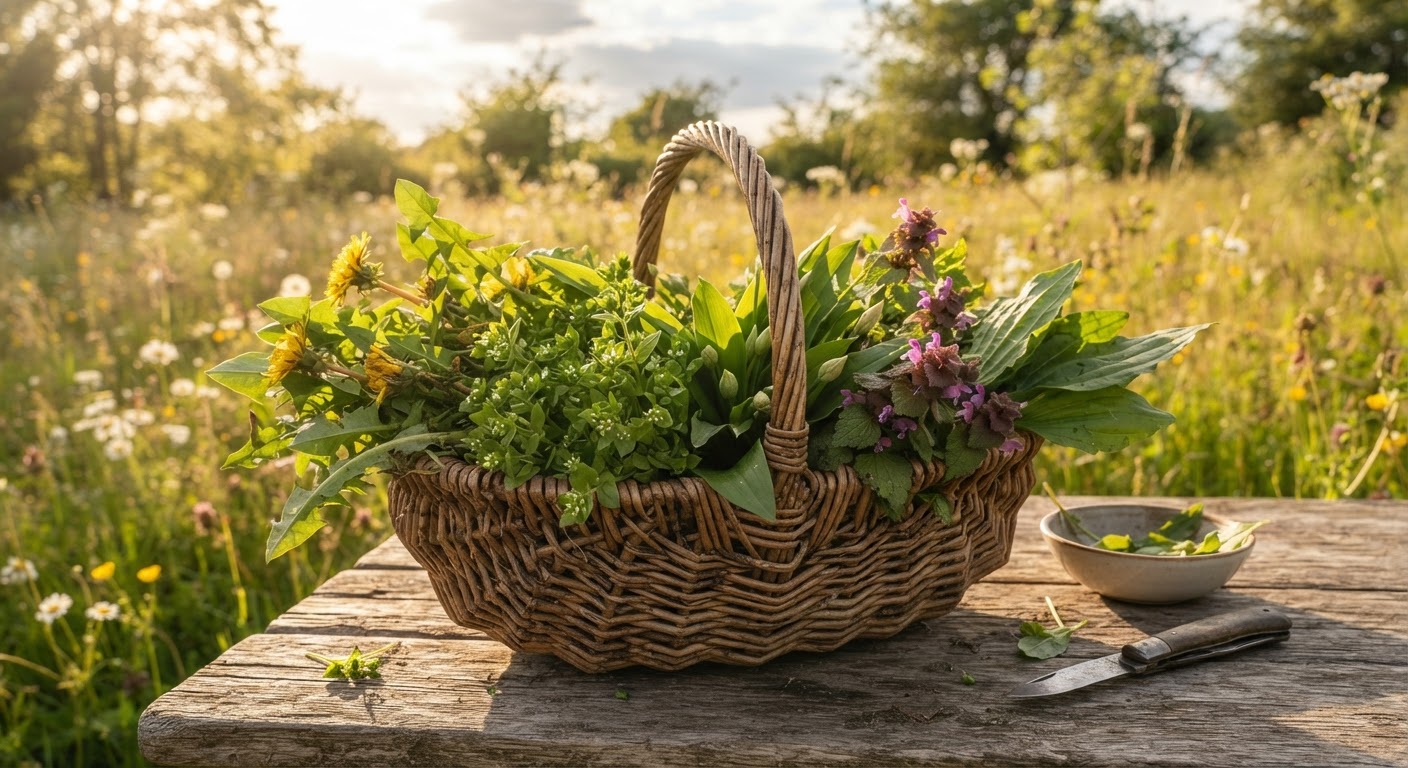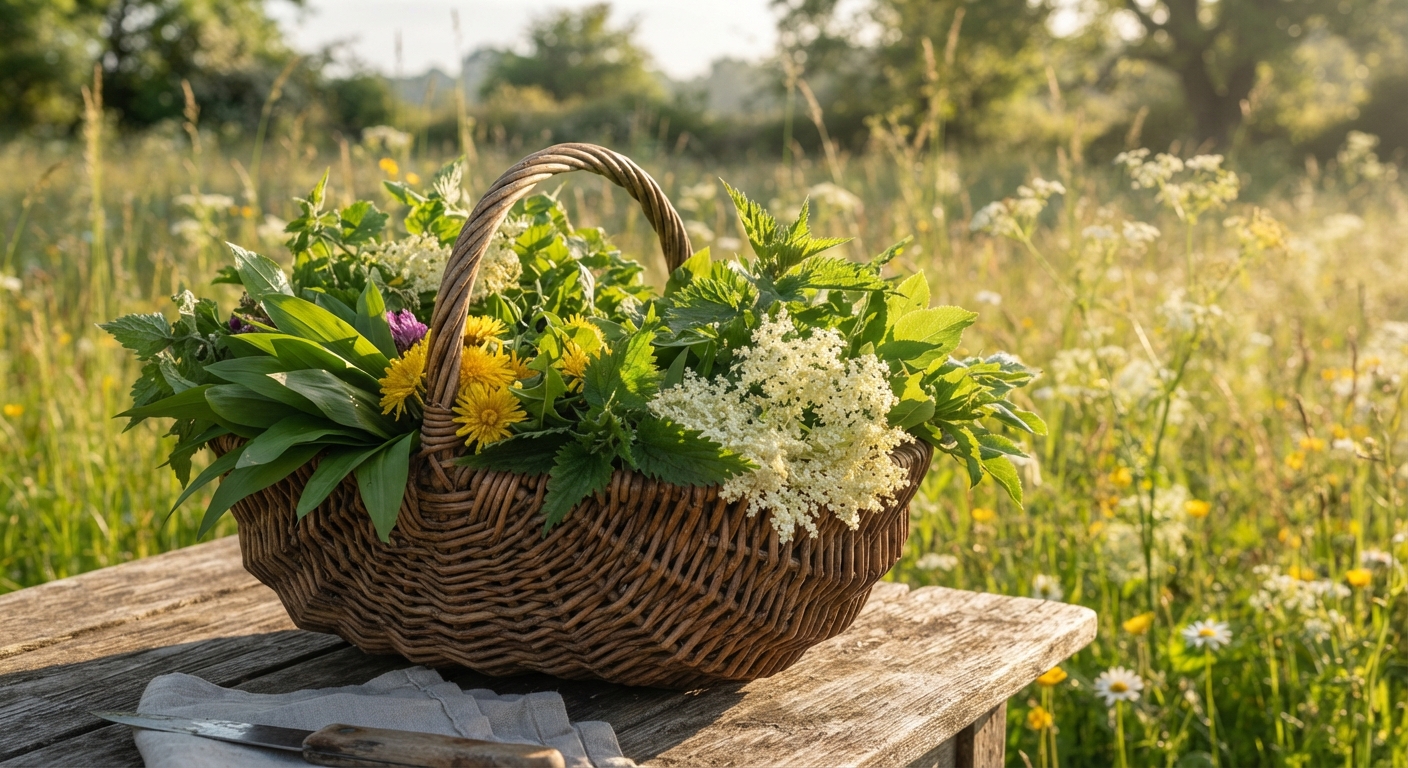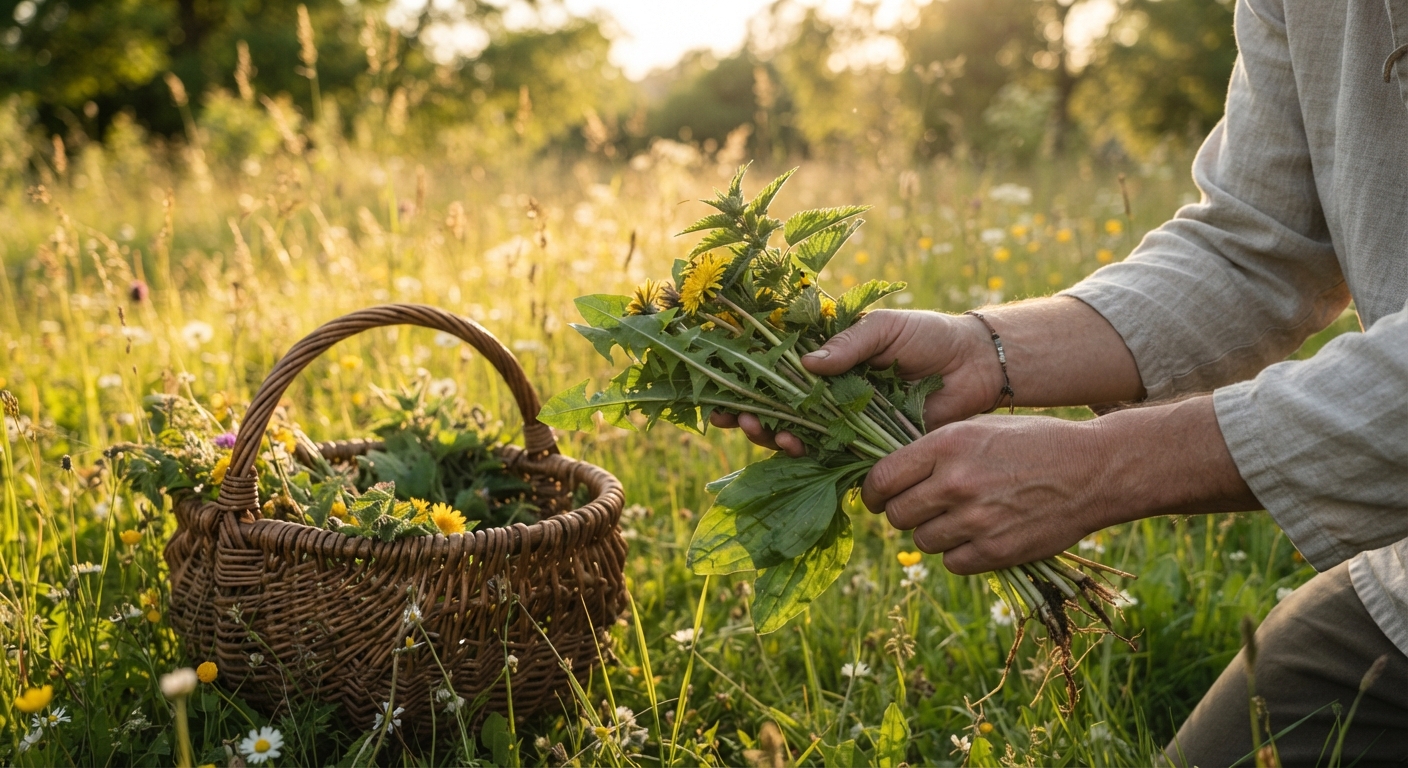
Here’s the mistake almost every beginner makes, and it’s the same mistake I made for my first two seasons. You find out a dandelion is edible, so you learn the dandelion. Then someone tells you plantain is a “natural bandage,” so you memorize that too. Then nettle. Then yarrow. Then chickweed. Before long you’ve got thirty plants rattling around in your head, you can’t confidently tell any two of them apart in the field, and the whole hobby starts to feel like cramming for a botany exam you never signed up for.
The problem isn’t that wild plants are hard. The problem is that most people learn them the wrong way — as a random pile of facts instead of a system.
This guide is the system. It takes you through learning wild plants that pull double duty as both food and medicine, in a specific order, with a repeatable method for each one. By the end you won’t know thirty plants half-well. You’ll know a handful cold, and you’ll have a process for learning the next fifty safely. That’s the difference between a forager and someone who reads plant blogs.
One rule sits above everything that follows, and it never goes away: if you cannot identify a plant with 100% confidence, you do not pick it. Not for a salad, not for a tea, not for a “natural remedy.” Cross-check every new plant against at least two independent sources — a regional field guide and a trusted photo database — before it touches your lips. Nothing in this guide replaces that. Everything in it depends on it.
The Core Idea: Learn Plants as a Pair, Not a List
Before the steps, you need the mindset shift that makes the whole thing work.
When a plant is both food and medicine, it has two completely different use profiles. The dandelion leaf in your salad is a slightly bitter green. The dandelion root in a slow decoction is a digestive bitter. Same plant, two jobs, two sets of rules. If you learn plants as a single “edible or not” checkbox, you’ll miss the entire second half of the plant — and worse, you might use the medicine half with the casualness of the food half.
So the system treats every plant as a pair: one food profile and one medicine profile. You learn both, but you learn them separately, because they demand different levels of caution. Food is forgiving. Medicine is not.
That distinction is the backbone of the six steps below. Keep it in mind and the rest falls into place.
Step 1: Start With the “Big Three”
You don’t start with thirty plants. You start with three. These three are the training wheels of dual-use foraging, chosen for one reason each: they’re easy to identify with certainty, they’re genuinely useful as both food and medicine, and they’re common enough that you’ll actually run into them.
Dandelion (Taraxacum officinale). The most recognizable plant in the Western hemisphere. Leaves, flowers, and roots are all food; the root and leaf are both traditional liver and digestive support. Its jagged, hairless, basal rosette of leaves and single hollow flower stem are hard to confuse once you’ve seen a real one up close.
Stinging nettle (Urtica dioica). The sting is actually its best identification feature — no other common plant announces itself so reliably. Cooked, it’s a mineral-dense green with more iron than spinach. As a tea, it’s a traditional blood-builder and seasonal tonic.
Broadleaf plantain (Plantago major). The “white man’s footprint” that grows in sidewalk cracks and gravel driveways everywhere. Young leaves are a mild cooked green; the crushed leaf is the classic field poultice for bug bites, stings, and minor scrapes.
Here’s the whole trio at a glance so you can see why they earn their spot:
| Plant | Key ID Features | Food Use | Medicinal Use (Traditional) | Beginner Difficulty |
|---|---|---|---|---|
| Dandelion | Jagged hairless leaves in a basal rosette; single hollow stem; milky sap | Young leaves in salad or sautéed; flowers for fritters; roasted root | Digestive bitters, liver support, mild diuretic | 5/5 — easiest |
| Stinging nettle | Serrated opposite leaves, fine stinging hairs, square stem | Cooked greens, soup, pesto (never raw) | Mineral-rich tonic tea, seasonal allergy support | 4/5 — sting confirms ID |
| Broadleaf plantain | Broad oval leaves with parallel veins, seed spike, grows in compacted soil | Young leaves cooked or in smoothies | Crushed-leaf poultice for bites, stings, scrapes | 5/5 — easiest |
Master these three before you move on. Not “recognize” them — master them. Be able to pick each one out at a glance, at multiple growth stages, in your own neighborhood. If you can’t find all three within a week of looking, you’re not looking slowly enough.
Step 2: Build a Repeatable Identification Loop
Memorizing a plant description is not identification. Identification is a process you run every single time you meet a plant, and it’s the step that keeps you alive.
The loop has four checks, and you run all four every time, even on plants you “know”:
- Location and habitat. Does this plant grow where the book says it should? A water-loving plant on a dry hilltop is a red flag, not a score.
- Whole-plant picture. Leaves, stem, flowers or seeds, root, and growth habit. Not just the leaf that caught your eye.
- Feature confirmation. Three to five specific, observable features that all match your field guide. Not one. Not “it looks right.” Three to five.
- Source cross-check. At least two independent references agree. A book and a photo database. Two books. Never a single app result on its own.
Then — and this is the part everyone skips — write it down. Start a plant journal. For each new plant, record the date, the location, the features you confirmed, and what you cross-checked it against. This journal is your E-E-A-T in real life: it’s the difference between “I think I remember this one” and “I’ve confirmed this one eight times across three seasons.”
A note on apps: plant identification apps are a starting point, not a verdict. They get you in the neighborhood; your field guide and your own feature check get you home. Use the app to get a candidate name, then confirm every feature against a written source before you pick.
Step 3: Learn One Food Prep and One Medicine Prep Per Plant
Once a plant is confirmed, you learn two preparations for it — no more. Trying to learn five recipes and three tinctures per plant is how you end up knowing nothing well.
For the food side, pick the single most forgiving preparation. For dandelion, that’s young leaves sautéed with garlic and a squeeze of lemon. For nettle, that’s a simple blanched-green soup. For plantain, young leaves cooked like spinach. One plant, one recipe, repeated until it’s boring.
For the medicine side, pick the gentlest, hardest-to-mess-up preparation. For all three of the Big Three, that’s a simple hot-water infusion — pour just-boiled water over the fresh or dried herb, cover, steep ten to fifteen minutes, strain. No alcohol, no measuring, no elaborate equipment. Infusions are the perfect first medicine prep because they’re hard to get dangerously wrong and easy to learn from.
Here’s the practical breakdown of the two tracks:
| Plant | Food Prep to Learn First | Medicine Prep to Learn First | What Not to Do Yet |
|---|---|---|---|
| Dandelion | Sautéed young leaves with lemon | Leaf infusion or roasted-root decoction | Don’t rely on it as a standalone “cleanse” |
| Stinging nettle | Blanched greens or simple soup | Nettle leaf infusion | Never eat raw — sting must be cooked out |
| Broadleaf plantain | Young leaves cooked like spinach | Crushed-leaf poultice for skin | Don’t harvest from sprayed or road edges |
The pattern to notice: food preps are hot, wet, and forgiving. Medicine preps are either equally gentle (infusions, poultices) or clearly labeled as a more advanced skill you’ll get to later. Stay in the gentle lane until the plant feels boring. Boring is good.
Step 4: Harvest by Season, Not by Mood
A plant’s usefulness changes across the year, and so does its safety. The dandelion leaf that’s pleasantly bitter in early spring becomes mouth-puckeringly harsh by late summer. Nettle should be picked young in early spring, before it flowers and turns fibrous (and slightly unkind to the kidneys in large amounts). Forgetting the calendar is the most common way beginners waste a perfectly good harvest.
Here’s the season chart for the Big Three, with what to gather when:
| Plant | Early Spring | Late Spring / Early Summer | Summer | Fall |
|---|---|---|---|---|
| Dandelion | Young leaves (mild) | Leaves + flowers | Leaves (bitter), skip | Roots (dig after first frost) |
| Stinging nettle | Tender tops — the prime harvest | Leaves before flowering | Stop harvesting (flowering) | Generally skip |
| Broadleaf plantain | Young leaves (tender) | Leaves + seeds | Older leaves (tough) | Seeds + late young growth |
Two rules hidden in that table. First, harvest the tender, young, pre-flowering part whenever you have a choice — that’s where both flavor and nutrition concentrate. Second, roots come in fall, after the plant has stored energy and the first frost has pushed sugars down. Pull a dandelion root in July and you’ll get a bitter, woody disappointment; pull it in October and you’ll get something worth drying.
Harvest respectfully, too. Take no more than about a third of any one stand, leave the roots and the flowering plants to regenerate, and never harvest from roadsides, dog-walking paths, or anywhere that’s been sprayed. The plant is only medicine if the ground it grew in was clean.
Step 5: Respect the Dose Gap
This is the step most beginner guides skip, and it’s the one that separates “forager” from “person who will eventually hurt themselves.” Food and medicine live on different ends of a dose spectrum, and the gap between them is not optional.
A handful of nettle in your soup is a mineral-rich vegetable. Three cups of strong nettle infusion a day, every day, is a medicinal protocol — and while nettle is gentle for most people, the principle is that quantity and frequency change what a plant is. The same leaf is food at culinary scale and medicine at therapeutic scale.
The Big Three are all on the gentler end of the spectrum, which is exactly why they’re your first plants. But even gentle plants interact with the real world:
| Plant | Culinary Scale (Food) | Therapeutic Scale (Medicine) | Caution |
|---|---|---|---|
| Dandelion | A handful of leaves in a dish, or a mug of root “coffee” | Consistent daily leaf infusion or root decoction | Mild diuretic — don’t overdo it with other diuretics |
| Stinging nettle | A serving of cooked greens | Daily infusion as a seasonal tonic | May interact with blood pressure or blood sugar meds |
| Broadleaf plantain | Cooked young leaves as a vegetable | Topical poultice on skin | Rare skin sensitivity — test a small area first |
And the non-negotiable, stated plainly: if you are pregnant, nursing, on prescription medication, or managing a health condition, talk to a qualified professional before using any plant as medicine. Wild plants are powerful precisely because they’re not inert. That power is the whole point — and the whole warning.
Step 6: Build Your First Dual-Use Shelf
You’ve learned the plant, the loop, the two preps, the season, and the dose. Now you make it stick by building a small shelf that holds both jobs.
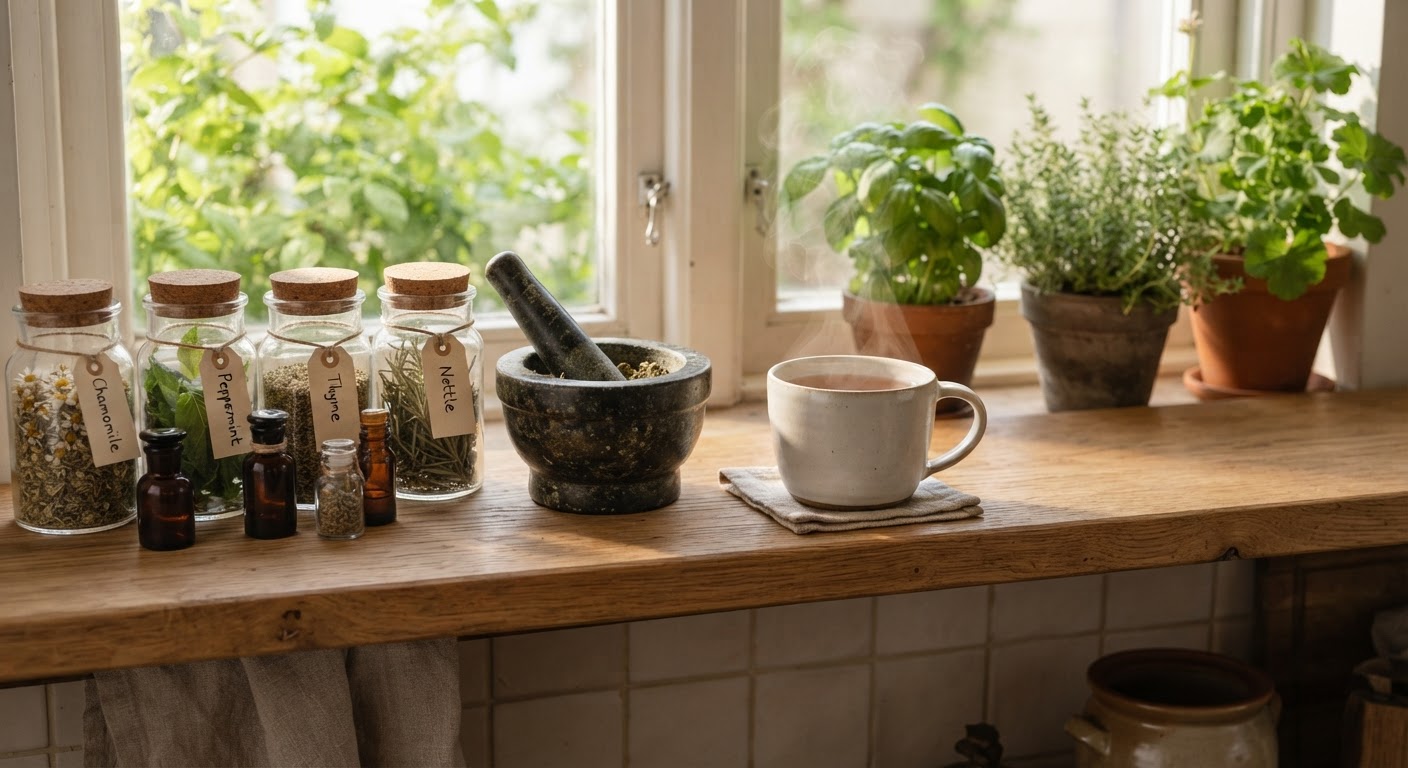
You don’t need anything elaborate. A handful of clean, dry glass jars. A way to dry herbs (a dehydrator, or just a warm, dark, well-ventilated shelf). A fine strainer for infusions. A mortar and pestle for poultices if you’re feeling fancy. That’s the whole kit.
Label every jar with three things: the plant name, the harvest date, and whether it’s food or medicine stock. Dried nettle for soup and dried nettle for tea are the same leaves — but the mental container changes how carefully you dose them, and the label keeps you honest.
Then use it. The shelf is not a museum. Cook with the food jars weekly. Make a mug of something from the medicine jars when the occasion actually calls for it. The shelf only teaches you if you keep reaching for it, season after season, until reaching for a dandelion feels as normal as reaching for the salt.
Pro Tips From Years of Getting It Wrong
Everything above is the clean version. Here’s the messy, earned version — the stuff I wish someone had told me before I wasted two seasons.
- Learn one plant per week, max. One plant, deeply, beats five plants shallow. The moment you rush, your confidence outruns your identification, and that’s how mistakes happen.
- Your first “no” is a milestone. The day you spot a lookalike, hesitate, and walk away is the day you became a real forager. Walking away is a skill. Practice it.
- Photograph before you pick. Snap the plant in place — leaves, stem, surroundings — before you harvest. That photo becomes your cross-check record and your journal entry.
- Smell is data. Many plants announce themselves by scent. Crushed wild garlic, mint, and pine are hard to mistake once you’ve smelled them. Let your nose contribute to the loop.
- Taste is the last test, not the first. The universal edibility test exists for survival situations, not Tuesday afternoons. Never put a plant in your mouth to “figure out” if it’s edible. Identification happens with eyes and references first.
- Keep a “not sure” pile. Physically and mentally separate the plants you haven’t confirmed. Never let a “probably” plant mingle with a “confirmed” plant on your counter.
- Medicine preps scale with respect. Food is shareable. Medicine is personal. You might hand your neighbor a jar of pesto. You should not hand them a tincture protocol you invented from a blog post.
- One book, well-worn, beats ten PDFs. Buy a single regional field guide specific to where you live and use it until the spine breaks. Regional specificity matters more than breadth.
Frequently Asked Questions
Answers kept short, because these are the questions I actually get asked in the field, not the ones that pad a page.
Can I just forage plants that are only food and skip the medicine part entirely? Absolutely, and honestly most people should start there. The medicine side is optional. The food side is the gateway. This guide pairs them because so many useful plants do both — but there’s no requirement to use a single plant as medicine, ever.
How do I know a plant is safe for me specifically? You confirm the ID, start with a tiny amount, and watch your body’s response. For medicine, add the professional-consult step if you’re pregnant, nursing, medicated, or managing a condition. “Safe” is a plant-plus-person equation, never just a plant.
What’s the single most dangerous beginner mistake? Overconfidence. Picking a plant because it “looks right” without running the full identification loop. Every serious foraging injury traces back to skipped checks, not to a plant being sneaky.
Do I need special tools to dry and store herbs? No. A warm, dark, well-ventilated spot and clean glass jars do it. A dehydrator is a convenience, not a requirement. The only real rule is that herbs must be bone-dry before jarring, or they mold.
How long does it take to feel confident? With one plant a week and honest journaling, most people feel genuinely confident on their first three plants inside a month. The confidence is real because it’s built on repeated confirmation, not memorization.
What if I can’t find a wild plant in my area? Look harder before you assume it’s absent — dandelion, plantain, and nettle grow in most temperate regions on Earth. If your climate genuinely lacks one, substitute a local common plant and run the same system. The method is portable; the Big Three are just a convenient starting trio.
Is foraging plants for medicine “instead of” going to a doctor? No. It never is. Wild plant medicine is a supplement to real care, not a replacement for it. If something is serious, see a professional. This is not a corner of the internet that substitutes for a diagnosis.
The Whole Point
Wild plants that feed and heal aren’t a novelty, a trend, or a reason to skip the doctor. They’re a quiet, durable skill — a way to look at the ground under your feet and see both dinner and a well-stocked shelf, if you learn them slowly and honestly.
The system is the safety. Learn a few plants deeply instead of many shallowly. Run the identification loop every time, no exceptions. Learn one food prep and one gentle medicine prep per plant. Harvest by season, respect the dose gap, and keep a labeled shelf you actually use.
Start with the dandelion. It’s in your yard right now, it’s impossible to misidentify once you’ve seen a real one, and it does both jobs as well as any plant on the planet. Go find it, photograph it, confirm it, and write it down. Then come back next week and learn the next one.
That’s how you build a pantry and a pharmacy from the ground up — one confirmed plant at a time.