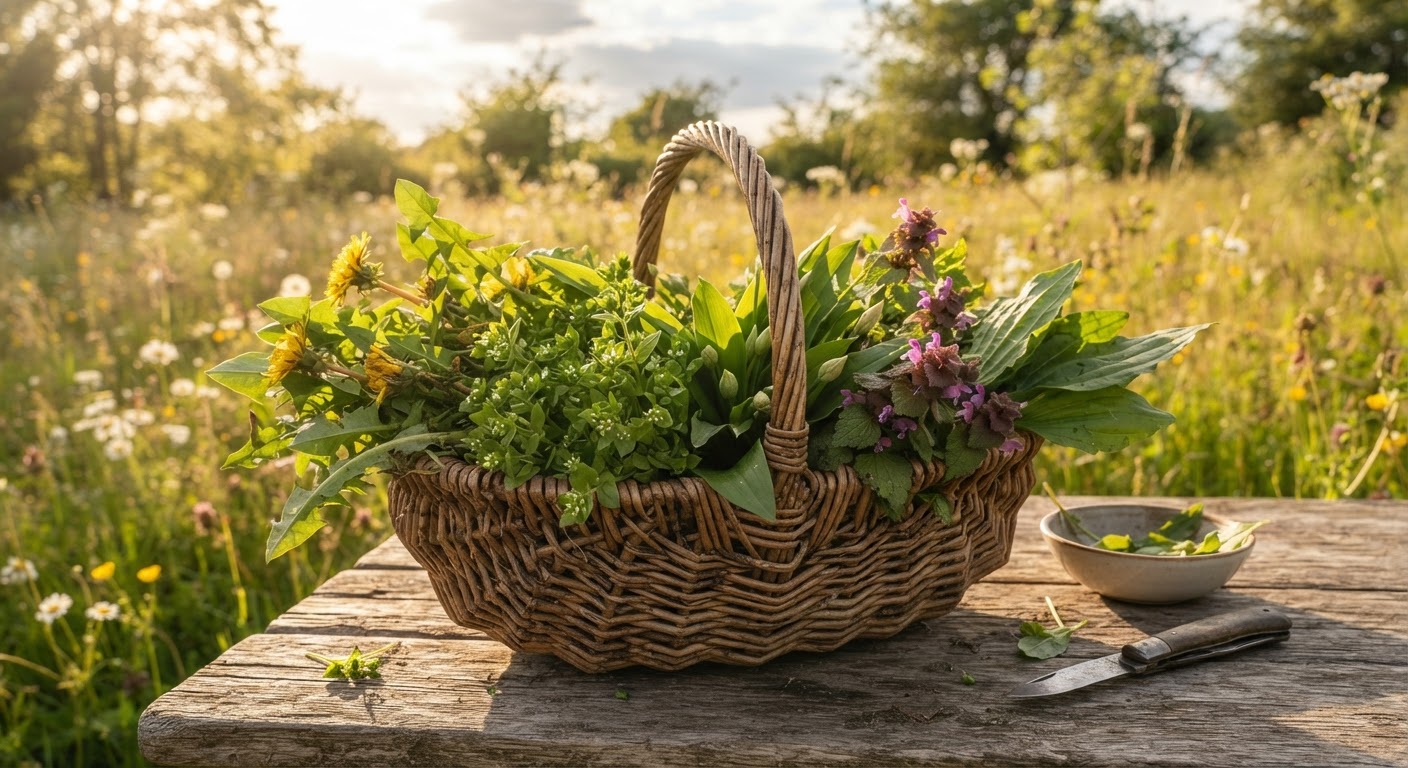
A friend of mine got a $200 ticket for picking dandelions. Not in a national park. Not on private property. In a county park in Ohio, where nobody had enforced the “vegetation removal” ordinance in living memory — until the day a rookie ranger decided to make an example. The dandelions were growing through cracks in the parking lot asphalt.
The ticket eventually got dismissed. But the lesson stuck: foraging law in America is a patchwork of federal, state, county, and municipal rules that can turn the most innocent handful of wild greens into a fine, a court date, or — in rare cases — a criminal charge. The frustrating part? Most of these rules weren’t written with foragers in mind. They’re broad “vegetation protection” statutes aimed at preventing habitat destruction, commercial plant theft, and vandalism. Foragers just get caught in the crossfire.
This guide walks you through the legal landscape at every level — federal, state, and local — with practical advice on how to research your area’s specific rules, what to do if you get stopped, and how to forage confidently without breaking the law.
Why Foraging Laws Are So Confusing — And Why They Vary So Much
Before diving into specific states, it helps to understand why the rules are such a mess. Foraging law wasn’t designed. It accumulated.
No single “foraging law” exists in any state. Instead, foraging legality is determined by a stack of overlapping rules: state park regulations, state forest codes, municipal park ordinances, Department of Natural Resources (DNR) policies, wildlife area restrictions, and federal land management rules. Each layer has its own definitions, exceptions, and enforcement priorities.
The rules weren’t written for food foragers. Most “vegetation removal” statutes were written to stop people from digging up wildflowers, stripping bark from trees, harvesting ginseng for the black market, or clear-cutting underbrush. A forager picking a handful of dandelion greens triggers the same legal language as someone poaching rare orchids. The law rarely distinguishes between the two.
Enforcement varies wildly. One ranger might wave and ask what you’re finding. Another — often a newer hire, still proving they can enforce rules — might write a citation for the same activity. The law on the books and the law as actually enforced are two very different things, and that gap is wider in foraging than almost any other outdoor activity.
Laws change, and websites don’t update. A 2023 revision to Oregon’s state park rules might not appear on the official website until 2025. A municipal code amended six months ago might still show the old version on the city’s outdated .gov page. Staying legal means checking primary sources, not trusting a blog post (including this one — always verify).
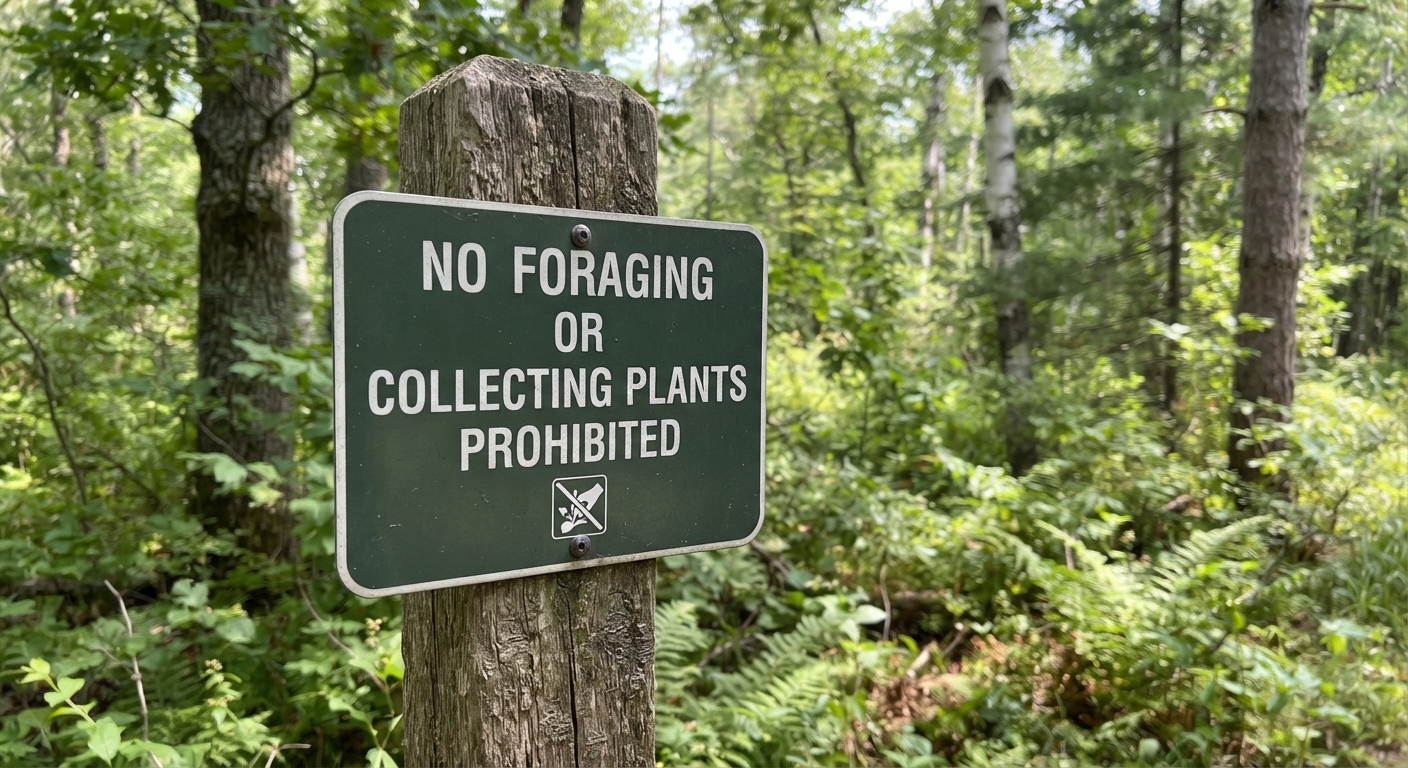
The Four Legal Categories: How Every State Approaches Foraging
Every state’s foraging rules fall into one of four broad categories. Understanding which bucket your state belongs to tells you what to expect before you ever read a single statute.
| Category | Description | What It Means for Foragers | Example States |
|---|---|---|---|
| Explicitly Permitted (with limits) | State parks and public lands have written rules that specifically allow personal foraging, usually with daily harvest limits | Easiest to forage legally; know the limits, follow them, and you’re protected | Alaska, Hawaii, Vermont, Oregon (some lands) |
| Regulated by Permit | Foraging is legal but requires a permit — sometimes free, sometimes paid, often species-specific | Extra paperwork, but clear legal protection once you have the permit | Washington (mushroom permits), Michigan (some state forests), California (some parks) |
| Gray Area — No Explicit Rules | Neither specifically allowed nor specifically prohibited; falls under general “don’t damage park resources” language | Technically at ranger discretion; most foragers operate quietly without issues, but legal protection is thin | Most states for personal-use foraging outside of parks |
| Broadly Restricted | Vegetation removal prohibited across most public lands with few or no foraging exceptions | Requires private land permission or sticking to explicitly legal spots (roadsides, your own property) | Many eastern states with strict park systems; varies by specific park, not uniform statewide |
The critical nuance: a single state can have lands in multiple categories. You might forage legally in a state forest with a permit (Category 2), illegally in a state park that prohibits all plant removal (Category 4), and perfectly legally on Bureau of Land Management (BLM) land where no rule prohibits it (Category 3) — all within the same afternoon.
Federal, State, and Private Land — Different Rules for Different Ground
Foraging legality depends less on which state you’re standing in and more on whose land you’re standing on. Here’s the breakdown by land type:
National Parks — Almost Always Prohibited
The rule is simple: foraging in national parks is illegal. The National Park Service exists to preserve ecosystems intact — and “intact” includes every plant, mushroom, and berry. Title 36 of the Code of Federal Regulations prohibits “possessing, destroying, or removing” any natural feature, plant, or wildlife from national parks.
The exceptions are vanishingly rare. Some national parks in Alaska allow subsistence gathering by indigenous communities under specific agreements. A few parks run regulated, limited harvest programs (like the National Park Service’s mushroom harvesting pilot programs). But for 99.9% of foragers on 99.9% of national park land, the answer is no.
The penalty isn’t theoretical. Fines for unauthorized plant collection in national parks start around $200 and can reach $5,000 with potential jail time for commercial poaching. Rangers in popular parks are trained to spot foragers and actively enforce this rule.
National Forests — Generally Allowed, With Caveats
National Forests (managed by the USDA Forest Service, not the National Park Service) are the friendliest federal lands for foragers. Personal-use harvesting of many plants, berries, mushrooms, and nuts is allowed without a permit in most National Forests.
What’s typically allowed: berries, mushrooms, nuts, greens, and other “forest products” for personal consumption. Daily harvest limits vary by forest — usually a gallon or two per person per day for most items.
What typically requires a permit: commercial harvesting, ginseng (heavily regulated everywhere), large quantities, and anything you plan to sell. Some high-demand species like morel mushrooms require free personal-use permits in certain forests to help the Forest Service track harvest pressure.
What’s never allowed: harvesting threatened or endangered species, damaging trees (stripping bark, cutting branches), and digging up entire plants in most forests.
How to check: each National Forest has a “forest products” page on the USDA website. Search “[Forest Name] forest products permit” and you’ll find the exact rules, limits, and whether you need a permit. Many forests now let you buy permits online.
Bureau of Land Management (BLM) Land — Generally Permitted
BLM land (concentrated in western states) tends to be the most permissive for foragers. Most BLM land allows personal-use plant collection without permits, though specific areas may have restrictions for sensitive habitats or high-demand species.
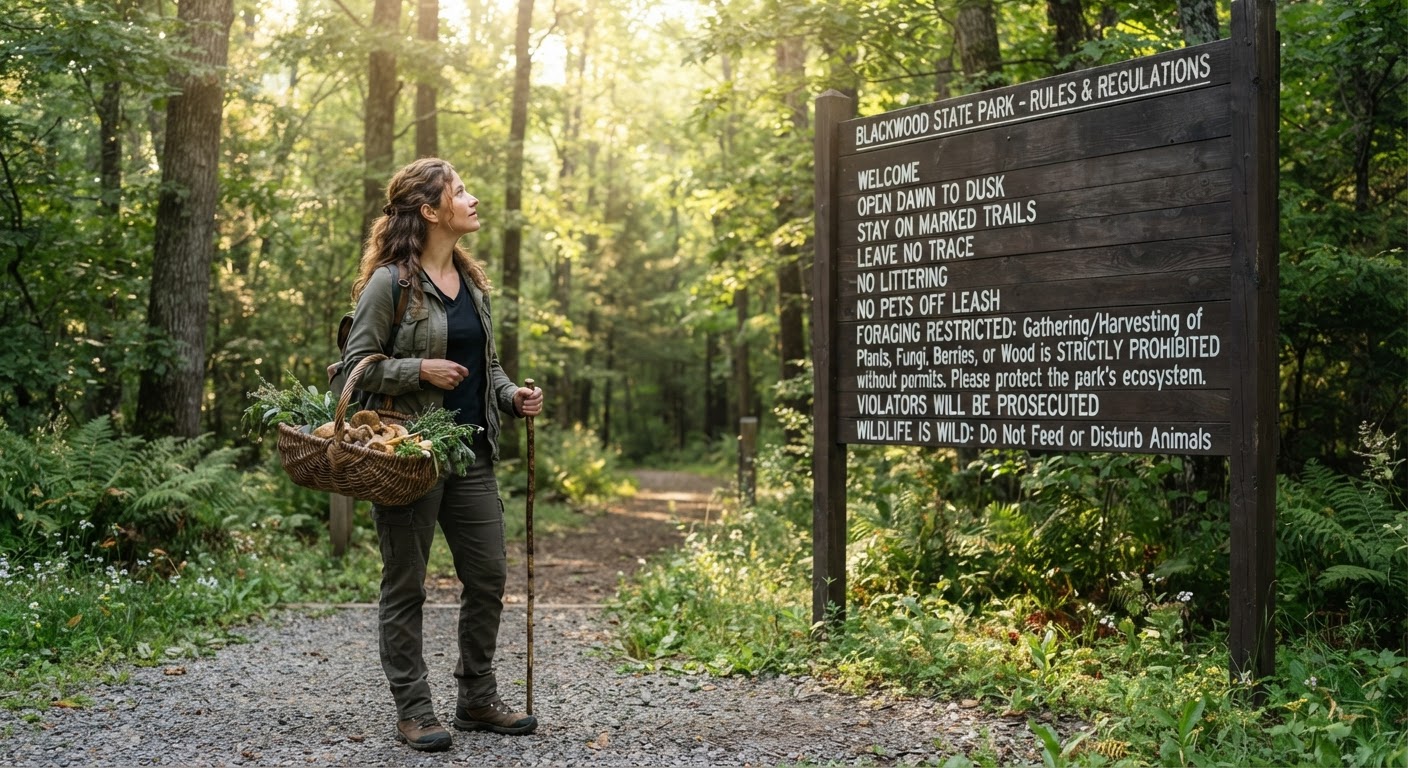
State Parks — The Biggest Variable
State parks are where most casual foragers get tripped up — and where the rules vary the most dramatically.
- Restrictive states (New York, New Jersey, Massachusetts): foraging prohibited in most state parks, with few or no personal-use exceptions
- Permissive states (Alaska, Vermont, Oregon on some lands): personal foraging allowed, sometimes with limits
- Permit states (Washington, Michigan): foraging allowed with an easily-obtained permit
- Silent states (many midwestern and southern states): regulations don’t specifically address foraging — which usually means it’s at the discretion of park staff
The universal rule for state parks: if you’re not sure, call the park office and ask. The 5-minute phone call beats a $200 ticket.
State Forests and Wildlife Management Areas
State forests typically have more permissive foraging rules than state parks. Many state forests explicitly allow mushroom, berry, and nut collection for personal use. Wildlife Management Areas (WMAs) are trickier — some allow foraging, some restrict it during hunting seasons, and some prohibit it entirely to avoid disturbing habitat.
City and County Parks — The Wild Card
Municipal parks have the most unpredictable rules. Some cities actively encourage foraging (Seattle’s Beacon Food Forest is a public food forest designed for harvesting). Others have strict “do not remove any vegetation” ordinances that an overzealous employee might enforce against a kid picking blackberries.
The move: find your city’s municipal code online (most cities publish this), search for “vegetation,” “plants,” “removal,” or “foraging.” If foraging isn’t mentioned, the standard “don’t destroy park property” language is the fallback — and a reasonable person harvesting responsibly is unlikely to be cited.
Private Property — The Safest Bet
Foraging on private property with the owner’s permission is legal in all 50 states. Landowner permission overrides almost every other restriction. If you can find a landowner who’ll let you forage — farms, large rural properties, conservation easements — you’ve solved the legal problem entirely.
Get it in writing. A text message or email from the landowner saying “yes, you can forage here” protects you if a neighbor calls the police or a game warden stops by. Verbal permission is legally valid but harder to prove.
Roadsides and Right-of-Way
The strip between the road and private property (often called the right-of-way or tree lawn) is usually public land managed by the state or county transportation department. Foraging here is rarely addressed in regulations — but road spray, herbicide application, and visibility concerns make this one of the more contested foraging zones. Many states spray herbicides along roadways. If you forage roadsides, call your state DOT and ask about their spraying schedule before harvesting anything.
State-by-State Foraging Rules at a Glance
The table below gives the general landscape for each region. This is a starting point, not legal advice. Regulations change, exceptions exist for specific parks and species, and local ordinances can override state-level rules. Always verify with the specific land manager before harvesting.
| Region / State | State Parks | State Forests | Notable Rules & Permits |
|---|---|---|---|
| Alaska | Personal foraging generally allowed | Allowed | Most permissive state; subsistence rights protect foraging on many lands |
| California | Varies by park — many restrict plant removal | Some state forests allow mushroom/berry harvest | Commercial mushroom harvesting requires permit in many areas |
| Colorado | Generally restricted in state parks | More permissive in state forests | BLM land offers abundant legal foraging opportunities |
| Florida | Generally restricted | Varies | State parks enforce strict “leave no trace” rules; water management district lands often more permissive |
| Georgia | Generally restricted in state parks | Some state forests allow limited harvest | Wildlife management areas have specific regulations — check WMA-by-WMA |
| Hawaii | Varies | N/A | Strong cultural foraging traditions; many native plants protected; invasive species harvest often encouraged |
| Idaho | Generally restricted | More permissive | Extensive BLM and National Forest land provides legal alternatives |
| Illinois | Generally restricted | Some state forests allow mushroom harvest | County forest preserve districts have their own rules separate from state parks |
| Indiana | Generally restricted | More permissive | State forests tend to allow mushroom and berry harvest for personal use |
| Kentucky | Generally restricted | More permissive | Ginseng harvesting is heavily regulated — permits and season restrictions apply |
| Maine | Generally restricted | Varies | Strong tradition of foraging; coastal public access laws provide additional opportunities |
| Maryland | Generally restricted | Some state forests allow limited harvest | County parks have varied rules — check individually |
| Massachusetts | Generally prohibited | Varies by property | One of the stricter eastern states for park foraging; conservation land rules vary by town |
| Michigan | Generally restricted | More permissive; some permit requirement | Mushroom harvesting is popular; commercial harvest requires permit in state forests |
| Minnesota | Generally restricted | More permissive | State forests allow berry and mushroom harvest for personal use; extensive public land |
| Missouri | Generally restricted | More permissive | Conservation areas have separate rules from state parks; check area-by-area |
| Montana | Generally restricted | More permissive | Abundant BLM and National Forest land offers legal alternatives |
| New Hampshire | Generally restricted | Varies | State forests generally more permissive than parks |
| New Jersey | Generally prohibited | Varies | Stricter than average; some county park systems have explicit foraging bans |
| New Mexico | Generally restricted | More permissive | BLM land provides broad foraging access |
| New York | Generally prohibited in state parks | Some DEC lands allow limited harvest | DEC-managed lands more permissive than state parks; Adirondack/Catskill preserves have specific rules |
| North Carolina | Generally restricted | Varies; some National Forests allow harvest | Extensive National Forest land in western NC |
| Ohio | Generally restricted | More permissive | County metroparks have independent rules; state forests allow mushroom/berry harvest |
| Oregon | Select parks allow limited foraging | Generally allowed | Some state parks explicitly allow small-quantity personal foraging; mushroom permits for commercial harvest |
| Pennsylvania | Generally restricted | Some state forests allow limited harvest | DCNR rules cover state forests; ginseng heavily regulated |
| Tennessee | Generally restricted | Varies | National Forest and TVA land in eastern TN provides additional options |
| Texas | Generally restricted | Varies | Limited public land overall; private land permission is key |
| Vermont | Generally allowed | Allowed | One of the most permissive eastern states; personal foraging generally permitted on state lands |
| Virginia | Generally restricted | Some state forests allow limited harvest | National Forest land in western VA provides alternatives |
| Washington | Generally restricted | More permissive; permit systems in place | Mushroom harvesting requires permits in many areas; DNR lands have specific rules |
| West Virginia | Generally restricted | More permissive | Ginseng heavily regulated; state forests more permissive than parks |
| Wisconsin | Generally restricted | More permissive | Extensive county forest system with varying rules; state forests allow personal berry/mushroom harvest |
| Wyoming | Generally restricted | More permissive | Abundant BLM and National Forest land for legal foraging |
Important caveats: “Generally restricted” means most state parks in that state prohibit or don’t explicitly allow plant removal. It doesn’t mean all parks in the state have the same rule. “More permissive” usually means personal-use foraging of common species (berries, mushrooms, nuts) is allowed. Endangered species, commercial harvesting, and large quantities are almost always regulated or prohibited regardless of land type.
How to Research Your Local Foraging Laws in 20 Minutes
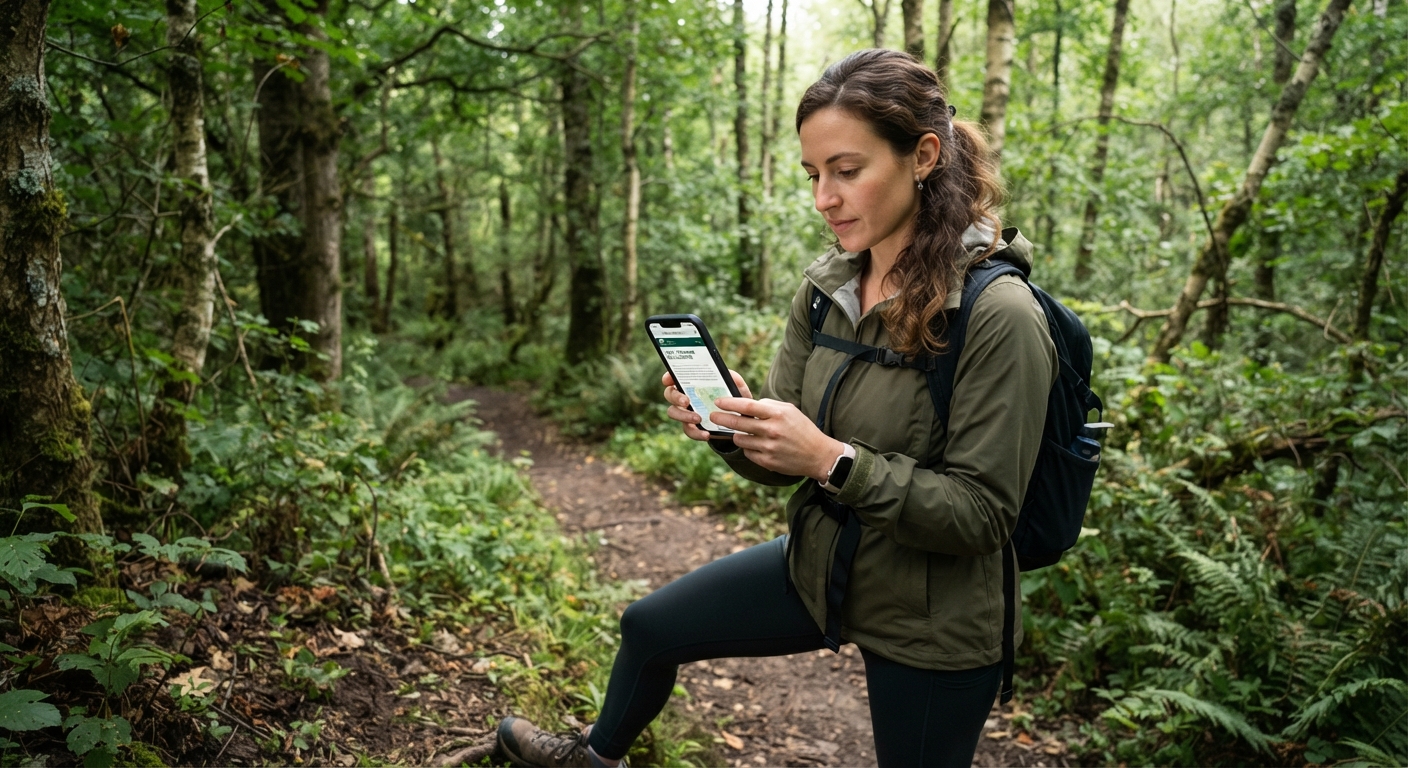
Most foragers skip this step because it sounds boring. But twenty minutes of research at home prevents the stomach-drop moment of seeing a ranger vehicle pull up while your basket is full.
Step 1: Search Your State Parks Website (5 minutes)
Go to your state’s Department of Natural Resources, Parks & Recreation, or equivalent agency website. Search for any combination of: “foraging,” “mushroom harvesting,” “plant collection,” “berry picking,” “forest products.”
Look for the specific park regulations PDF — most state park systems have a single document covering all parks. Search within it (Ctrl+F) for “plant,” “vegetation,” “collect,” “harvest,” and “remove.” If the document explicitly says personal-use foraging is allowed with limits, screenshot the relevant section. If it prohibits “removal of vegetation,” you have your answer.
Step 2: Check Your National Forest Rules (5 minutes)
If you have a National Forest within driving distance, visit the USDA Forest Service website and find your specific forest’s page. Look for “forest products,” “permits,” or “mushroom harvesting.” Most National Forests publish clear rules online, including harvest limits and whether you need a permit.
Step 3: Look Up Municipal Park Codes (5 minutes)
Search “[your city/county] municipal code” → navigate to the parks and recreation chapter → look for “vegetation,” “plants,” “removal,” or “natural resources.” If the municipal code doesn’t address foraging, the default is usually “don’t destroy park property” — which responsible foraging shouldn’t trigger.
Step 4: Make One Phone Call (5 minutes)
Call the ranger station or park office for the specific park you want to visit. Say: “I’m interested in harvesting some wild edible plants — berries, mushrooms, greens — just for personal use in small amounts. Can you tell me what the rules are for this park?”
Rangers appreciate people who ask first. You’ll either get a clear yes, a clear no, or a “well, technically…” that tells you grazing is tolerated but not officially permitted. All three answers are useful.
Step 5: Document Everything
Screenshot the relevant regulations. Save the phone number you called and the name of whoever you spoke with. If a ranger tells you in person that foraging is fine in a particular spot, note their name and the date. This isn’t paranoia — it’s due diligence. The ranger who stops you next week might not know about the conversation you had with their colleague.
7 Legal Mistakes That Get Foragers in Trouble
Most foraging citations aren’t issued to people who are deliberately breaking the law. They go to people who made assumptions. Here are the most common legal pitfalls:
| Mistake | What Happens | How to Avoid It |
|---|---|---|
| Assuming all public land is the same | Foraging legally in a National Forest, then walking 100 yards into a National Park boundary with the same basket | Know land boundaries before you go; use apps like onX Hunt or Gaia GPS that show public land types with clear boundary lines |
| Harvesting “just a little” ginseng without a permit | Ginseng is regulated at the federal level (CITES) and by most states; illegal harvest can mean fines in the thousands + criminal charges | Never harvest ginseng without researching your state’s specific ginseng season, permit requirements, and harvest rules |
| Crossing onto private land following a berry patch | Trespassing charge layered onto potential harvesting violations | Maps, maps, maps — know property boundaries; purple paint on trees means “no trespassing” in many states |
| Selling foraged goods without a commercial permit | Selling at a farmers market or to a restaurant without proper licensing violates state food safety laws AND land-use permits | Separate commercial foraging from personal foraging; commercial foraging requires separate permits for both harvesting AND food sales |
| Picking in a Wildlife Management Area during hunting season | Entry restrictions during hunts, fines for being in closed areas, and — worse — safety risk from active hunters | Check WMA seasonal closures; many close to non-hunters during specific hunting windows |
| Digging up entire plants on public land | Removing the whole plant (roots and all) is treated differently from harvesting leaves/berries — often as “destruction of park property” | Harvest sustainably — take leaves, flowers, and fruit, leave the root system intact unless you’re on private land with explicit root-harvest permission |
| Trusting outdated internet info | A 2018 blog post saying “X State Park allows foraging” when the rules changed in 2021 | Always verify against the official park website or by calling the ranger station directly; never rely on third-party summaries alone |
What to Do If You Get Stopped — Or Ticketed
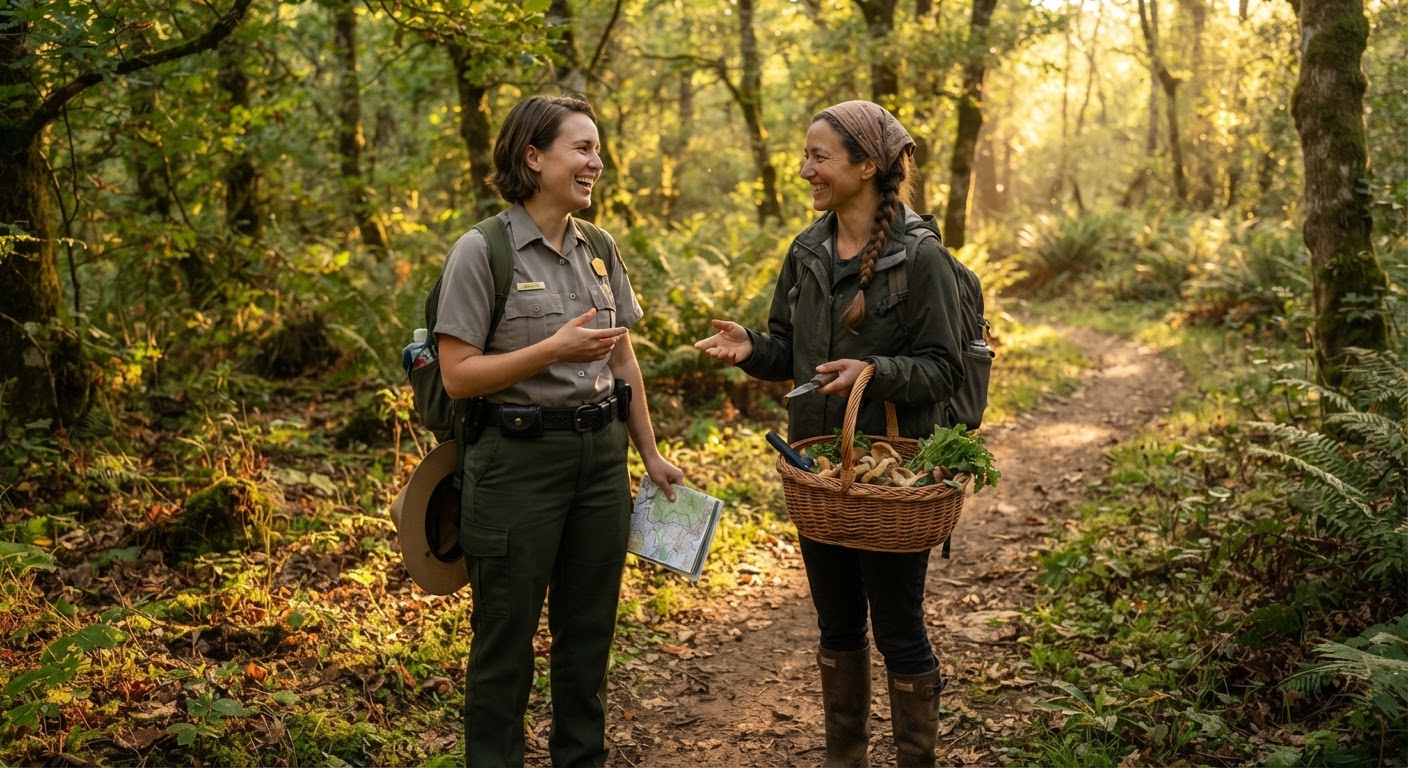
Being approached by a ranger or law enforcement while foraging triggers an immediate adrenaline response — even if you’ve done nothing wrong. Here’s how to handle it.
If You’re Approached by a Ranger
Stay calm and be transparent. Put your basket down. Show them what you’ve collected. Most rangers aren’t looking to ticket foragers — they’re checking that you’re not poaching endangered plants, digging up the landscape, or harvesting for commercial sale.
Lead with what you know. Say something like: “I’m harvesting edible plants for personal use — these are lamb’s quarters and dandelion greens. I’m not taking any roots or damaging anything. I checked the regulations online but I’m happy to stop if this isn’t allowed here.” This demonstrates good faith immediately.
Accept redirection gracefully. If the ranger says foraging isn’t allowed here, say: “Thank you for letting me know — I’ll head out. Is there anywhere nearby where foraging is permitted?” Don’t argue. Even if you’re technically right about the regulations, the ranger is the one who writes the ticket.
If You Receive a Citation
Don’t argue at the scene. Take the citation, be polite, and leave. Anything you say can make things worse. The time to contest is later, not in the moment.
Document immediately. Write down the exact location, time, what you were harvesting, who you spoke with, and what they said. Take photos of the area — especially any missing or unclear signage. If a sign prohibiting foraging wasn’t visible from where you entered, that’s relevant.
Research the specific statute you were cited under. The citation will reference a specific law or regulation code. Look it up. Does it actually prohibit what you were doing? Was it meant for commercial poaching, not personal foraging? Many citations get dismissed when the cited statute doesn’t match the activity.
Consider your options. For a minor fine ($50–200), paying it and moving on is often the practical choice, even if you believe the citation was unfair. For larger fines or criminal charges, consult an attorney who understands natural resources law — this is a specialized area and a general practice lawyer may not know the relevant regulations.
One citation is usually not a big deal. Most foraging citations are civil infractions, not criminal charges. They rarely appear on background checks. The biggest consequence is usually the fine itself and the memory of the experience.
Pro Tips From Foragers Who’ve Navigated the System
Learn the name of every plant in your basket. If a ranger stops you and asks what you’re harvesting, “edible plants I found on TikTok” is the wrong answer. “Lamb’s quarters — Chenopodium album — the young leaves are excellent steamed” tells them you know what you’re doing. Competence buys credibility.
Forage with a field guide visible. A physical field guide in your hand or visible in your basket signals “educated amateur” rather than “random person stripping plants.” It changes the entire tone of an interaction.
Harvest during off-hours. Early weekday mornings, especially at less-trafficked parks, dramatically reduce your chances of encountering enforcement. Most ranger patrols concentrate on weekends and peak hours.
Know the invasive species list for your state. Many states explicitly encourage — or at minimum don’t prohibit — the removal of invasive species. Garlic mustard, Japanese knotweed, autumn olive, and kudzu are fair game in most jurisdictions. If a ranger stops you while you’re pulling garlic mustard, they might thank you.
Join a local foraging group. Local mycological societies and foraging meetups have members who’ve been navigating the legal landscape for decades. They know which rangers are friendly, which parks quietly tolerate foraging, and which spots to avoid entirely. This institutional knowledge isn’t published anywhere online.
Build relationships with land managers. If you forage regularly in a particular state forest or park, introduce yourself to the ranger station. Let them know what you’re doing. Over time, you become “the forager who checks in” rather than “the suspicious person in the woods with a basket.”
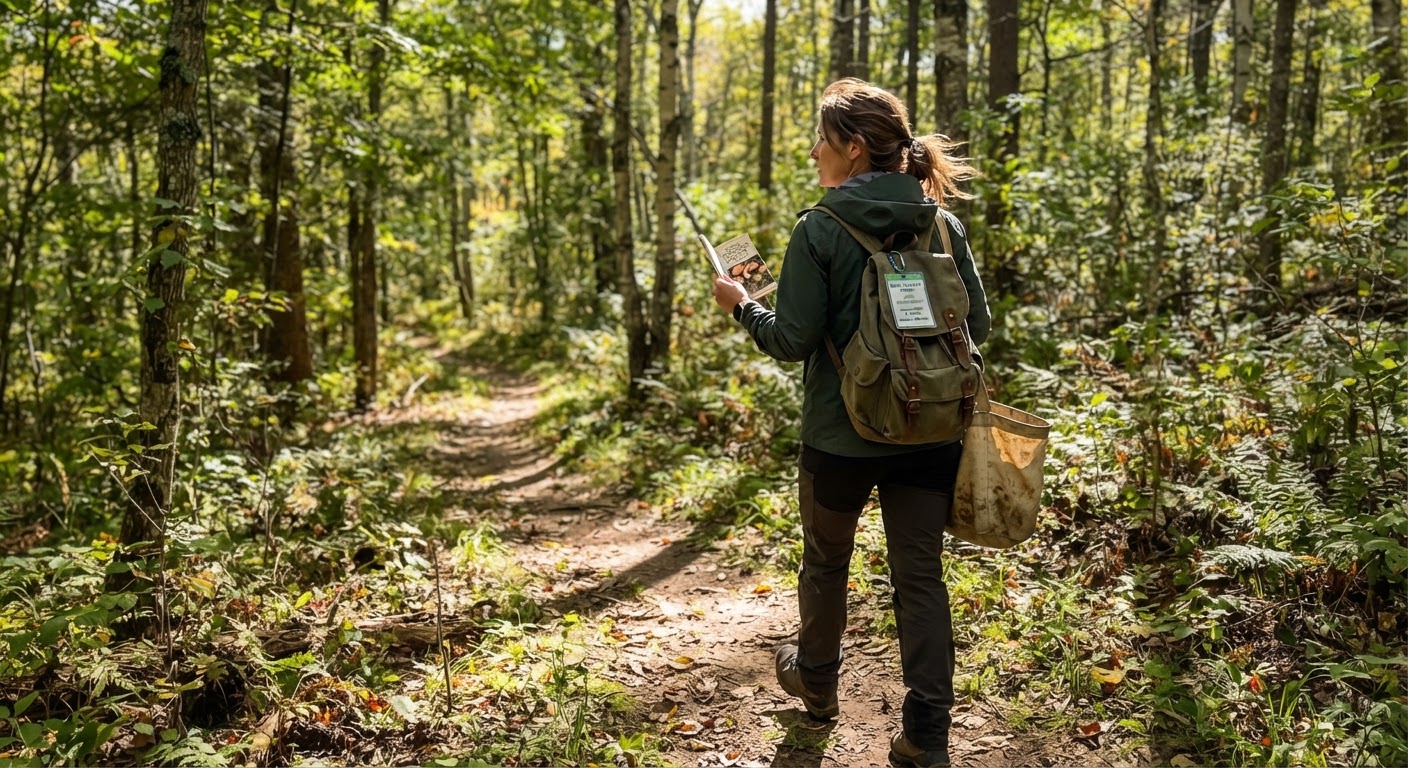
The “personal use” defense has real weight. Foraging citations almost always target commercial harvesting and environmental damage, not personal food gathering. If what you’re doing is clearly personal — a small basket, not a truck bed full of plants — most officials will warn rather than cite, and most citations that do get issued will be reduced or dismissed if challenged.
Quick Answers to Common Legal Questions
“Can I forage in my local city park?”
Maybe. City parks fall under municipal codes, not state or federal regulations. Most don’t explicitly address foraging. If your city’s park code says nothing about plant removal, a reasonable person harvesting small amounts from abundant species is unlikely to face enforcement. But a phone call to the parks department eliminates the guesswork — and most departments are surprisingly helpful.
“What happens if I accidentally forage on the wrong side of a property line?”
If you genuinely didn’t know where the boundary was and you crossed onto private property, you’ve technically trespassed — but in practice, if you’re clearly foraging (not hunting, not dumping trash, not causing damage), most landowners will ask you to leave rather than press charges. The exception: marked property with “No Trespassing” signs or purple paint, where the landowner has clearly indicated no entry. Those situations can escalate to trespassing citations.
“Do I need a permit for mushroom foraging?”
It depends on the land and sometimes the species. National Forests in the Pacific Northwest and parts of the Midwest often require free or low-cost mushroom permits, especially for morels and other commercially valuable species. State forests sometimes require permits. National Parks almost never allow it. When in doubt, search “[specific forest/park name] mushroom permit” — the answer is usually one click away.
“Can I sell what I forage?”
Selling foraged goods triggers a separate set of legal requirements: commercial harvesting permits for the land you’re harvesting from, food safety certifications for what you’re selling (varies by state cottage food laws), and potentially business licenses. It’s significantly more complex than foraging for personal consumption. Start personal, and only explore commercial foraging after thoroughly researching the requirements — ideally with guidance from someone already doing it legally in your area.
“Is foraging legal on Bureau of Land Management land?”
Generally yes, for personal use. BLM land (concentrated in the western US) is the most permissive public land category for foragers. Most BLM-managed land allows personal-use collection of common plants, berries, nuts, and mushrooms without permits. Exceptions exist for sensitive habitats, commercially valuable species, and tribal lands. Check the specific BLM field office for the area you plan to visit.
“What’s the worst-case legal scenario for foraging?”
The worst outcomes involve commercial poaching of regulated species (ginseng is the most common example), harvesting in national parks with intent to sell, or repeated trespassing on clearly posted private property. These situations can result in felony charges, thousands in fines, and in extreme cases, jail time. For a personal-use forager harvesting common edible plants on public land, the realistic worst case is a citation and a fine — typically under $300 — and even that is uncommon for first-time encounters.
“Does foraging ever become a ‘right’ or protected activity?”
In the United States, foraging is not a protected right in the way that hunting and fishing sometimes are (through state constitutional amendments and treaties). The closest exceptions: Alaska’s subsistence laws protecting traditional harvesting by rural residents, and Native American treaty rights that protect gathering on ancestral lands. For everyone else, foraging is a permitted or tolerated activity — not a legally protected right.
The Law Is a Starting Point, Not the Final Word
Here’s what twenty hours of reading foraging regulations across fifty states teaches you: the law matters, but it’s not the whole story. A state park with a strict “no vegetation removal” rule on paper might have rangers who wave at blackberry pickers every August. A National Forest that technically allows foraging might have a ranger who hassles anyone carrying a basket. Enforcement is human, discretionary, and inconsistent — which means your best legal protection isn’t a memorized statute. It’s being respectful, knowledgeable, and visibly responsible.
Know the rules before you go. Carry a field guide. Harvest sparingly. Leave no trace. Answer questions honestly. And if you’re ever not sure whether you’re allowed to pick something — call and ask. The ranger who answers the phone today is the same person who might stop you on the trail tomorrow.
The goal isn’t to become a foraging lawyer. It’s to harvest wild food with enough confidence in your legal standing that you can focus on what actually matters: finding the plants, cooking the meal, and enjoying the walk.