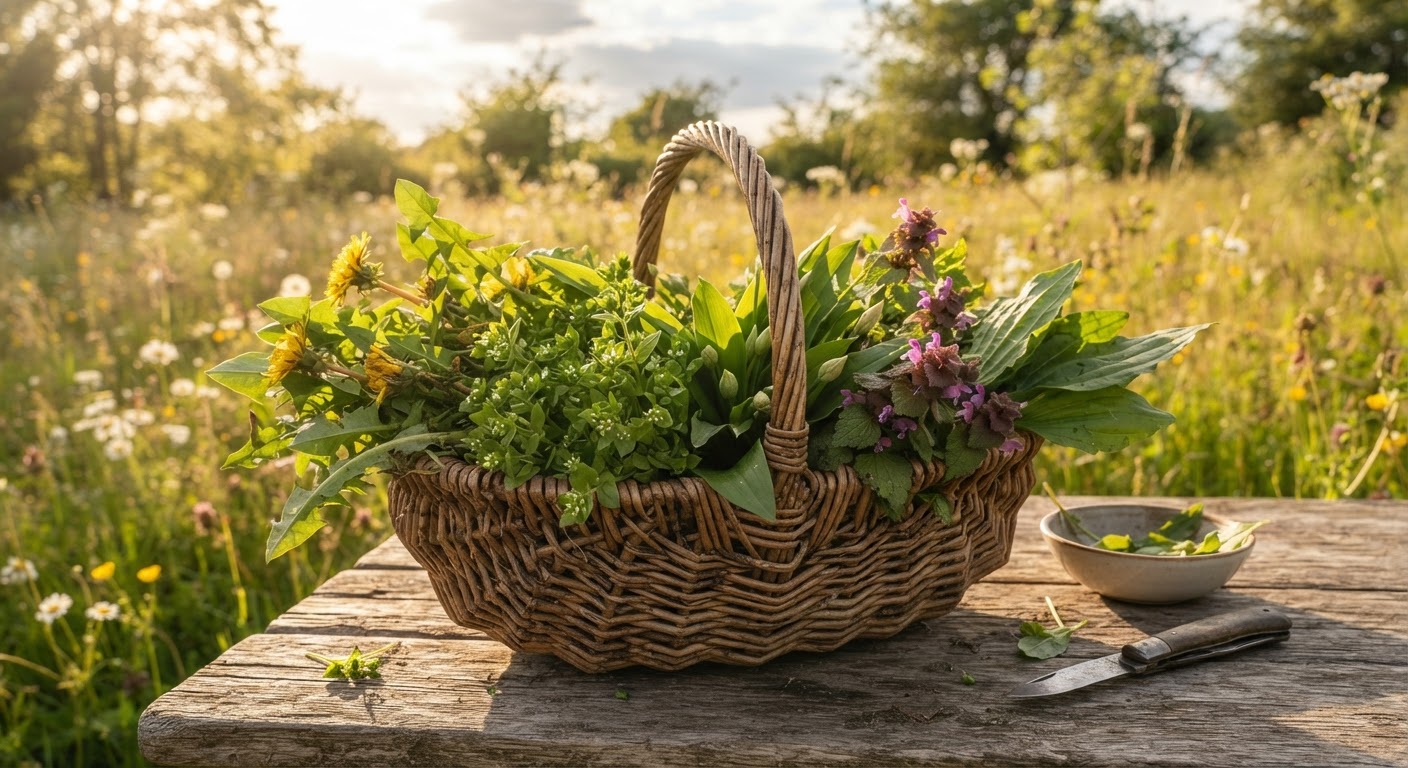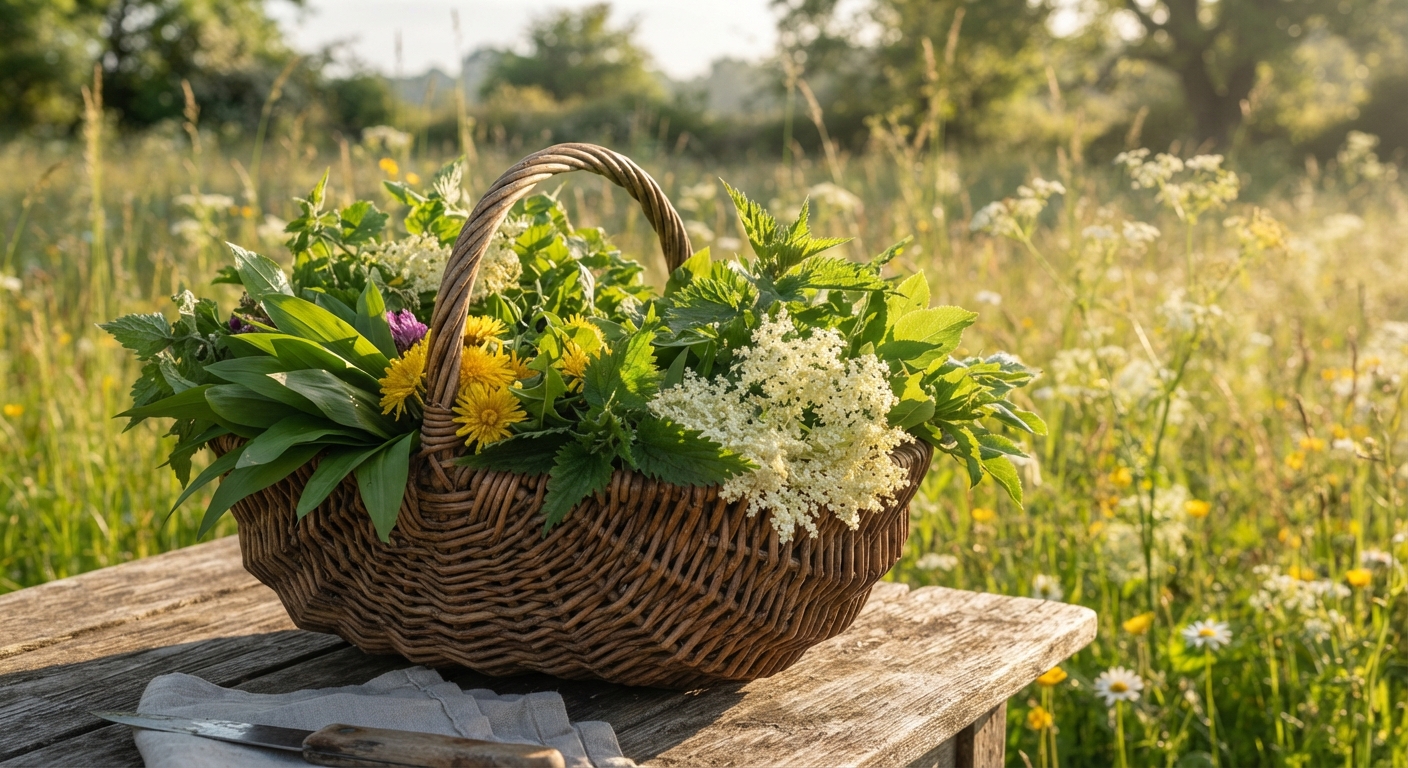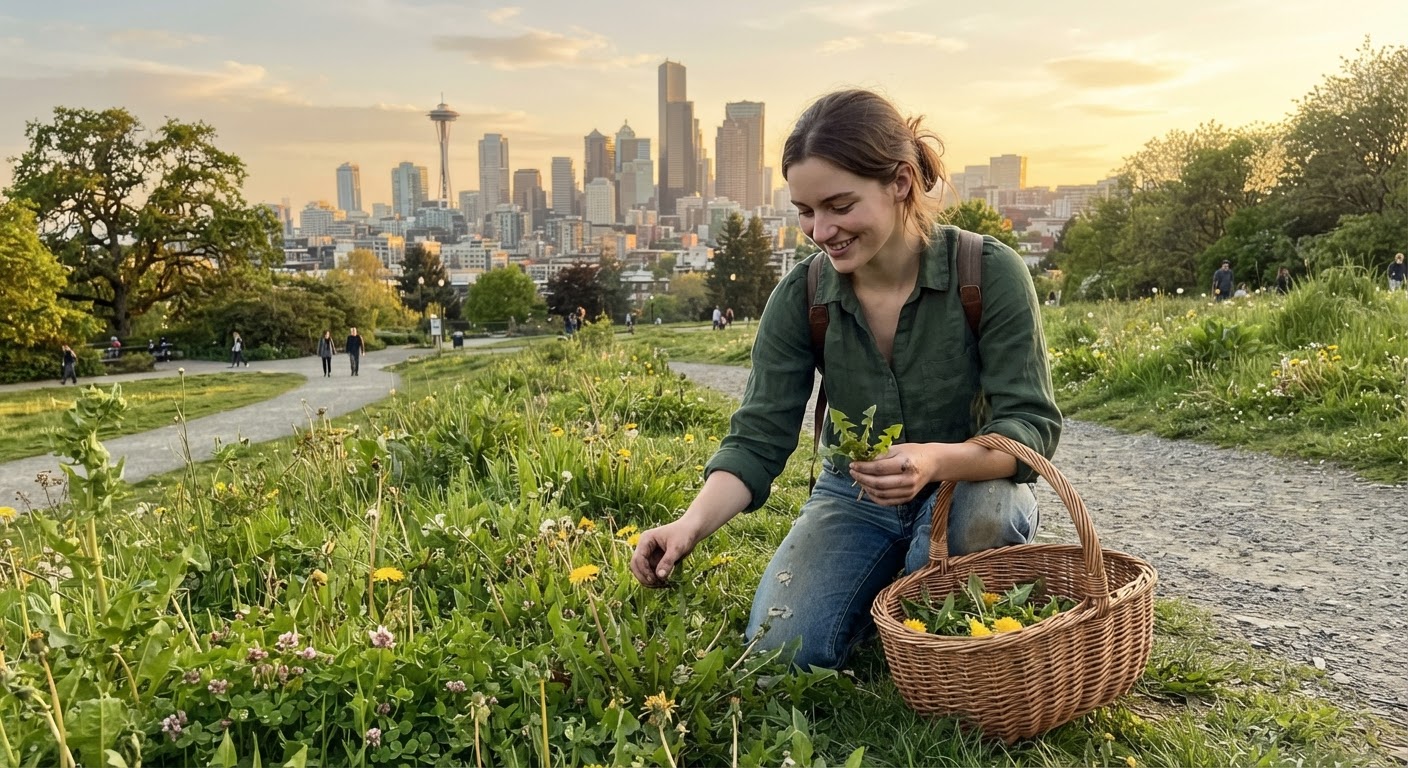
Here’s a number that surprises most people: a single square mile of urban parkland often contains more edible plant species than an equivalent patch of monoculture farmland or managed forest. Cities, it turns out, are accidental botanical gardens — nurseries, landscaping, bird droppings, and wind-blown seeds have turned sidewalks, vacant lots, and fence lines into distributed wild-food pantries.
But here’s the catch. Rural foragers worry about misidentification. Urban foragers worry about that plus dog urine, herbicide spraying, heavy metal soil contamination, trespassing laws, and whether the neighbor who saw you picking “weeds” from the curb is about to call someone.
City foraging is a different game with a different rulebook. The plants are often the same species found in forests and meadows — dandelion, purslane, lamb’s quarters, wood sorrel — but the context changes everything. This guide walks you through every layer: what grows where, how to stay safe and legal, when to harvest, and how to turn your neighborhood into a regular food source nobody else even sees.
Why Cities Are Secretly Foraging Goldmines
Most people picture foraging in national forests, not strip mall landscaping. But the urban environment accidentally creates ideal conditions for edible plants.
Disturbed soil is plant paradise. Construction sites, road edges, and freshly mulched beds mimic the kind of disturbed, nutrient-rich soil where pioneer species — the plants we eat — naturally thrive. Dandelions don’t grow in pristine old-growth forest. They grow where humans have kicked up the dirt.
Microclimate diversity. Cities run 2–5°F warmer than surrounding areas (the “heat island effect”), which extends growing seasons by weeks on both ends. South-facing brick walls create warm pockets where chickweed survives mild winters. Shady alleyways keep watercress-like plants going through July when open fields have already baked dry.
No pesticides by accident. Here’s the irony: the “weeds” growing in sidewalk cracks and abandoned lots often receive zero chemical treatment. Nobody sprays the alley behind the laundromat. Nobody herbicides the vacant lot between two apartment buildings. Meanwhile, the “pretty” landscaping at the office park gets doused in glyphosate monthly. Urban foraging is about knowing where chemicals are used — and, more importantly, where they aren’t.
Plant diversity through immigration. Cities are melting pots — not just for people, but for plants. Immigrant communities bring seeds, intentionally and unintentionally. A patch of lamb’s quarters behind a Mediterranean restaurant, purslane thriving near a Middle Eastern grocery, garlic mustard spreading from an old European immigrant neighborhood garden — urban plant communities tell stories of human migration.
The result: a typical city block might host 12–20 edible species within a five-minute walk. Most residents walk past them every day without noticing.
The 5 Rules Every Urban Forager Must Memorize
Before the fun part — the plants, the seasons, the routes — let’s establish non-negotiables. These aren’t suggestions. Break any one of them and you’re gambling with your health or your freedom.
Rule 1: Know What’s Underground Before You Eat What’s Above
Urban soil can carry legacy contamination — lead from pre-1970s paint and gasoline, heavy metals from industrial runoff, arsenic from old pressure-treated wood. Plants absorb these at different rates.
The quick risk-assessment framework:
| Risk Level | Location Type | Safe to Forage? | Precautions |
|---|---|---|---|
| Lowest risk | Raised beds in community gardens, residential yards you know the history of | Yes, with basic washing | Standard triple-wash protocol |
| Low risk | Parks established >20 years, away from roads and old buildings | Generally yes | Avoid plants within 30 feet of roads, wash thoroughly |
| Medium risk | Vacant lots without known industrial history, edges of residential streets | Proceed with caution | Peel root vegetables, avoid leafy greens from questionable soil |
| High risk | Former gas station sites, industrial zones, railroad rights-of-way, demolition sites | No — don’t forage here | Heavy metals and petroleum hydrocarbons likely present |
| Unknown risk | Any site where you can’t determine history | Assume high risk | Test soil ($15–30 home kit) or skip |
Practical rule of thumb: if the lot has been residential green space for 30+ years and you’re harvesting above-ground parts (leaves, flowers, fruits) rather than roots, the risk is manageable. Fruits and flowers accumulate the least soil contaminants. Leafy greens accumulate moderate amounts. Root vegetables concentrate whatever’s in the soil — avoid them entirely from unknown urban sites.
Rule 2: Identify the Spray Schedule Before You Identify the Plant
Municipal parks departments, landscaping companies, and homeowners associations spray herbicides. Sometimes they post signs. Usually they don’t.
Red flags that a site gets sprayed:
- Uniformly dead “weed” patches surrounded by healthy grass
- Plants with twisted, cupped, or yellowed new growth (2,4-D herbicide damage looks exactly like this)
- A suspiciously weed-free manicured look in public landscaping
- Fresh mulch that smells chemical or unusually strong
How to check: call your city’s parks department and ask directly — “Do you use herbicides in [park name]? Which ones and when?” Most departments will answer. If they won’t, treat the site as sprayed.
Rule 3: Stay 30 Feet from Busy Roads
Car exhaust deposits heavy metals — lead, cadmium, zinc — on soil and plant surfaces within roughly 30 feet of high-traffic roadways. This isn’t paranoia; it’s well-documented in urban agriculture research. Plants growing right against a curb collect tire dust and brake pad residue too.
The 30-foot buffer also keeps you safe from another urban hazard: dog walkers. Any plant under 18 inches tall in a frequently-walked area has probably been marked by at least one dog. Harvest from knee height and above, or from areas dogs can’t easily reach.
Rule 4: Public Land ≠ Open Season
Foraging rules vary dramatically by city and by land type:
| Land Type | Typical Foraging Status | What to Check |
|---|---|---|
| City parks | Varies by municipality | Municipal code — “removing vegetation” clauses; some cities explicitly allow foraging, most don’t address it |
| National/state parks | Almost always prohibited | Posted regulations; rangers enforce these |
| Public right-of-way (tree lawns, sidewalk strips) | Legal gray area | Technically public, maintained by adjacent property owner; ask the resident |
| Vacant lots | Usually trespassing | Even if abandoned, someone owns the land |
| Your own yard | Go wild | Your land, your rules |
| Community gardens | Ask the garden coordinator | Some welcome foragers, others don’t |
| Private property with permission | Perfectly legal | Always get explicit permission — in writing if possible |
The safest approach: forage on private property where you have explicit permission. Second safest: city parks where foraging isn’t prohibited and you’ve confirmed no spraying. When in doubt, ask your city council member or parks department for clarification. Better to get a “no” from an official than a citation from an officer.
Rule 5: The 100% Identification Rule (No Exceptions, No Shortcuts)
This rule applies everywhere, but it bites urban foragers harder because cities concentrate both edible plants and toxic ornamentals in close proximity. English ivy, yew, oleander, castor bean, and foxglove — all common in urban landscaping — can send you to the hospital or worse.
The three-point ID check:
- Visual match across at least two field-guide sources (app + book, or two different apps)
- Habitat match — does this plant grow where the guide says it grows?
- Season match — is this the right time of year for this species at this growth stage?
If all three don’t align, walk away. Urban foragers face an extra identification challenge: cultivated garden escapees. Arugula volunteers in sidewalk cracks. Mint spreads from planter boxes into alleys. Cherry tomatoes appear in mulch beds. These are edible — but you need to confirm the ID from plant characteristics, not location. Never assume a plant is edible because it’s near a garden.
Reading the Urban Landscape — 6 Micro-Habitats Where Edible Plants Hide
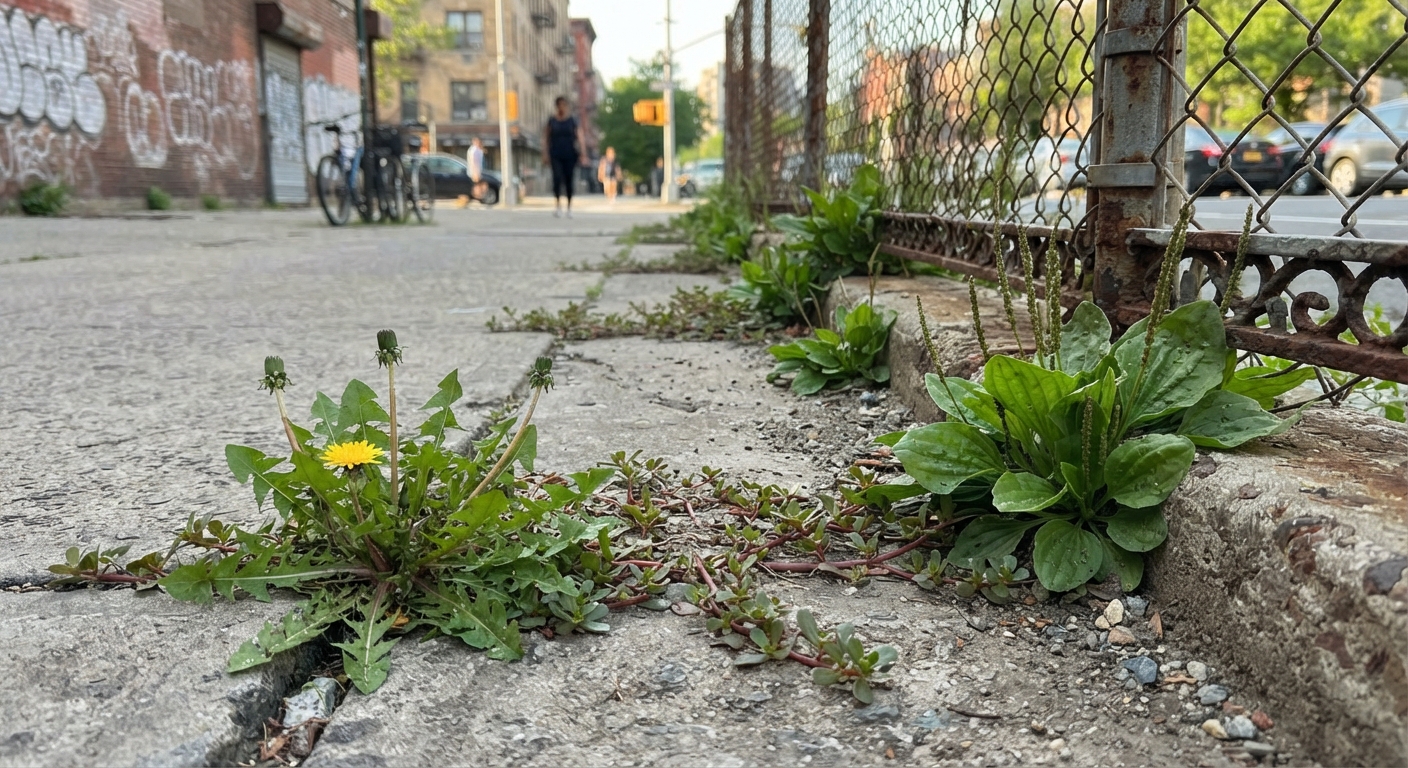
The city isn’t one environment. It’s a mosaic of distinct micro-habitats, each with its own plant community. Learning to read these zones transforms random wandering into targeted foraging.
1. The Sidewalk Crack Zone
The most overlooked habitat in any city. Compacted, poor soil with excellent drainage — exactly what purslane and prostrate knotweed prefer. You’ll find plantain (Plantago major) thriving in the most trampled spots, dandelions pushing through asphalt cracks, and purslane sprawling across hot pavement.
What to harvest here: purslane (thick, red-stemmed succulent with paddle-shaped leaves), broadleaf plantain (parallel-veined oval leaves hugging the ground), dandelion (in the smallest cracks, surprisingly tender leaves).
What to skip here: anything growing within 3 feet of a fire hydrant or utility pole (dogs target these), plants near dumpster pads (leachate contamination), anything where you can see visible vehicle fluid stains on the pavement.
2. The Neglected Fence Line
Fences create undisturbed corridors — nobody mows right against a chain-link fence, and nobody’s dog can reach the far side. These strips accumulate wild plants year after year.
Prime targets: lamb’s quarters (goosefoot-shaped leaves with a white, powdery coating on young growth), garlic mustard (kidney-shaped leaves with garlic smell when crushed, second-year plants with small white flowers), chickweed (tiny pointed oval leaves with a single line of hairs running down the stem), and blackberry brambles (common along wooden fences).
Why fence lines are safer: the fence itself creates a physical barrier between the plants and foot traffic, vehicle spray, and lawn equipment. Plants here have often been undisturbed for years.
3. Tree Lawns (The Strip Between Sidewalk and Street)
That narrow strip of grass between the sidewalk and the curb? It’s public right-of-way, and it’s one of the most productive urban foraging zones. Trees create dappled shade, leaf litter builds soil, and residents rarely treat these strips with chemicals.
What thrives here: dandelions (the undisputed queen of the tree lawn), white clover (three rounded leaflets with pale chevrons, pink-white flower heads), broadleaf plantain, and — surprisingly — morel mushrooms in spring where hardwood trees drop leaves.
The road proximity rule applies hard here. Only harvest from tree lawns on quiet residential streets, not arterials. The curb-facing side of the strip gets road spray; the house-facing side is cleaner.
4. Woodland Edges of City Parks
Every city park with trees has an edge habitat — the transitional zone between open lawn and wooded area. This is urban foraging’s highest-yield zone because it combines the biodiversity of forest edges with the accessibility of parks.
Seasonal bounty: spring brings garlic mustard and dandelion greens before the canopy fills in. Summer produces blackberries, mulberries (check for overhanging branches on park perimeter trees), and wood sorrel in the understory. Fall drops walnuts, acorns, and late-season lamb’s quarters.
Pro tip: walk the park perimeter path, not the interior. The edges — especially where park meets residential property — have the most plant diversity because they receive seed dispersal from both sides.
5. The Community Garden Edge
Community gardens are usually off-limits for foraging inside the fence. But the outside of the fence — where garden plants have self-seeded into the surrounding area — is often fair game.
Look for: volunteer cherry tomatoes, escaped mint patches, arugula gone to seed, borage volunteers, and calendula (pot marigold) spreading beyond the garden boundary.
The ethical line: if it’s growing outside the garden fence, it’s arguably fair game. If you’re not sure, find the garden coordinator and ask. Most are friendly to foragers who show respect.
6. Abandoned Lots and Demolition Sites
These are simultaneously the most productive and most risky urban foraging sites. The soil has been deeply disturbed, which pioneer edible plants love — but it’s also where contamination risk peaks.
Before considering this habitat: check the site’s history (city property records are often online), test the soil if you can, and only harvest above-ground plant parts. If the lot previously held a gas station, dry cleaner, auto shop, or factory — stay away permanently. Those contaminants don’t go away.
Top 10 Urban Edible Plants — Quick ID and Harvest Guide
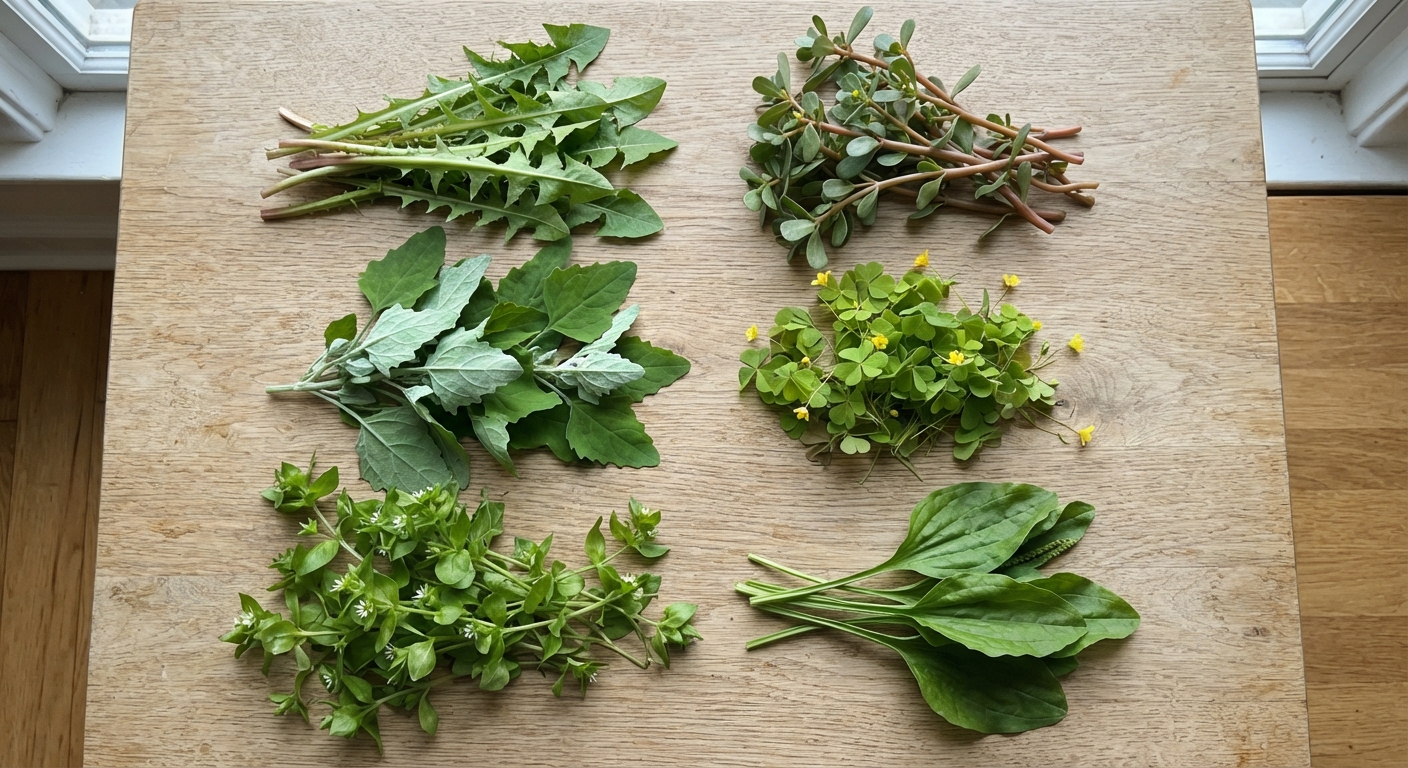
These ten plants appear in virtually every North American and European city. Learn five of them deeply before expanding your repertoire.
| # | Plant | Key ID Features | Urban Hotspots | Best Season | Edible Parts | Urban-Specific Caution |
|---|---|---|---|---|---|---|
| 1 | Dandelion (Taraxacum officinale) | Jagged backward-pointing leaves, hollow stem with white sap, single yellow flower per stalk | Tree lawns, park edges, sidewalk cracks | Spring–Fall (leaves); Spring (flowers); Fall (roots) | Leaves, flowers, roots | Avoid from sprayed lawns — uniform green turf with no other weeds |
| 2 | Purslane (Portulaca oleracea) | Thick reddish stems, succulent paddle-shaped leaves, tiny yellow flowers, grows flat against ground | Sidewalk cracks, gravel driveways, garden bed edges | Mid-Summer–Early Fall | Leaves, stems, flower buds | Grows in driveway runoff — harvest uphill from pavement, not in drainage paths |
| 3 | Lamb’s Quarters (Chenopodium album) | Goosefoot-shaped leaves with white powdery coating on young growth, grows 2–6 ft tall | Fence lines, vacant lots, garden edges, construction sites | Late Spring–Summer | Young leaves and tender stem tips | White powder is natural mineral excretion, not mold — rinse and eat |
| 4 | Wood Sorrel (Oxalis stricta) | Three heart-shaped leaflets, tiny 5-petal yellow flowers, seed pods that pop when touched | Shady lawn edges, park understories, mulched beds | Spring–Fall | Leaves, flowers, green seed pods | Oxalic acid content — eat in moderation, avoid if you have kidney issues |
| 5 | Chickweed (Stellaria media) | Tiny pointed oval leaves in opposite pairs, single line of hairs along stem, small white star-shaped flowers | Shady fence lines, garden bed edges, park understory | Late Winter–Early Summer | Entire above-ground plant | Dies back in heat — target in cool seasons only; look for the hair line to confirm |
| 6 | Broadleaf Plantain (Plantago major) | Broad oval leaves with parallel veins, fibrous flower stalk, grows in compacted trampled soil | Sidewalk edges, dirt paths, sports field margins | Spring–Fall | Young leaves (steamed), seeds | Tougher than most greens — steam or sauté, don’t eat mature leaves raw |
| 7 | Garlic Mustard (Alliaria petiolata) | First year: kidney-shaped leaves with scalloped edges, garlic smell when crushed. Second year: tall stalk with small white 4-petal flowers | Wooded park edges, shady fence lines, stream banks | Spring (second-year leaves and flowers); Late Spring (seeds) | Leaves, flowers, young seed pods, roots | Invasive species — harvest aggressively, you’re doing the ecosystem a favor |
| 8 | White Clover (Trifolium repens) | Three rounded leaflets with pale chevron marks, white-to-pink globe-shaped flower heads | Lawns, tree lawns, park fields | Spring–Fall | Flowers (raw or dried), young leaves (steamed) | Flowers ferment quickly — use within hours of picking; avoid if grass is sprayed |
| 9 | Mulberry (Morus spp.) | Medium to large tree with variable leaves (some lobed, some unlobed on same tree), berries like elongated blackberries in June–July | Park edges, residential property lines, old neighborhood streets | Early–Mid Summer | Ripe berries (purple-black, soft) | Only harvest white and purple-ripe fruit — unripe and reddish berries can cause stomach upset |
| 10 | Wild Onion/Garlic (Allium spp.) | Thin hollow or flat grass-like leaves with strong onion/garlic smell, small bulbs underground | Lawns, park fields, tree lawns | Spring–Early Summer; Fall | Leaves, bulbs | Death camas look-alike — if it doesn’t smell like onion/garlic, it’s NOT an Allium. Smell test is non-negotiable |
The Urban Contaminant Checklist — 6 Questions Before Every Harvest
Rural foragers have one contamination concern: was this sprayed? Urban foragers have a longer checklist. Run through these six questions before you put anything in your basket.
1. What’s underneath this soil? Lead paint from demolished pre-1978 buildings doesn’t disappear — it’s still in the soil. Old industrial sites, demolished houses, and land within 50 feet of heavily-trafficked pre-1990 roads are lead-risk zones. Above-ground harvests reduce risk significantly.
2. Is there standing water nearby? Urban runoff carries everything from motor oil to lawn fertilizer. Plants growing where runoff pools — drainage ditches, gutter downspout outlets, low spots in parking lots — absorb whatever the water carries. Skip these entirely.
3. Can dogs reach this? Anything below knee height along sidewalks, in parks with dog walkers, or near apartment building entrances has likely been visited by dogs. Harvest above waist height when possible. Always wash thoroughly regardless.
4. Does this spot get lawn service? The telltale signs: unnaturally uniform green grass, sharp edges along walkways, absence of any weeds except the ones you’re eyeing. Professional lawn services spray regularly. If the property looks maintained, ask before harvesting.
5. Is there visible pollution? Soot on leaves near busy roads, oily residue on plants near parking lots, visible trash or chemical containers nearby — these are obvious but easy to overlook when you’re excited about a find.
6. What was this place 30 years ago? Urban land use changes fast. That “natural meadow” was a gas station in 1990. That community garden was a factory parking lot in 1985. City property records, historical Google Earth imagery, and Sanborn fire insurance maps (available through many public libraries) can answer this question. It’s worth the 15-minute research investment.
The Urban Forager’s Seasonal Calendar
City foraging follows the same seasonal rhythms as rural foraging but with urban-specific timing shifts thanks to the heat island effect. Here’s what to target and when:
| Season | Months (Northern Hemisphere) | What’s Available | Where to Look | Urban Timing Note |
|---|---|---|---|---|
| Late Winter | February–March | Chickweed, hairy bittercress, young dandelion greens, garlic mustard (first-year rosettes) | South-facing walls, sunny fence lines, heated building foundations | City microclimates push these 2–3 weeks earlier than rural areas |
| Spring | April–May | Dandelion flowers and tender leaves, garlic mustard (second-year shoots), wild onion, violet flowers, dead nettle, chickweed (peak) | Park edges, tree lawns, community garden perimeters, neglected yard corners | Spring “green-up” happens 1–2 weeks earlier in city centers |
| Early Summer | June–July | Mulberries, lamb’s quarters (tender growth), purslane (early), wood sorrel, clover flowers, daylily buds | Mulberry trees along property lines, sunny vacant lots, park perimeter paths | Berry season starts earlier on south-facing urban trees |
| Late Summer | August–September | Purslane (peak), lamb’s quarters (mature but still good), amaranth, blackberries, wild grapes, crabapples | Fence lines, railroad edges (keep 30ft+ from tracks), old neighborhood alleys, park thickets | Purslane peaks during urban heat waves when other plants shut down |
| Fall | October–November | Dandelion roots (for roasting), acorns, black walnuts, rose hips, late lamb’s quarters, hardy chickweed (returning) | Mature oak trees in older parks, walnut trees in established neighborhoods, rose bushes in untended landscaping | Root harvest ideal after first light frost — earlier in cities than rural areas |
| Winter | December–January | Chickweed (mild winter areas), garlic mustard rosettes, wild onion greens (mild spells) | South-facing building foundations, heated microclimate pockets, protected courtyard corners | Many cities have a continuous chickweed season if winter stays mild |
Your Weekly Urban Foraging System — From Zero to Regular Harvest
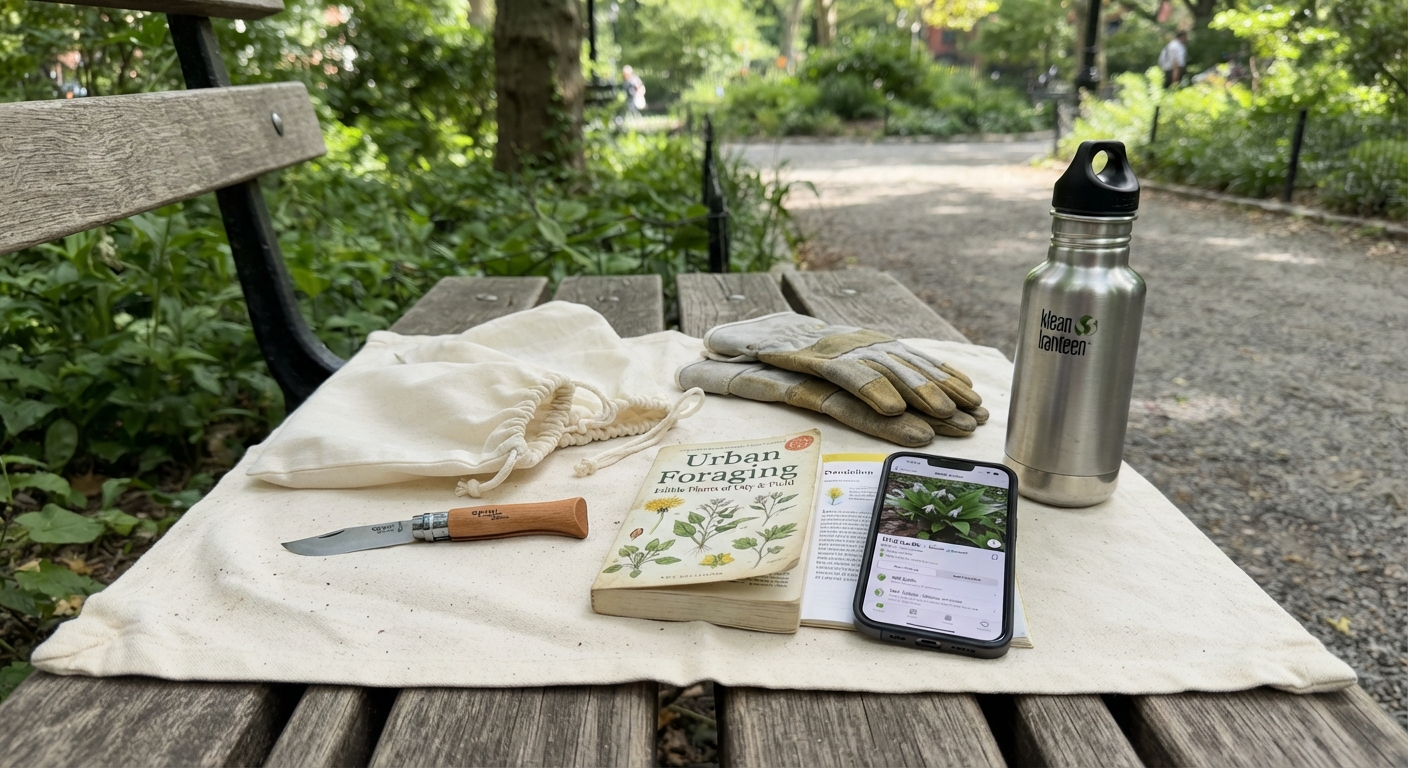
Foraging works best when it becomes a habit, not a special expedition. Here’s how to build a system that produces fresh wild food every week without consuming your life.
Step 1: Map Your Territory (One Saturday Afternoon)
Open Google Maps. Drop pins on every potential foraging spot within a 15-minute walk of your home:
- Parks (green patches)
- Tree lawns on quiet residential streets
- Fence lines visible from sidewalks
- Community gardens (for edge foraging)
- Vacant lots (research history first)
- Schoolyards (only on weekends/holidays when empty, confirm no spraying)
- River/creek banks accessible via public paths
You’ll end up with 15–30 pins. That’s your territory. You don’t need more than this — the goal is depth, not breadth.
Step 2: The 20-Minute Route Walk (Twice Weekly)
Pick two days a week. Tuesday evening and Saturday morning work well for most schedules. Walk a loop that hits 5–8 of your pins in about 20 minutes. Bring:
- Two or three cloth produce bags (plastic bags suffocate greens)
- A small folding knife or scissors (many parks prohibit knives — scissors are lower-profile)
- Your phone with a plant ID app open
- A water bottle (for you — and for rinsing gritty plants on-site)
On each walk, note what’s in season, what’s almost ready, and what’s past peak. After four walks, you’ll know your territory’s seasonal rhythm intimately.
Step 3: The Harvest Threshold Rule
Don’t take everything you find. This isn’t just ethics — it’s practical. If you strip a patch clean, it won’t produce next time. The rule: take no more than one-third of any plant patch. For plants like dandelions and purslane that regrow quickly, you can push this to one-half. For slow-growers like garlic mustard that are invasive anyway, take freely.
For rare or single-specimen finds (that lone mulberry tree, the one patch of wild grapes), leave enough for wildlife and other foragers. Urban foraging spots can’t replenish like rural ones — there’s less total area, fewer backup patches.
Step 4: Process Immediately (The 30-Minute Rule)
City-foraged plants degrade faster than farmers market produce. They’ve been stressed by heat, foot traffic, and less-than-ideal soil. Get them into cold water within 30 minutes of harvesting — the multi-soak method (three cold water baths, swishing gently between each) removes grit, bugs, and surface contaminants.
After washing, spin dry if eating raw within 24 hours. For greens you’ll cook later, wrap in damp paper towel inside a loose plastic bag and refrigerate — they’ll hold for 2–3 days tops.
Step 5: Keep a Foraging Log (30 Seconds Per Walk)
A notes app entry per walk: date, what you harvested, from where, condition notes, and what’s coming up next. After one season, this log becomes your personal almanac — you’ll know that the mulberries on Elm Street peak around June 15, that the best chickweed patch disappears by May 10, and that the lamb’s quarters behind the community garden hits its sweet spot in late July.
This is how you stop “hoping to find something” and start knowing exactly what’s available, exactly when, exactly where.
Pro Tips — Lessons From Hundreds of Urban Foraging Walks
The basketball court shortcut. City parks with basketball courts almost always have drinking fountains nearby. These leak. The constantly moist soil around fountain bases produces huge, tender dandelion leaves and chickweed patches even in midsummer when everything else has gone tough and bitter.
Mulch beds are indicator zones. Commercial landscaping mulch in shopping centers and office parks gets replaced annually — and the fresh mulch suppresses existing weeds. If you see a thriving weed community in a mulch bed, it hasn’t been treated recently. Industrial parks with neglected perimeter landscaping are often surprisingly productive.
The cemetery exception. Old cemeteries are some of the most chemically-untouched green spaces in cities, and many allow public access during daylight hours. Gravel paths, old trees, and decades of undisturbed soil create excellent foraging habitat. Just be respectful — this is sacred ground for someone.
Learn the “lawn weeds” first. The plants growing in ordinary suburban lawns — dandelion, plantain, clover, wood sorrel — are the safest, easiest-to-identify, and most widespread urban edibles. Master these four before attempting anything trickier. They account for 80% of what you’ll actually harvest in a city.
After rain is prime time. A good soaking rain does three things: it washes dust and surface pollutants off leaves, it plumps up greens that were getting leathery, and it triggers a growth spurt in many edible species. The 24–48 hours after rainfall are urban foraging’s sweet spot.
The 5 AM advantage. Early-morning foraging — before dog walkers, before parks maintenance crews, before anyone else is around — means cleaner plants, zero awkward conversations, and the best picking. It’s also cooler and the plants are at peak hydration. Try it once and you’ll never go back to afternoon foraging.
Don’t overlook ornamental edibles. Daylilies (Hemerocallis — the common orange ditch lily) are planted in landscaping everywhere, and the unopened flower buds are a fantastic vegetable (sauté in butter, trust me). Hostas — yes, those shade plants in every office park — have edible young shoots that taste like asparagus crossed with lettuce. Both are so common in urban landscaping that you’ll see them within two blocks of wherever you’re standing.
FAQ — Urban Foraging Concerns, Straight Answers
“Isn’t urban foraging dangerous because of pollution?”
The risk is real but manageable. The science consistently shows that above-ground plant parts (leaves, flowers, fruits) accumulate far fewer soil contaminants than root vegetables. Combined with the 30-foot road buffer and the contaminant checklist earlier in this guide, urban foraging is comparable in risk to eating conventionally-grown grocery store produce — with the added benefit of zero pesticide residue on truly wild plants.
“Can I get in legal trouble for picking ‘weeds’ in a public park?”
Honestly? It depends on your city and how visible you’re being. Most municipal codes don’t specifically address foraging, but they often have broad “removal of vegetation” clauses. In practice, enforcement is rare for small-scale personal foraging — but it’s not zero. Know your local rules. Be discreet. Avoid high-traffic areas during busy hours. If an official asks you to stop, stop immediately and politely.
“How do I know if a plant has been sprayed with herbicide?”
Spray damage shows within 24–48 hours: twisted, curled, or cupped leaves on new growth, yellowing that follows spray patterns (not natural senescence), and plants dying in groups rather than individually. Healthy plants look relaxed — their leaves spread naturally. Stressed, sprayed plants look like they’re clenching. Trust that instinct.
“What’s the single most important piece of gear for urban foraging?”
Knowledge. Specifically, knowing five plants cold — their appearance across all growth stages and seasons, their look-alikes, their habitat preferences. Second most important: cloth produce bags. Third: a phone with at least two plant ID apps, because cross-referencing catches mistakes that a single app might miss.
“Do I need to ask permission to forage on the tree lawn in front of someone’s house?”
Legally, tree lawns (the strip between sidewalk and street) are usually public right-of-way, but practically, the adjacent homeowner maintains it. Knocking on the door and asking takes 30 seconds and builds goodwill. Most people say yes — especially when you explain you’re harvesting dandelions and “weeds” they’d otherwise mow down. Some will even point you to their backyard where they don’t spray.
“Can I really find enough food in the city to make this worthwhile?”
A committed urban forager on a well-mapped territory can harvest 1–3 pounds of fresh greens per week during the growing season, plus seasonal berries, nuts, and roots. That’s a meaningful supplement to grocery shopping — and with zero food miles, zero packaging, and zero cost. Is it going to replace the grocery store? No. Is it going to give you the freshest salad greens you’ve ever eaten, for free, while teaching you to see your city differently? Absolutely.
The City Is Your Garden — You Just Haven’t Claimed It Yet
Foraging in the city rewires how you see your environment. That neglected corner lot stops being an eyesore and becomes a lamb’s quarters patch. The tree lawn dandelions transform from lawn nuisance to tomorrow’s salad. The mulberry tree staining the sidewalk in June? Public fruit.
The skills compound. After one season, you’ll spot edible plants automatically — while walking the dog, biking to work, waiting for the bus. After two seasons, you’ll have timed the rhythms of your territory so precisely that you never miss a harvest window.
Start small. Learn five plants. Map your neighborhood. Walk your route twice a week. Let the city feed you — it’s been trying to this whole time. You just needed to know where to look.