Most foraging guides dump 50 plant profiles on you and expect you to memorize them all before stepping outside. That’s backwards.
Here’s the thing: you don’t need to know every plant. You need to know the plants that grow where you’re actually standing.
This guide flips the script. Instead of scrolling through an encyclopedia, you look at where your feet are — lawn, woodland edge, stream bank, or cracked sidewalk — and zero in on the edible plants that live in that exact spot.
No botany degree required. Just your eyes and about five minutes.
Before You Touch Anything — The 10-Second Safety Check
Three rules. No exceptions.
Rule 1: Positive ID or don’t pick. “I think it might be…” is not good enough. You either know the plant or you walk away.
Rule 2: Know the look-alikes. Every edible plant section below includes its most dangerous imposter. Read the warning before the description.
Rule 3: One new plant per outing. Learn it properly — taste, texture, habitat, season — before adding another. Foragers who rush end up in the ER.
Carry a field guide app. Take photos from multiple angles. When in doubt, leave it.
Quick-ID by Where You’re Standing
Forget Latin names for now. Group plants by the ground under your feet.
Lawn & Backyard Regulars
These five grow in every suburban lawn, park, and backyard across North America and Europe. You’ve probably mowed over all of them.
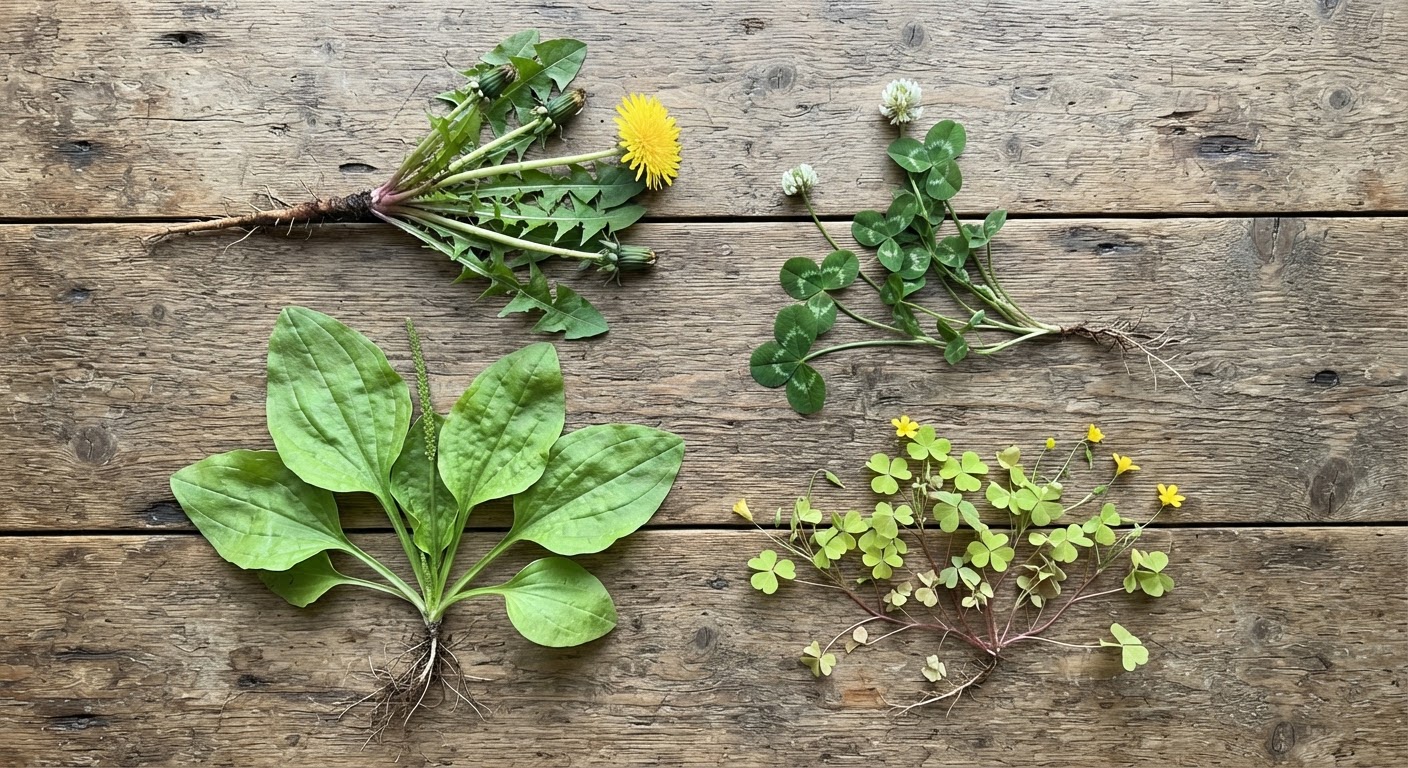
Dandelion (Taraxacum officinale)
The one plant everyone knows. Jagged leaves with backward-pointing teeth, hollow stem oozing white sap, single yellow flower per stalk.
- Eat: Young leaves raw in salad, flowers battered and fried, roots roasted for “coffee”
- Watch out: No dangerous look-alikes once you see the flower. Young leaves can resemble chicory (also edible) or wild lettuce (bitter but safe)
- Quick trick: If it has multiple flowers on one stalk, it’s not dandelion
Broadleaf Plantain (Plantago major)
Not the banana relative — the flat, oval-leaf weed that grows in compacted soil and sidewalk cracks. Parallel veins running lengthwise, fibrous stalk.
- Eat: Young leaves steamed (tougher than spinach, hits the same spot), seeds as a fiber supplement
- Watch out: Hostas in gardens have similar leaf shape but different vein patterns (branched, not parallel). Hostas are non-toxic but don’t confuse plant ID habits
- Quick trick: Pull a leaf apart slowly — plantain shows stretchy white “strings” (the parallel veins)
White Clover (Trifolium repens)
Three rounded leaflets, often with a pale crescent mark, white-to-pink puffball flower.
- Eat: Flowers raw as trail snacks (slightly sweet), leaves steamed, dried flowers in tea
- Watch out: Wood sorrel has similar three-leaf pattern but heart-shaped leaflets (clover is oval). Both are edible
- Quick trick: If the leaf has a white chevron mark — clover. If it tastes lemony and has heart-shaped leaves — wood sorrel
Wood Sorrel (Oxalis stricta)
Three heart-shaped leaflets, tiny yellow five-petal flowers, seed pods that explode when touched.
- Eat: Leaves raw (lemony tang — incredible on fish tacos), flowers as garnish
- Watch out: Clover triple-leaf confusion (see above — both safe). Don’t eat pounds of it; oxalic acid builds up
- Quick trick: Taste a tiny bit. If it’s sour like lemon, it’s wood sorrel. Clover tastes grassy
Purple Dead Nettle (Lamium purpureum)
Square stem (mint family tell), purplish top leaves, small pink-purple flowers.
- Eat: Young leaves and flowers raw, whole plant in tea, cooked as potherb
- Watch out: Henbit (Lamium amplexicaule) is its cousin — also edible, similar look. Easily confused but both safe
- Quick trick: Square stem + purple top leaves + mint-family scent = dead nettle. Unlike true nettle, it won’t sting
Woodland Edge Finds
Where the trees thin out and the sun hits the undergrowth. Dappled shade, rich soil, often near trails.
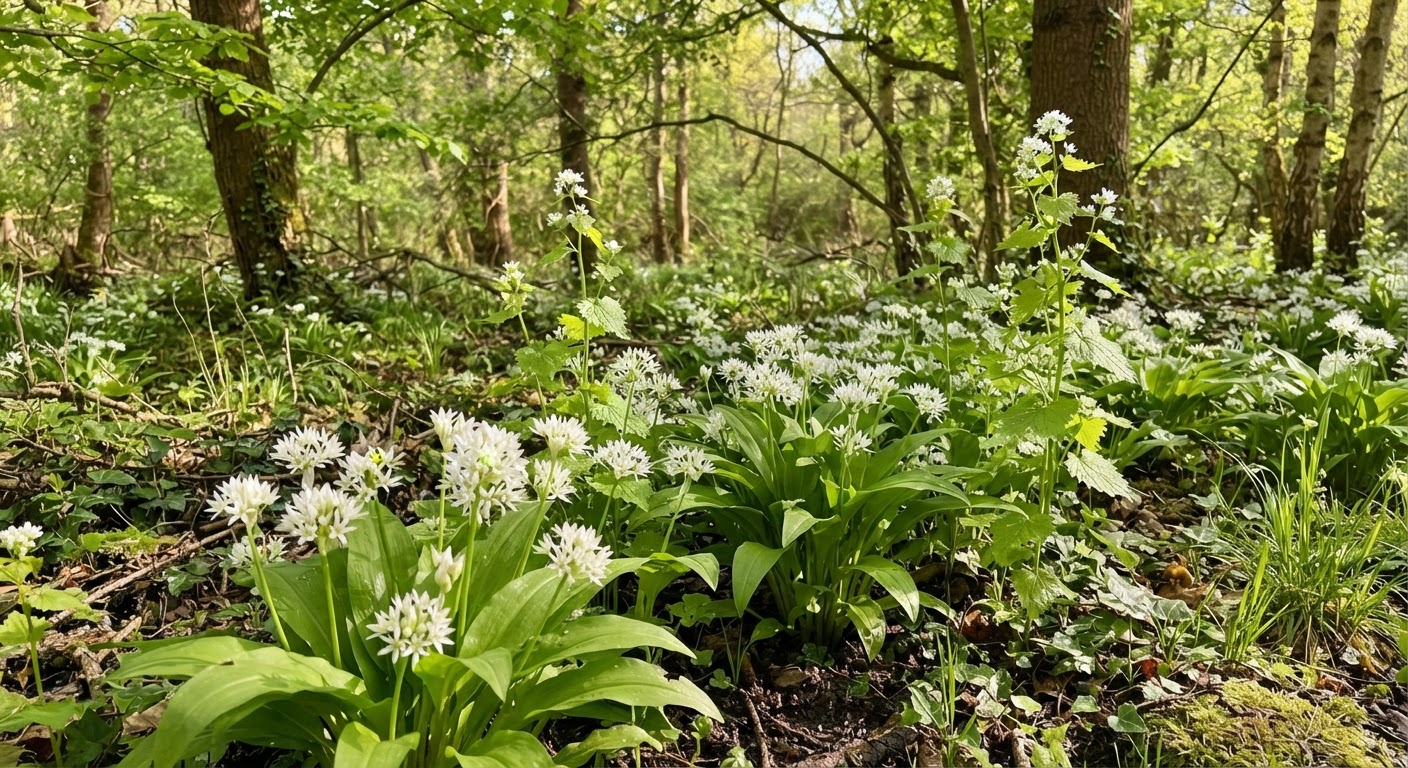
Wild Garlic / Field Garlic (Allium vineale)
Thin, hollow, tubular leaves that smell unmistakably of garlic when crushed. Grows in clumps, often in lawns too.
- Eat: Leaves chopped like chives, bulbs as mild garlic substitute, flowers for salads
- Watch out: Death camas and star-of-Bethlehem have similar leaves but NO garlic scent. If it looks like wild garlic but doesn’t smell like it — walk away
- Quick trick: The smell test is 100% reliable. No allium scent = not an allium
Garlic Mustard (Alliaria petiolata)
Kidney-shaped leaves with scalloped edges, garlic scent when crushed, tiny white four-petal flowers on a tall stalk in year two.
- Eat: Young leaves in pesto, older leaves cooked, roots as horseradish substitute
- Watch out: Violet leaves have a similar shape but no garlic scent. Ground ivy (creeping charlie) has a minty smell, not garlic
- Quick trick: Crush a leaf. Garlic + mustard scent = garlic mustard. Mint scent = ground ivy (edible in tea, medicinal)
Common Blue Violet (Viola sororia)
Heart-shaped leaves, purple-blue five-petal flowers with a distinctive “face” shape.
- Eat: Flowers raw (mildly sweet), leaves cooked (mild, slightly mucilaginous), candied flowers on desserts
- Watch out: Lesser celandine has similar heart-shaped leaves but glossy yellow flowers with more petals and grows in wetter spots. Lesser celandine is TOXIC when raw
- Quick trick: Violet flowers have 5 petals — the bottom one has a spur behind it. Lesser celandine has 8+ glossy yellow petals and no spur
Stinging Nettle (Urtica dioica)
Serrated, pointed leaves growing in pairs on a square-ish stem, covered in fine stinging hairs. You’ll know it when you touch it.
- Eat: Young top leaves cooked (blanching kills the sting instantly), dried for tea, soup base
- Watch out: Dead nettle (Lamium) has similar leaf shape but no sting, square stem, and purple flowers. Dead nettle is edible — this is a “good” confusion
- Quick trick: Wear gloves. Snip the top 4-6 inches. 30 seconds in boiling water and the sting is permanently gone
Water’s Edge & Damp Spots
Stream banks, pond edges, drainage ditches, spring seeps. These plants need constant moisture.
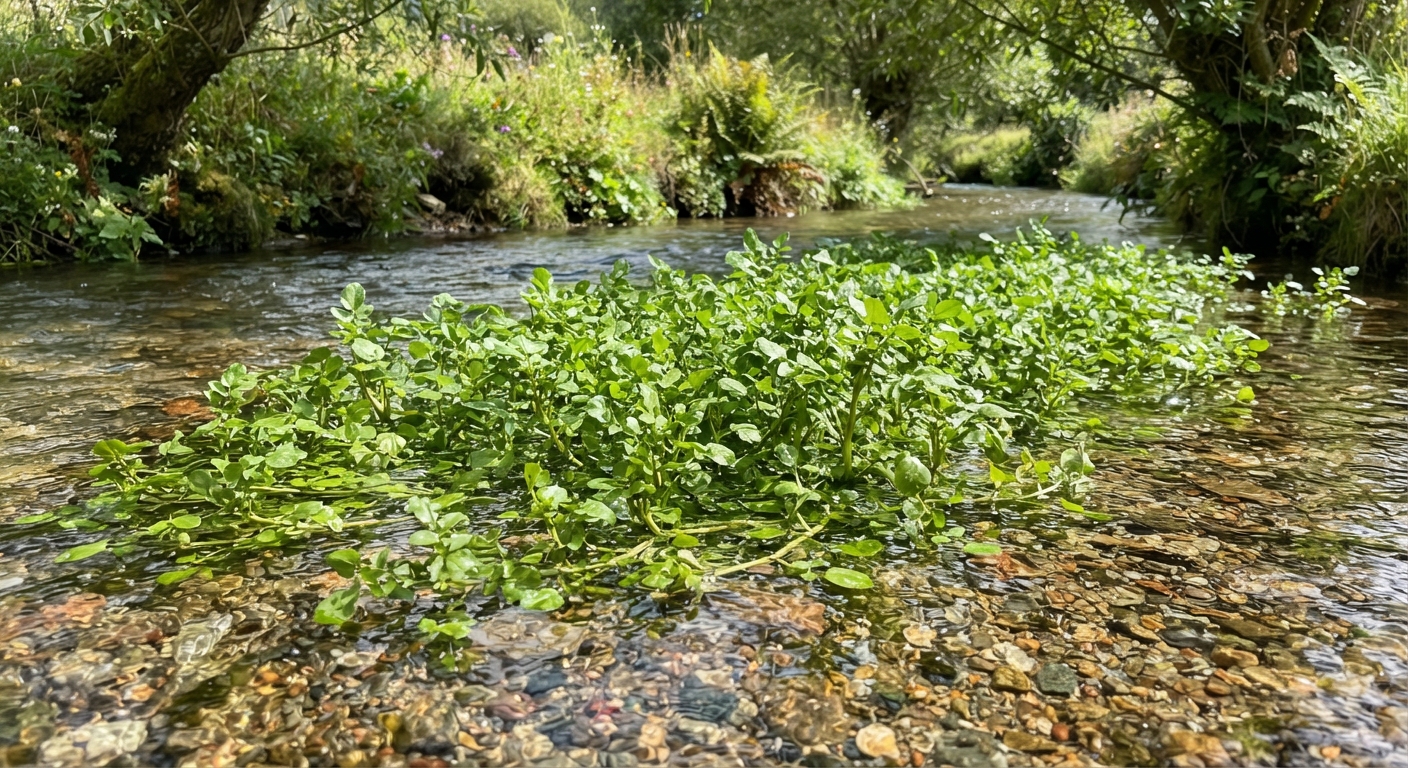
Watercress (Nasturtium officinale)
Floating or creeping stems with rounded leaflets, small white four-petal flowers, peppery taste.
- Eat: Leaves and stems raw, classic soup base, sandwich green that puts lettuce to shame
- Watch out: Fool’s watercress (Apium nodiflorum) and hemlock water dropwort (Oenanthe crocata) grow in the same habitat. Only eat from clean, moving water — never stagnant ditches
- Quick trick: Watercress has a peppery, mustard-like bite. Fool’s watercress tastes bland or slightly celery-like. Hemlock water dropwort is DEADLY. If uncertain about water quality or plant ID, skip it
Wild Mint (Mentha arvensis)
Square stem, opposite leaves, unmistakable mint scent, small purple flower clusters at leaf joints.
- Eat: Leaves fresh in tea, chopped in salads, muddled in cocktails
- Watch out: Pennyroyal (Mentha pulegium) has a similar look but a much stronger, almost medicinal mint smell and is TOXIC in large doses. Lythrum species have similar purple flowers but no mint scent
- Quick trick: Mint family = square stem + aromatic leaves. If it’s square-stemmed and smells minty, it’s mint
Cattail (Typha latifolia)
Flat, sword-like leaves, tall stalk with the classic brown “hot dog” seed head on top.
- Eat: Young shoots peeled and eaten raw (“Cossack asparagus”), green flower spikes boiled, pollen as flour substitute, rhizome starch
- Watch out: Yellow flag iris (Iris pseudacorus) has similar flat leaves but grows from a fan-shaped base, has showy yellow flowers, and is TOXIC. Blue flag iris also toxic
- Quick trick: No other plant produces the brown cigar-shaped seed head. If the brown spike is present, you cannot mistake it. Without flowers, check for sword-like leaves in deep water — cattails grow IN water, irises grow AT the edge
Urban Lots & Sidewalk Cracks
The rebels. These plants thrive in disturbed soil, vacant lots, and the cracks civilization built for them.
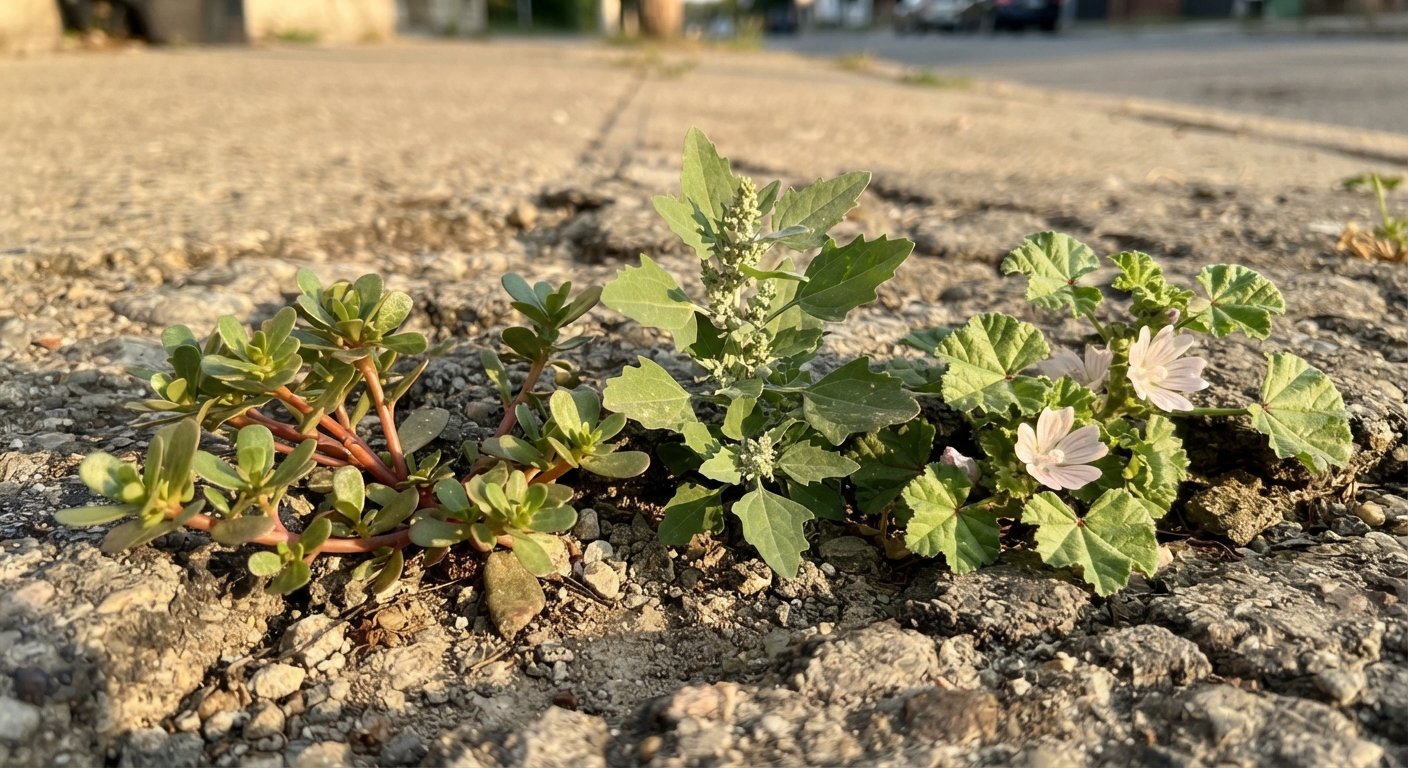
Purslane (Portulaca oleracea)
Smooth, reddish stems creeping flat along the ground, thick succulent leaves that look like tiny jade plant leaves, small yellow flowers.
- Eat: Leaves and stems raw (crisp, slightly lemony), cooked in stir-fries, pickled. Highest plant source of omega-3 fatty acids
- Watch out: Spurge (Euphorbia species) has a similar prostrate growth but breaks to show white milky sap — purslane has clear sap. Spurge leaves are thinner and flatter. Spurge is TOXIC
- Quick trick: Snap a stem. Clear sap = purslane (edible). White milky sap = spurge (toxic). This test is foolproof
Lamb’s Quarters (Chenopodium album)
Diamond-shaped leaves with a telltale white powdery coating on young growth, especially on the undersides. Grows tall and bushy.
- Eat: Young leaves raw or cooked (tastes like spinach but sweeter), seeds as grain substitute
- Watch out: Black nightshade (Solanum nigrum) has similar leaf shape when young but different leaf texture — no white powder, and develops small white flowers that become black berries (berries toxic when unripe)
- Quick trick: Check the leaf underside. If it’s got that white-mealy dust, it’s lamb’s quarters. Nightshade leaves are waxy-smooth
Common Mallow (Malva neglecta)
Round, scalloped leaves (kids call them “cheese wheels”), creeping habit with pinkish-white flowers, and distinctive round, flat seed pods.
- Eat: Leaves cooked (mild, slightly mucilaginous — great for thickening soups), young seed pods raw (“mallow cheeses”), flowers as garnish
- Watch out: Ground ivy has round scalloped leaves but a minty scent and purple-blue flowers. Hollyhock is a garden relative with larger, rougher leaves — also edible but not wild
- Quick trick: The round, flat “cheese wheel” seed pods are unique to mallow. No other common weed produces them
Edible vs. Toxic Look-Alikes — Quick Reference Table
This table covers the most dangerous mix-ups. Tape this to the inside of your field guide.
| Edible Plant | Toxic Look-Alike | The Decisive Difference | Reliability |
|---|---|---|---|
| Wild Garlic | Death Camas | Crush leaf — garlic scent means safe. No scent means danger | 100% |
| Purslane | Spurge | Break stem: clear sap = purslane. White milky sap = spurge | 100% |
| Wild Carrot (Queen Anne’s Lace) | Poison Hemlock | Carrot has hairy stem, smells like carrot. Hemlock has smooth purple-spotted stem, smells musty | High |
| Watercress | Hemlock Water Dropwort | Watercress tastes peppery. Dropwort has parsley-like leaves and thicker stems. Only harvest from flowing water | High |
| Blue Violet | Lesser Celandine | Violet has 5 petals with a spur behind the bottom one. Celandine has 8+ glossy petals, no spur | 100% |
| Elderberry (blue/black) | Pokeweed | Elderberry grows in flat clusters on woody shrubs. Pokeweed berries hang in dangling grape-like clusters on herbaceous stalks | 100% |
| Lamb’s Quarters | Black Nightshade | Lamb’s quarters has white mealy coating on leaf undersides. Nightshade leaves are waxy-smooth | High |
| Cattail | Yellow/Blue Flag Iris | Cattail has the brown cigar seed head. Iris has showy flowers and a fan-shaped leaf base | 100% (with flowers present) |
The golden rule: If a “decisive difference” requires a judgment call you’re not confident making, don’t eat it. Come back with a field guide and verify all three distinguishing features.
The 5-Item Kit That Actually Matters
You don’t need a $200 foraging vest. Five items cover 95% of what you’ll actually use:
- Cut-resistant gloves — $8 gardening gloves save you from nettle stings and thorns. Far more useful than specialized foraging gloves at triple the price
- A folding Opinel or Mora knife — not for cutting plants (use your fingers for greens), but for digging roots and trimming stems. Mushroom foragers need the brush attachment; plant foragers don’t
- Cloth bags, not plastic — paper bags get wet. Plastic bags make greens sweat and wilt. Reusable mesh produce bags or cotton totes keep your harvest breathing
- Your phone with a plant ID app installed — PictureThis, iNaturalist, or Seek. Photo from leaf, flower, and stem angles. Apps aren’t 100% but they narrow the field
- A small pocket field guide — physical, not digital. Batteries die. Signal drops. A $12 Peterson or Falcon pocket guide weighs 3 ounces and works forever
From Ground to Plate — One Plant, Three Meals
The real test of plant knowledge isn’t identifying it. It’s cooking it well.
Take dandelion as your example plant:
- Breakfast: Young leaves (harvest before the flower stalk appears, when they’re least bitter) tossed with olive oil, lemon, and hard-boiled eggs. A warm bacon dressing cuts the bitterness entirely
- Lunch: Dandelion flowers dipped in tempura batter, fried 45 seconds per side, sprinkled with flaky salt. Kids will eat these
- Dinner: Dandelion root — dug, scrubbed, roasted at 350°F until dark brown and brittle, ground, and brewed. Tastes closer to coffee than you’d expect, zero caffeine
That’s three meals from one plant most people pay to remove from their lawn.
Frequently Asked Questions
Can I really learn plant identification from a blog post? No — and neither can you from a single field guide. This post gives you the shortcuts and common plants. You practice in the field, verify with multiple sources, and learn one plant at a time. Anyone who says you can learn foraging in a weekend is selling something.
What if my plant ID app gives me the wrong answer? Apps are a starting point, not the final word. Use them to generate a candidate species, then verify against a physical field guide or a trusted online source (like university extension sites, which end in .edu). Always check three features: leaf shape, flower structure, and growth habit.
Is urban foraging safe? The plants are growing near roads. Harvest at least 50 feet from busy roads. Avoid plants growing in sprayed lawns (most municipal parks). Look for plants in the back of parks, along rail-trails, and in community gardens (with permission). Rinse everything twice. Urban foraged food is still cleaner than most industrially farmed produce.
How do I know if I’m allergic to a plant I’ve never eaten? The universal edibility test takes time but exists for a reason. For common greens like dandelion and purslane (which virtually nobody is allergic to), try a small portion first. Rub a tiny piece on your inner wrist, wait 15 minutes. Eat a pea-sized amount, wait 20 minutes. No reaction? You’re likely fine.
What’s the single easiest plant for a first-time forager? Dandelion. You already know what it looks like. It has no toxic look-alikes once you see the flower. Every part is edible. You can find it anywhere. Your first successful foraged meal should be dandelion — it builds confidence and you can’t mess it up.
Your 5-Minute Foraging Protocol
Print this or screenshot it. This is what you actually do in the field:
- Stand still and scan — Look at the ground around you. Lawn? Woodland edge? Water nearby? That tells you which section above to work from
- Pick one plant to identify — not five. Find a candidate, work through the descriptions above
- Run the look-alike check — Cross-reference the table. If there’s a toxic twin, verify the “decisive difference”
- Take photos — Leaf top, leaf bottom, flower, stem, whole plant. You’ll want these later
- Harvest sustainably — Take at most 10% of what’s there. Leave the roots of perennial plants. Don’t pick rare species whether they’re edible or not
The goal isn’t to fill a basket on your first outing. It’s to walk away knowing one more plant than you did when you walked in. Do that ten times and you’ve got a mental library of wild food you can spot from fifty feet away.
Happy foraging. Start with dandelion.