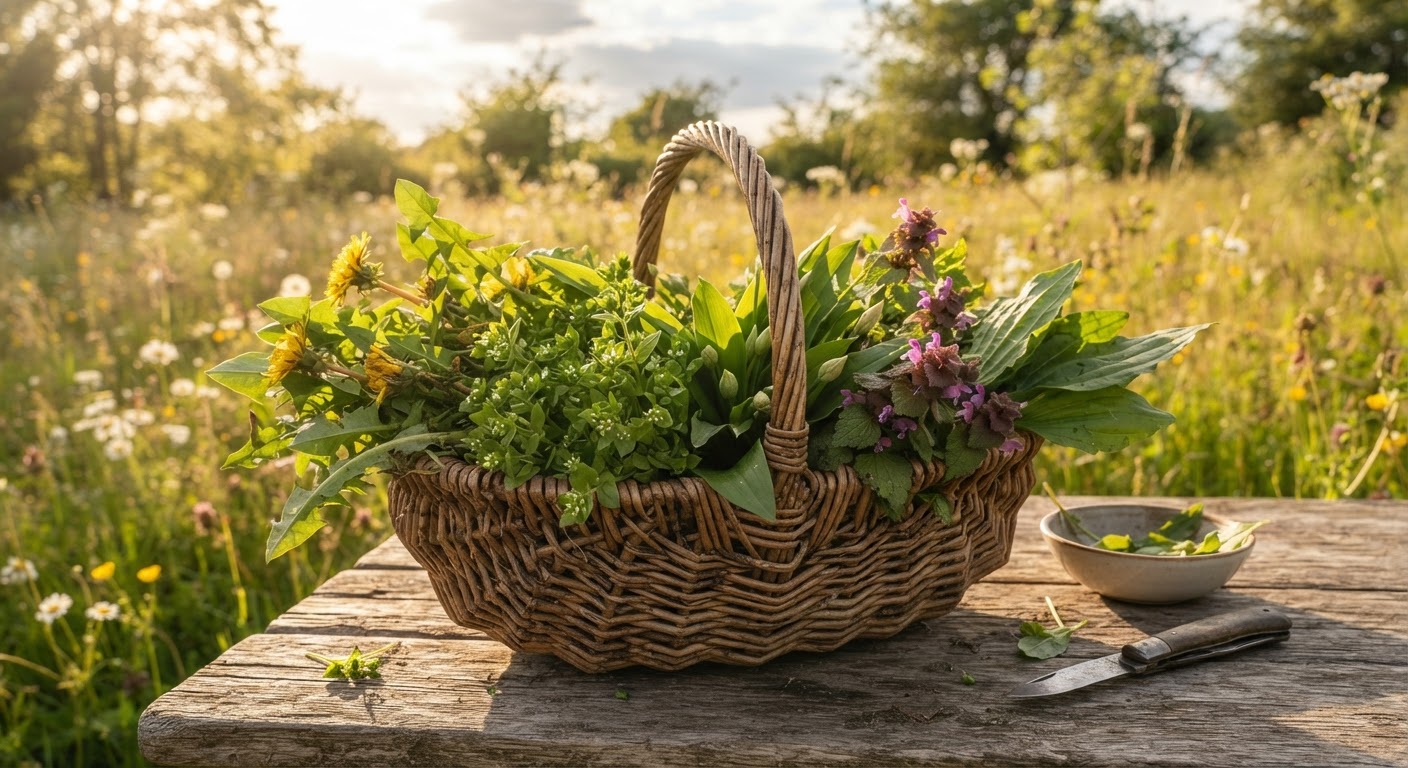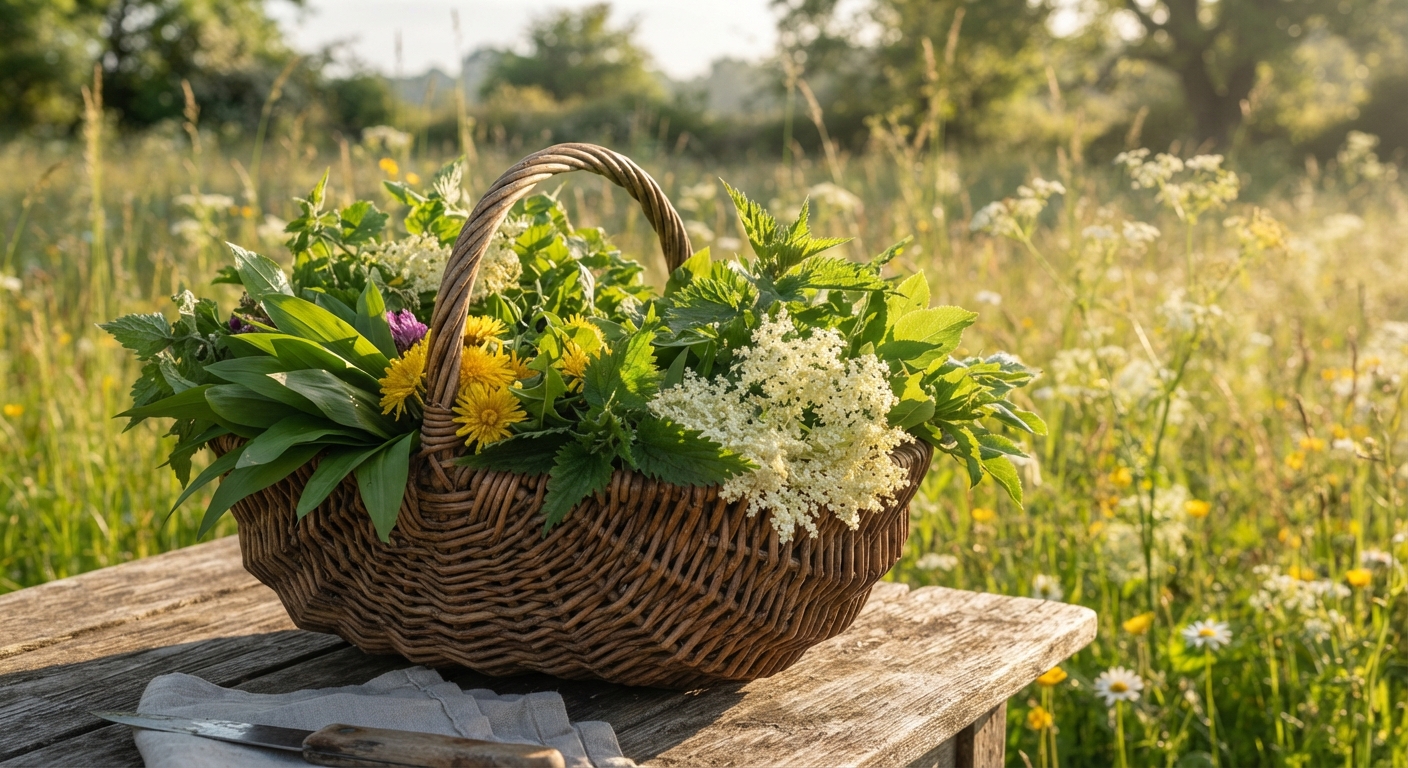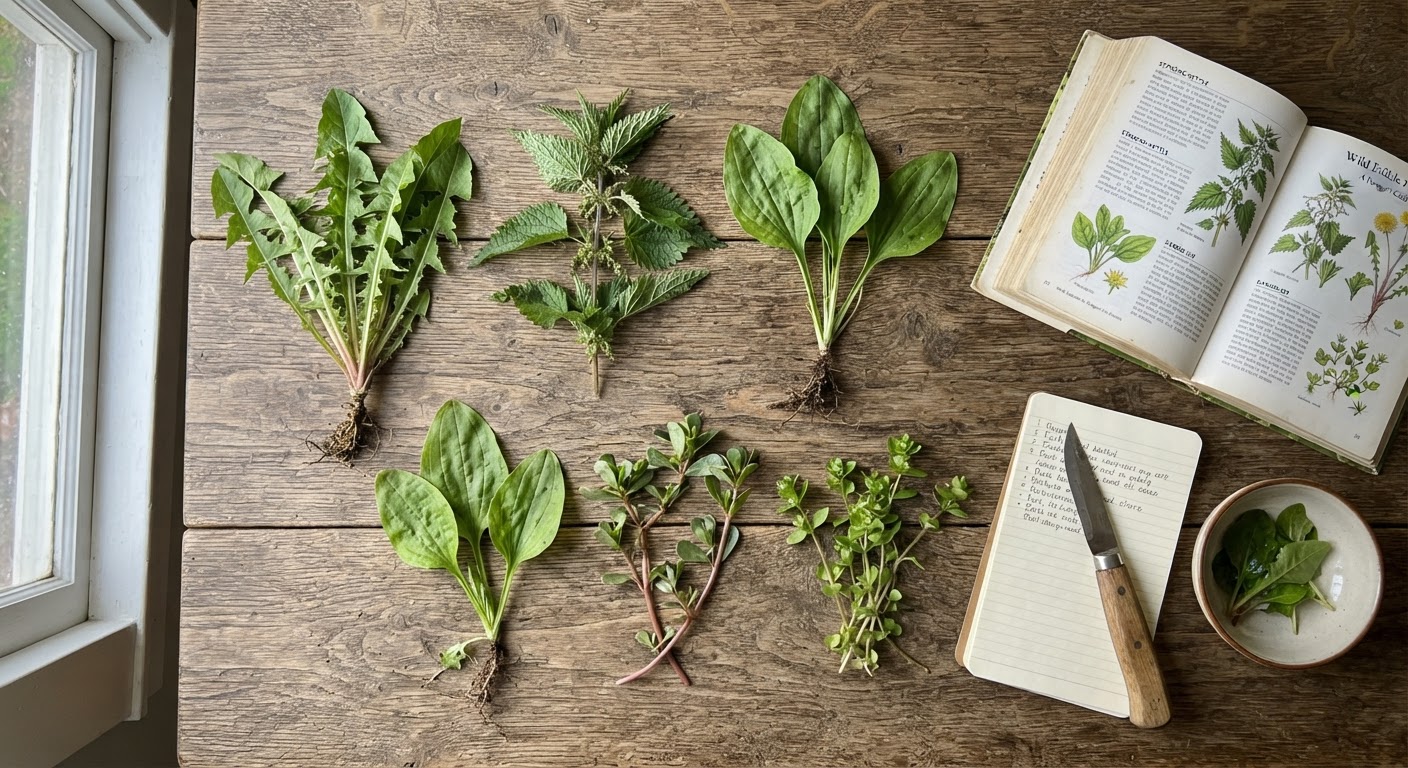
A list of edible wild plants is only useful if the plant in front of you matches the plant in your head. That’s the whole problem with most “edible plants” roundups: they give you a name and a few adjectives — “toothed leaves,” “hairy stem” — and then leave you squinting at a weed wondering if it’s dinner or a trip to the clinic.
This list fixes that by doing one thing differently. For every plant below, I’m giving you the single visual feature that gives it away in a photo — the one detail that survives a blurry phone snap, a quick glance, or a pressed sample. If you remember nothing else about a plant, remember its cue. The rest — Latin name, edible part, season, and the lookalike that actually matters — is here to back it up.
Every plant on this list is common, well-documented, and safe when positively identified. That last part is non-negotiable, and I’ll say it more than once.
Read This Before You Pick Anything
Three rules, then we get to the plants. They take ten seconds and they’re the difference between a safe salad and a bad afternoon.
- One cue is not a full ID. The photo cue below gets you toward an ID fast, but you still confirm with a regional field guide — or better, a second source and a person who knows the local flora — before you eat anything.
- If there’s a poisonous lookalike, it’s named. Pay attention to the “watch for” line. That’s the one that keeps you out of trouble.
- No sprays, no roadsides. Never harvest from lawns that get treated, or from ground within 30 feet of a busy road.
Done. Now the fun part.
The 12-Plant List, One Photo Cue Each
These are ordered roughly from “hard to mess up” to “take your time.” Each entry is the plant you’ll actually see, not the exotic one from a video thumbnail.
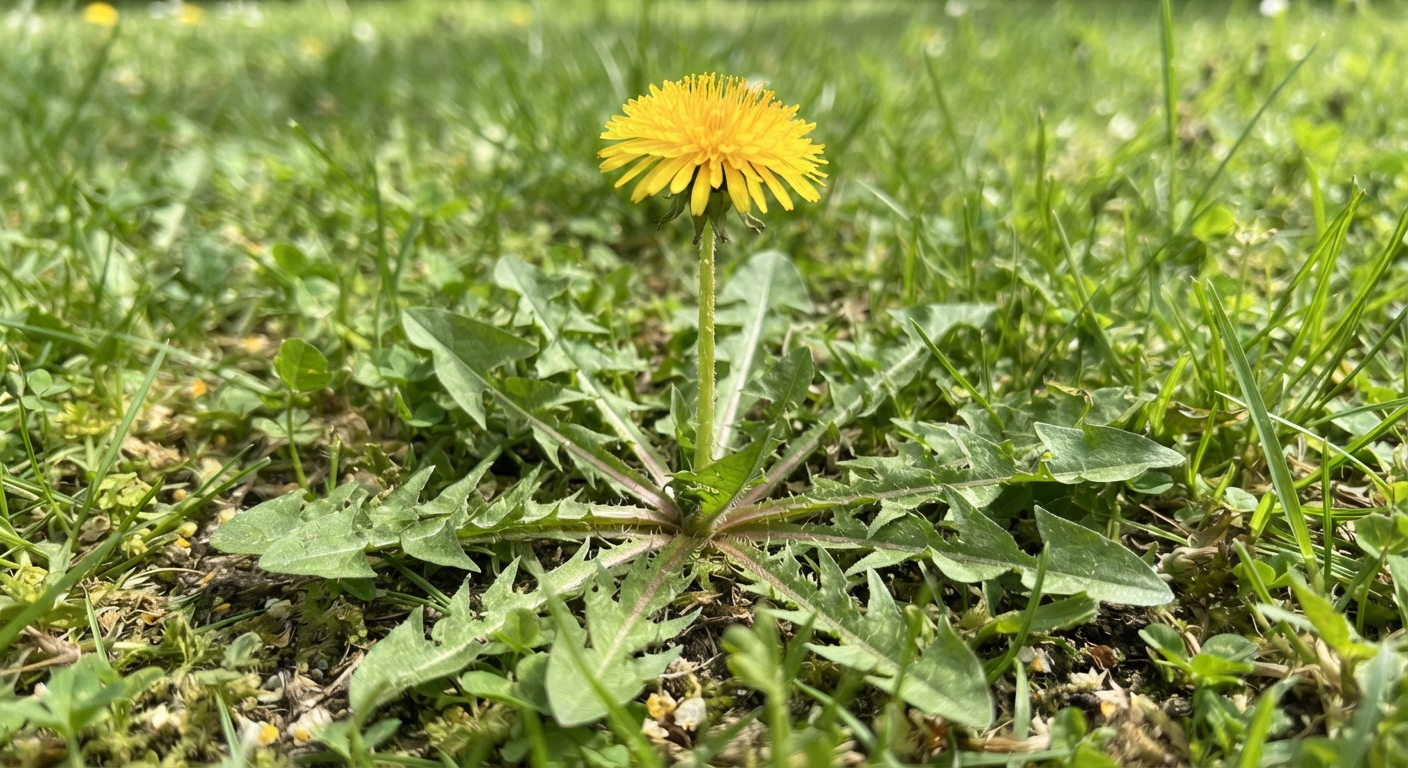
1. Dandelion — Taraxacum officinale
Photo cue: deeply toothed leaves (the “lion’s tooth” edges) growing in a flat rosette, and a single yellow flower per hollow, unbranched stem.
No other common lawn plant does that: one flower, one smooth hollow stalk, no leaves on the stalk. The leaves bleed a milky white sap when snapped.
Eat: young leaves raw or sautéed; flowers for fritters; roasted root for a coffee-ish drink.
Watch for: chicory and cat’s-ear look similar but have branched, solid flower stems. Neither is dangerous, but the lookalikes with solid stems are worth knowing so you don’t grab the wrong green.
2. Stinging Nettle — Urtica dioica
Photo cue: opposite leaves with serrated edges, and a stem covered in fine stinging hairs that you’ll feel the instant you brush it.
That sting is actually your best ID tool — a plant that stings on contact and has opposite, toothed leaves is nettle, not much else. Gloves on, or pinch the stem firmly to crush the hairs before you touch the leaves.
Eat: only young spring tops, blanched or sautéed (cooking kills the sting). Excellent green, close to spinach.
Watch for: dead-nettle and other lookalikes don’t sting, so the sting is the giveaway — no sting, not nettle.
3. Broadleaf Plantain — Plantago major
Photo cue: broad, oval leaves with strong parallel veins running stem-to-tip, and a tall seed stalk that looks like a thin green spike with tiny flowers around it.
You’ve walked on it a hundred times — it grows in lawn edges and cracks in pavement. The parallel veins (not netted) plus the seed spike nail it.
Eat: very young leaves in salad or a quick cook; seeds can be used like psyllium.
Watch for: little to confuse it with once you check the veins. Just avoid sprayed lawns.
4. Purslane — Portulaca oleracea
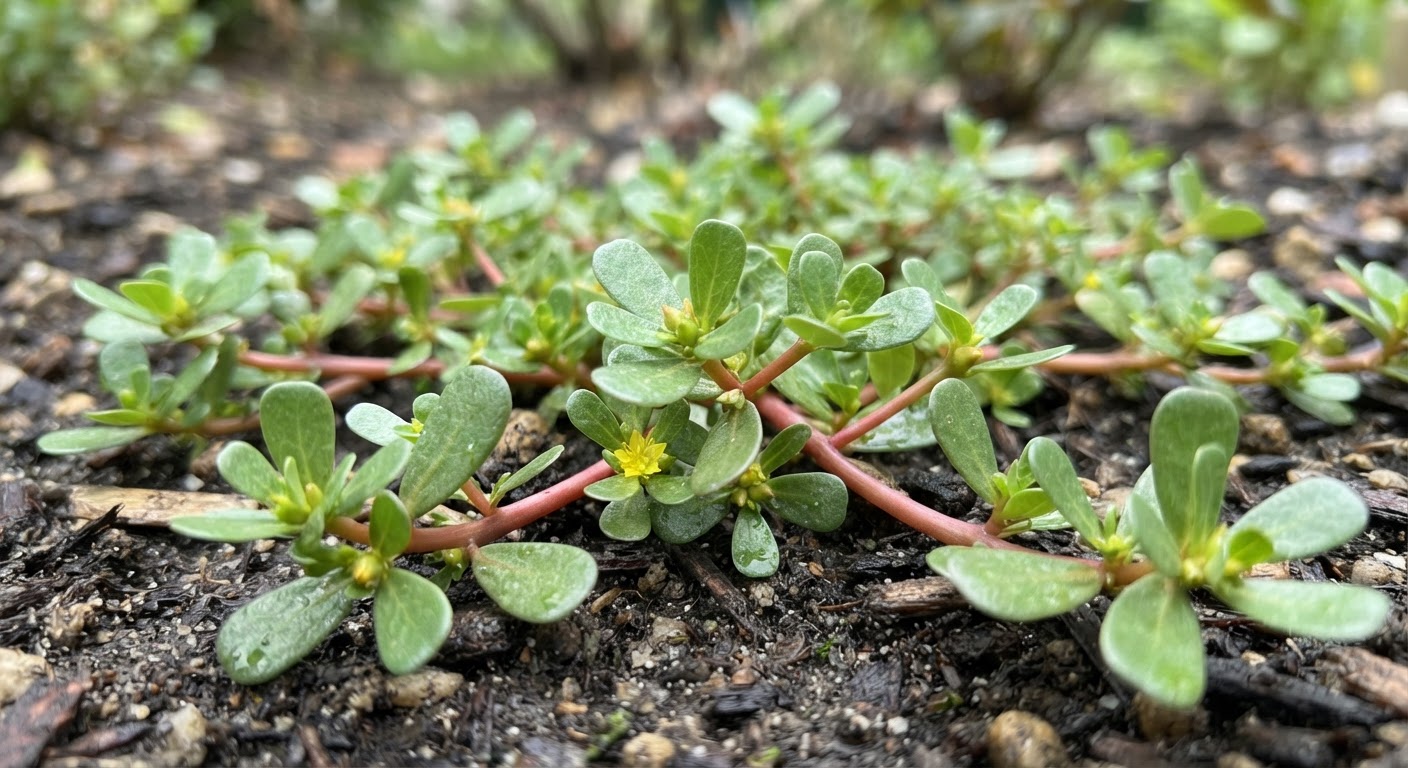
Photo cue: thick, red, succulent stems that sprawl flat with paddle-shaped, fleshy green leaves.
Purslane grows low and dense, often in garden beds and dry cracks. Break a stem: if it’s juicy and the whole plant looks like a tiny succulent, you’ve got it. It’s one of the easiest and safest wild edibles to learn.
Eat: whole aerial plant raw in salads or lightly cooked — slightly lemony, slightly mucilaginous (thickening). Great in soups.
Watch for: spurge — a toxic, lookalike that also sprawls low — has thinner stems, milky sap when broken, and much smaller leaves. Purslane’s sap is clear, not milky.
5. Chickweed — Stellaria media
Photo cue: tiny star-shaped white flowers (five deeply split petals that look like ten) and a stem with a single line of fine hairs down one side.
Chickweed is small, soft, and cool-weather. The “one line of hairs” trick is famous among foragers because it’s so specific — roll the stem between your fingers and you’ll feel it.
Eat: the whole soft top raw in salad or as a cooked green. Mild, slightly sweet.
Watch for: scarlet pimpernel has similar size and flowers but square-ish stems and no single hair line; it’s also mildly toxic.
6. Lamb’s Quarters — Chenopodium album
Photo cue: diamond-to-goosefoot-shaped leaves with a white, powdery (mealy) coating on the underside, especially on young leaves.
Tilt a leaf and the underside looks dusted with flour. That’s the signature. It’s the wild relative of quinoa and spinach, and it’s everywhere in disturbed soil.
Eat: young leaves and tender tops, cooked like spinach (raw in moderation — it contains oxalates and saponins that cooking reduces).
Watch for: nothing dangerously similar, but always confirm the mealy underside before harvesting.
7. Wood Sorrel — Oxalis stricta
Photo cue: three heart-shaped leaflets like clover, with a sharp lemony-sour taste — the “sour clover.”
Wood sorrel leaves look like clover but the leaflets are distinctly heart-shaped (notched at the tip) and the taste is unmistakably sour. It grows in lawns and woodland edges.
Eat: leaves and flowers raw in small amounts for a lemon-like zing; nice in salads and as a garnish.
Watch for: clover itself is edible but bland; the sour taste is the check that you have sorrel, not clover. Keep portions small — it’s high in oxalic acid.
8. Wild Garlic / Field Garlic — Allium vineale (and ramps, Allium tricoccum)
Photo cue: the smell. If it smells like garlic or onion when crushed, it’s an Allium.
This is the one plant where smell outranks sight. Wild garlic sends up thin, round, hollow leaves; ramps have broad, flat leaves and a red-tinged stem. But the rule is the same for every one: crush and sniff. Garlic/onion smell = in the Allium family.
Eat: leaves and bulbs, raw or cooked. Ramps are the spring prize; use field garlic like chives.
Watch for: the toxic lookalikes — death camas, star-of-Bethlehem, lily-of-the-valley — look vaguely grassy but have no onion smell. If there’s no onion-garlic scent, walk away. This is the single most important smell test in foraging.
9. Amaranth / Pigweed — Amaranthus retroflexus
Photo cue: a tall, coarse plant with a bristly seed plume at the top and often a reddish tint to the stem or taproot.
Amaranth is the weedy cousin of the ancient grain. The seed heads look like rough, fuzzy spikes or drooping plumes, and the plant can reach knee-to-waist height in garden rows and field edges.
Eat: young leaves cooked like spinach; seeds harvested and cooked as a grain (time-consuming but doable).
Watch for: distinguish from the genuinely toxic nightshade family — nightshades have alternate leaves and berry-like fruit, while amaranth’s seed spikes and reddish stems are the tell. When in doubt, skip it.
10. Burdock — Arctium minus
Photo cue: huge, wavy-edged leaves with a woolly white underside, and round burrs that stick to everything.
Burdock is hard to miss once it’s mature — big rhubarb-sized leaves and those Velcro-like burrs. The burrs are the photo cue that separates it from lookalike dock and rhubarb.
Eat: the first-year taproot, peeled and cooked (it’s what gives some cuisines their “gobo” root); young leaf stalks can be peeled and cooked too.
Watch for: burdock is often confused with rhubarb (leaf stalks) — rhubarb leaves are toxic, so confirm the burrs and woolly underside, and only ever eat the burdock root, never the leaves.
11. Elderberry — Sambucus canadensis / Sambucus nigra
Photo cue: flat-topped or dome-shaped clusters of tiny dark-purple berries on red stems, on a shrub with compound (leaflet) leaves.
Elderberry is a real foraging prize — but it earns its “take your time” ranking. The berry clusters hang heavy and the individual berries are tiny, dark, and grow in umbrella-like sprays.
Eat: only the ripe, cooked berries (syrup, jam, pie). Never raw — raw berries, leaves, stems, and especially roots contain compounds that cause nausea.
Watch for: water hemlock and pokeberry are the two scary lookalikes — water hemlock (deadly) has white flowers and grows in wet ground; pokeberry has berries in a drooping spike on a magenta stem. Elderberry’s red stems and compound leaves, plus 100% ripe fruit, are your checks.
12. Wild Violet — Viola sororia
Photo cue: heart-shaped leaves and a purple (sometimes white) five-petaled flower with a spurred back petal.
Wild violets carpet lawns and shady edges in spring. The heart-shaped leaves plus that distinctive flower — with the little backward spur — are unmistakable.
Eat: flowers (raw, as a garnish or candied) and young leaves (mild, good in salads or cooked).
Watch for: nothing seriously toxic looks like it, but always confirm the flower; leaves alone can be confused with other heart-leaved groundcovers.
The Lookalike Table: Five Pairs That Trick People
This is the table I’d tape inside a field notebook. The safe plant is on the left; the one that gets people hurt is on the right.
| Safe plant | Key feature | Lookalike | The difference that matters |
|---|---|---|---|
| Wild garlic / onion | Crushed = strong onion smell | Death camas, lily-of-the-valley | No onion smell at all — leave it |
| Purslane | Thick red stems, clear sap | Spurge | Milky sap, thinner stems |
| Elderberry (ripe, cooked) | Red stems, compound leaves | Water hemlock, pokeberry | Hemlock = white flowers/wet soil; poke = drooping magenta spike |
| Wild carrot / Queen Anne’s lace | Hairy stem, carrot smell | Poison hemlock | Smooth, purple-spotted stem, no carrot smell |
| Wood sorrel | 3 heart leaflets, sour | Clover | Rounder leaflets, bland, not sour |
One pattern runs through the whole table: the dangerous one usually fails a smell, sap, or stem test. If a plant smells wrong, bleeds milky sap when it shouldn’t, or has purple blotches on a smooth stem, stop and re-check.
Quick Reference: Season and Edible Part
For when you just need the answer in two seconds.
| Plant | Best season | Edible part | Prep note |
|---|---|---|---|
| Dandelion | Spring–fall | Leaves, flowers, root | Young leaves best raw |
| Stinging nettle | Spring | Young tops | Must be cooked |
| Broadleaf plantain | Spring–summer | Young leaves, seeds | Young leaves only |
| Purslane | Summer | Whole aerial plant | Raw or cooked |
| Chickweed | Spring, fall | Tops | Raw or cooked |
| Lamb’s quarters | Spring–summer | Young leaves | Cook to reduce oxalates |
| Wood sorrel | Spring–fall | Leaves, flowers | Small amounts only |
| Wild garlic / ramps | Spring | Leaves, bulbs | Raw or cooked |
| Amaranth | Summer–fall | Young leaves, seeds | Cook leaves; cook seeds |
| Burdock | Fall–spring | First-year root | Peel and cook |
| Elderberry | Late summer | Ripe berries only | Must cook, never raw |
| Wild violet | Spring | Flowers, young leaves | Raw flowers, cook leaves |
Photo Habits That Turn a Blurry Snap Into a Real ID
Since you’re building a list with pictures — your own — here’s how to take photos that actually help you identify a plant later.
- Shoot the whole plant first, then a leaf close-up, then the flower or stem. Three angles beats one artsy shot.
- Get the stem and leaf attachment. The way leaves attach (opposite vs. alternate) is one of the most useful ID features and it’s invisible in a top-down photo.
- Include a size reference. Your hand, a coin, a key. “Big leaf” means nothing without scale.
- Photograph the underside of the leaf. Hairiness and that mealy lamb’s-quarters coating live there.
- Note the habitat in the photo or caption. Dry crack, wet ditch, lawn, forest floor — where it grows is a clue, not just background.
60-Second Summary Checklist
Before you eat anything wild, run this:
- Match the photo cue for the plant.
- Confirm with a regional field guide (a second source).
- Check the lookalike table — does the dangerous twin fail a smell/sap/stem test?
- Confirm edible part and prep (raw vs. cooked).
- Only harvest from unsprayed, non-roadside ground.
If any step feels shaky, the answer is the same every time: don’t eat it today. Take more photos, ask someone who knows, and come back.
Quick FAQ
What’s the single easiest edible wild plant to start with? Dandelion. One yellow flower per hollow stem, toothed leaves, milky sap — and it grows everywhere. Master it, then add purslane and broadleaf plantain.
How do I know a plant from a photo is safe? You don’t, from a photo alone. A photo gets you a shortlist; a field guide and a second source confirm it. Never eat on a picture-match by itself.
Are there apps that identify edible wild plants? Plant-ID apps (PictureThis, iNaturalist, Seek) can suggest an ID, but treat them as a hint, not a verdict — especially for anything you plan to eat. Cross-check every app result against a field guide.
What’s the most dangerous plant to confuse? Anything in the carrot family (wild carrot vs. poison hemlock) and anything onion-like (wild garlic vs. death camas). The smell and stem tests above are your lifelines there.
Do I need to cook wild greens? Often yes. Cooking neutralizes oxalates and saponins in plants like lamb’s quarters, kills the sting in nettle, and makes elderberries safe. Only eat raw the plants listed as raw-safe above, and only in moderation.