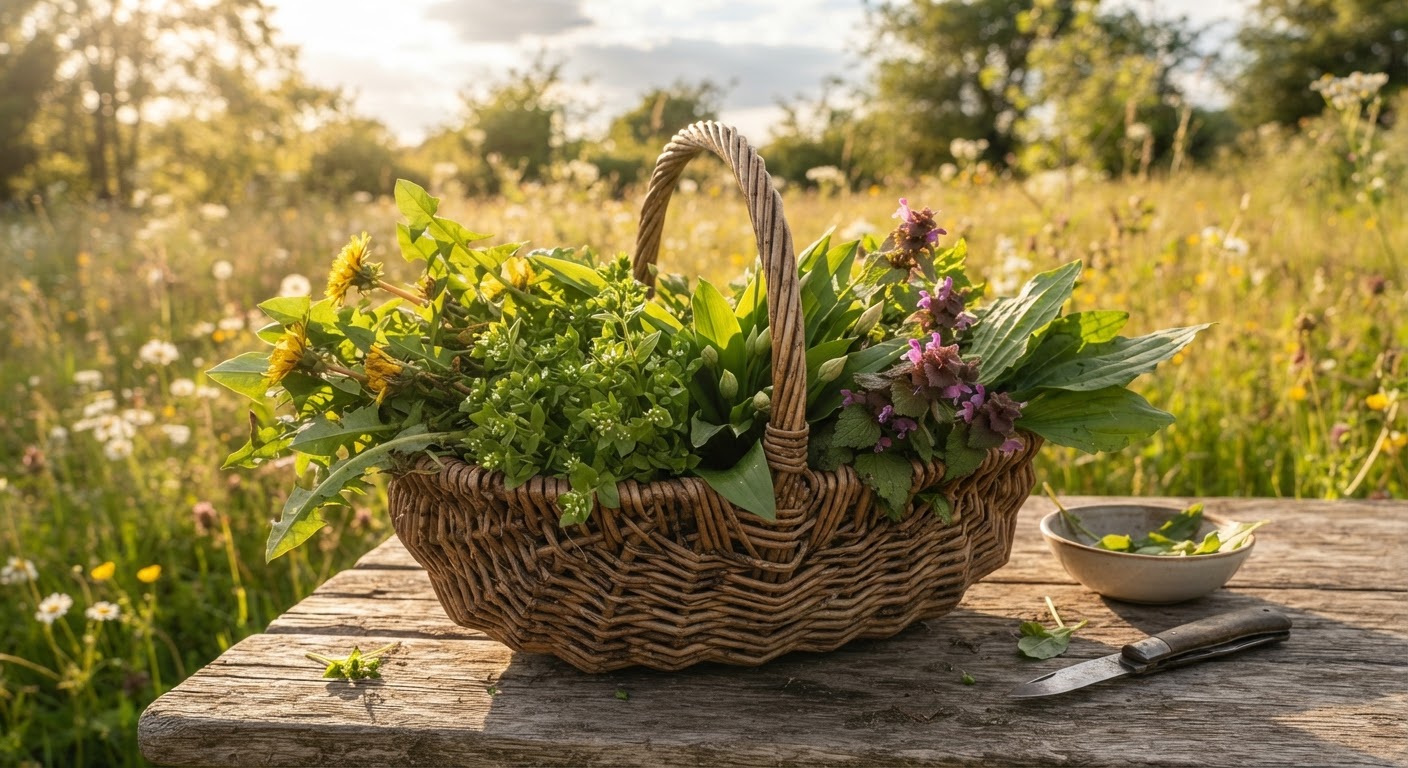
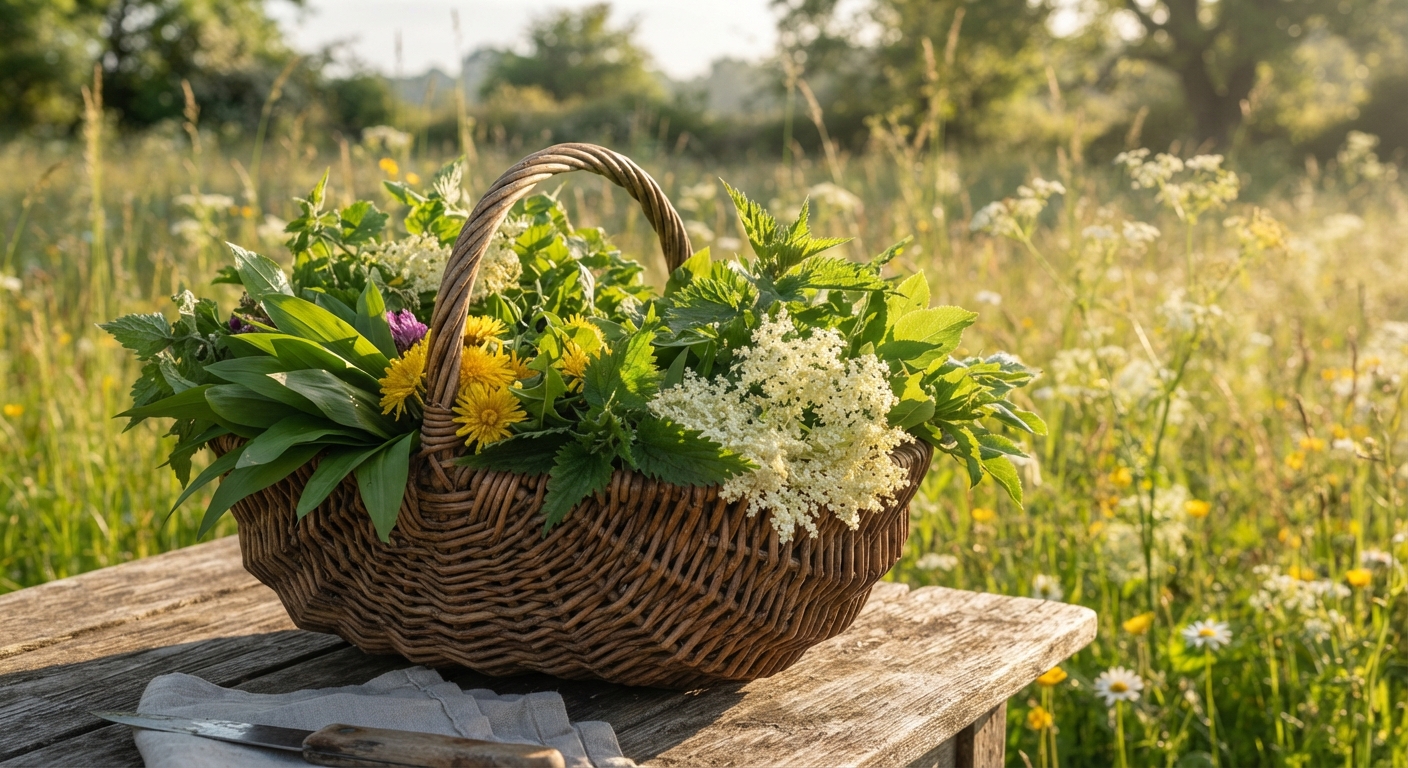
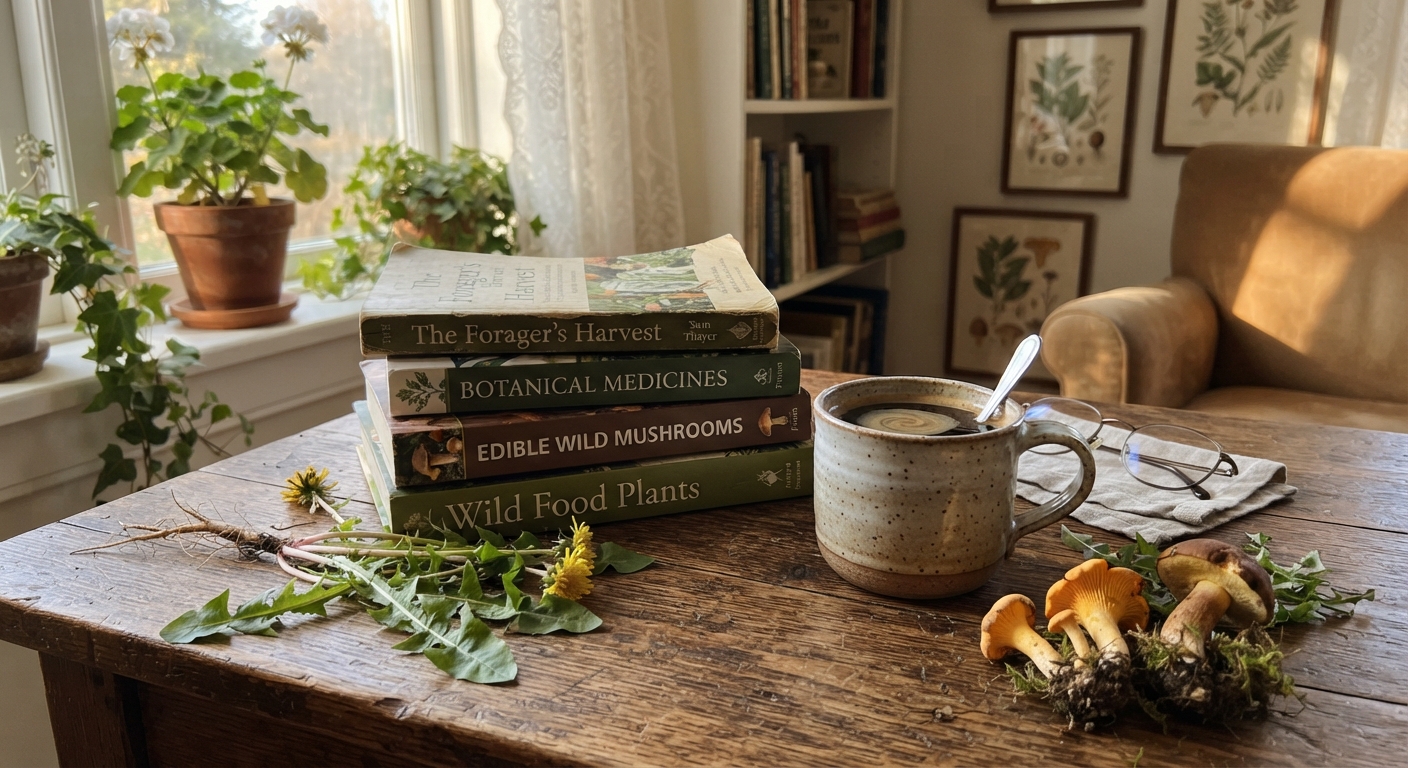
Edible Wild Plants List: 23 Picks Ranked by Mistake Risk
The first foraging list most people find is alphabetical. Arrowhead, burdock, cattail, chickweed, chicory, dandelion — a tidy A-to-Z that says nothing about which of those plants you should actually touch on a Saturday morning with no experience and a plastic bag.
That is the wrong order. Plants do not fail beginners because they are rare. They fail because the list never told you which ones punish a small mistake. A misidentified dandelion costs you a bitter mouthful. A misidentified wild carrot can put you in a hospital. Both sit on the same alphabetical list, in the same font.
So this list is ordered by cost of error: twenty-three plants, three tiers, and a clear line between “learn this today” and “leave this until you have a season behind you.” You get identification tables, a month-by-month chart, prep methods that fix flavor, and the specific mistakes I watch people repeat.
One rule sits above everything below: never eat a plant you cannot identify with certainty. “It looks like the picture” is not identification. This guide makes you faster and safer at it. It cannot be certain on your behalf.
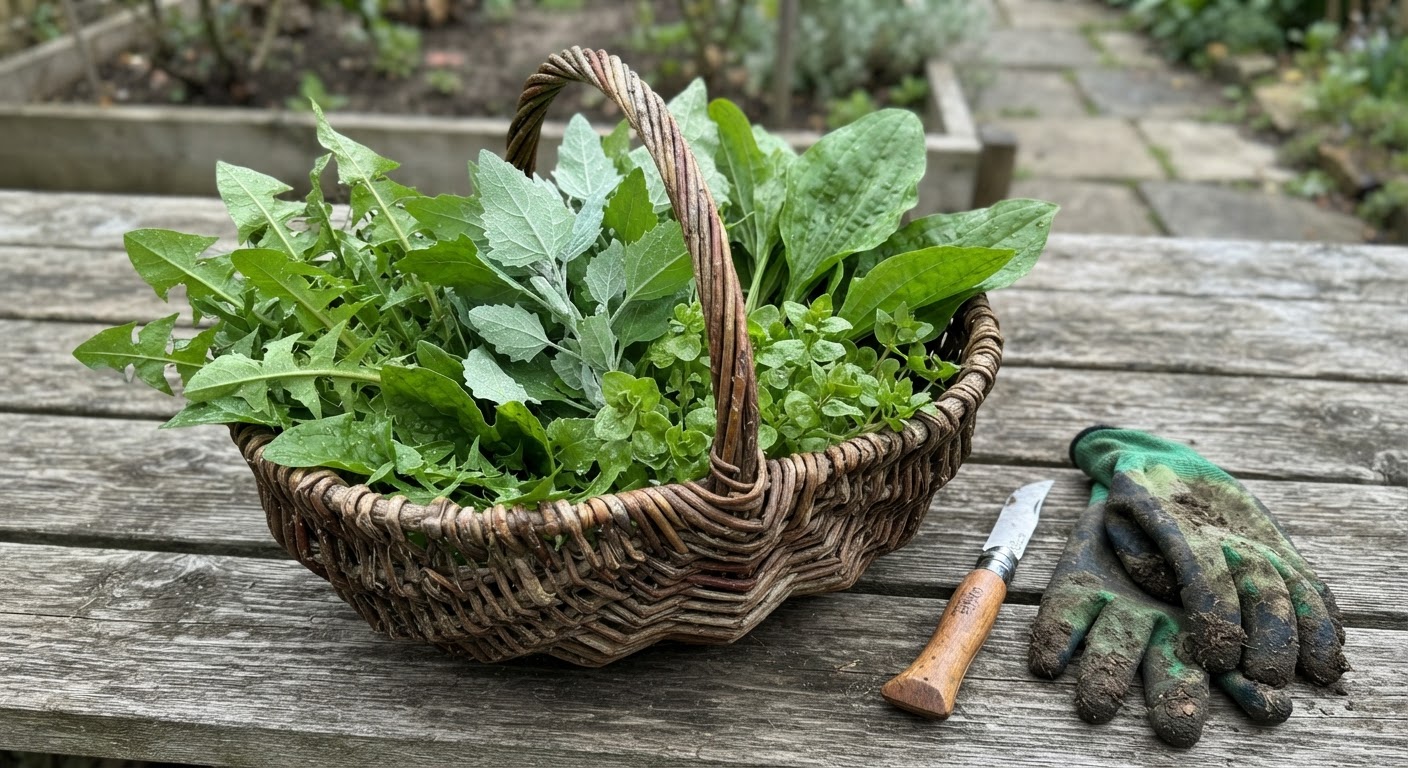
Why Alphabetical Lists Get People Hurt
Someone reads a list, memorizes eight names, and goes looking for those eight names. They find something that matches roughly, fill a bag, and eat it. Nothing happens — usually. Then they repeat the same process with a plant one rung higher on the danger scale, at the same level of care, and that is where the story turns.
The problem is not the plants. A flat list implies flat risk. It treats wood sorrel and poison hemlock as two entries of equal weight, when the distance between them is the distance between a snack and an emergency room.
There is a second problem: identification by picture. A photo shows one leaf, one stage, one angle, one season. Real plants vary by age, soil, and sunlight. The same species looks lush in a garden bed and small and red-stemmed in gravel.
The fix is a progression. Start with plants that have almost no dangerous lookalikes, learn what “certain” feels like, then add species that require real verification. That is what the tiers do.
How This List Is Built
| Tier | What it means | Verification effort | Cost of a mistake | Who it’s for |
|---|---|---|---|---|
| Tier 1 | Few or no dangerous lookalikes in North America and Europe | One field guide, one cross-check | Bland taste, upset stomach at worst | First season |
| Tier 2 | Common, but with at least one serious lookalike | Three features confirmed, two sources, habitat check | Real illness possible | After a full season |
| Tier 3 | Edible only after processing, or with a step that can go wrong | Tier 2 checks plus technique | Illness from poor prep | Second year onward |
Tier 1 is not “safe.” It is “safer to learn.” Every plant still needs a positive ID from a regional source, and every new food deserves a small first serving, because allergies have nothing to do with how edible a plant is.
Use the tiers one plant at a time. Learn the leaf, stem, growth habit, and habitat. Photograph it. Confirm it twice — a regional field guide plus a second independent source, not two photos from the same website. Then eat a small amount.
Step 1: Set Your Three Filters Before You Look at a Plant
Most people identify first and ask questions later. Flip that. Three filters decide whether a plant is even worth identifying.
Is the ground legal and clean? Roadsides, dog-walking strips, industrial edges, sprayed lawns, and farmland margins are out. Heavy metals, herbicide, and animal waste do not wash off reliably. This filter removes more risk than any identification skill.
Is it the right part at the right stage? A plant edible in spring can be unpleasant by midsummer. Pokeweed is the classic case: young shoots, boiled twice, are a traditional dish; mature stems, leaves, and roots are not something you should eat. Bitterness is often the plant telling you the window closed.
Can you name it without hedging? Say it out loud with the scientific name and family. “Some kind of wild green” fails. “Lamb’s quarters, Chenopodium album, amaranth family, mealy white coating under the leaf” passes.
If a plant clears all three, think about harvesting. If not, take a photo and walk on. There is no prize for a full bag.
Step 2: Work Tier 1 — Ten Plants With Almost Nothing to Confuse Them With
Tier 1 species are what I hand beginners because you can confirm them from a standing position, and the lookalikes are harmless, obvious, or both.
| Plant | Edible parts | Season | Habitat | The feature that settles it |
|---|---|---|---|---|
| Dandelion (Taraxacum officinale) | Leaf, flower, root | Mar–Nov | Lawns, paths, disturbed ground | Hollow stem, milky sap, toothed basal rosette |
| Broadleaf plantain (Plantago major) | Young leaf, seed | Apr–Oct | Compacted soil, paths, lawns | Ribs run base-to-tip without branching |
| Lamb’s quarters (Chenopodium album) | Leaf, seed | May–Sep | Gardens, disturbed soil | White mealy bloom on new growth and undersides |
| Chickweed (Stellaria media) | Whole aerial part | Feb–Nov | Gardens, mulch, damp shade | Single line of fine hairs down one side of the stem |
| Wood sorrel (Oxalis stricta) | Leaf, flower | Apr–Oct | Garden beds, woodland edge | Three heart-shaped leaflets; sour, lemony taste |
| Purslane (Portulaca oleracea) | Stem, leaf | Jun–Sep | Hot bare soil, cracks, garden rows | Thick reddish stems, fleshy paddle leaves |
| Common violet (Viola sororia) | Leaf, flower | Mar–Jun | Lawns, woodland edge, shade | Heart-shaped leaves from a crown, no above-ground stem |
| Wild strawberry (Fragaria vesca) | Fruit, leaf | May–Jul | Woodland edge, sunny banks | Fruit hangs down; seeds sit on the surface |
| Blackberry (Rubus spp.) | Fruit, young shoot | Jul–Sep | Hedges, clearings, disturbed edge | Thorny arching canes, fruit pulls off a white core |
| Stinging nettle (Urtica dioica) | Young leaf, seed | Mar–Jun | Rich damp soil, stream banks | Opposite serrated leaves, square stem, stinging hairs |
Dandelion: the plant that teaches you the whole skill
Every part is useful and the ID is nearly self-teaching: hollow stem, milky sap, jagged backward-pointing teeth, one flower per stem. Cat’s ear and hawkweed look similar and are harmless. Eat young leaves raw, blanch older ones, roast the root as a coffee substitute, pickle the buds. What you are really learning is stage — April leaves and August leaves are two different ingredients.
Broadleaf plantain: the one in your driveway
Ribs that run base to tip with no branching, a flat rosette, and a rat’s-tail flower spike. Once you see it, you cannot unsee it. Young leaves are edible raw but stringy; older ones are better blanched and chopped. Seeds can go into coarse flour. Watch the habitat — plantain loves trodden ground, which is often exactly where you should not harvest.
Lamb’s quarters: the free spinach of July
The mealy white coating on new leaves is the tell, along with the diamond-shaped leaf. It bolts in heat, so take tips in early summer. One caution for the whole goosefoot family: it concentrates oxalates and, on heavily amended soil, nitrates. Cook it, do not eat pounds raw, and keep it off manure piles even though it loves them.
Chickweed: the winter gap-filler
Chickweed is what you eat when nothing else is up. The stem hair is the feature most people miss — a single line that switches sides between nodes. It tastes like mild corn silk and collapses to nothing when cooked, so use it raw, in quantity, or as a last-minute pan addition.
Wood sorrel: three leaves, sour taste
Three heart-shaped leaflets that fold at night, with a clean lemony sourness from oxalic acid. It is a garnish, not a vegetable: a handful on a sandwich, a few leaves in salad. Anyone with a history of kidney stones should keep it occasional.
Purslane: the summer succulent
Thick reddish stems, fleshy leaves, a crisp sour bite. It grows in the hottest, driest, most neglected soil you have, which makes it the reliable summer green. Modest omega-3 content, excellent raw, decent in a quick stir-fry, and it thickens soup.
Common violet: flowers you can trust
Heart-shaped leaves from a crown with no above-ground stem, plus the flower, makes violet one of the easiest spring IDs. Leaves in salad, flowers as garnish or candied. Know lesser celandine: glossier, fleshier, darker leaves and yellow flowers, and not something to eat.
Wild strawberry: fruit that hangs
True wild strawberries hang downward and carry seeds on the surface. Mock strawberry — yellow flowers, suburban lawns — points upward and tastes like watery nothing. Not dangerous, just disappointing. Learn it once and you will never be fooled again.
Blackberry: the gateway fruit
Thorny arching canes, white five-petaled flowers, aggregate fruit that leaves a white core when picked. That last detail separates blackberry from raspberry. Young spring shoots, peeled, are a decent trail vegetable.
Stinging nettle: gloves, then dinner
Opposite serrated leaves, square stem, stinging hairs — you may confirm this one with your wrist. Blanch for a minute and the sting is gone, leaving one of the most nutrient-dense greens anywhere. Harvest the top four leaves of young plants before flowering, and leave the lower stem.

Step 3: Tier 2 — Eight Plants That Demand Real Verification
These are good plants, and they are where a confident beginner gets hurt. Each has at least one lookalike that matters, and the difference usually comes down to a detail you have to deliberately check.
| Plant | Dangerous or confusing lookalike | The check that separates them |
|---|---|---|
| Wild garlic (Allium ursinum) | Lily of the valley, autumn crocus | Crush a leaf: garlic smell or walk away |
| Wild carrot (Daucus carota) | Poison hemlock, fool’s parsley | Hairy green stem vs. smooth stem with purple blotches |
| Common milkweed (Asclepias syriaca) | Dogbane | Milky white sap vs. clear sap and stringy stems |
| Daylily (Hemerocallis fulva) | Other lilies, including toxic ones | Flat folded leaves from a crown; flowers last one day |
| Watercress (Nasturtium officinale) | Fool’s watercress, water hemlock nearby | Round leaflets on pinnate leaves; fast clean water only |
| Pokeweed (Phytolacca americana) | The plant itself is the hazard | Young shoots under 8 inches, boiled twice, water discarded |
| Staghorn sumac (Rhus typhina) | Tree of heaven, poison sumac | Fuzzy red upright cones vs. smooth bark or white drooping berries |
| Burdock (Arctium spp.) | Lookalike thistles | First-year rosette, huge heart-shaped leaves, burr seed heads |
Wild garlic: smell is the whole test
Broad leaves, white star flowers, a woodland carpet. Lily of the valley looks close enough to fool people every spring and is seriously toxic. The test is not visual. Crush a leaf between your fingers: garlic smell means wild garlic. No smell, no harvest. If the patch edge has no scent, check individual leaves instead of trusting the crowd. More detail in the wild garlic identification guide.
Wild carrot: the plant that keeps foragers humble
Queen Anne’s lace has an ugly neighbor problem: poison hemlock grows in the same ditches, at the same height, with the same white umbels. Check the stem — hairy and green for carrot, smooth with purple blotches for hemlock. Check the smell — carrot-like versus musty. If the stem is smooth and blotched, do not touch it with bare hands.
Common milkweed: milky sap, and only certain parts
Young shoots under six inches, boiled, are a traditional spring vegetable; buds are better. The sap must be milky white, because dogbane looks similar and bleeds clear. Avoid mature leaves, never eat any part raw, and change the water — the plant carries cardiac glycosides that cooking reduces.
Daylily: flowers yes, leaves carefully
Buds and flowers are excellent, faintly sweet and slightly crunchy. The ID depends on leaf habit: flat, folded leaves rising from a crown, with flowers that last a single day. Not every orange lily in a ditch is a daylily, and some lily relatives are not edible. If you did not plant it and cannot confirm the leaf structure, skip it.
Watercress: the water matters more than the plant
The plant is easy: pinnate leaves with rounded leaflets, hollow stem, peppery taste. The danger is the water. Cress downstream of livestock or in stagnant drainage carries liver fluke and bacterial risk. Fast, clean, cold water only — and cook it if the source is uncertain.
Pokeweed: a technique, not an ingredient
Poke sallet is a real Appalachian tradition and one of the most common wild-plant poisonings in the United States. Young shoots only, under eight inches, before any purple shows in the stem. Boil in two changes of water, discard both, cook again. Roots and berries are toxic. If you will not follow the process exactly, admire it and leave it.
Staghorn sumac: red cones, fuzzy stems
The red fruit clusters make a genuinely good lemonade substitute. The risks are tree of heaven, which has smooth bark and no fuzzy fruit, and poison sumac, which grows in wet ground with white or gray berries hanging downward. Edible sumac: red, upright, fuzzy. Poison sumac: white, drooping, wet.
Burdock: first-year root, second-year burr
First-year burdock root is a real vegetable — earthy, sweet, good roasted. Enormous heart-shaped leaves with woolly undersides give it away. The trick is the year: a second-year plant has already spent its root energy on the flower stalk.
Step 4: Tier 3 — Five Plants Worth the Extra Work
These are not harder to identify. They are harder to prepare, and preparation is where people get sloppy.
Acorns. Leached of tannins, acorns are a serious calorie source. Shell, grind, then leach in repeated water changes until the water runs clear and the flour tastes bland. Cold leaching takes days; hot leaching takes hours but can gelatinize the starch. White oak acorns carry fewer tannins than red oak.
Cattail. Shoots in spring, pollen in early summer, rhizome in fall. Shoots are mild and cucumber-like; pollen is a real flour substitute. The catch is habitat — cattail filters water, so harvest only from clean water.
Ostrich fern fiddleheads. Smooth green stem with a deep U-shaped groove, brown papery scale, tight cluster. Bracken fern is not a safe substitute and grows nearby. Harvest tight coils, cook thoroughly, never raw.
Jerusalem artichoke. Sunflower-like plant, small tubers at the base, sweet and nutty. They contain inulin, so a large portion will make you extremely gassy. Start small.
Prickly pear. Pads and fruit are both edible and both covered in nearly invisible glochids. Burn or scrape the spines, then peel. Wear gloves you do not love.
The Season Chart: What Is Worth Picking Each Month
| Month | Best bets | What to skip |
|---|---|---|
| March | Chickweed, nettle tips, violet leaves, wild garlic | Anything already bolting |
| April | Nettle, dandelion, violet, watercress, wild garlic | Older dandelion leaves |
| May | Lamb’s quarters tips, chickweed, daylily shoots | Bitter late dandelion |
| June | Lamb’s quarters, purslane, milkweed buds, cattail pollen | Nettle after flowering |
| July | Purslane, blackberry green fruit, lamb’s quarters seed heads | Tough spring greens |
| August | Blackberry, purslane, sumac reddening, wild carrot | Dry-season nettle |
| September | Blackberry tail end, sumac, acorns dropping, burdock root | Heat-stressed greens |
| October | Acorns, burdock, Jerusalem artichoke, watercress returns | Most leafy greens |
| November | Chickweed returning, violet leaves, plantain, roots | Anything frosted and limp |
| Dec–Feb | Chickweed, plantain, violet leaves, pine needle tea | Everything else |
This is a planning tool, not a guarantee. Latitude, elevation, and the year move everything by two to four weeks. In a cold spring, the whole table slides right.
Step 5: Match the Method to the Plant Part
| Part | Best method | Time | Why it works |
|---|---|---|---|
| Tender leaves (chickweed, lamb’s quarters, purslane) | Raw or wilted in a hot pan | 2–4 min | Heat collapses volume without turning it to mush |
| Bitter leaves (dandelion, dock, mature nettle) | Blanch, then sauté in fat | 5–8 min | Water carries off bitter compounds; fat brings flavor back |
| Irritating plants (nettle, milkweed) | Boil in plenty of water, discard water | 3–10 min | Heat destroys the irritant; discarding removes water-soluble compounds |
| Roots (burdock, dandelion, Jerusalem artichoke) | Roast at 200°C / 400°F until caramelized | 25–40 min | Roasting converts starch and inulin to sweetness |
| Seeds (lamb’s quarters, plantain, cattail pollen) | Dry, winnow, grind or toast | 20–40 min | Moisture is the enemy of storage |
| Fruit (blackberry, sumac, strawberry) | Eat fresh, freeze, or steep | Minutes | Heat destroys delicate aromatics |
Pro Tips From Getting It Wrong First
- Photograph the whole plant, then the detail. Leaf, stem, underside, flower, and where it meets the ground. Half my early misidentifications were solved by a photo of the stem I did not think to take.
- Identify at the plant, not from the bag. Leaves wilt and lose the shape you relied on. Confirm before you cut. For the full routine, see how habitat narrows identification.
- Harvest one species per trip while learning. A mixed bag is where mistakes hide.
- Taste confirms, it does not test. Wood sorrel’s sourness confirms it. Using taste to identify an unknown plant is how people get a mouthful of something caustic.
- Keep a dated photo log. It tells you when to return next year, which beats any notification.
- Carry two independent sources. Two photos from one publisher is one source. A regional flora plus a local confirmed observation is two.
- Take no more than a tenth of a patch. It keeps the plant there and your harvest honest.
- Cook every new plant the first time, including salad greens. It gives your body a smaller first exposure.
The Mistakes That Actually Cause Trouble
Using one feature. “It has white flowers” is not an ID. You need a combination: leaf arrangement, stem cross-section, sap, smell, habitat, season.
Treating an app as the final word. Apps are good at getting you into the right family and dangerous as a standalone confirmation. Use them to form a hypothesis, then verify against a real guide.
Harvesting from the wrong ground. A perfect ID from a sprayed verge is still a bad meal.
Ignoring preparation. Pokeweed, acorns, milkweed, and fiddleheads are all “edible” and all require a specific process. Skipping it is the hazard.
Eating a large first portion. Any new food can disagree with you. A forkful first, then wait a few hours.
If you want the deeper verification routine, read the universal edibility test — including why it is a last resort rather than a hobby.
Quick Answers to the Questions I Get Most
“What if I only learn five plants?” Then you have a skill. Five you can identify with certainty in the rain beats fifty you half-recognize. Experienced foragers usually run on ten to fifteen species and add slowly.
“Are all plants with milky sap poisonous?” No. Lettuce, dandelion, and milkweed all bleed milky sap. This is exactly the shortcut rule that gets repeated online and then fails in the field. Identify the plant, not the sap.
“Can I forage in a city park?” Sometimes legally, often not wisely. Parks get sprayed and mowed, and the soil can carry decades of contamination. Check local rules, and prefer hedgerows and land you have permission to use.
“How do I know a patch was not sprayed?” You often cannot, which is why farmland edges, utility corridors, and manicured lawns are poor choices. Learn what fresh spraying looks like — uniform browning, curled margins, chemical smell — and walk away when unsure.
“Should I worry about heavy metals?” Near old industrial sites, busy roads, and former orchards, yes. Roots concentrate more than leaves. Rotate your patches.
“What about mushrooms?” Different discipline, different rules, and not covered here. Learn fungi separately, with a local expert, and never transfer plant confidence to a mushroom.

The List Is the Beginning, Not the Answer
A list gives you names. What keeps you fed and safe is the habit underneath the names: check the ground, check the stage, confirm three features, cross-check two sources, cook it properly, eat a little first.
Start with ten Tier 1 plants this season. Add two or three from Tier 2 next year, once you know what real certainty feels like. Leave Tier 3 until the process feels boring — boring is the goal. The foragers who get hurt are rarely the ones who know the least. They are the ones who got comfortable fastest.
That last uncertain ten percent is the whole job. Snap the leaf, the stem, the flower, and the ground, and check it against a reference before it goes in the bag — especially when you are out of signal and the field guide is at home. Edible Plant Identifier runs fully offline, gives identification notes and lookalike warnings from a single photo, and is built to be the first pass, not the final word. Use it to slow down at the exact moment slowing down matters.