Most “edible wild plants” lists fail for one simple reason: they were written by someone who forgot what it’s like to know nothing. Fifty plants. Grainy thumbnails. Every single entry described as “delicious” or “versatile.” You finish reading, step outside, and realize you couldn’t confidently pick a single one of them out of a lawn.
This list works the other way around. It gives you ten plants instead of fifty, chosen for three reasons only: they’re common across most of North America and temperate Europe, they’re safe for a beginner to learn, and each one has a single identifying detail that sorts it out fast. Everything below is ranked roughly by how quickly you can go from “never heard of it” to “I’d eat that.”
One rule overrides everything that follows: never eat a wild plant you can’t identify with 100% confidence. Cross-check every entry against a regional field guide and a trusted photo database before it touches your mouth. The list shortens the learning curve; it does not remove it.
How This List Is Scored
Each plant gets a quick “ease” rating out of five based on three things: how common it is, how hard it is to misidentify, and how little processing it needs. Five means “learn it in an afternoon and eat it the same week.” Two means “worth knowing, but it takes more care.”
Here’s the whole list at a glance so you can skim first and read later.
| # | Plant | What You Eat | Season | Ease | The One Detail to Remember |
|---|---|---|---|---|---|
| 1 | Dandelion (Taraxacum officinale) | Leaves, flowers, roots | Spring–fall | 5/5 | Hairless, deeply toothed leaves + one flower per hollow stalk |
| 2 | Chickweed (Stellaria media) | Leaves, stems | Cool seasons | 5/5 | Tiny white “star” flower + a single line of hairs on the stem |
| 3 | Stinging nettle (Urtica dioica) | Cooked leaves | Spring | 4/5 | Saw-toothed leaves that sting — cook to disarm |
| 4 | Broadleaf plantain (Plantago major) | Young leaves, seeds | Spring–fall | 4/5 | Parallel veins + a “rat-tail” flower spike |
| 5 | Wood sorrel (Oxalis spp.) | Leaves, flowers, pods | Spring–fall | 5/5 | Heart-shaped leaflets in threes that fold shut |
| 6 | Purslane (Portulaca oleracea) | Leaves, stems | Summer | 4/5 | Thick, juicy reddish stems + clear (not milky) sap |
| 7 | Lamb’s quarters (Chenopodium album) | Young leaves | Spring–summer | 3/5 | Diamond leaves with a white, powdery underside |
| 8 | Cattail (Typha spp.) | Shoots, spikes, pollen, rhizome | Year-round | 3/5 | The brown “cigar” seed head in wet ground |
| 9 | Wild blackberry/raspberry (Rubus spp.) | Berries | Summer | 5/5 | Aggregate berries (many bumps) on thorny canes |
| 10 | Clover (Trifolium spp.) | Leaves, flowers | Spring–fall | 4/5 | Three leaflets + round pom-pom flowers |
The 10 Plants, One by One
1. Dandelion (Taraxacum officinale) — Start Here
You already know this plant; you’ve just been calling it a weed. Dandelion is the single best first forage because there’s no toxic lookalike and the identification is genuinely easy: deeply toothed, completely hairless leaves growing in a rosette, one yellow flower on a single hollow stalk, and milky sap in every part.
- Eat: young leaves (raw or cooked), flowers (fritters or tea), roots (roasted as a coffee substitute).
- When: spring and fall for the mildest leaves; roots in late fall.
- Caution: mature leaves turn aggressively bitter. Pick the youngest inner leaves from plants that haven’t flowered.
2. Chickweed (Stellaria media) — The Mild Salad Green
Chickweed is the most forgiving wild salad green there is — soft, mild, and faintly grassy, with no bitterness to fight. It grows in cool seasons almost everywhere there’s bare, moist soil. The two details that nail it: tiny white flowers with five petals so deeply split they look like ten, and a single line of fine hairs running down one side of the stem (rotate the stem and you’ll see the hairs switch sides).
- Eat: the top few inches of stems and leaves, raw.
- When: spring, late fall, and mild winters.
- Caution: learn the spotted spurge difference before you pick — more on that in the comparison section below.
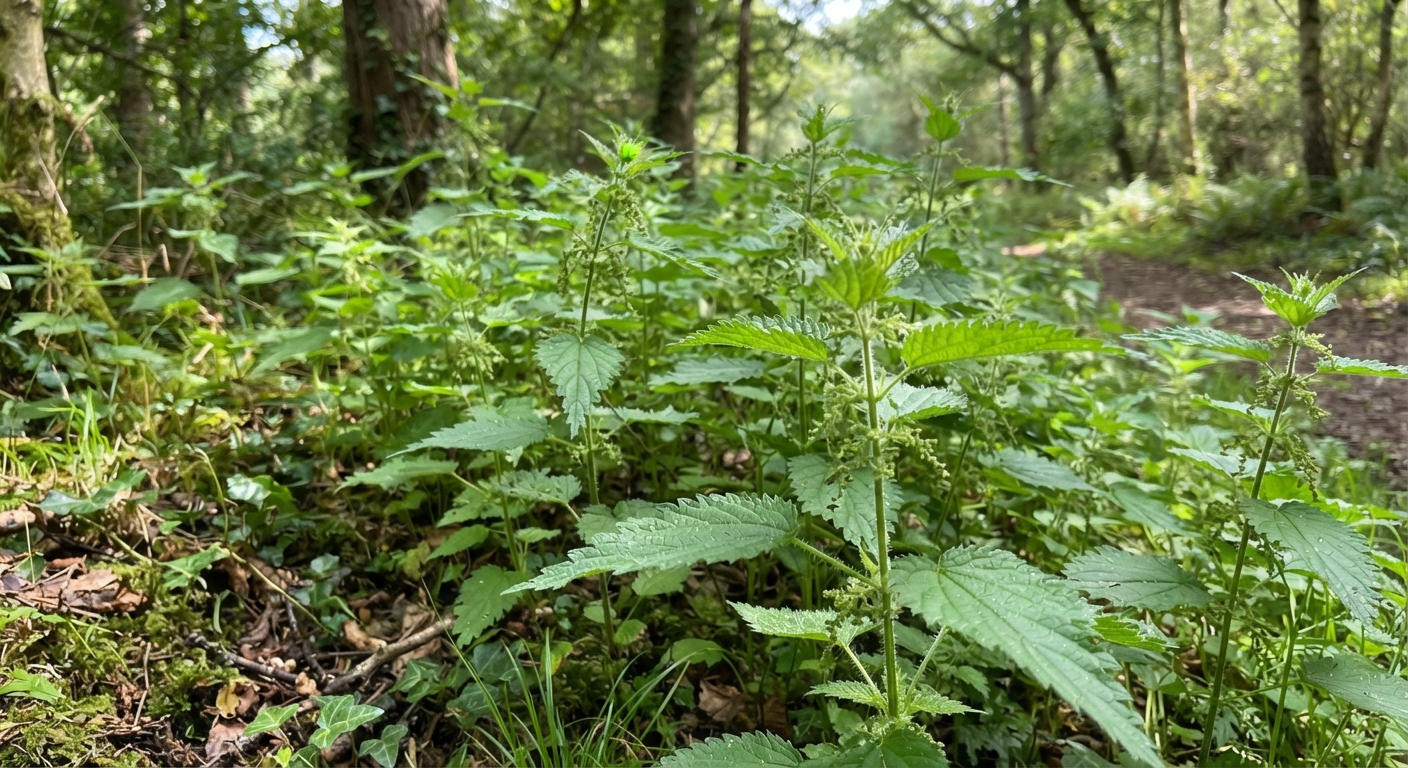
3. Stinging Nettle (Urtica dioica) — The Protein Green
Nettle asks for a tiny bit of work up front and pays you back with one of the most nutritious greens in the wild — rich in protein, iron, and vitamins. The identification is almost self-confirming: opposite, saw-toothed leaves covered in fine stinging hairs. Touch it and you’ll know exactly what you’ve found.
- Eat: leaves, always cooked — a minute of boiling or steaming removes the sting completely.
- When: early spring, before the plant flowers.
- Caution: wear gloves to harvest. Once cooked, it’s as harmless as spinach.
4. Broadleaf Plantain (Plantago major) — The Lawn Staple
This is the flat, oval-leafed plant growing out of every sidewalk crack and compacted path. It’s not the banana-like plantain fruit — it’s a leafy green, and it’s everywhere. Look for broad, oval leaves with strong parallel veins running lengthwise, and a tall, thin flower spike that looks like a rat’s tail.
- Eat: young leaves (cooked — they’re stringy raw), and the small seeds.
- When: spring through fall; youngest leaves in spring.
- Caution: older leaves are tough and fibrous. Harvest small and young, and strip the stringy midrib before cooking.
5. Wood Sorrel (Oxalis spp.) — The Lemony Garnish
Wood sorrel looks like clover but tastes like lemon candy. The giveaway is the leaf: three heart-shaped leaflets, each with a crease down the middle, and the whole leaf folds shut at night or in harsh sun. Clover leaves stay flat and round. The tiny five-petal flowers are usually yellow.
- Eat: leaves, flowers, and the crunchy immature seed pods, raw.
- When: spring and fall, when the leaves are plump.
- Caution: it contains oxalic acid, so treat it as a garnish and seasoning — a handful at a time, not a bowl.
6. Purslane (Portulaca oleracea) — The Summer Survivor
When most greens turn tough and bitter in July heat, purslane is just getting started. It’s a low, sprawling succulent with thick, juicy, reddish stems and paddle-shaped leaves — the closest the wild comes to a “normal” salad green. It’s also one of the best plant sources of omega-3 fatty acids.
- Eat: leaves and tender stems, raw or cooked.
- When: high summer, when little else is fresh.
- Caution: the spurge lookalike. Break a stem — purslane sap is clear; spurge bleeds milky white latex.
7. Lamb’s Quarters (Chenopodium album) — The Wild Spinach
Often called wild spinach, lamb’s quarters is a tall, leafy plant with diamond- or goosefoot-shaped leaves coated in a fine white, powdery bloom on the underside — water beads up on it. It tastes like a nuttier, more mineral spinach.
- Eat: young leaves and tender tops, cooked (or very young leaves raw).
- When: spring and early summer, before it gets tall and tough.
- Caution: eat in moderation — it contains oxalates and saponins, so cook older leaves and don’t make it a daily staple.
8. Cattail (Typha spp.) — The Multi-Season Starch
Cattail is the closest thing the wild has to a one-stop grocery. Different parts are edible in different seasons, and the starchy rhizome provides actual calories, which most greens don’t. The ID is unmistakable: tall reedy leaves and the brown “cigar” seed head standing in wet ground.
- Eat: young shoots (spring), immature green flower spikes cooked like corn (early summer), golden pollen as flour (late summer), and the starchy rhizome (year-round).
- When: year-round, depending on the part.
- Caution: only harvest from clean water — cattails absorb whatever is in the water around them.
9. Wild Blackberry & Raspberry (Rubus spp.) — The Safest Berries
If you only learn one berry rule, make it this: aggregate berries are almost always safe. Aggregate berries are the ones made of many small bumps clustered together — blackberries, raspberries, mulberries, and their relatives. Wild blackberries and raspberries grow on thorny, arching canes, and once you’ve seen one, you’ll never mistake it.
- Eat: ripe berries, raw or cooked.
- When: mid to late summer.
- Caution: avoid white or yellow berries, and never eat any berry you can’t positively name — “birds eat it” is not proof it’s safe for you.
10. Clover (Trifolium spp.) — The Abundant Green
White and red clover cover lawns across the continent, and both are edible. Look for three leaflets (sometimes four, but the ID still holds) and the round, pom-pom flower heads of many tiny pea-flowers.
- Eat: leaves and flowers — flowers raw, leaves better lightly cooked.
- When: spring through fall.
- Caution: eat in moderation. Raw clover is a bit tough to digest for some people, and cooking makes it gentler.
The Three Lookalikes to Learn Before You Pick
Identification isn’t just about knowing the edible plant — it’s about knowing the dangerous twin. These three pairs cause the most beginner confusion, and two of them matter a lot.
| Edible Plant | Lookalike to Avoid | The Deciding Detail |
|---|---|---|
| Chickweed | Spotted spurge (toxic) | Break a stem: chickweed has no milky sap; spurge bleeds white latex and has tiny leaves with a red spot |
| Purslane | Spotted spurge (toxic) | Same test: purslane stems are thick and juicy with clear sap; spurge is thin and milky |
| Wild carrot (Queen Anne’s lace) | Poison hemlock (deadly) | Wild carrot has a hairy green stem and smells like carrot; hemlock has a smooth, purple-blotched stem and a musty smell |
That last row deserves more than a glance. Wild carrot and poison hemlock both belong to the carrot family (Apiaceae), the same family that contains some of the deadliest plants in North America. As a beginner, the correct move is simple: skip the entire carrot family. Hairy-stemmed “wild carrot” root is genuinely edible, but the downside of getting it wrong is death. No amount of free food is worth that trade. There are always easier plants nearby.
If You Only Learn Three Plants
Short on time? Learn these three and you’ve covered most of what a beginner actually needs: a green, a garnish, and a berry.
- Dandelion — the green. It’s everywhere, it’s unmistakable, and it’s safe.
- Wood sorrel — the garnish. A handful brightens any salad for free.
- Wild blackberry — the berry. The aggregate-berry rule makes it nearly foolproof.
Master those three on ordinary walks, then add chickweed, nettle, and purslane one at a time. Real foraging confidence comes from a few plants learned deeply, not fifty plants half-remembered.
Summary: Your 60-Second Cheat Sheet
- Start with dandelion, wood sorrel, and wild blackberries — the three easiest wins.
- Learn one key detail per plant, not the whole plant — the fold of wood sorrel, the hair-line of chickweed, the hollow stem of dandelion.
- Break stems on chickweed and purslane — milky white sap means spurge, and you don’t eat it.
- Skip the whole carrot family as a beginner — the hemlock risk isn’t worth it.
- Pick young, pick clean — away from roads, sprayed lawns, and pet traffic.
- Cook when you can — heat softens fiber and neutralizes irritants like nettle’s sting.
- Identify with 100% confidence or leave it — no exceptions, ever.
Fast Answers to the Usual Questions
- What’s the single easiest wild plant to start with? Dandelion — it’s everywhere, has no toxic lookalike, and you already recognize it.
- Are all parts of a dandelion edible? Yes — leaves, flowers, and roots all are, though each has its best season and prep.
- Do I need to cook wild greens? Some, not all. Chickweed and purslane are great raw; nettle must be cooked to remove the sting; plantain and older lamb’s quarters are better cooked.
- How do I know a berry is safe? In North America, aggregate berries (blackberries, raspberries, mulberries) are the safe category. Avoid white and yellow berries and anything you can’t name.
- What’s the most dangerous beginner mistake? Eating something from the carrot family — wild carrot and poison hemlock look alike, and hemlock is deadly.
- Is foraging legal? Depends where you are. Parks and private land often restrict it, so check local rules before you pick. Your own yard is always fair game.
- What do I need to start? A regional field guide, a phone for photo cross-checking, and a willingness to walk past anything you’re not sure about.