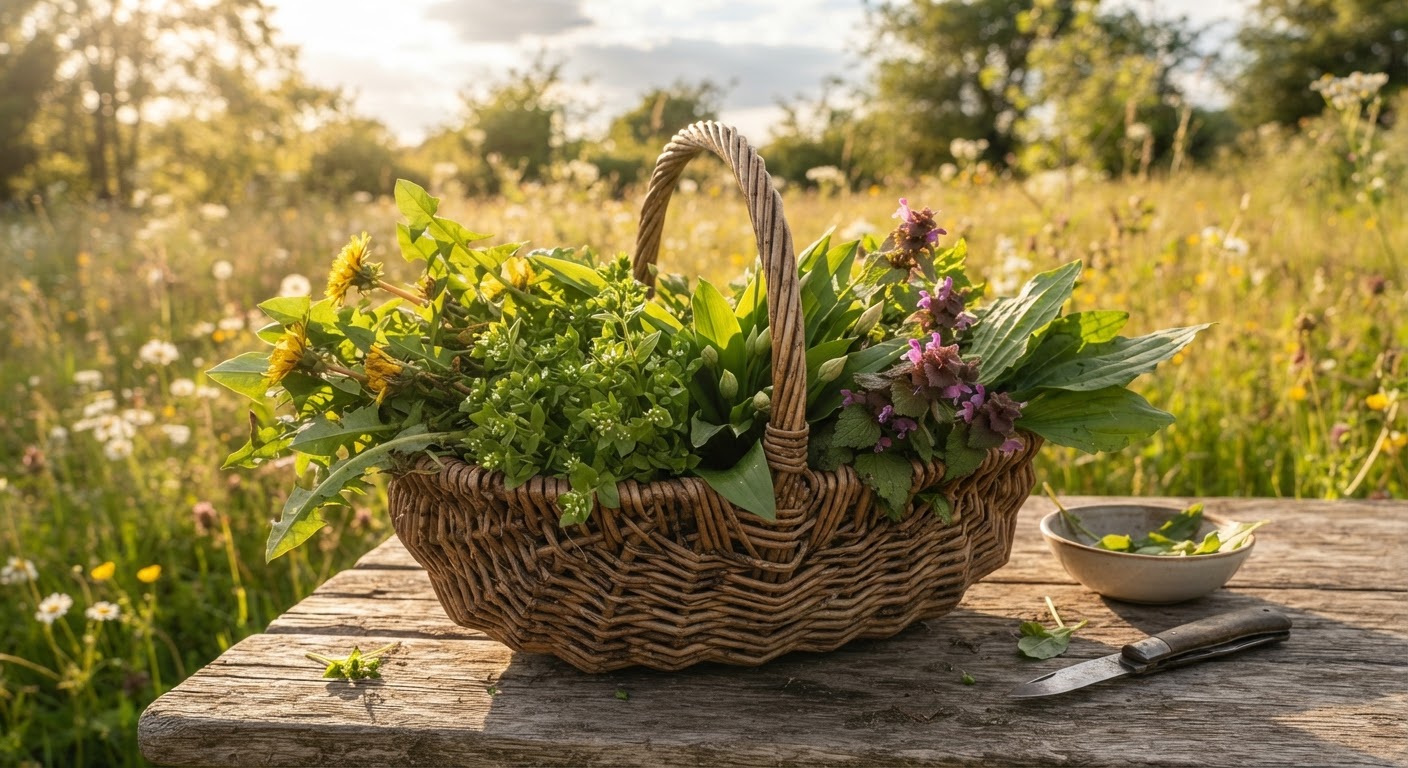
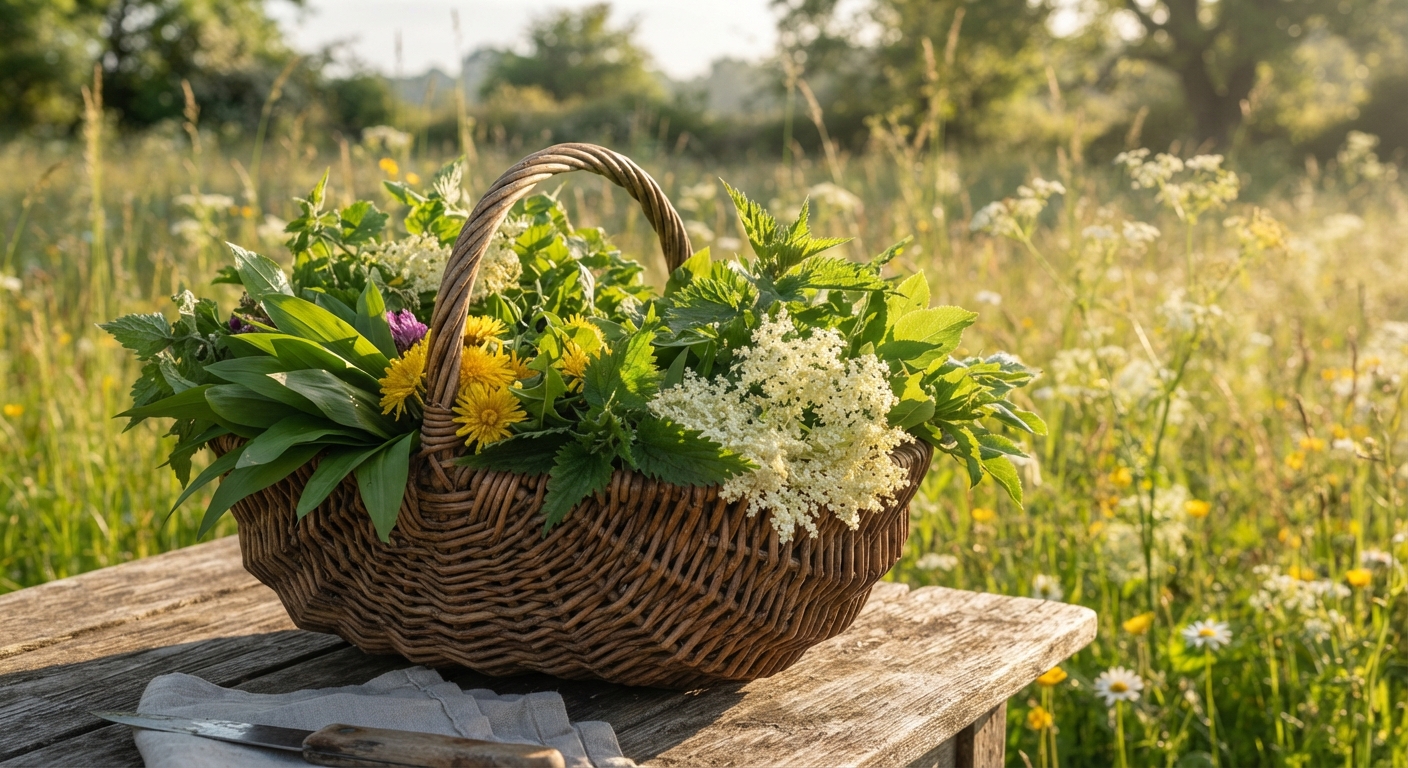
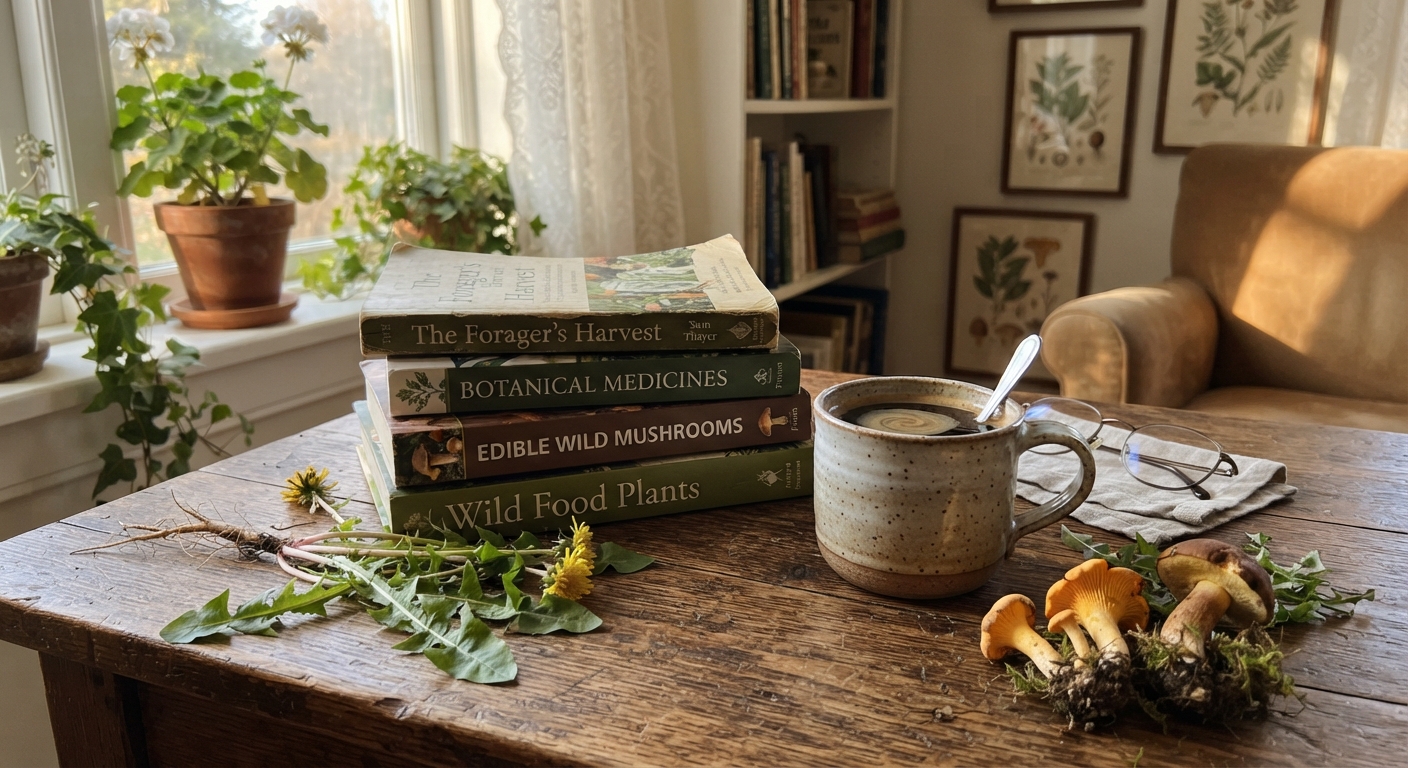
Edible Wild Plants List: 24 Wild Plants You Can Eat — and the Order to Learn Them
You’ve probably already saved a few of these lists. Maybe a screenshot, maybe a bookmark you never reopened. That’s fine — the list was never the problem. The problem shows up the first time you actually stand outside with one. You’re holding your phone, the list says “lamb’s quarters,” and there are four different green things at your feet. None of them is wearing a name tag. The list goes quiet exactly when you need it most.
That’s the gap this article is trying to close. Twenty-four edible wild plants is a sane size for a list — enough to be useful, not so many that your eyes glaze over. But a list is just inventory. What turns it into actual food is knowing which plants to learn first, which ones to leave alone until your eye is trained, and how each one fits into a real meal instead of a fantasy about “living off the land.”
So here’s the plan. A master table you can screenshot and carry. Then the same twenty-four plants split into three learning tiers, in roughly the order I’d teach them to a friend. Then comparison tables for real situations, a first-week study plan, the mistakes that quietly undo all of it, and straight answers to the questions beginners ask me most.
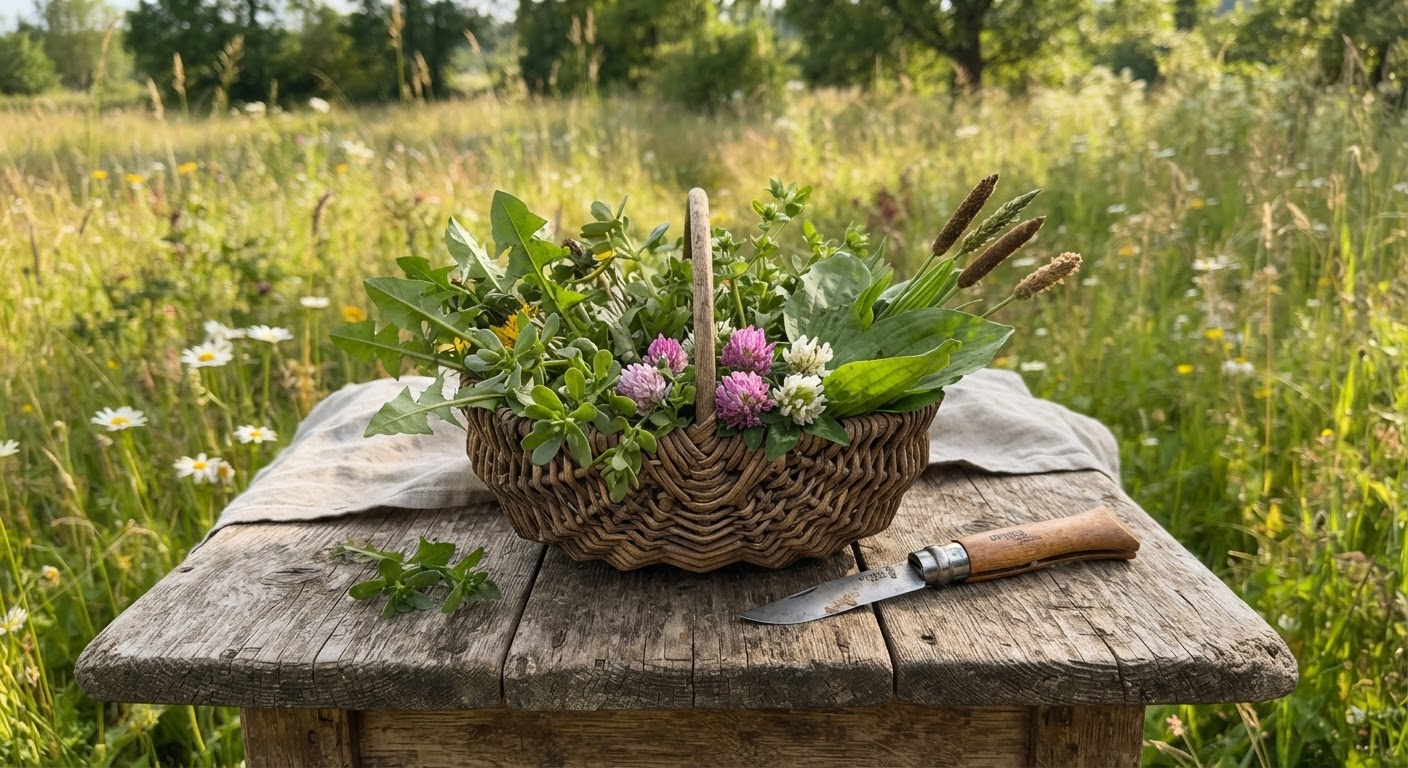
Why a List Won’t Feed You (and What Does)
A list of plant names does three things well: it proves edible wild plants exist, it gives you search terms, and it makes you feel like you’ve made progress. What it can’t do is match a name to the living plant in front of you, and that matching step is the entire job.
The reason is simple. Identification doesn’t happen in your head; it happens in your eyes, comparing the real plant against remembered shapes. A written name gives your eyes nothing to compare against. That’s why people who “know” a dozen plants from lists still go home empty-handed — they’ve memorized vocabulary without ever learning to read.
Three habits close that gap, and they work for every plant in this article:
- Look at the plant, then the surroundings. The same species looks different in shade, sun, wet soil, and dry soil. Learn the range, not one snapshot.
- Check three features before you commit — never one. Leaf shape, leaf arrangement along the stem, and smell or texture. A single feature is how confident beginners end up in trouble.
- Compare against a lookalike on purpose. For every plant you learn, learn its dangerous twin at the same time. The pair sticks in memory far better than the plant alone.
Do those three things and any list — including this one — starts working.
How This List Is Organized
Every entry tells you the same five things: which parts are edible, when they’re worth picking, where they grow, the one cue that most reliably separates them from everything nearby, and their main lookalike.
Then the plants are grouped into three tiers. The tiers aren’t about how unusual a plant is — they’re about how forgiving it is.
- Tier 1 — Starter Six: almost nothing dangerous looks like them. You can learn these confidently in a single weekend.
- Tier 2 — Solid Middle: safe plants with a little more nuance (thorns, spines, timing, cooking).
- Tier 3 — Handle With Care: genuinely worth knowing, but each has a lookalike or a preparation rule that punishes carelessness.
Start at the top. Stay there longer than feels necessary. The tiers exist because rushing to Tier 3 is the single most common way beginners get hurt.
The Master List: 24 Edible Wild Plants at a Glance
| # | Plant | Edible parts | Best season | Where to find it | Signature cue | Main lookalike to know |
|---|---|---|---|---|---|---|
| 1 | Dandelion | Leaves, flowers, root | Spring–fall | Lawns, fields, cracks | Deeply toothed leaves in a flat rosette; hollow stem with milky sap | Cat’s ear (harmless, hairier leaves) |
| 2 | Broadleaf plantain | Young leaves, seeds | Spring–fall | Paths, lawns, compacted soil | Oval leaves with 5–7 parallel veins; leaf stalks don’t branch | None serious |
| 3 | Chickweed | Whole aerial parts | Cool spring/fall | Gardens, damp shade | Opposite paired leaves, single line of hairs on the stem | Scarlet pimpernel (mildly toxic) |
| 4 | Red clover | Flowers, young leaves | Late spring–summer | Meadows, roadsides (clean) | Three leaflets with a pale “V” mark; round pink flower heads | Other clovers (all edible) |
| 5 | Wood sorrel | Leaves, flowers | Spring–fall | Shady woods, garden edges | Three heart-shaped leaflets, clover-like; sour, lemony taste | Black medic (not sour, edible but different) |
| 6 | Lamb’s quarters | Leaves, seeds | Spring–summer | Disturbed soil, gardens | Leaves dusted with a white “meal” on new growth; goosefoot shape | Other goosefoots (edible); careful with nightshade seedlings |
| 7 | Stinging nettle | Young leaves, seeds | Early spring | Moist soil, rich ground | Opposite serrated leaves, square stem, stinging hairs | Dead nettle (no sting, edible) |
| 8 | Common purslane | Leaves, stems | Summer | Gardens, sidewalk cracks | Fleshy reddish stems, thick spoon-shaped leaves, mucilaginous | Spurge (milky sap, toxic) |
| 9 | Cattail | Shoots, rhizome, pollen | Spring–early summer | Pond and marsh edges | Flat strap leaves and a brown cigar-shaped seed head | Iris and sweet flag (leave unless certain) |
| 10 | Wild violet | Flowers, leaves | Spring | Shade, lawns, woodland | Heart-shaped leaves on a low plant; irregular 5-petal flower | None serious |
| 11 | Daylily | Buds, flowers, tubers | Summer | Old gardens, roadsides | Long strap leaves folded at the base; trumpet flowers | Other lilies (some toxic — confirm the base) |
| 12 | Watercress | Leaves, stems | Cool seasons | Clean moving water | Pinnate leaves; peppery taste; grows in flowing water only | Cardamine species (edible); avoid stagnant water |
| 13 | Sheep sorrel | Leaves | Spring–summer | Acidic meadows, dry soil | Arrow-shaped leaves with two side lobes at the base; tart | Other docks (edible) |
| 14 | Wild amaranth | Leaves, seeds | Summer–fall | Fields, waste ground | Reddish ridged stems; soft oval leaves | Pigweed identification overlaps; avoid prostrate pigweed in sprayed areas |
| 15 | Burdock | Root, young stalks | Fall–spring | Waste ground, ditches | Huge heart-shaped leaves, woolly undersides; burrs later | None serious; rhubarb leaves are NOT a match (toxic) |
| 16 | Blackberry | Berries, young shoots | Summer | Hedges, edges, thorny thickets | Arching thorny canes; white 5-petal flowers; aggregate berries | Dewberry (edible); never confuse with nightshade berries |
| 17 | Wild carrot | Root, young leaves | Spring–fall | Dry meadows, roadsides | Ferny leaves, hairy stem, small white umbels with a dark center floret | Poison hemlock, water hemlock — deadly |
| 18 | Wild onion / wild garlic | Leaves, bulbs | Spring | Woodland, damp meadows | Onion/garlic smell when a leaf is crushed | Death camas — no smell, deadly |
| 19 | Common milkweed | Young shoots, buds, pods | Late spring–summer | Fields, roadsides | Opposite thick leaves with milky sap; pink clustered flowers | Dogbane (similar leaves, not milky-sapped in the same way) |
| 20 | Ostrich fiddleheads | Tight young fronds | Early spring | Riverbanks, damp woods | Tight coil (“fiddle”) with brown papery scales | Bracken — do not eat raw/repeatedly |
| 21 | Pokeweed | Young shoots only (prep required) | Early spring | Edges, disturbed soil | Magenta stems on mature plants; white flowers; dark purple berries | Whole plant toxic when mature — shoot-only, boiled twice |
| 22 | Jerusalem artichoke | Tubers | Fall–winter | Roadsides, old fields | Sunflower-like flowers, rough hairy leaves, knobby tubers | None serious |
| 23 | Wild grape | Fruit, leaves, tendrils | Late summer–fall | Woodland edges, climbing trees | Tendrils opposite leaves; loose clusters of small grapes | Moonseed — look at the seed: 1 flat moon-shape vs. grapes’ round seeds |
| 24 | Oak / acorns | Nuts (leached) | Fall | Woodland, parks | Lobed leaves; acorns in caps | None serious; avoid acorns with hole/grub damage |
Tier 1 — The Starter Six
These are the plants to learn before anything else. Your odds of a dangerous mix-up here are close to zero, which means you can build confidence and pattern-recognition without gambling.
Dandelion
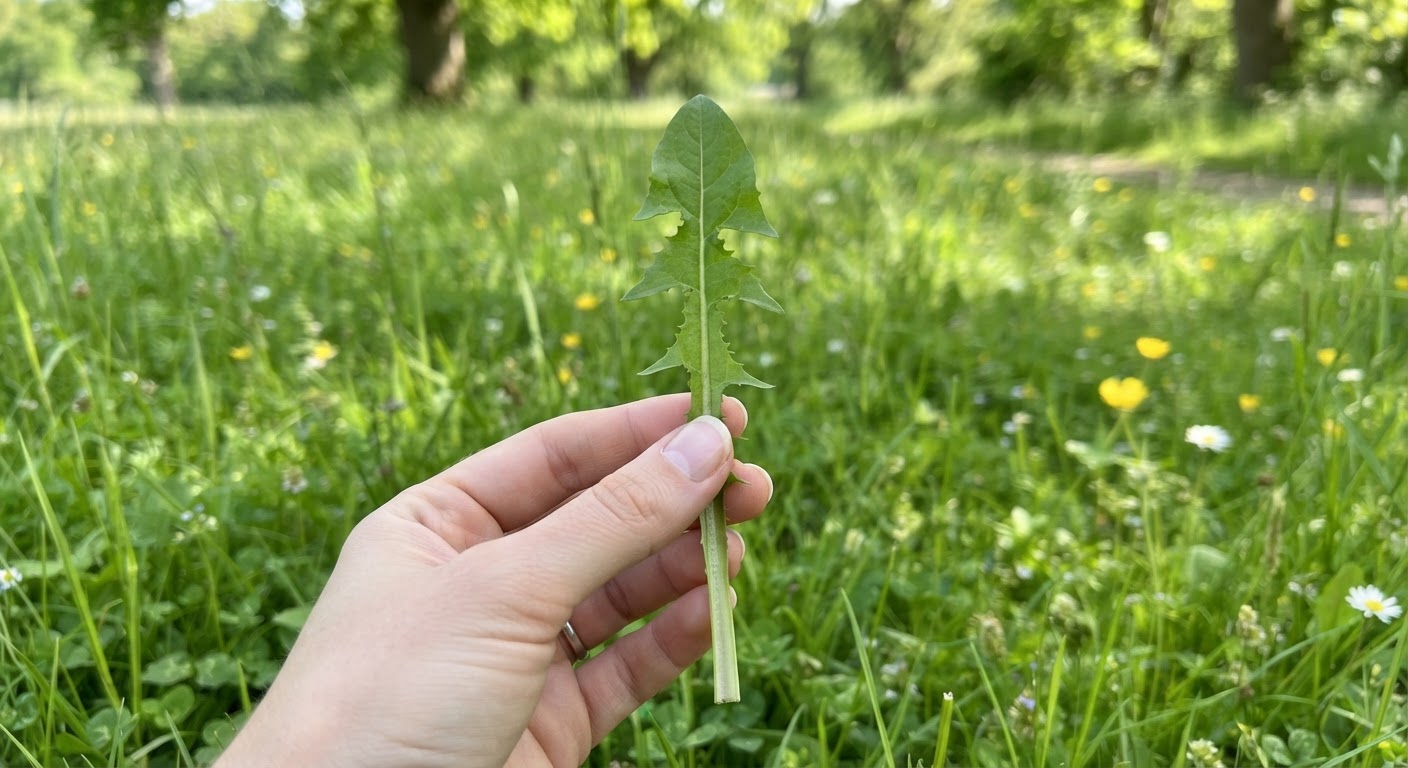
Every part works: young leaves for salad, flowers for fritters and wine, root roasted as a coffee stand-in. The giveaway is the flat rosette of deeply jagged leaves plus a single hollow flower stalk with milky sap — no branching, no leaves on the stem. Bitter leaves stay best before the plant flowers; after that, cook them to soften the bite. Its friendly lookalike, cat’s ear, has hairy leaves and a solid, sometimes forked stem, and it’s not dangerous either — so a mix-up costs you flavor, not safety.
Broadleaf Plantain
Look at a compacted path and you’ll usually find it. Oval leaves with five to seven strong parallel veins running the length, in a flat rosette, with flower stalks that rise unbranched. Young leaves are the tender ones; older leaves get stringy — strip the fibrous veins out before cooking. The seeds (“psyllium”) are edible too. Few dangerous plants share its shape, which makes it a great first practice plant.
Chickweed
The tell is delicate: opposite pairs of small oval leaves and a single line of fine hairs running down one side of the stem (rotate the stem — the hairs switch sides at each leaf pair). It’s a cool-weather plant, best in spring and fall, and it makes a mild, fresh salad green or a chopped addition to soup. Its lookalike, scarlet pimpernel, is a small plant with square stems and orange-red flowers — mildly toxic, so learn the flowers and pop out of the picture early.
Red Clover
Three leaflets, each with a pale chevron “V,” plus a rounded pink flower head. Eat the flowers raw in salads or dried as tea; the young leaves work cooked. All the common clovers are edible, so you have room to learn without panic. Prefer flowers picked away from roadsides and pet areas.
Wood Sorrel
Three heart-shaped leaflets that fold down at night, and a sharp lemony sourness from oxalic acid. That sour taste is your confirmation key — if it isn’t sour, stop. Good in small quantities raw as a trail nibble, in salads, or as a garnish. Because of the oxalic acid, don’t make it a daily staple, especially if you’re prone to kidney stones.
Lamb’s Quarters
The classic “wild spinach.” Young leaves carry a white powdery coating, like a dusting of flour, and the leaf shape is a soft, angled goosefoot. It grows fast in disturbed soil and tastes close to spinach when cooked. Its realistic lookalike is other goosefoot species (edible), but the one to watch for near it is young nightshade — check that the leaves aren’t part of a plant with purple flowers and shiny black berries, and skip anything with those.
Tier 2 — The Solid Middle
Ten plants that are safe but ask a little more attention — for timing, for cooking, or for their texture and thorns.
Stinging Nettle
Best before it flowers, when the top few leaf pairs are still tender. Grab with gloves, cook, and the sting vanishes — the formic acid breaks down with heat. It’s one of the most nutritious greens in this entire list and the most reliable soup base. Harvest the top set of leaves only; older, seeded plants get gritty and tough. Its harmless lookalike, dead nettle, lacks the sting — a mix-up just means an easier harvest.
Common Purslane
Thick, reddish, fleshy stems sprawl across garden beds and sidewalk cracks. The leaves are spoon-shaped and juicy; the taste is slightly salty and citrusy. It’s superb raw in salad or chopped into a yoghurt dish. The essential caution: check for milky sap. If you break a stem and white latex appears, you’ve got spurge, not purslane — leave it.
Cattail
The supermarket of the marsh. In spring, pull the young shoots and eat the tender inner core like a cucumber or slice them into a stir-fry; the rhizome is starchy and can be peeled and cooked; the green pollen in summer can be collected as flour. Only harvest from clean water — cattails concentrate whatever is in their water, so avoid agricultural runoff and stagnant pools. Don’t confuse the young shoots with iris or sweet flag; eat only the ones you can trace back to a plant with a proper brown seed head.
Wild Violet
Heart-shaped leaves and small five-petal flowers, usually purple but sometimes blue, white, or yellow. Both are edible raw and make a gentle salad and beautiful candied flowers. This is one of the easiest plants to learn as a child’s first plant, which is exactly why it’s in the middle tier — the flowers are easy, but leaf shape overlaps with some harmless but confusing plants, so learn the flower alongside the leaf.
Daylily
Common around old homes and roadside edges. Edible in many parts: the just-opening buds and the opened flowers are great in fritters and stir-fries; the small tubers can be boiled like potatoes. The critical check is at the base — daylily leaves are folded lengthwise into a strap with a ridged foot, while some true lilies (which can be toxic) sit differently. Learn the base, not just the flower.
Watercress
Peppery leaves growing only in clean, moving water — that’s the point. Salad green and soup finisher. The rule is water quality: never pick watercress from a stream near livestock, industry, or still water, because of parasites and pollution. If you’re not sure the water is clean, cook it thoroughly or skip it.
Sheep Sorrel
Arrow- or spear-shaped leaves with two distinctive lobes at the base, and a strong tart taste. It’s the wild cousin of garden sorrel and behaves similarly — a little goes far in soup or as a lemony accent. Same oxalic-acid caveat as wood sorrel: flavor, not a staple.
Wild Amaranth
Reddish, ridged stems and soft, broad leaves; the seed heads later yield a tiny grain you can thresh. The greens cook up like spinach and the seeds can be toasted or ground. Keep away from sprayed areas — amaranth thrives on disturbed, sometimes chemically treated ground, and it’s a notorious “garden weed” that people reach for the sprayer over.
Burdock
A taproot that can be a foot long, tough in the ground but rewarding once cooked — roast it, or slice and stir-fry for a sweet, earthy flavor close to artichoke. Young stalks in spring can be peeled and eaten like a cooked vegetable. Never mix it up with rhubarb leaves (broad, not heart-shaped, and toxic) — check for the fuzzy, woolly underside of the huge leaves.
Blackberry
You already know the berries; the bonus is the tender young shoots in spring, peeled and eaten raw. Learn to pick from thorny arching canes with white five-petal flowers in summer. The berry leaves work as tea too. The one to avoid is nightshade — separate it by the plant, not the berry: nightshades have no thorns, smooth shiny leaves, and small white or purple star flowers.
Tier 3 — Worth Knowing, Handle With Care
Every plant here is genuinely edible or useful — and every one can hurt you if you ignore its rule. Learn the lookalike first, then the plant.
Wild Carrot (Queen Anne’s Lace)
Edible root and young leaves, but this is the entry that has killed people through carelessness. It belongs to the carrot family, the same family that includes poison hemlock and water hemlock — both deadly. Tells that matter: wild carrot has a hairy green stem, ferny leaves that smell of carrot, and umbels of tiny white flowers, usually with a single dark red- or purple-centered floret in the middle. If the stem is smooth with purple blotches, or it smells musty rather than carrot-like, it’s hemlock — walk away. Never pick this plant on the strength of the flower alone.
Wild Onion / Wild Garlic
The rule is a single test: crush a leaf and smell it. Real onion or garlic smells unmistakably of onion or garlic. Its killer lookalike, death camas, has similar grass-like leaves and grows in the same meadows — but the smell is absent or grassy. No onion smell, no harvest. Learn the flowers too: wild onion/garlic has white or pink six-petal flower clusters, while death camas is a cream-white cluster on a different stalk.
Common Milkweed
The young shoots, buds, and young pods are edible after boiling, but the plant carries a milky latex that you should respect. Break a stem: the white sap is the ID. Best in late spring and early summer, before the pods get tough and fibrous. Don’t eat the tough, older stems or mature leaves. Its close relative dogbane can look similar — if you’re unsure whether the milky sap is present, don’t eat it.
Ostrich Fiddleheads
The tight, coiled young fronds of the ostrich fern are a spring delicacy, eaten cooked. The caution is twofold: confirm you have ostrich fern (deeply grooved stem and brown papery scales), and never eat bracken fiddleheads, which are carcinogenic and generally best avoided. Even safe fiddleheads should be boiled then cooked fully — never raw.
Pokeweed
Young shoots only, and only after double-boiling with a water change — the mature plant is toxic. Magenta stems, white flowers, and glossy dark-purple berries on older plants are all warning flags, not a harvest. Honestly, if you’ve never done this before, learn the plant by sight and leave it in the ground. Expert foragers prepare poke pokes safely; beginners don’t need to.
Jerusalem Artichoke
A tall sunflower relative with rough, hairy leaves and yellow flowers; the tubers are knobby and crisp, tasting somewhere between a potato and an artichoke heart. The main “care” here is not identification but digestion — the tubers carry inulin, which can cause gas if you eat a big serving the first time. Start small.
Wild Grape
Fruit, leaves, and tendrils are useful, and wild grape shows up draped over trees at woodland edges. The check is the seed: wild grape has round seeds, while its dangerous lookalike moonseed has a single flat, crescent-shaped seed inside each fruit. If you can’t check the seed, don’t eat the fruit.
Oak / Acorns
Acorns are calorie-dense food, but they carry bitter tannins that need leaching before they’re edible. Shell them, crush or grind them, then soak in repeated changes of water until the bitterness is gone (cold soaking takes days; hot water speeds it up). The leached meal can be baked into flour. Skip any acorn with a small hole or a grub inside — that one’s taken.
Comparison Table: Match the Plant to the Situation
Different outings need different plants. Here’s how to pick fast.
| Situation | Best picks | Why they work |
|---|---|---|
| Raw trail salad | Chickweed, wood sorrel, wild violet, purslane | Edible raw and pleasant-tasting with no cooking |
| Cooking greens | Lamb’s quarters, nettle, amaranth, dandelion | Bulk up a pot like spinach once cooked |
| Survival calories | Cattail rhizome, acorns, Jerusalem artichoke, burdock root | Starchy, filling, energy-dense |
| Something warm to drink | Red clover flowers, blackberry leaf, wild mint relatives | Easy teas and infusions |
| Something sweet | Blackberry, wild grape, daylily flowers, clover | Fruit and flowers for a quick calorie hit |
| Emergency hydration | Purslane, chickweed, cattail shoot core | High water content (with clean-source caution) |
| Skill-builder / first plants | Dandelion, plantain, chickweed, red clover | Nearly nothing dangerous resembles them |
Season at a Glance
| Season | What’s at its best | Prepare for |
|---|---|---|
| Early spring | Nettle tops, fiddleheads, cattail shoots, daylily shoots, dandelion greens | Fast plants — go often, pick young |
| Late spring | Lamb’s quarters, chickweed, violets, wild onion/garlic | Confirm onion smell on every single plant |
| Summer | Purslane, amaranth, clover, daylily flowers, milkweed pods, cattail pollen | Heat wilts tender greens — pick early morning |
| Early fall | Blackberries, wild grapes, amaranth seed, burdock root, oak starting | Berry season — watch the seed check on grapes |
| Late fall / winter | Acorns, Jerusalem artichoke, burdock, dandelion root | Roots are the pantry when greens are gone |
Your First Week: A Beginner’s Learning Order
Don’t try to absorb twenty-four plants at once. Use the tiers as a schedule.
Days 1–2 — One plant, many places. Pick chickweed. Find it in your own garden or a local park. Look at it at three different times of day and in two different light conditions. Photograph the stem hairs. Learn this one plant obsessively; the pattern-recognition you build is transferable.
Days 3–4 — Add two lookalike checks. Learn dandelion versus cat’s ear, and pursue the purslane-versus-spurge sap test. This is where identification actually lives: in the differences, not the names.
Day 5 — Learn one cooking green. Take lamb’s quarters or nettle home and cook it like spinach. Notice the taste, the texture, how much it shrinks. Foraging is cooking; the plant is only half the skill.
Day 6 — Learn one Tier 3 pair on paper. Study wild carrot and poison hemlock side by side — but don’t harvest either. You’re training your eyes to spot the dangerous one from a distance, which is a safety skill, not a foraging skill.
Day 7 — Repeat a patch. Go back to your first spot. What changed in a week? What’s bigger, what’s flowering, what’s gone? Foragers who learn plants as processes rather than pictures become reliable much faster.
Five Mistakes That Undo a Good List
- Learning from photos only. A screen teaches you shape; the outdoors teaches you context. Compare what you studied at home with the real plant, then doubt the match — that doubt is protective.
- Eating a full portion of a new plant on day one. Even safe plants cause reactions in some people. Try a small amount, wait a day, then increase. “Edible” doesn’t mean “edible for you in any quantity.”
- Foraging beside roads and sprayed ground. Exhaust residue, herbicides, and pet waste don’t wash off. The cleanest patch 200 meters from the road is worth more than the biggest patch beside it.
- Trusting one feature. The dark “V” on clover or the sour taste of sorrel is a check, not a proof. Confirm with a second and third feature every time.
- Ignoring the part and the age. Leaves are edible and stems aren’t; young shoots are food and mature plants are poison. The plant’s stage of life decides it as much as its species.
Quick-Answer FAQ
Are any of these plants safe to eat raw? Several are — chickweed, wood sorrel, violet, purslane, and dandelion leaves are commonly eaten raw in salads. Others (nettle, milkweed, fiddleheads, acorns, pokeweed) need cooking or leaching, and a few are best cooked to be gentle on the stomach even when raw isn’t dangerous. When in doubt, cook it.
How many plants should I learn at one time? Three at most, and ideally one “easy” plant plus its lookalike. People who try to learn a dozen in a weekend usually retain none of them accurately.
Do I need special gear? A sharp folding knife, a cloth or canvas bag, a pair of gloves for nettles, and a proper regional field guide. A phone camera is genuinely useful for reviewing your finds later — but it’s a review tool, not a decision tool.
| Quick question | Short answer |
|---|---|
| Is wild foraging legal? | Depends on the land — many parks prohibit it. Check local rules and never pick protected species. |
| What if I’m not 100% sure? | Don’t eat it. No plant is worth the risk, and there’s always another one tomorrow. |
| Can I forage in cities? | Yes, in clean edges and parks — but avoid roadside strips, sprayed lawns, and dog-walking spots. |
| Should I wash everything? | Always. Rinse well and look for insects, grit, and anything growing on the leaf. |
| Do I need to worry about allergies? | Yes — try small amounts first and be alert for tingling, swelling, or nausea. |
| What’s the safest way to start? | Learn the Starter Six, cook one green, and pair every plant with its lookalike. |
A Word on Safety
Everything above is meant to train your judgment, not replace it. Local species vary, regional field guides differ, and two plants that look identical on a screen can be unmistakable in the hand. Always cross-check with a reputable local guide, learn the dangerous plants in your area specifically, and treat any new plant with small, cautious, isolated trials. If you’re ever unsure, the correct number of unknown plants to eat is zero.
When you’re out on a trail with a bag half-full and a plant in your hand that you think matches, the gap between “think” and “know” is the whole game. That’s exactly the gap Edible Plant Identifier was built for. Point your camera at a leaf, a flower, or a whole plant, and it gives you a fast read on whether it’s a known edible, along with identification notes and lookalike warnings you can check against your own eyes. It works fully offline, so it keeps working when the signal drops and the field guide is at home on the shelf. Think of it as a second opinion in your pocket — useful, quick, and best used alongside the skills in this article rather than instead of them.