The first winter I tried foraging, I walked through a frost-covered forest for two hours and came home with nothing but cold fingers and a bruised ego. Every plant I’d learned to identify in summer was either buried under snow or had withered into an unrecognizable brown stalk. I genuinely believed the woods were dead.
I was wrong. Embarrassingly wrong.
What I eventually learned — from old field guides, patient mentors, and plenty of frozen fingers — is that winter doesn’t end the foraging season. It just changes the game. While most people pack away their foraging baskets in October, winter offers a surprising abundance of nutrient-dense wild foods hiding in plain sight. You just have to know what you’re looking at.
Here’s everything I’ve learned about finding edible wild plants in winter — the ones that survive frost, the ones that taste better after a freeze, and the ones that might just save your dinner when everything else looks dead.
Why Winter Foraging Is Worth Braving the Cold
Most foragers hang up their baskets after the first frost. That’s good news for anyone willing to layer up — because it means less competition. Beyond the solitude, winter-foraged foods have some surprising advantages:
Cold improves flavor. Plants like parsnips, carrots, and salsify concentrate sugars in their roots as a natural antifreeze. A winter-dug burdock root tastes noticeably sweeter than its summer counterpart. Even some greens — like chickweed and wintercress — develop a milder, less bitter profile after exposure to light frost.
Fewer lookalikes. The plant kingdom simplifies considerably in winter. Many of the confusing summer lookalikes have died back, making identification easier for certain species — especially trees (by bark and persistent fruit) and evergreen perennials.
Nutrient density. Plants that survive freezing temperatures often pack higher concentrations of certain nutrients. Rose hips, for example, can contain up to 20 times more vitamin C than oranges — and they’re at their peak in late fall and winter.
Year-round skill development. If you only forage half the year, you’re only developing half your identification skills. Learning to identify plants by bark, dried seed heads, persistent berries, and winter rosettes turns you into a dramatically better forager in every season.
The Winter Forager’s Mindset Shift
Before we dive into specific plants, understand this: winter foraging asks for a different way of seeing. Summer is generous — bright flowers, obvious leaves, everything screaming “here I am!” Winter is quieter. You’ll be looking at bark, buds, dried stalks, basal leaves, and evergreen foliage rather than showy flowers.
The three categories of winter edibles to focus on:
| Category | What to Look For | Examples |
|---|---|---|
| Evergreen perennials | Plants that keep green leaves through winter | Chickweed, wintercress, garlic mustard rosettes |
| Roots & tubers | Underground storage organs | Burdock, Jerusalem artichoke, wild parsnip |
| Persistent fruits & nuts | Fruits and nuts that hang on through winter | Rose hips, hawthorn berries, black walnuts |
15 Edible Wild Plants You Can Find in Winter
1. Rose Hips (Rosa spp.)
If you forage only one thing in winter, make it rose hips. These bright red-orange fruits cling to wild rose bushes long after the flowers have gone, often well into February. They’re one of the most reliable winter finds — easy to spot against snow and dead vegetation.
What to look for: Oval or round red fruits, about the size of a cherry tomato, with small wispy hairs at the base. Wild roses have thorny stems and compound leaves with 5–7 serrated leaflets (though leaves are often gone by winter).
How to use: Rose hips are loaded with vitamin C — one of the best wild sources anywhere. The tiny hairs inside the fruit are irritating (kids used to use them as itching powder), so always strain them out. Simmer halved hips in water for 15 minutes, strain through a fine cloth, and use the liquid for tea, syrup, or jelly. Don’t boil in aluminum — it destroys the vitamin C.
⚠️ Warning: Only harvest from areas you know haven’t been sprayed. Rose bushes near roads or in parks are often treated with pesticides.
2. Chickweed (Stellaria media)
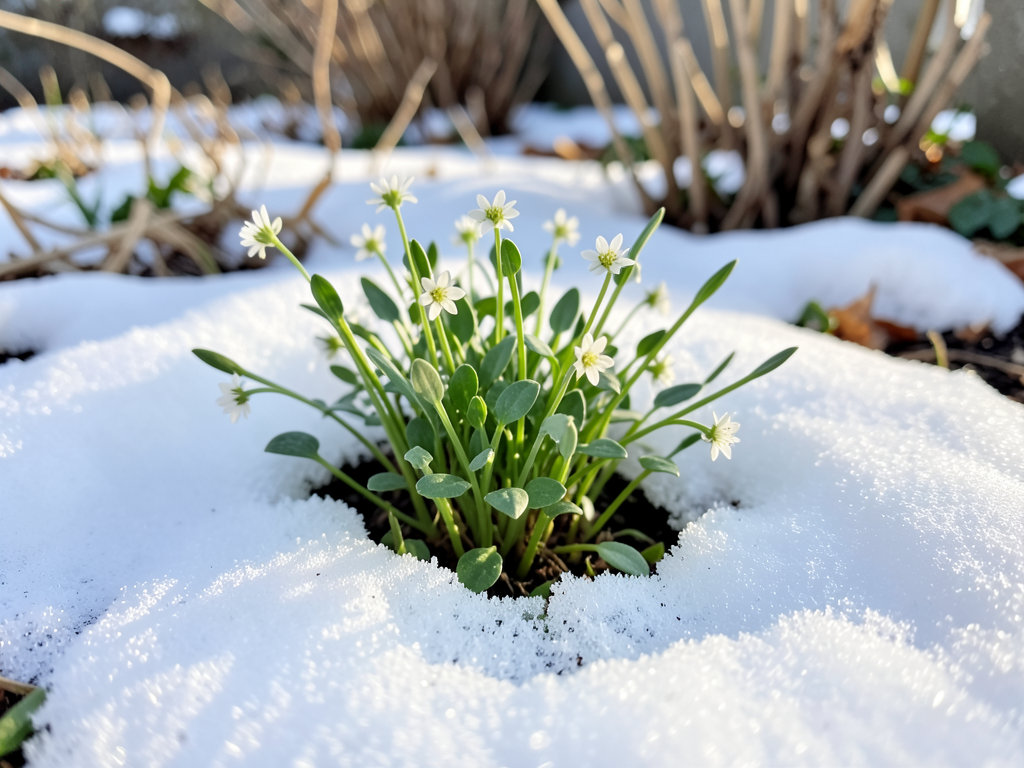
Chickweed is the winter forager’s best friend. It’s one of the few plants that stays green and tender through freezing temperatures, often growing right through light snow. You’ll find it in disturbed soil — garden beds, field edges, and along paths.
What to look for: Low-growing mats of small, oval, pointed leaves arranged in opposite pairs. Tiny white star-shaped flowers with five deeply cleft petals (they look like ten petals but are actually five split ones). The stems have a single line of fine hairs running along one side — this is your key identification feature.
How to use: Mild, slightly sweet, and tender enough for raw salads. Chickweed is also excellent wilted into soups, blended into pesto, or used as a sandwich green. It’s rich in vitamin C, iron, and calcium — more nutritionally dense than iceberg lettuce by a mile.
3. Burdock Root (Arctium spp.)
Burdock is a biennial — first-year plants produce a rosette of large leaves and a deep taproot (edible), while second-year plants send up a tall flower stalk with burs (root becomes woody and inedible). The trick in winter is telling first-year roots from second-year — look for the dead flower stalk. No stalk? Good chance the root is tender.
What to look for: Large, heart-shaped basal leaves that are woolly underneath. In winter, these may be wilted but still recognizable as a basal rosette. Second-year plants will have a tall, dried brown stalk with clinging burs.
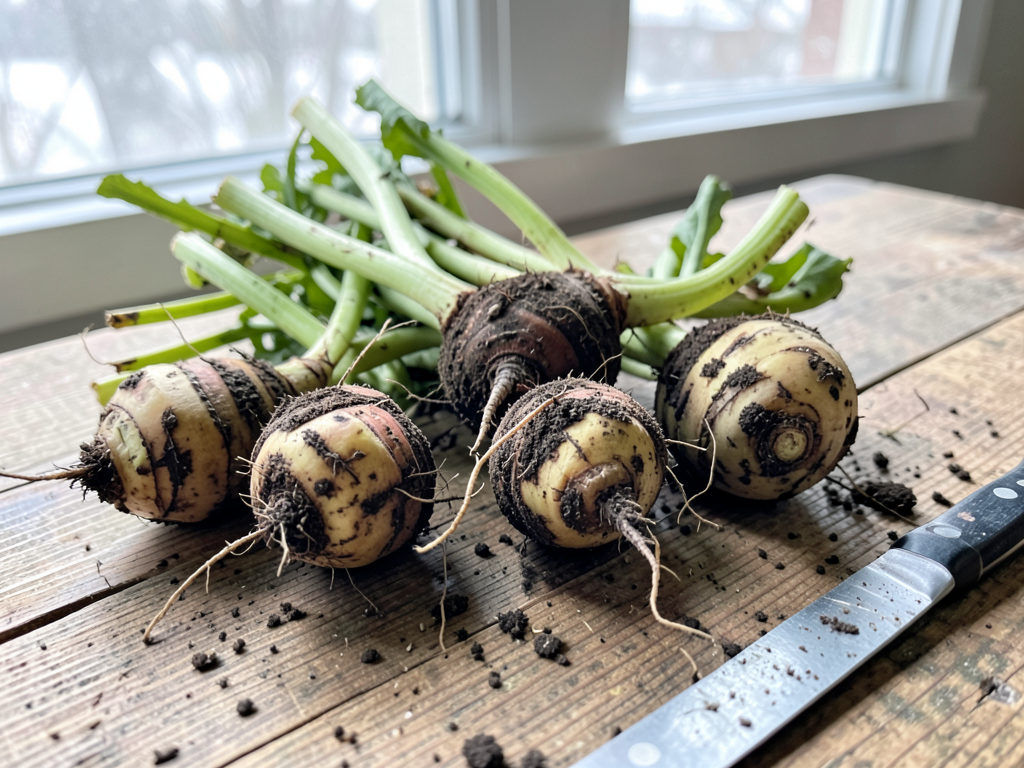
How to use: Burdock root is long, deep, and stubborn. Bring a digging stick or trowel — you’ll need it. Peel the dark outer skin, then slice the white interior into rounds. It’s slightly sweet with an earthy, artichoke-like flavor. Stir-fry with soy sauce and sesame oil, or add to miso soup. Japanese cuisine calls it “gobo” — and winter-dug burdock is notably sweeter.
⚠️ Warning: Be absolutely certain you’re not digging wild parsnip (see below). Burdock leaves are larger, softer, and woolly underneath. Parsnip leaves are compound, hairless, and can cause severe skin burns.
4. Jerusalem Artichoke (Helianthus tuberosus)
Also called sunchokes, these native North American tubers are one of the easiest winter foods to harvest. Unlike most tubers, Jerusalem artichokes store their carbohydrates as inulin rather than starch, which means they don’t freeze solid in the ground. You can dig them anytime the soil isn’t frozen solid — and they’re delicious.
What to look for: Tall, dried stalks (6–10 feet) with rough, hairy leaves. In winter, the stalks are brown and brittle, but once you recognize them, they’re unmistakable. The tubers look like knobby, tan-colored ginger root.
How to use: Scrub clean (don’t bother peeling) and roast with olive oil and salt until crispy outside and creamy inside. They can also be sliced thin and eaten raw in salads — they’re crisp and slightly nutty. Fair warning: Jerusalem artichokes have a reputation for causing gas. Cooking them with a strip of kombu seaweed or a pinch of epazote helps.
5. Wild Garlic / Field Garlic (Allium vineale)
The onion family is a winter forager’s gift — the distinctive smell means you’re never guessing about identification. Wild garlic sends up slender, hollow, tube-like leaves in late fall and winter, often the first green you’ll see in otherwise brown fields.
What to look for: Thin, round, hollow leaves (like chives but skinnier) emerging from small underground bulbs. Crush a leaf — if it smells unmistakably like garlic or onion, you’re in business. The bulbs are small but intensely flavored.
How to use: The entire plant is edible. Use the green tops like chives — snipped into soups, eggs, or potato dishes. The bulbs can be pickled, roasted, or used like small shallots. Winter-harvested wild garlic tends to be milder than summer specimens.
⚠️ Warning: The smell test is non-negotiable here. Some toxic bulbs (like daffodils) can look vaguely similar but have no onion/garlic smell. If it doesn’t smell like allium, don’t eat it.
6. Wintercress / Yellow Rocket (Barbarea vulgaris)
Wintercress earns its name honestly — it’s one of the most cold-hardy greens around, staying green right through freezing temperatures. It’s a biennial mustard that forms a basal rosette of dark green, glossy leaves in its first year.
What to look for: A low rosette of dark green, lobed leaves with a large, rounded terminal lobe and smaller side lobes. The leaves are glossy and somewhat thick. In early winter, first-year rosettes are tender; by late winter, second-year plants start bolting and become bitter.
How to use: Young winter leaves are excellent raw — peppery like arugula but more complex. Older leaves benefit from brief cooking: blanch for 30 seconds in boiling water to reduce bitterness, then sauté with garlic and olive oil. The unopened flower buds (appearing in late winter) taste remarkably like broccoli rabe.
7. Wild Parsnip — With Extreme Caution (Pastinaca sativa)
I’m including wild parsnip because it’s abundant and the roots are excellent — but I’m leading with a massive red flag. Wild parsnip sap contains furanocoumarins that cause phytophotodermatitis: severe chemical burns when skin exposed to the sap is hit by sunlight. Even winter handling requires caution.
What to look for: A basal rosette of compound leaves with saw-toothed leaflets, yellow-green in color. First-year roots are pale yellow-white and carrot-shaped. Second-year plants produce a tall stalk with flat-topped yellow flower clusters (in summer).
Harvesting safely: Wear gloves and long sleeves. Dig the root, don’t grab the leaves. Keep sap off your skin. The root itself is delicious — sweeter than garden parsnips, especially after frost converts starches to sugars. Roast them like carrots.
⚠️⚠️⚠️ Only harvest if you are 100% confident in your identification. The skin reaction from wild parsnip is not a mild rash — it’s second-degree chemical burns that can leave scars lasting months.
8. Tree Nuts: Black Walnuts, Hickory Nuts, and Acorns
Winter is nut season — or rather, nut cleanup season. By December, most tree nuts have fallen. The ground harvest is what you’re after, and the cold weather actually helps: frozen ground means fewer competing critters and less rot.
Black walnuts (Juglans nigra): Green-yellow husks turn black and soft when ripe. Inside is a deeply ridged, incredibly hard shell. Crack with a hammer on concrete. The nutmeat is intensely flavored — far more than store-bought English walnuts.
Shagbark hickory (Carya ovata): Look for peeling, shaggy bark — the tree’s signature feature. Hickory nuts are sweet, rich, and worth the effort. The shells are thick but the flavor is unmatched.
Acorns (Quercus spp.): All acorns are edible once you leach out the tannins. White oak acorns have less tannin and are sweeter. Red oak acorns need more leaching. The process: shell them, grind coarsely, then soak in cold water (changing water daily) until the bitterness is gone — usually 3–7 days. Dried, leached acorn meal makes excellent flour.
9. Dandelion (Taraxacum officinale)
Most people think dandelions disappear in winter. They don’t. The leaves die back, but the roots and crown — packed with energy for spring growth — remain perfectly harvestable. In mild winters, you’ll even find fresh basal rosettes of dandelion leaves under the snow.
What to look for: The telltale toothed leaves in a flat basal rosette. Even when wilted and purplish from cold, the leaf shape is distinctive. Dig carefully and you’ll find the taproot — brown outside, white inside, leaking milky sap when cut.
How to use: Winter dandelion roots are less bitter than summer roots. Clean thoroughly, slice, and roast at 350°F until dark brown and fragrant. Grind and brew like coffee — it’s an excellent caffeine-free alternative with liver-supporting compounds. Fresh winter leaves (when available) are milder and sweeter than summer leaves.
10. Pine (Pinus spp.)
Every pine tree is a winter pantry. The needles, inner bark, and nuts (from certain species) are all edible — and pine is impossible to misidentify in winter when everything else is bare.
Pine needles: All true pines (Pinus) are safe. Avoid yew (Taxus) which has flat needles and red berries — yew is highly toxic. Pine needles make a vitamin C-rich tea that tastes like the forest smells. Steep a small handful of fresh needles in just-boiled water for 10 minutes. White pine (Pinus strobus) needles are particularly mild and pleasant.
Inner bark: The cambium layer — the soft, pale tissue between the rough outer bark and the hard wood — is edible. Harvesting kills the tree or the branch, so take only from recently fallen limbs or trees you’re already removing. The inner bark can be dried and ground into a flour extender or fried into crispy strips.
Pine nuts: Only certain pines produce nuts worth the effort — piñon pines in the Southwest and Korean pines in the Northeast are the best-known. Harvesting pine nuts is labor-intensive, but foraging them yourself makes you appreciate why they’re $30 a pound.
⚠️ Warning: Pregnant women should avoid pine needle tea in large quantities — some species may have compounds linked to potential issues. And again: avoid yew at all costs.
11. Cattail (Typha spp.)
Cattails are the supermarket of the swamp, and winter makes their rhizomes sweeter and starchier. Find a cattail stand in a clean wetland (no agricultural runoff, no roadside drainage), and you’ve found dinner.
What to look for: The unmistakable brown “hot dog on a stick” seed heads, even if they’ve started falling apart. Green, sword-like leaves emerge from shallow water. In winter, the leaves die back but the stalks and seed heads persist.
How to use: The rhizomes (underground stems) are the winter prize. Dig them from the mud — they’re long, fibrous, and white inside. Peel the outer layer, then crush and soak the inner core in water. The starch settles to the bottom; pour off the water and you have cattail flour. One mature stand can yield surprising amounts of clean, white starch — it behaves almost exactly like wheat flour in cooking.
12. Barberry (Berberis vulgaris)
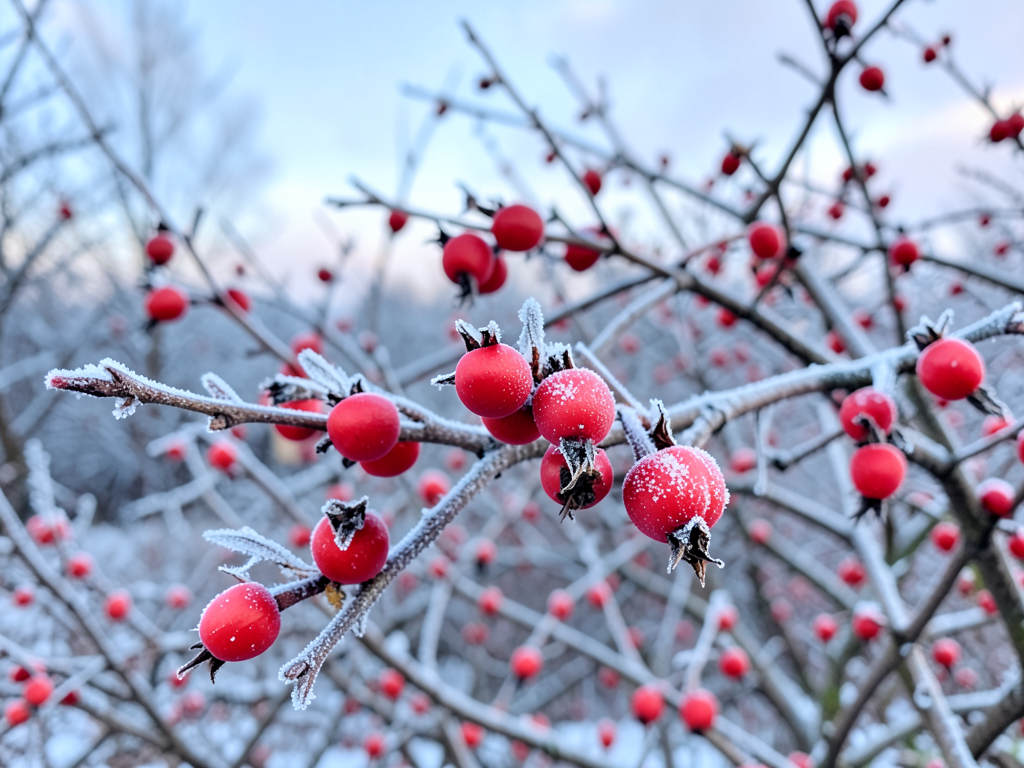
Barberry is one of the few shrubs that holds its bright red berries deep into winter. The tart, almost sour flavor is intense — think cranberry with a citrus edge. In some areas, barberry is considered invasive, so harvesting is actively encouraged.
What to look for: Thorny shrubs with small, oval leaves that turn red in fall (often still present early winter). Clusters of small, oblong bright red berries hang from the branches. The inner bark is bright yellow — a distinctive identification feature.
How to use: Barberries are excellent dried — they’re the “zereshk” of Persian cuisine. Add to rice pilafs, stews, or trail mix for a tart punch. They also make an incredible jelly. The berries are high in vitamin C and berberine, a compound with antimicrobial properties.
13. Juniper Berries (Juniperus communis)
Juniper isn’t technically a berry — it’s a fleshy cone — but for culinary purposes, it functions like one. These blue-purple “berries” are what give gin its distinctive flavor and are available year-round on evergreen juniper shrubs.
What to look for: Low-growing or upright evergreen shrubs with needle-like or scale-like leaves. Berries start green, mature to a dusty blue-purple, and take 2–3 years to fully ripen. A single bush will have berries at different stages.
How to use: A little goes a long way. Crush 3–4 berries and add to braised red cabbage, venison stew, or sauerkraut. Juniper pairs beautifully with game meats, potatoes, and anything roasted slowly. The berries are also a key ingredient in traditional European digestive bitters.
⚠️ Warning: Avoid during pregnancy. Some juniper species (particularly Juniperus sabina) are toxic — stick to common juniper (Juniperus communis), which is the culinary species.
14. Garlic Mustard (Alliaria petiolata)
Garlic mustard is one of North America’s most aggressive invasive plants — which means you can harvest it with a clean conscience. Its first-year rosettes stay green through winter in many regions, and there’s no lookalike that smells like garlic when crushed.
What to look for: A basal rosette of kidney-shaped, scallop-edged leaves with deeply impressed veins. Crush a leaf — it should smell distinctly like garlic. Second-year plants (appearing in late winter) produce triangular, toothed leaves on a taller stalk.
How to use: First-year winter rosettes are garlicky and slightly bitter — excellent in pesto (blend with olive oil, nuts, and Parmesan), added to soups, or chopped into a winter salad. The root also has a horseradish-like kick when grated fresh.
15. Turkey Tail Mushroom (Trametes versicolor)
Most edible mushrooms are warm-weather finds — but turkey tail is an exception. It’s tough, woody, and not something you’d sauté in butter. But it’s one of the most studied medicinal mushrooms in the world, and it grows year-round on dead hardwood logs.
What to look for: Thin, leathery, fan-shaped brackets growing in overlapping clusters on dead wood. The top surface has concentric zones of brown, tan, gray, and sometimes blue or green. The underside is white to pale yellow with tiny pores (not gills). The top is velvety-fuzzy.
How to use: Turkey tail is too tough to eat directly. The traditional preparation is a long-simmered decoction: break the mushrooms into pieces, simmer in water for at least an hour (longer is better), strain, and drink the tea. Some people powder dried turkey tail and add it to soups or smoothies.
⚠️ Warning: Turkey tail has dangerous lookalikes, including some crust fungi. The key identifiers: thin and flexible (not thick and woody), tiny white pores on the underside (never gills), velvety top with distinct color zones. If you’re new to mushroom identification, go with an experienced forager first.
Essential Winter Foraging Gear
Winter foraging requires slightly different equipment than your summer kit. Here’s what I’ve learned to carry:
- Digging tool: A hori-hori knife or small trowel. Frozen ground is no joke.
- Heavy-duty gloves: For roots, thorny shrubs, and warmth. Neoprene-coated work gloves work well.
- Insulated waterproof boots: Cold feet end foraging trips early.
- Pruning shears: For woody stems (rose hips, juniper, pine).
- Mesh bags or baskets: Breathable containers prevent condensation from making everything soggy.
- Field guide: Phone batteries die faster in cold. Bring a physical book.
- Hand warmers: One in each pocket makes a world of difference.
Winter Foraging Safety Rules
The rules of foraging don’t change in winter — but some risks are amplified.
Rule 1: 100% identification. Never eat anything you can’t positively identify. In winter, identification is harder because you’re often working without leaves. Don’t guess. Use multiple field marks.
Rule 2: Know your lookalikes. Several highly toxic plants — poison hemlock (Conium maculatum) and water hemlock (Cicuta spp.) — have roots that could theoretically be confused with wild parsnip or other edible roots. Both hemlocks are deadly in small amounts. If you’re digging roots, you must know what hemlock looks like in ALL seasons.
Rule 3: Avoid contaminated areas. Winter foraging often means harvesting roots and tubers from the ground — which is exactly where soil contaminants accumulate. Avoid roadsides (salt and heavy metal runoff), old industrial sites, agricultural field edges (pesticide residue), and dog-walking areas.
Rule 4: Respect the plants. In winter, plants are operating on minimal energy reserves. Harvest conservatively. Never take all the roots from one patch. Leave plenty for regeneration and wildlife.
Rule 5: Tell someone where you’re going. Winter foraging means cold, slippery conditions, and shorter daylight. Have a plan, bring a phone (in an inside pocket so the battery stays warm), and let someone know your route.
Frequently Asked Questions
Can you really forage in winter when there’s snow on the ground?
Yes, but it depends on snow depth. Light snow cover (under 6 inches) is manageable — many winter plants poke through, and tree nuts sit on top. Deep snow makes most ground foraging impractical, though you can still harvest rose hips, juniper berries, pine needles, and barberries from above the snow. The key is knowing where to look before the snow falls — mark productive spots in your mind (or on a GPS app) during fall.
What’s the easiest winter plant for a complete beginner?
Rose hips, without question. They’re brightly colored, grow at eye level or above, have no dangerous lookalikes when you’re looking at the fruit, and you can harvest them wearing gloves without digging. Chickweed is a close second if you have snow-free ground — it’s mild, abundant, and the single-line-of-hairs stem feature is a reliable identifier.
Are winter-foraged plants less nutritious than summer plants?
Some are, some aren’t. Roots and tubers often concentrate sugars in winter, making them more caloric. Rose hips actually peak in nutritional value after the first frost. Winter greens (chickweed, wintercress) are still nutrient-dense, though they may have slightly less water content. The real nutritional concern in winter isn’t the plants — it’s that you’re burning more calories staying warm, so you need more food overall.
How do I learn to identify plants without leaves?
Start in fall, when leaves are still present. Watch the same plants through the season as they lose their leaves — you’ll learn the winter “profile” of each species. Bark patterns, bud shapes and colors, persistent fruit, dried seed heads, and growth habit all become your winter identification toolkit. The best winter foragers spend autumn memorizing.
Is it legal to forage in winter on public land?
Foraging laws don’t change by season — the same rules apply year-round. National forests generally allow personal-use foraging (check specific forest regulations). State parks vary widely — some prohibit all plant removal, others allow limited gathering. National parks almost universally prohibit foraging. Always check local regulations before harvesting.
The Winter Foraging Payoff
Two winters ago, on a January afternoon when the temperature hovered around 20°F, I came home with a basket that would have impressed my summer self. Rose hips from the hedgerow. Burdock root from the field edge. A handful of chickweed from under the snow near an old garden bed. Some wild garlic from the south-facing slope that melted first. A few turkey tail clusters from a fallen oak.
That night, I made rose hip tea, stir-fried burdock with wild garlic, and tossed a chickweed salad with olive oil and apple cider vinegar. All of it harvested in January, when the world outside my window looked frozen and barren.
Winter foraging isn’t about abundance in the summer sense. It’s about finding food where most people see nothing. It’s a different rhythm — slower, more deliberate, more connected to the quiet landscape. And it makes you a better forager in every season.
So layer up, grab a digging tool, and go look at the winter woods with fresh eyes. You’ll be amazed at what’s been there all along — you just hadn’t learned to see it yet.