The first time I took a friend foraging, she pulled out her phone and opened a plant identification app. She’d scan a plant, read the name, nod, and move on. Twenty minutes later she’d spotted seventeen different species — and couldn’t name a single one without reopening the app.
“That was exhausting,” she said. “How do you do this for hours?”
The answer surprised her: I don’t memorize plants. I read landscapes.
Every experienced forager eventually discovers this shortcut. You stop seeing individual plants and start seeing patterns — plant families that share leaf arrangements, habitats that predict what you’ll find, seasonal cues that tell you when something is at peak edibility. Once you learn to read the landscape, foraging stops being a scavenger hunt and becomes something closer to grocery shopping in a store where you know exactly which aisle has what.
This guide teaches you that shift. Instead of another alphabetical list of 50 plants with thumbnail photos, you’ll learn how to walk into any environment and predict what edible plants are likely growing there — before you even look down.
The Pattern Problem: Why Picture Lists Alone Don’t Work
Drop a typical “edible wild plants list with pictures” in front of a beginner and here’s what happens. They scroll through thirty photos of plants they’ve never seen before. The pictures look crisp and clear. The descriptions make sense. They feel ready.
Then they walk outside and realize: every green thing looks vaguely like seven different plants in the guide. The dandelion in the photo was photographed in perfect light against dark soil. Their dandelion is growing tangled in grass at an odd angle with half the leaves chewed by insects. The photo doesn’t match reality.
This isn’t a failure of the photos. It’s a failure of the approach.
Plants don’t grow in isolation. Every plant you’ll encounter exists within a specific habitat, at a specific time of year, surrounded by companion species that often grow in the same conditions. If you know you’re standing in a disturbed urban lot in July, you should already have a shortlist of five likely edible plants before you look at a single leaf. That’s what this guide teaches.
Here’s what changes when you learn by habitat instead of by list:
| Old Approach (Memorize Plants) | New Approach (Read Landscapes) |
|---|---|
| Walk outside, start scanning random plants | Walk outside, identify your habitat type first |
| Try to match every green thing to 50+ photos | Narrow to 5–8 likely edible species for that habitat |
| Hope you remember the lookalike warnings | Know the lookalikes because they share the same habitat |
| Feel overwhelmed by 200+ edible species | Know 30 species spread across 4 habitats — manageable |
| Second-guess every identification | Multiple habitat cues confirm what you’re seeing |
| Give up after three frustrating walks | Build confidence with each habitat you master |
The shift takes about three focused foraging walks. After that, it becomes automatic.
The Plant Family Shortcut: Learn 6 Families, Recognize 80% of Edible Wild Plants
Before we dive into habitats, there’s an even more fundamental pattern that makes identification dramatically easier: plant families.
Most of the edible wild plants in North America belong to just six plant families. If you learn the shared characteristics of each family — the leaf arrangement, flower structure, growth pattern — you can walk up to an unfamiliar plant, place it in its family within seconds, and immediately know whether it’s worth a closer look.
The Six Families You Need to Know
1. Asteraceae — The Daisy Family
This is the largest plant family on earth and your single most useful one to recognize. Members include dandelion, chicory, wild lettuce, sow thistle, oxeye daisy, burdock, and sunflower. The giveaway: composite flowers that look like one bloom but are actually hundreds of tiny individual flowers packed together. If it looks like a daisy, a dandelion, or a sunflower, you’re looking at an Asteraceae.
What this tells you immediately: Most Asteraceae are non-toxic (though some are intensely bitter). The young leaves of almost all species are edible when cooked. The flowers are generally safe. The family contains very few deadly members — ragwort is the main one to watch for, and it’s distinctive with its clusters of small yellow button flowers on tall stalks.
Key identification pattern: Flower head composed of many tiny florets (ray florets around the edge, disc florets in the center). Leaves are usually alternate. Milky or watery sap when stems are broken.
2. Lamiaceae — The Mint Family
Square stems. That’s the dead giveaway. Run your fingers along the stem — if it has four distinct flat sides with ridges at the corners, you’re holding a mint family member. This family includes wild mint, purple dead-nettle, henbit, ground ivy, wild bergamot, and lemon balm.
What this tells you immediately: The mint family contains zero deadly-poisonous species in North America. Some members are unpleasant-tasting or mildly irritating, but none will send you to the hospital. This makes Lamiaceae one of the safest families to explore.
Key identification pattern: Square stems (the non-negotiable field mark), opposite leaves (pairs facing each other), often aromatic when crushed. Flowers are tubular with an upper and lower lip, usually arranged in whorls around the stem.
3. Brassicaceae — The Mustard Family
Four petals arranged in a cross. That’s the signature of every mustard family member — so consistent that the old botanical name for this family was Cruciferae, meaning “cross-bearing.” Includes wild mustard, shepherd’s purse, garlic mustard, watercress, and wintercress.
What this tells you immediately: All Brassicaceae are edible. The entire family is non-toxic, though some members taste better than others. The flowers, leaves, young seed pods, and roots are all usable. This is the safest plant family to experiment with.
Key identification pattern: Four petals in a cross shape (×), six stamens (four long, two short), seed pods that are typically long and thin (siliques) or round and flat (silicles). Most have a peppery, mustardy taste when you chew a tiny piece.
4. Amaranthaceae — The Amaranth Family
This family gives us some of the most nutritious wild greens on the planet. Includes lamb’s quarters, amaranth, and epazote. The leaves often have a distinctive mealy or powdery coating, especially on the undersides — it looks like someone dusted them with flour.
What this tells you immediately: Members of this family are generally edible and highly nutritious. Lamb’s quarters alone rivals spinach in most nutritional categories while being easier to grow and find. The main caution: these plants accumulate nitrates from over-fertilized soil, so avoid harvesting from heavily-manicured lawns or agricultural field edges.
Key identification pattern: Simple alternate leaves, often with a whitish-mealy coating on young growth. Inconspicuous green flowers clustered densely on spikes. The stems are often ridged or grooved, sometimes with red or magenta coloration.
5. Rosaceae — The Rose Family
If it looks like a wild strawberry, a blackberry, a raspberry, a rose hip, or a wild apple, it’s a rose family member. This family contains more edible fruits than any other plant family in temperate regions. The flowers have five petals and numerous stamens radiating from the center.
What this tells you immediately: Fruits from the rose family are almost universally edible. The family includes strawberries, blackberries, raspberries, serviceberries, wild plums, hawthorn berries, and rose hips. The leaves and seeds of some members (cherry, apple, plum) contain cyanogenic compounds and should not be consumed in large quantities, but the fleshy fruit is always safe.
Key identification pattern: Five-petaled flowers (sometimes more in cultivated varieties), numerous stamens radiating from a central receptacle, leaves often with serrated edges and stipules at the base, fruit is typically fleshy with seeds inside.
6. Apiaceae — The Carrot Family
This is the family that demands your full attention. It contains wild carrot, wild parsnip, and dozens of edible herbs — but it also contains poison hemlock, water hemlock, and fool’s parsley, some of the deadliest plants on the continent. Learn to recognize this family by its flower structure, and then learn which members to avoid.
What this tells you immediately: Stop. Any Apiaceae requires careful identification. The edible members are delicious and nutritious, but the toxic members can kill you. Never harvest an Apiaceae without confirming at least four distinct identification features.
Key identification pattern: Compound umbels — flowers arranged in umbrella-like clusters where multiple small stalks radiate from a single point, and each stalk ends in a smaller umbrella of tiny white or yellow flowers. Hollow stems, often with purple spots or streaks. Leaves are finely divided, fern-like, and sheathe the stem at their base.
The Apiaceae Rule: If it looks like a carrot, parsley, or dill flower — all those lacy white umbel flowers — and you can’t identify it with 100% certainty using four separate features, leave it alone. The plants are too dangerous for guesswork.
Plant Family Quick-Reference Table
| Family | Key Field Mark | Edibility Profile | Risk Level | Examples |
|---|---|---|---|---|
| Asteraceae (Daisy) | Composite flower head, milky sap | Most are edible, some bitter | Very low | Dandelion, chicory, sow thistle, burdock |
| Lamiaceae (Mint) | Square stem, opposite leaves | All non-toxic, many aromatic | Zero | Wild mint, dead-nettle, wild bergamot |
| Brassicaceae (Mustard) | Four petals in a cross | Entire family edible | Zero | Wild mustard, watercress, shepherd’s purse |
| Amaranthaceae (Amaranth) | Mealy leaf coating, ridged stems | Highly nutritious greens | Low (avoid fertilized areas) | Lamb’s quarters, amaranth |
| Rosaceae (Rose) | Five petals, many stamens | Fruits edible universally | Low (seeds/leaves caution) | Wild strawberry, blackberry, rose hips |
| Apiaceae (Carrot) | Compound umbel flowers | Some highly edible, some deadly | HIGH — must verify | Wild carrot (edible), poison hemlock (DEADLY) |
Master these six families and you’ll be able to categorize roughly 80% of the herbaceous plants you encounter in North America within seconds. That’s the foundation everything else builds on.
Reading the Landscape: Edible Wild Plants by Habitat
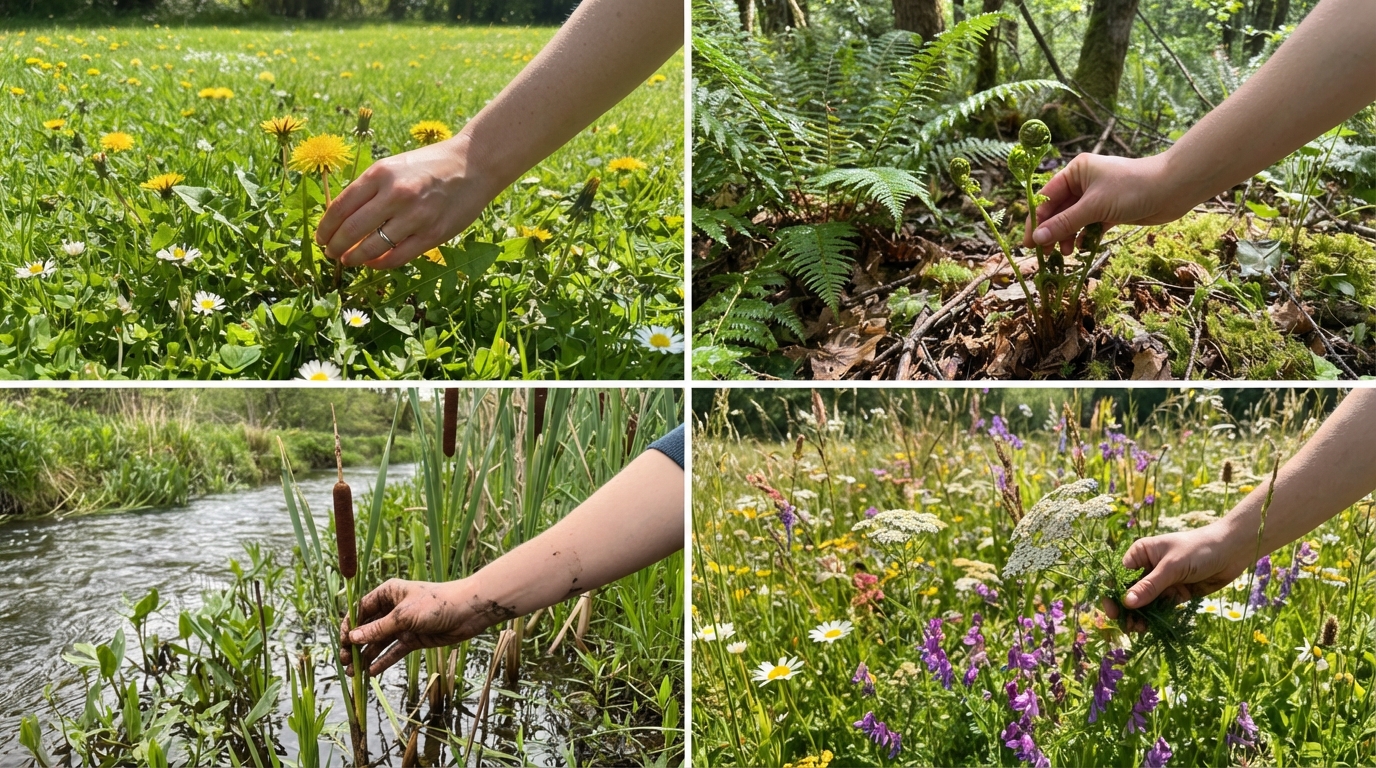
Now let’s apply the family knowledge to real environments. Each habitat below has a predictable cast of edible plants. Once you learn to recognize the habitat, you know what to look for before scanning individual plants.
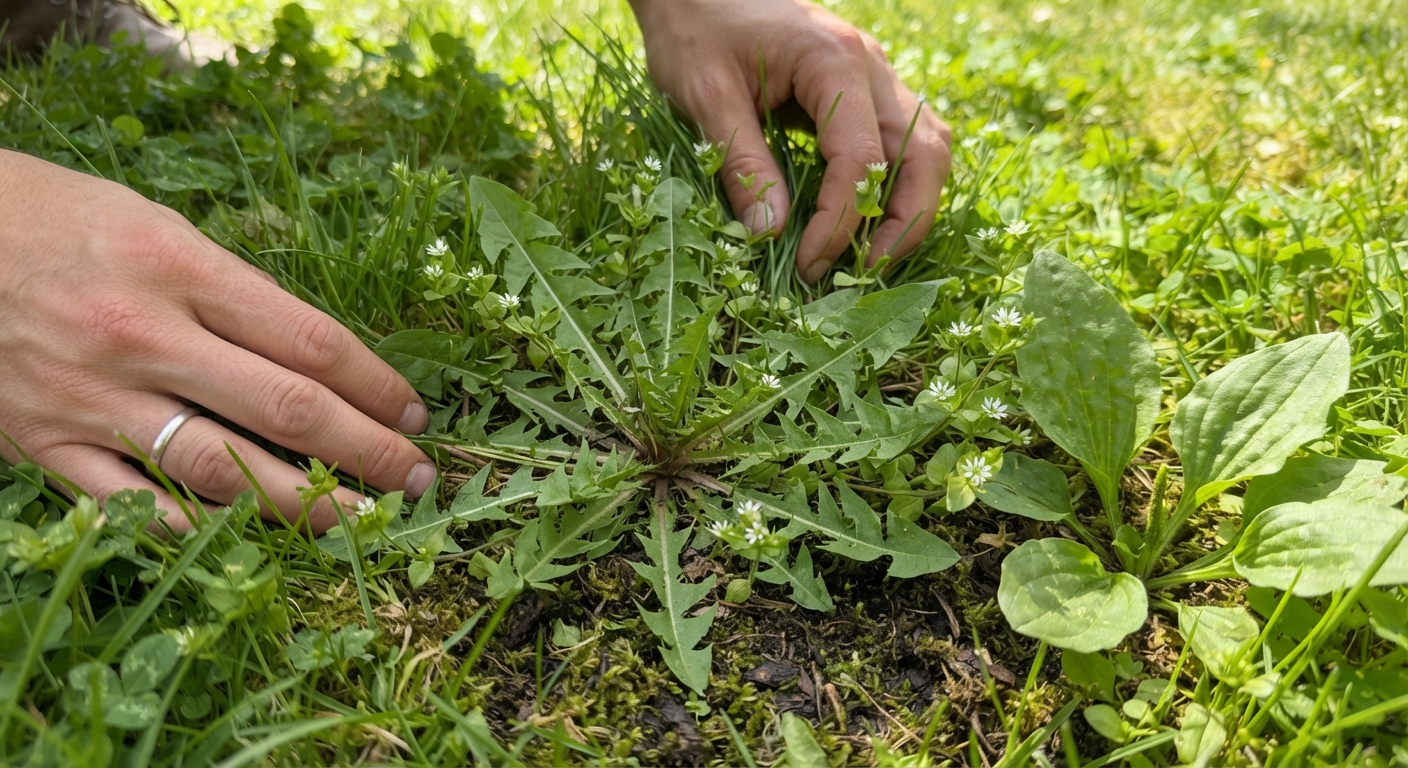
Habitat 1: Lawns, Sidewalks, and Disturbed Soil
What defines this habitat: Frequently mowed or trampled, compacted soil, full sun to partial shade, human activity. This is the easiest habitat for beginners because it’s everywhere and the plants here have evolved to thrive despite constant disturbance. If you have a lawn, a driveway crack, or a neglected garden bed, you have this habitat.
Why edible plants love it here: Disturbed soil exposes seeds and prevents larger plants from shading out smaller ones. Many edible “weeds” are pioneer species — they’re the first to colonize bare ground. This means you’ll find more edible biomass per square foot in a neglected lawn than in a pristine forest.
What you’ll find here:
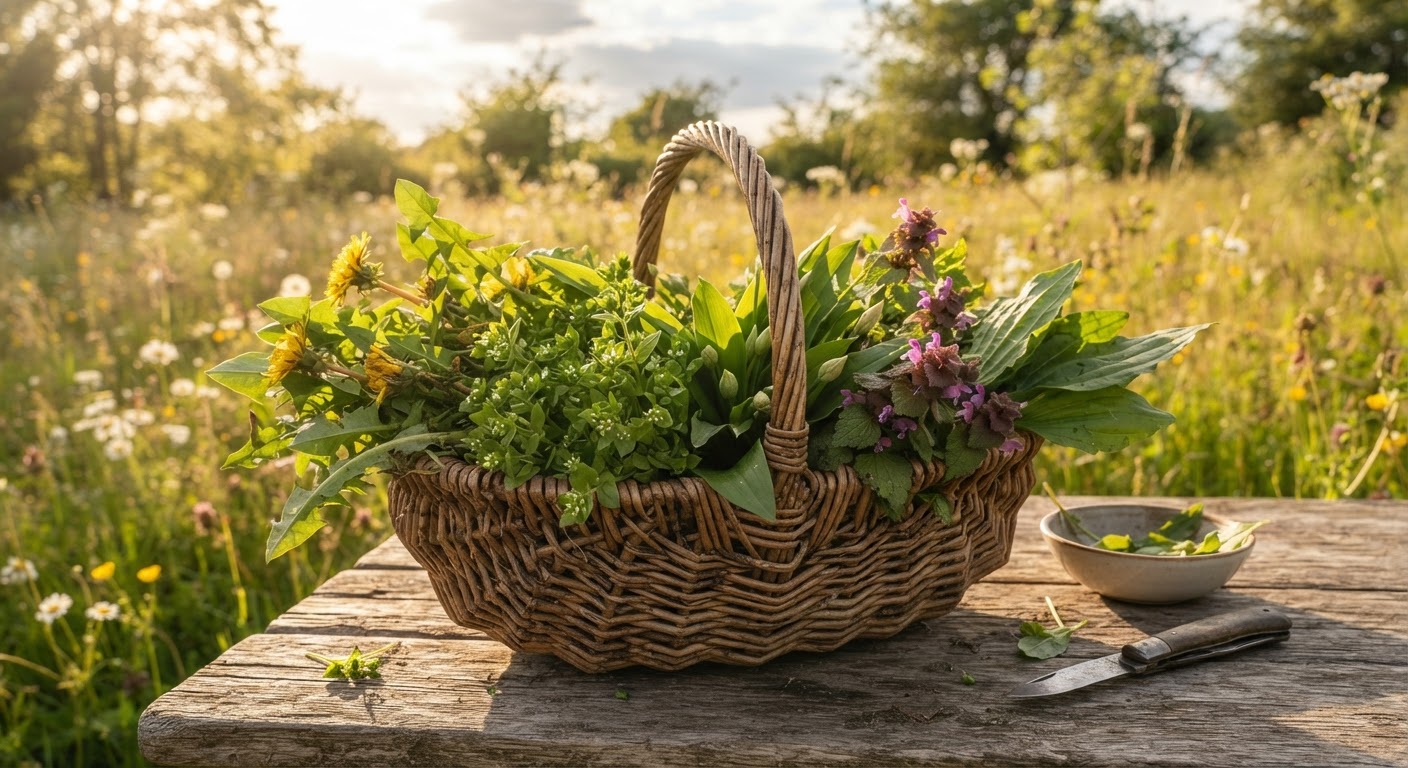
Dandelion (Taraxacum officinale) — The gateway foraging plant. Leaves, flowers, buds, and roots are all edible. Young spring leaves make excellent salad greens. Flower petals pulled from the bitter green base add color and mild sweetness to pancakes, fritters, and baked goods. Deep taproots roasted and ground produce a credible coffee substitute. If you learn nothing else from this guide, learn dandelion.
Purslane (Portulaca oleracea) — A succulent ground-hugger with thick, reddish stems and paddle-shaped leaves. It thrives in the hottest, driest parts of summer when everything else has given up. The stems snap cleanly and the leaves are crisp and juicy with a mild, lemony-salty flavor. Purslane holds the record for omega-3 fatty acid content among leafy greens. One caution: spurge (Euphorbia species) looks vaguely similar but has thinner stems, much smaller leaves, and exudes white sap when broken. Purslane’s sap is clear. White sap = leave it. Clear sap = eat it.
Plantain (Plantago major, P. lanceolata) — Not the banana, but the flat-leaved weed in every sidewalk crack. Broadleaf plantain has oval leaves with distinctive parallel veins running from base to tip. Narrow-leaf plantain has long, lance-shaped leaves with the same parallel vein pattern. Young leaves are edible cooked (they’re too fibrous raw). More famously, a chewed leaf applied to insect bites and minor wounds provides genuine anti-inflammatory relief — this isn’t folkloric, the compounds aucubin and allantoin in plantain are well-documented.
Chickweed (Stellaria media) — A cool-season ground cover with tiny white star-shaped flowers. The stems have a single line of fine hairs running down one side (run your finger along it — you’ll feel it). The leaves are small, oval, and grow in opposite pairs. Chickweed tastes like mild corn silk or young lettuce and makes one of the best raw salad greens in the foraging world. The line-of-hairs stem is your definitive ID check.
Violet (Viola species) — Heart-shaped leaves with scalloped edges and distinctive purple (sometimes white or yellow) flowers with five petals and a spur behind. Both leaves and flowers are edible. The flowers make stunning salad garnishes, can be candied for desserts, and produce a color-changing syrup that shifts from purple to pink with the addition of lemon juice. Violet leaves are mild and slightly mucilaginous — good as a soup thickener.
Wood Sorrel (Oxalis stricta) — Not a true sorrel despite the name. Three heart-shaped leaflets per leaf (looks like a clover but each leaflet has a distinct fold down the middle). Tiny yellow flowers with five petals. The taste is unmistakable — a sharp lemony tang from oxalic acid, like nature’s Sour Patch Kid. Fantastic as a trail snack, salad accent, or lemonade substitute (steep a handful in water and sweeten). Don’t eat pounds of it — the oxalic acid can be problematic in massive quantities, but handfuls are perfectly safe.
Habitat 2: Forest Edges and Woodland Clearings
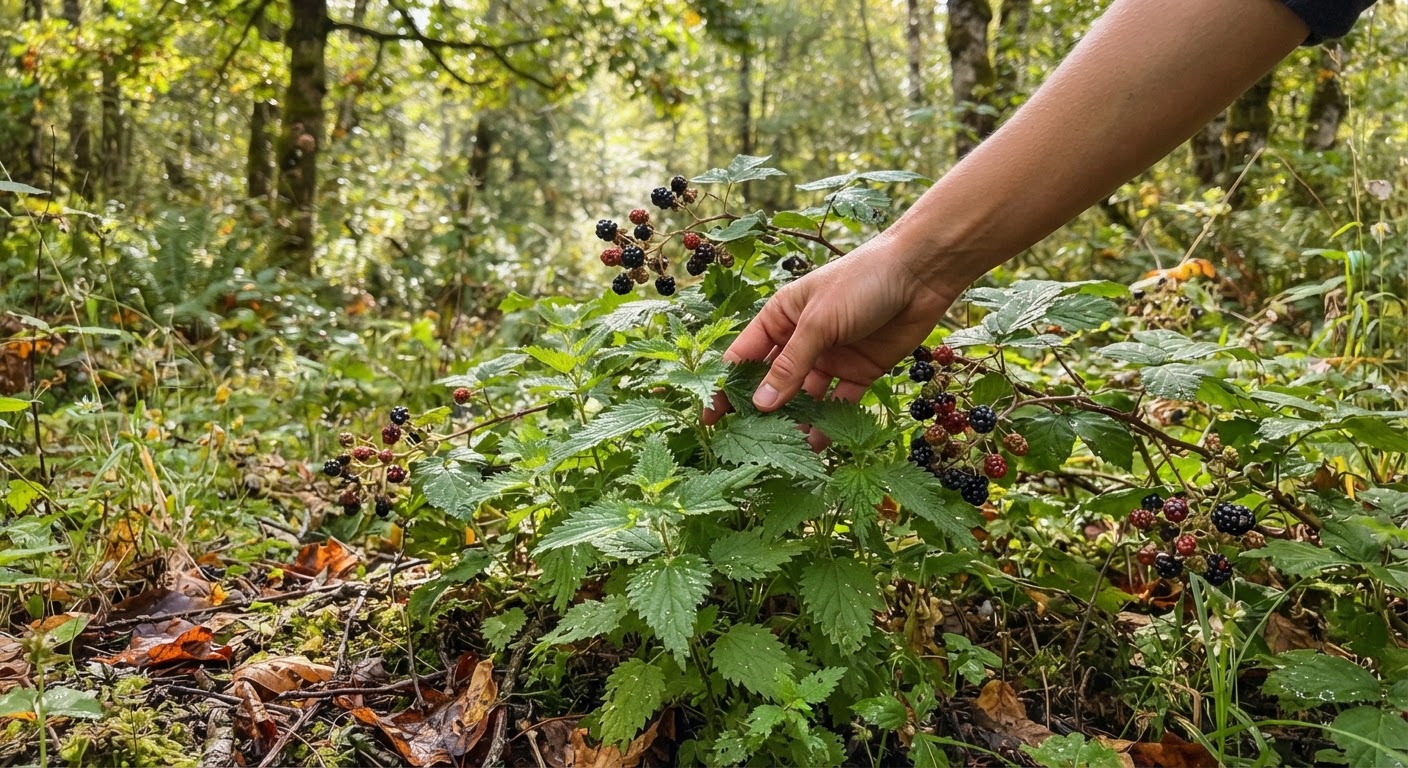
What defines this habitat: Partial shade to dappled sunlight, rich leaf-litter soil, protection from wind, higher moisture retention than open fields. Forest edges — where woodland meets meadow or trail — are consistently the most productive foraging zones because they combine the soil richness of forests with enough light penetration for understory plants to thrive.
Why edible plants love it here: Forest edges offer the “edge effect” — an ecological principle where the boundary between two habitats supports more biodiversity than either habitat alone. You get woodland plants on one side, meadow plants on the other, and a unique community of edge-specialists right at the boundary.
What you’ll find here:
Garlic Mustard (Alliaria petiolata) — An aggressive invasive with a redeeming quality: it’s delicious. First-year plants form low rosettes of kidney-shaped leaves with scalloped edges. Second-year plants send up flower stalks with triangular, sharply-toothed leaves and clusters of small white four-petaled flowers. The definitive test: crush any leaf and smell it. If it smells like garlic, you have garlic mustard. Nothing else smells the same. Use young leaves for pesto (blend with olive oil, nuts, parmesan), sauté older leaves, or chop the roots as a horseradish substitute. Eating garlic mustard is ecological service — every plant you harvest is one less producing seeds.
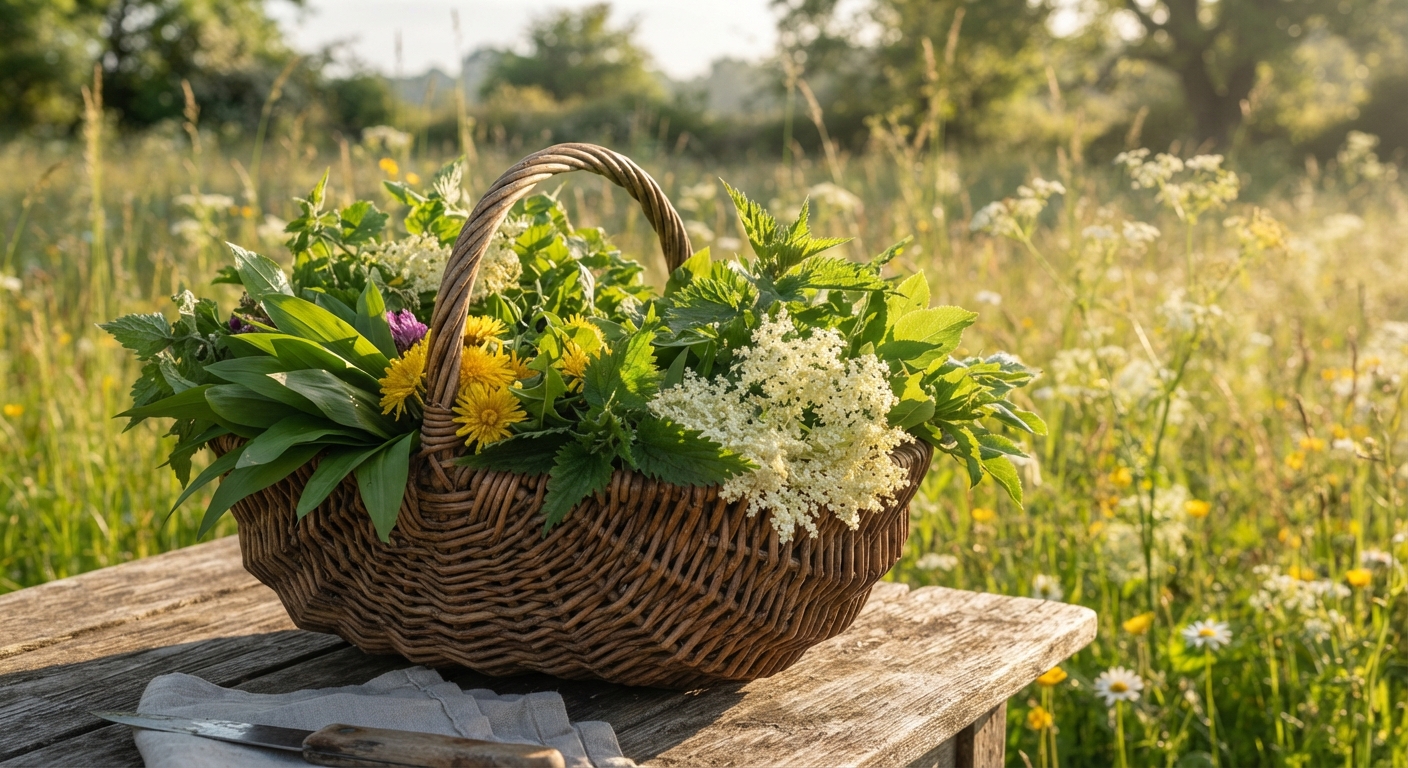
Stinging Nettle (Urtica dioica) — Yes, it stings. Yes, it’s worth it. The stinging hairs (trichomes) inject a cocktail of histamine, serotonin, and formic acid that causes a temporary burning rash. Wear gloves to harvest. Once cooked or dried, the sting disappears completely and what’s left is one of the most nutritious greens on the planet — more protein than any other leafy green, more iron than spinach, more calcium than milk by weight. Nettle soup is a European spring tradition for good reason. Young top leaves in early spring are the prize; once the plant flowers, the leaves develop gritty particles (cystoliths) that can irritate the urinary tract.
Wild Berries (Rubus species) — Blackberries, raspberries, wineberries, and dewberries all belong to the genus Rubus in the rose family. The plants are armed with thorns and brambles (wear long sleeves), but the fruit is universally safe to eat across all species worldwide. There is no toxic Rubus species anywhere. The prime harvesting window varies by species and latitude, but generally runs June through August. Key identification: compound leaves with 3–5 serrated leaflets, thorny canes, aggregate fruits composed of many small drupelets.
Wild Strawberry (Fragaria virginiana, F. vesca) — Much smaller than supermarket strawberries but dramatically more flavorful. Three leaflets per leaf, each with serrated edges. White five-petaled flowers. The fruit is miniature — thumbnail-sized or smaller — but the flavor intensity is concentrated. Wild strawberries prefer the edges of trails and clearings where they get morning sun and afternoon shade. The lookalike: mock strawberry (Potentilla indica) has yellow flowers (not white) and tasteless, seedy fruit that’s technically edible but pointless.
Violets appear here too — they thrive in both lawn and forest edge habitats.
Habitat 3: Stream Banks, Marshes, and Wet Meadows
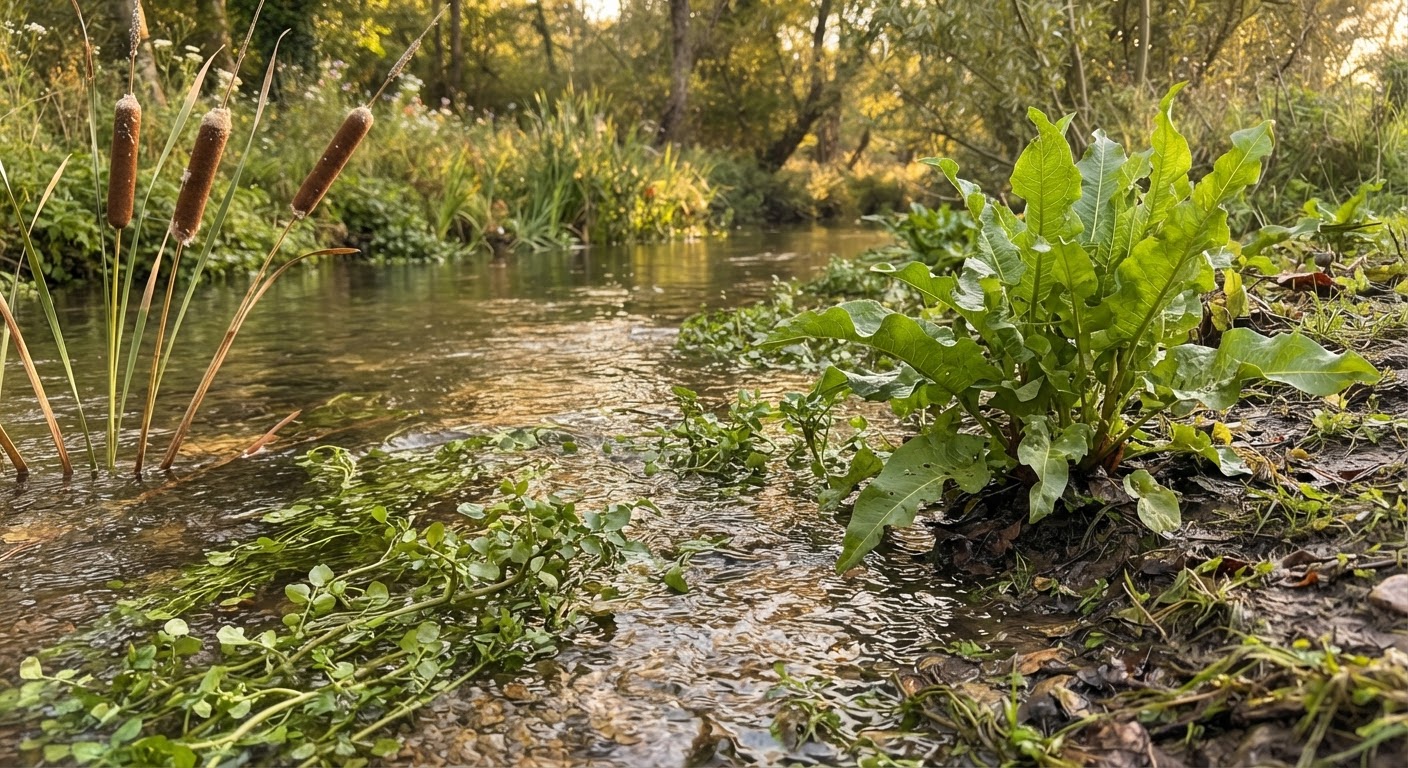
What defines this habitat: Consistently moist to wet soil, proximity to water, often lush and fast-growing vegetation. These areas can be buggy and muddy, but they produce some of the most calorically valuable wild foods available — plants that were staple foods for indigenous peoples across North America.
Why edible plants love it here: Unlimited water access means rapid growth and large, tender leaves. Many wetland plants store energy in underground structures (rhizomes, tubers, corms) that provide dense carbohydrates — something most wild greens lack.
What you’ll find here:
Cattail (Typha species) — The supermarket of the swamp. Almost every part of the cattail is edible at some point in its growth cycle. Young shoots in spring (peel back the outer leaves and harvest the tender white core — it tastes like cucumber or zucchini). Green flower spikes in early summer (boil and eat like corn on the cob, with butter and salt). Yellow pollen in mid-summer (collect by shaking the spikes into a bag, then use as a protein-rich flour extender). Rhizomes in fall and winter (peel, crush in water, let the starch settle, and use as flour). The brown cigar-shaped seed heads are also useful as tinder. There is no toxic cattail lookalike — but do check your identification against wild iris (iris leaves are flat and fan-shaped at the base, cattail leaves are rounded and originate from a central point).
Watercress (Nasturtium officinale) — A mustard family member that grows directly in clean, slow-moving water. The leaves are compound with rounded leaflets and the stems are hollow. The taste is peppery and sharp — it’s the original salad green, cultivated since ancient times. Watercress is one of the most nutrient-dense foods ever analyzed, with an Aggregate Nutrient Density Index score of 100 (the maximum possible). Critical safety note: Only harvest watercress from clean, tested water sources. The plant can harbor liver fluke parasites (Fasciola hepatica) if the water is contaminated by livestock runoff downstream.
Curly Dock (Rumex crispus) — Look for tall (2–4 foot) plants with long, narrow leaves that have distinctly wavy/curled edges. The young spring leaves are edible cooked (they’re high in oxalic acid raw, so boil and discard the water). By summer the leaves become tough and intensely bitter — shift your attention to the seed stalks, which turn a rusty brown and can be stripped, winnowed, and ground into a gluten-free flour that tastes nutty and slightly buckwheat-like.
Water Mint (Mentha aquatica) — Square stem (remember Lamiaceae), opposite leaves with serrated edges, and the unmistakable mint scent when crushed. Grows with its roots in water or saturated soil at the edges of streams and ponds. Use exactly as you would garden mint — teas, sauces, salads, cocktails. Wild mint species are all safe and aromatic.
Habitat 4: Open Meadows and Abandoned Fields
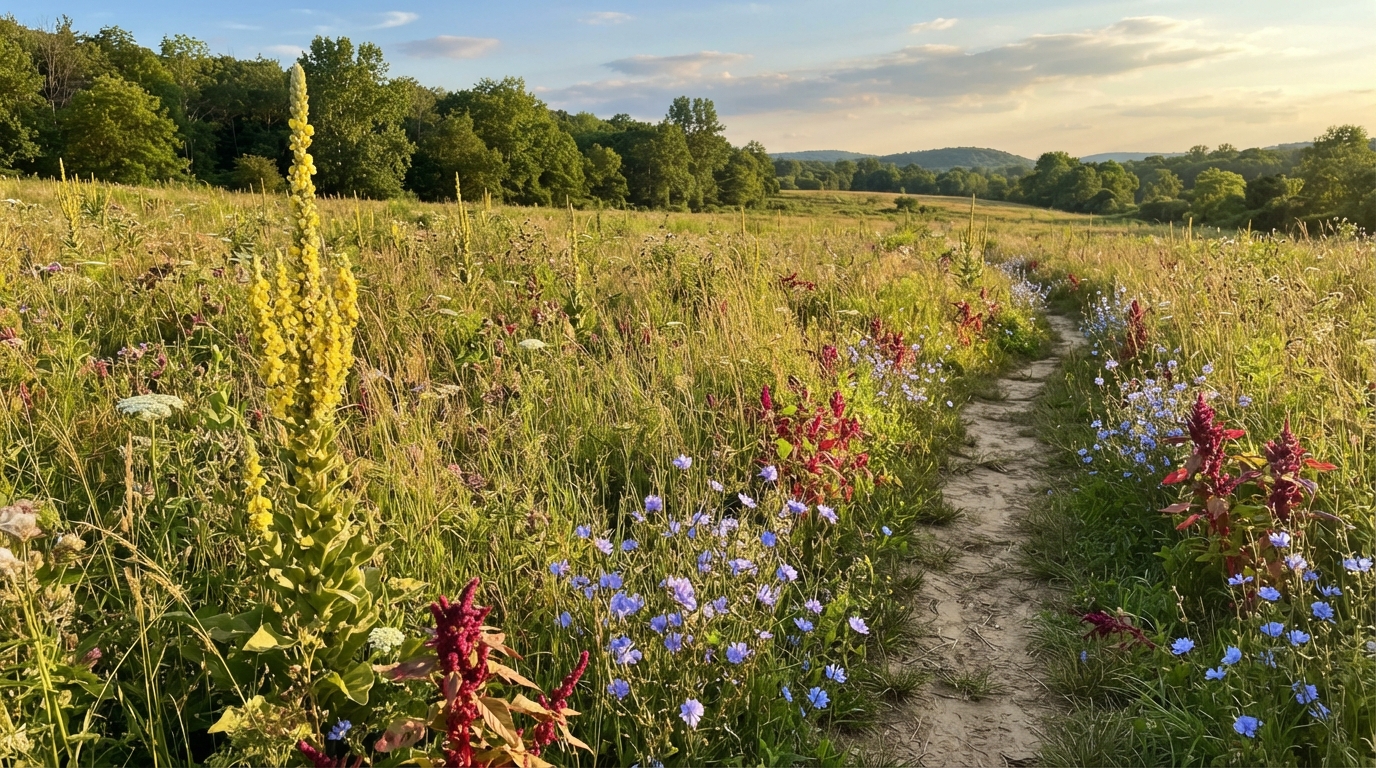
What defines this habitat: Full sun, deep soil, grasses and tall herbaceous plants, often former agricultural land. These are your summer and fall foraging grounds, producing seeds, grains, roots, and late-season fruits.
Why edible plants love it here: Maximum sunlight drives maximum growth. Many meadow plants are annuals or biennials that grow fast, produce massive amounts of seed, and store energy in large taproots. The competition from grasses forces edible plants to grow tall, making them easy to spot.
What you’ll find here:
Lamb’s Quarters (Chenopodium album) — Also called wild spinach, goosefoot, or fat hen. The leaves are roughly diamond-shaped with irregularly toothed edges and a distinctive white-mealy coating on the undersides — rub a young leaf and your finger will come away with a fine white powder. Lamb’s quarters is, nutritionally, a superior vegetable to spinach: more calcium, more protein, more vitamin A, more vitamin C, more B vitamins. The taste is mild, slightly nutty, and completely inoffensive — even picky eaters won’t notice it in a quiche or soup. Harvest the top 4–6 inches of young plants before flowering.
Amaranth (Amaranthus retroflexus, A. hybridus) — Pigweed to farmers, superfood to foragers. The leaves are edible like lamb’s quarters (cook them). The real prize is the seeds: each plant produces thousands of tiny black seeds in dense, bristly flower spikes. Harvest the seed heads when they’re dry and rustling, rub them between your palms over a bucket, and winnow away the chaff by pouring back and forth between containers in a light breeze. Amaranth seeds are gluten-free, protein-rich (14% protein, complete amino acid profile), and can be cooked like quinoa or ground into flour. The leaves also contain significant protein and iron.
Wild Carrot / Queen Anne’s Lace (Daucus carota) — This is your introduction to the Apiaceae family. Wild carrot is the ancestor of cultivated carrots and is identifiable by: finely divided, lacy leaves that smell distinctly like carrot when crushed; a flat-topped cluster of tiny white flowers (the umbel) that often has a single dark purple floret in the center; and flower clusters that curl upward into a “bird’s nest” shape as the seeds mature. DO NOT harvest wild carrot until you can distinguish it from poison hemlock with absolute certainty. The differences: wild carrot has hairy stems (hemlock stems are smooth with purple spots), smells like carrot when crushed (hemlock smells musty and unpleasant), and grows in dry, sunny meadows (hemlock prefers wet areas). If any doubt exists, don’t harvest. This plant is for intermediate foragers only.
Chicory (Cichorium intybus) — You’ve walked past chicory a hundred times. It’s the plant with the stunning periwinkle-blue flowers growing from gravelly roadsides and field edges. The leaves look like dandelion leaves on steroids — larger, more deeply lobed, and intensely bitter when raw. The roots, however, are the prize: dig the deep taproot in fall, wash and chop, dry roast at 300°F until dark brown and aromatic, then grind and brew. Chicory “coffee” has been a staple in New Orleans and throughout the South for centuries, and once you’ve tried it, you’ll understand why. The flowers are also edible as a salad garnish.
Mullein (Verbascum thapsus) — First-year mullein forms a large, soft rosette of fuzzy, velvety leaves. Second-year plants send up a towering flower spike that can reach 6 feet or more. The leaves make one of the best wild teas for respiratory issues (steep dried leaves for a soothing, mild tea that traditional herbalists use for coughs and congestion). The yellow flowers can be infused in olive oil to make a remedy for earaches (garlic-mullein ear oil is a classic herbal preparation). The tall, dried flower stalks can be dipped in tallow or wax to make natural torches.
Seasonal Calendar: What to Harvest When
The same plant can be perfect in April and useless in August. Here’s your year-round harvest calendar organized by habitat, so you know exactly where to go and what to look for in any season.
Spring (March – May)
| Plant | Habitat | Part to Harvest | Peak Window | Notes |
|---|---|---|---|---|
| Dandelion leaves | Lawns, fields | Young leaves | March–April | Pre-flowering leaves are mildest |
| Nettle tops | Forest edges, streams | Top 4–6 inches | April–early May | Before flowering; wear gloves |
| Chickweed | Lawns, gardens | Whole above-ground | March–May | Dies back in summer heat |
| Garlic mustard | Forest edges | Leaves, flower buds | April–May | Second-year plants in flower |
| Violet leaves & flowers | Lawns, woods | Leaves, flowers | April–May | Flowers first, leaves follow |
| Wild strawberry leaves | Edges, clearings | Young leaves | April–May | For tea; fruit comes later |
| Cattail shoots | Streams, marshes | Young shoots | April–May | Peel to white core; brief window |
| Watercress | Streams | Leaves, stems | March–May | Before water warms and flowers |
| Curly dock leaves | Fields, meadows | Young leaves | March–April | Only youngest leaves; boil |
| Lamb’s quarters | Fields, gardens | Young shoots | April–May | Harvest before flowering |
Summer (June – August)
| Plant | Habitat | Part to Harvest | Peak Window | Notes |
|---|---|---|---|---|
| Purslane | Lawns, cracks | Leaves, stems | July–August | Thrives in heat; clear sap check |
| Dandelion flowers | Lawns, fields | Petals only | May–June | Pull petals from green base |
| Blackberry/Raspberry | Forest edges | Fruit | June–August | Varies by species and latitude |
| Cattail pollen | Marshes, streams | Yellow pollen | June–July | Shake into bag; flour extender |
| Amaranth leaves | Fields, meadows | Young leaves | June–August | Before seed heads form |
| Wood sorrel | Lawns, edges | Leaves, flowers | May–September | Lemony, eat in moderation |
| Plantain leaves | Lawns, cracks | Young leaves | May–July | Cook older leaves |
| Wild mint | Streams, wet areas | Leaves | June–September | Harvest before flowering |
| Daylily buds/flowers | Roadsides, edges | Flower buds, open flowers | June–July | Buds before they open; eat cooked |
| Mullein leaves | Fields, meadows | Leaves | June–August | First-year rosettes for tea |
Fall (September – November)
| Plant | Habitat | Part to Harvest | Peak Window | Notes |
|---|---|---|---|---|
| Dandelion roots | Lawns, fields | Taproot | October–November | After first frost; roast for coffee |
| Chicory roots | Roadsides, fields | Taproot | October–November | Same preparation as dandelion |
| Curly dock seeds | Fields, meadows | Seeds | September–October | Strip, winnow, grind for flour |
| Amaranth seeds | Fields, meadows | Seeds | September–October | Rub heads, winnow for grain |
| Rose hips | Edges, fields | Fruit | September–November | After first frost sweetens them |
| Cattail rhizomes | Marshes, streams | Rhizome | October–November | Starch extraction; messy but worth it |
| Wild carrot roots | Meadows | Taproot | October–November | First-year roots; verify ID carefully |
| Hawthorn berries | Forest edges | Fruit | September–October | For tea, jam, or syrup |
| Acorns | Forests | Nuts | September–October | White oak preferred; must leach tannins |
| Burdock root | Fields, edges | Taproot | October–November | First-year roots; dig deep |
Winter (December – February)
| Plant | Habitat | Part to Harvest | Peak Window | Notes |
|---|---|---|---|---|
| Chickweed | Lawns, gardens | Above-ground | December–February | Cool-season; dies in deep freeze |
| Dandelion leaves | Lawns, fields | Leaves | Mild winter days | Bitter but available |
| Cattail rhizomes | Marshes, streams | Rhizome | If ground isn’t frozen | Tough to harvest in frozen soil |
| Rose hips | Edges, fields | Fruit | Through winter | Wrinkled but still good |
| Pine needles | Forests | Needles | Year-round | For vitamin C tea (Eastern white pine) |
| Wintercress | Streams, fields | Leaves | Winter–early spring | Mustard family; cold-hardy |
| Wild garlic/onion | Lawns, edges | Leaves, bulbs | Year-round mild climates | Smell check = definitive |
A note on winter foraging: In most temperate regions, winter foraging is limited but possible. Chickweed is the star — it germinates in fall, grows through mild winter periods, and is at its most tender during cool weather. Pine needle tea from Eastern white pine (Pinus strobus) is famously high in vitamin C and has been used to prevent scurvy since pre-colonial times. Don’t harvest from yew trees (Taxus species — they have red berries and flat needles, not clustered needles), which are toxic.
The Lookalike Table: 10 Plants Where Getting It Wrong Matters
This is the table that prevents emergency room visits. Every plant pair below shares enough visual similarity to confuse beginners, and half of them share enough similarity to fool intermediate foragers who get complacent.
| Edible Plant | Toxic Lookalike | Key Difference #1 | Key Difference #2 | Key Difference #3 | Confidence Level Needed |
|---|---|---|---|---|---|
| Wild Carrot | Poison Hemlock | Hairy stems | Smooth stems with PURPLE SPOTS | Carrot smell when crushed | Musty, unpleasant smell |
| Wild Grape | Canada Moonseed | Round seeds, tendrils opposite leaves | Crescent-moon-shaped seed | Moonseed leaves lack tendrils | Grape leaves have serrated edges |
| Garlic Mustard | Early Saxifrage/Toothwort | Crushed leaf smells like garlic | No garlic smell | 4 petals in cross (Brassicaceae) | Different flower structure |
| Purslane | Spurge (Euphorbia) | Clear sap when stem broken | WHITE, milky sap | Thick rubbery stems, paddle leaves | Thin stems, much smaller leaves |
| Wild Strawberry | Mock Strawberry | White flowers | YELLOW flowers | Delicious sweet fruit | Tasteless, dry fruit |
| Blueberry | Tutsan / Black Nightshade (unripe) | 5-pointed crown on berry | Different plant structure | Blueberries grow on woody shrubs | Nightshade is herbaceous |
| Morel Mushroom | False Morel | Hollow from stem through cap | Chambered or solid inside | Honeycomb-pitted cap | Wrinkled/lobed cap |
| Wild Onion/Garlic | Death Camas | Smells like onion/garlic | NO onion/garlic smell | All parts smell | Death camas has no scent |
| Elderberry (ripe) | Pokeweed Berries | Flat-topped clusters, tiny stems | Hanging grape-like clusters, magenta juice | Elderberry has compound leaves | Pokeweed has magenta stems |
| Dandelion | Hawksbeard / Cat’s Ear | Single flower per hollow stem | Branched solid stems, multiple flowers | All leaves from base rosette | Hairy leaves, branched stems |
The most important row on this table is wild carrot vs. poison hemlock. Read it twice. Poison hemlock has killed people throughout history — it’s the plant that executed Socrates. It grows in all 48 contiguous US states and throughout southern Canada. It looks enough like wild carrot to fool someone in a hurry. Every single year, someone makes this mistake. Don’t let it be you. The purple spots on hemlock stems are your best field mark — they look like someone splattered purple paint on a smooth, hairless green stem. Wild carrot stems are uniformly green and noticeably hairy.
Pro Tips: How Experienced Foragers Think
After thousands of hours in the field, here’s what separates the people who forage confidently from the people who still second-guess every plant.
1. Master One Habitat at a Time
Pick one habitat — I recommend lawns and disturbed areas because they’re everywhere — and learn every edible plant in it before moving on to the next. You should be able to walk through that habitat and name every plant you see, edible or not. Three walks in the same habitat will teach you more than reading ten field guides.
2. Take Your Own Reference Photos
The photos in this guide and every other guide were taken in someone else’s lighting conditions. Your plants don’t look exactly like those photos. Take your own photos of every plant you identify, in the habitats where you actually forage, at the times of day you actually go out. Build a personal reference library on your phone. You’ll be amazed how much faster identification becomes when you’re comparing against your own images.
3. Use the 3-Feature Rule (Minimum)
Never identify an edible plant by a single characteristic. Find at least three distinct features that all point to the same species: leaf shape AND flower structure AND stem characteristics, for example. If even one feature doesn’t match the description, treat it as a red flag and investigate further before harvesting.
4. The Nibble Test Won’t Save You
There’s a persistent foraging myth that you can test an unknown plant’s edibility by touching a small piece to your lip, then your tongue, then chewing a tiny amount and waiting. This protocol — the Universal Edibility Test — was developed for military survival situations where the alternative is starvation. It is NOT designed for recreational foraging. It will not detect the most dangerous plant toxins (like those in poison hemlock and water hemlock), and it can cause permanent organ damage from plants that taste fine but destroy your liver over the following days. Use positive identification, not experimental nibbling.
5. Look Down, Then Look Up
Most foraging guides focus entirely on what’s at ground level. Experienced foragers know to look up too. Trees produce some of the most abundant wild foods — mulberries, serviceberries, persimmons, walnuts, hickory nuts, pine nuts, maple sap. If you’re only looking at your feet, you’re missing half the edible landscape.
6. Harvest Like You’re Gardening, Not Gathering
Take no more than 10% of any plant population you find. This isn’t just ecological ethics — it’s practical. Taking only the best specimens and leaving the rest means the population stays healthy and produces even more next year. For roots and rhizomes (dandelion, chicory, cattail), dig only from dense patches where your harvest won’t be noticed. For leafy greens, take individual leaves rather than whole plants when possible.
7. The Soil Tells a Story
Before harvesting from an urban or suburban location, ask: what’s been on this soil? Railroad rights-of-way are sprayed with herbicides. Roadside ditches collect road runoff (oil, heavy metals, salt). Old industrial lots may have contaminated soil. Beautiful lawns are often chemically treated. The best foraging spots in developed areas are: your own untreated yard, organic farms with permission, parks that you’ve confirmed aren’t sprayed, and wild areas far from roads. When in doubt, don’t harvest.
What You Actually Need in Your Foraging Kit
You don’t need $200 worth of specialty gear. Here’s what actually makes a difference:
- A sturdy basket or cloth bag — Plastic bags make greens wilt and sweat. Baskets let air circulate and keep your harvest fresh.
- Gloves — Leather or heavy canvas. Nettle stings, thorny brambles, and poison ivy all suddenly become non-issues.
- Scissors or pruning shears — Clean cuts heal faster than torn stems. Better for the plant, better for your harvest quality.
- Paper bags or wax paper — For separating different species so you’re not sorting through a mixed pile at home trying to remember what was what.
- A small digging tool — A hori-hori knife or garden trowel for roots. Dandelion taproots run deep.
- Field guide for your region — Apps are supplementary, not primary. Your region-specific field guide is the authority.
- A notebook or phone camera — Document what you find, where you found it, and when. Build your personal foraging map over seasons.
- Water and a small spray bottle — Rinse gritty roots and clean your hands. The spray bottle also helps keep greens fresh on hot days.
Notice what’s NOT on this list: a $40 foraging knife, a special harvesting apron with seventeen pockets, a GPS tracker, or any of the other gear that foraging influencers try to sell you. The plants don’t care about your equipment.
Frequently Asked Field Questions
“I found a plant that matches the photo in my guide, but the leaf margin looks slightly different. Is that within normal variation?”
Yes — and this is probably the most common source of beginner anxiety. Plants vary. A leaf might be slightly wider, narrower, more or less toothed depending on soil quality, sun exposure, age, and rainfall. This is why field guides that show only one idealized photo are dangerous. Look at multiple photos of the same species online (from different sources, different regions) to get a sense of the natural range of variation. The structural features — flower arrangement, stem shape, leaf attachment pattern, sap color — are much more consistent than leaf size and shape.
“How do I know if a plant has been sprayed with pesticides?”
You often can’t — not visually. Chemical herbicide damage sometimes shows as curled, discolored, or distorted new growth, but many pesticides leave no visible trace. This is why location awareness is crucial. Ask the landowner or park management about their spraying practices. Assume conventional lawns, golf courses, railroad edges, and agricultural field margins are sprayed. Your safest bets: your own untreated property, deep wilderness areas, and organic farms where you’ve confirmed practices with the farmer.
“Can I forage in national and state parks?”
Generally no — most national parks and many state parks prohibit removing any plant material. National Forests (managed by the USDA Forest Service, not the National Park Service) are often more permissive and may allow personal-use foraging with limits. Bureau of Land Management (BLM) lands are typically the most permissive. Always check the specific regulations for the land you’re on. The rules are not uniform, and a “but I didn’t know” defense won’t help you with a ranger.
“How do I know if a mushroom is safe to eat?”
Mushrooms are categorically different from plants and require their own complete education. There is no family-level shortcut for fungi — edible and deadly species coexist within the same genera. The only safe approach to mushroom foraging is learning individual species thoroughly, including all possible toxic lookalikes, from an experienced mentor or a specialized mushroom field guide. Start with foolproof beginner species like morels, chicken of the woods, giant puffballs, and chanterelles — each has distinctive features that make confident identification possible with proper study.
“What’s the one plant every beginner should learn first?”
Dandelion. It’s everywhere, it’s impossible to fatally misidentify, every part is usable, and learning dandelion thoroughly teaches you the pattern-recognition skills that apply to every other plant. Plus, once you’ve made dandelion fritters and dandelion root coffee, you’ll understand viscerally that weeds aren’t just “edible” — they’re genuinely good food.
The Path Forward: Your First Three Foraging Walks
Reading about foraging is useful. Doing it is transformative. Here’s a concrete plan for your first three walks that will take you from “I read about it” to “I ate it.”
Walk 1 — Your Lawn (30 minutes): Go outside right now — your yard, a nearby park, the strip of grass by the sidewalk. Find and positively identify three plants from Habitat 1 in this guide. Take photos. Check three features on each. Do not harvest anything yet — just identify. Come back inside and verify your IDs against at least two sources. You’re building the identification habit before you build the eating habit.
Walk 2 — Harvest and Cook (45 minutes): Return to the same area. Harvest a small amount of dandelion leaves (young ones), a handful of chickweed, and a few violet flowers. Bring them home. Wash thoroughly. Make a simple salad with olive oil, lemon juice, and salt. Eat it. You just ate your lawn.
Walk 3 — A New Habitat (1 hour): Find a forest edge or stream bank near you. Use the habitat descriptions in this guide to predict what you might find before arriving. When you get there, check how many of your predictions were correct. Identify three new plants. Note: for this walk, focus on identification, not harvesting — especially if your new habitat includes any Apiaceae plants. Build the identification skills before the harvest skills.
After three walks, you’ll have seen the pattern shift happen. The green blur starts resolving into individual plants. You’ll spot dandelions from 50 feet away without thinking about it. Your brain will start automatically categorizing by leaf shape and flower structure. That’s the moment foraging stops being a skill you’re learning and starts being a way you see the world.
And once you see it, you can’t unsee it. Every walk, every park, every roadside pullout becomes a potential meal. That’s not exaggeration — that’s what happens when you learn to read the landscape.
Happy foraging. Stay curious, stay cautious, and never eat anything you’re not absolutely certain about.