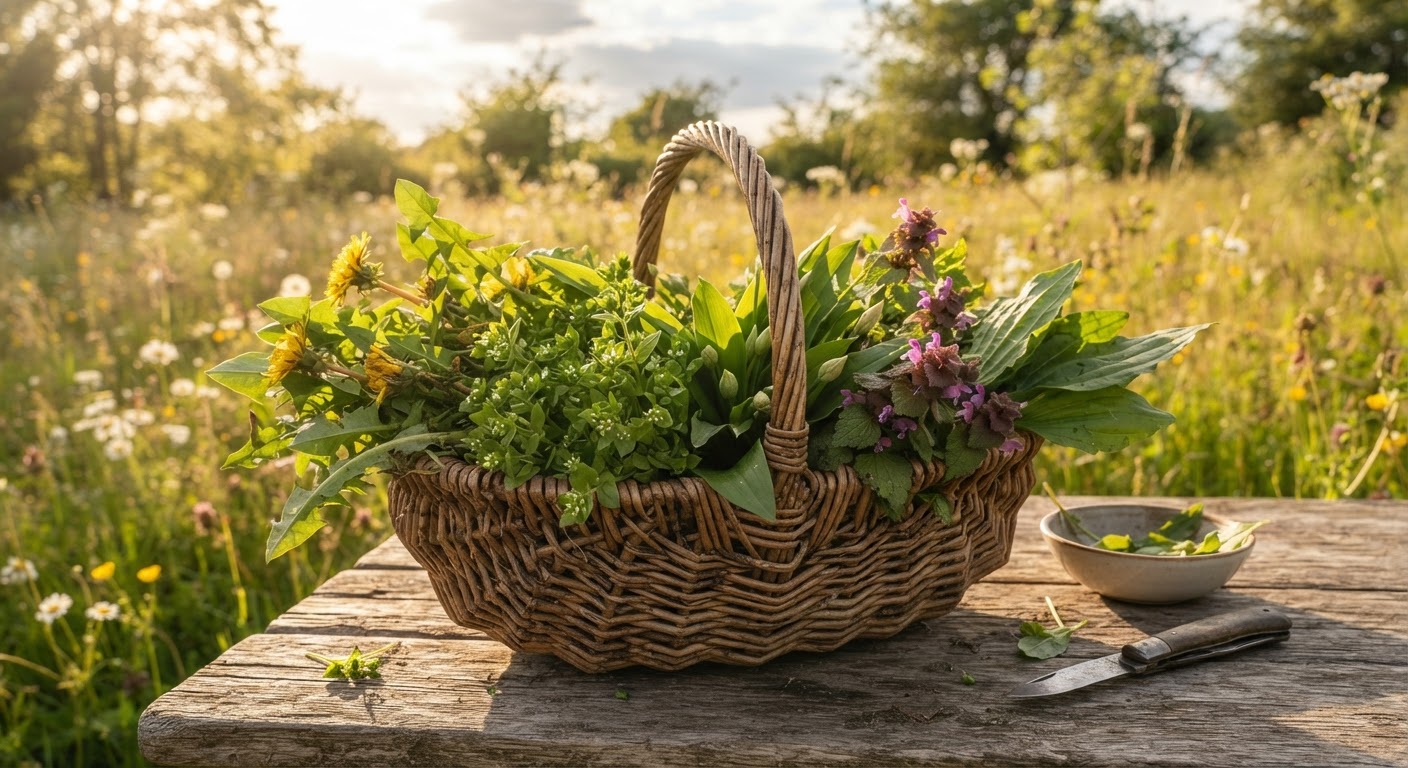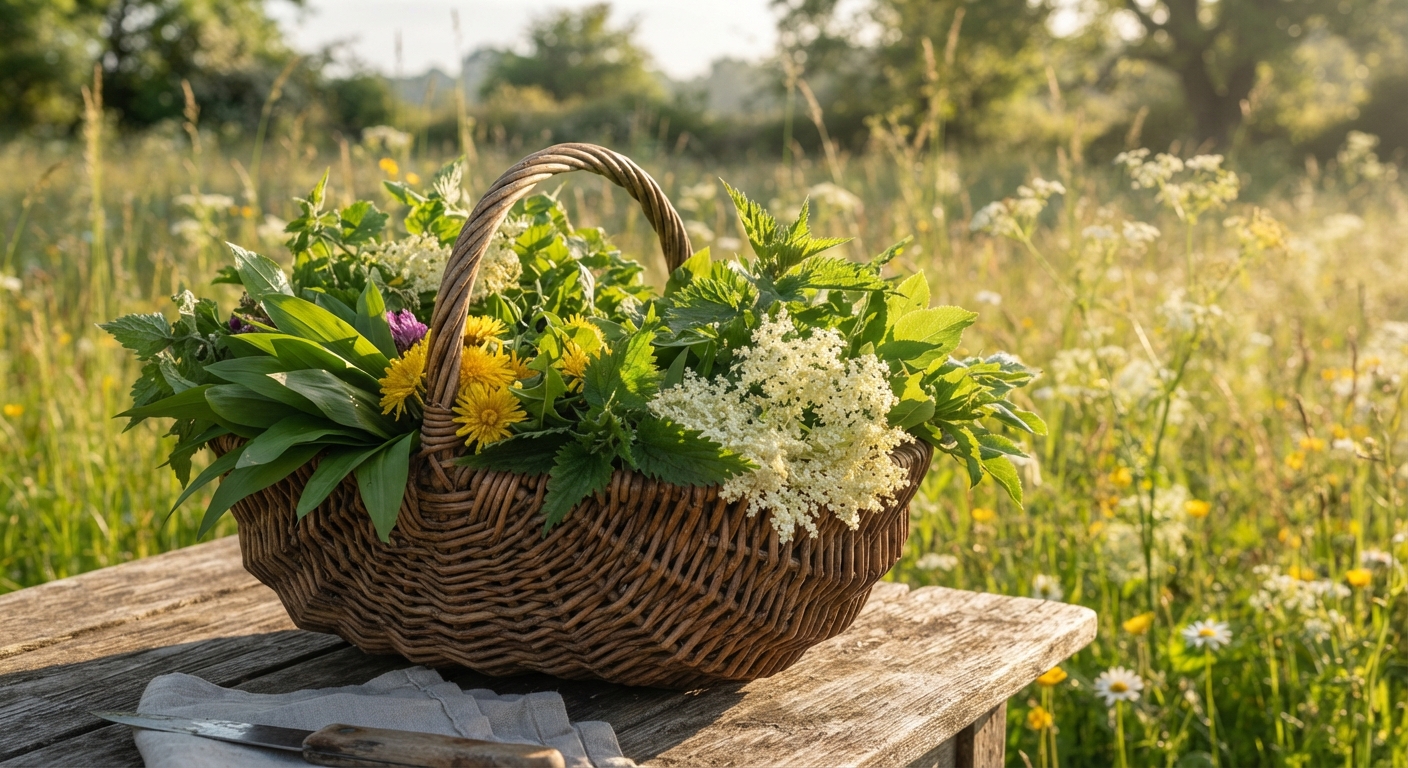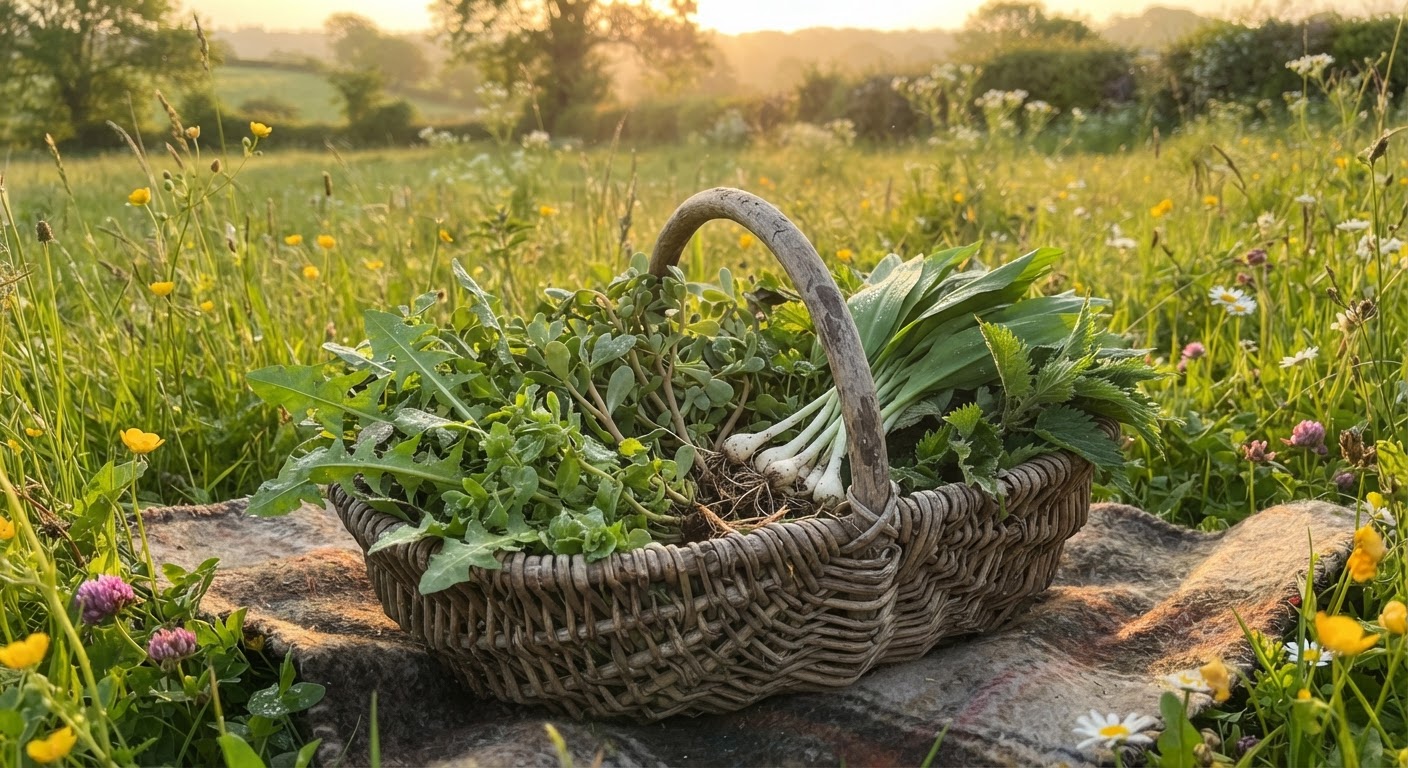
Your local supermarket charges $4.99 for a plastic clamshell of organic baby greens — the same plants growing, for free, in the patch of lawn next to the parking lot. Walk past a neglected garden bed in July and you’ll likely find purslane spilling over the edges — a succulent green that contains more omega-3 fatty acids than any other leafy vegetable on Earth. That patch of “weeds” the grounds crew sprays with herbicide every spring? Half of it is probably edible, and some of it is genuinely more nutritious than anything in the produce aisle.
The barrier isn’t availability. It’s knowing what you’re looking at.
This list cuts through the noise. Twelve of the most common edible wild plants — the ones you’ll actually encounter, not the rare mountain herbs that require a three-hour hike — covered with the identification markers that matter in the field, not in a botanical textbook.
Quick-Reference Identification Table
Bookmark this table. When you spot a plant and need a fast ID check, scan these columns before reaching for a field guide.
| Plant | Season | Habitat | Unmistakable ID Marker | Toxic Lookalike? |
|---|---|---|---|---|
| Dandelion | Spring–Fall | Lawns, fields, cracks | Single flower per hollow stem, jagged toothy leaves | No (chicory is edible too) |
| Purslane | Summer | Garden beds, dry soil | Thick reddish stems, succulent spoon-shaped leaves | Yes — spurge has white sap |
| Chickweed | Spring–Fall | Moist shady soil, gardens | Tiny white star flowers, single line of hairs on stem | Yes — scarlet pimpernel |
| Wood Sorrel | Spring–Fall | Woodland edges, lawns | Three heart-shaped leaflets, sour lemon taste | No (clover is edible) |
| Lamb’s Quarters | Summer–Fall | Disturbed soil, gardens | Powdery white coating on young leaves, goosefoot shape | No (unrelated to toxic plants) |
| Stinging Nettle | Spring–Fall | Rich moist soil, forest edges | Tiny stinging hairs on stems and leaves, serrated leaves | No (dead nettle is harmless) |
| Wild Garlic | Spring–Summer | Damp meadows, woodland | Distinct garlic-onion smell, hollow tubular leaves | Yes — Death Camas bulbs (no smell) |
| Broadleaf Plantain | Year-round | Compacted soil, paths, lawns | Parallel veins on broad oval leaves, seed stalks like rat tails | No |
| Garlic Mustard | Spring–Summer | Woodland edges, shaded paths | Crushed leaves smell like garlic, tiny white four-petal flowers | No |
| Wild Amaranth | Summer–Fall | Disturbed soil, farm edges | Tall red-tinged seed head, edible leaves and seeds | No |
| Curly Dock | Spring–Fall | Fields, roadsides, disturbed ground | Long narrow leaves with wavy edges, tall rusty seed stalks | No (but contains oxalates) |
| Violet | Spring–Summer | Lawns, woodland shade | Distinctive purple/white irregular flowers, heart-shaped leaves | No (wild pansy is edible) |
Plant-by-Plant Field Guide
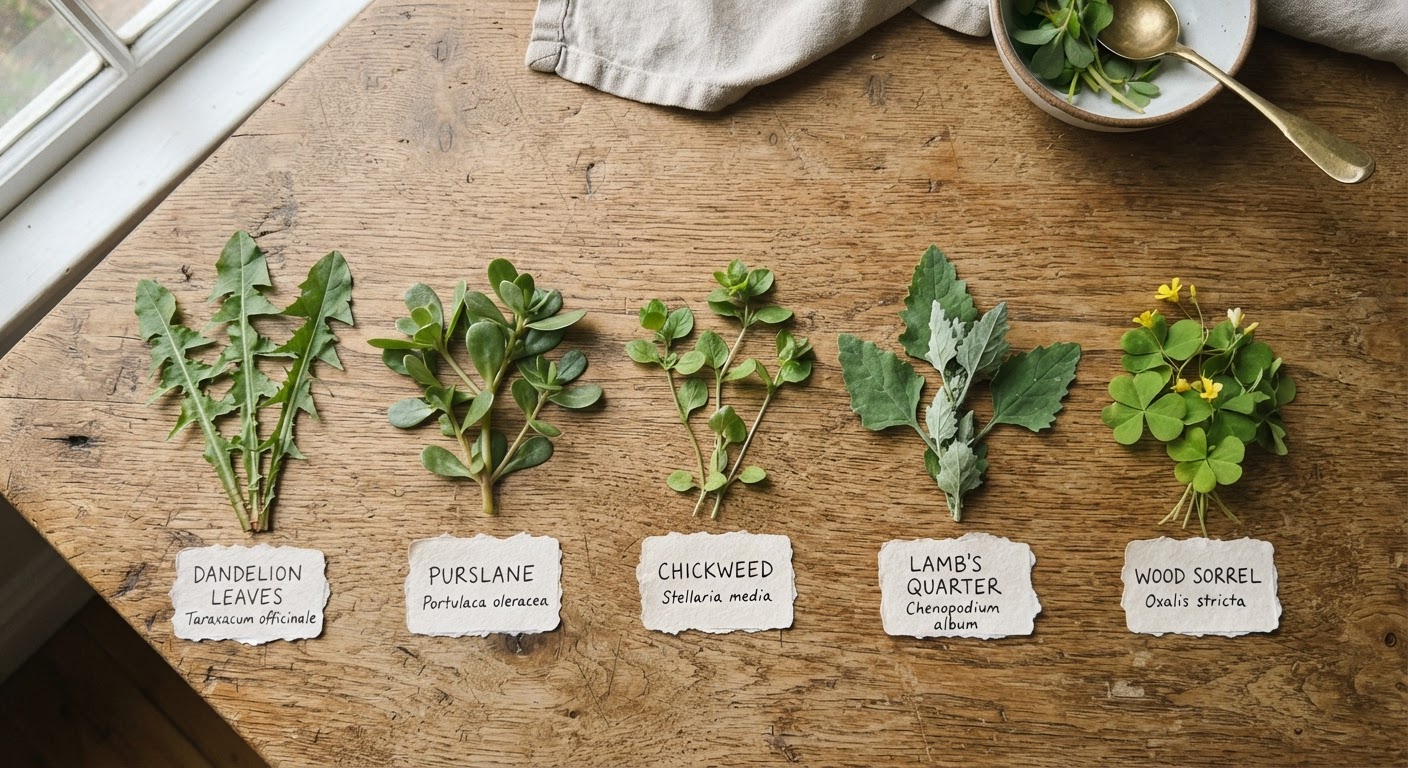
1. Dandelion (Taraxacum officinale)
If you only learn one wild plant, make it this one. Dandelions grow on every continent except Antarctica, and every part of the plant is edible.
What to look for: Rosette growth pattern at ground level, deeply toothed leaves (the name comes from French dent de lion — lion’s tooth), hollow flower stems with a single yellow flower per stem. When you break a stem, white latex oozes out. Autumn dandelions are less bitter than spring ones.
Harvest tip: Pick young leaves before the plant flowers — they’re dramatically less bitter. Roots can be roasted as a coffee substitute. Flowers make a decent country wine.
One thing nobody tells you: Dandelion greens from a lawn you mow regularly will be tender and mild. The massive, leathery leaves from a neglected field edge will taste like chewing on aspirin.
2. Purslane (Portulaca oleracea)
A succulent ground-cover plant with more omega-3 fatty acids than salmon (by dry weight), more vitamin E than spinach, and a pleasant lemony crunch. It’s a superfood that gardeners worldwide spend hours trying to kill.
What to look for: Reddish-brown succulent stems that creep horizontally along the ground. Small, paddle-shaped leaves that feel thick and rubbery between your fingers. Tiny yellow flowers that open only in direct sunlight.
WARNING — the one lookalike you can’t ignore: Spurge (Euphorbia species) grows in the same spots and looks similar at a glance. Break a stem. If white, milky sap oozes out immediately, do not eat it — that’s spurge, and it’ll give you a stomach full of regret. Purslane sap is clear, not milky. This is the single most reliable test.
3. Chickweed (Stellaria media)
Tastes like mild corn silk or soft lettuce. Grows in thick, sprawling mats and is one of the first greens available in early spring.
What to look for: Tiny white flowers with five petals — but each petal is so deeply split that it looks like ten petals. The stem has a single line of fine hairs running down one side (this is the definitive ID trick — rotate the stem and you’ll see the hair line shift). Leaves are small, oval, and grow in opposite pairs.
Harvest tip: Pick the top 3–4 inches of growth. The stems get stringy lower down. Chickweed wilts fast — rinse it and use it within a day. It makes an excellent raw salad green or a quick wilted side dish.
4. Wood Sorrel (Oxalis species)
The plant that looks like clover but tastes like green apple candy. Kids who grew up foraging call it “sour grass” — and that’s exactly what it tastes like.
What to look for: Three heart-shaped leaflets per stem (often confused with clover, which has rounded leaflets). Delicate five-petal flowers in yellow, white, or pink depending on species. The sour flavor when chewed is unmistakable — no toxic plant tastes like this.
Harvest tip: Eat it raw in small quantities as a trail snack or salad accent. Cooking destroys the sour flavor. Don’t overdo it — oxalis contains oxalic acid, which in massive quantities can interfere with calcium absorption. A handful in a salad is fine. A bowl of pure wood sorrel is not.
5. Lamb’s Quarters (Chenopodium album)
Also called goosefoot, fat hen, or wild spinach — and if you’ve been pulling this out of your garden, you’ve been weeding actual gourmet food. Lamb’s quarters tastes like a sweeter, more mineral-rich version of spinach.
What to look for: Triangular or diamond-shaped leaves with irregularly toothed edges. The key marker is the powdery white or pinkish coating on the youngest leaves at the center of the plant — it looks almost like fine frost and rubs off when you touch it. The leaf shape resembles a goose’s foot, hence the name.
Harvest tip: Treat it like spinach. The young leaves and tender tips are best raw. Older leaves should be cooked. The seeds are also edible — they’re a relative of quinoa and can be harvested by shaking the seed heads into a bag in late summer.
6. Stinging Nettle (Urtica dioica)
Yes, it hurts to touch. No, that shouldn’t stop you. Nettles are arguably the most nutritious green you’ll ever eat — loaded with iron, calcium, magnesium, and more protein than most leafy greens. The sting disappears completely with cooking or drying.
What to look for: Tall plants (2–6 feet) with opposing, deeply serrated, heart-shaped leaves. The stem and leaf undersides are covered in tiny, needle-like hairs — these are the stingers. Each hair is basically a microscopic glass syringe that injects histamine and formic acid into your skin.
Harvest tip: Wear gloves. Harvest only the top 4–6 inches of young growth in spring. Blanch in boiling water for 30–60 seconds and the sting is gone forever. The cooking water makes good soup stock. Nettle tea (from dried leaves) has a clean, green, almost seaweed-like flavor.
7. Wild Garlic / Field Garlic (Allium vineale)
If it smells like garlic and onion, it’s a Allium — and it’s edible. This family rule saves more foragers than any field guide.
What to look for: Thin, hollow, tubular leaves emerging from a small underground bulb. The leaves look almost like chives but are round in cross-section, not flat. Small bulblets form at the top of the stalk in summer. The entire plant smells unmistakably of garlic when crushed.
WARNING: Death Camas (Toxicoscordion venenosum) bulbs can grow in the same areas and look vaguely similar. The difference: Death Camas has no onion or garlic smell whatsoever. None. Zero smell test = zero eating. If you can’t smell garlic, you’re not holding garlic.
8. Broadleaf Plantain (Plantago major)
Not the banana. This is the flat-leaved weed growing in every driveway crack, footpath, and compacted patch of dirt in North America. It’s so common you’ve walked on it a thousand times without noticing.
What to look for: Broad, oval, ribbed leaves forming a flat rosette. The defining feature is the parallel veins running from stem to tip — they’re so prominent you can feel them with your finger. In summer, tall thin stalks rise from the center with a rat-tail-like seed head at the top.
Harvest tip: Young leaves are edible raw in salads; older leaves get fibrous and are better cooked. The seeds (psyllium-like) can be eaten or ground. Plantain leaf poultice is a traditional field remedy for insect bites and minor cuts — crush a leaf and apply it to the affected area.
9. Garlic Mustard (Alliaria petiolata)
An invasive species in North America that you should feel zero guilt about harvesting aggressively. Every plant you pull is one less threatening native woodland species.
What to look for: Rounded, scallop-edged leaves with a garlicky odor when crushed. In its second year, it sends up a 1–3 foot stalk with clusters of tiny white four-petal flowers. The root smells like horseradish.
Harvest tip: First-year rosettes have the mildest leaves — harvest before the plant bolts (sends up a flower stalk). The roots can be ground into a horseradish-style condiment. The seeds make a decent mustard-like spice.
10. Wild Amaranth / Pigweed (Amaranthus retroflexus)
A plant that produces both edible greens and a grain-like seed — and is classified as a noxious weed in most agricultural contexts. The irony of modern food systems in one plant.
What to look for: Tall (2–6 feet), erect plants with a reddish-tinged stem and a bristly, densely-packed seed head at the top that can be green, red, or deep purple. Leaves are oval with pointed tips, alternate on the stem, and often have a slight red V-shaped marking in the center.
Harvest tip: Young leaves cook like spinach. The seeds (late summer to fall) can be harvested by shaking the dried seed heads into a bag — thresh, winnow, and cook like quinoa. One plant can produce 100,000+ seeds.
11. Curly Dock (Rumex crispus)
You’ve seen this one growing along roadsides and field edges your entire life. The seed stalks persist through winter and are one of the most recognizable plant silhouettes in a dormant landscape.
What to look for: Long, narrow leaves with distinctively wavy/curly edges — this is the curl that gives it its name. Leaves grow in a basal rosette early in the year, then the plant sends up a tall (2–4 foot) stalk that turns dark rusty brown in late summer, covered in papery seed casings.
Harvest tip: Young leaves are edible but contain oxalic acid — cook them and discard the water. The seeds can be ground into flour. Avoid harvesting from roadsides (the plant accumulates heavy metals from exhaust and runoff).
12. Common Violet (Viola sororia)
Wild violets might be the prettiest edible weed on this list — and one of the easiest to identify, because those distinctive flowers are hard to mistake for anything else.
What to look for: Heart-shaped leaves with scalloped edges growing from a central point. The flowers are the giveaway: five irregular petals, usually deep purple with white markings, occasionally white or blue. The flowers appear in early spring before the leaves fully develop.
Harvest tip: Both flowers and young leaves are edible raw. The flowers have a sweet, mild taste and look stunning scattered over a salad or frozen into ice cubes. Leaves taste like mild lettuce but get tough and bitter as temperatures rise.
Harvest Calendar at a Glance
Timing matters as much as identification. An edible plant in April can be woody, bitter, or inedible by August.
| Plant | Early Spring | Late Spring | Summer | Fall | Winter |
|---|---|---|---|---|---|
| Dandelion | ✅ leaves | ✅ flowers | ✅ all | ✅ leaves | — |
| Purslane | — | — | ✅ full | ✅ early | — |
| Chickweed | ✅ best | ✅ good | ✅ shade | ✅ best | mild regions |
| Wood Sorrel | ✅ | ✅ | ✅ | ✅ | mild regions |
| Lamb’s Quarters | — | ✅ tips | ✅ full | ✅ seeds | — |
| Nettle | ✅ best | ✅ good | — | — | — |
| Wild Garlic | ✅ | ✅ flowers | ✅ bulbs | — | — |
| Plantain | ✅ | ✅ | ✅ | ✅ | mild regions |
| Garlic Mustard | ✅ leaves | ✅ flowers | ✅ seeds | ✅ first-year rosettes | — |
| Wild Amaranth | — | — | ✅ leaves | ✅ seeds | — |
| Curly Dock | ✅ young | ✅ | ✅ seeds | ✅ seeds | ✅ seeds |
| Violet | ✅ flowers | ✅ leaves | — | — | — |
When Pictures Aren’t Enough: The Lookalike Problem
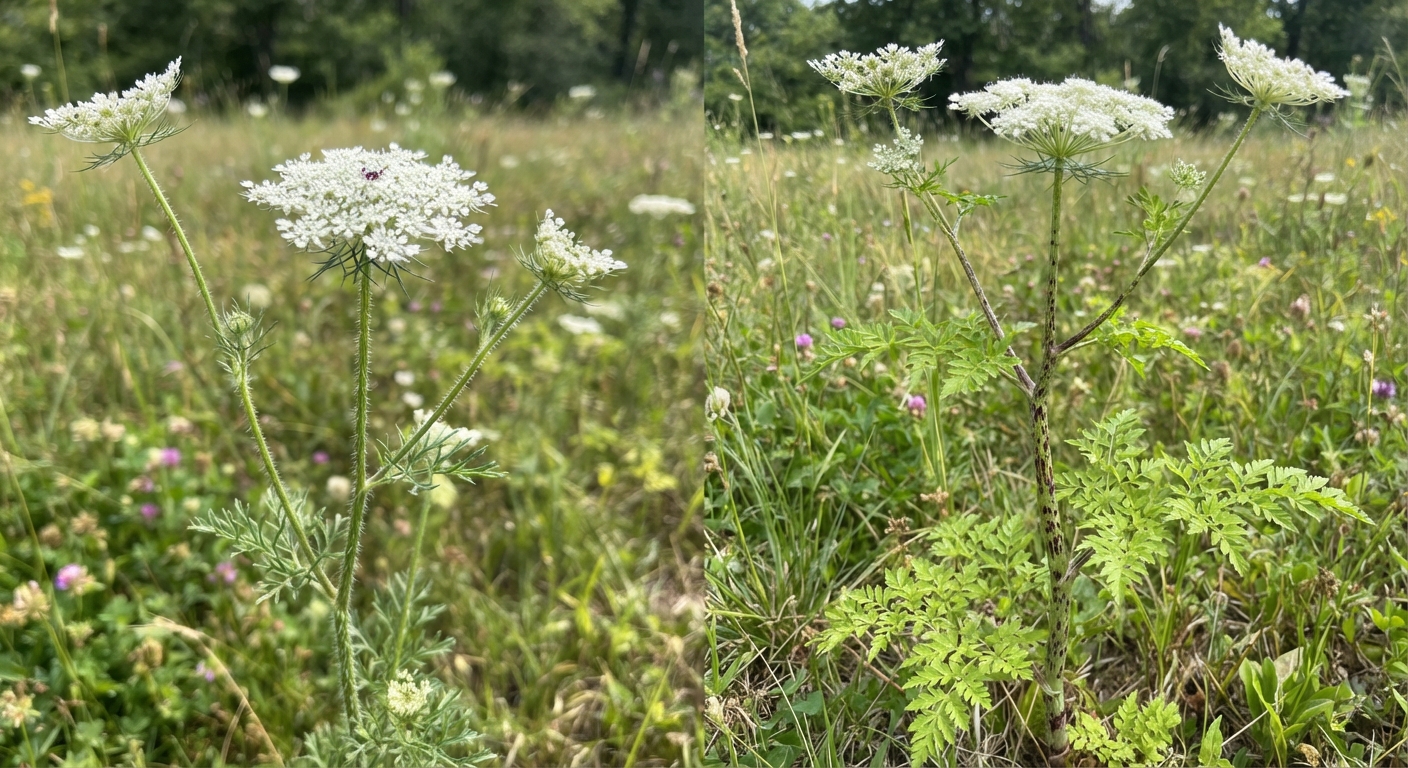
Online plant identification from photos alone is lottery-level reliability. The same species can look dramatically different depending on age, season, soil quality, and how much sun it gets. A dandelion growing in full sun with rich soil is practically a different visual experience from one eking out an existence in a sidewalk crack.
Here are the three mistakes that picture-based ID leads to most often:
Mistake 1: Queen Anne’s Lace vs. Poison Hemlock. Both have white umbrella-shaped flower clusters and fern-like leaves. Hemlock has smooth, purple-spotted stems — Queen Anne’s lace has hairy, green stems. Hemlock killed Socrates. Don’t be Socrates. Check the stems.
Mistake 2: Wild Garlic vs. Death Camas. As covered above. The smell test is the only test that matters. No onion-garlic smell = do not risk it.
Mistake 3: Pokeweed Shoots vs. Wild Asparagus. Early spring pokeweed shoots look deceptively like asparagus spears. The difference: pokeweed shoots are thicker, often tinged red or purple at the base, and lack the scale-like triangular leaves that asparagus has. Pokeweed is toxic raw and requires specific preparation to be edible — not a beginner’s plant.
The solution isn’t to memorize every toxic plant. It’s to learn positive identification — you confirm what a plant IS, not rule out what it ISN’T. Triple-confirm using three separate identification markers before eating anything. One field guide plus one photo from a trusted source plus one in-person ID from someone experienced.
Three Rules That Replace a Lifetime of Memorization
1. The Smell Test. Alliums (onion family) smell like onion. Mint family plants have square stems and smell minty. The smell test identifies entire plant families instantly. Use it.
2. White Sap Warning. Milky white sap in a plant you haven’t positively identified? Stop. Some plants with white sap are edible (dandelion, wild lettuce), but many more are irritants or toxic. This isn’t a rule that says “don’t eat white-sap plants” — it’s a rule that says “confirm identity before proceeding.”
3. One New Plant Per Outing. Foragers who try to learn five new plants in one afternoon end up learning zero with confidence. Pick one plant, find it, photograph it, confirm it from two sources, harvest it, eat a small amount, and wait 24 hours. Then move on to the next plant. Rushing makes you dangerous, not efficient.
Frequently Asked Questions
Can I eat these plants raw in the field?
Some, yes. Wood sorrel, chickweed, purslane, violet flowers — all safe raw. Others need cooking: nettle (stingers), curly dock (oxalates), and older lamb’s quarters (saponins). When in doubt, cook first.
How do I wash wild plants?
Three-basin method: rinse in clean water, soak in water with a splash of vinegar for 5 minutes, final rinse. Gets rid of dirt, bugs, and any surface contaminants. If you’re foraging in urban areas, this step is non-negotiable.
Where is it legal to forage?
Public land rules vary massively by jurisdiction. National parks: usually prohibited. National forests: usually allowed for personal use. City parks: check local ordinances — some allow it, some fine for it. Private land: always ask. The safest bet? Your own yard and friends’ yards, with permission.
What if I eat something and feel sick?
Call poison control immediately — don’t wait for symptoms to “get worse.” Bring a sample of what you ate. In the US, the Poison Help Line is 1-800-222-1222. Add it to your phone contacts before you ever go foraging.
How much can I harvest without damaging the ecosystem?
The standard rule: take no more than 10–20% of a plant population. Never harvest the only patch you can find. For annuals like purslane and lamb’s quarters — generous harvesting is fine. For slow-growing perennials like ramps — extreme restraint or avoid entirely.
Bottom Line
You don’t need a botany degree. You need to learn about six to eight plants that grow near you, understand their seasonal rhythm, and build the habit of positive identification before every harvest.
Start with dandelion, purslane, chickweed, and lamb’s quarters — four plants available in most of North America and Europe, growing in places you already walk past. Learn them cold. Then add wood sorrel, wild garlic, and nettles. Before you know it, you’ll walk through a park and see food where you used to see weeds.
That’s not a metaphor. That’s what actually happens when you build the skill.