A few summers ago, I was hiking in the Pacific Northwest with a friend who pulled out his phone to identify a cluster of mushrooms growing along the trail. The app confidently labeled them as Cantharellus — chanterelles. He was ready to harvest them for dinner.
The problem? They were Omphalotus olearius — jack-o’-lantern mushrooms. Not deadly, but they’d leave you vomiting for hours and questioning every life choice that led you to that moment.
What stopped him was a battered copy of David Arora’s Mushrooms Demystified I had in my daypack. Five minutes flipping through pages confirmed the truth: gills that glow faintly in the dark, orange flesh that bruises differently — details no app caught that day.
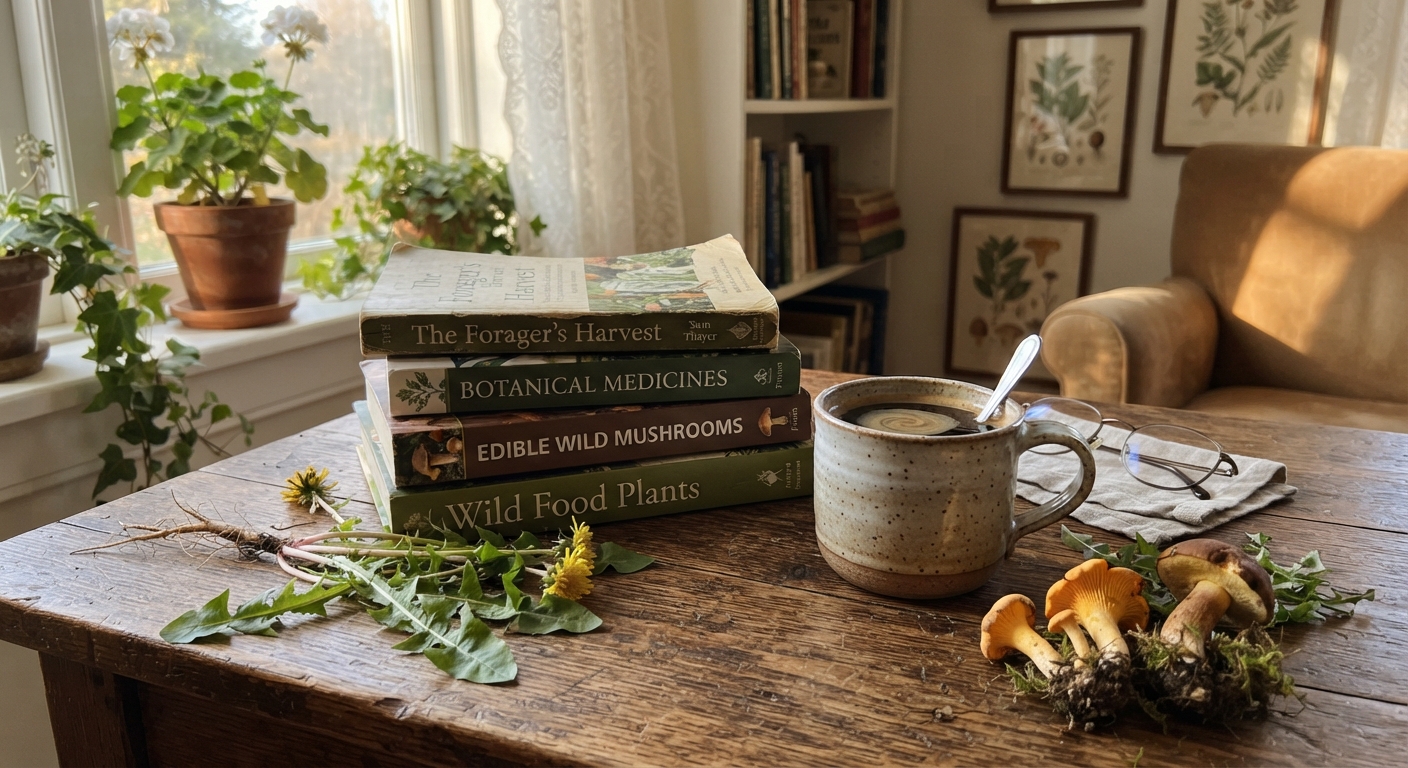
This is why a physical foraging book belongs in your pack, on your shelf, and in your hands when it matters. This guide covers the books worth buying, which ones to skip, and how to build a foraging library that will actually keep you safe and well-fed.
Why Foraging Books Still Matter in the Age of Apps
Plant identification apps have improved dramatically. Seek by iNaturalist, PictureThis, and PlantNet can all give you a name in seconds. But the gap between “a name” and “safe to eat” is where books earn their place.
A 2024 study published in Clinical Toxicology tested five plant ID apps against 38 known toxic species. The best performer correctly flagged only 83% of them as dangerous. The worst? 42%. When one in five toxic plants gets a clean bill of health from an algorithm, you need a second opinion.
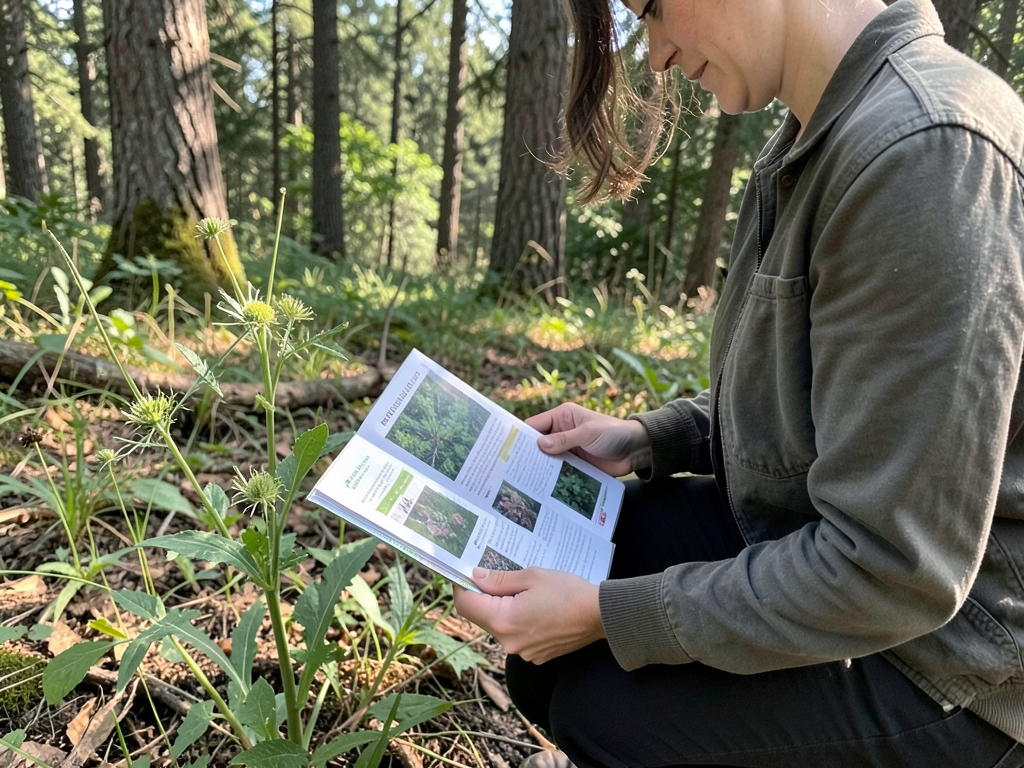
Books don’t lose signal. They don’t run out of battery. They don’t hallucinate plant names because the lighting is weird. And critically, a good field guide teaches you how to identify — not just what the answer is. You learn to look at leaf arrangement, stem structure, habitat context, and seasonal patterns. That knowledge compounds. Each plant you learn makes the next one easier.
The Three-Tier Foraging Library
Most foragers don’t need thirty books. You need three types:
| Tier | Purpose | Examples |
|---|---|---|
| Field Guide | Pocket-sized, quick reference in the field, photo or illustration-heavy | Peterson Field Guides, National Audubon Society |
| Reference Manual | In-depth botany, detailed keys, comprehensive coverage of a region | Botany in a Day, Samuel Thayer’s books |
| Specialized Book | Deep dives — mushrooms, seaweeds, medicinal plants, specific regions | Mushrooms Demystified, Pacific Seaweeds |
Start with one field guide. Add a reference manual when you outgrow it. Specialize from there.
Best Beginner Foraging Books
If you’re new to foraging and can only buy one book, start here.
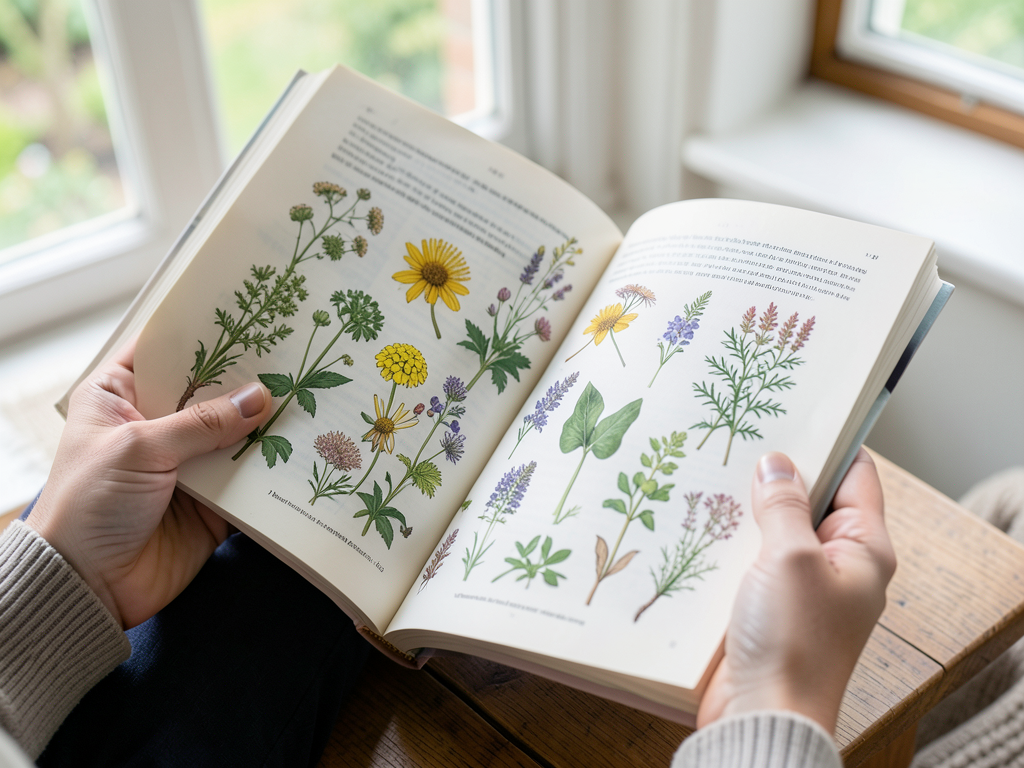
1. The Forager’s Harvest by Samuel Thayer
This is the book I recommend to every single beginner who asks me where to start — and it’s not even close.
Thayer doesn’t try to cover 500 plants in shallow detail. He covers about 30 plants in extraordinary depth, with personal stories, harvesting techniques, processing instructions, and — crucially — detailed lookalike comparisons. Every plant he writes about is something he has personally harvested, cooked, and eaten hundreds of times.
What sets this book apart is the photography. Thayer took every photo himself with a foraging-specific eye. He shows you what the plant looks like at different growth stages, from different angles, and next to its toxic lookalikes. This is the book that taught me cattails aren’t just “survival food” — they’re genuinely delicious when harvested at the right time.
Best for: Absolute beginners who want to learn a small number of plants really, really well.
2. Nature’s Garden by Samuel Thayer
Thayer’s follow-up follows the same format but covers different plants — wild fruits, nuts, greens, and root vegetables not covered in his first book. Together, The Forager’s Harvest and Nature’s Garden cover roughly 65 wild edibles with the kind of depth you simply won’t find anywhere else.
If you buy both, you’ll have a better practical foraging education than most people get from a dozen mediocre field guides.
Best for: Intermediate foragers ready to expand beyond the basics.
3. Edible Wild Plants: A North American Field Guide by Thomas Elias and Peter Dykeman
This one is a solid compromise between depth and breadth. It covers over 200 species with color photos and clear identification keys. The organization by season makes it especially useful — you can flip to “Spring” and immediately see what’s available right now.
The toxic lookalike warnings are among the clearest I’ve seen in any general-purpose guide. Each entry has a dedicated “Caution” box when applicable, with side-by-side comparison points.
Best for: Beginners who want broader coverage without sacrificing safety.
Best Regional Foraging Guides
Generic guides are fine, but regional guides are better. Plants don’t grow everywhere — a guide covering “North America” will show you plants you’ll never encounter alongside ones you walk past every day.
4. Pacific Northwest Foraging by Douglas Deur
If you live between Northern California and British Columbia, this is your book. Deur covers 120 wild edibles specific to the Pacific Northwest, from coastal seaweeds to mountain huckleberries. His treatment of traditional Indigenous harvesting practices adds valuable cultural context that most guides ignore entirely.
Best for: Anyone in the PNW bioregion.
5. Northeast Foraging by Leda Meredith
Meredith’s guide to the northeastern US covers 120 plants you’re likely to find in urban parks, suburban edges, and rural forests of New England and the Mid-Atlantic. Her perspective as someone who forages extensively in and around Brooklyn gives this book a unique urban-foraging lens that most guides lack.
Best for: Northeast US foragers, especially urban and suburban.
6. Southeast Foraging by Chris Bennett
Bennett covers 120 wild edibles across the Southeast, from the Carolinas to Florida and west to Texas. The humidity and long growing seasons of the Southeast create a completely different foraging landscape than what you’ll find in northern guides — this book acknowledges that reality on every page.
Best for: Southeastern US foragers who find northern-centric guides frustrating.
Best Mushroom Foraging Books
Mushroom foraging demands its own library. The stakes are uniquely high, and the identification challenges are more complex than with plants.
7. Mushrooms Demystified by David Arora
This is the mushroom bible. At nearly 1,000 pages, it’s not a field guide — it’s a comprehensive reference manual that happens to be wildly entertaining. Arora’s writing voice is irreverent, funny, and deeply authoritative. His descriptions of mushroom flavors are legendary (“tastes like a cross between lobster and filet mignon, with the texture of wet cardboard”).
The dichotomous keys are thorough. You’ll learn mushroom identification the right way — through deliberate, step-by-step observation of every feature from cap shape to spore print color.
Best for: Serious mushroom hunters who want the definitive reference.
8. All That the Rain Promises and More by David Arora
Arora’s pocket-sized companion to Mushrooms Demystified. It’s deliberately quirky — Arora appears on the cover playing a trumpet while wearing a tuxedo and a mushroom-covered hat — but the identification information is serious. The format is built around a clever visual key system organized by mushroom shape and habitat.
At roughly 260 pages in a compact paperback format, it’s the mushroom book you’ll actually carry into the woods.
Best for: Mushroom hunters who want a portable field companion to the big Arora book.
9. Edible Mushrooms: A Forager’s Guide to the Wild Fungi of North America by Geoff Dann
Dann is a British forager who’s developed a strong following in North America. His photography is exceptional — each mushroom is shown in its natural habitat at multiple angles. The emphasis on edibility and cooking makes this more practical for the foraging kitchen than most mushroom guides, which lean heavily toward academic identification.
Best for: Foragers who want to eat mushrooms, not just identify them.
Best Foraging Books for Survival and Self-Reliance
10. Botany in a Day by Thomas J. Elpel
Elpel’s approach is different from every other book on this list. Rather than teaching you individual plants, he teaches you plant families. Once you can recognize the patterns of a family — say, the characteristic flower structure of the mint family (Lamiaceae) or the umbel inflorescence of the carrot family (Apiaceae) — you can recognize hundreds of related plants by their shared architecture.
This is the book that fundamentally changed how I see plants. Walking through a meadow went from “green things with the occasional identifiable flower” to “that’s a mustard, that’s a legume, that’s a mint” — all from a glance at leaf arrangement and flower structure. The plant kingdom becomes legible in a way that memorizing individual species never achieves.
Best for: Anyone who wants to move beyond memorization and truly understand plant identification.
11. Edible Wild Plants: Wild Foods from Dirt to Plate by John Kallas
Kallas is a wild foods educator with decades of teaching experience, and it shows. This book reads like a course — methodical, thorough, and designed to build skills progressively. The photography is outstanding, with detailed sequence shots showing plants at every growth stage.
His treatment of wild greens is the strongest section — Kallas knows his cresses, mustards, and docks better than almost anyone writing today. The nutrition data for each plant is unusually detailed, with actual lab analysis figures rather than estimates.
Best for: Systematic learners who want the closest thing to an actual foraging course in book form.
Best Books on Edible Weeds and Urban Foraging
12. Backyard Foraging by Ellen Zachos
Zachos makes a compelling argument: you don’t need pristine wilderness to forage. Your yard, your neighborhood park, and the vacant lot down the street are probably full of edible plants you’ve been walking past for years. She covers 65 common plants found in urban and suburban environments across North America.
Her recipes section is genuinely useful — lamb’s quarters spanakopita, anyone? — and the photography makes urban foraging look like the treasure hunt it actually is.
Best for: City dwellers, suburban gardeners, and anyone who thinks foraging requires driving to a national forest.
How to Choose Your First Foraging Book
If you’re standing in a bookstore or scrolling through options feeling overwhelmed, here’s a decision framework:
-
Are you foraging for mushrooms? → Start with All That the Rain Promises and More. Add Mushrooms Demystified when you’re serious.
-
Are you a complete beginner with plants? → The Forager’s Harvest by Samuel Thayer. Don’t overthink it.
-
Do you want broad coverage of common plants? → Edible Wild Plants: A North American Field Guide by Elias and Dykeman.
-
Do you want to learn plant families, not just species? → Botany in a Day by Thomas Elpel.
-
Do you live in a specific US region? → Buy the Timber Press regional guide for your area (PNW, Northeast, Southeast, Southwest, Midwest, or Mountain States).
What to Avoid in Foraging Books
Not every foraging book deserves your shelf space. Here’s what raises red flags:
Books with drawings instead of photographs. Illustrations have their place in botany, but for a beginner trying to identify something they might eat, high-quality photographs are non-negotiable. The subtle color variations and textures that distinguish safe plants from toxic ones rarely translate well to drawings.
Books that cover too many plants in too little detail. A book promising “500 edible plants of North America” in 200 pages is giving every plant about 0.4 pages. That’s not enough for safe identification. You want depth over breadth.
Books without clear lookalike warnings. Any foraging guide that doesn’t explicitly address toxic lookalikes for every major edible plant is incomplete and potentially dangerous. This should be a dealbreaker.
Books with no author credentials. Who wrote this? Are they a botanist? A longtime forager? A survival instructor? If the author’s background isn’t clear, be skeptical. Foraging is one subject where expertise genuinely matters — lives depend on it.
Digital Companions: Books + Apps
Books and apps aren’t enemies. They’re complementary tools, and smart foragers use both.
A practical workflow: use an app like Seek or iNaturalist for an initial ID suggestion, then verify with your field guide before even considering eating anything. If the app and the book disagree, trust the book. If you’re still uncertain, don’t eat it. No meal is worth an ambulance ride.
Several of the books on this list have companion apps or digital versions. Arora’s mushroom books have spawned multiple digital key projects. Samuel Thayer’s website provides supplementary photos and seasonal harvest calendars. But the core identification work still lives best on paper.
Field Guide Care Tips
A foraging book is a tool, not a decoration. Here’s how to keep yours functional:
- Waterproof it. A gallon Ziploc bag in your pack costs pennies and saves your $25 field guide from rain.
- Tab the pages. Use small adhesive tabs to mark your most-referenced plants. You don’t want to flip through an index with muddy hands.
- Write in it. Underline key identification points. Add notes about where and when you found each plant. Your annotations turn a generic book into a personal foraging journal.
- Keep a backup at home. The book you carry in the field will get wet, dirty, and battered. Have a clean reference copy on your shelf for cross-checking at home.
The Bottom Line
You don’t need a shelf full of books to be a good forager. You need one or two truly excellent ones that you actually use — that you carry into the field, get dirty, annotate, and learn from until the pages are worn and the information is internalized.
Start with Thayer. Add a regional guide. Get Arora if you’re into mushrooms. Build slowly and deliberately. The goal isn’t to own the most books — it’s to know the plants in your ecosystem deeply enough that you can walk through it with confidence and bring dinner home in your basket.
Frequently Asked Questions
Is one foraging book enough to get started?
Yes. One good field guide — especially Samuel Thayer’s The Forager’s Harvest or a regional Timber Press guide — gives you everything you need to start identifying and harvesting a dozen or more common wild edibles safely. Most experienced foragers recommend mastering five to ten plants thoroughly before expanding your list.
Should I get a mushroom-specific book or a general foraging book first?
If mushrooms are your primary interest, get a mushroom-specific book. Mushroom identification requires different skills and carries different risks than plant identification. If you’re interested in both plants and mushrooms, start with a general plant guide and add a mushroom guide later — the plant guide will give you more immediate, lower-risk opportunities to practice identification skills.
Are older foraging books still reliable?
Some are, many aren’t. Botanical taxonomy changes over time as scientists reclassify species. A book from the 1970s may use outdated scientific names or lack current safety information about plants now known to have toxic lookalikes. Books by recognized experts (like Euell Gibbons or Bradford Angier) remain valuable for their foraging philosophy and historical perspective, but pair them with a modern field guide for identification.
How many plants should I learn before I start actually eating what I find?
Start with one. Pick a single common, unmistakable plant — dandelions, blackberries, or cattails are excellent choices — and learn everything about it. Find it in multiple locations and growth stages. Harvest it. Cook it. Eat it. Once you have that plant completely dialed in, add another. This one-plant-at-a-time approach is slower but infinitely safer than trying to memorize fifty plants from a book.
Can I trust foraging books from outside my region?
Use them for education and inspiration, but not for primary identification. A book written for the British Isles or Australia will include plants that look similar to — but are not the same as — North American species. Always pair any non-regional guide with a local field guide for verification.
What’s the single most important book for a prepper or survivalist?
Botany in a Day by Thomas Elpel. In a true survival situation, you can’t carry a library. Understanding plant family patterns lets you make intelligent judgments about unfamiliar plants based on their botanical relatives — which families are safe, which are dangerous, and which require special caution. Combined with a regional field guide, it’s the most versatile survival botany foundation available.