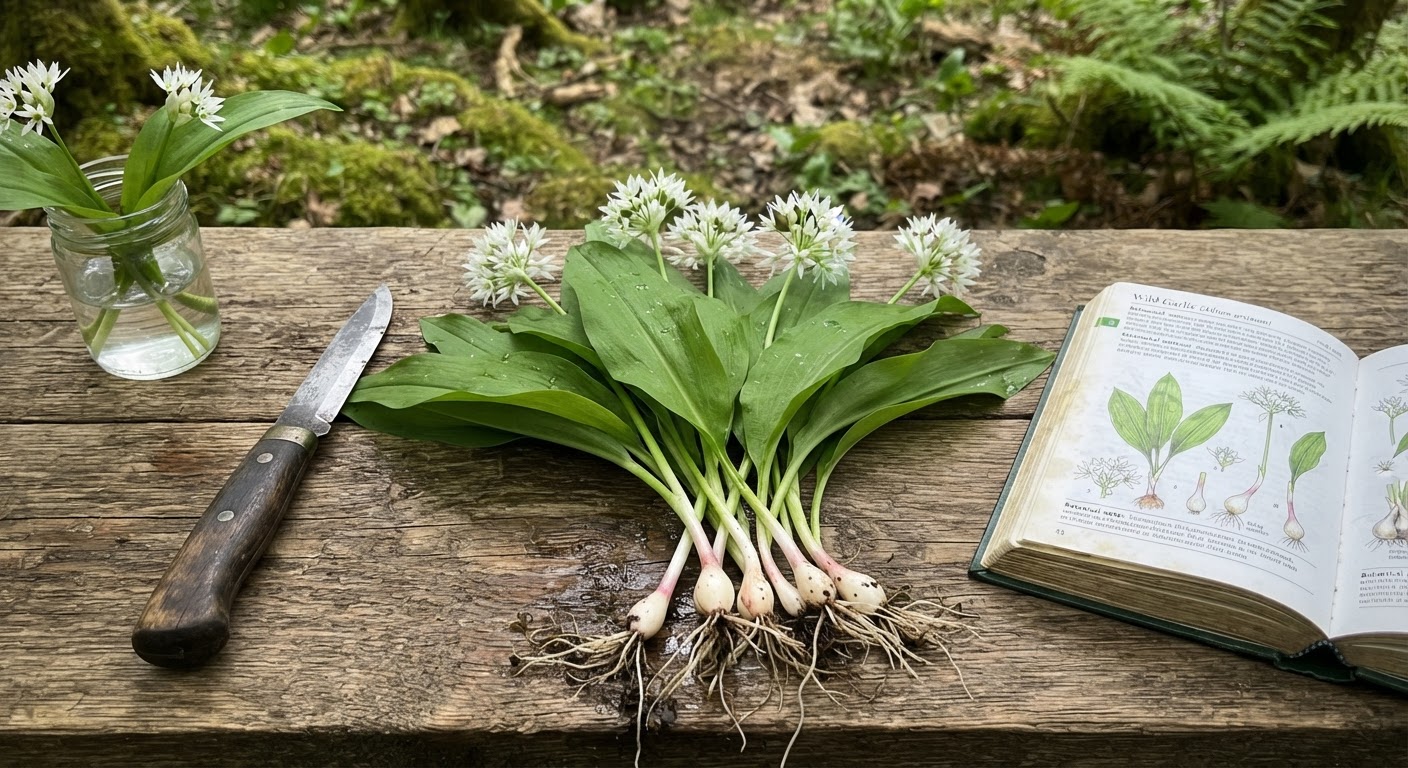
I almost poisoned myself once. Not with a mushroom, not with some obscure root I couldn’t pronounce — with what I was absolutely certain was wild garlic.
It was early spring in the Appalachian foothills, and I’d been foraging for about three years. Confident. Cocky, even. I spotted a dense patch of broad green leaves carpeting a shady slope and thought, Jackpot. Ramps. I pulled a few, gave them a quick sniff, and tossed them in my bag.
Back at the truck, I started cleaning my haul. One of the leaves caught my eye — it was just slightly wrong. The veins ran parallel to the leaf edge in a way that didn’t look quite right. I held it up to my nose and sniffed again. Nothing. No garlic. No onion. Just… green.
It was lily of the valley (Convallaria majalis), growing intertwined with the actual ramps I’d harvested. I’d been so focused on the patch that I hadn’t checked every single plant individually. One mouthful of that leaf could have sent me to the emergency room with cardiac glycoside poisoning.
That day fundamentally changed how I approach wild Allium identification, and it’s the reason I’m writing this guide. This isn’t a recipe article — you won’t find a single pesto recipe here. This is a deep-dive identification manual for every edible wild garlic and onion species in North America, plus the toxic imposters you need to recognize on sight.
If you take nothing else from this article, take this: the smell test is not optional. Every single plant must pass it individually. No exceptions.
The Allium Family: What Makes Wild Garlic, Wild Garlic?
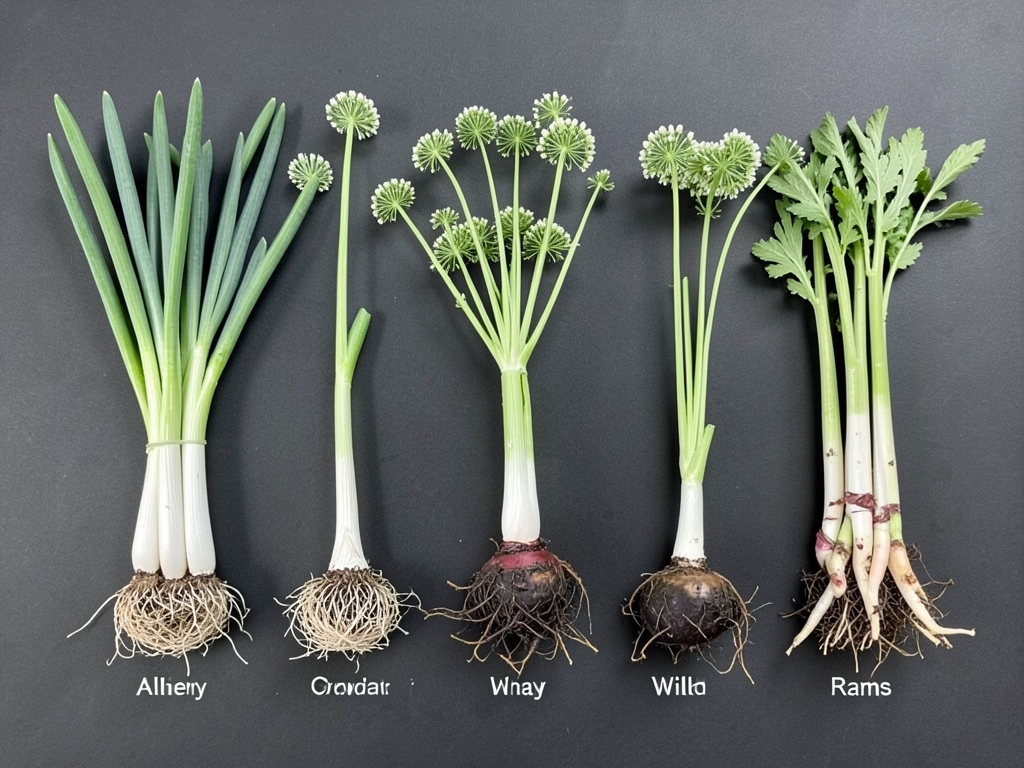
Before we get into individual species, let’s establish what unites them. All edible wild alliums belong to the genus Allium, part of the Amaryllidaceae family. The genus includes somewhere around 900 species worldwide, but in North America, foragers typically encounter five main edible types:
- Wild garlic (Allium ursinum, also called ramsons, bear’s garlic, or buckrams)
- Ramps (Allium tricoccum, also called wild leeks, spring onions, or ramson — confusing, I know)
- Wild onion (Allium canadense, also called meadow garlic or Canada onion)
- Field garlic (Allium vineale, also called crow garlic, wild garlic, or onion grass)
- Crow garlic (Allium vineale var. compactum — essentially field garlic’s top-setting form)
If those common names seem like a mess, that’s because they are. “Wild garlic” gets applied to at least three different species depending on where you live. “Ramson” might mean Allium ursinum to a British forager and Allium tricoccum to someone in West Virginia. This is exactly why you always pair common names with scientific names when you’re verifying a find.
The unifying characteristic of every edible wild Allium is the smell. Crush any part of the plant — leaf, stem, bulb — and it will release that unmistakable sulfurous compound, allicin, the same substance that gives your kitchen garlic its punch. This smell is the single most important identification tool in your arsenal. If a plant looks like a wild allium but doesn’t smell like garlic or onion, you are holding something else — possibly something dangerous.
Species One: Wild Garlic / Ramsons (Allium ursinum)
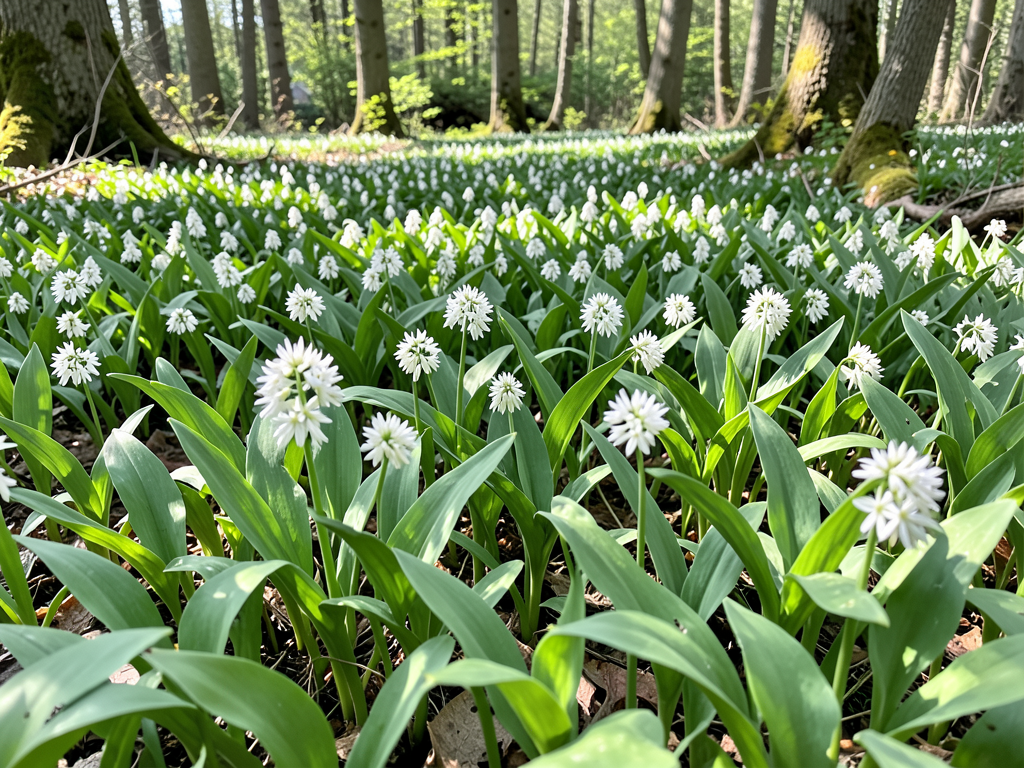
Allium ursinum is the classic European wild garlic. If you’ve seen those viral photos of British woodlands absolutely carpeted in green with the air thick with garlic scent — that’s ramsons. The species name ursinum means “bear,” likely because brown bears historically dug up the bulbs, or because the plant emerges when bears wake from hibernation.
Key Identification Features
Leaves: Broad, lance-shaped, and smooth-edged. Each leaf typically measures 2–5 cm wide and 10–25 cm long. They emerge individually from the base (not from a central stem the way ramps do). The leaf surface is matte — not glossy — with a soft, almost velvety texture when young. The underside is slightly paler than the top. One of the most reliable ID markers: the leaf stalk (petiole) is distinctly triangular in cross-section if you cut it and look at the cut end.
Flowers: Pure white, star-shaped, with six pointed petals. They appear in loose, round clusters (umbels) on a single leafless flowering stalk that stands 20–50 cm tall. Bloom time is April to June, depending on latitude. There are typically 10–20 individual flowers per umbel. Critically, there are no bulbils in the flower head — if you see tiny bulbs mixed in with the flowers, you’re looking at field garlic, not ramsons.
Bulb: Narrow, white, and elongated — more like a slender spring onion than a round garlic clove. Typically 2–4 cm long and about 1 cm wide. The bulb is relatively small compared to the above-ground foliage.
Smell: Intense garlic — unmistakable. Even brushing against a large patch releases a cloud of garlic scent.
Where and When to Find Them
Ramsons are native to Europe and western Asia. In North America, they’re an introduced species found primarily in the Northeast and Pacific Northwest, often in urban woodlands near old settlements where they escaped cultivation. Their preferred habitat is deciduous woodland with rich, moist, alkaline soil — think stream banks, shaded slopes, and the edges of old-growth forest.
Harvest window: Leaves are best from March through early May, before flowering. Once the plant flowers, the leaves become tougher and more bitter. The flowers themselves are edible and make a gorgeous garnish that tastes like mild garlic. The bulbs can be harvested from midsummer through fall but are small and not really worth the effort for cooking — you’re better off leaving them to regrow for next spring.
A Personal Lesson in Ramsons Hunting
My most memorable ramsons harvest was not in Europe but in a small patch of woods just outside Portland, Oregon. A friend who studies invasive species tipped me off that a naturalized population had been spreading near an old homestead. I went in late March at dawn — mist still hanging in the trees — and found roughly an acre of woodland floor that looked like someone had laid down green carpet. The smell hit me before I saw a single leaf.
But even in that massive patch, I checked every leaf I harvested individually. I found three dock leaves and one lords-and-ladies (Arum maculatum) growing among the ramsons. Lords-and-ladies contains calcium oxalate crystals that cause intense burning if eaten raw. Same broad leaf shape, same habitat, zero garlic smell. The smell test saved me from a very unpleasant afternoon.
Species Two: Ramps / Wild Leeks (Allium tricoccum)
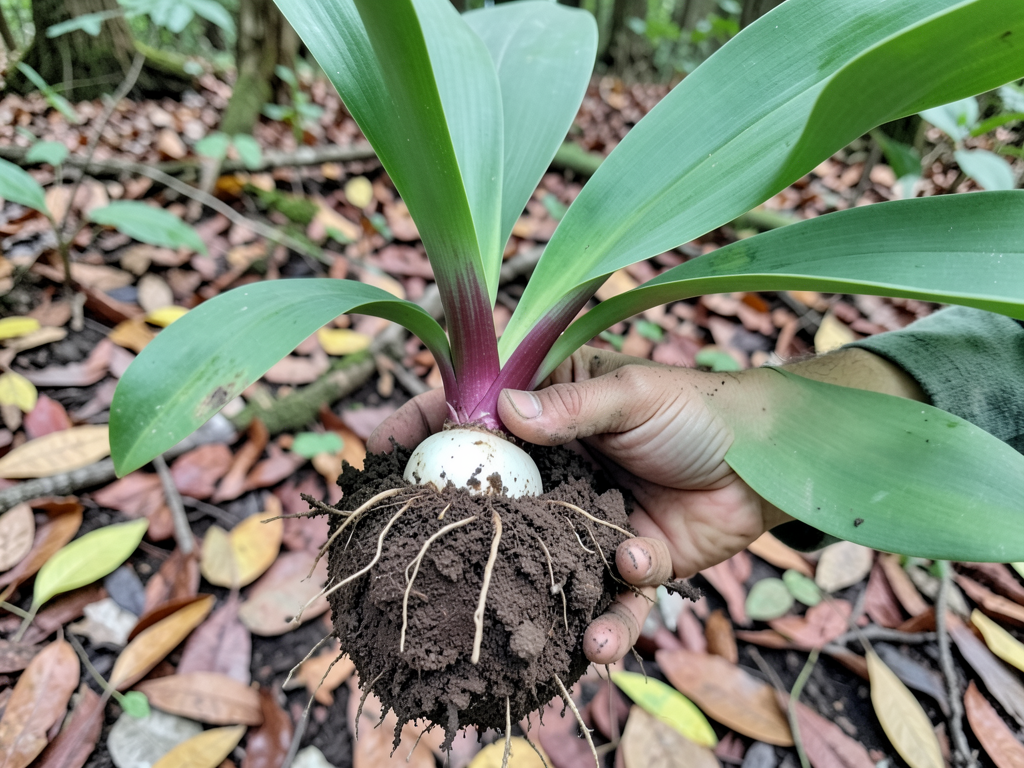
Ramps are the crown jewels of Appalachian spring foraging — and the most overharvested wild allium in North America. Their intense flavor falls somewhere between garlic and onion, and their cultural significance in the American South and Appalachia runs deep, celebrated at community ramp dinners and festivals every spring.
Key Identification Features
Leaves: Broad, smooth, and elliptical — similar to lily of the valley, and this is the comparison that kills people. Each ramp plant produces 2–3 leaves from a single stalk. The leaves are 5–10 cm wide and 15–30 cm long, with a smooth, slightly waxy surface. They taper to a pointed tip and narrow into a distinct purplish or reddish petiole (leaf stalk) that connects to the bulb. This purple coloration is a strong field marker — not every ramp has it, but most do, especially mature plants.
Stem and Bulb: The bulb is white with a purplish or reddish sheath, shaped like a small elongated onion, typically 2–6 cm long and 1–3 cm wide. A cluster of thin white roots extends from the base. The bulb is more substantial than ramsons and is the part most prized by chefs — though harvesting the bulb kills the plant, which is why sustainability-minded foragers take only the leaves.
Flowers: Ramps flower in mid to late summer (June–August), after the leaves have completely died back. This is a critical ID fact: if you see broad green leaves AND flowers on the same plant in spring, it is not a ramp. The flowering stalk rises 15–40 cm from the bare ground with a spherical cluster (umbel) of small white flowers, each with six tepals. The flower head contains no bulbils.
Smell: Strong onion-garlic hybrid scent. If it doesn’t smell like an onion, it’s not a ramp.
Where and When to Find Them
Ramps are native to eastern North America, from South Carolina up through Quebec and west to Minnesota and Missouri. Their prime territory is the Appalachian range — West Virginia, Virginia, North Carolina, Tennessee, Kentucky, and Pennsylvania have the densest populations. They favor north-facing slopes in rich, moist deciduous forests, often under sugar maple, beech, and basswood trees.
Harvest window: Leaves only — April through early May, before tree canopy fills in. Patches emerge as soon as snow melts and soil temperatures hit about 50°F (10°C). The window is narrow — maybe 3–4 weeks in a given location. At higher elevations, you might find ramps into late May.
The Sustainability Problem
I want to pause here because this matters. Ramps reproduce slowly. A ramp plant takes 5–7 years to reach maturity from seed. When you dig up the bulb, that plant is gone forever. Some ramp patches in popular foraging areas have been decimated — literally wiped out — by overharvesting.
The sustainable way to harvest ramps: Take one leaf per plant, from no more than 10% of the plants in a patch. Use a sharp knife or scissors. Do not pull the plant. Do not dig the bulb. The leaves contain plenty of flavor, and the plant survives to grow again next year. This practice is catching on among responsible foragers, and it’s the only way we’ll still have ramps to harvest in 50 years.
If you absolutely must harvest bulbs, take only mature plants with at least three fully developed leaves, from patches of 100+ plants, and never more than 5% of the patch per year. But honestly? Just stick with the leaves.
Species Three: Wild Onion / Meadow Garlic (Allium canadense)
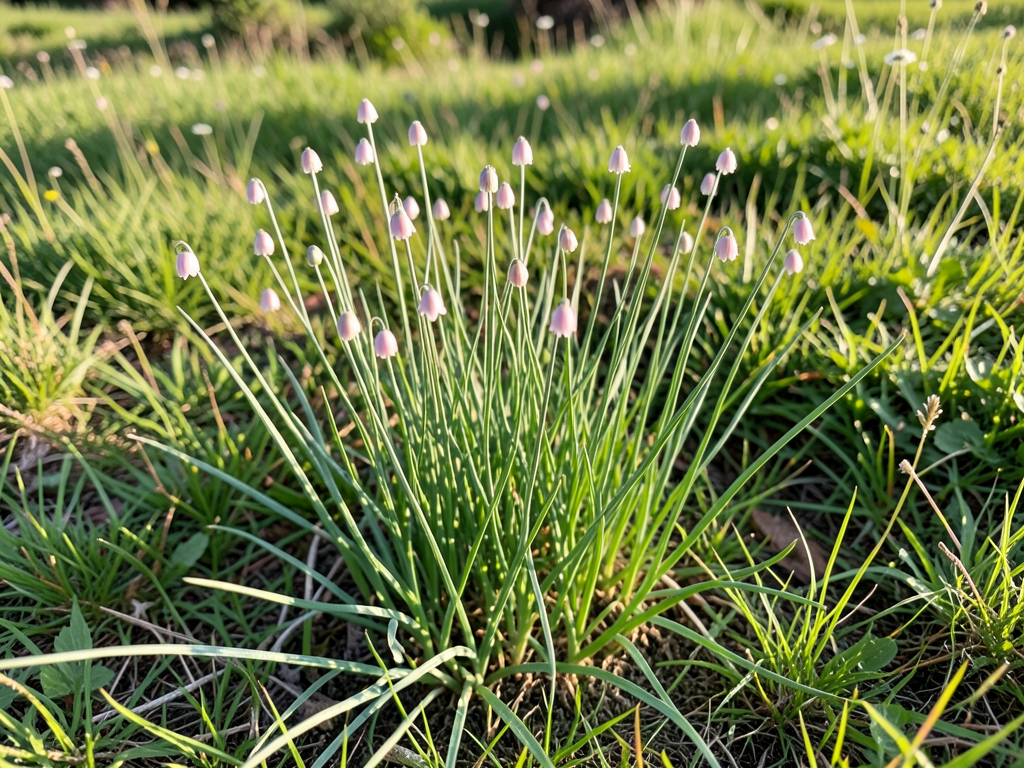
Wild onion is one of the most common and widely distributed wild alliums in North America, found across most of the eastern and central United States and into parts of Canada. If you’ve ever noticed an onion-y smell while mowing your lawn, there’s a good chance you’ve got wild onion growing right under your feet.
Key Identification Features
Leaves: Thin, round, and hollow — like chives or a skinny green onion. They’re typically 2–5 mm in diameter and 20–50 cm tall. The leaves are the most consistent field marker: if the leaves are flat or solid (not hollow), you’re not looking at A. canadense. They emerge from the bulb in clusters of 2–6, with a waxy, slightly blue-green tint to the color.
Flowers and Bulbils: This is where wild onion gets tricky. The flowering stalk is 30–60 cm tall and topped with a cluster that often contains a mix of actual flowers (small, pink to white, bell-shaped) and small aerial bulbils — tiny onion-like structures that can sprout into new plants. In some populations, the flowers are rare or absent, and the entire head is replaced by a cluster of bulbils. This “top-setting” behavior is a key trait that distinguishes it from ramps and ramsons, which never produce bulbils in the flower head.
Bulbs: Underground bulbs are small (1–2 cm diameter), round to oval, and covered with a fibrous, net-like outer layer that’s tan to brown. They’re noticeably different from the smooth-skinned bulbs of ramps. The bulb has a strong onion scent and flavor.
Smell: Pronounced onion scent, less garlic-forward than ramsons or ramps.
Where and When to Find Them
Wild onion grows in a remarkable range of habitats — moist meadows, prairie remnants, open woodlands, roadsides, and yes, suburban lawns. It tolerates more sun and drier conditions than ramps or ramsons, which makes it the most accessible wild allium for many foragers. USDA hardiness zones 3–9, from central Texas to Manitoba, Florida to Maine.
Harvest window: Leaves can be harvested from early spring through fall, though they’re at their best in spring. Bulbs are best dug in late summer or fall when the aerial growth starts to die back. The bulblets from the flower head can be harvested in summer and used like pearl onions, or planted to start your own patch.
Species Four: Field Garlic / Onion Grass (Allium vineale)
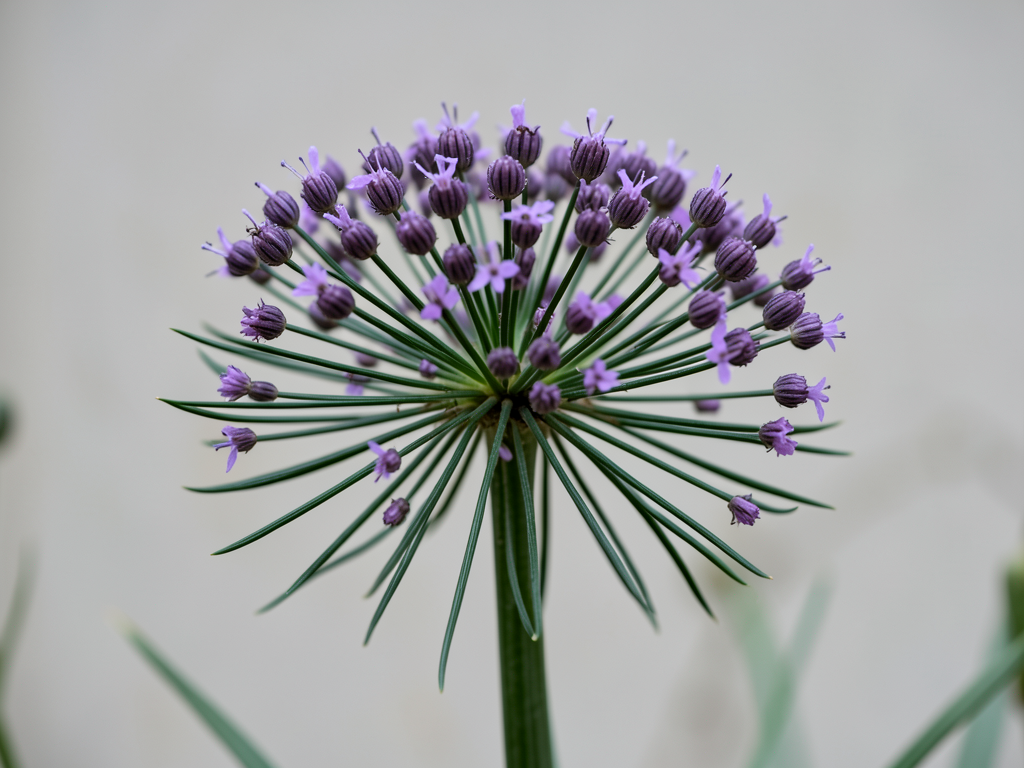
Field garlic looks a lot like a miniature version of wild onion, and the two are often confused. In fact, some older field guides use “crow garlic” and “field garlic” interchangeably. The differences are subtle but learnable.
Key Identification Features
Leaves: Extremely thin, round, and hollow — like dark green wires, typically only 1–3 mm in diameter. They grow 30–80 cm tall and emerge in dense tufts. If wild onion’s leaves remind you of chives, field garlic’s leaves remind you of coarse dark-green thread. They have a distinct groove running lengthwise along one side — run your fingernail along a leaf and you’ll feel it.
Flowers and Bulbils: Like wild onion, field garlic often produces bulbils instead of true flowers, but field garlic takes this to an extreme. The flower head is a dense, purplish cluster almost entirely composed of bulbils, sometimes with a few tiny pink or purple flowers scattered among them. When these bulbils mature, they often sprout small green shoots while still attached to the parent plant — a distinctive sight that looks otherworldly.
Underground Bulbs: Small (1–2 cm), often offset by side-bulblets that share a papery outer wrapper. These offset bulbs peel apart easily, unlike the single cohesive bulb of wild onion. If you dig one up and it separates into multiple small cloves, you’ve got field garlic.
Smell: Onion-garlic mix, with a sharper, more pungent edge than wild onion.
Where and When to Find Them
Field garlic is a European native that has naturalized aggressively across most of North America. It’s particularly common in the eastern and midwestern United States. You’ll find it in lawns, pastures, fields, roadsides, and disturbed ground — basically anywhere the soil has been turned. It’s considered an agricultural weed in wheat and hay fields, where it can taint grain and milk with onion flavor.
Harvest window: Year-round in most of its range, though growth slows in winter. The underground bulbs and topsetting bulbils are easiest to harvest from mid-summer through fall. The leaves can get tough in summer heat but are usable in spring and fall.
Species Five: Crow Garlic (Allium vineale var. compactum)
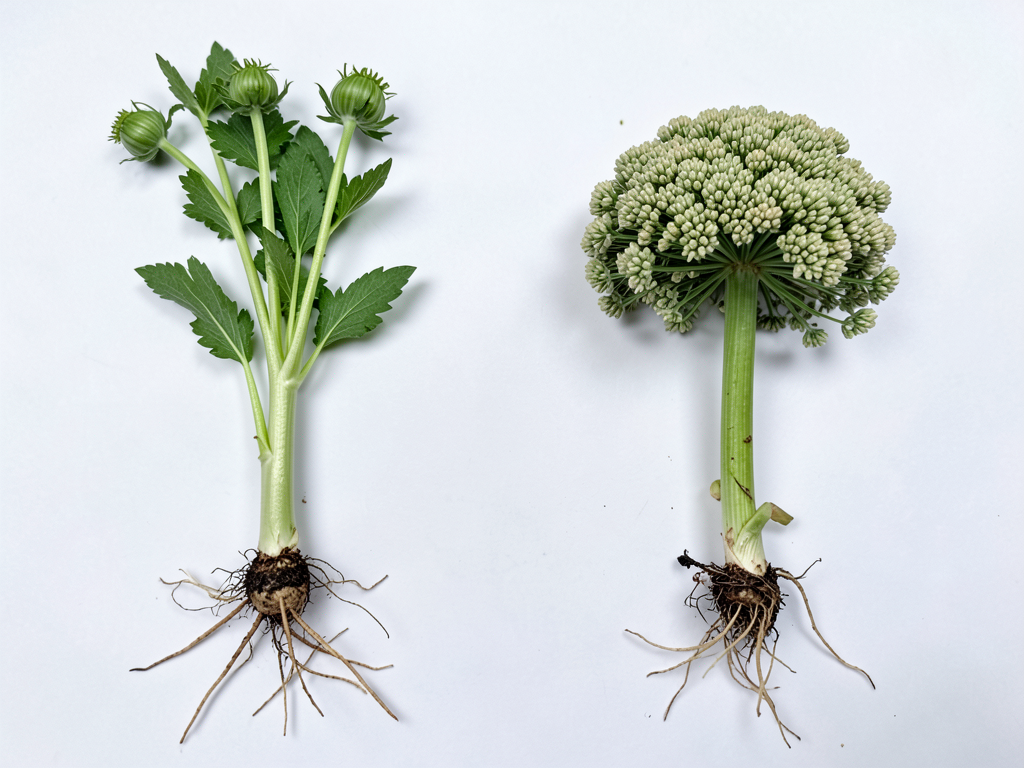
Crow garlic is often treated as a distinct foraging category even though botanically it’s a variety of field garlic. The key difference is that crow garlic’s flower head is composed entirely of bulbils in a dense, tight cluster — no true flowers at all — and the plant tends to be shorter and more compact overall. In practice, from a forager’s perspective, crow garlic is perfectly edible and is harvested the same way as field garlic. The identification distinction matters more for botanical accuracy than for safety, since both pass the smell test. If it looks like field garlic, has a denser head, and smells like onion-garlic, you’re in the right genus.
The Smell Test: Your Non-Negotiable Safety Protocol
Every foraging book and every experienced forager will tell you some version of this rule: “If it smells like garlic or onion, it’s safe to eat.” This rule has saved countless lives, but it has limitations that nobody talks about enough. Let’s cover both the power and the pitfalls.
How to Do the Smell Test Properly
-
Test every single plant individually. Even if you’re standing in a patch of 500 plants and the air smells like an Italian kitchen, crush a small piece of each plant you intend to keep and bring it to your nose. Lily of the valley and death camas can grow intermingled with true alliums.
-
Crush, don’t just sniff. The garlic/onion odor doesn’t release until the plant tissue is damaged. If you just lean down and sniff an intact plant, you might not detect it — especially on cold days or when your nose is stuffed up.
-
Clean your hands between tests. If you’ve been handling actual alliums, your fingers will smell like garlic. You can contaminate the next plant you test and get a false positive. Rub your hands with a bit of clean grass or soil between tests, or wipe them on your pants.
-
Test a clean piece. Don’t use the part of the leaf you just touched with garlic-scented fingers. Take a fresh, small tear from a part of the plant you haven’t handled yet.
-
If there’s ANY doubt, discard. A plant that “kind of” smells like onion or “maybe” has a garlic note is not a plant you should eat. The smell should be unmistakable and immediate.
Where the Smell Test Can Fail
The “if it smells like onion, it’s safe” rule is wonderful and true, but it has blind spots that every forager should understand:
Nose blindness: After smelling several alliums in a row, your olfactory receptors adapt. The scent becomes harder to detect. This is a real physiological phenomenon — your sensitivity to sulfur compounds drops temporarily. Take breaks. Smell something neutral (your sleeve, clean soil) between tests. If you’ve been harvesting for more than 30 minutes, take a 5-minute breather.
Cold weather: On chilly spring mornings, the volatile sulfur compounds that create the garlic smell are less volatile. A crushed leaf that would smell strongly at room temperature might give you a much weaker hit at 40°F (4°C). Crush more aggressively and warm the crushed piece in your closed hand before smelling.
Congestion and allergies: If you have a cold or seasonal allergies during peak ramp season, your nose is a compromised instrument. I’ve made the decision to skip foraging entirely on days when my allergies were so bad I couldn’t smell my own coffee.
Desensitization over days: Foragers who handle alliums daily during peak season can develop temporary desensitization. Your nose simply stops registering the compound as strongly. If you notice the patch doesn’t smell as garlicky as it did yesterday, but your foraging partner can still smell it fine — that’s olfactory fatigue. Switch to someone else’s nose for verification, or take a day off.
The Deadly Lookalikes: Plants That Will Harm or Kill You

This is the section that might save your life. Three toxic plants — one of them frequently fatal — are regularly confused with wild alliums by inexperienced foragers. Learn these before you learn anything else.
Lily of the Valley (Convallaria majalis) — The Most Common Mistake
Lily of the valley is the lookalike most likely to be growing alongside ramps, and it’s the one that almost got me.
Similarities to ramps: Broad, smooth, elliptical leaves that emerge in spring in the same woodland habitats. Similar size and growth pattern. Both favor moist, shady slopes.
How to tell them apart:
| Feature | Ramps (Allium tricoccum) | Lily of the Valley (Convallaria majalis) |
|---|---|---|
| Leaf surface | Smooth, matte, slightly waxy | Glossier, more ribbed with parallel veins |
| Leaf base / stem | Purple or reddish petiole connecting to bulb | Leaves emerge directly from creeping rhizome, no colored stem |
| Roots | Cluster from a bulb base | Horizontal creeping rhizome (underground stem) |
| Smell when crushed | Strong onion-garlic | Green, plant-like — zero garlic/onion |
| Flowers | White, round cluster on bare stalk (mid-summer) | White bell-shaped, hanging on one side of stalk (spring) |
| Plant structure | Leaves attached to bulb individually | Leaves sheathed together at base, no bulb |
Toxin: Cardiac glycosides (convallatoxin). Symptoms: nausea, vomiting, abdominal pain, slowed heart rate, visual disturbances. Can be fatal. If you suspect ingestion, seek emergency medical attention immediately — do not wait for symptoms.
Death Camas (Toxicoscordion venenosum / Zigadenus spp.) — The Lethal One
Death camas is genuinely lethal and responsible for documented human fatalities. The name isn’t exaggeration.
Similarities to wild onion: Grows from a bulb. Grass-like leaves. Similar habitats — moist meadows, mountain slopes, open woodlands. Historically, death camas bulbs have been mistaken for wild onion bulbs, sometimes with fatal results.
How to tell them apart:
| Feature | Wild Onion (Allium canadense) | Death Camas (Toxicoscordion spp.) |
|---|---|---|
| Leaves | Round, hollow — like chives | Flat, v-shaped in cross-section, solid (not hollow) |
| Leaf color | Blue-green, waxy coating | Yellow-green, grass-like, no wax |
| Flowers | Pink to white, in round cluster | Cream to yellowish-green, in a tall spike or raceme |
| Bulb | Covered in net-like fibers, onion-shaped | Smooth, no net-like coating, often darker outer layer |
| Smell when crushed | Strong onion | Zero onion/garlic smell |
Toxin: Zygacine (a steroidal alkaloid). Symptoms: vomiting, salivation, muscular weakness, slowed heart rate, lowered blood pressure, respiratory failure. Fatalities have occurred. This is not a plant to be casual about.
A critical safety note: Death camas is primarily a western North American plant. Its range overlaps with wild onion populations from the Rocky Mountains westward. If you forage wild onions in the West, you must verify the round-hollow leaf structure and the onion smell on every single plant.
Autumn Crocus / Meadow Saffron (Colchicum autumnale)
Less commonly confused with alliums than the first two, but worth knowing because the consequences are severe.
Similarities to wild garlic: Broad, lance-shaped leaves. Emerges in spring. It can grow in similar woodland-edge habitats in eastern North America where it has naturalized.
How to tell them apart: Autumn crocus leaves are thicker, more leathery, and have a distinct white central midrib. The leaves emerge as a tight central rosette from a corm (not a bulb), and there is no stem or petiole dividing the leaves. No garlic or onion smell whatsoever.
Toxin: Colchicine. Symptoms: burning throat, nausea, vomiting, bloody diarrhea, multi-organ failure. Treatment is supportive — there is no antidote. Fatalities occur at relatively low doses.
Quick Reference: Visual Comparison Table
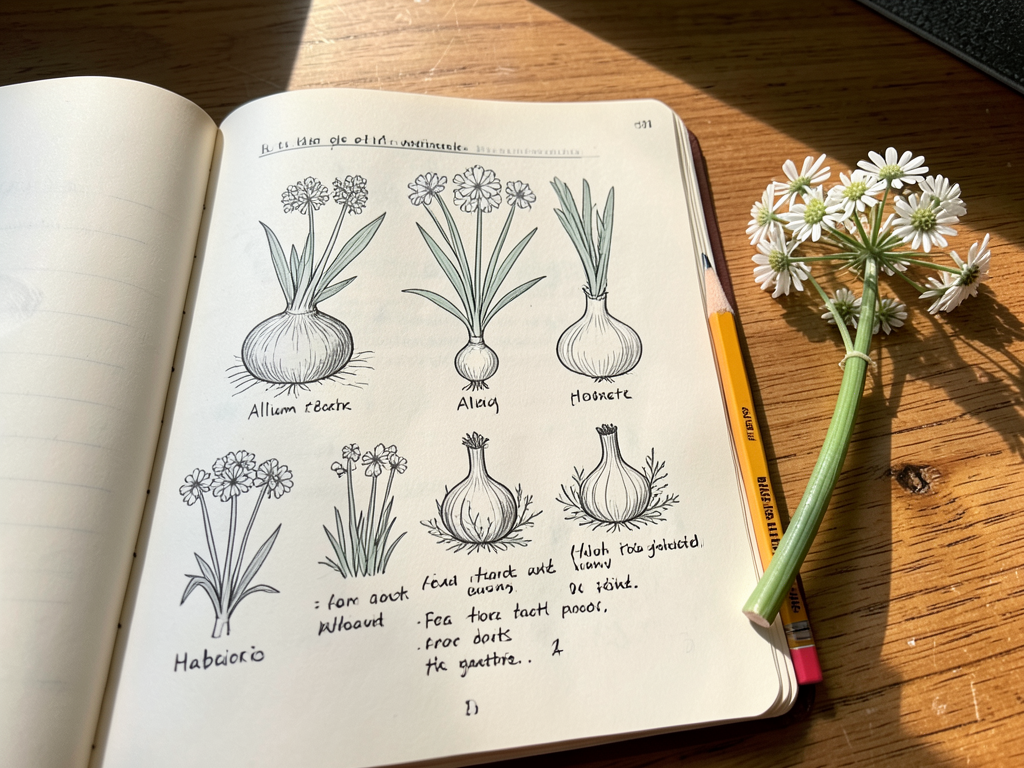
This table is designed to be screenshot and saved on your phone for field reference.
| Species | Leaves | Flowers | Bulb | Smell | Peak Season | Habitat |
|---|---|---|---|---|---|---|
| Ramsons (A. ursinum) | Broad, flat, lance-shaped, matte | White stars in loose cluster, no bulbils | Small, narrow, white | Garlic | Mar–May | Woodland, rich soil |
| Ramps (A. tricoccum) | Broad, elliptical, purple petiole | White in sphere (after leaves die), no bulbils | White/reddish, larger | Onion-garlic | Apr–May | Deciduous forest, slopes |
| Wild Onion (A. canadense) | Thin, round, hollow | Pink-white bells + bulbils | Round, netted coating | Onion | Mar–Oct | Meadows, lawns, roadsides |
| Field Garlic (A. vineale) | Very thin, round, hollow, grooved | Mostly bulbils, few flowers | Small, offset bulbs | Sharp onion-garlic | Year-round | Lawns, fields, disturbed soil |
| Crow Garlic (A. vineale compactum) | Like field garlic, shorter | All bulbils, dense head | Like field garlic | Same as field garlic | Same as field garlic | Same as field garlic |
Foraging Ethics and Legal Considerations

Before you head out, a few practical realities:
Know your local regulations. Ramps are protected or have harvest limits in parts of their range, including Quebec (where commercial harvest is banned) and sections of the Great Smoky Mountains National Park (where any harvest is prohibited). Check with your state or province’s Department of Natural Resources before harvesting on public land.
Private land requires permission. This isn’t optional. “Nobody uses these woods anyway” is not a defense. Ask. Most landowners will say yes if you explain what you’re doing and promise to leave no trace.
Never harvest from roadsides or treated areas. Roadside alliums absorb vehicle exhaust contaminants and are frequently sprayed with herbicides by highway departments. That tempting patch of field garlic growing along the highway shoulder is not your dinner.
The 10% rule for ramps. In any patch, take leaves from no more than 10% of the plants. For wild onion and field garlic — which are far more abundant and often considered weeds — you can harvest more aggressively, but still leave enough for the population to sustain itself.
A Forager’s Story to Close
I was in the woods last spring with a friend who was new to foraging. She’d read about ramps online, bought a field guide, and was eager to find her first patch. We walked a north-facing slope in Virginia for about an hour before she spotted them — broad green leaves, just like the pictures.
She dropped to her knees, reached for a leaf, and I stopped her hand. “Smell it first,” I said.
She crushed the leaf, brought it to her nose, and her face fell. Nothing. Just plant smell.
It was false hellebore (Veratrum viride), a toxic plant that emerges in the same habitat at the same time as ramps, with leaves that look strikingly similar to the untrained eye. She’d been seconds away from harvesting a plant that would have made her violently ill.
Twenty minutes later, we found the real thing. The smell hit us before we saw the patch, and this time when she crushed the leaf, her face lit up. “That’s it,” she said. “That’s onion.”
That’s the experience I want for every forager reading this. The difference between a good day and a trip to the hospital is a single sniff — but it has to be a sniff you actually take, on every plant, every time.
Get out there. Find your patch. And smell every single leaf.
For more plant identification guidance, check out our Plant Identification guide and our deep dive into Poisonous Lookalikes. If you’re just starting out, our Foraging for Beginners article covers all the fundamentals.