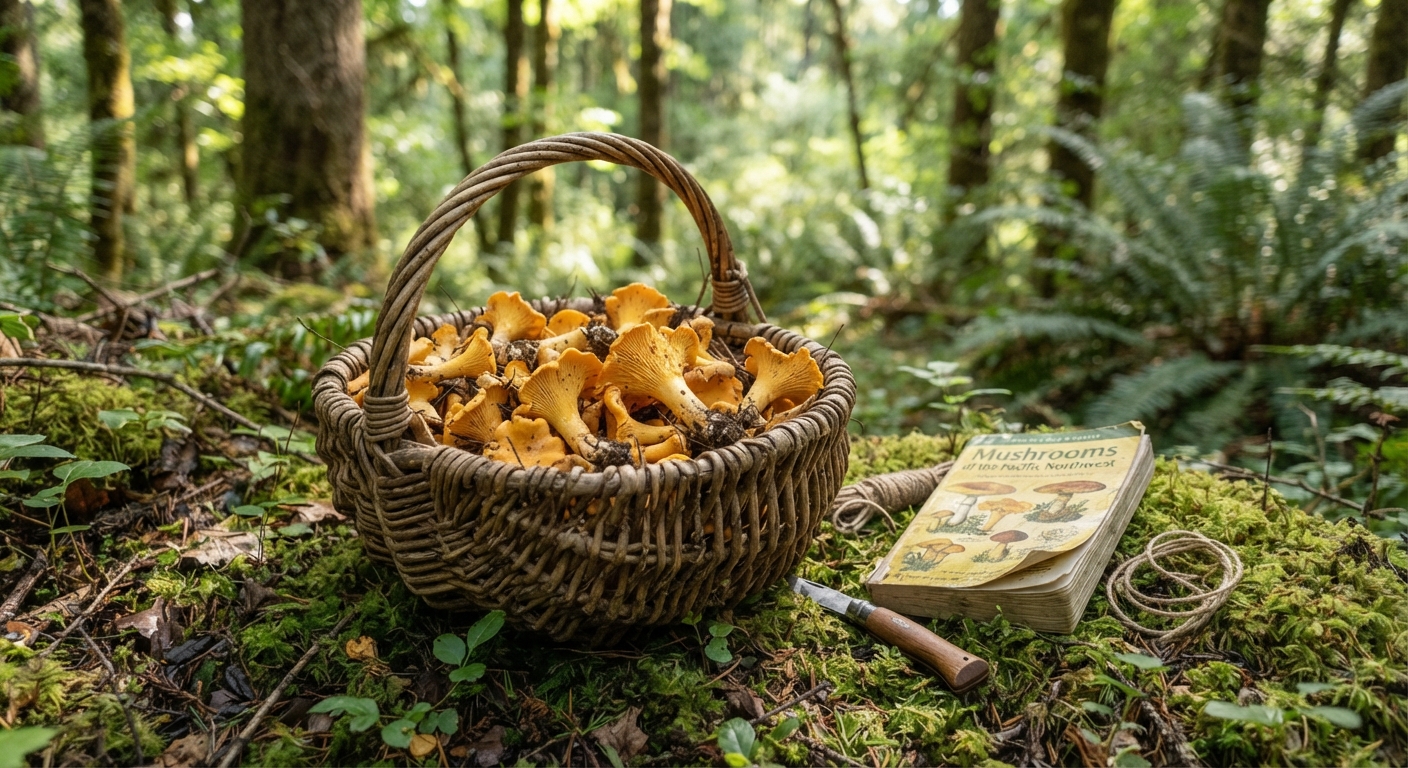
Edible Mushrooms for Beginners: 6 Foolproof Species to Start Foraging Safely
Let me start with something I tell every single person who asks me about mushroom foraging: mushrooms can kill you. Not in a “you might get a stomachache” way — in a “your liver shuts down and there’s no antidote” way. I’m not saying this to scare you off. I’m saying it because I want you to take this seriously.
That said, mushroom foraging is also one of the most rewarding things you’ll ever do in the woods. There’s nothing like the rush of spotting a golden chanterelle glowing through the leaf litter, or the satisfaction of cooking a chicken of the woods you gathered yourself. The key is knowing exactly where the line is between safe and dangerous — and never, ever crossing it.
This guide covers six mushrooms I call the gateway species. They’re distinctive, relatively easy to identify, and have few or manageable lookalikes. Master these six before you even think about branching out.
The Cardinal Rule: Never Eat What You Can’t 100% Identify
Let’s tattoo this on your brain right now: If you have even 1% doubt, do not eat it. Not “probably safe.” Not “looks like the picture.” Not “my friend says it’s fine.” One hundred percent certainty, backed by multiple identification features — field markings, habitat, season, spore print, and ideally confirmation from an experienced forager.
This isn’t like identifying wild berries, where the worst you’ll get is a bad afternoon. With mushrooms, the worst is organ failure. There are mushrooms in North America — Amanita bisporigera, the destroying angel — where eating just half a cap is fatal. No do-over. No stomach pump saves you. You die, slowly, over several days, as your liver and kidneys fail.
⚠️ SAFETY DISCLAIMER: The information in this article is for educational purposes only. Mushroom identification requires in-person verification with an expert. The author and ediblewildplant.com assume no liability for injury, illness, or death resulting from the consumption of wild mushrooms. Always consult multiple field guides and an experienced local forager before eating any wild mushroom.
Right. Now that I’ve properly terrified you — let’s get into the fun stuff.
Essential Gear for Mushroom Foraging
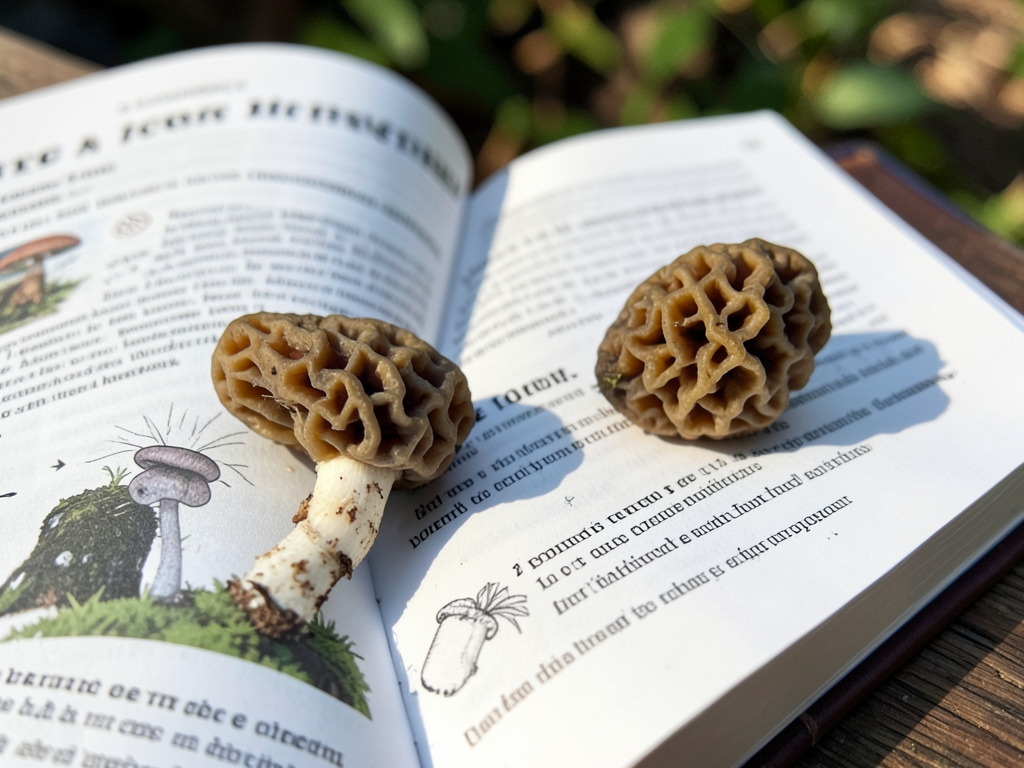
Before you step into the woods, get your kit together. Mushroom foraging doesn’t require much, but what you need matters:
- Woven basket or mesh bag: NOT a plastic bag. Mushrooms need airflow — a plastic bag turns them into mush in hours. Plus, a woven basket lets spores fall through as you walk, which is good for the forest. Use a basket with a flat bottom so mushrooms aren’t crushed under their own weight.
- Sharp knife: A folding Opinel or Mora knife works perfectly. Use it to cut the stem cleanly at the base — don’t yank mushrooms out of the ground, which can damage the mycelium.
- Soft brush (pastry brush or mushroom brush): Clean your mushrooms in the field, not at home. Once dirt dries into the gills or pores, it’s miserable to remove. A soft-bristle brush is perfect.
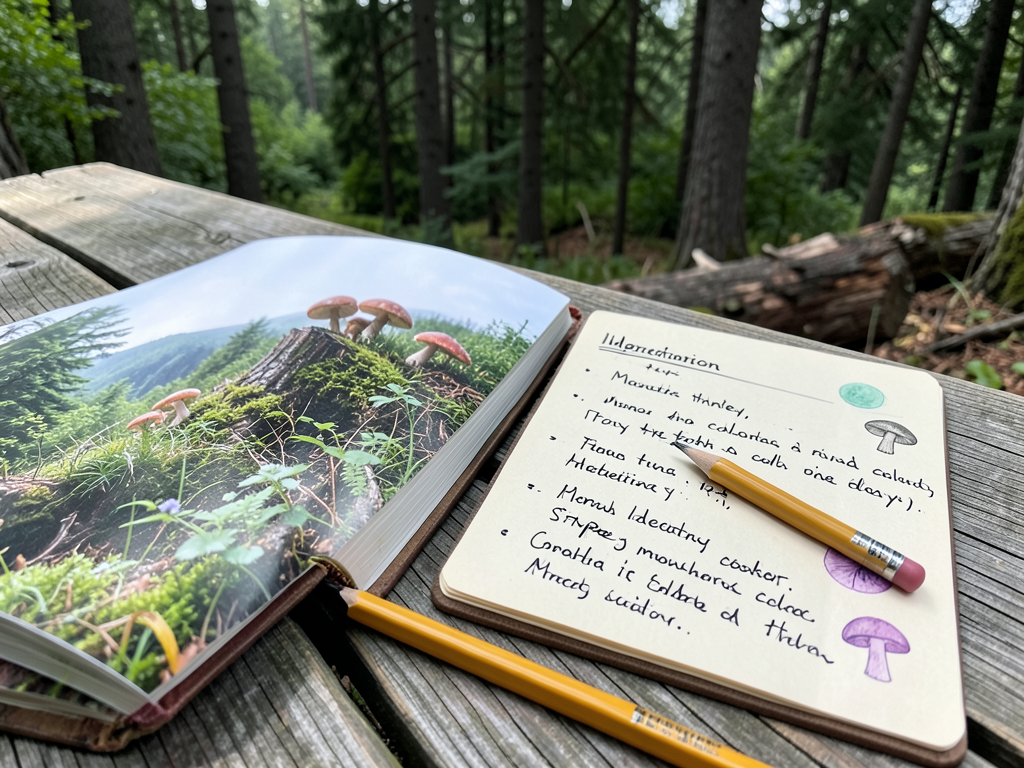
- Field guide — a real one, not just your phone: I recommend at least two. David Arora’s Mushrooms Demystified is the bible for North America. Pair it with a region-specific guide. Phones die. Batteries drain. Your guidebook doesn’t.
- Paper bags or wax paper: For collecting unknown specimens for spore prints. Keep each unknown separated — you don’t want a toxic mushroom rubbing against your edible haul.
- Notebook and pen: Write down where you found it, what it was growing on, nearby trees, elevation, time of year. Patterns make you a better forager.
- GPS or phone with offline maps: You’ll want to mark productive spots. Trust me, you won’t remember where that chanterelle patch was next year.
The Spore Print: Your Most Underrated ID Tool
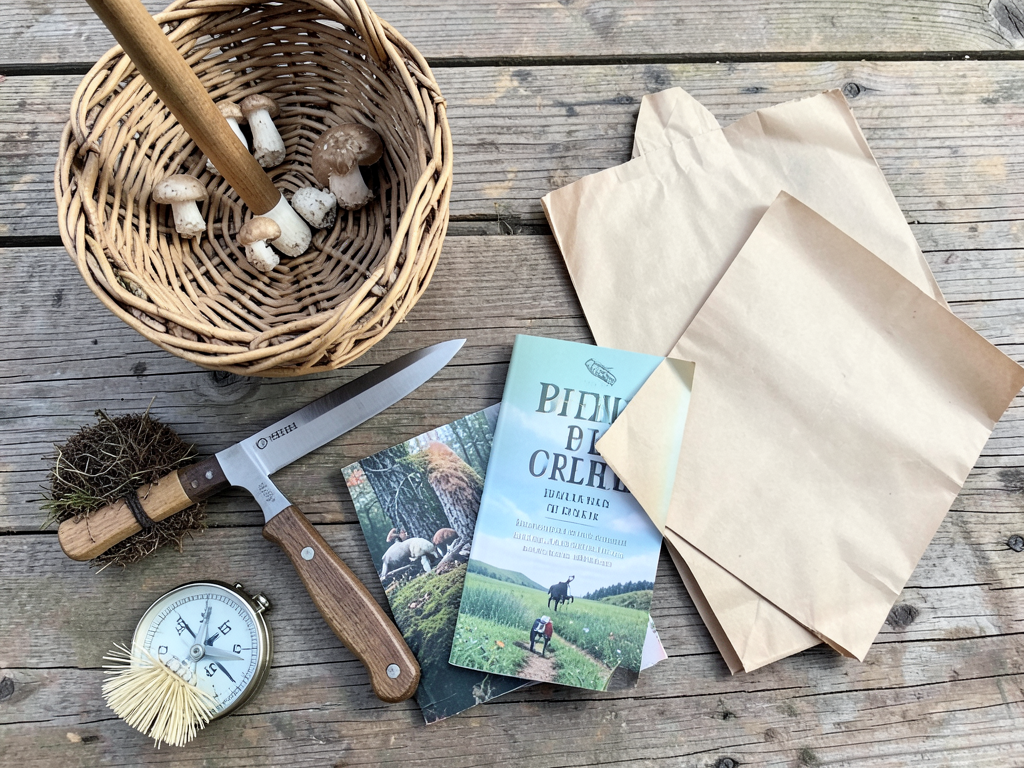
A spore print is exactly what it sounds like — you let a mushroom drop its spores onto paper, revealing their color. Spore color is a critical identification feature that the naked eye can’t see on the mushroom itself.
How to make a spore print:
- Cut the stem off a mature mushroom cap
- Place the cap gills-down on a piece of paper (use both white and black paper — or one piece of half-white, half-black — so you can see spores of any color)
- Cover with a bowl or glass to prevent air currents from blowing spores away
- Wait 4-8 hours (overnight is ideal)
- Lift the cap — you’ll see a beautiful spore print
Different mushrooms produce dramatically different spore colors: white, cream, pink, brown, purple-black, black. The difference between an edible mushroom and a deadly one can come down to spore color. For example, the delicious Agaricus (field mushroom) has a chocolate-brown spore print, while the deadly Amanita has a white spore print. Both can look similar at a glance.
Make a spore print for every new species you encounter. It’s not optional — it’s part of the identification process.
The Foolproof Six: Your Starter Mushrooms
I’m calling these “foolproof,” but let’s be real — no mushroom is truly foolproof if you’re careless. What I mean is: these six species have distinctive features that make them recognizable, and their dangerous lookalikes can be ruled out with methodical checking. They’re your gateway into the mushroom world.
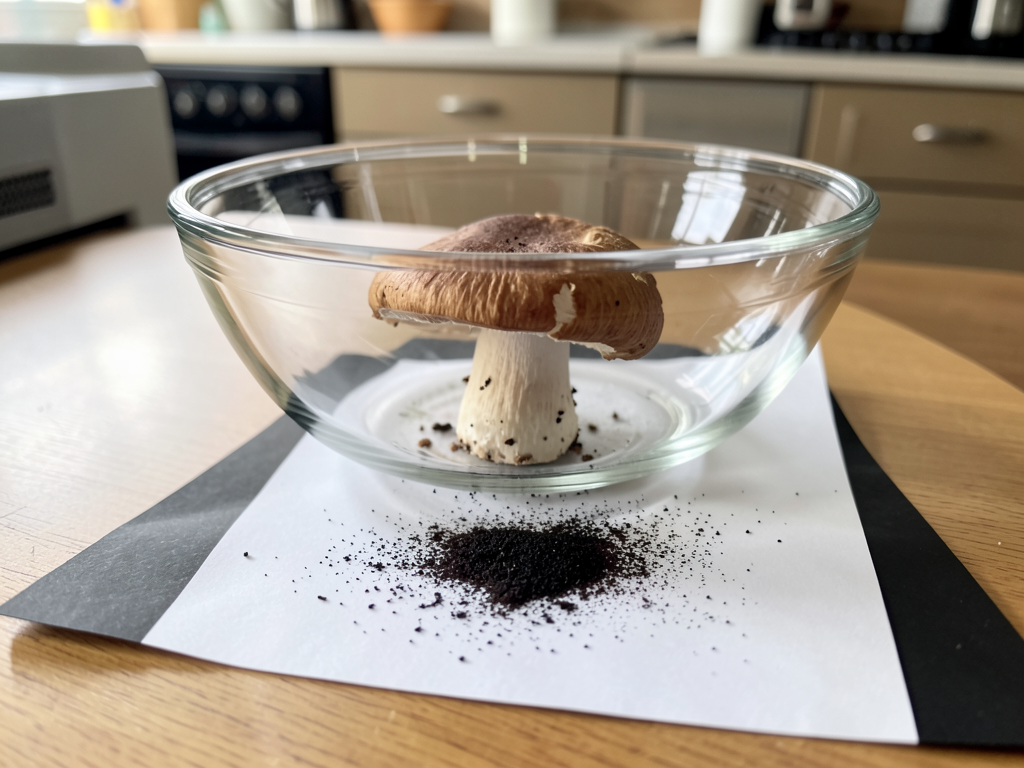
1. Morels (Morchella species)
When & where: Spring (March-May, depending on your latitude). Look around dead or dying elm, ash, and apple trees. Also in old orchards, burn sites (especially the year after a forest fire), and disturbed ground. They love well-drained soil near creeks.
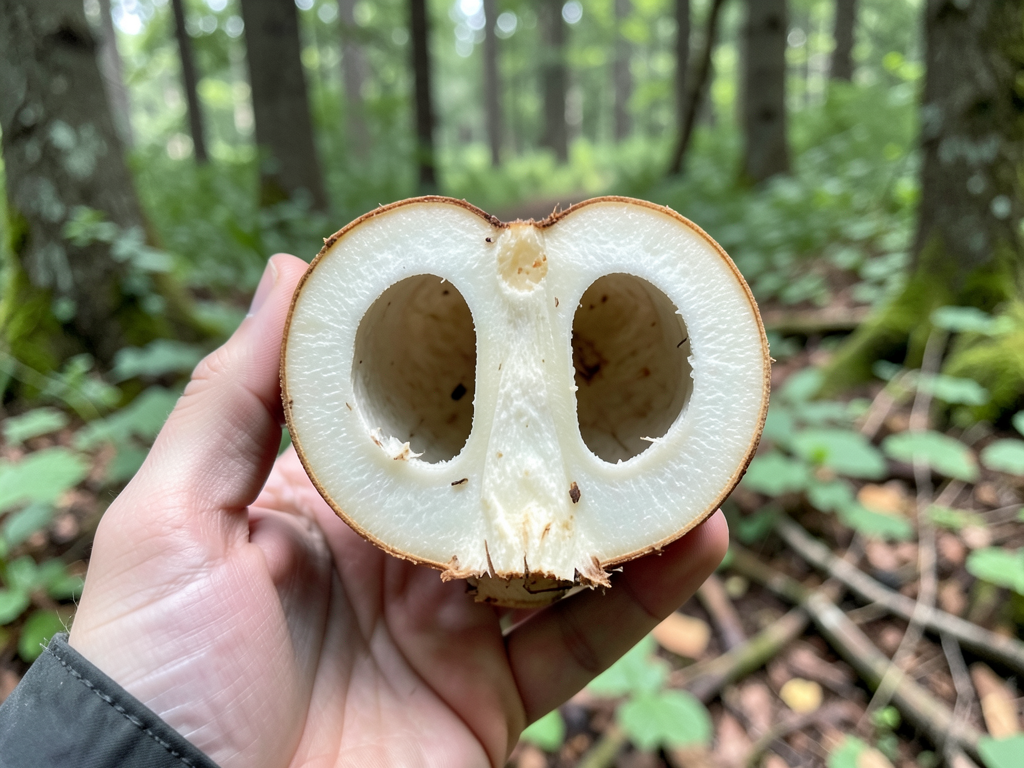
How to identify: Morels look like little honeycomb brains on a stalk. The cap is pitted and ridged in a distinctive honeycomb pattern. The cap AND stem are completely hollow when cut lengthwise — this is your key test. The cap attaches directly to the stem (not hanging free).
The lookalike — False morel (Gyromitra species): False morels are brain-like but WRINKLED, not pitted. Their caps look like a crumpled brown paper bag or a brain. Most critically: slice it open. A true morel is completely hollow from tip to base. A false morel has chambered, cotton-like tissue inside. False morels contain gyromitrin, a toxin that metabolizes into monomethylhydrazine — yes, literal rocket fuel. People have died from eating them.
How to eat: Morels MUST be cooked — never eat them raw. They contain a heat-sensitive toxin that cooking destroys. Sauté in butter with a pinch of salt. That’s all they need. Heaven.
2. Golden Chanterelles (Cantharellus cibarius group)
When & where: Summer through early fall (June-September). Look under oak, beech, and conifer trees. They grow from the ground — never on wood. They tend to appear in the same spots year after year, so mark your finds. They love mossy areas and well-drained slopes.
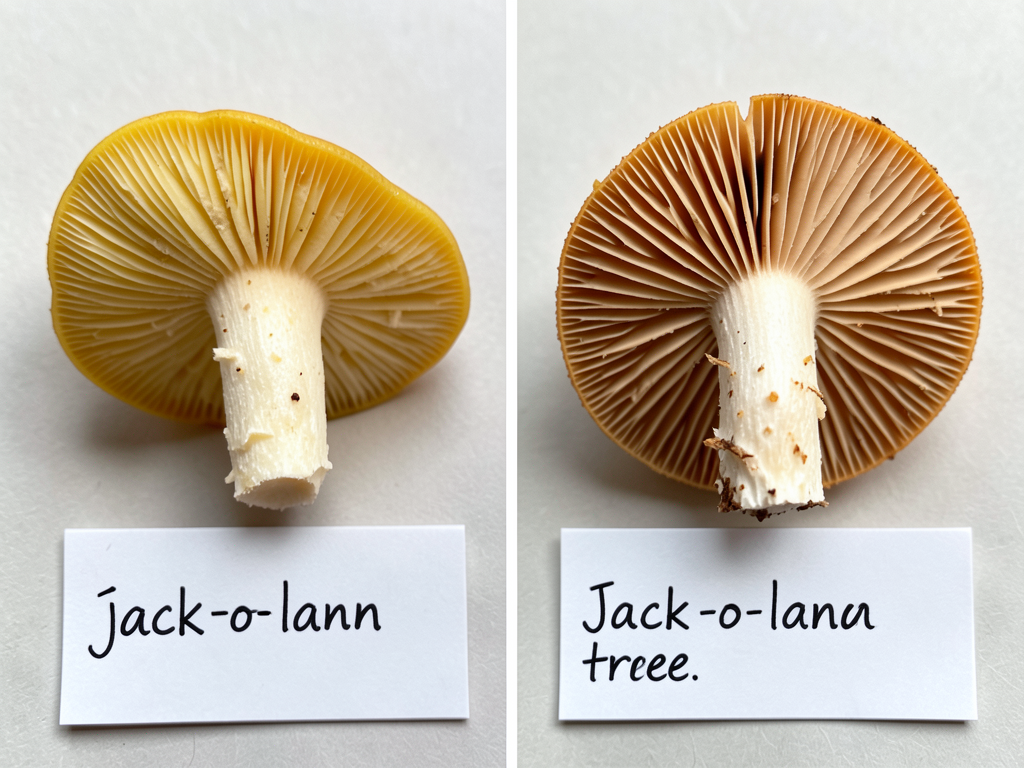
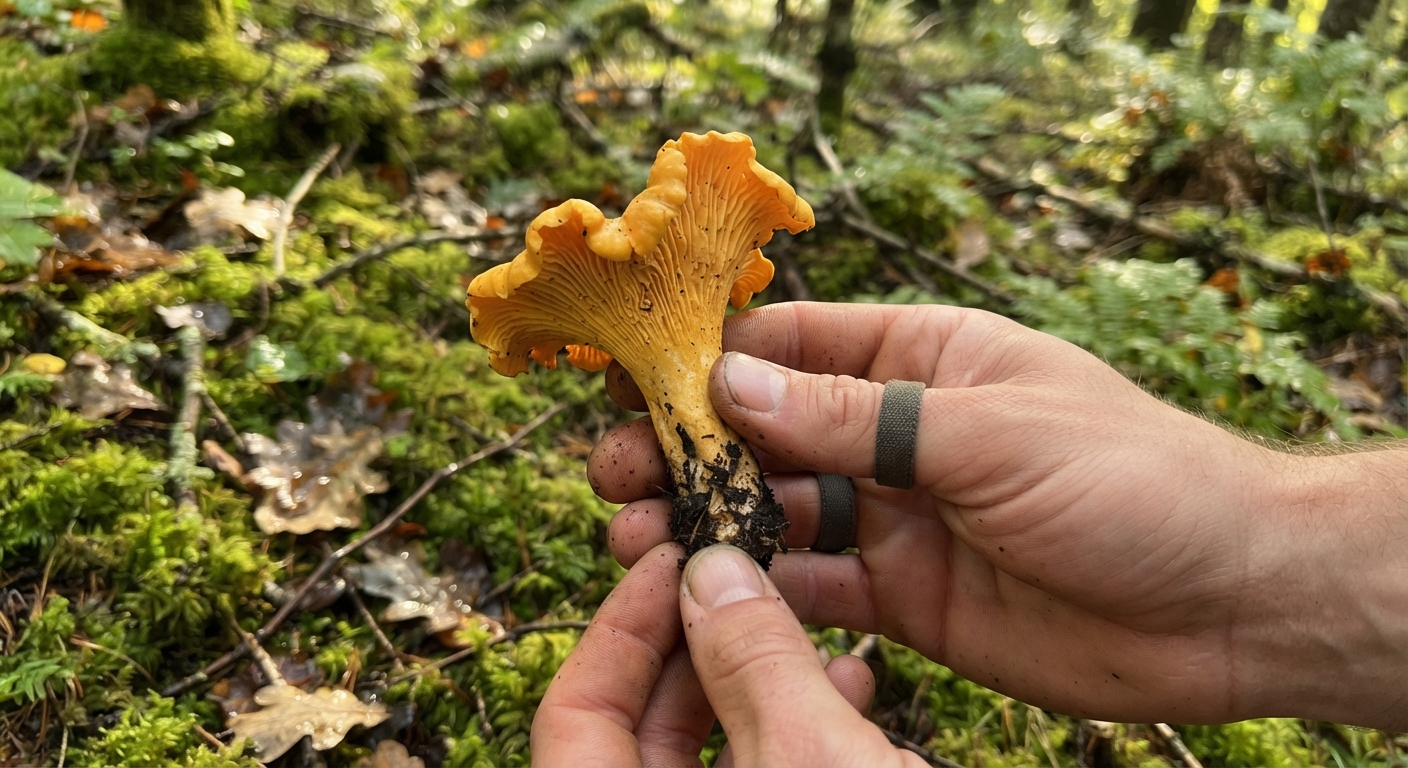
How to identify: Chanterelles are golden-yellow to egg-yolk orange with a fruity, apricot-like smell. Instead of true gills, they have false gills — blunt, forked ridges that run down the stem and are clearly part of the flesh (like melted wax). True gills are thin, sharp, blade-like, and separate easily. Rub your finger across them — false gills feel like ridges, not separate blades. The cap is wavy and irregular at maturity, often funnel-shaped.
The lookalike — Jack-o’-lantern mushroom (Omphalotus olearius): This is the one that fools beginners. Jack-o’-lanterns are orange, grow in dense CLUSTERS on wood (especially stumps or buried roots), and have TRUE gills — sharp, thin, non-forked blades. They also bioluminesce — go in a completely dark room and their gills glow faint green. Chanterelles never grow in tight clusters on wood, never have true sharp gills, and don’t glow. Jack-o’-lanterns will give you violent gastrointestinal distress — not fatal, but you’ll wish you were dead for about 24 hours.
How to eat: Chanterelles are versatile. Sauté in butter, add to cream sauces, fold into omelets, or dry them. They have a peppery, fruity flavor that pairs beautifully with poultry and eggs. Don’t wash them under running water — they soak up moisture like sponges. Brush clean instead.
3. Chicken of the Woods (Laetiporus sulphureus and relatives)
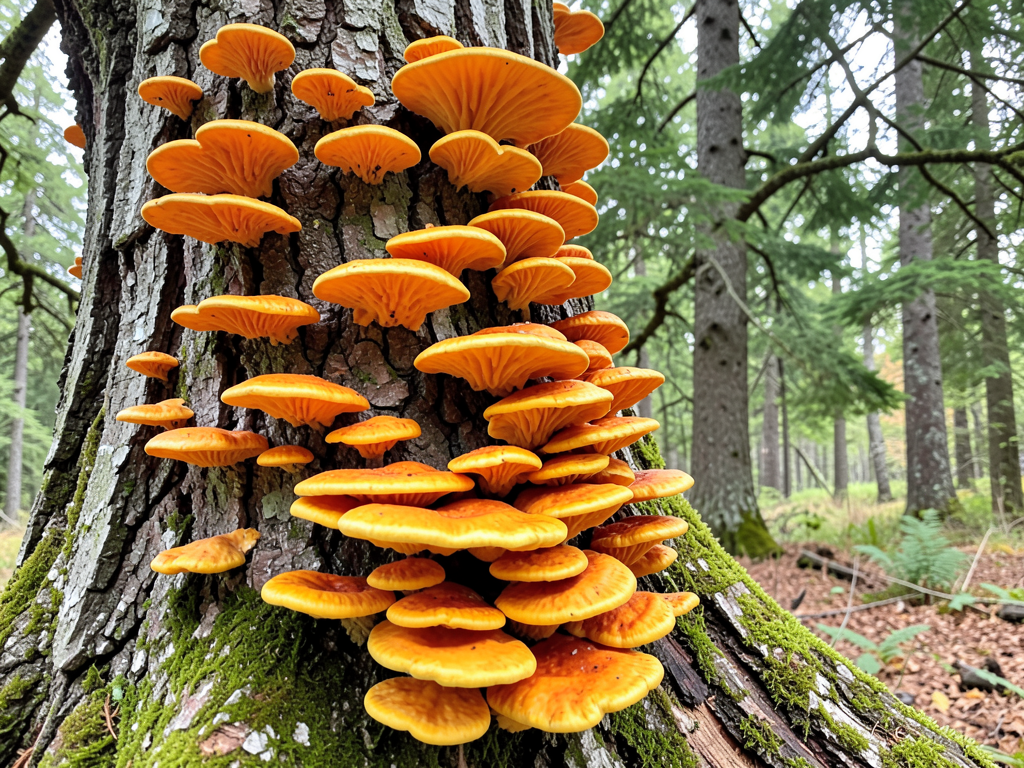
When & where: Late spring through fall (May-October). This is a shelf fungus that grows DIRECTLY on wood — living or dead trees, stumps, and logs. It favors oak, cherry, and eucalyptus. You’ll see it as bright orange and yellow overlapping shelves, visible from a hundred feet away.
How to identify: Chicken of the Woods is unmistakable — bright sulfur-yellow on the underside with orange to orange-red bands on top. It has no gills; the underside is covered in tiny pores. The shelves are thick, fleshy, and soft when young. When you break a piece off, it looks and shreds exactly like cooked chicken breast. It grows in large overlapping clusters, sometimes weighing 20+ pounds.
The lookalike — Berkeley’s polypore (Bondarzewia berkeleyi): This one grows in similar rosette-like clusters on wood, but it’s dull tan to brown, never bright orange-yellow. It’s much tougher and has a bitter taste. Not deadly, but not worth eating either. The color difference alone should be enough — if it’s not bright orange-yellow, it’s not chicken of the woods.
Important caution: Some people have allergic reactions to chicken of the woods. Cook a small piece first and eat only a bite. Wait 24 hours before eating more. Also, avoid specimens growing on conifers (pine, hemlock) or eucalyptus — they may absorb compounds from the tree that cause stomach upset.
How to eat: Sauté in butter, bread and fry like chicken nuggets, add to stir-fries, or simmer in curry. The texture is freakishly similar to chicken. Harvest only the tender outer edges — the inner portion near the attachment point gets woody.
4. Hen of the Woods / Maitake (Grifola frondosa)
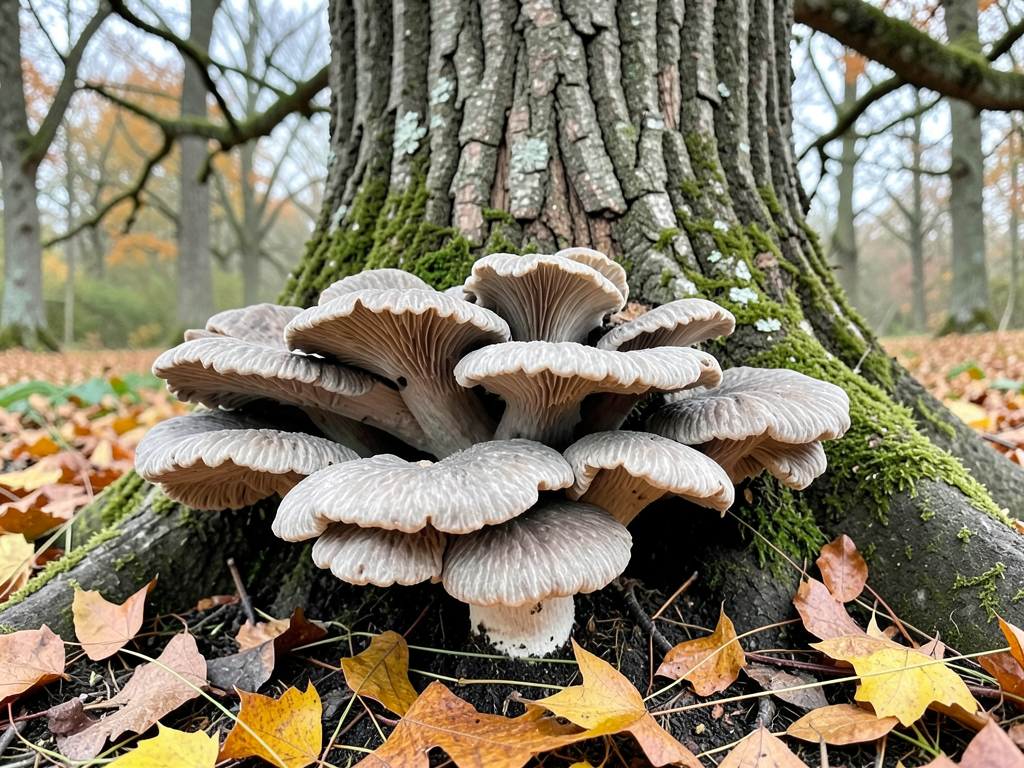
When & where: Fall (September-November). This mushroom grows at the base of oak trees — I’m talking right at the base, often where the roots meet the trunk. It returns to the same tree year after year. In Japan, foragers call it “maitake” — the dancing mushroom — because finding one was cause for celebration.
How to identify: Hen of the Woods looks like a cluster of overlapping gray-brown caps that resemble a ruffled chicken — hence “hen.” Each individual cap is fan-shaped, gray to brown, with a white pore surface underneath (not gills). The whole thing can grow to the size of a basketball or bigger. The pore surface bruises brownish when handled.
The lookalike — Black-staining polypore (Meripilus sumstinei): This one looks similar — clustered overlapping caps at the base of trees. The difference: break or bruise it, and it quickly stains BLACK (within minutes). Hen of the woods bruises brownish, not black. Black-staining polypore is not deadly but is tough, bitter, and unpalatable.
How to eat: Maitake has a rich, earthy, almost smoky flavor. It’s fantastic in soups, risottos, and sautéed as a side dish. Japanese cuisine uses it extensively. It’s also one of the most studied medicinal mushrooms for immune support. Harvest by cutting the cluster at the base — don’t pull it up.
5. Giant Puffball (Calvatia gigantea)
When & where: Late summer through fall (August-October). Look in open grassy areas — meadows, pastures, lawns, golf courses, park edges. They often appear after rain.
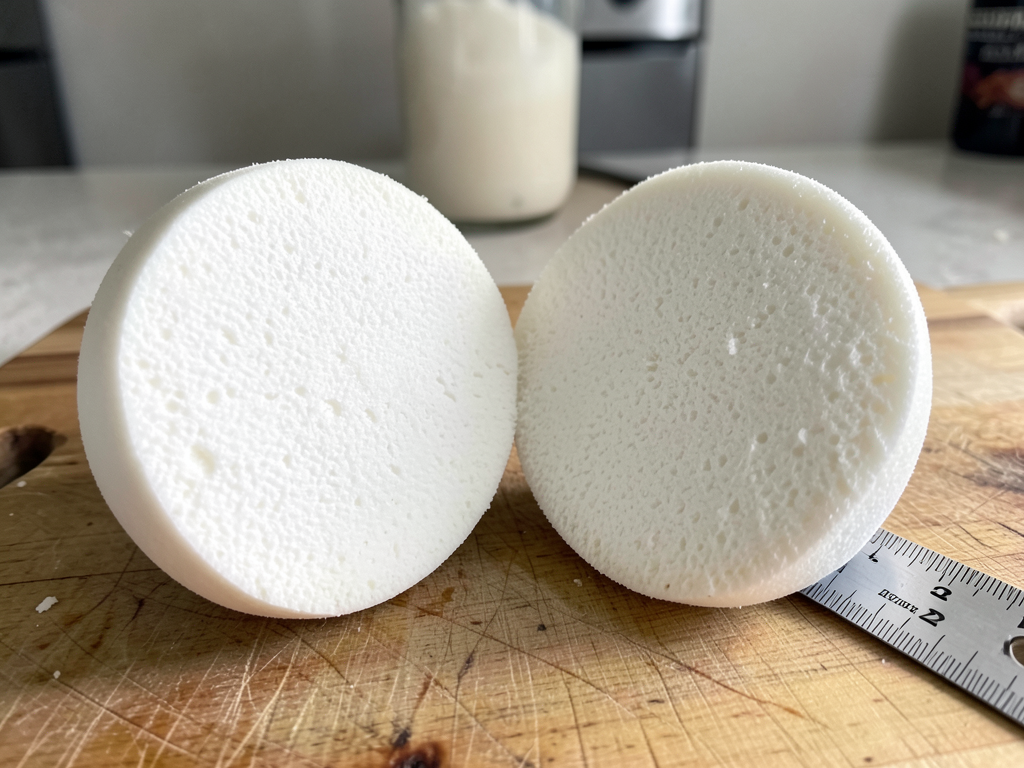
How to identify: Giant puffballs look like white volleyballs sitting in the grass. They can reach soccer-ball size (8-20 inches across). No stem, no cap, no gills — just a solid white ball attached to the ground with a minimal root-like cord. The critical test: slice it open from top to bottom. The interior must be uniformly white, solid, and marshmallow-like throughout. No patterns, no outline of a developing mushroom inside, no color change.
The lookalike — Destroying angel (Amanita bisporigera) in its “egg” stage: This is the deadliest lookalike you’ll face. Amanita species start as a white egg-like sac before the mushroom pushes up. The difference: slice it in half. A puffball is uniformly white with NO internal structures. An Amanita egg shows the outline of a developing mushroom — you’ll see a faint cap shape, gill lines, and stem inside. It looks like a tiny mushroom waiting to emerge. If you see ANY internal structure — throw it away immediately. This is exactly the kind of mistake that kills people. Take the slicing test seriously. Every. Single. Time.
How to eat: Slice into steaks and fry in butter, cube into stir-fries, batter and deep-fry like tofu, or use as a pizza base. Puffballs are mild, absorbing whatever flavors you cook them with. Only eat while the interior is pure white — if it’s turning yellow or brown, it’s past prime and will cause digestive upset. Cook thoroughly.
6. Oyster Mushrooms (Pleurotus ostreatus)
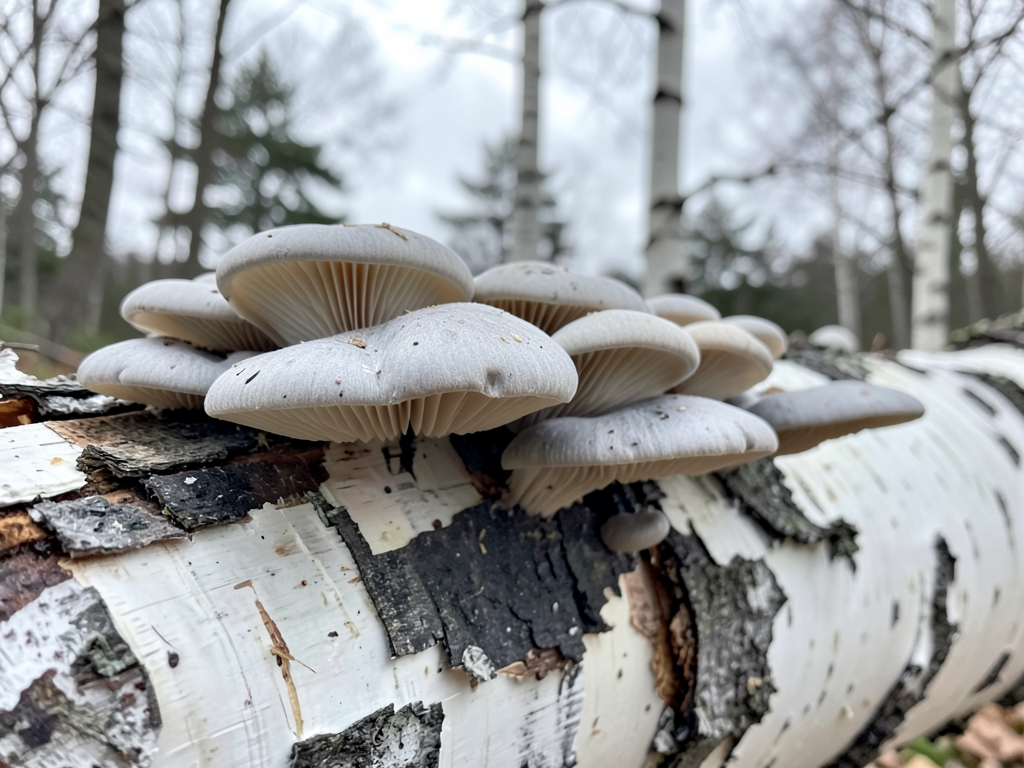
When & where: Year-round, but especially fall through early spring. They grow in shelf-like clusters on dead or dying HARDWOOD trees — cottonwood, aspen, elm, maple, beech. Look up — oyster mushrooms often grow high on standing dead trees.
How to identify: Oyster mushrooms grow in shelving clusters overlapping like roof shingles. The caps are fan-shaped, white to gray to brownish, with a smooth surface. The gills are white to cream, run DECURRENTLY down the stem (meaning the gills run partway down the stem, not stopping at the cap), and are widely spaced. They smell faintly of anise or licorice. The stem is typically off-center or absent. They grow on wood — never on the ground.
The lookalike — Angel wings (Pleurocybella porrigens): Angel wings are white, thin, and grow on conifer wood (especially hemlock). They look similar to white oyster mushrooms but are much thinner and more fragile. Here’s why it matters: angel wings were linked to several deaths in Japan in 2004, involving elderly people with compromised kidney function. The risk to healthy people is debated, but given the stakes, avoid any thin white shelf mushroom growing on conifer wood. True oysters grow on HARDWOODS, are thicker-fleshed, and have a distinct anise smell.
How to eat: Oyster mushrooms are delicate and cook fast. Sauté with garlic, add to soups at the last minute, or use in stir-fries. They release a lot of liquid when cooking — don’t overcrowd the pan. They also dry beautifully and rehydrate well.
Beginner Mistakes That Can Get You Hurt
I’ve been foraging for years, and I’ve seen — and made — every beginner mistake in the book. Here are the ones that matter:
1. Relying on a single identification feature. “It has a honeycomb cap, must be a morel.” No. You need to check: cap pattern, interior structure (hollow?), habitat, season, what trees are nearby, spore print. Stack your evidence. One feature isn’t enough.
2. Eating raw mushrooms. Literally never do this. Many edible mushrooms — morels included — are toxic raw. Cooking breaks down the toxins. Also, raw wild mushrooms carry bacteria, parasites, and whatever animals have been walking over them. Cook every wild mushroom thoroughly.
3. Storing mushrooms in plastic. Use breathable containers. Mushrooms are 90% water and start decomposing immediately in plastic. A soggy, slimy mushroom can make you sick even if the species itself is edible.
4. Foraging in contaminated areas. Don’t pick mushrooms from roadsides, golf courses, industrial sites, or treated lawns. Fungi are bioaccumulators — they soak up heavy metals, pesticides, and pollutants from their environment. Your perfect puffball from the chemically-treated golf course isn’t the find you think it is.
5. Eating old or buggy specimens. Just because it’s edible doesn’t mean it’s good. Old mushrooms harbor bacteria from natural decomposition. Insect larvae are a sign of advanced decay. Fresh is best. If it’s slimy, smells off, or is riddled with holes, leave it.
6. Assuming you remember what a mushroom looks like. Memory is unreliable. I’ve been doing this for years and I STILL check my field guide every time I encounter a species I haven’t seen in a few months. Bring the book. Do the spore print. Be systematic.
7. Using AI identification apps as your only ID source. Apps like iNaturalist and Picture Mushroom are useful supplements, not substitutes. They can get it wrong — sometimes dangerously wrong. Use them to get in the ballpark, then verify with field guides, spore prints, and experts.
How to Get Into Mushroom Foraging Safely — Your First Steps
If you’re reading this and thinking, “Okay, I want to try this but I’m nervous” — good. That’s the right mindset. Here’s how to start safely:
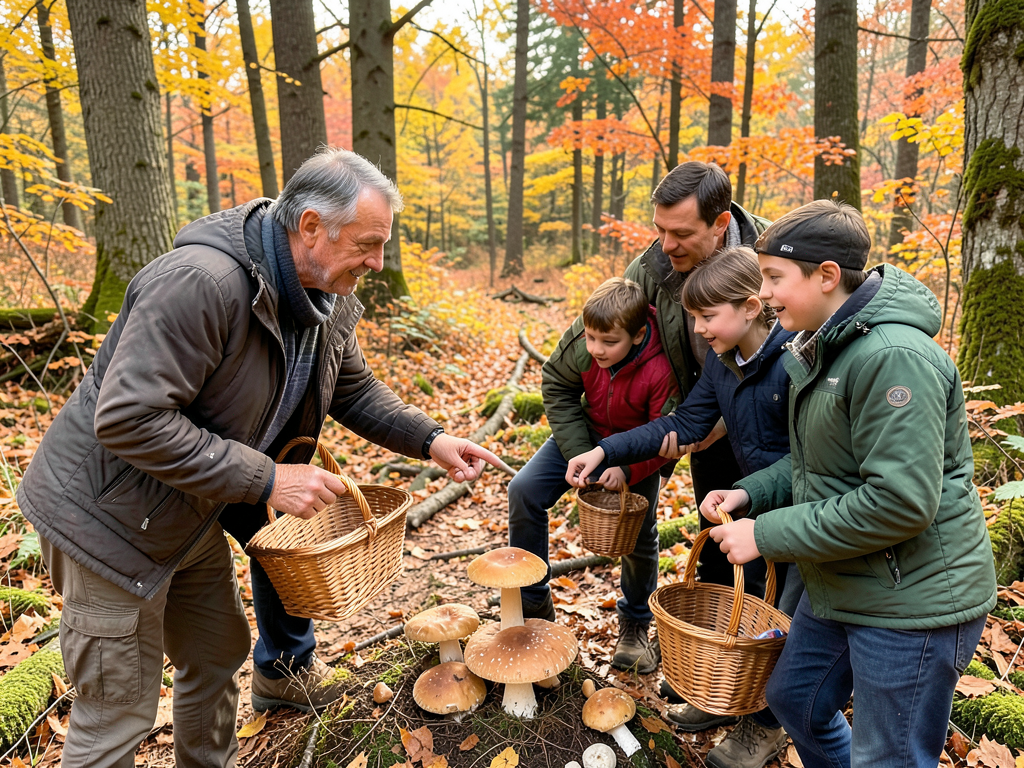
Step 1: Join a local mycological society or club. Almost every region has one. They host guided forays with experts who will teach you in the field. There’s no substitute for in-person mentoring. Go on as many forays as you can.
Step 2: Buy two field guides. One comprehensive guide (Mushrooms Demystified by David Arora for North America, or the Audubon Society Field Guide) and one region-specific guide (look for titles like “Mushrooms of [Your State]”). Cross-reference EVERY identification.
Step 3: Start with the Foolproof Six. Don’t try to learn 50 mushrooms at once. Focus on the six species in this guide. Learn them intimately — their habitats, their seasons, their lookalikes, their spore colors, their smells. Only graduate to new species once you can identify all six with total confidence.
Step 4: Take photos and spore prints of EVERYTHING. Even mushrooms you don’t plan to eat. Build your pattern recognition. After a season or two, you’ll start seeing the family resemblances.
Step 5: Eat only a small amount the first time. Even with 100% correct identification, individual reactions vary. Cook a small piece. Wait 24 hours. If no issues, enjoy the rest. Always cook wild mushrooms — never eat them raw.
Step 6: Keep one fresh specimen aside. When you eat a new mushroom species for the first time, save one uncooked specimen in the fridge. If something goes wrong, you’ll have the mushroom available for medical identification. This is standard practice among experienced foragers.
Quick Reference: The Foolproof Six at a Glance
| Mushroom | Season | Grows On | Key ID Feature | Deadliest Lookalike |
|---|---|---|---|---|
| Morel | Spring | Ground (near elm, ash, apple) | Honeycomb cap, completely hollow | False morel (chambered interior) |
| Chanterelle | Summer-Fall | Ground (near oak, beech) | False gills, apricot smell, yellow-orange | Jack-o’-lantern (true gills, on wood) |
| Chicken of the Woods | Spring-Fall | Living/dead hardwood trees | Bright orange-yellow shelves, pores underneath | Berkeley’s polypore (dull tan-brown) |
| Hen of the Woods | Fall | Base of oak trees | Gray-brown ruffled caps, white pores | Black-staining polypore (bruises black) |
| Giant Puffball | Late Summer-Fall | Ground (meadows, lawns) | Solid white interior, no internal structures | Amanita egg stage (internal mushroom outline) |
| Oyster | Year-round | Dead hardwood trees | Decurrent gills, anise smell | Angel wings (conifer, thin, fragile) |
Regional Considerations
A few quick notes depending on where you forage:
- Pacific Northwest (USA/Canada): You’re in mushroom heaven. Chanterelles and oysters are abundant, but you’ll also encounter Amanita species frequently. The region has several edible species not covered here, but the Foolproof Six are all present.
- Northeast USA: Great for morels in spring, hen of the woods in fall. Old apple orchards are morel goldmines.
- Southeast USA: Chanterelles love the humidity. Look under oaks and pines. Summer oyster mushrooms are common on hardwoods.
- Midwest: Morels are practically a religion here. Many communities have annual morel festivals. Check old elm stands.
- UK/Europe: The Foolproof Six all occur here, but some species have additional European lookalikes. Use a UK/Europe-specific field guide. The Blewit (Lepista nuda) is a popular beginner mushroom in the UK not covered in this guide.
- Australia/NZ: Different mushroom species entirely in some cases. Chicken of the Woods (Laetiporus) occurs in Australia on eucalyptus. Seek local expertise.
Final Word
Mushroom foraging is one of the most rewarding outdoor skills you can learn. It combines botany, ecology, mycology, and cooking into one activity. It gets you out in the woods during the most beautiful seasons. And there’s no grocery store produce that compares to the taste of wild mushrooms sautéed in butter 30 minutes after you picked them.
But the price of entry is vigilance. You can’t half-learn mushroom identification. You can’t guess. You can’t “well, it’s probably…” your way through it.
Learn the six species in this guide thoroughly. Go on guided forays. Make spore prints religiously. Cook everything. Start with one bite. And if you’re ever not 100% sure — walk away. The mushrooms will be there next year. You need to be there too.
⚠️ FINAL SAFETY REMINDER: This guide is not a substitute for in-person identification training with an expert. Mushroom foraging involves inherent risks including the potential for fatal poisoning. Always cross-reference multiple authoritative field guides, verify identification with an experienced mycologist or local foraging group, cook all wild mushrooms thoroughly, and consume only a small amount when trying any species for the first time. If you experience any symptoms after eating wild mushrooms, seek emergency medical attention immediately and bring a sample of the mushroom with you.
Happy (and safe) foraging. See you in the woods.
Frequently Asked Questions
Q: Can I use a mushroom identification app instead of a field guide? A: Apps are useful supplementary tools, not replacements. They can help narrow things down, but their accuracy varies widely and misidentifications can be fatal. Always verify with a physical field guide and, ideally, an experienced forager.
Q: Is it true that you can test a mushroom by seeing if animals eat it? A: ABSOLUTELY NOT. This is a dangerous myth. Squirrels and deer can safely eat mushrooms that would kill a human. Their digestive systems are fundamentally different from ours. Never use animal consumption as a safety indicator.
Q: What should I do if I think I ate a poisonous mushroom? A: Go to the emergency room immediately. Bring a sample of the mushroom you ate (and any you prepared). Do not wait for symptoms — some deadly mushrooms (like Amanita phalloides, the death cap) have a latent period of 6-24 hours before symptoms appear, during which liver damage is already occurring. Call poison control (US: 1-800-222-1222).
Q: Can I freeze or preserve wild mushrooms? A: Yes. Most wild mushrooms freeze well after cooking (sauté in butter first, cool, freeze in portions). Drying works beautifully for morels, chanterelles, and oysters. Pickling is possible but the texture changes significantly. Never freeze raw wild mushrooms — their high water content turns them to mush.