The first time I found chicken of the woods, I almost walked right past it. It was late August, muggy as only an Ohio summer can get, and I’d been trudging through an oak forest for two hours looking for chanterelles. Nothing. Then I rounded a fallen log and there it was — a massive, overlapping cascade of brilliant orange and yellow shelves bursting from the trunk of a dead oak, practically glowing in the dappled forest light.
I remember just standing there for a solid minute, grinning like an idiot. If you’ve never seen a prime chicken of the woods flush in person, it’s hard to describe. It looks like something from a fantasy novel. Bright sulphur-yellow edges fading to deep orange at the base, soft and velvety, with a smell that somehow manages to be both mushroomy and faintly lemony.
I harvested about three pounds that day, took it home, sautéed a chunk in butter, and took a bite. The texture was remarkable — fibrous like cooked chicken breast, pulling apart in tender strands. The flavor was mild, slightly earthy, with just enough personality to hold its own in any dish. My wife, who side-eyes every wild mushroom I bring through the door, asked for seconds.
That was years ago. Since then, I’ve found Laetiporus dozens of times across multiple states, cooked it every way imaginable, made my share of mistakes, and learned lessons only experience can teach. This guide is everything I wish someone had handed me before my first hunt.
What Is Chicken of the Woods?
Chicken of the woods isn’t a single mushroom species — it’s a common name for several closely related fungi in the genus Laetiporus. Think of it like “oak tree” referring to dozens of Quercus species. The ones you’re most likely to encounter in North America are Laetiporus sulphureus, Laetiporus cincinnatus, and Laetiporus huroniensis.
The name “chicken of the woods” comes from what happens when you cook it: the flesh pulls apart into tender, fibrous strands that look and feel remarkably similar to cooked chicken breast. This isn’t a hyperbolic comparison. Serious chefs, including some Michelin-starred ones, use Laetiporus as a direct chicken substitute in everything from stir-fries to fried “chicken” sandwiches.
These mushrooms are what mycologists call polypores or bracket fungi. Unlike your typical cap-and-stem mushroom, chicken of the woods grows in overlapping shelves directly from wood — usually dead or dying hardwoods. The underside isn’t covered in gills but in tiny pores, which is one of the most important identification features (more on that later).
Here’s a quick breakdown of the main species you’ll encounter:
| Species | Common Name | Substrate | Pore Surface | Notes |
|---|---|---|---|---|
| L. sulphureus | Sulfur shelf | Hardwoods (esp. oak) | Bright yellow | Most common, classic orange-yellow shelves |
| L. cincinnatus | White-pored COTW | Hardwoods (esp. oak) | White to cream | Grows from roots/buttress, rosier cap color |
| L. huroniensis | Great Lakes COTW | Conifers (esp. hemlock) | Yellow | More reports of GI upset — exercise caution |
For most foragers in most of North America, if you find a bright orange-yellow shelf mushroom on an oak with yellow pores, you’re looking at L. sulphureus — the classic, and widely considered the best-tasting variety.
How to Identify Chicken of the Woods (With Confidence)
Misidentifying mushrooms can have serious consequences. But here’s the good news: a mature, healthy chicken of the woods specimen is one of the more distinctive wild mushrooms out there. Once you know what to look for, it’s difficult to confuse with anything dangerously toxic — provided you check every characteristic.
The Seven-Point ID Checklist
Run through these in order every single time. If anything doesn’t match, don’t eat it.
1. Growth Pattern — Shelf Clusters
Chicken of the woods grows in overlapping, fan-shaped shelves that emerge directly from wood. There’s no central stem. The shelves are typically 5 to 30 cm across, fleshy and thick when young, thinning toward the margin. Multiple shelves often cascade down a trunk in a staggered formation.
2. Cap Surface — Velvety, Orange to Yellow
The upper surface is smooth to slightly suede-like, never slimy or sticky. Colors range from bright orange-red at the base to sulphur-yellow at the growing margin. Older specimens fade to pale yellow or whitish. The surface should be dry — if it’s viscid or slimy, you’re looking at something else.
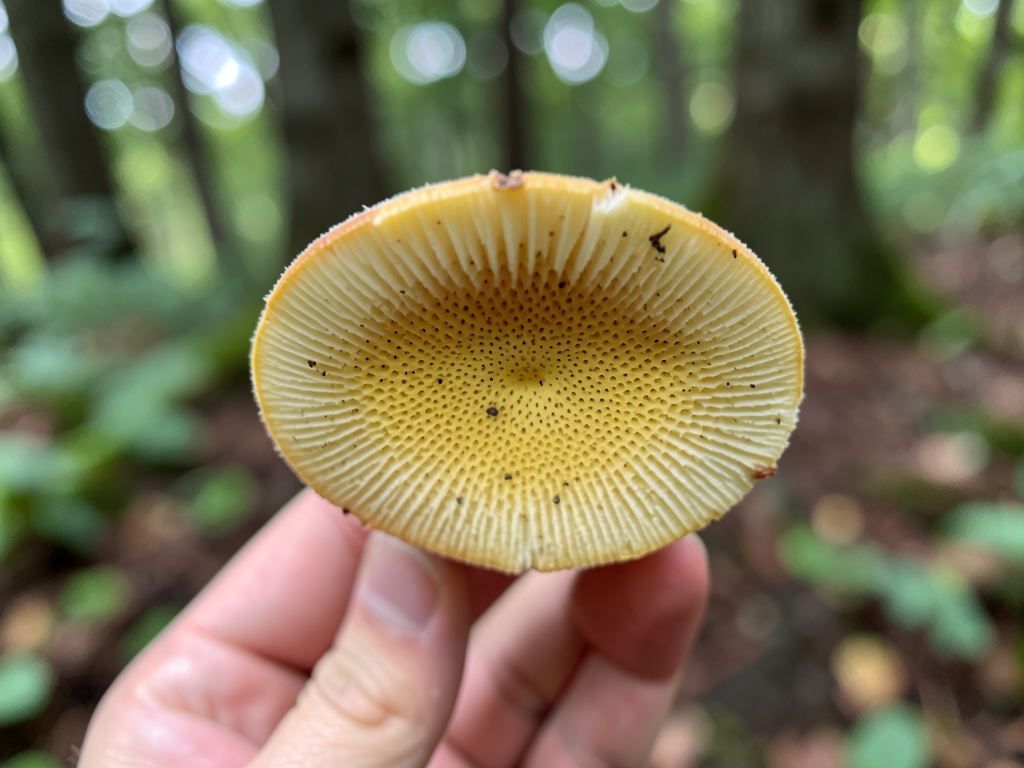
3. Pore Surface — No Gills
Flip a shelf over. You should see a flat surface covered in tiny pores — not gills (the blade-like structures under most mushroom caps). In L. sulphureus, this pore surface is bright yellow when fresh. In L. cincinnatus, it’s white to cream. The pores are so small they’re barely visible to the naked eye — about 2 to 4 per millimeter.
4. Flesh — Soft, Fibrous, Moist
Slice into it. The flesh should be soft, somewhat moist, and fibrous — like raw chicken breast. Young specimens have a succulent, almost juicy quality. As they age, the flesh becomes drier, tougher, and sometimes chalky or crumbly. The color of the flesh is white to pale yellow, and it doesn’t change color dramatically when cut.
5. Smell — Mushroomy with a Hint of Lemon
Give it a sniff. Chicken of the woods has a pleasant, mild fungal aroma, often described as having a faint citrus or lemony note. There should be no strong, unpleasant, or chemical smells. If it smells like phenol, iodine, or anything harsh — pass.
6. Spore Print — White
If you want to be thorough (and you should, especially early on), take a spore print. Place a shelf pore-side down on a dark piece of paper, cover with a bowl, and wait 4-8 hours. The spore deposit should be white. A spore print that’s brown, rusty, or any other color means you’ve got the wrong mushroom.
7. Substrate — Hardwood (Usually)
Chicken of the woods almost always grows on hardwoods — oak, cherry, beech, maple, and sweetgum are favorites. Specimens growing on conifers (pine, hemlock, spruce) may be a different species (L. huroniensis or L. conifericola) and are associated with higher rates of gastrointestinal distress in some people. If you’re new to foraging, stick to specimens on hardwoods.
Identification Red Flags to Watch For
If you see any of these, do not harvest:
- Gills instead of pores on the underside — you may be looking at a Pleurotus (oyster mushroom) or jack-o’-lantern (Omphalotus), the latter of which is toxic
- Slimy or sticky cap surface — not a Laetiporus trait
- Brown, rusty, or colored spore print — Laetiporus spores are white
- Thin, leathery, or woody texture — suggests an inedible polypore species
- Growing directly from the ground not attached to wood — likely not Laetiporus
- Strong unpleasant odor — could indicate decay or a different species entirely
Where and When to Find Chicken of the Woods
Timing and habitat are everything. You can know all the identification details perfectly, but if you’re looking in the wrong place at the wrong time, you’ll come home with an empty basket.
Seasonality
Chicken of the woods is primarily a summer and early fall mushroom, though the exact window depends on your region:
- Southern US (Zones 7-9): May through October, with a peak in June-July
- Midwest/Mid-Atlantic (Zones 5-7): June through September, peak July-August
- Northeast/Pacific Northwest (Zones 4-6): July through early October, peak August-September
- Higher elevations: Later — expect August through October
The flush is triggered by warm temperatures after consistent rainfall. I’ve noticed the best flushes happen about 3-5 days after a good soaking rain during stretches of 75-85°F daytime temperatures. If it’s been hot and dry for two weeks, don’t bother — the mushrooms aren’t fruiting.
Preferred Habitat
Chicken of the woods is a heart rot fungus. It grows on the dead heartwood of living trees and on dead standing trees or fallen logs. It’s both saprobic (feeding on dead wood) and weakly parasitic (causing brown rot in living trees).
The textbook locations to check:
- Mature oak forests — oak trees are the number one host. Old growth or mature second-growth forests with plenty of deadfall are ideal.
- Dead or dying hardwoods — standing dead trees (snags), fallen logs, and stumps of oak, cherry, maple, beech, sweetgum, and eucalyptus (in California).
- Tree bases and root zones — especially for L. cincinnatus, which often fruits from buried roots or at the very base of the trunk.
- Riparian zones and creek bottoms — areas with higher humidity tend to produce more flushes.
- Recent storm damage areas — windthrown or lightning-struck trees often fruit Laetiporus within 1-3 years of damage.
- Urban parks and cemeteries — surprisingly productive. Old oaks in maintained landscapes with irrigation are consistent producers.
How to Spot It from a Distance
Once your eyes are trained, you can spot chicken of the woods from 50 yards away. The bright orange-yellow shelves stand out dramatically against the greens and browns of the forest. Train yourself to scan for that unnatural splash of orange — it’s about the same color as a traffic cone, and it’s just as eye-catching in the right light. Look especially after rain, when the colors are at their most saturated and the shelves are plump with moisture.
Lookalikes and Safety: Mushrooms You Might Confuse It With
The good news: there are few (if any) mushrooms that look exactly like a fresh chicken of the woods that are lethally toxic. The bad news: confusion can still lead to a very unpleasant evening. Let’s walk through what you might mistake for Laetiporus, and how to tell them apart.
Jack-o’-Lantern Mushroom (Omphalotus illudens)
This is the most frequently cited danger in chicken of the woods discussions, but honestly, the confusion is mostly theoretical. Jack-o’-lanterns are orange and grow on wood — that’s where the similarity ends.
| Feature | Chicken of the Woods | Jack-o’-Lantern |
|---|---|---|
| Growth form | Thick, fan-shaped shelves | Clusters of stemmed caps |
| Underside | Tiny pores (flat surface) | True gills (blade-like) |
| Color | Orange-yellow, two-toned | Uniform deep orange |
| Texture | Soft, fibrous, fleshy | Thinner, more fragile |
| Bioluminescence | None | Gills glow faintly green in dark |
| Toxicity | Edible (for most) | Severely toxic — GI poison |
The takeaway: if it has gills and a stem, it is not chicken of the woods. Period. Walk away.
Berkeley’s Polypore (Bondarzewia berkeleyi)
This massive polypore grows at the base of oaks and can form large rosettes of overlapping caps that, from a distance, might look like a pale chicken of the woods. Up close, it’s obviously different: the caps are tan to cream (not bright orange), the pores are much larger and irregular, and the flesh is extremely tough. It’s technically edible when very young but so chewy and bland that most foragers ignore it.
Black-Staining Polypore (Meripilus sumstinei)
Another large polypore that grows at tree bases, this one has grayish-brown caps that bruise black when handled. The black staining is instant and unmistakable — rub the pore surface with your finger and it turns sooty within seconds. It’s edible when young but inferior to Laetiporus, and the black staining makes it easy to rule out.
Dryad’s Saddle (Cerioporus squamosus)
Also known as pheasant back, this polypore has a distinct dark brown scale pattern on the cap — imagine pheasant feathers — and smells like watermelon rind. The cap color is tan to brown, not orange-yellow. It’s edible when young and tender but with a completely different flavor and texture profile.
When Chicken of the Woods Itself Can Make You Sick
Here’s something most guidebooks gloss over: chicken of the woods isn’t universally digestible. Some people — estimates range from 5% to 20% of the population — experience nausea, vomiting, or stomach upset after eating even properly cooked Laetiporus.
Risk factors that increase the likelihood of a bad reaction:
- Age of the mushroom: Older, tougher specimens have more indigestible chitin and are harder on the stomach
- Host tree: Specimens growing on conifers, eucalyptus, black locust, or other “questionable” hosts seem to cause more GI issues
- Undercooking: Unlike button mushrooms, Laetiporus needs thorough cooking. The mushroom is rich in compounds that break down with heat
- Individual sensitivity: Some people are simply sensitive to Laetiporus proteins, similar to how some people can’t eat morels with alcohol
Always do a small test portion — cook a thumb-sized piece thoroughly, eat it, and wait 2-3 hours before committing to a full meal. This is standard practice for any new wild mushroom you haven’t eaten before, no matter how well you’ve identified it.
How to Harvest Chicken of the Woods
Harvesting correctly matters — not just for your meal, but for the future of the mushroom patch.
When to Harvest
The ideal harvesting window is narrow: 3 to 7 days after the flush appears. You want the shelves to be full-sized but still young — soft, moist, and vibrant in color. Here’s what to look for:
Prime stage indicators:
- Bright, saturated colors (deep orange to sulphur yellow)
- Flesh feels soft and spongy, yields to gentle pressure
- Margins (outer edges) are thick and rounded, not thin and wavy
- Pore surface is evenly colored, not pitted or insect-damaged
- Minimal to no insect activity visible
Pass on specimens that are:
- Pale, faded, whitish — past prime, will be dry and chalky
- Thin, brittle edges that crumble when touched
- Heavily insect-infested (visible bore holes, larvae tunnels)
- Waterlogged and starting to rot (unpleasant sour smell)
- Growing on a host you can’t confidently identify
How to Cut
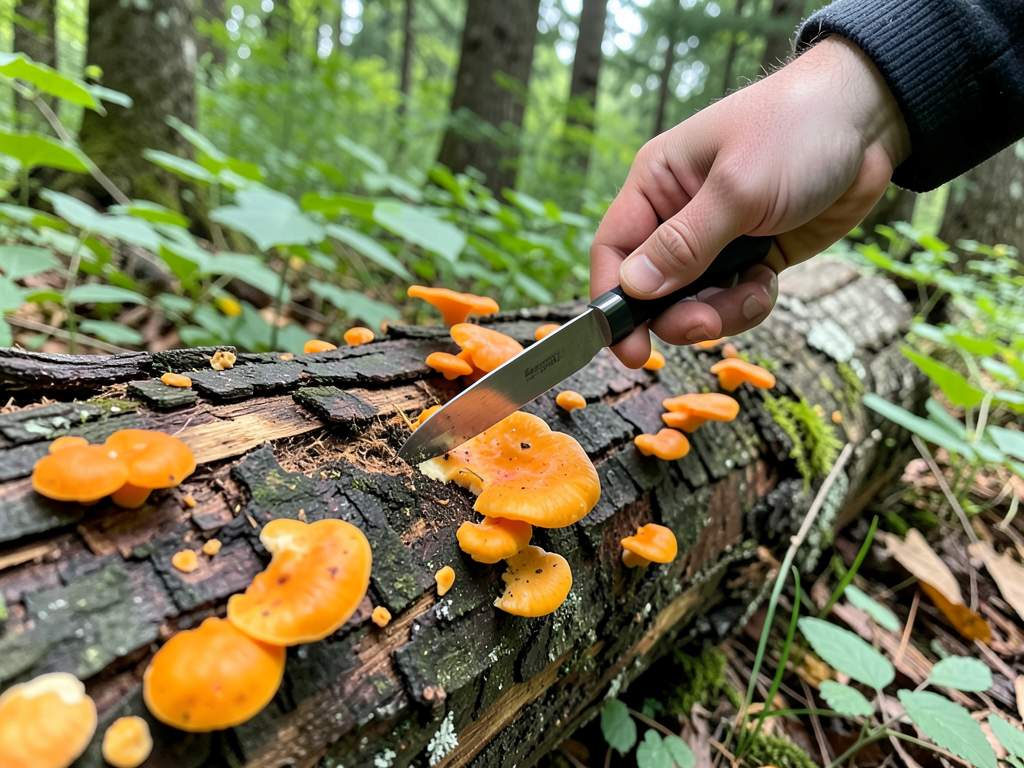
Use a sharp knife — a 4-6 inch foraging knife is perfect. Cut the shelves at the base where they attach to the wood, taking only the tender outer portion. I typically leave behind anything more than about 3-4 inches from the growing edge, as the older tissue near the attachment point becomes tough and woody.
Cut cleanly — don’t tear or rip. A clean cut leaves the mycelium intact and increases the chances that the fungus will fruit again in the same spot in future years. I’ve been harvesting from the same two oak logs for five consecutive seasons.
Harvest etiquette:
- Take no more than 1/3 of a flush — leave plenty for wildlife, spore dispersal, and other foragers
- Don’t harvest from protected areas, nature preserves with no-collection policies, or private property without permission
- Carry mushrooms in a mesh bag or basket, not plastic — spores drop as you walk, propagating the species
Cleaning and Storing Your Harvest
Chicken of the woods is a clean mushroom compared to something like morels, but it still needs proper handling.
Cleaning
The best approach is dry cleaning whenever possible. Use a soft brush or a damp paper towel to remove debris, dirt, and the odd beetle. Water makes the flesh soggy, and chicken of the woods — being soft and porous — soaks up water quickly. Reserve washing for stubborn dirt that won’t brush off, using a quick rinse under running water followed by immediate patting dry.
Trim away any tough portions near the base, any parts with visible insect damage, and any sections that feel woody or crumbly.
Storage
| Method | Duration | Notes |
|---|---|---|
| Refrigerator (paper bag) | 5-7 days | Keep dry, don’t seal in plastic |
| Freezer (blanched) | 6-12 months | Blanch 2 min, ice bath, dry, freeze flat |
| Freezer (sautéed) | 6-12 months | Sauté in butter until moisture releases, cool, freeze |
| Dehydrator | 1-2 years | Slice 1/4“ thick, dry at 115°F until brittle |
| Pickled | 3-6 months | Vinegar brine, refrigerate after opening |
My preferred method for long-term storage is the sauté-and-freeze approach. Cook the cleaned mushroom in butter or oil until it releases its moisture and starts to brown, then cool completely and pack into freezer bags with the air squeezed out. This preserves both texture and flavor remarkably well, and you can drop frozen chunks directly into soups, stews, and pasta dishes months later.
Cooking Chicken of the Woods: Techniques and Recipes
This is where the magic happens. Chicken of the woods is one of the most versatile wild mushrooms in the kitchen, but it does have quirks you need to understand before you fire up the stove.
The Golden Rule: Always Cook Thoroughly
I can’t stress this enough. Raw or undercooked chicken of the woods can cause significant stomach upset in many people. Unlike button mushrooms (which you can eat raw in a salad), Laetiporus needs heat. Think of it like cooking poultry — no one eats raw chicken breast for a reason. The mushroom should be cooked through, with no raw or rubbery sections remaining.
Basic Preparation
Young, tender specimens need minimal prep. Trim the tough base, brush off debris, slice into strips or chunks. Older specimens may need the outer edge with the narrowest growth ring trimmed — that’s the part that looks almost like a thin ruffle and tends to be the driest.
Texture management tip: If your specimen is on the mature side (starting to dry out, colors fading), par-boil it for 3-4 minutes, drain, then proceed with your recipe. This rehydrates the flesh and softens tougher fibers. Drain well — excess water is the enemy of good browning.
Recipe 1: Classic Butter-Basted Pan-Fried Chicken of the Woods
This is the gateway dish. If you’ve never eaten this mushroom before, start here.
Ingredients:
- 1 pound fresh young chicken of the woods, cleaned and sliced into 1/2-inch strips
- 3 tablespoons butter
- 2 cloves garlic, smashed
- 2 sprigs fresh thyme
- Salt and freshly ground black pepper
- Squeeze of lemon juice
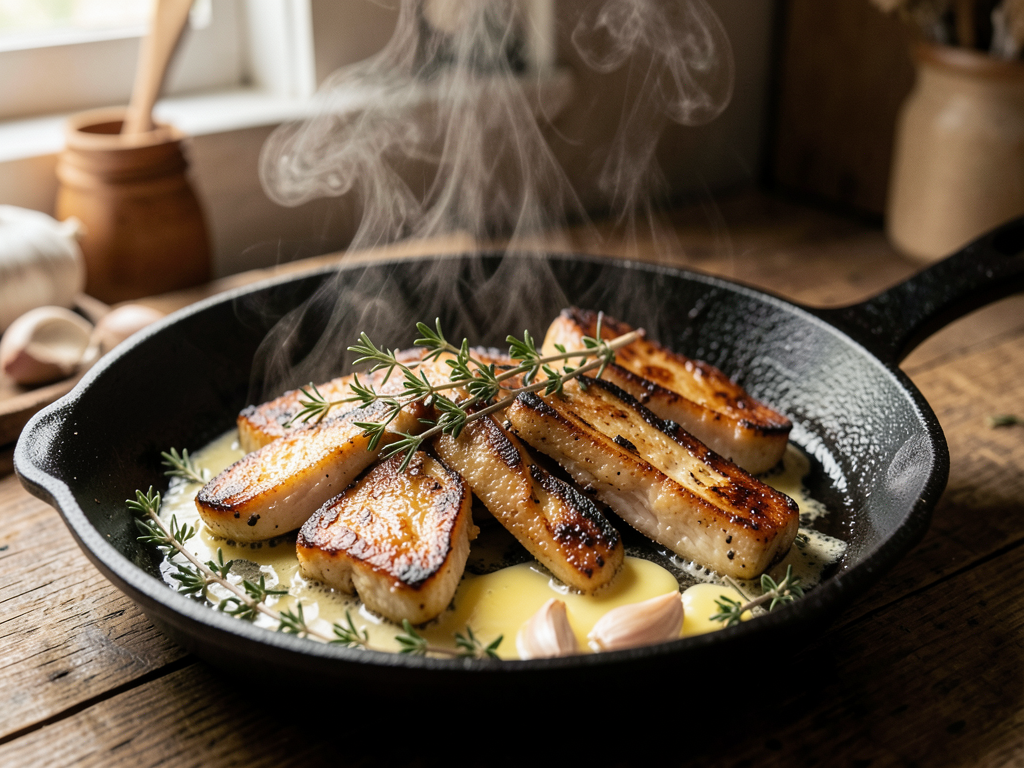
Method: Heat butter in a wide skillet over medium-high heat until foaming. Add the mushroom strips in a single layer — don’t crowd the pan. Cook undisturbed for 3-4 minutes until the bottom is deeply golden. Flip, add garlic and thyme, and cook another 3-4 minutes, basting with the butter. Season generously with salt and pepper, finish with lemon juice. The result should be crispy-edged, tender-centered pieces that taste nothing like any mushroom you’ve eaten before.
Recipe 2: Fried “Chicken” of the Woods Sandwich
This is the recipe that turns skeptics into believers.
Ingredients:
- 4 large, thick chicken of the woods shelves (about 6 oz each)
- 1 cup buttermilk (or plant milk + 1 tbsp lemon juice)
- 1 cup all-purpose flour
- 1 tsp each: paprika, garlic powder, onion powder, salt
- 1/2 tsp cayenne
- Oil for frying (peanut or vegetable)
- Brioche buns, coleslaw, pickles, spicy mayo
Method: Par-boil the mushroom pieces for 3 minutes, drain, and pat very dry. Soak in buttermilk for 15 minutes. Mix flour and spices in a shallow dish. Dredge each piece thoroughly, pressing the flour into all the crevices. Fry at 350°F for 3-4 minutes per side until deep golden and crispy. Drain on a wire rack, season immediately with salt. Serve on toasted brioche buns with slaw, pickles, and spicy mayo. It’s not chicken — but it’s close enough that I’ve served it to guests who didn’t realize until I told them.
Recipe 3: Coconut Curry Chicken of the Woods
This Southeast Asian-inspired preparation highlights the mushroom’s ability to soak up bold flavors while maintaining its texture.
Ingredients:
- 1 lb chicken of the woods, torn into bite-sized pieces
- 1 can (14 oz) coconut milk
- 2 tbsp red curry paste
- 1 onion, sliced
- 2 bell peppers, sliced
- 1 tbsp fish sauce (or soy sauce)
- 1 tsp palm sugar (or brown sugar)
- Fresh Thai basil, lime wedges
Method: Sauté the mushroom pieces in a tablespoon of oil over high heat until they release moisture and start browning — about 6-8 minutes. Remove and set aside. In the same pan, fry curry paste for 1 minute until fragrant, add coconut milk, fish sauce, and sugar. Bring to a simmer, add onions and peppers, cook 5 minutes. Return mushrooms, simmer 5 more minutes. Finish with Thai basil and lime. Serve over jasmine rice.
Recipe 4: Chicken of the Woods and Wild Rice Soup
Perfect for cooler autumn foraging days. This soup is deeply savory, hearty, and freezes beautifully.
Ingredients:
- 1 lb chicken of the woods, diced
- 1 cup wild rice
- 1 onion, diced
- 3 carrots, diced
- 3 celery stalks, diced
- 4 cloves garlic, minced
- 8 cups chicken or vegetable stock
- 2 bay leaves
- Fresh thyme, parsley
- Salt and pepper
Method: Sauté the mushroom in butter until golden — about 8 minutes. Remove and set aside. In the same pot, sweat onion, carrots, and celery until softened. Add garlic, cook 1 minute. Add stock, wild rice, bay leaves, and thyme. Simmer 45 minutes until rice is tender. Return mushrooms, season, simmer 10 more minutes. Remove bay leaves, garnish with fresh parsley.
Recipe 5: Chicken of the Woods Tacos
Quick, easy, and the kind of meal that makes you wonder why anyone pays for meat.
Ingredients:
- 1 lb chicken of the woods, shredded by hand into strips
- 2 tbsp olive oil
- 1 tsp cumin, 1 tsp smoked paprika, 1/2 tsp chili powder
- Corn tortillas, warmed
- Toppings: diced onion, cilantro, lime, salsa verde, crumbled cotija
Method: Toss shredded mushroom with oil and spices. Cook in a hot cast iron skillet until edges are crispy and the “meat” is tender — about 10 minutes, stirring occasionally. Pile into warm tortillas, top generously. The cumin and smoked paprika do something magical with the mushroom’s natural umami.
Nutritional Profile and Health Benefits
Chicken of the woods isn’t just delicious — it’s genuinely good for you. Here’s what the science says about its nutritional composition.
Macronutrients (per 100g fresh weight, approximate)
| Nutrient | Amount | Notes |
|---|---|---|
| Calories | 33-38 kcal | Very low caloric density |
| Protein | 2.5-3.5 g | Contains all essential amino acids |
| Carbohydrates | 5-7 g | Mostly complex polysaccharides |
| Fiber | 2-3 g | High in beta-glucans |
| Fat | <1 g | Negligible |
Bioactive Compounds
Research published in peer-reviewed mycology journals has identified several interesting compounds in Laetiporus species:
- Beta-glucans: Immune-modulating polysaccharides found in the cell walls. Similar to those in reishi and turkey tail, though in lower concentrations.
- Ergosterol: A precursor to vitamin D2 — when exposed to UV light (sun or artificial), the mushroom produces significant vitamin D.
- Phenolic compounds: Including gallic acid and caffeic acid, which exhibit antioxidant activity in laboratory studies.
- Lectins: Proteins that bind to carbohydrates; Laetiporus lectins have been studied for potential antimicrobial properties.
Vitamin and Mineral Content
Chicken of the woods provides notable amounts of potassium, phosphorus, and B-complex vitamins, particularly niacin (B3) and riboflavin (B2). When exposed to sunlight (leave your harvested mushrooms on a windowsill for 30 minutes before cooking), vitamin D2 content can increase significantly.
Important caveat: The nutritional data comes from a relatively small number of laboratory analyses. Exact values vary based on substrate, age, species, and growing conditions. Eat chicken of the woods because it tastes incredible, not because you’re chasing micronutrients — but know that you’re getting solid nutrition as a bonus.
Common Mistakes Beginners Make (And How to Avoid Them)
I’ve trained dozens of novice foragers over the years, and I see the same mistakes pop up again and again. Here they are, so you can skip the learning curve:
Mistake 1: Harvesting Anything Orange on a Tree
The enthusiasm is understandable — you’ve seen pictures, you’re excited, and you find something orange on a log. Slow down. Go through the seven-point checklist every time. Orange + on wood ≠ automatically chicken of the woods. I’ve had beginners bring me dried-out amber jelly fungus, old turkey tail, and even spray-painted bark fragments.
Mistake 2: Eating Old, Tough Specimens
Just because it’s the right species doesn’t mean it’s good eating. An old, faded, woody chicken of the woods is about as pleasant to eat as a dry kitchen sponge. Worse, the high chitin content in aged specimens makes them hard to digest, increasing the chance of stomach upset. If it looks tired, leave it.
Mistake 3: Undercooking
I’ve said it before, I’ll say it again: cook it thoroughly. A quick 30-second sauté is not enough. You want the mushroom to release its moisture, then cook until the released liquid evaporates and the mushroom pieces start to brown. This usually takes 8-12 minutes depending on thickness.
Mistake 4: Skipping the Sensitivity Test
You wouldn’t eat a whole bowl of an unfamiliar food you’ve never tried — don’t do it with wild mushrooms either. Eat a small, well-cooked piece, wait a few hours, and only then eat a full portion. This simple habit prevents most of the “I got sick from wild mushrooms” stories you hear.
Mistake 5: Harvesting from Treated or Polluted Areas
Mushrooms are bioaccumulators. They concentrate whatever’s in their environment — including pesticides, herbicides, heavy metals, and roadside pollutants. Don’t harvest from:
- Golf courses and heavily manicured lawns
- Roadsides (within 50 feet of traffic)
- Industrial areas or brownfield sites
- Railroad rights-of-way (creosote-treated ties)
- Orchards or farms using chemical sprays
Mistake 6: Assuming Every Flush Is Identical
Chicken of the woods can look dramatically different depending on age, species, host tree, and environmental conditions. A young L. cincinnatus growing from buried oak roots looks different from a mature L. sulphureus on a standing dead maple. Learn to recognize the species across its range of variation, not just the one “textbook” photo.
Frequently Asked Questions
Can you eat chicken of the woods raw?
No. Never eat chicken of the woods raw or undercooked. The mushroom contains heat-labile compounds that can cause significant gastrointestinal distress. Always cook thoroughly — this means 8-12 minutes of heat until the flesh is tender and any released moisture has evaporated.
Does chicken of the woods taste like chicken?
Sort of. The texture is remarkably chicken-like — fibrous, tender, and strand-y when pulled apart. The flavor is mild, earthy, and mushroomy, not poultry-like. It’s the texture that earns the name, more than the flavor. That said, with the right seasoning and preparation (see the fried “chicken” sandwich recipe above), it can be genuinely convincing.
Is chicken of the woods safe for everyone?
Most people tolerate it fine when properly cooked, but 5-20% of the population appears to be sensitive to Laetiporus. Reactions range from mild nausea to vomiting. Always start with a small portion. People with mushroom allergies, compromised immune systems, or a history of sensitivity to wild mushrooms should exercise extra caution or avoid it entirely.
What time of year is best for chicken of the woods?
Summer through early fall, with regional variation. In most of the continental United States, July through September is peak season. The flush depends on warmth plus moisture — look 3-5 days after heavy summer rains.
Can you freeze chicken of the woods?
Yes. The best method is to sauté it first, cool completely, and freeze in portions. Blanching and freezing also works. Don’t freeze raw — the texture degrades significantly.
Will chicken of the woods grow back in the same spot?
Often yes. The mycelium (the actual fungal organism) remains in the wood even after you harvest the fruiting body. If the log still has nutrients and conditions are favorable, it will likely fruit again — sometimes multiple times in a single season, often annually for several years. I’ve been visiting the same fallen oak for five consecutive summers.
How can you tell if chicken of the woods is too old to eat?
The easiest indicators: faded color (pale yellow to whitish instead of bright orange-yellow), dry and crumbly texture, thin brittle edges, visible insect damage or bore holes, and a sour or unpleasant smell. When in doubt, cut into it — if it feels like cutting particle board rather than a firm sponge, pass.
What trees does chicken of the woods grow on?
Primarily hardwoods. Oak is far and away the most common host, followed by cherry, beech, maple, sweetgum, and locust. In the West, eucalyptus is a common host. Avoid specimens from conifers (pine, hemlock, spruce, fir) as these tend to cause more GI reactions.
Is there a poisonous lookalike?
No deadly lookalikes that a careful examination would confuse. The most commonly cited concern is the jack-o’-lantern mushroom (Omphalotus), which is toxic but easily distinguished by its gills (versus pores). There is no known mushroom with orange shelf-like growth, a pore surface, and soft fleshy texture that is dangerously poisonous.
Can dogs eat chicken of the woods?
There’s very little research on this. While it’s unlikely to be acutely toxic to dogs, their digestive systems handle fungal chitin differently than ours. The general veterinary consensus is to avoid feeding wild mushrooms to pets — the risk-to-benefit ratio simply isn’t there.
Bringing It Home
Chicken of the woods is, in my opinion, one of the finest wild edibles on the continent. It’s striking enough that finding it feels like discovering treasure, distinctive enough that a careful beginner can identify it with confidence, and versatile enough in the kitchen to anchor everything from weeknight tacos to dinner-party centerpieces.
But like any wild food, it demands respect. Respect for proper identification. Respect for thorough cooking. Respect for the forest that produced it and the mycelium that might fruit again next year if you harvest with care.
The best advice I can give is deceptively simple: 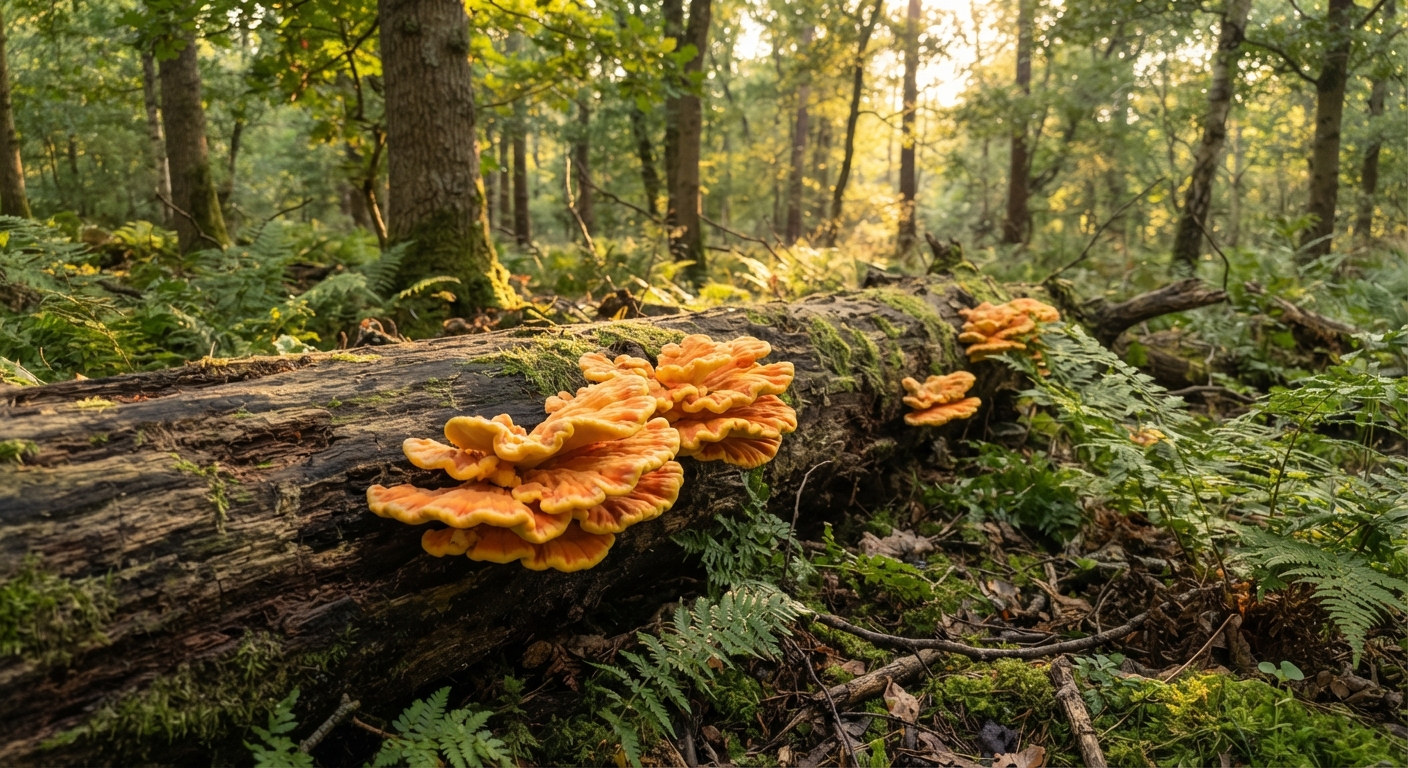
go for a walk in an oak forest a few days after a summer rain. Scan the trunks and fallen logs for that impossible traffic-cone orange. If you find it, work through your checklist. Take a small amount. Cook it well, eat a test portion, and if all goes well — enjoy one of the great gifts of the North American woods.
It’s not chicken. It’s better.
Disclaimer: The information in this article is for educational purposes only. Wild mushroom foraging carries inherent risks. Always consult multiple authoritative field guides, ideally with an experienced forager present, before consuming any wild mushroom. The author and publisher assume no liability for adverse effects from the use or misuse of this information.